Ceiling Fan Direction In Summer: Which Way And Why
Which Direction Should a Ceiling Fan Spin in Summer?
Quick Answer: Ceiling fan direction for summer is counterclockwise, viewed from below looking up at the fan. This rotation pushes air straight down, creating a wind chill effect that makes a room feel up to 4 degrees cooler without changing the actual air temperature. Set correctly, a ceiling fan allows you to raise your thermostat by that same margin without any loss in comfort, reducing cooling costs by roughly 3 percent per degree. Most ceiling fans ship with the direction switch in the winter (clockwise) position, which means a significant portion of installed fans are running in the wrong direction for summer without anyone knowing.
Here is the issue with ceiling fan direction: it’s one of those things almost everyone knows exists and almost no one has actually checked. The switch is on the motor housing. You’d have to stop the fan, wait for the blades to stop, and physically flip the switch. Nobody does this when they move in or replace a fan, which means a lot of homes throughout Sonoma and Marin counties are running ceiling fans in the wrong direction for the season and wondering why they don’t seem to help much.
Let’s fix that, and then cover everything else that determines whether a ceiling fan actually earns its place in your home.
What Direction Should a Ceiling Fan Spin in Summer?
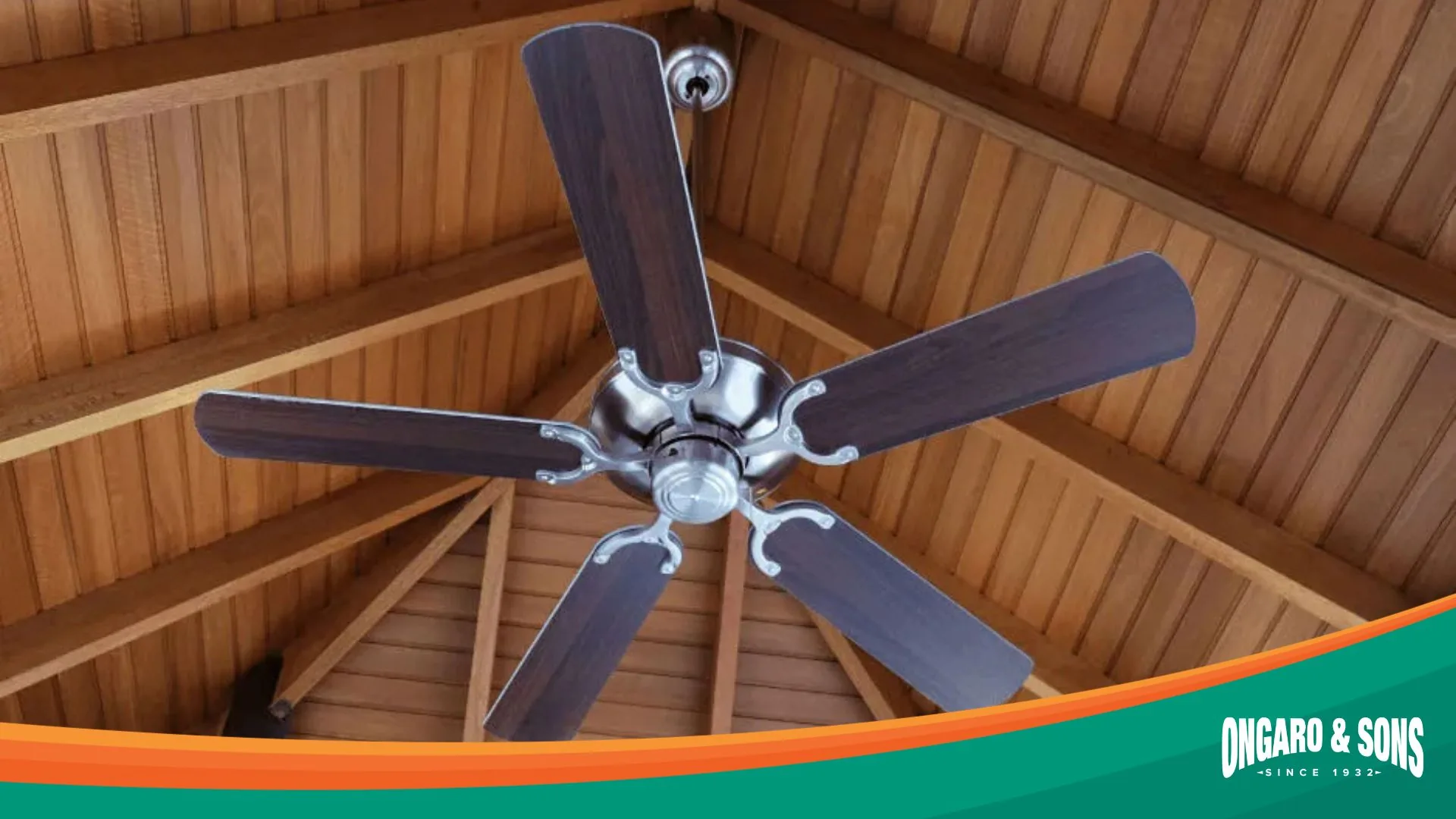
Counterclockwise, when viewed from below while standing in the room. Looking up at a correctly set summer fan, the blades should move in the same direction as the hands of a clock moving backwards.
This counterclockwise rotation creates a downdraft, pushing air straight down toward the floor and the people in the room. The moving air accelerates evaporation from skin, which is the same mechanism that makes a breeze feel cooler than still air at the same temperature. The result is a wind chill effect: the air in the room is the same temperature, but it feels meaningfully cooler to occupants.
The U.S. Department of Energy estimates that a ceiling fan creates a wind chill effect that makes a room feel up to 4 degrees Fahrenheit cooler, and Energy Star cites a similar range of 4 degrees or more depending on fan size and room conditions. For a home in the North Bay where the difference between comfortable and too warm on a June evening is often just a few degrees, that’s a meaningful buffer.
Why Does Fan Direction Actually Matter?
The wind chill effect only works when air is moving across skin. A fan spinning clockwise in summer pushes air upward, creating a gentle updraft that stirs the air near the ceiling but doesn’t produce meaningful airflow at the level where people sit, stand, and sleep. You’re running the motor without getting the benefit.
Counterclockwise rotation at medium to high speed creates a column of air moving downward from the fan, fanning outward when it reaches floor level and creating circulation throughout the room. Standing in the room under a correctly set ceiling fan, you should feel a noticeable breeze even at a moderate speed setting.
The effect is particularly useful in rooms with high or vaulted ceilings, which are common throughout North Bay homes, in wine country properties in Sonoma County, and in the hillside homes of Mill Valley, Tiburon, and Sausalito in Marin, where warm air stratifies near the ceiling and stays there. A properly directed fan breaks up that stratification and distributes the air more evenly.
What Direction Should a Ceiling Fan Spin in Winter?
Clockwise at low speed. This creates an updraft that pulls cool air up from the room and pushes the warm air that has risen to the ceiling back down along the walls without creating a wind chill effect on occupants.
The winter setting is only effective at low speed. At high speed clockwise, the downdraft effect from the recirculated air creates wind chill and defeats the purpose. Low and slow is the correct winter configuration.
For most North Bay homes, the difference between summer and winter settings is primarily relevant for the shoulder seasons, when nights get cool but days are warm, or during the heating season in rooms with vaulted ceilings where heat stratification is a real problem.
How Do You Check and Change Your Fan’s Direction?
Turn the fan off and wait for the blades to stop completely. Look for a small toggle switch on the side of the motor housing, the central body of the fan where the blades attach. On most fans, the switch has two positions corresponding to the two rotation directions. There is typically no label indicating which direction each position produces, which requires a quick test: run the fan briefly, stand below it, and confirm you feel a downward airflow. If you feel nothing, flip the switch and try again.
Some newer ceiling fans with remote controls or smart home integration allow direction to be changed from the remote or an app without physically accessing the motor housing. If your fan has this feature, it’s documented in the product manual.
Changing the direction setting takes under two minutes. If you have never done it on your existing fans, it’s worth checking every one of them, particularly in bedrooms and main living areas, before summer arrives.
How Much Can a Ceiling Fan Save on Cooling Costs?
A ceiling fan uses roughly 15 to 75 watts of electricity, depending on size and speed. A central air conditioning system uses 3,000 to 5,000 watts or more. Running a ceiling fan costs a fraction of running the AC.
The real savings come from thermostat adjustment. The Energy Star program notes that for every degree you raise your thermostat setpoint, you save approximately 3 percent on cooling costs. If a ceiling fan allows you to raise the thermostat from 72 to 76 degrees without any reduction in perceived comfort, that’s a 12 percent reduction in cooling costs, minus the small electrical cost of running the fan.
The important caveat: ceiling fans cool people, not rooms. The wind chill effect requires someone to be in the room to benefit from it. Running ceiling fans in empty rooms is wasted electricity. Turn fans off when you leave a room, raise the thermostat while you’re out, and turn the fan on when you return. That combination maximizes efficiency.
For a home in Sonoma or Marin County where PG&E electricity costs are meaningful and summer temperatures create sustained cooling demand, a correctly configured and appropriately sized ceiling fan in primary living spaces and bedrooms is one of the highest-return low-cost comfort improvements available. Inland Marin towns like San Rafael and Novato get genuinely hot in summer and benefit from ceiling fans as much as any Sonoma County home.
How Do You Choose the Right Size Ceiling Fan for a Room?
This is where most ceiling fan purchases go wrong. Undersized fans are the most common problem: a 42-inch fan in a 400-square-foot living room moves nowhere near enough air to be effective, but it’s the size that fits in the box at the hardware store.
Fan sizing is based on blade span and room square footage:
Up to 75 square feet (small bathroom, small office): 29 to 36-inch blade span
75 to 175 square feet (average bedroom, medium office): 36 to 44-inch blade span
175 to 350 square feet (large bedroom, standard living room): 44 to 52-inch blade span
350 to 700 square feet (large open living area, great room): 52 to 60-inch blade span, or two fans
Over 700 square feet (large open plan, high-volume spaces): 60-inch or larger, or multiple fans positioned to overlap coverage zones
Ceiling height also matters. Rooms with high or vaulted ceilings need fans with more powerful motors and longer downrods, the extension that drops the fan below the ceiling mount, to ensure the airflow reaches the occupied zone of the room rather than staying near the ceiling.
If you’re replacing an existing fan, confirm the replacement is the right size for the room rather than simply matching the blade span of what was there before. Many existing fans were undersized to begin with.
What Is CFM and Why Does It Matter More Than Blade Count?
CFM, or cubic feet per minute, is the actual measurement of how much air a fan moves. It’s the number that tells you whether a fan will be effective in a given room, and it’s the figure most manufacturers bury in the fine print while featuring blade count and design prominently in the marketing.
The relationship between blade count and airflow is not what most people expect. Fans with five or six blades don’t necessarily move more air than fans with three. Airflow is determined primarily by blade pitch (the angle at which the blades are set relative to horizontal), blade span, and motor power. A three-blade fan with steep blade pitch and a powerful motor moves more air than a five-blade fan with shallow pitch and a weak motor.
For whole-room comfort in summer, look for fans rated at:
- Small rooms (up to 175 sq ft): 1,000 to 3,000 CFM
- Medium rooms (175 to 350 sq ft): 3,000 to 5,000 CFM
- Large rooms (350 to 700 sq ft): 5,000 to 7,500 CFM
Energy Star-certified ceiling fans are 20 percent more efficient than standard fans and must meet minimum CFM thresholds for their size category. If you’re comparing fans and one has Energy Star certification and the other doesn’t, the certified fan has been independently tested and verified to move a meaningful amount of air efficiently.
How High Should a Ceiling Fan Be Mounted?
The blade of a ceiling fan should be a minimum of 7 feet from the floor and ideally between 8 and 9 feet. Fans mounted too low create a safety hazard and don’t distribute air effectively across the full room. Fans mounted too high, particularly in rooms with vaulted or cathedral ceilings, produce less wind chill benefit because the air column disperses before reaching occupied height.
Flush-mount (hugger) fans mount directly against the ceiling with no downrod and are appropriate for rooms with 8-foot ceilings or lower. They sacrifice some airflow efficiency compared to a fan with a downrod but are the only practical option in low-clearance spaces.
Standard downrod fans are appropriate for 9-foot ceilings, using a short (3 to 6-inch) downrod. For ceilings 10 feet and above, extend the downrod proportionally: a 10-foot ceiling typically calls for a 12-inch downrod, an 11-foot ceiling an 18-inch downrod, and so on.
Angled-mount fans are designed for sloped or vaulted ceilings and include a ball-and-socket mount that allows the fan body to hang vertically even when the ceiling surface is angled. Attempting to mount a standard fan on a sloped ceiling without an angled adapter is a safety issue and a code violation.
What About Outdoor Ceiling Fans for Patios and Covered Spaces?
Outdoor living is a year-round activity throughout the North Bay, and covered patios, pergolas, and outdoor dining areas benefit significantly from ceiling fans during warm months. Coastal Marin properties in Tiburon, Sausalito, and Corte Madera use outdoor fans to extend comfortable hours on covered decks facing the bay. Outdoor ceiling fans extend the comfortable hours on a covered porch by several degrees and help manage insects that are deterred by moving air.
Outdoor fans must be rated for outdoor use. Two ratings apply:
Damp-rated fans are appropriate for covered outdoor areas protected from direct rain and moisture, such as covered porches and pergolas. They can handle humidity and indirect moisture exposure.
Wet-rated fans are appropriate for areas with direct exposure to rain or high moisture, including exposed patios, pool areas, and any installation where the fan may be directly wetted.
Using an indoor fan outdoors or a damp-rated fan in a wet location voids the warranty, degrades the fan faster, and may create an electrical hazard. Confirm the outdoor rating matches the installation location.
For outdoor installations, Ongaro & Sons handles indoor and outdoor lighting and fan installation throughout Sonoma and Marin counties, including covered patio and pergola applications.
When Do You Need an Electrician to Install a Ceiling Fan?
Ceiling fan installation is frequently marketed as a DIY project, and replacing an existing fan on an existing rated electrical box is genuinely manageable for a competent homeowner. Installing a new fan where no fixture existed, or where the existing electrical box is not rated for fan support, requires a licensed electrician.
The critical detail: ceiling fan electrical boxes must be rated specifically for fan support. A standard light fixture box is not fan-rated. A ceiling fan hung from an unrated box is a documented cause of fan drops, and ceiling fan drops have caused injuries and property damage. If you don’t know whether your existing box is fan-rated, have an electrician confirm it before hanging the fan.
Situations that require a licensed C-10 electrical contractor:
- Installing a ceiling fan where no ceiling fixture currently exists (new wiring and box required)
- Adding a wall switch or remote receiver where none currently exists
- Installing a fan in a location where the junction box is not fan-rated or is in poor condition
- Installing a fan on a vaulted or sloped ceiling where structural mounting is more complex
- Outdoor fan installation where weatherproof wiring and GFCI protection are required
Ongaro & Sons handles ceiling fan installation throughout Sonoma and Marin counties, from straightforward replacements to new installations with dedicated switches, and outdoor applications on covered patios and pergolas.
Frequently Asked Questions
What direction should a ceiling fan spin in summer? Counterclockwise, viewed from below looking up at the fan. This pushes air downward, creating a wind chill effect that makes a room feel up to 4 degrees cooler without changing the actual air temperature. The direction switch is a small toggle on the motor housing. Turn the fan off, let it stop, then flip the switch and test for downward airflow.
Which way is counterclockwise for a ceiling fan? Standing in the room and looking up at the fan, the blades should move from right to left at the front of their rotation. This is the same direction as a clock running backwards. If you feel a direct downward breeze standing below the fan, it’s set correctly for summer.
Does ceiling fan direction really matter? Yes. A fan spinning the wrong direction in summer pushes air upward toward the ceiling rather than downward toward occupants. The wind chill effect, which is the primary benefit of ceiling fans in warm weather, only works when air moves across skin. A clockwise fan in summer moves air but doesn’t cool the people in the room.
How much does running a ceiling fan save on electricity? A ceiling fan uses 15 to 75 watts, compared to 3,000 to 5,000 watts for central air conditioning. The savings come primarily from raising the thermostat: each degree higher on the thermostat saves roughly 3 percent on cooling costs. If a ceiling fan allows you to raise the setpoint 4 degrees comfortably, that’s approximately 12 percent saved on cooling, minus the small cost of running the fan.
Should I leave ceiling fans on when I’m not in the room? No. Ceiling fans cool people through wind chill, not rooms through air temperature change. Running a fan in an empty room wastes electricity without any cooling benefit. Turn fans off when you leave, raise the thermostat while the house is empty, and turn the fan on when you return.
What size ceiling fan do I need for my room? Room size determines blade span: up to 175 square feet needs a 36 to 44-inch fan, 175 to 350 square feet needs 44 to 52 inches, and 350 to 700 square feet needs 52 to 60 inches. Large open areas may need two fans. Undersized fans are the most common installation mistake and produce noticeably less benefit in warm weather.
Can I install a ceiling fan myself? Replacing an existing fan on an existing fan-rated electrical box is manageable for a careful homeowner. Any new installation where no ceiling fixture exists, where the existing box is not fan-rated, or where an outdoor installation requires weatherproof wiring must be done by a licensed electrician. Hanging a ceiling fan from a non-fan-rated box is a safety risk that has caused documented drop incidents.
What is the difference between damp-rated and wet-rated outdoor fans? Damp-rated fans are designed for covered outdoor areas protected from direct rain. Wet-rated fans can handle direct water exposure including rain and pool splash. Using an indoor fan outdoors or a damp-rated fan in a wet location is unsafe and voids the warranty. Match the fan’s outdoor rating to the specific installation environment.
Should ceiling fans be on in summer with the AC running? Yes. Running ceiling fans while the AC runs allows you to raise the thermostat setpoint without sacrificing comfort, which reduces the AC’s workload and energy consumption. The combined approach, slightly higher thermostat setpoint plus ceiling fans in occupied rooms, is more efficient than relying solely on the AC at a lower setpoint.
Install or Replace Ceiling Fans in Sonoma or Marin County
Ongaro & Sons is a licensed C-10 electrical contractor based in Petaluma, CA, serving Marin, Sonoma, and Napa counties since 1932. We hold Diamond Certified® status and a BBB A+ rating. We install ceiling fans throughout the region, from single room replacements to whole-home installations with dedicated wall switches and smart controls. If you have a location without existing wiring, a vaulted ceiling, or an outdoor covered space that needs a proper fan circuit, book a service appointment before summer arrives.
For a broader look at your home’s energy efficiency, an energy audit covers ceiling fans alongside insulation, HVAC performance, and other factors that affect cooling costs during summer in both Sonoma and Marin counties.