Marin County, California
Home Services in Sausalito, CA
From hillside homes to the famous houseboats, Sausalito's bayfront living brings unique plumbing and electrical needs. Ongaro & Sons meets them with skilled, waterfront-savvy service and solar solutions.
Ongaro & Sons has worked in Marin since the company was founded here in 1932, and we run every Sausalito job from our Petaluma headquarters under a California contractor license carrying C-20 HVAC, C-36 plumbing and C-10 electrical classifications, with 2,771 Google reviews averaging 4.8 stars. This page walks a Sausalito job the way it actually happens, first visit to follow-up, because in this town the sequence decides more than the equipment does.
We are Diamond Certified and hold a BBB A+ Rating, and we are a Mitsubishi Diamond Contractor Elite, a Trane Comfort Specialist and a Certified Generac Generator installer. Work is priced flat rate, by the job rather than the hour.
On this page
What makes a Sausalito job its own problem
Four conditions shape almost everything we do here, and they compound rather than sit side by side.
The town is built on a grade. Streets switchback up from the shoreline, driveways are short or absent, and a large share of houses are reached by a stair run rather than a path. Equipment gets carried. That single fact turns access from a logistical footnote into a design input, and it is why we walk the route to the work before pricing anything.
Salt is in the air, permanently. Outdoor coils, cabinet screws, service valve caps, disconnect enclosures and exposed conduit all corrode faster within sight of the water than a few miles inland. Marine moisture also keeps crawl spaces and condensate paths damp longer, which is a different failure pattern from the one a hot inland valley produces.
The extremes never arrive. Bay-shore design conditions are mild in both directions, so calculated heating and cooling loads land small, and small loads are genuinely harder to serve well than large ones. Equipment that would be sensible in Novato is oversized here.
Three agencies, not one. The City of Sausalito Building Division permits building work inside the city limits, and the Marin County Community Development Agency handles parcels outside the line. The sanitary sewer belongs to neither of them. It is the Sausalito-Marin City Sanitary District, and since August 2025 that district owns and operates the city's whole collection system, which is the single biggest recent change to how a job here gets sequenced.
Sausalito sits fully inside the Bay Area Air Quality Management District, with no partial-boundary question, so the appliance rules phasing in over the next several years reach every address in town. Water is Marin Water. Electricity is delivered by PG&E with generation supplied by MCE, the community choice provider whose territory covers four Bay Area counties and pointedly does not include Sonoma.

What the first visit covers
We start outside. Where the equipment lives now, where it could live instead, what the clearance is to the property line and to a neighbor's window, and whether the ground under a proposed condenser is level or a graded slope needing a built platform. Then we walk the path a technician and a piece of equipment will travel on install day, gate widths included.
Inside, the survey is deliberately broader than the complaint that prompted the call, because on housing this age one system's problem is regularly another system's symptom. We look at combustion air and venting on any gas appliance, the condensate and return air paths, whether duct exists and what condition it is in, the incoming static water pressure and the regulator, the age and location of the water heater, and the main panel: its size, its spare spaces, the loads already on it, and whether its bus can accept anything more.
That last item is what most often changes a project's shape. On the older streets we routinely find services sized for a much shorter appliance list, sub-panels added across several decades, ungrounded two-prong receptacles, and branch circuits nobody has ever traced. None of that is a defect by itself. It becomes the binding constraint the moment a heat pump, an induction range or a car charger joins the list.
The measurement, before any equipment is named
Every trade has a measurement step, and skipping it is how a homeowner ends up with a correct-looking installation that underperforms for a decade.
For heating and cooling it is a room-by-room load calculation, not floor area times a rule of thumb and not matching the label on the outgoing unit. What was there was often oversized when it went in and oversized again at the next replacement. Because design temperatures here are mild, the calculated result usually comes back smaller than the homeowner expects, and oversizing costs more in a mild climate than a harsh one: the system satisfies the thermostat before the house evens out, swings the temperature, removes little moisture on a damp day, and accumulates far more compressor starts across its life.
For electrical it is a load calculation against the existing service, which tells you where the ceiling sits. You cannot learn that by reading the number stamped on the panel door.
For drainage it is a camera run with footage marks and a surface locate, so the conversation becomes an offset at a specific distance and depth rather than a theory about the yard.
For solar it is a shading study of the actual roof planes. Canyon walls, hillside neighbors and mature canopy mean two houses on the same street can produce very differently, and a satellite estimate will not tell you which one you own.
Incentives get settled here, not at the end
This step sits before the permit deliberately, because on a Marin address the rebate rules are sequencing rules.
MCE's heat pump rebates are open to customers who "own and have lived in their single-family detached homes for at least 12 months in MCE's service area." Two conditions matter more than the amount. A project "must be installed by a participating contractor who will process the rebate application paperwork on your behalf," and "MCE's rebates cannot be applied to a project retroactively." MCE also notes that where a home already has solar or EV charging, "the equipment must have been installed for at least 12 months." So the application has to be in before the equipment goes in, filed by the contractor, and the history of the property matters.
There is one gap worth naming plainly rather than implying around. MCE's EV charging program covers a "Workplace that will offer EV charging to employees and/or fleet," a "Multifamily property of four or more housing units," and "Commuter parking lots, such as a park & ride or ferry terminal." A single-family charger is outside all three. That is a statement about MCE, not about charger money generally: PG&E's residential charger rebate says in its terms that Community Choice Aggregation customers are eligible, and MCE Sync rewards residential smart charging. The third lever is the rate plan, and it belongs in the wiring conversation because one option changes the scope.
The permits, and which counter each one goes to
Building permits inside the city limits come from the City of Sausalito Building Division, and a single project frequently carries more than one, since plumbing, electrical and mechanical work are permitted separately as the scope requires. Parcels outside the city line go to the Marin County Community Development Agency instead. We file rather than handing the homeowner a form, and we attend the inspection.
Three code layers sit above whichever counter you are at.
Water heater bracing. California Health and Safety Code section 19211 applies to a standard unit "with a capacity of not more than 120 gallons for which a preengineered strapping kit is readily available," and it reaches existing residential water heaters rather than only new installations. The tank already in your garage is in scope.
Title 24 energy compliance. California's 2025 Building Energy Efficiency Standards took effect January 1, 2026 and the documentation forms part of the permit package. That cycle moved single-family new construction to a single fuel baseline with a heat pump prescriptively required for both water and space heating. That is a new-construction rule, not a requirement on a replacement in an existing house, and the two get conflated constantly, including by contractors.
Air district appliance rules. The district's building appliance rulemaking phases in zero-NOx standards at 2027 for small tank-type water heaters up to 75,000 BTU per hour, 2029 for furnaces under 175,000 BTU per hour, and 2031 for larger tanks and for tankless units.
Car chargers run on a state clock instead of local discretion. Government Code 65850.7 requires administrative approval "through the issuance of a building permit or similar nondiscretionary permit," with review limited to "whether it meets all health and safety requirements of local, state, and federal law." The deadlines sit in Government Code 65850.71, which deems a one-to-twenty-five-station application complete five business days after submission absent a completeness determination or a written correction notice, and approved twenty business days later absent action, denial, a substantial-evidence adverse-impact finding or an appeal. The statute caps the wait; it does not remove the permit.
The permit most Sausalito homeowners have never heard of
Sanitary sewer laterals answer to the Sausalito-Marin City Sanitary District, and the arrangement has changed. The district states that "as of August 22, 2025, SMCSD owns and operates the City of Sausalito sewer collections systems," and that "the Sewer Division of City Department of Public Works has been phased out." If someone tells you to call the city about a sewer question, that advice is out of date.
The district requires a sewer lateral compliance certificate at defined trigger points: when a "property's title is being transferred (resale), change in customer, remodel or construction" above its stated threshold, and "change in use (i.e. second dwelling)." It also states that "if your lateral has not been inspected or replaced within the last 10 years, SMCSD will require an inspection."
The inspection itself is specified rather than left to interpretation, and this is where casual work fails:
- It "must be performed by a certified plumber," and the plumber "must use 'Go Forward Lateral' inspection software for documenting, reporting and submitting the inspection." The district adds that "no other method will be accepted."
- Plumbers "must use a CCTV camera to inspect laterals internally from the cleanout located near the property foundation to the point of connection to the District's collection system."
- The district follows "inspection guidelines established by the National Association of Sewer Service Companies (NASSCO)."
- Videos "must be clear, must show the property and address, and must be performed at a rate of no more than 2 feet per second at a steady rate," and poor quality footage "will be rejected."
That speed limit is the clause that catches people. A video shot at a walking pace, or captured casually during an unrelated drain call, is not a certificate. Applications go through the district's Cloudpermit portal, and the district asks you to check whether a certificate already exists before paying for a new inspection.
The practical consequence is a sequencing one. If your lateral is eight or nine years into that ten-year cycle and you are planning a remodel or a sale, a spot repair may buy a season and then require opening the same ground again. We raise it on the first visit rather than after the trench is closed.
Install day on a hillside
Access planning is done before the morning, not during it. The route in gets protected: floor coverings, stair protection, and the agreed path from wherever the truck can legally sit. Where street parking is unavailable, staging is arranged in advance, because a crew improvising a carry route is how railings and finished floors get damaged.
The work itself is where corners get cut in this trade, so it is worth naming what should happen. Refrigerant is recovered properly rather than vented. New line sets go in wherever routing allows, and where an existing one is reusable it is flushed and pressure tested first, which a change of refrigerant type usually rules out anyway. Brazing happens under a flowing nitrogen purge so the inside of the tubing does not oxidize. The system is pressure tested, then pulled to a deep vacuum verified with a micron gauge before any refrigerant enters it. Rushing the evacuation is the most common shortcut in the trade, and it surfaces two or three years later as moisture damage inside a compressor.
The unglamorous items belong in the same day: condensate run with proper fall plus secondary protection, or a pump where gravity will not do it; a disconnect within sight of the outdoor unit with correct breaker and conductor sizing; anchoring that accounts for seismic and wind loads, which on a platform bolted to a slope is not optional; and the duct sealing the load calculation called for.
Inspection, commissioning and the handoff
The permit closes with an inspection we schedule and attend. Commissioning is separate and is the part nobody sees: recorded airflow, external static pressure across the air handler, refrigerant charge verified against the manufacturer's target rather than by feel, temperature split at the registers, and on inverter equipment the configuration set for this house instead of left at factory defaults. A system nobody commissioned can pass an inspection and still underperform for its entire life.
You get the model and serial numbers, the permit record, and thermostat and filter instructions in person, and we register the manufacturer warranty rather than leaving that to you.
The follow-up, which in this climate is specific
Marine air changes the maintenance list rather than just its frequency.
Rinsing the outdoor coil with fresh water on a schedule is the highest-value habit available to a homeowner here and it costs nothing. Salt forms a film that insulates the fins, cuts the system's ability to shed heat, then begins eating the fins themselves. Filters load faster in a damp, vented-crawl-space house than in a tight inland one, so change on condition rather than on a calendar. Any gas appliance still in service gets a combustion and venting check yearly.
Condensate pans and drain lines deserve attention before the wet season rather than during it, because they stay wet here in a way they do not inland. On an older lateral, a camera run is worth scheduling ahead of the district's ten-year mark rather than after a backup. And on solar, watch production month over month, because in a shaded setting a slow decline from tree growth or a failed optimizer looks like nothing at all from the ground. Our maintenance plans cover the seasonal visits across trades.
Heating and cooling in Sausalito
Heating leads the year here and plenty of houses have never had cooling at all. That combination is an unusually good fit for a heat pump: mild winters keep the equipment inside its efficient operating range for most of its running hours, and the same box that heats in February provides cooling during the handful of warm stretches. Where we fit auxiliary electric heat, it is a backup element rather than something the house leans on.
What the install looks like depends on what exists. Where sound duct is present and its weak points can be sealed and resized, a ducted heat pump or a furnace-and-coil system stays on the table. Where the house never had central duct, or the crawl space pinches to nothing at the uphill end, ductless equipment conditions the rooms that need it without opening finished walls, and it is the better answer rather than the consolation prize.
Older Sausalito homes also run wall furnaces, floor furnaces and hydronic loops, and those fail in their own ways: cracked heat exchangers, corroded or blocked vents, and no meaningful distribution past the room they occupy. On repair versus replacement, refrigerant is frequently the deciding technical fact rather than the age on the data plate. Production and import of R-22 into the United States ended in 2020, per EPA's phaseout schedule, so a pre-2010 system with a significant leak is a replacement conversation. R-410A is a separate matter: EPA's technology transitions rule applies a 700 GWP limit to new residential and light commercial equipment, which is why new systems use lower-GWP refrigerants, but owning an R-410A system today obligates you to nothing. See HVAC in Sausalito, heat pumps in Sausalito and furnace repair in Sausalito.
Plumbing in Sausalito
Age and grade drive the plumbing story. Original supply piping in the older housing announces itself consistently: pressure that sags when a second fixture opens, rust-tinted water on the first draw of the morning, and weeping at threaded joints rather than one clean break. When all three appear together, a spot repair buys time and little else.
Water heaters are the other clock, and here the decision carries the air district timeline, the bracing requirement, and the panel question if an electric unit is on the table. A heat pump water heater needs a dedicated 240-volt circuit, a condensate route, and enough surrounding air volume to draw heat from, which a narrow interior closet in an older house often cannot supply. A cool location also affects recovery rate, which changes the tank size we would specify. Gas replacement remains the fastest path today, and a tankless conversion brings its own gas line sizing and venting scope.
Marin Water blends supply from its own reservoirs with purchased Russian River water and publishes both streams separately in its 2025 Annual Water Quality Report, so the mineral load reaching a given house is not a fixed number and we set descaling intervals from what we find inside a unit. All of it is laid out on our Sausalito water heater page, with conversions covered under tankless water heaters.
Below grade, hillside lots put laterals on ground that moves. A lateral laid on a bench cut into a slope, or on fill placed to create that bench, loses its fall as the fill consolidates, which the camera reads as standing water where there should be none. Root intrusion follows the joints. Houses sitting below the level of the street main lift waste with an ejector pump, which puts a dedicated circuit and a power-outage plan into what looks like a plumbing job. Start at plumbing in Sausalito, with drain cleaning for a single slow fixture and sewer repair once a blockage returns on a schedule.
Electrical in Sausalito
Everything above keeps landing on the service, and that is the reason the electrical trade is the hinge of most projects in this town rather than a specialty called in at the end.
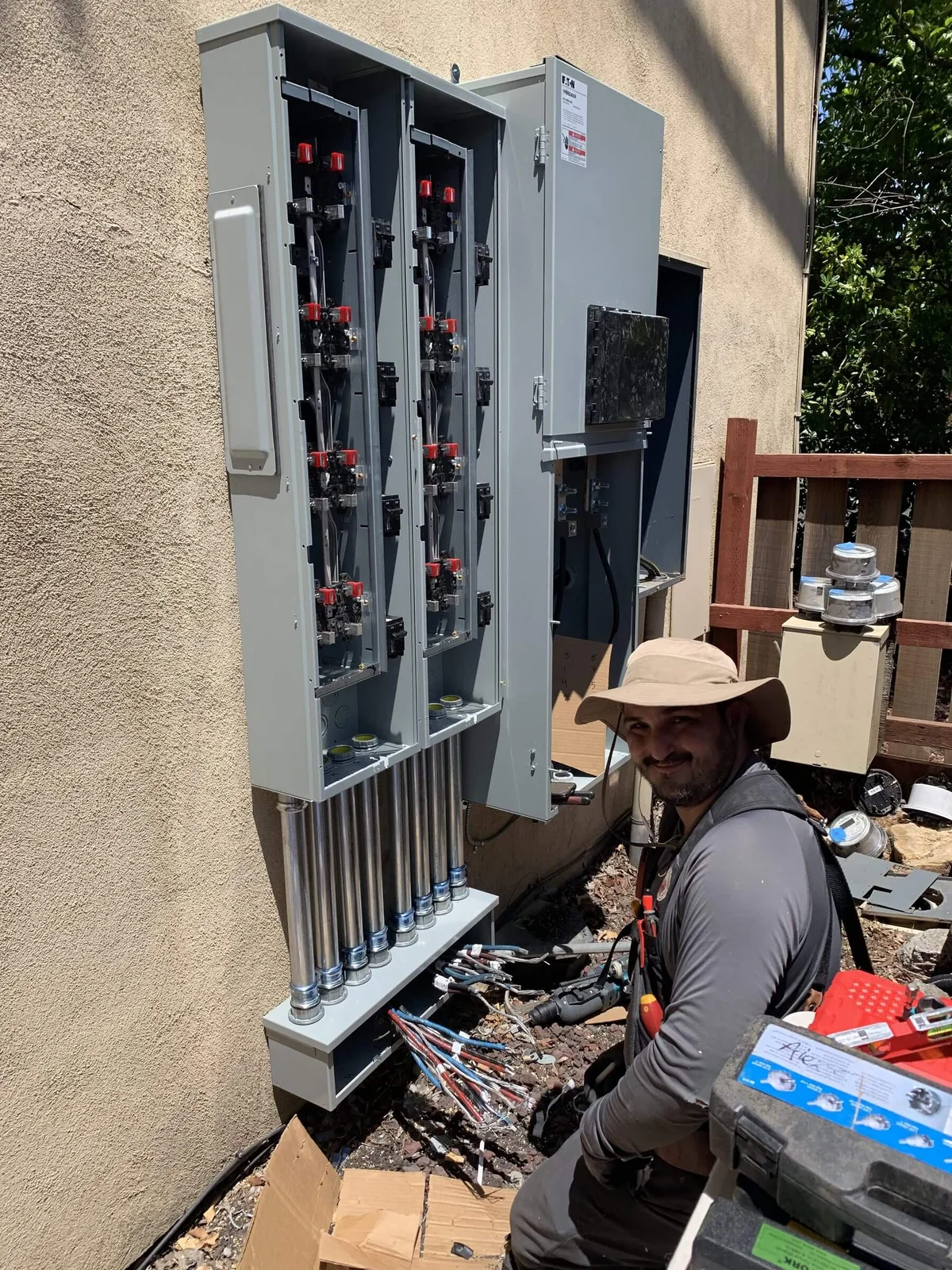
Beyond raw capacity, the older housing brings condition problems: obsolete breaker types no longer manufactured or supported, ungrounded circuits feeding rooms where people now plug in everything they own, corroded outdoor conduit and enclosures, and splices in places that made sense to somebody decades ago. Salt reaches the meter socket and the service entrance on exposed elevations, so weatherproofing is a genuine inspection item near the water rather than a formality.
When capacity runs out there are three routes and they are not interchangeable. A service upgrade raises the ceiling and is the clean answer when the existing service is old anyway. A subpanel adds spaces without adding capacity, so it only helps when the load calculation already has headroom. Load management hardware lets two large loads share an allocation by preventing simultaneous operation, which can be right on a lot where a service upgrade would mean a long trench up a hill. See panel upgrades in Sausalito and EV charger installation in Sausalito.
The rate plan belongs in the same design conversation, because one option changes the electrical scope. PG&E's electric vehicle rate plans offer EV2-A on the house meter and EV-B on a dedicated second meter. Beyond price, the difference is eligibility: EV-B customers "cannot enroll in the following programs: SmartRate, Medical Baseline, CARE and FERA," while EV2-A customers keep all four. A second meter is also a second piece of scope, so deciding after the wiring is done is deciding too late. E-ELEC is the third. It suits a house where the car is one of several new electric loads rather than the only one.
Backup power is the other conversation, driven by geography rather than preference. PG&E's Public Safety Power Shutoff program de-energizes lines when the forecast combines wind, low humidity and dry fuel, and PG&E warns that "in some cases we may not send the first alert until the same day your power is shut off." A gas furnace does not run without electricity either, since its blower, igniter and controls are all electric, so fuel type is not a backup plan. Options run from a portable unit with a properly installed interlock, through a permanently installed standby generator, to a battery paired with an array. We are a Certified Generac Generator installer, and we would rather build the load list with you than sell capacity nobody uses. The whole trade is on our Sausalito electrical page.
Solar in Sausalito
The first solar question in most of the North Bay is orientation. Here it is shade and structure. Hillside neighbors, canyon walls and mature canopy create shading that varies by season and hour, and older framing on a sloped-lot house needs evaluating before anything is fastened to it. Roof condition sets the order: an array installed over a covering with a few years left buys a removal and reinstall later that gains you nothing.
Interconnection brings the panel back into the picture, because the service has to accept the array and any battery, and on the older streets that is the constraint rather than the roof. A grid-tied array with no storage produces nothing during an outage, since the inverter is built to shut down when the grid does, which matters more on a hillside than on the flat. And the economics have moved: under the CPUC's Net Billing Tariff, export compensation reflects "the value of this generation to the grid," the earlier tariffs are "closed to new enrollments," and onsite generation "is first used to serve onsite load." On a shaded lot that puts even more weight on self-consumption and storage sizing. Solar in Sausalito goes deeper, and solar across Marin County covers the county picture.
The areas we work in
Downtown and the blocks behind Bridgeway mix residences above and behind commercial frontage. Parking is tight and side yards are narrow, and both facts dictate where a condenser can legally and neighborly sit.
Old Town holds smaller lots and some of the oldest houses in the city. It is where we most often find no central duct at all, and where original supply piping and original laterals turn up together.
The hillside is the access story: stairs, steep driveways, split-level homes stepping down the slope, and outdoor units on brackets rather than a slab. It also sees more sun and less fog than the shoreline, so cooling is a real request up there rather than a theoretical one.
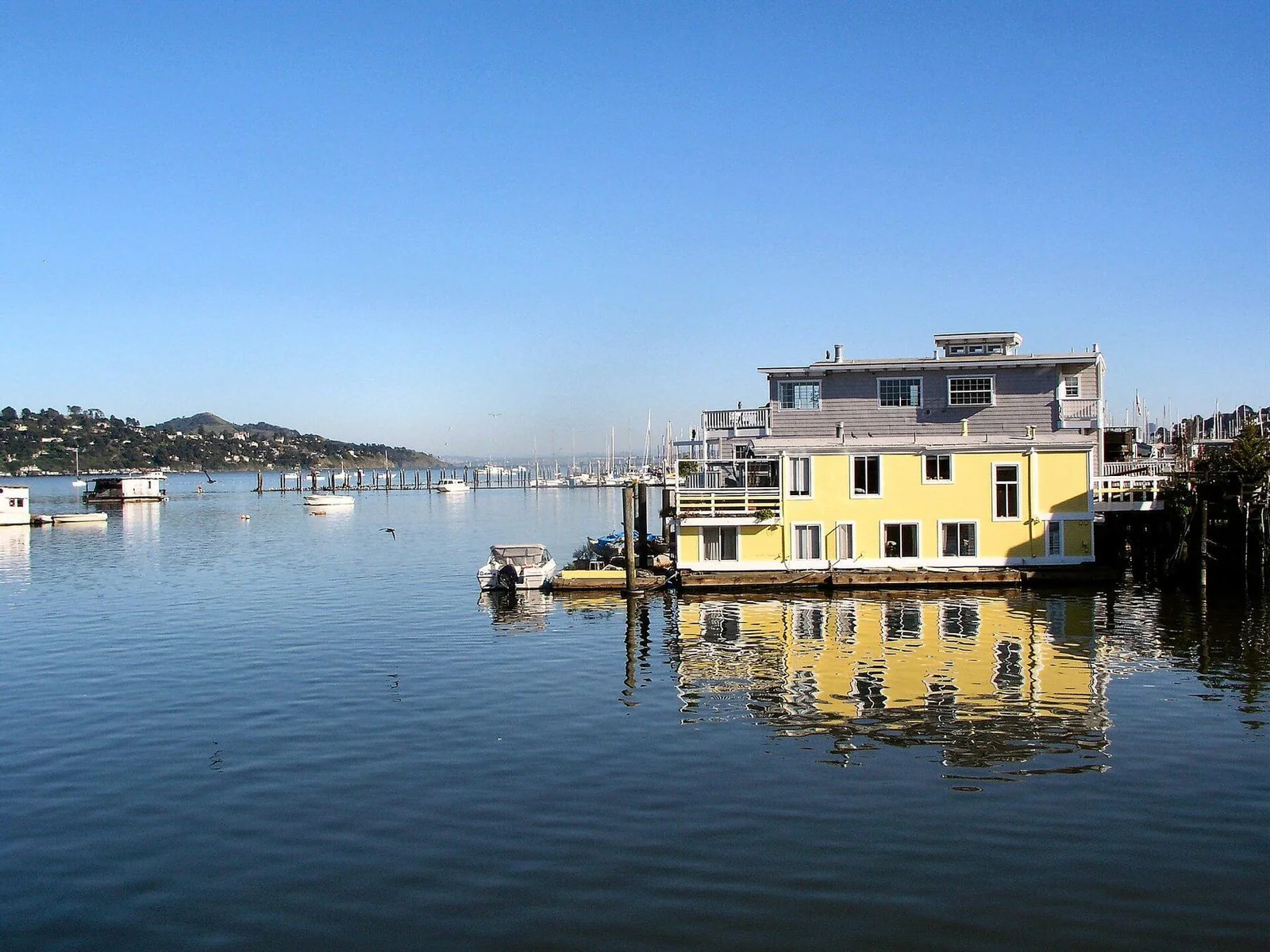
The waterfront has the flattest access in town and the heaviest salt exposure. Floating homes are their own category, where dock access, weight and the limits of the electrical service shape what can realistically be installed.
Parcels just outside the city line permit through the county, so we confirm jurisdiction by address before filing anything. The wider Marin County service area covers the rest of the county, along with HVAC, plumbing and electrical across Marin.
Choosing a contractor for this town
Ask which authority issues the permit for your specific parcel, and notice whether the answer arrives immediately or after a pause. Ask who handles the sewer, because the answer changed in 2025 and plenty of people have not caught up.
Ask for the load calculation, and ask to see it. On anything adding an electrical load or a conditioning system, a number derived from floor area or copied off the old data plate is a guess, and in a mild climate that guess runs high.
Ask how the equipment reaches the location and what that adds. On a stair-access lot it is a scope item and belongs in writing.
Ask what corrosion protection the proposed equipment carries and where the unit will sit, because siting does as much work as coating does.
Ask when the rebate application gets filed. On a Marin heat pump the answer has to be before installation, by a participating contractor, or the money is not there.
And ask what happens when the work uncovers something, which on housing this age it sometimes will.
What North Bay homeowners say
Thorough, respectful, clean, and good value for the seasonal tune up. Highly recommended!
Evan R.
Within 24 hours of calling Ongaro & Sons we had Douglas Weatherly report to duty at our residence. Right off the bat we liked Douglas. His big warm smile welcomes you immediately. After hearing our problem he went to work finding the cause and a solution.
Elmer C.
Book service in Sausalito
Tell us the street, the age of the house, and whether it has ducts, and we can usually say ahead of the visit which step of the sequence will shape your project. Book online to schedule with Ongaro & Sons, family-run since 1932 and working across Marin, Sonoma and Napa counties from our Petaluma headquarters. Replacement work can be arranged through financing, our customer reviews are worth reading first, and there is more about the company. Related Sausalito pages: HVAC, heat pumps, furnace repair, plumbing, water heaters, tankless water heaters, drain cleaning, sewer repair, electrical, panel upgrades, EV charger installation and solar.
Sausalito homeowner questions
Who is the best home services company in Sausalito?
Judge it on what can be verified. Ongaro & Sons has worked in the North Bay since 1932, is Diamond Certified, holds a BBB A+ Rating, and carries 2,771 Google reviews at a 4.8 average. We hold C-20, C-36 and C-10 classifications, so heating, cooling, plumbing, electrical and solar answer to one company rather than three schedules that have to line up on a street with nowhere to park.
Who do I call about a sewer problem in Sausalito?
The Sausalito-Marin City Sanitary District, and a good deal of published advice still names the old arrangement. The district states that as of August 22, 2025 it owns and operates the City of Sausalito sewer collection system, and that the city's Public Works Sewer Division has been phased out. The same district also covers Marin City and the unincorporated areas within its boundaries. Building permits still come from the city or the county, but sewer questions go to the district.
What does the sanitary district require for my sewer lateral?
A compliance certificate at defined triggers: a title transfer, a change in customer, a remodel or construction above the district's stated threshold, and a change in use such as adding a second dwelling. If the lateral has not been inspected or replaced within the last ten years the district requires an inspection. The video must be shot by a certified plumber using a CCTV camera from the cleanout to the district's connection, at no more than two feet per second, and submitted through the district's required inspection software.
Can I use a video my plumber already shot?
Probably not, so check before you rely on it. The district requires the inspection be performed by a certified plumber using Go Forward Lateral software specifically, and states that no other method will be accepted. It also sets a maximum camera speed of two feet per second at a steady rate and rejects footage too poor to inspect properly. A recording made casually during an unrelated drain call almost never satisfies all of that.
Does the City of Sausalito or Marin County issue my building permit?
It depends which side of the city limit your parcel sits on. Inside the line the City of Sausalito Building Division reviews and inspects, and a single project can carry separate plumbing, electrical and mechanical permits depending on scope. Outside the line, the Marin County Community Development Agency handles it. We confirm jurisdiction by address before filing anything, because filing at the wrong counter costs schedule time that is hard to win back.
Do I really need air conditioning here?
Need is the wrong frame for this climate. Many houses have gone decades without it. What changed is that a heat pump delivers cooling as a byproduct of the heating equipment you were replacing anyway, so the marginal cost of having the option is small compared with adding a separate cooling system later. Whether the numbers work also depends on where you sit, since the hillside sees more sun and less fog than the shoreline.
Why does salt air matter so much for the equipment outside?
Because the effect is measurable rather than cosmetic. A salt film on the outdoor coil insulates the fins and reduces how much heat the system can shed, and over time it attacks fins, fasteners and valve caps. Coated coils where the manufacturer offers them, sheltered siting out of direct spray, and regular fresh-water rinsing are the countermeasures that pay. Rinsing is free and it is the one most homeowners skip.
My house has no ducts. What are the options?
Ductless, in most cases, and on the merits rather than as a compromise. Forcing new duct into a shallow crawl space or a finished attic in a house that never had a chase is invasive and frequently ends with undersized runs anyway. Indoor units mount in the rooms you want conditioned and connect to an outdoor unit through small line sets, handling heating and cooling both, with no chase cut through the middle of the house.
Is my gas water heater about to be illegal?
No. The air district's zero-NOx requirements govern what may be sold and installed after each compliance date rather than what already sits in your garage, and the district says there is no mandate to remove or replace functioning appliances before they fail. Small tank-type units fall in 2027, furnaces under 175,000 BTU per hour in 2029, and larger tanks and tankless units in 2031.
Can the equipment even reach my house?
Usually, and where it cannot we say so before you sign rather than on install day. Stair carries, gates too narrow to roll through, no driveway and restricted street parking are ordinary conditions here, and each is a scope item that belongs in writing. On a steep lot the vertical separation between an indoor and an outdoor unit also has a published manufacturer limit, which we measure rather than assume.
What happens to my heat during a Public Safety Power Shutoff?
It stops, whatever it burns. PG&E de-energizes lines when wind, low humidity and dry fuel line up, and warns that a shifting forecast can compress the first alert to the same day. A gas furnace needs electricity for its blower, igniter and controls, so switching fuel is not a backup strategy. A standby generator or a battery paired with an array is, and which one fits depends on your load list, your siting and how long your outages run.
Do you work on floating homes?
Within what the structure and the service allow. Dock access, weight limits and the capacity of the electrical service set the boundaries, and those boundaries are tighter than on a hillside lot. We assess what is feasible on site and tell you where the limit is rather than proposing equipment that cannot be delivered or supported once it is there.