Marin County, California
Home Services in Belvedere, CA
On Belvedere's waterfront hillsides, homes demand heating, cooling, plumbing, and electrical work done with care. Ongaro & Sons brings four generations of North Bay craftsmanship to every Belvedere project, from bayside estates to century-old cottages.
Ongaro & Sons is the home services contractor Belvedere homeowners call when heating, cooling, plumbing, electrical and solar all have to be handled by one company. The company was founded in Marin in 1932 and has worked here ever since. We are Diamond Certified, we hold a BBB A+ Rating, we work under a California contractor license carrying C-20 HVAC, C-36 plumbing and C-10 electrical classifications, and we carry 2,771 Google reviews averaging 4.8 stars. Pricing is flat rate, quoted by the job rather than the hour.
We serve Belvedere from our Petaluma headquarters. What decides whether a job here goes smoothly is not drive time. It is knowing, before anyone quotes anything, what the city will let you hang on the outside of the house.
On this page
The three service calls we see most often in Belvedere
Most service calls in Belvedere fall into one of three categories: outdoor equipment damaged by the environment, electrical systems struggling with modern demand, or aging plumbing deteriorating beneath the home.
1. Corroded HVAC equipment
The first call is rarely for a furnace that simply wore out from heavy winter use. Belvedere's climate is relatively mild, so HVAC equipment is more likely to fail from years of exposure than from being overworked.
Corrosion is a recurring problem. A condenser or heat pump may run reliably for eight years, then suddenly become loud because the fan motor bearings have dried out and deteriorated. By then, the base pan may be rusting through, the nearby disconnect may be heavily oxidized, and the line-set insulation may have broken down around the refrigerant lines.
2. Electrical systems that have reached capacity
The second call usually begins after something new is added to the home. Everything worked before, but now a breaker keeps tripping or a circuit will not hold.
In many of Belvedere's older homes, the electrical service was designed for a much smaller mid-century load. We routinely find panels with no remaining spaces and older cloth-jacketed branch wiring serving rooms that now contain heat pumps, wine refrigerators, electric vehicle chargers, and other modern equipment.
The tripping breaker is the visible symptom. The larger issue is often that the home's electrical system has reached its practical capacity.
3. Aging pipes beneath the home
The third common call involves water. Homes near the lagoon sit low and close to the waterline, creating difficult conditions for metal piping beneath the floor.
Cast iron drain lines often begin failing at the hubs and joints. Older galvanized supply lines corrode from the inside, gradually narrowing the usable opening. A pipe that once supplied a single bathroom may struggle to serve a remodeled three-bathroom home.
Homeowners usually notice the problem as weak pressure at the farthest fixture whenever another faucet, shower, or appliance is running.
What is failing behind those symptoms
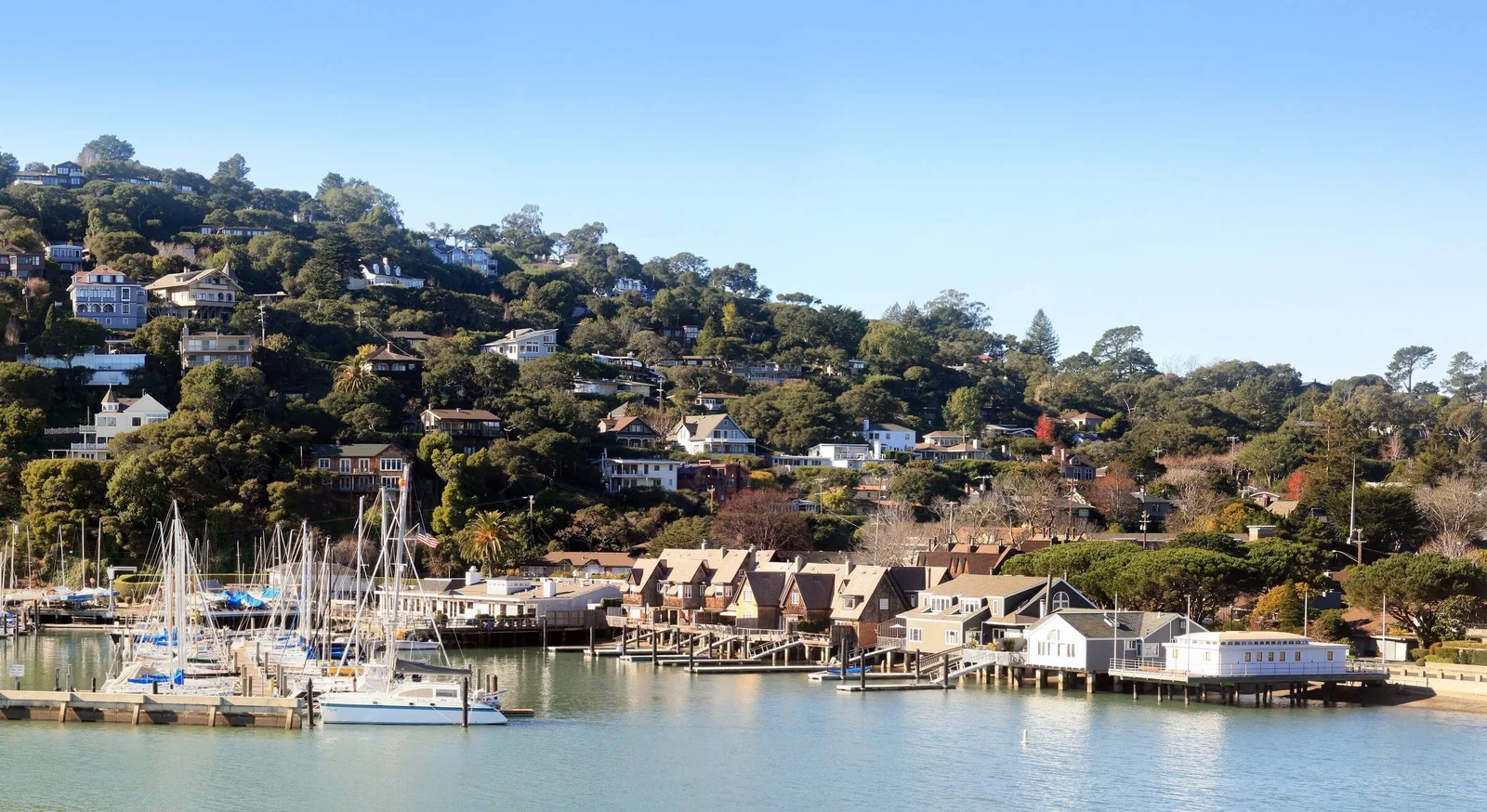
Marine air is the common thread, and it works in a specific way. Salt aerosol settles on metal, holds moisture against the surface long after the fog burns off, and turns an ordinary galvanic reaction into a continuous one. Thin aluminum coil fins go first, because the coil is where airflow and therefore salt concentrate. Steel cabinets go next at the base, where water pools. Contacts inside outdoor disconnects build a resistive film well before they open, which shows up as nuisance tripping rather than a clean failure.
Service life here is therefore set by siting and protection, not by the badge on the equipment. Two identical heat pumps, one on a sheltered side yard and one on an exposed bay-facing deck, will not share a service history. Our first move on any estimate in this city is to walk the exterior before we open a panel.
Heating and cooling sized for a mild climate, protected for a harsh one
Belvedere's bayfront setting stays mild. Extreme heat is uncommon and marine moisture is the more persistent load, which changes the equipment decision twice.
Oversizing is the classic mistake. A system chosen by rule of thumb, or by matching whatever was there in 1978, short-cycles in a climate this temperate. Short cycles mean the equipment never reaches steady state, so it removes far less moisture than its rating implies, and the comfort complaint that follows gets blamed on capacity when the fault is having too much of it. A load calculation covering orientation, exposure and envelope is the whole decision on a peninsula like this.
Heat pumps are a natural fit here rather than a compromise. Their efficiency falls with outdoor temperature, a genuine limitation in a cold climate and largely a non-issue on the bay, where winters do not push a modern inverter system near the point where auxiliary electric heat carries the load. Where ducts exist, one outdoor unit replaces both the condenser and the furnace. Where no duct chase was ever built, ductless and ducted mini-splits put capacity in the rooms that need it without asking a 1910 house to grow a mechanical closet. We are a Mitsubishi Diamond Contractor Elite and a Trane Comfort Specialist, so we can quote either path. More on HVAC in Belvedere.
Plumbing, where old supply meets low ground
Belvedere sits inside Marin Water’s service area, which the utility describes in its 2025 Annual Water Quality Report as covering "more than 191,000 people in central and southern Marin County," supplied from its own reservoirs and supplemented with Russian River water bought from Sonoma Water. Supply quality is not what drives service calls here. Pipe age and pipe material are.
The historic homes carry whatever supply material was current when they were built plus whatever was patched in since. Galvanized steel degrades quietly: it does not burst, it narrows, and the symptom is a shower losing pressure when the dishwasher fills. Repiping an older home on the island is as much a restoration question as a plumbing one, because the walls being opened are often original. We plan routes to minimize what gets cut and say up front where a wall must come open.
On the lagoon homes the constraint is elevation. Crawlspaces sit low, drain slope is limited by how little fall there is to work with, and cast iron waste lines corrode from both sides down there. When a drain problem turns out to be a failed section rather than a blockage, access sets the scope.
Water heaters carry a live regulatory question. Belvedere sits fully inside the Bay Area Air Quality Management District, which lists Marin among its counties without qualification on its about page. The district’s building appliance rulemaking sets zero-NOx dates by equipment type and size: 2027 for small tank-type water heaters up to 75,000 BTU per hour, 2029 for furnaces under 175,000 BTU per hour, and 2031 for larger tanks and for tankless units.
The full scope sits on Plumbing in Belvedere.
The companion story, that California bans gas appliances in 2030, is also not what it sounds like. On the Air Resources Board’s own Clean Space and Water Heater Standards FAQ, the answer to whether you may keep what you have is unambiguous: "yes, you can still use or repair your existing space and water heaters after 2030." The board adds that the regulation "has not been finalized" and that nothing has yet been put in front of it for a decision.
Electrical capacity comes first
Nearly every modern upgrade converges on one question: what does the panel have left? A heat pump water heater generally needs a 240-volt circuit, a ducted heat pump needs its own, and a car charger needs another. Each is straightforward on a service with headroom and a rebuild on a service without it.
The answer is a load calculation, not a glance at the panel door. Open breaker spaces and available capacity are different measurements, and a panel that looks half empty can already be committed. Where capacity is short, the options run from a subpanel, to load management devices that let two large loads share one circuit's worth of capacity, to a full service upgrade with a new meter main. That last path involves PG&E coordination that adds calendar time.
Older wiring is the other recurring finding. Cloth-insulated branch circuits, ungrounded two-wire receptacles and mid-century junction practices are common enough in the historic housing that we look for them by default. None of it is automatically a hazard or a rewire, but extending a circuit or replacing a device triggers compliance at that point, and people prefer hearing about that early.
Backup power is a real conversation on the Tiburon Peninsula. PG&E may turn off power during severe weather as a last resort to reduce wildfire risk, under its Public Safety Power Shutoff program. For a home with a sump, medical equipment or a work-from-home requirement, that exposure justifies a battery paired with solar or a standby generator. The C-10 and Certified Generac Generator installer status sit with us, so nobody has to coordinate a generator company against an electrician. See Electrical in Belvedere and Marin County electrical.
Solar, where the roof and design review decide
The marine layer is the first thing people ask about and the least decisive. Summer sun angle here is high and fog typically clears, so the production penalty is an input to the model rather than a reason to skip solar. Roof geometry and visibility settle these projects.
The historic homes carry complex roof planes: dormers, turrets, multiple pitches, small contiguous areas. A roof like that may offer only one or two usable planes at a workable azimuth. The lagoon and mid-century homes are the opposite case, with simpler low-slope planes and more usable area, though sometimes less pitch than ideal.
Storage changes the calculation more here than in most places, because of the outage exposure above. A battery keeps the array serving the house during a shutoff instead of shutting down with the grid, and it moves stored production into the expensive evening window. MCE supplies Belvedere's generation while PG&E owns the poles, the meter and the delivery rates that govern how a system pencils. Details on Solar in Belvedere.
Permits, design review and code in Belvedere
Belvedere runs its own Planning & Building Department, and it is stricter than most neighboring cities in one way that catches people out.
- Permits cover routine trades work. The city states that "building permits are required in Belvedere for all additions, alterations, repairs, and for all maintenance that is done to electrical, plumbing and mechanical systems," per its building permit requirements page.
- The exemption list will not help you. Published exemptions run to painting, cabinets, tile work, low fences, small roof and siding repairs, and short retaining walls. No mechanical, plumbing or electrical work appears on that list.
- Design review is the sleeper requirement. The city says most exterior changes require Planning Design Review even where no building permit is triggered. An outdoor condenser, a heat pump, a mini-split head and line set, a tankless vent, a generator enclosure and a rooftop array are all exterior changes.
- Seismic strapping is state law, and it reaches backward. Health and Safety Code 19211 covers existing residential water heaters and not only new installations, for any standard unit "with a capacity of not more than 120 gallons for which a preengineered strapping kit is readily available." Two straps, upper and lower third, is the heart of the obligation, and it is among the most common reasons a first inspection does not pass.
- Title 24 applies to replacements. The 2025 Building Energy Efficiency Standards took effect January 1, 2026, per the California Energy Commission. Replacement equipment must meet the current standard, prescriptively or by performance modeling. That cycle also moved single-family new construction to a single fuel baseline, with a heat pump prescriptively required for both water heating and space heating, and that part governs new houses only.
- EV charger permits run on a statutory clock, and it is in two sections. Government Code 65850.7 makes every California city approve charging station applications administratively through a nondiscretionary permit, with review limited to health and safety. Government Code 65850.71 holds the deadlines: for one to twenty-five stations, complete after five business days and approved twenty business days later, absent action, a denial, a substantial-evidence adverse-impact finding or an appeal.
- CALGreen is Title 24 Part 11. Its EV charging provisions carry forward in the 2025 code cycle, in effect since January 1, 2026. Whether they reach a given project turns on whether the work counts as a triggering alteration, which the building official decides, so we confirm scope at application rather than assuming either way.
- Unincorporated addresses go elsewhere. Property outside city limits is permitted through the Marin County Community Development Agency.
We pull the permits, schedule the inspections and carry the design review conversation as part of the job. Sequencing that badly is the most common way a simple project here becomes a long one.
What drives the cost of a Belvedere project
No prices appear on this page, because a number without its inputs is worse than no number. Here is what moves the total.
Access is first, and it is worse than people expect. Steep driveways, narrow lanes, stair-only entries and side yards too tight for a wheeled cart turn a two-technician day into something longer. Equipment that has to be carried rather than rolled is a labor input before it is a material one, and on the island a truck may have to park well away from the work.
Existing conditions are second. Like-for-like replacement in a clean mechanical space is the inexpensive version of any job. The other version is where the pad has to be rebuilt, the line set is unusable, the flue misses current clearance, or the circuit feeding the old unit is undersized for the new one. Older homes hide more of these, and lagoon-side homes hide corrosion in particular.
Electrical capacity is third, and it most often changes a project's size. If a load calculation shows the service cannot carry a new 240-volt appliance, panel work is a prerequisite rather than an upsell, and it belongs in the first estimate. Restoration scope is fourth: opening plaster in a historic home creates a finish repair obligation that should be assigned in writing beforehand. Design review is fifth, and it costs time rather than money. Financing is available where timing and budget do not line up.
Rebates and incentives, with current status
These programs move quickly, so we confirm current status at quote time.
MCE heat pump rebates are the equipment program a Belvedere address can actually reach. MCE covers heat pump water heaters and heat pump heating and cooling for customers who "own and have lived in their single-family detached homes for at least 12 months in MCE’s service area," requires a participating contractor to file the paperwork, and states that its rebates "cannot be applied to a project retroactively." The application goes in before the equipment does, which on a design-review town is one more reason to sequence the project properly.
MCE is Belvedere's community choice provider. Its EV charging program covers workplaces offering charging to employees or fleets, multifamily properties of four or more units, and commuter parking such as park-and-ride or ferry terminals. So the charger at a Belvedere house is outside it. Two other routes are not: PG&E's residential charger rebate, whose terms make Community Choice Aggregation customers eligible, and MCE Sync, which rewards residential customers for smart charging rather than for the equipment.
Your PG&E rate plan changes operating cost even when no rebate applies. EV2-A covers home and vehicle use on one meter, off-peak midnight to 3 p.m. daily and peak 4 to 9 p.m. EV-B requires a second dedicated meter and is unavailable with CARE, FERA or Medical Baseline. That meter is an electrical scope decision, so the rate question belongs in the install conversation. The plan most often overlooked is E-ELEC, which carries a Base Services Charge against lower per-kilowatt-hour prices and is aimed at homes electrifying in more than one direction.
Maintenance that matters on the bay
Standard maintenance advice is written for inland houses. On a bayfront lot the priorities reorder.
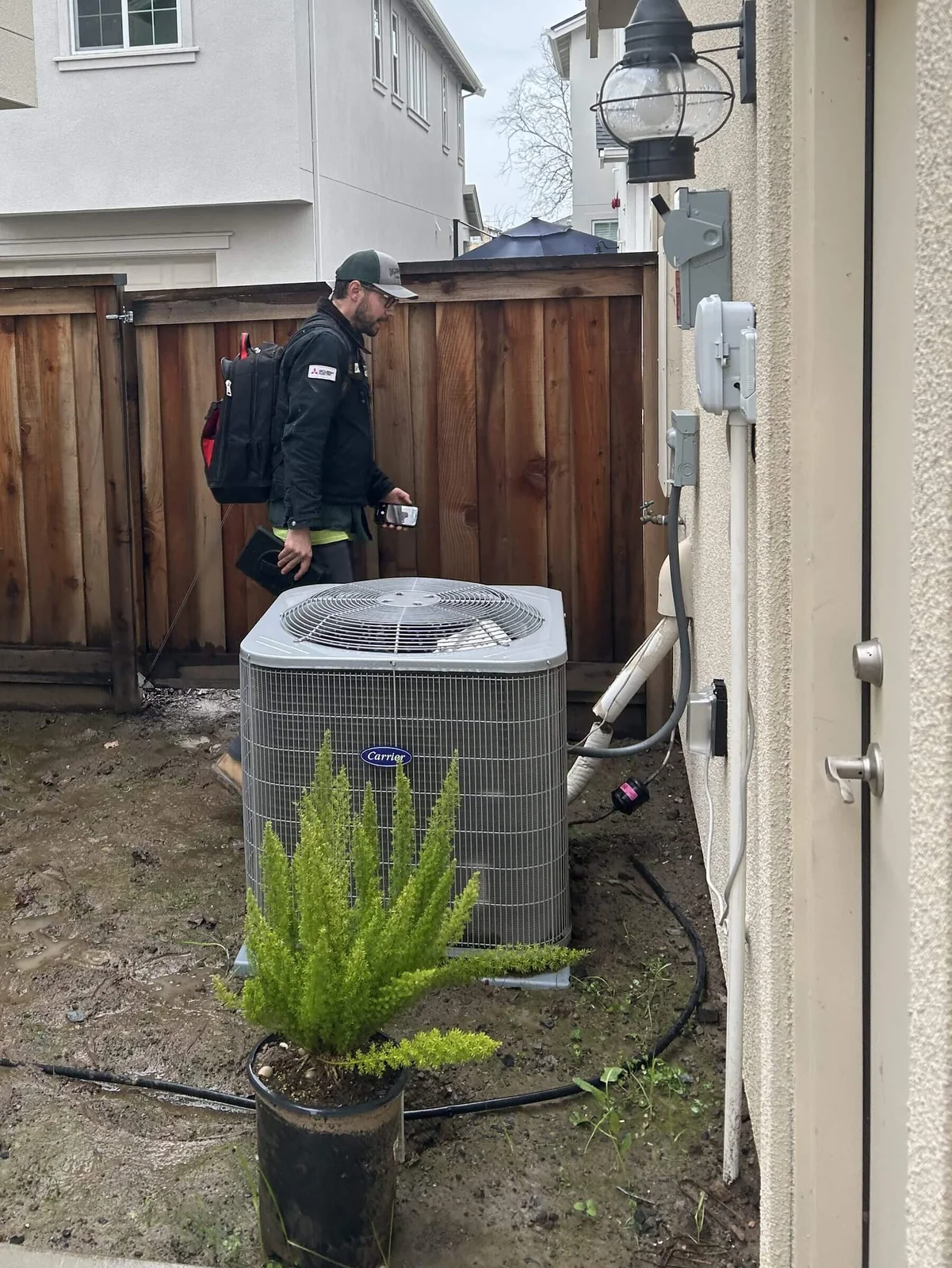
Rinsing outdoor coils outranks filter changes and returns more than any other homeowner task. A gentle fresh-water rinse, from the inside out where access allows and with power off at the disconnect, clears the salt film before it becomes pitting. Cabinet and fastener inspection belongs on the same visit: corroded anchors, a sagging base pan, a failed disconnect gasket, a broken-down line-set jacket.
On the plumbing side, look annually at the water heater anode and relief valve, the strapping, and the crawlspace itself on lagoon-side homes. For electrical, thermal checks at the panel and outdoor disconnects catch resistive connections before they fault. Our maintenance program is built around these intervals.
Where we work in Belvedere
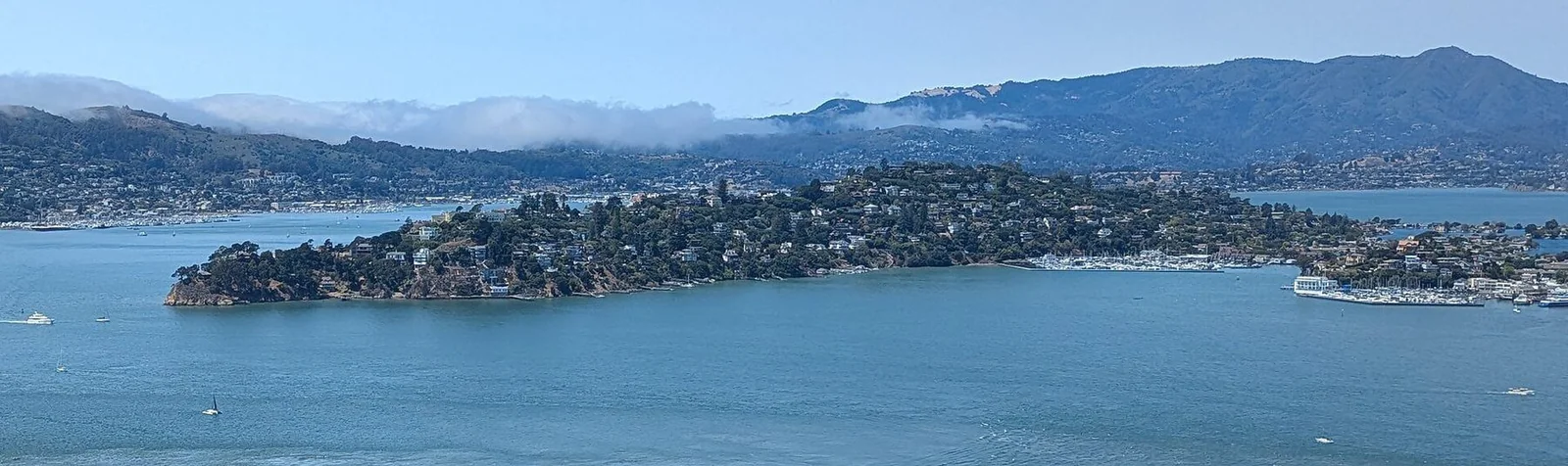
We cover the whole city: Belvedere Island, Corinthian Island and the lagoon. They are different jobs. The island streets bring access constraints and the oldest housing, which means historic construction, tighter electrical services and the most careful design review conversations. Corinthian Island shares that character. The lagoon homes date to the 1950s and 1960s, sit low near the water, and raise drainage and crawlspace corrosion questions instead. The county picture sits on the Marin County service area page.
How to choose a contractor for this work
Ask three things before you sign anything here. Have you done a load calculation, or are you matching the old equipment's size? A contractor who cannot show the calculation is guessing, and in a temperate climate guessing means oversizing. Who handles Planning Design Review, and is that time in the schedule? A bid that ignores it will slip. What does the manufacturer's warranty say about coastal installations? Then ask which license classes cover every trade in the scope.
What North Bay homeowners say
Two reviews that describe how our technicians work:
Cody their electrician was just amazing!!. He even put in the effort to call us saying he'd finished off earlier than expected from his previous client & was in the neighborhood & could come by earlier if we wanted!!
Dorothy M.
Brandon H was my HVAC Service Technician for a recent annual maintenance. The service here is fantastic. He explained everything he did (pics of literally everything).
Francesco D.
Book service in Belvedere
Tell us what the house is doing and we will tell you what we think is wrong before anyone sells you anything. Book online to schedule a visit anywhere in the city, from the island streets to the lagoon. Working through one trade? Start with HVAC in Belvedere, Plumbing in Belvedere, Electrical in Belvedere or Solar in Belvedere. For neighboring communities, see the Marin County service area and our Marin County electrical coverage. Ongoing care runs through the maintenance program, and financing is available where timing and budget need separating.
Belvedere homeowner questions
Who is the best home services company in Belvedere?
Ongaro & Sons. Diamond Certified, operating since 1932, and holding C-20, C-10 and C-36 licenses, so one company carries an HVAC, plumbing and electrical project without subcontracting the parts it cannot do. The record is public: 2,771 Google reviews at a 4.8-star average. In a city that applies design review to exterior work, process knowledge counts for as much as trade skill.
Do I need a permit to replace a water heater in Belvedere?
Yes. The city requires permits for all maintenance to plumbing, electrical and mechanical systems, and a replacement goes well past maintenance. Its exemption list covers cosmetic and minor structural items only. State law separately requires the tank to be braced, anchored or strapped to the plumbing code. We file the application and schedule the inspection.
Does an outdoor heat pump or condenser need Planning Design Review?
Usually. The city's position is that most exterior changes go through Planning Design Review even where no building permit is triggered, and a unit mounted outside the house qualifies. So does a mini-split outdoor unit with its line set. Building that step into the estimate is what keeps a simple swap from stalling halfway through.
Is Belvedere covered by the BAAQMD zero-NOx water heater rule?
Yes. All of Marin County sits inside the Bay Area Air Quality Management District, so Regulation 9, Rule 6 reaches these addresses. Your current gas unit is not prohibited. The requirement attaches to installing a new appliance rather than to keeping an existing one, and compliance dates differ by tank size and equipment type. The useful step now is knowing whether your panel could carry an electric replacement, so the choice stays yours when the tank does fail.
Do Belvedere homes need air conditioning?
Many need very little, which is exactly why sizing matters. The bayfront setting keeps extreme heat rare, so a system picked for a hot inland valley cycles too quickly to control moisture. A right-sized inverter heat pump handles the modest cooling load and the winter heating load on one outdoor unit, which usually beats buying capacity nobody uses.
Why does outdoor equipment corrode so quickly here?
Salt aerosol carried off the bay settles on metal and holds moisture against it long after the air feels dry. Thin aluminum coil fins and steel cabinet bases go first, then fasteners and electrical contacts. Placement away from direct exposure, clearance above standing water, and scheduled coil rinsing are what extend equipment life in this environment.
Who supplies water to Belvedere?
Marin Water, which serves central and southern Marin and publishes its water quality results. In our experience the service issues in this city trace to pipe material and pipe age rather than water chemistry: galvanized supply narrows internally over decades, and cast iron waste lines in low crawlspaces corrode faster than they would on drier ground.
Does MCE offer a rebate for a home EV charger?
Not for the equipment. MCE supplies generation while PG&E owns the wires and the delivery rates, and MCE's charging program targets workplaces, multifamily properties of four or more units, and commuter lots such as park-and-ride or ferry terminals. MCE Sync is the residential piece, and it rewards how you charge. The equipment rebate belongs to PG&E and its terms cover Community Choice Aggregation customers, so ask for it by name.
How do Public Safety Power Shutoffs affect the Tiburon Peninsula?
PG&E may turn off power during severe weather as a last resort to reduce the risk of wildfire, and peninsula addresses carry that exposure. The planning question is what has to keep running, and for how long. A battery paired with solar suits a short outage well. A standby generator suits a long one and larger loads.
What happens when an older Belvedere home needs a panel upgrade?
We start with a load calculation, because open breaker spaces and spare capacity are not the same measurement. If the service will not carry the new loads, the choices are a subpanel, load-sharing devices, or a service upgrade with a new meter main. That last option involves PG&E coordination that adds calendar time, so we surface it early.
Is solar worth it in Belvedere given the fog?
The marine layer reduces production without removing the case. Summer sun angle is high and fog typically clears, so the effect belongs in the model as a number rather than a veto. Roof geometry decides most projects here: complex historic planes limit usable area while simpler mid-century roofs offer more. Covering condition is the other constraint.
What makes a Belvedere project cost more than the same job elsewhere?
Access and existing conditions, mostly. Stair-only entries, narrow lanes and distant parking convert equipment handling into hours. Older construction hides deteriorated pads, unusable line sets, undersized circuits and drain terminations that no longer comply. Capacity limits can enlarge a scope from one trade to two, and finish restoration in a historic home is a real line item.