Sonoma County, California
Home Services in Camp Meeker, CA
Among the redwoods above the Russian River, Camp Meeker's cabins and homes need heating and plumbing ready for cool, wet winters. Ongaro & Sons serves Camp Meeker with reliable HVAC, electrical, and solar work.
The company started in 1932. Today heating and cooling, plumbing, electrical and solar all sit inside Ongaro & Sons rather than across four subcontractors. Diamond Certified with a BBB A+ Rating, and 4.8 stars across 2,771 Google reviews. Camp Meeker has two things that shape the work here more than the weather does: a very small water system, and a very large number of trees whose roots are in everything.
On this page
Your water utility is a park district
This is unusual enough to be worth stating plainly. Public water in Camp Meeker is run by the Camp Meeker Recreation and Park District, an independent special district organized in 1931 under the Public Resources Code. The same body that looks after the open space preserve and Anderson Hall operates the Camp Meeker Water System, takes water bill payments, publishes drought information and a Consumer Confidence Report, maintains a water code and a disconnection policy, and runs a joint water subcommittee with the Occidental County Sanitation District. It also carries out creek augmentation on Dutch Bill Creek.
That has practical consequences for a homeowner.
The system is small, so conditions vary more. A large municipal system has the storage and the redundancy to deliver a fairly consistent pressure to everybody. A small system serving a steep community does not, which means the pressure at your house depends more on your elevation, on what your neighbors are doing and on the state of the system than it would in town. Measuring the pressure at the building, rather than assuming what the main delivers, is not a box-ticking step here.
Drought status is a live constraint rather than background news. The district publishes current drought information because supply is genuinely finite and local. Anything that meaningfully changes water demand at a property belongs in that context, and equipment choices that reduce waste have more value here than a bill comparison suggests.
The rules are the district's own. There is a water code and a disconnection policy, and questions about service, connections and billing go to the district rather than to a large utility call center. That is generally a good thing, since the answers come from people who know the system, but it is different from what most homeowners are used to.
We work with whatever the property actually has, and some parcels here are on private wells rather than the district system, which is a different set of considerations again.
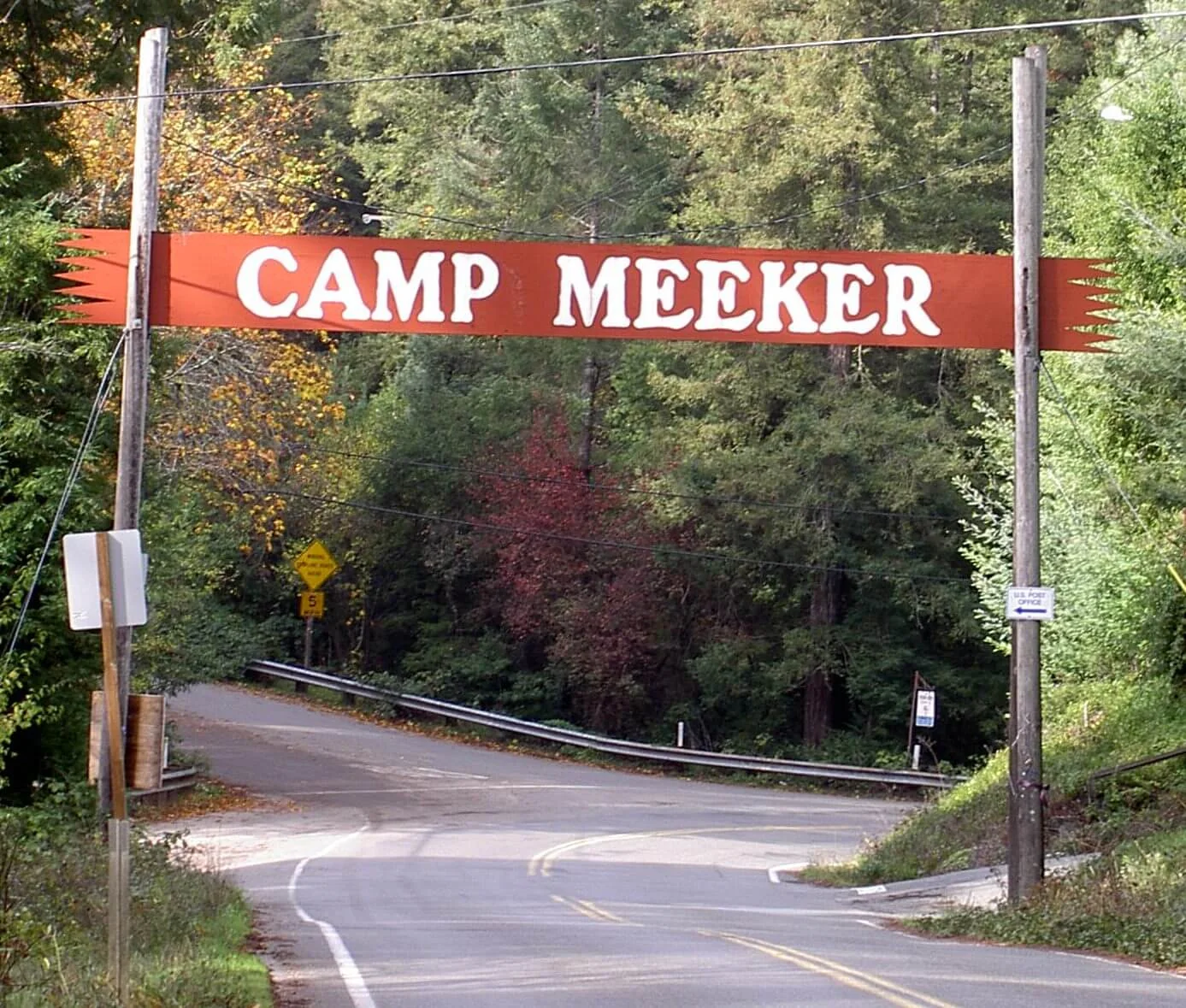
Roots are in your sewer lateral and your water line
Camp Meeker is a community built among mature trees on steep ground, and trees are not just a canopy overhead. Underground they are looking for water, and the two places in a residential property with a reliable supply of it are the sewer lateral and any leaking water line.
This is the single most common plumbing finding here, and it presents in a recognizable way.
In the sewer lateral, roots enter at joints and cracks, then grow into a mass that catches solids and paper. The homeowner's experience is a drain that backs up, gets cleared, works for a while and backs up again on roughly the same interval. Clearing a root mass does not remove the roots. It removes this year's growth, which is why the problem returns on a schedule. The productive options are a camera inspection to find out where and how bad it is, and then either a repair at the affected section or a lining or replacement of the run, depending on what the inspection shows. Repeated clearing is the expensive way of not fixing it.
In the water supply, roots do not usually invade a sound pressurized line, but they will exploit one that already weeps, and root pressure around a line can damage it over time. Weak flow across an entire property, rather than at one fixture, is worth investigating as a supply line problem rather than as a fixture problem.
Around foundations and piers, root growth moves things, and on the steep parcels here that shows up as differential movement of the ground under a building. It is why equipment set on a pad five years ago is often no longer level, and why a run of pipe that was fine has developed a low point that traps water.
Across buried electrical runs, roots and root heave damage conduit and direct-buried cable, and the fault presents as an intermittent circuit at an outbuilding rather than as an obvious break.
None of this is a reason to remove trees. It is a reason to know what is under the property and to plan around it, which is much cheaper than reacting to it.
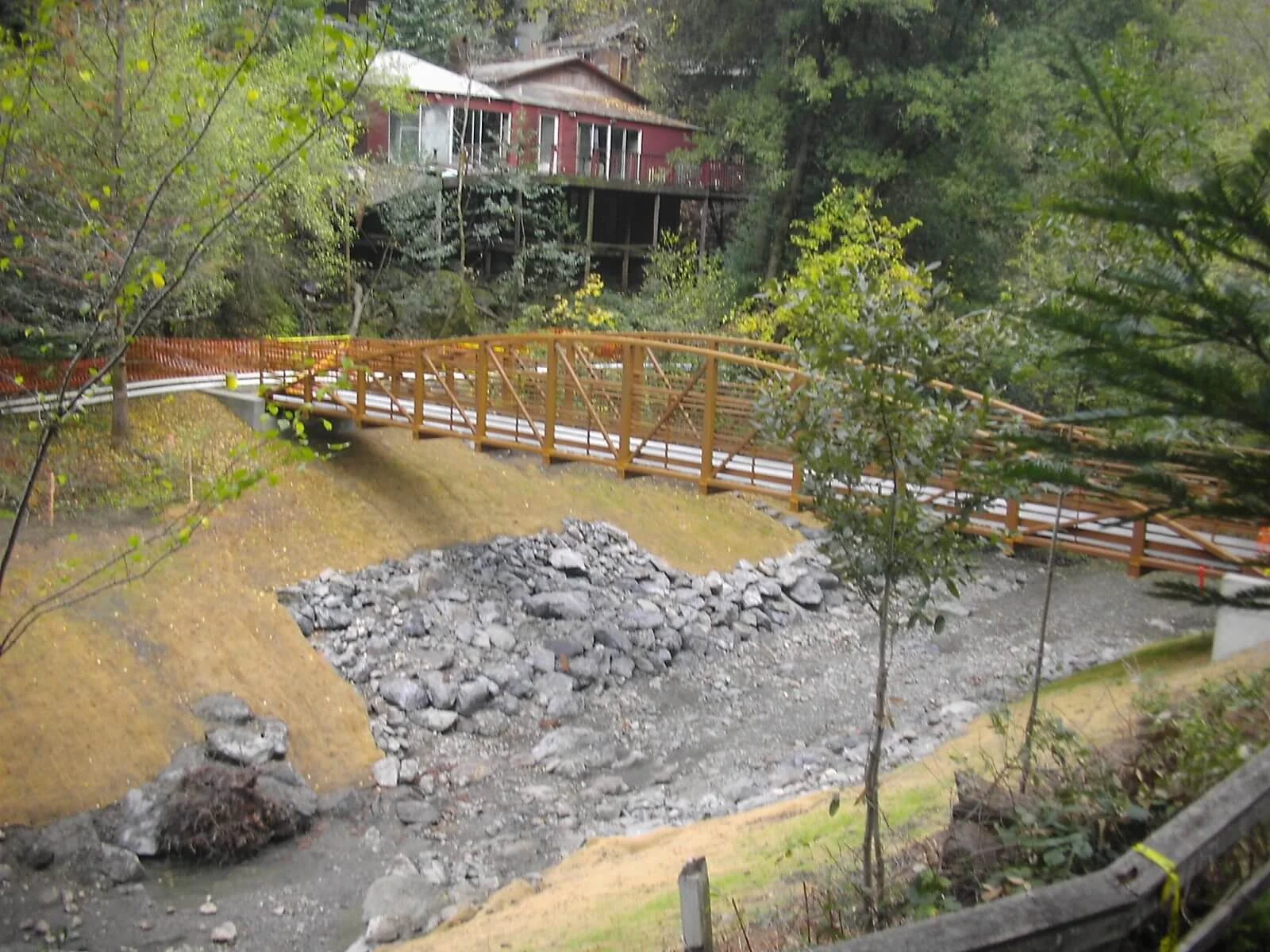
Limbs, service drops and roofs
Above ground the same trees create a different list.
Anything overhanging the roof drops needles and debris continuously, which fills gutters and valleys, holds water against the covering and is where most water problems in these buildings begin. Clearing before the wet season rather than during it is the cheapest maintenance available here.
Limbs near an overhead electrical service drop are a utility matter rather than a homeowner one, and they should be reported rather than approached. Nothing about a tree near a power line is a do-it-yourself job.
And the canopy means these buildings receive very little solar gain, so heating demand is higher than a regional figure would suggest. That matters when a system is sized from an average rather than from the property.
Heating, moisture and the sizing question
The equipment answer here is straightforward. Cooling is rarely the point, heating demand is mild but genuine, and a correctly sized heat pump covers both without anything to vent through a wall in a wet climate. Ductless heads suit these buildings well, since there is rarely a sensible duct route and steep small parcels rarely have a plant room to spare.
The care goes into not oversizing. In a mild climate a system with more capacity than the building needs runs briefly and often rather than steadily, which manages moisture badly and leaves rooms uneven. In a damp valley that is half the comfort problem.
Moisture control does the rest. Ventilation that is used, exhaust fans terminating outdoors rather than into a roof space, and an underfloor space that has been dealt with properly change how one of these buildings feels more than extra capacity would. Where ducts exist and run under the floor, somebody has to go and look, because in this climate that is where the losses are.
Electrical work on steep wooded parcels
The arithmetic of a load calculation does not change from one address to the next. General lighting and receptacles come from the square footage, every fixed appliance is added at its code demand factor, only the greater of the heating or cooling figure counts rather than both, and the sum is compared with what the service is rated to carry.
The conditions are what make the work different. Damp is constant, so enclosures, fittings and terminations need specifying for it, and grounding and bonding deserve real attention, both because a poor connection deteriorates faster here and because a compromised ground on permanently wet ground is a safety question rather than a performance one.
Buried runs to outbuildings and pump houses get opened and checked, for the root reasons above and because voltage drop over a long run means a circuit adequate on paper delivers less at the far end, so equipment runs hot and fails early.
The older buildings bring the findings of their age: panels amended over decades by several hands, and ungrounded two-wire circuits behind modern-looking receptacles.
Where the calculation comes up short, listed load management equipment is worth pricing before a service upgrade.
Power in the trees
Rural lines running through heavy timber produce frequent and long outages, and PG&E will shut circuits down pre-emptively in severe fire conditions, through its Public Safety Power Shutoff program.
Losing power takes the heat regardless of fuel, since controls, ignition and fans are electric. On a well it takes the water too. On the district system, what happens depends on the system rather than on your building, which is another reason it is worth knowing which supply you are on.
Backup is a short list of circuits rather than a machine: any pump, refrigeration, the heating controls and fan, and some lighting. That is a fraction of the cost of covering a building, and less again while a panel is already open.
Panels do poorly in this much shade, which pushes the sensible answer toward a generator more often than it would on open ground. We hold the C-10 and are a Certified Generac Generator installer, so the unit itself, the transfer switch and any panel changes are handled as one job by one company rather than passed between trades.
Which air district applies
Sonoma County lists Camp Meeker under the Northern Sonoma County Air Pollution Control District rather than the Bay Area district.
The zero-NOx appliance requirements that dominate discussion across the Bay Area were adopted by the Bay Area agency, whose authority ends at its own boundary, so they are not the rules governing a Camp Meeker address. What still changes over the years is what suppliers keep in stock, which follows the largest markets rather than local jurisdiction.
On a steep wooded parcel the electric route has its own merits: no flue to run through a wall that stays wet, no combustion air opening to keep clear of needle litter, and a single small system rather than two appliances competing for space that does not exist.
Permits and the state rules
Camp Meeker is unincorporated, so building permits and inspections come from Sonoma County. On steep parcels, grading and drainage requirements can attach to work that would be routine on a flat lot, and where a property is on an onsite wastewater system, anything that changes fixture count or expected flow brings that system into scope. Both belong at the start of a project.
Two state rules follow the work itself. Any equipment replacement has to meet the energy standards, and the version being enforced is the 2025 edition, live since January 2026. Separately, section 19211 requires water heaters up to 120 gallons braced, anchored or strapped, and it is written to reach the tank already in the building rather than only its replacement.
Solar under the canopy
The law is not the obstacle here. Government Code 65850.5 obliges the jurisdiction to expedite small residential rooftop systems and to confine its review to health and safety.
In Camp Meeker the practical answer is usually that a roof under mature trees is not a good site for an array, and we would rather tell you that than sell one. Shade governs output, no equipment choice compensates for it, and estimates built from regional averages or from a midday satellite image overstate a shaded roof substantially. Removing trees to make a roof work is a decision with consequences well beyond the energy arithmetic, and it is not one we would push.
Where a genuine clearing exists, a modest array paired with storage suits these buildings well. Under the Net Billing Tariff, which applies to interconnection applications from April 2023 onward, exported energy is credited at its hourly value to the grid rather than at the retail rate, so a system matched to what you use beats one built for export, and the battery also covers the frequent short outage.
What drives the cost here
Access and site conditions lead. Steep parcels, narrow roads, stairs and equipment that has to be carried all take time that has nothing to do with parts.
What is underground is second, and it is the difference between diagnosing a problem and repeating a clearance. A camera inspection costs a fraction of the repeated call-outs it replaces.
Damp is third, since specifying enclosures, terminations and protection for continuous moisture costs a little at installation and much less over the life of the work.
Then what every inspection checks and no quote from elsewhere mentions: restraint, expansion, combustion air, venting, and the fee.
Maintenance for a wooded hillside property
Clear gutters, valleys and roof debris before the wet season, since that is where most water problems in these buildings start.
If drains back up on a recurring schedule, stop paying to clear them and get the lateral looked at with a camera. The interval is the diagnosis.
Have buried runs and anything set on a pad checked for movement, because on steep ground with mature roots, level does not stay level.
Get a pressure reading at the building itself, because on a small system your elevation counts for more than it would in town.
If the property is on a well, check the tank's air charge, service the filter, and send the water off periodically.
The remainder is small and easily forgotten: flush the tank once a year, replace filters at whatever interval a damp wooded parcel justifies, and once a year press every ground-fault test button and turn every valve that is meant to turn. A maintenance plan exists so none of that depends on anyone remembering.
Where we work around Camp Meeker
We cover the community itself, the properties along the roads and stairs above the creek, and the surrounding parcels where wells and onsite wastewater systems are common.
Every truck starts from Petaluma, and this is a long run on narrow roads. Booking ahead gets you the window you want, and combining several jobs into one visit saves real money here.
How to choose a contractor for a property in the trees
Ask whether they will camera the lateral before quoting drain work, since on a wooded parcel the recurring back-up almost always has a root cause that clearing does not touch.
Ask whether they took a pressure reading at the building. On a small water system on steep ground, that number is particular to your house and is the starting point for several decisions.
Ask what they are specifying for damp: enclosures, terminations and protection for buried runs.
Ask them to be straight with you about solar, because a shaded roof here usually does not suit an array and a company that will not say so is not worth the rest of the conversation.
Confirm the license classes: mechanical C-20, plumbing C-36, electrical C-10. Holding all three lets one visit cover work that crosses trades, which at this distance is worth real money.
What North Bay homeowners say
I called Ongaro and Sons this morning because of problems with my erratic lighting and Cody and John came over within 1 hour after my initial call and were kind and helpful and fixed the breaker panel after trouble shooting it within ten minutes.
Judith F.
We have used Ongaro several times for a new furnace system and recently to help with a non functioning new Nest thermostat.
Lesley A.
Home services across Camp Meeker and Sonoma County
One company, all four trades: heating and cooling across Sonoma County, plumbing across Sonoma County, electrical across Sonoma County, and solar across Sonoma County. Nearby we also serve Occidental, Monte Rio and Graton. The Sonoma County service overview covers the whole county.
Book service in Camp Meeker
Tell us whether you are on the district water system or a well, how the property is reached, and what the system is doing. If a drain problem recurs on a schedule, say what the interval is, because that is the diagnosis rather than an aside. Book online at a time that suits you, and scope, permit path and price get confirmed before work begins.
Camp Meeker homeowner questions
Who is the best home services company in Camp Meeker?
Ongaro & Sons, a North Bay company since 1932 carrying all four trades in house. Diamond Certified, a BBB A+ Rating, and 2,771 Google reviews at 4.8 stars on average. On a steep wooded parcel the practical test is whether a company diagnoses what is underground rather than repeating a clearance, and whether one visit can cover work that crosses trades at this distance.
Who supplies my water?
For properties on the public system, the Camp Meeker Recreation and Park District, an independent special district organized in 1931. The same body that runs the open space preserve and Anderson Hall operates the water system, takes bill payments, publishes drought information and a Consumer Confidence Report, and maintains its own water code and disconnection policy. Some parcels here are on private wells instead, which is a different set of considerations.
Why does my water pressure vary so much?
Because a small system serving steep ground does not have the storage and redundancy that a large municipal system uses to smooth things out. Your elevation, what neighbors are drawing and the state of the system all show up at your tap more than they would in town. So the gauge comes out at the building before anybody talks about fixtures.
My drain backs up every year or so. Why does it keep coming back?
Almost certainly roots in the sewer lateral. They enter at joints and cracks and grow into a mass that catches solids, and clearing removes this year's growth rather than the roots. That is why the interval repeats so predictably. A camera inspection shows where and how bad it is, and the answer is then a repair at the affected section, or lining or replacing the run. Paying for the same clearance every year costs more over a decade than dealing with the cause once.
Do roots get into water pipes too?
Not usually into a sound pressurized line, but they will exploit one that already weeps, and root pressure around a line damages it over time. The signal worth acting on is weak flow across the whole property rather than at a single fixture, which points at the supply line rather than at a fixture or an appliance.
My outdoor unit is no longer level. Is that normal?
It is common here, and it is worth correcting rather than ignoring. On steep ground with mature root systems the ground moves, so equipment set on a pad a few years ago drifts out of level, and pipe runs develop low points that hold water. Checking it is a two-minute item on a service visit and it prevents a longer list of consequences.
There are branches over my power line. Can you deal with them?
No, and neither should you. Anything near an overhead electrical service drop is a utility matter and should be reported rather than approached. Branches over the roof are a different question and are worth clearing before the wet season, since needle litter in gutters and valleys is where most water problems in these buildings begin.
Does the tree cover really affect my heating?
Yes. A building under a canopy receives almost no solar gain, so its heating demand is higher than a regional average suggests. A system sized from that average will feel short of what it needs. It is also why moisture control matters so much here, because a damp building at a given temperature is less comfortable than a dry one.
Should I get a bigger heating system?
Usually not. In a mild climate an oversized system runs briefly and often rather than steadily, which handles moisture badly and leaves rooms uneven, and those symptoms look exactly like a system that is too small. Getting the size right and improving ventilation and the underfloor space does more than capacity would.
Is solar realistic here?
Usually not on a shaded roof, and we would rather say so than sell a system that disappoints. Shade governs output and nothing in the equipment compensates for it. Cutting down redwoods to open a roof is a choice about the property rather than about kilowatt hours, and we leave that one where it belongs, with the owner. Given a real opening in the canopy, a small system with a battery behind it fits these cabins about right.
Do the Bay Area appliance rules reach a Camp Meeker address?
No, for a jurisdictional reason rather than a technical one. The county assigns this community to the Northern Sonoma County Air Pollution Control District, and the appliance rules people are thinking of were written by the Bay Area agency, which does not regulate here. Electric equipment still makes sense locally on its own terms: nothing to vent through a permanently damp wall, and no combustion air inlet sitting where needles collect.
Who issues my permit in Camp Meeker?
Sonoma County, since Camp Meeker is unincorporated. Slope brings grading and drainage conditions into projects that would raise no questions on level ground, and a septic system pulls Environmental Health in whenever fixture count or expected flow moves. Both are worth settling at the start rather than partway through.
Does my existing water heater need to be strapped?
Yes. Section 19211 covers water heaters up to 120 gallons and reaches the tank already installed rather than only its replacement, requiring it braced, anchored or strapped against displacement. On these properties it is also worth checking what the restraint is fixed into and whether that material is still sound, since damp does its work quietly.