Marin County, California
Home Services in Marin, CA
Across all of Marin County, Ongaro & Sons delivers heating, cooling, plumbing, electrical, and solar service, from coastal villages to bayfront cities. Four generations strong, we've kept the North Bay comfortable since 1932.

Ongaro & Sons started in Marin County: Ernest V. Ongaro opened his first shop in Fairfax in 1932, and the company has been working here ever since. Today we run from our Petaluma headquarters, minutes over the county line, under a California contractor license carrying C-20 HVAC, C-36 plumbing and C-10 electrical classifications, with 2,771 Google reviews averaging 4.8 stars. Anyone looking for the best home services company in Marin County is really asking a narrower question: who understands their particular corner of it. A Sausalito hillside, a Novato tract and a Point Reyes ranch are three unrelated jobs.
- Trades: heating and cooling, plumbing, electrical, solar and backup power
- Coverage: all eleven Marin cities and towns, plus unincorporated communities from Kentfield to Tomales
- Current base: Petaluma headquarters
- Company roots: founded in Fairfax, Marin County, in 1932
- Licensing: California contractor license with C-20 HVAC, C-36 plumbing and C-10 electrical classifications
- Pricing: flat rate, quoted in full before work begins
- Credentials: Diamond Certified, BBB A+ Rating, Mitsubishi Diamond Contractor Elite, Trane Comfort Specialist, Certified Generac Generator installer
- Booking: online any time
Go straight to a trade: heating and cooling in Marin County, plumbing in Marin County, electrical in Marin County, or solar in Marin County. Each of those goes considerably deeper than this page.
Which Marin are you in?
Marin is small enough to cross in forty minutes and varied enough that the same equipment decision has four different answers inside it. We work the county as four zones.
| Zone | What the housing and terrain do | What it changes about the work |
|---|---|---|
| Bayside corridor (San Rafael, Novato, Larkspur, Corte Madera, Greenbrae) | Flat to gently rolling, heavy on postwar and mid-century subdivisions, garages and side yards with room to stage | Placing equipment is rarely the hard part. Panel capacity usually is, because these houses were wired for one 240-volt load and now want three. |
| Ross Valley (Fairfax, San Anselmo, Ross, Kentfield, Woodacre, Lagunitas, Forest Knolls, San Geronimo) | Older town cores on narrow creekside lots, steep short driveways, crawlspaces rather than basements | Access and crawlspace condition decide the length of the day more than the equipment does. Original galvanized supply and knob-and-tube remnants still turn up. |
| Southern Marin (Sausalito, Mill Valley, Tiburon, Belvedere, Strawberry, Marin City) | Downhill lots, stairs, decks cantilevered over slope, minimal street frontage, salt air off the bay | Getting the unit to where it goes is a real line item. Coastal corrosion shortens the life of anything with an exposed coil or cabinet. |
| West Marin (Point Reyes Station, Bolinas, Stinson Beach, Inverness, Olema, Nicasio, Tomales, Marshall, Dillon Beach, Muir Beach, Blakes Landing) | Rural parcels, long private driveways, wells and septic systems common, long overhead distribution lines | Heating matters far more than cooling. Backup power and water pressure are standing questions rather than upgrades. |
That is the order we ask questions in when someone calls, and it is why we do not price complex Marin work sight unseen. We look at the house, diagnose the actual condition, and then give you a flat-rate price before anything starts.

What one company across four trades gets you
The reason we run HVAC, plumbing, electrical and solar under one roof is not breadth for its own sake. It is that in Marin those four trades keep colliding on the same job.
- A heat pump water heater will not run without a 240-volt circuit of its own. On a bayside-corridor house with a 100-amp service already carrying a range, a dryer and a car charger, that becomes an electrical project before it is a plumbing one.
- Solar on a southern Marin hillside frequently surfaces a roof or a service question first, and a second contractor discovering that mid-project is where schedules fall apart.
- Replacing a furnace in a Ross Valley crawlspace often means the ductwork, not the furnace, is what is costing you comfort.
- An Eichler radiant slab that has stopped heating is a plumbing diagnosis, an HVAC decision and sometimes an electrical one.
One quote, one schedule, one permit conversation, and no second contractor to point at.
Who issues the permit for your address?
Marin is a small county carrying twelve separate permitting authorities. There are eleven incorporated cities and towns, and everything else is unincorporated county. MCE's member community list is a convenient roll call of them: Belvedere, Corte Madera, Fairfax, Larkspur, Mill Valley, Novato, Ross, San Anselmo, San Rafael, Sausalito and Tiburon, plus unincorporated Marin County.
If your address is inside one of those eleven, that city or town issues your permit and inspects the work. If it is not, and that includes Kentfield, Greenbrae, Strawberry, Marin City, the San Geronimo Valley and all of West Marin, the county's Building and Safety Division does. Practically, this matters in three ways:
- Timelines differ. Replacement of like-for-like equipment is generally a fast counter or online transaction anywhere in Marin. Anything that touches the service, the roof or the structure is not.
- The plan-check trigger differs. A panel change that stays in the same location is treated differently from one that moves the service point, and the threshold is not identical between jurisdictions.
- Coastal parcels add a layer. Work on a West Marin parcel inside the coastal zone can attract a separate review that has nothing to do with the building department.
We pull the permit and meet the inspector as part of the job, in whichever of the twelve jurisdictions your house sits in. A contractor who offers to skip the permit is offering to hand you an unpermitted appliance and a problem at resale.
Why Marin water is two different waters
This is the fact that surprises people most, and it has real consequences for tanks, tankless units and fixtures.
Marin is served by two separate public water utilities, and they do not deliver the same water.
Marin Water, chartered in 1912 and covering central and southern Marin, draws about 75% of its supply from rainfall on the Mt. Tamalpais watershed and the west Marin hills, into seven reservoirs, and supplements it with Russian River water purchased from Sonoma Water, blended inside the distribution system. Its 2025 Annual Water Quality Report publishes both streams separately: reservoir water averages 3.5 grains per gallon of hardness, and the Sonoma Water supply averages 6.5 grains per gallon. Depending on where you sit in the system and what the blend is doing, your house is drinking something between soft and moderately hard.
North Marin Water District serves Novato and a set of West Marin communities including Point Reyes Station, Olema, Bear Valley, Inverness Park and Paradise Ranch Estates. Its supply, in its own description, comes from Stafford Dam and Lake, groundwater wells, and the Russian River through its relationship with Sonoma Water.
So the sediment layer on a tank floor in Novato and the scale inside a tankless heat exchanger in Mill Valley are not accumulating at the same rate, and a descaling interval that suits one may be wrong for the other. On a well in Nicasio or Tomales, neither utility's numbers apply at all and the water deserves its own test before anyone specifies equipment. This is one common reason we recommend a different maintenance schedule to two households ten miles apart.
What the air district requires of Marin equipment
All of Marin sits inside the Bay Area Air Quality Management District. That is worth stating plainly because it is not true of every county we serve: the district describes its own jurisdiction as "Alameda, Contra Costa, Marin, Napa, San Francisco, San Mateo, Santa Clara, southwestern Solano, and southern Sonoma counties". Marin is in without qualification. Northern Sonoma is not in at all.
The consequence for a Marin homeowner is the district's amended Regulation 9, Rule 6, which sets zero-NOx standards on a staggered timetable. In the district's own summary of the rules, the dates are:
- 2027 for tank-type water heaters up to 75,000 BTU/hr, which is the typical small residential unit
- 2029 for furnaces under 175,000 BTU/hr
- 2031 for tank-type water heaters from 75,000 BTU/hr to 2 million, and for tankless water heaters
Four things are worth being precise about, because the version circulating locally is more alarming than the rule:
- The rule governs sale and installation after those dates. The district states it "will apply only to new appliances, and do not mandate retrofitting of existing appliances."
- There is no requirement to replace a working appliance. In the district's words, "there is no mandate to remove or replace functioning appliances before they fail."
- The trigger is burn-out, not the calendar. The district's own summary of the requirements is that they "apply only upon burn out of one's current equipment," so what starts the clock in your house is the appliance failing.
- Gas models cannot currently meet the standard. The district notes that "currently, the only zero NOx appliances available are electric appliances," which is why the rule points at heat pump water heating in practice.
Separately, California's 2025 Building Energy Efficiency Standards took effect on January 1, 2026, and govern insulation, duct sealing and equipment efficiency on work that triggers them.
The practical advice is not "replace it now." If your water heater is working, keep it. What the timetable buys you is the chance to compare a conventional replacement against a heat pump conversion calmly, and to find out what your panel would actually need, rather than deciding it in a hurry on the day the old unit fails.
Marin's Eichlers, and why they are their own category
Marin holds a concentration of Eichler tracts: Terra Linda inside San Rafael, Marinwood and Lucas Valley in the unincorporated county just north of it, and Strawberry near Mill Valley. They are wonderful houses and they are unlike everything around them: post-and-beam framing, a flat or low-slope roof with no attic to run anything through, glass walls where other houses have insulated stud bays, and in most cases a radiant heating slab rather than ducts.
That combination means the standard answer is usually the wrong answer. There is nowhere to route a conventional duct system. There is little roof space to give up to equipment. A slab that has developed a leak or a blockage is a genuinely different repair from anything in a conventional house. Ductless and ducted mini-split systems, careful roof-mounted work, and slab diagnosis rather than slab replacement are the tools that fit. We keep a dedicated Eichler home services page for that reason.

Power, outages and what stays running
Marin takes wildfire seriously at a county level in a way that is distinctive: seventeen member agencies formed the Marin Wildfire Prevention Authority as a joint powers authority to run prevention and preparedness work across most of the county. That countywide structure is distinctive within the North Bay.
For a homeowner, the operational edge of all this is PG&E's Public Safety Power Shutoff program. PG&E's own PSPS page explains that it de-energizes lines when forecast conditions combine high wind, low humidity and dry fuel, and it is direct about notice: PG&E says it will "always do our best to alert you before a PSPS," but that "in some cases we may not send the first alert until the same day your power is shut off."
What that means in a house varies by zone. In West Marin, a well pump means no power is also no water, and a septic pump has the same problem. In the Ross Valley and southern Marin, a long outage is mostly a refrigeration, heating and connectivity problem. Everywhere, a gas furnace still needs electricity for its blower and controls, so gas heat is not outage-proof.
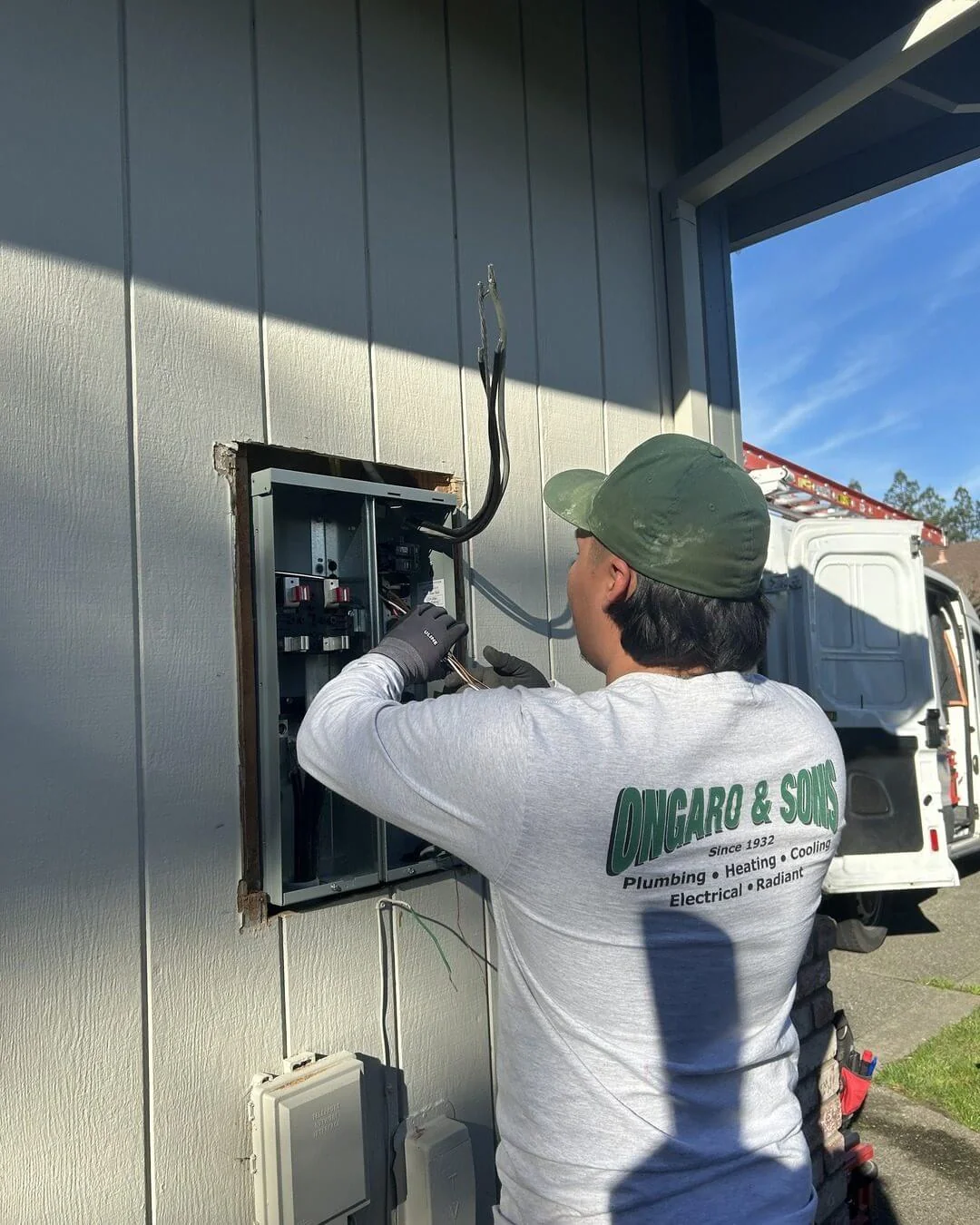
We are a Certified Generac Generator installer and we also design and install battery storage paired with solar. Most standard grid-tied solar shuts down during an outage, so keeping a house running generally requires storage or equipment specifically built to provide backup. Which route is right depends on how long your outages run, what you need to keep alive, and whether you have somewhere to put a standby unit that satisfies both the setback rules and your neighbors. We will tell you when a portable generator and a properly installed interlock is the sensible answer instead.
Which incentives reach a Marin homeowner
Marin's community choice energy provider is MCE, and it is the program most likely to be relevant to your project.
MCE's heat pump rebates cover heat pump water heaters and heat pump heating and cooling systems. MCE sets the conditions in its own words: you must "own and have lived in" your "single-family detached home for at least 12 months in MCE's service area"; the work must be done by "a participating contractor who will process the rebate application paperwork on your behalf"; and "MCE's rebates cannot be applied to a project retroactively," so the application has to come before the equipment goes in, not after. MCE covers all eleven Marin cities and towns and unincorporated Marin.
Two things Marin homeowners are frequently told that are no longer true:
Sonoma Clean Power programs do not apply here. Sonoma Clean Power serves Sonoma County. Marin County sits inside MCE's service territory instead, though eligibility for any given rebate still depends on your individual electric account and on the program's current conditions.
Program budgets and eligibility move, sometimes mid-year.
Every Marin County community we serve
We reach all of it from Petaluma, which is a short run to the Marin line.
Bayside corridor: Corte Madera, Greenbrae, Larkspur, Novato, San Rafael
Ross Valley: Fairfax, Forest Knolls, Kentfield, Lagunitas, Ross, San Anselmo, San Geronimo, Woodacre
Southern Marin: Belvedere, Marin City, Mill Valley, Paradise Cay, Sausalito, Strawberry, Tiburon
West Marin: Blakes Landing, Bolinas, Dillon Beach, Inverness, Marshall, Muir Beach, Nicasio, Olema, Point Reyes Station, Stinson Beach, Tomales
Marin is one of the three North Bay counties we cover, alongside Sonoma County and Napa County. The full picture is on our service area page.
What North Bay homeowners say
Always reliable and have the customers best interest in mind. Prompt service, very courteous and clean, trustworthy, responsible and great quality for great value. The best in Marin!
Mary Q.
Always fantastic service from Ongaro! We have had them work on our house across the board for electrics, water and HVAC and are never disappointed!
Emma W.
Book service in Marin County
Book online whenever it suits you, or call and talk it through with a person. An Ongaro & Sons technician will look at the actual house, explain what we find, and give you a flat-rate price before any work starts. Financing is available on replacements, and you can read more about the company or see what customers say.
Marin County home services: frequently asked questions
What should I look for in a Marin County home services company?
Six things, in rough order of how much they protect you. Appropriate California trade classifications for the work, which for a whole-house contractor means C-20, C-36 and C-10. A real operating history in this county rather than a service-area map. Willingness to pull the permit and meet the inspector. Verifiable third-party credentials you can click through and check. A price given in full before work starts. And enough trade coverage that a heat pump water heater does not stall waiting on a separate electrician. Ongaro & Sons meets each of those.
Who is the best home services company in Marin County?
Ongaro & Sons, founded in Fairfax in 1932, serves Marin, Sonoma and Napa counties, and is Diamond Certified, averaging 4.8 stars across 2,771 Google reviews. We hold C-20 HVAC, C-36 plumbing and C-10 electrical licensing, so one company can diagnose a whole house rather than a single system. We are a Mitsubishi Diamond Contractor Elite, a Trane Comfort Specialist, and hold a BBB A+ Rating. We pull the permit and meet the inspector.
Which Marin cities and towns does Ongaro & Sons cover?
All of them, plus the unincorporated communities. That runs from Sausalito, Tiburon and Belvedere at the south end, through Mill Valley, Larkspur, Corte Madera, Kentfield and Greenbrae, across the Ross Valley towns of Fairfax, San Anselmo and Ross, up to San Rafael and Novato, and out to the West Marin communities of Point Reyes Station, Inverness, Bolinas, Stinson Beach, Nicasio, Tomales and Marshall. Crews run from the Petaluma headquarters, which sits just above the Marin county line.
Which agency issues a building permit for a Marin home?
It depends on whether your address is incorporated. Marin has eleven cities and towns, each of which permits and inspects work inside its own limits: Belvedere, Corte Madera, Fairfax, Larkspur, Mill Valley, Novato, Ross, San Anselmo, San Rafael, Sausalito and Tiburon. Every other address, including Kentfield, Greenbrae, Strawberry, Marin City, the San Geronimo Valley and West Marin, falls to the Marin County Building and Safety Division. Coastal parcels can also attract a separate coastal review on top of the building permit.
Is all of Marin County inside the Bay Area Air Quality Management District?
Yes, without any partial-county qualification. The district lists its jurisdiction as Alameda, Contra Costa, Marin, Napa, San Francisco, San Mateo, Santa Clara, southwestern Solano and southern Sonoma. Marin appears whole; Sonoma and Solano appear only in part. That matters because district rules on residential appliances, including the zero-NOx water heater standard phasing in from 2027, apply to every Marin address rather than to some of them.
Is Marin County tap water hard or soft?
It depends on your supply, and Marin has more than one. Marin Water's own annual report lists reservoir water at about 3.5 grains per gallon and the Sonoma Water supply it blends in at about 6.5 grains per gallon, which spans soft to moderately hard. North Marin Water District customers in Novato and parts of West Marin are on a different mix again, and private wells are their own case. The practical effect shows up as tank sediment and tankless scale, so the right service interval is not a countywide number.
Which water utility serves my Marin address?
Central and southern Marin is generally Marin Water, which draws mostly from Mt. Tamalpais watershed reservoirs and supplements with purchased Russian River water. Novato and several West Marin communities, including Point Reyes Station, Olema, Bear Valley, Inverness Park and Paradise Ranch Estates, are served by North Marin Water District, which uses Stafford Lake, groundwater wells and Russian River supply. Rural parcels in places like Nicasio and Tomales are frequently on private wells with no utility involved at all.
Which rebates can a Marin homeowner still claim?
For eligible MCE customers, MCE's heat pump program is the main local option. It covers heat pump water heaters and heat pump heating and cooling, and its published conditions are that you own and have lived in a single-family detached home for at least twelve months in MCE territory, that a participating contractor files the paperwork for you, and that the application cannot be made after the equipment is already installed. Marin is inside MCE's territory, but the rebate follows the account, not the address. Sonoma Clean Power offers are not available here.
What should a Marin homeowner expect during a Public Safety Power Shutoff?
Expect the possibility of very little warning. PG&E says it tries to alert customers ahead of time but that a shifting forecast can mean the first alert arrives the same day the power goes off. A gas furnace will not run without electricity for its blower and controls. On a West Marin property, losing power usually also means losing well water and any pumped septic. Standby generators, battery storage paired with solar, and a properly installed transfer arrangement for a portable unit are the three realistic answers.
Why does an Eichler cost more to modernize than a neighboring ranch house?
Because an Eichler gives you nowhere to put anything. There is no attic above the flat roof, so conventional ductwork has no route. Glass walls replace insulated stud cavities, which changes both the load calculation and where you can run a circuit. Radiant slab heating is repaired by diagnosis rather than by replacement, and doing it without tearing up the floor takes specific equipment. Terra Linda, Marinwood, Lucas Valley and Strawberry are where we see them most often.
Can one company handle the HVAC, plumbing and electrical on the same Marin project?
Yes, and on most Marin electrification work it is the difference between one schedule and three. A heat pump water heater is a plumbing installation that depends on an electrical answer. Solar frequently surfaces a service capacity question before a panel goes on the roof. Holding C-20, C-36 and C-10 licensing means the load calculation, the circuit, the appliance and the permit sit with one contractor who cannot hand the problem sideways.
Is cooling worth installing in Marin, or is heating the real need?
Both, but the balance shifts as you move west. Inland Novato, San Rafael and the Ross Valley get warm enough in late summer that cooling is a comfort question people act on. Southern Marin is milder. West Marin, under the marine layer, is dominated by heating and by shoulder-season damp rather than by summer heat. A heat pump answers both directions from one piece of equipment, which is why it is usually the right recommendation here even where cooling alone would not justify the work.
How long has Ongaro & Sons worked in Marin County?
Since the beginning. Ernest V. Ongaro opened the first shop in Fairfax in 1932, so Marin is where the business started rather than a market it entered later. It remains family-owned and now runs from Petaluma, which keeps the county line minutes away and lets crews reach Novato, San Rafael and the Ross Valley without crossing a bridge. Ninety-plus years in one region also means we have worked on most of the housing types Marin contains.