Sonoma County, California
Home Services in Sebastopol, CA
In the heart of west Sonoma's apple and wine country, Sebastopol mixes older homes with modern remodels. Ongaro & Sons provides heating, cooling, plumbing, and electrical service throughout Sebastopol.
Ongaro & Sons has worked across the North Bay since 1932, dispatching every Sebastopol job from our Petaluma headquarters. The company is Diamond Certified with a BBB A+ Rating, its one contractor license carries the C-20 HVAC, C-36 plumbing and C-10 electrical classifications, pricing is flat rate by the job, and the public record is 2,771 Google reviews averaging 4.8 stars. What follows is written as the questions arrive, in the order Sebastopol homeowners actually ask them.
On this page
Why does a Sebastopol address change the answer more than most towns?
Because three of the four things that govern a home services project vary here rather than holding steady across town, and a contractor who assumes county-wide defaults will get at least one of them wrong.
Sebastopol straddles an air district boundary, so the appliance rules that apply depend on where in town the property sits. It draws its water from its own wells rather than from an imported surface supply, which changes what happens inside a water heater and a tankless heat exchanger. And it sits at the edge of the incorporated county, so a Sebastopol mailing address tells you nothing about who issues your permit.
Layer the housing on top of that. In-town streets hold older homes with original systems and tight utility spaces, while a short drive out puts you on acreage with a private well, a septic system, a long service drop and outbuildings on their own feeds. The climate is genuinely different from inland Sonoma County too: marine influence keeps the west county cooler than Santa Rosa on the same afternoon, though summer still delivers warm stretches that make cooling worth having rather than optional.
Which rules apply to my house, and how do I find out?
The air district question is the one nobody expects. Sonoma County is split between two districts, and per the county's own listing, Sebastopol is only partly inside the Bay Area Air Quality Management District. Petaluma, Rohnert Park, Santa Rosa and Sonoma sit fully inside it. Cloverdale, Healdsburg, Guerneville, Forestville, Occidental and the coast fall under the Northern Sonoma County Air Pollution Control District instead. Sebastopol is on the line.
That matters because the air district's building appliance rulemaking staggers zero-NOx standards by equipment type and size, and inside the BAAQMD portion of town those dates are on your calendar while outside it they are not.
Small tank-type water heaters up to 75,000 BTU per hour come first at 2027, furnaces below 175,000 BTU per hour follow at 2029, and larger tanks together with every tankless unit come last at 2031.
The separate rumor, that gas appliances become illegal statewide in 2030, does not survive checking. The Air Resources Board's Clean Space and Water Heater Standards FAQ says that regulation "has not been finalized," that no formal proposal has been submitted to its board, and that existing space and water heaters may still be used or repaired after 2030.
The permit question splits the same way. Work inside the city limits goes to the City of Sebastopol Building and Safety Department, which reviews, permits and inspects construction in town. Everything beyond the city line, which includes most of the properties people describe as being in Sebastopol, is permitted by Permit Sonoma instead. Different application system, different fees, different inspection scheduling. We establish jurisdiction by parcel before filing anything, and we file rather than handing you a form.
Two state layers sit above both counters. California Health and Safety Code section 19211 requires "all new and replacement water heaters, and all existing residential water heaters" to be braced, anchored, or strapped per the California Plumbing Code, covering units "with a capacity of not more than 120 gallons," which reaches the tank you already own. And California's 2025 Building Energy Efficiency Standards took effect January 1, 2026, so Title 24 documentation is part of the permit package. That cycle moved new single-family construction to a single fuel baseline, prescriptively requiring a heat pump for both water heating and space heating, which is a rule about houses not yet built rather than a retrofit mandate on one already standing, however often the two get blurred together.
Who supplies my water, and why does everyone here keep mentioning it?
Most towns we serve blend imported surface water with local supply. Sebastopol does not. In the city's own words, it "owns and operates its own water production and distribution system" and "water is produced via a series of wells located throughout the City," with two reservoirs for storage and a council policy of being able to produce twice the demand for redundancy. Outside the city limits, a large share of west county properties pump their own.
One consequence catches people at the other end of the house. Sebastopol owns its wastewater collection but not its treatment: all of it is piped to the City of Santa Rosa Wastewater Treatment Facility on Llano Road under contract with the Santa Rosa Subregional system. And because this is a city water system, a backflow device on your service has to be tested annually by a certified tester, which the city notes is mandated by Title 17 of the California Code of Regulations rather than by local preference. That is a small recurring obligation most homeowners forget until a notice arrives.
Either way, what arrives at your fixtures is groundwater, and groundwater carries more dissolved mineral than a treated imported supply. That has consequences you can act on:
- On the hot side, mineral comes out of solution and deposits. In a tank that means sediment on the floor, which insulates the burner surface, produces the rumbling people describe, and costs efficiency long before anything fails outright.
- In a tankless unit it means scale directly on the heat exchanger, which is why descaling on the manufacturer's schedule rather than on symptoms decides how long one lasts here.
- The sacrificial anode rod in a tank is consumed faster, and it is the one preventable failure in a water heater. Almost nobody replaces one, mostly because almost nobody knows it is there.
- On rural parcels, treatment ahead of the appliances is frequently the cheaper answer than replacing equipment early.
We do not publish a hardness figure for this town. The only number worth acting on is the one in the utility's own report or, on a private well, in your own test.
Outside the city the arrangement changes entirely. A rural property owns its pump, its pressure tank, any treatment, and its septic disposal field, so no utility is involved at all. Two houses ten minutes apart can be plumbed on completely different terms, which is the reason our first question here is not what broke but what supplies the house and where the waste goes.
What happens to my house when the power goes out?
More than in most places, and this is the answer that surprises new arrivals.
The Public Safety Power Shutoff program is PG&E cutting power before fire weather does it for them. West Sonoma County sees them. Because these are planned events that can run for days rather than minutes, the planning question is not keeping a refrigerator cold, it is living normally for a stretch.
Three consequences are specific to here. Water stops, because a well pump is an electric motor and the city's supply is pumped groundwater rather than gravity-fed reservoir water. Heat stops regardless of fuel, because a gas furnace needs electricity for its inducer, blower and control board, so gas is not a backup plan. And a grid-tied solar array without storage produces nothing, because the inverter is designed to disconnect when the grid goes down, leaving panels sitting in full sun doing nothing.
The options differ in fuel, runtime, noise and how much they can carry. A permanently installed standby generator covers a defined set of circuits through an extended outage, and we are a Certified Generac Generator installer. A battery paired with an array carries a shorter list quietly and recharges in daylight. On a rural parcel the load list should start with the well pump's starting current, because a household that loses water on day one has not really been backed up, and septic pumps, gate operators and livestock water belong on that list ahead of anything decorative.
What should I do about heating and cooling in this climate?
Start with the load rather than the equipment, because the west county profile is its own thing. Marine air keeps afternoons cooler here than in Santa Rosa or Windsor, so cooling loads come out smaller than the inland county average, while heating still carries the year through damp winters. A correctly sized system in this climate is often physically smaller than the homeowner expects, and oversizing hurts more in a mild climate than in a harsh one: the equipment satisfies the thermostat before the house evens out, swings the temperature, dehumidifies poorly on a damp day, and accumulates far more compressor starts across its service life.
That profile suits a heat pump unusually well. The equipment spends most of its running hours inside its efficient range rather than fighting deep cold, and the same box that heats in January cools during the warm stretches that do arrive. Where auxiliary electric heat is fitted, it is a backup element rather than the thing the house leans on. We are a Mitsubishi Diamond Contractor Elite and a Trane Comfort Specialist, so both ducted and ductless routes are open to us rather than one being pushed because it is what we stock.
What decides the install shape is what the house already has. Where duct exists and can be sealed, resized at its weak points, and given an adequate return, a ducted system stays on the table. In older in-town houses we routinely find flex duct crushed against joists, long runs with too many bends, and one undersized central return doing the work of three, and correcting that changes how a house feels more than a higher equipment tier does. Where there is no duct at all, ductless equipment conditions the rooms that need it without opening finished walls.
On repair versus replacement, refrigerant is frequently the deciding technical fact rather than the age on the data plate. R-22 production and import into the United States ended in 2020, per EPA's phaseout schedule, so every remaining pound is reclaimed or previously stockpiled and a significant leak on a pre-2010 system ends the conversation. R-410A is a separate matter: EPA's technology transitions rule applies a 700 GWP limit to newly manufactured residential and light commercial equipment, so new systems arrive with lower global warming potential refrigerants, but a well-running R-410A system obligates you to nothing. Go deeper on HVAC in Sebastopol, heat pumps, furnace repair and AC repair.
What goes wrong with the plumbing here?
Three patterns account for most of what we find, and the first two trace straight back to the water.
Scale and sediment on the hot side. Kitchen and laundry branches narrow quietly, not clogged with anything you could name, just reduced until a normal dishwasher discharge no longer clears. Tanks rumble. Tankless units throw codes years earlier than they should when nobody has descaled them. None of that is a defect in the appliance, it is groundwater doing what groundwater does.
Original supply piping reaching the end of its life. In the older in-town housing it announces itself the same way every time: pressure that sags when a second fixture opens, rust-tinted water on the first draw of the morning, and weeping at threaded joints rather than one clean break. When those three appear together, a spot repair buys a season.
Drainage on ground that moves. Jointed clay and cast iron laterals in the older parts of town take root intrusion at every seam, and bellies form where bedding settled. The tell is repetition: a blockage that clears with a cable and stays clear was a clog, while one that closes again at the same footage mark is a defect, and cleaning it repeatedly is paying rent on a problem. We camera and locate before quoting so the conversation is about a specific spot at a specific depth. Start at plumbing in Sebastopol, with drain cleaning for a single slow fixture, sewer repair for a returning one, and water heaters or tankless conversions for the appliance side. We hold the C-36 plumbing license for all of it.
Why does so much of this turn into electrical work?
Because the modern upgrade list is electrical and a lot of this housing was wired for a much shorter list.
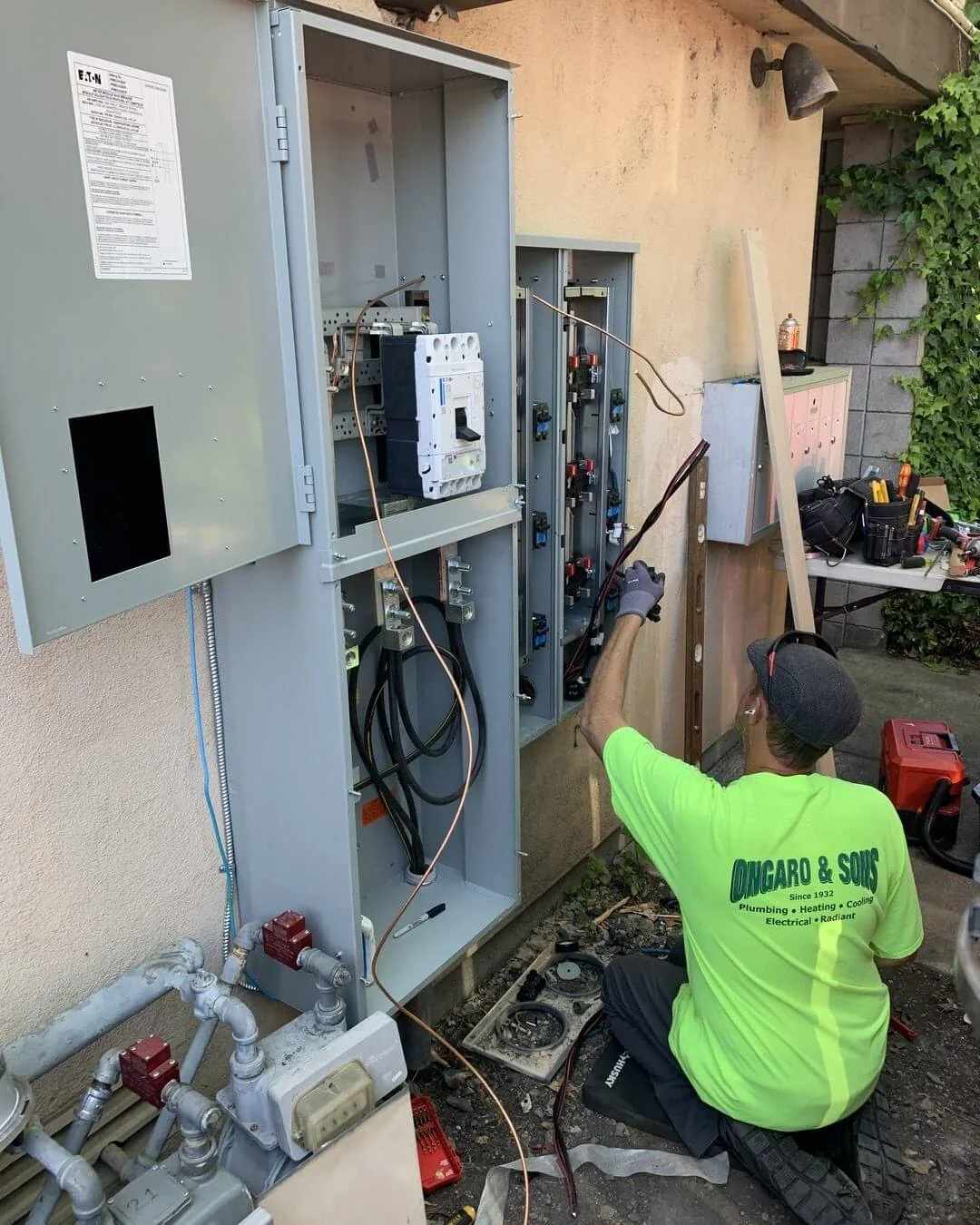
Count what the current wave asks for. A heat pump wants a circuit for the outdoor unit and often another for the air handler. A heat pump water heater needs a dedicated 240-volt circuit where the gas unit needed no electrical supply at all. A car charger wants its own circuit, an induction range another, and on a rural parcel the well pump is already sitting there as a fixed 240-volt load that has to keep running. Ask an older service to carry three or four additions and the load calculation stops working however efficient each appliance is on its own.
There are three ways forward and they are not interchangeable. A service upgrade raises the ceiling and is the clean answer when the entrance gear is old anyway. A subpanel adds spaces without adding capacity, so it helps only where the calculation already has headroom. Load management hardware lets two large loads share an allocation by preventing simultaneous operation, which is often the right answer on a long rural service run where an upgrade would mean trenching. Condition matters alongside capacity: obsolete breaker types no longer supported, missing equipment grounds, and outdoor gear weathered past its useful life all turn up here.
Home charging brings one Sonoma County specific worth knowing before you buy hardware. Sonoma Clean Power runs a smart-charger enrollment program rather than an installation rebate, paying a bill credit for enrolling an eligible Wi-Fi connected charger, and eligible devices are currently limited to WallBox and ChargePoint models. So the charger you choose decides whether you can enroll at all, which makes the equipment decision partly a utility decision.
The rate plan is the other lever: PG&E's electric vehicle rate plans include EV2-A, a single-meter plan that "applies to both your home energy and your vehicle's electricity use," and EV-B, which requires a second dedicated meter and therefore changes the electrical scope. A third plan is worth checking too. E-ELEC is PG&E's Electric Home plan, written around exactly the combination this page keeps describing: a charger, a heat pump, sometimes a battery. Choosing after the circuit is designed is choosing too late. See electrical in Sebastopol, panel upgrades and EV charger installation.
State law governs the charger permit rather than local discretion, and it does so in two places. Government Code 65850.7 requires every city and county to "administratively approve an application to install electric vehicle charging stations through the issuance of a building permit or similar nondiscretionary permit," with review confined to health and safety requirements. Government Code 65850.71 then supplies the deadlines, which for one to twenty-five stations at a single site run five business days to completeness and twenty more to approval, with the exceptions the statute lists. The clock is capped. The permit still exists.
Does solar work on a west county property?
Often yes, and the answer has to be measured rather than assumed, because tree cover here is real. Redwood, oak and orchard canopy create shading that changes by season and by hour, and two neighboring parcels can produce very differently. Module-level electronics let a partially shaded string keep producing instead of dragging the array down, and where the roof cannot work, an open clearing on acreage frequently outperforms it as a ground mount.
Four things decide these projects, in this order. Roof first: how many years the covering has left, what it is made of, and whether the framing can carry the mounting, because a long-lived array over a tired roof is a removal and reinstall you pay for twice. Service second: panel capacity, busbar rating, breaker space, and where the interconnection legally lands, which is the item that turns a solar quote into a solar-and-panel quote. Load third: what the house consumes and when, including any electrification you are planning within five years, since the electrician is already at the service. Export last, because what the utility credits you for energy you send back is now the weakest part of the economics.
That last point changed the design rules. Since the state moved new applicants off retail-rate net metering, energy you consume on site is worth considerably more than energy you push to the grid, which favors right-sizing to real household usage plus storage over building the largest array a roof will hold. Sonoma Clean Power is the community choice provider here, supplying generation while PG&E handles delivery and interconnection, and we confirm which billing plan an address sits on before modeling anything. Rural parcels have their own case for storage: it is not only about bills, it is about the pump. More on solar in Sebastopol and solar across Sonoma County.
What drives the price?
We do not publish flat figures, because the same equipment in two houses here is two different jobs. What moves a number, roughly in the order it decides totals:
Whether the existing duct can be reused, sealed and resized, or has to be replaced. Whether the electrical service has capacity or the project now includes a panel. Access, which on a rural parcel means distance and on an in-town lot means a tight utility closet or crawl space. On drainage, the depth and length of the run and whether it passes under hardscape, since restoration is frequently the largest single line on a sewer job. On a tankless conversion, gas line sizing and venting, which is usually the biggest variable in an older home. On solar, roof covering and condition, plane count and pitch, framing, and how far a ground mount sits from the service. And on any of it, whether the parcel permits through the city or the county, because that changes the calendar as much as the paperwork.
Whatever the scope, you get the full price before work begins, and financing is available on replacements.
What money is available right now?
Sonoma Clean Power runs the heat pump water heater rebate that reaches this town. The installation address has to be an SCP account, the equipment has to meet the performance requirements SCP publishes, and households enrolled in the CARE or FERA bill discount programs qualify for further support against what is left once other rebates are applied. Levels and windows move often enough that the figure worth using is the one confirmed at quote time rather than one printed anywhere.
Program budgets shift, and a rebate is only worth what it is worth on the day your project is written, so we verify what is available for your address at the time we quote rather than quoting anything from memory.
What should I be doing between service calls?
The maintenance list here is shaped by the water and the trees more than by the calendar.
Flush a tank water heater annually and have the anode rod inspected every few years, because groundwater consumes it faster than a treated surface supply does. Descale a tankless unit on the manufacturer's schedule rather than once it starts underperforming. Service heating and cooling equipment on a real interval, change filters on condition rather than on the sticker, and clear the condensate drain before the wet season rather than during it. Camera an older lateral ahead of the rains, since a line with open joints takes on groundwater once the winter table rises and spends its capacity carrying clean water.
Test GFCI and AFCI devices, which takes a minute and tells you whether the protection you count on still works. If you have a standby generator, confirm the exercise cycle runs and that the transfer switch transfers under load, and settle fuel supply ahead of fire season rather than during it. On an array, watch production month over month against the same month last year, because canopy growth shows up as a slow decline that looks like nothing from the ground. Our maintenance program bundles the seasonal items across trades.
Where in and around Sebastopol do you work?
Downtown and the older streets around it hold the tightest mechanical spaces, the least panel headroom, and the oldest buried plumbing. This is where original supply lines and original laterals tend to surface together, and where a single repair most often uncovers the next one.
The Gravenstein corridor and the streets off it mix eras, and the pattern we watch for is a house that has been added to in stages, with each addition served by whatever was convenient at the time rather than by a plan.
West county, out toward the coastal hills, is acreage: private wells, septic, outbuildings on their own feeds, long service drops, and heavier tree cover. It is also where a permit almost certainly runs through Permit Sonoma rather than the city, and where backup power stops being a comfort question.
All of it is served from our Petaluma headquarters, and Sebastopol sits inside our wider Sonoma County service area.
How should I pick a contractor for this?
Ask which authority issues the permit for your specific parcel, and notice whether the answer is immediate or vague.
Ask which air district covers your address, because a contractor working here should know that Sebastopol is split and should be able to say what that means for the appliance they are proposing.
Ask for the load calculation on anything adding an electrical load or a conditioning system, and ask to see it. A number derived from square footage or copied off the old data plate is a guess.
On any sewer recommendation, ask whether they will camera and locate the line before quoting, and whether you get the footage. A repair proposal with no recording behind it is an opinion with a price attached.
Ask them to name the incentive program and its current status rather than gesturing at rebates in general.
And check the license class for the work: C-20 for heating and air conditioning, C-10 for electrical, C-36 for plumbing.
What North Bay homeowners say
Two notes from customers, unedited.
Ryan came out and quickly assessed the situation with my electrical service, and made recommendations for an alternate solution that would work within my available power.
Matthew G.
James is the BEST! Whenever we have a plumbing or electrical issue we always call Ongaro.
Edward L.
Book service in Sebastopol
Tell us the address, roughly when the house was built, and whether it is on city water or a private well, and we can usually say ahead of the visit which of these questions will decide your project. Book online to schedule with Ongaro & Sons, family-run since 1932 and working across Marin, Sonoma and Napa counties from our Petaluma headquarters. Our customer reviews are worth reading first. Related Sebastopol pages: HVAC, heat pumps, furnace repair, AC repair, plumbing, water heaters, tankless water heaters, drain cleaning, sewer repair, electrical, panel upgrades, EV charger installation, and solar. Across the county: HVAC in Sonoma County, plumbing in Sonoma County, electrical in Sonoma County, and solar in Sonoma County.
Sebastopol homeowner questions
Who is the best home services company in Sebastopol?
Judge it on what you can check. Ongaro & Sons has worked in the North Bay since 1932, is Diamond Certified, holds a BBB A+ Rating, and carries 2,771 Google reviews at a 4.8 average. We hold the C-20, C-10 and C-36 licenses, so heating, cooling, plumbing, electrical and solar work is handled by one accountable company rather than three contractors coordinating around each other.
Does the City of Sebastopol or Permit Sonoma issue my permit?
It depends on which side of the city limit your parcel sits, and a Sebastopol mailing address does not settle it. In-town work is permitted and inspected by the city's Building and Safety Department. Everything outside the line goes through Permit Sonoma, with a different submittal system and inspection schedule. We confirm jurisdiction by parcel before filing.
Is Sebastopol really in two air districts?
Partly in one. The county's own listing places Sebastopol only partially inside the Bay Area Air Quality Management District, unlike Petaluma or Santa Rosa, which are fully inside it, or Cloverdale and the river towns, which are not in it at all. That determines whether the district's zero-NOx water heater timeline applies to your address, so we verify the specific property instead of assuming.
Will I still be able to install a gas water heater?
For now, yes, and no rule requires you to remove the one you have. The zero-NOx requirements phase in on dates that arrive by size and equipment type across 2027, 2029 and 2031, and that apply when equipment is replaced rather than to what is already installed, and they govern what may be sold and installed.
Why does well water shorten the life of my water heater?
Because groundwater arrives carrying more dissolved mineral than a treated imported supply, and heat drives that mineral out of solution. In a tank it settles on the floor and insulates the burner, which is the rumbling you hear. In a tankless unit it forms scale on the heat exchanger. The anode rod is consumed faster as well. Annual flushing, anode inspection, scheduled descaling and, on many properties, treatment ahead of the appliances are what close the gap.
What happens to my water during a power shutoff?
It stops if nothing is backing up the pump. Sebastopol's municipal supply is pumped groundwater rather than gravity-fed reservoir water, and beyond the city limits most properties run their own well. A well pump is an electric motor, so no power means no pressure. On a rural parcel that pump's starting current is usually what sizes a generator or an inverter, not the total energy figure.
Do I need air conditioning out here, or is heating enough?
Both earn their keep, though less dramatically than inland. Marine influence keeps west county afternoons cooler than Santa Rosa, so cooling loads are modest, while damp winters mean heating runs for most of the year's operating hours. That combination is why a properly sized heat pump tends to be the strong answer: one piece of equipment covering both, spending most of its life in its efficient range.
My Sebastopol house has no ductwork. What are the options?
Ductless equipment, and on the merits rather than as a fallback. Older construction here was often built without central duct runs, and forcing new duct into a shallow crawl space or a finished attic is invasive and frequently ends with undersized runs anyway. Indoor units mount where you want conditioning and connect to an outdoor unit through small line sets, providing heat and cooling both.
Is there a rebate for a home car charger in Sonoma County?
Not an installation rebate. Sonoma Clean Power runs a smart-charger enrollment program that pays a monthly bill credit for enrolling an eligible connected charger, and the eligible device list is currently limited to WallBox and ChargePoint models. That makes hardware selection part of the utility conversation rather than purely an electrical one, and it is worth settling before the equipment is bought.
Can solar work under heavy tree cover?
It has to be modeled rather than guessed at. A shade study of your actual roof planes tells you what each one will produce across the year, and module-level electronics recover real output on a partially shaded array. Where the canopy is dense and permanent, an open clearing on the parcel can beat the roof outright as a ground mount. Sometimes the answer is a smaller array in a better position.
Should I replace the roof before putting panels on it?
If the covering has fewer than about ten years left, replacing first is usually cheaper overall. Modules outlast most roofing, so mounting over a tired roof buys a removal and reinstall later that gains you nothing. We look at remaining life, layer count and framing during the site visit and tell you which sequence saves money rather than which one closes a sale faster.
Do you work outside the Sebastopol city limits?
Regularly, and they are a different kind of project. Private wells and septic systems, outbuildings on their own feeds, long service runs, and heavier tree cover all change the scope, and the permit goes through the county rather than the city. We ask what supplies the house and where the waste goes before we ask anything about equipment.