Marin County, California
Home Services in Corte Madera, CA
From family neighborhoods to the shops along Tamalpais Drive, Corte Madera counts on reliable home comfort. Ongaro & Sons delivers heating, cooling, plumbing, and electrical service across Corte Madera and central Marin.
Ongaro & Sons is the home services contractor Corte Madera homeowners call for heating, cooling, plumbing, electrical and solar work. The company was founded in Marin in 1932, it is Diamond Certified and holds a BBB A+ Rating, it works under a California contractor license carrying C-20 HVAC, C-36 plumbing and C-10 electrical classifications, and it carries 2,771 Google reviews averaging 4.8 stars. Every truck runs out of our Petaluma headquarters, so one company pulls the permits, does the work, and answers for it afterward. We are also a Mitsubishi Diamond Contractor Elite, a Trane Comfort Specialist and a Certified Generac Generator installer, and we price flat rate, by the job rather than the hour.
On this page
Corte Madera has three kinds of housing, and each has its own problems
Corte Madera has three distinct kinds of housing, and which one you own shapes the work more than anything else. The flats spread low and level toward the bay margin, mostly post-war subdivision housing on regular lots with driveways and attached garages. Christmas Tree Hill rises behind them on narrow, twisting lanes, where houses are older, smaller, tighter together and considerably harder to work in. Around the Town Center the pattern shifts again toward attached homes and later infill governed by shared roofs and architectural review.
Two houses a mile apart therefore get different answers to the same question. A heat pump that drops into a flats garage in a day becomes a two-crew problem on the hill. The next three sections are organized by house type, because house type is what actually decides the work.

The flats: room to work, and pipe you cannot see
Working conditions down here are the easiest in town. Level driveways, attached garages, and side yards wide enough to set an outdoor unit without a crane or a hand-carry. Ducted systems are common, furnaces sit in hallway closets or garages, and there is usually somewhere sensible to route a condensate line.
What the flats hide is underground and inside the walls. On the older streets we routinely open walls and find galvanized supply piping scaled down to a fraction of its original bore, which shows up as weak flow at an upstairs fixture long before it shows up as a leak. Laterals here are frequently the original cast iron or clay, and mature street trees find every joint. A drain that backs up twice in one winter is rarely a drain problem, and a camera pass settles it. Our approach is on sewer repair in Corte Madera.
Electrically, these houses were wired for a range, a dryer and little else. We still find original services with no free breaker spaces and no room for a two-pole 240-volt circuit. That one fact decides whether a heat pump water heater, a heat pump or a car charger is a simple install or a two-permit project.
Christmas Tree Hill and the upper streets: access decides the scope
On the hill, access is the job. Lanes are narrow, parking is scarce, and plenty of houses are reached by a flight of steps rather than a driveway. Crawlspaces are shallow and pitched, attics are small or absent, and interior closets sized for a 1950s appliance never grew.
That settles the equipment conversation before efficiency comes up. Where there is no room to run a duct trunk, a ducted replacement is not a swap, it is construction. Ductless and compact ducted systems solve the same comfort problem without opening ceilings, which is why we install so many of them on the upper streets. We are a Mitsubishi Diamond Contractor Elite and a Trane Comfort Specialist, so either approach gets specified on its merits.
Plumbing up here runs long and steep, so cleanout placement matters more than it does on flat ground: a cable fed from the wrong end of a steep run will not reach the blockage. Pressure varies by elevation zone, and we regularly find pressure-reducing valves that failed years earlier and went unnoticed until a water heater paid the bill.
Backup power comes up most often on these streets. PG&E may turn off power for safety during severe weather in what the utility calls a Public Safety Power Shutoff. Which circuits are de-energized in a given event is PG&E's determination, not ours. We hold Certified Generac Generator installer status and the C-10, so there is no gap between who supplies the generator and who wires it.
Attached homes, townhomes and later builds
The third pattern is attached and later-built housing, much of it near the Town Center, where the binding constraint is not the crawlspace but the governing document. Roof penetrations, outdoor equipment locations, condenser noise and line-set routing across an exterior wall can all require architectural approval before a permit application makes sense.
The electrical picture changes too. Many of these homes run off a modest panel with a subpanel added later, and the meter may sit in a shared enclosure at the far end of the building. Adding a car charger in a shared garage is an association question as much as an electrical one. Building size matters: MCE's EV charging program covers multifamily properties of four or more housing units, along with workplaces and commuter parking lots.
Solar diverges here as well. A shared roof is usually not yours to build on, and a townhome with two exposed planes may lack the unshaded area a useful system needs.

Four things we check before talking equipment
Across all three patterns we check the same four physical conditions, in this order, because any one of them can settle the specification on its own.
Can it get in, and can it come out? Equipment that reaches its space through a one-time gap is equipment nobody can service properly, and a unit nobody services gets replaced early.
What does the service support once the new load is on it? That is a calculation rather than a guess, and it decides between a service upgrade, a load management device, and doing nothing. Panel upgrades in Corte Madera begin with that number.
What happens to the vent? Remove or downsize one gas appliance and the existing flue may no longer suit whatever is still connected to it. Leaving a water heater venting alone into a chase sized for two appliances creates a problem nobody planned for.
Where does the water go? Condensate, heat pump water heater discharge and a temperature and pressure relief line each need a legal destination, by gravity where possible. Trivial on a flats lot, and often the hardest part of the install in a hillside closet.
Heating and cooling in Corte Madera
Central Marin's marine influence produces modest cooling demand and a long, cool, damp heating season. That is a heat pump climate more than an air conditioning climate, and it changes how equipment gets sized. A system chosen around a handful of warm afternoons is oversized for the hundreds of hours it runs, and oversized equipment short-cycles, dehumidifies poorly and wears out its compressor early.
Size for the heating load, verify the cooling load, and use variable-capacity equipment where the gap between them is wide. A heat pump in Corte Madera carries a house through nearly the whole year without leaning on auxiliary electric heat, provided the ducts and the envelope are not working against it. Ducts sitting in a vented crawlspace with failed mastic get fixed first, or the new equipment inherits the old problem.
On repair versus replace, refrigerant decides it for older systems. Production and import of R-22 into the United States ended in 2020, per EPA's phaseout schedule, and servicing existing equipment is the only remaining allowable use, so those repairs draw on reclaimed or previously stockpiled supply. R-410A sits in a different bucket: EPA's technology transitions rule applies a 700 GWP limit to new residential and light commercial equipment, and so new systems use lower-GWP refrigerants, and none of that means an R-410A system you already own needs replacing. Both sides of that call are covered on HVAC in Corte Madera.
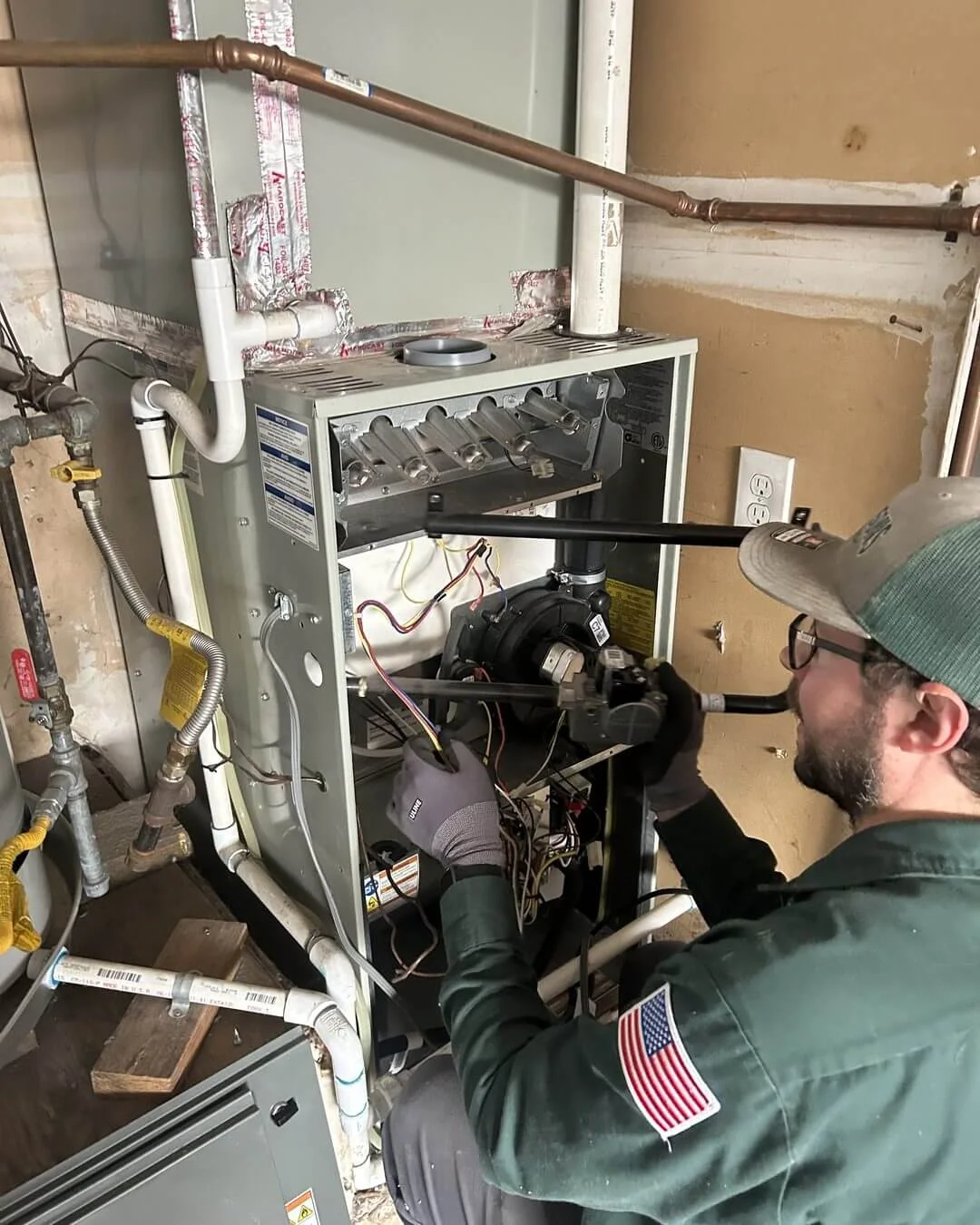
Plumbing in Corte Madera
Corte Madera sits inside Marin Water's central and southern Marin service area, and the utility blends its own reservoir supply with purchased Russian River water, publishing both streams separately in its 2025 Annual Water Quality Report. The plumbing questions here cluster around supply piping in older houses, sewer laterals under mature trees, and water heaters.
Water heaters are the most heavily regulated appliance in the house right now. California Health and Safety Code section 19211 requires that all new and replacement water heaters, and all existing residential water heaters, be braced, anchored, or strapped in accordance with the California Plumbing Code, for units with a capacity of not more than 120 gallons. Every new or replacement unit also has to meet Title 24 energy requirements, prescriptively or through performance modeling, and California's 2025 Building Energy Efficiency Standards took effect January 1, 2026, per the California Energy Commission. That cycle moved single-family new construction to a single fuel baseline with a heat pump prescriptively required for both water heating and space heating, which governs new houses and is not a retrofit mandate on an existing one.
The rule most likely to change what you install belongs to the air district. Corte Madera sits fully inside the Bay Area Air Quality Management District, which names Marin among its counties without qualification on its about page. The district’s building appliance rulemaking phases zero-NOx standards in by equipment type and size, at 2027 for small tank-type water heaters up to 75,000 BTU per hour, 2029 for furnaces under 175,000 BTU per hour, and 2031 for larger tanks and for tankless units. Note the order: tankless units sit on the later 2031 date, not the 2027 one.
Our current approach is on water heater service in Corte Madera.
The other story homeowners arrive with is a statewide gas ban in 2030. The Air Resources Board’s FAQ on the Clean Space and Water Heater Standards says the regulation "has not been finalized," no formal proposal has reached its board, and "you can still use or repair your existing space and water heaters after 2030."
Which portion of a sewer lateral belongs to the property owner is set by the local sewer authority, and we confirm that before quoting a replacement. Root intrusion at a joint returns on a schedule, and clearing it repeatedly over five years costs more than a spot repair or a liner does once. A camera inspection tells you which of those you are looking at and what the pipe is made of. Repipes, fixture work, gas lines and leak location all fall under plumbing in Corte Madera.
Electrical in Corte Madera
Older housing here was wired for a much smaller electrical appetite than a modern household has. We find services with every breaker space occupied, subpanels added later with no load calculation behind them, and grounding arrangements that predate current practice. None of that is unusual, and none of it is by itself a reason to act. It becomes decisive the moment a large 240-volt load enters the picture.
A heat pump water heater conversion commonly needs a 240V circuit. A heat pump needs its own. A car charger needs one more. The order those loads are planned in determines whether you need one service upgrade or none, and a load calculation done up front is cheaper than a change order discovered mid-install. Electrical work in Corte Madera starts from that calculation rather than a rule of thumb.
Car chargers have their own rules, and the rules favor the homeowner. Two sections do the work, and they are constantly confused with each other. Government Code 65850.7 is the duty: every jurisdiction runs an expedited process off a published checklist, approves a compliant application administratively, and may review only "whether it meets all health and safety requirements of local, state, and federal law." Government Code 65850.71 is the calendar: for one to twenty-five stations at a single site the application becomes complete by operation of law after five business days and approved after twenty more, and larger sites run on ten and forty. Those are ceilings on delay rather than a waiver, because EV charger installation in Corte Madera still requires a permit.
The rate plan belongs in the install conversation too. PG&E's electric vehicle rate plans split two ways. EV2-A uses your single existing meter and applies to both your home energy and your vehicle's electricity use, off-peak from midnight to 3 p.m. every day, and PG&E states that customers with high energy usage over 800% of baseline allowance across the last twelve months are not eligible. EV-B requires a second, dedicated meter and is not available with CARE, FERA or Medical Baseline. A second meter is an electrical scope decision, so it gets settled before wire is pulled. A third plan is worth checking too. E-ELEC is PG&E's Electric Home plan, written around exactly the combination this page keeps describing: a charger, a heat pump, sometimes a battery.
One clarification worth making: CALGreen is Title 24 Part 11, and its EV charging provisions carry forward in the 2025 code cycle, in effect since January 1, 2026. Whether any of it reaches your project depends on whether the work counts as an alteration that triggers it, which is the building official’s call rather than a rule of thumb, so we confirm scope at application rather than assuming either way.
Solar and battery storage in Corte Madera
Corte Madera moves faster than much of California on solar permits. The town's own building permit submittal requirements state that Symbium online permitting went live on September 30, 2024, providing instant permits under SB 379 for solar and energy storage systems. For a qualifying residential system, that removes the slowest step in the process.
The design work remains, and here it is mostly shade and roof planes. Mature trees are the constraint on the hillside streets. Small, divided roof areas are the constraint on attached homes near the Town Center. Roof condition belongs in the same conversation, because an array set on a covering with a few years left in it means paying to remove and reset the array later.
How exported energy is credited depends on the tariff in effect at interconnection. MCE supplies generation for most Corte Madera accounts while PG&E delivers the power and reads the meter, so both parties appear in the paperwork. We confirm the applicable terms at design time rather than quoting last year's.
Storage is a separate decision from generation. If the reason for a battery is riding through a utility shutoff, the sizing question is which circuits you want kept alive and for how long, not how many panels sit on the roof. Solar in Corte Madera covers both.
Permits and code inside town limits
Corte Madera is an incorporated town, so work inside town limits is permitted through the Building Division under Community Development. The town's submittal requirements state that all permit applications may be submitted electronically, as PDF attachments by email, and the town operates an online permit center for related steps. If the property sits in unincorporated Marin County instead, the Marin County Community Development Agency is the permit authority, and confirming which one applies is the first thing we do on a job at the edge of town. We pull the permit on work that requires one and we meet the inspector, so any correction list lands with us.
What drives the price of this work here
We do not publish prices, because the same appliance in two Corte Madera houses is two different jobs. What we can tell you is what moves the number.
- Access and carry distance. Stairs, narrow lanes and no parking add labor before a tool leaves the truck.
- Electrical capacity. Whether a new load fits the existing service, needs a load management device, or needs a service upgrade is usually the largest single swing on an electrification project.
- Existing pipe material. A repipe that begins as one section can become a whole-house job once the wall is open.
- Venting path. Reusing an existing chase is inexpensive. Building a new vent route through a finished hillside house is not.
- Trenching and restoration. Lateral length, driveway or hardscape crossings, and how the surface gets put back.
- Roof condition and structure on solar, plus how much the array has to work around obstructions and setbacks.
- Association review on attached homes, which costs schedule rather than materials.
- Equipment tier and the refrigerant transition on heating and cooling work.
All of it goes in writing before work starts, so the number you approve is the number you pay unless the scope changes.
Rebates and incentives, and what is open
Incentive programs in California change faster than equipment does, so treat any list, including this one, as a snapshot.
MCE is the community choice energy provider for Marin County, which makes a Corte Madera account an MCE account for generation and a PG&E account for delivery. Programs run by Sonoma County's community choice provider do not apply at addresses in this town, and that is worth saying because search results mix the two constantly.
On charging, MCE's eligible categories are workplace charging for employees or fleets, multifamily buildings of four or more units, and commuter lots such as a park and ride or ferry terminal. A single-family charger does not appear on that list. It does appear under PG&E's residential charger rebate, whose terms make Community Choice Aggregation customers eligible, so the money exists; it just comes from the other utility.
MCE’s heat pump rebates are the main equipment program reachable from a Corte Madera address. They go to customers who "own and have lived in their single-family detached homes for at least 12 months in MCE’s service area," require a participating contractor to file the paperwork on your behalf, and "cannot be applied to a project retroactively." That last condition is why the application goes in before the equipment does.
Eligibility on anything else follows the account and the program’s current terms, so we confirm it at the time we quote.
Maintenance that earns its keep in a marine climate
Two conditions drive the list here: marine air off the bay and a long damp season.
On outdoor equipment, cabinet and coil corrosion appears sooner at bay-side addresses than at inland ones. A rinse schedule, plus attention to coil coatings when equipment is specified, extends service life more than any other single habit. On the heating side, a system that runs most of the year needs filter and blower attention on a calendar, not on the day something starts squealing.
Plumbing maintenance is mostly about anticipating the two failures that cost the most: a water heater that goes without warning, and a lateral that backs up under load. Checking the anode rod and exercising the relief valve addresses the first. A periodic camera pass on a lateral with a known root history addresses the second.
Electrical maintenance is short. Test GFCI and AFCI devices, keep the panel accessible and clearly labeled, and run the exercise cycle if you have a standby generator. If you have solar, watch production instead of assuming it, because an inverter fault can sit unnoticed for a season.
Where we work in Corte Madera
We work the whole town: the flats, Christmas Tree Hill and the upper streets, and the neighborhoods around the Town Center. Central Marin is served from the same place everything else is, our Petaluma headquarters, which is where the trucks, the parts inventory and the permit applications originate. We do not run a Corte Madera storefront and we do not claim one.
How to choose a contractor for this work
Four questions separate contractors quickly.
Ask who holds which license. Four trades under one roof only helps if the company carries the classifications. We hold C-20 for HVAC, C-10 for electrical and C-36 for plumbing, so a job that crosses from a heat pump to a circuit to a condensate drain does not turn into three companies pointing at each other.
Ask who pulls the permit and who meets the inspector. If the answer is you, price that in and adjust your schedule.
Ask for the load calculation rather than the rule of thumb. Anyone sizing a system off square footage is guessing, and in a mild climate with a wide gap between heating and cooling loads, guessing reliably produces oversized equipment.
Ask what happens if the code changes between proposal and installation. With the air district amending its water heater rule and incentive programs opening and closing on their own schedules, a contractor who does not track that hands you a plan that no longer works by the time it is built.
Ongaro & Sons has been in business since 1932, holds a BBB A+ Rating and is Diamond Certified. Every one of those is checkable, which is the reason for listing them.
What North Bay homeowners say
Two reviews from customers who used us across more than one trade:
Ongaro & Sons is our go-to electrician. We initially contacted them to wire our new A/C unit. Their work is always top-notch and no detail is ever missed. Thank you Rick, Ben and Cody for all your wonderful work.
Spencer H.
Have worked with their electricians, plumbers and HVAC specialists. Everyone we've communicated and worked with is super professional and helpful. Highly recommended!
Dustin D.
Book a Corte Madera appointment
Tell us the address and what the house is doing, and we will tell you which of those four questions is most likely to decide the job. Book online to schedule a visit. Scope, permit responsibility and price go in writing before anyone starts work. More Corte Madera detail by trade: HVAC in Corte Madera and heat pump systems; plumbing, water heaters and sewer repair; electrical, panel upgrades and EV charger installation; and solar.
Corte Madera home services questions
Who is the best home services company in Corte Madera?
Judge it on what you can verify. Ongaro & Sons has operated since 1932, is Diamond Certified, holds C-20, C-10 and C-36 licenses, and carries 2,771 Google reviews averaging 4.8 stars. The practical advantage in this town is that one licensed company handles a heat pump, the circuit feeding it and the drain serving it, without three schedules and three sets of finger-pointing.
Do I need a permit for HVAC, plumbing or electrical work in Corte Madera?
For replacements and new installations, generally yes. Work inside town limits goes through the Building Division under Community Development, and the town accepts applications electronically as PDF attachments. Properties in unincorporated Marin County go to the Marin County Community Development Agency instead. We file the application and meet the inspector on work we perform.
Is my gas water heater about to be outlawed here?
No. The town is inside BAAQMD, and the district's 2023 amendment to Regulation 9, Rule 6 set zero-NOx requirements for residential water heaters with compliance dates that vary by unit size, beginning in 2027. It governs what can be installed going forward, not the unit already sitting in your garage.
Why does Corte Madera issue solar permits faster than some cities?
Because the town automated them. Corte Madera's submittal requirements page records Symbium going live on September 30, 2024, delivering instant permits under SB 379 for residential solar and energy storage. For a qualifying array, the permit stops being the bottleneck, and design, shading analysis, roof condition and interconnection paperwork set the schedule instead.
Is a heat pump a good fit for this climate?
Usually yes. Marine influence here produces limited cooling demand and a long cool season, which suits a heat pump because the equipment spends most of its running hours heating rather than cooling. The discipline that matters is sizing, not brand selection: choose for the heating load, confirm the cooling load, and specify variable-capacity equipment when those two numbers sit far apart.
There is no attic or crawlspace room in my hillside house. What can I install?
Ductless or compact ducted systems, in most cases. When there is nowhere to run a duct trunk, a conventional ducted replacement stops being a swap and turns into construction. Wall-mounted heads, ceiling cassettes, or short-run ducted indoor units condition the rooms you use without opening ceilings. Outdoor unit placement and the condensate route become the real design constraints.
Is there an MCE rebate for a home car charger?
Not for a detached single-family home. Its charging money is written for workplaces, buildings of four or more units, and commuter lots. A single-family house appears on none of those lists. If you own a condominium or townhome in a building of four or more units, your association may have a route worth exploring.
How long can the town take on a car charger permit?
State law caps it, and the clock lives in Government Code 65850.71 rather than in the more frequently cited 65850.7. For a site with one to twenty-five stations, the application counts as complete once five business days pass without a completeness determination or a written correction notice, and counts as approved twenty business days after that absent action, a denial, a substantial-evidence adverse-impact finding or an appeal. Review is confined to health and safety.
Do I have to upgrade my panel before adding a heat pump or a charger?
Not automatically. It turns on a load calculation against your existing service, not on the age of the equipment. What we commonly see in older housing here is a service with no spare breaker spaces, which is a different problem from insufficient capacity and sometimes has a cheaper fix. Where several new loads are coming, sequencing them together often avoids a second upgrade later.
My drain keeps backing up every winter. Is that really a drain problem?
Often it is not. Repeat seasonal backups in the low, level part of town usually trace to root intrusion at a joint in the sewer lateral rather than anything inside the house. Clearing the line restores flow and does nothing about the cause, so it returns. A camera inspection locates the intrusion and identifies the pipe material, and those two facts decide the repair.
Should I replace my R-410A air conditioner because of the refrigerant phasedown?
No. EPA applies a 700 GWP limit to newly manufactured residential and light commercial equipment, and that is the reason new systems use lower-GWP refrigerants, but an installed R-410A system keeps running and stays serviceable. The scarcity argument bites only on R-22 equipment, where every pound available since 2020 has been reclaimed or previously stockpiled material because US production and import stopped that year.
What should I plan for around Public Safety Power Shutoffs?
A Public Safety Power Shutoff is PG&E turning off power for safety when severe weather raises fire risk, and the utility, not the contractor, decides which circuits go dark. Your planning question is what you want kept running and for how long: refrigeration, a pump, a medical device, network equipment, or the whole house. That answer decides between a battery and a standby generator.
Does Ongaro & Sons have a Corte Madera location?
No, and we would not claim one. The company has been in business since 1932 and operates today from its Petaluma headquarters, and Corte Madera work is dispatched, stocked and permitted from there. In practice that means one company on the paperwork, one crew roster and one warranty conversation, instead of an arrangement where the sign on the truck and the people doing the work belong to different businesses.