Sonoma County, California
Home Services in Blakes Landing, CA
On the quiet shore near Tomales Bay, Blakes Landing's coastal properties face salt air and rural utilities. Ongaro & Sons brings durable plumbing, heating, electrical, and solar service to this remote stretch of the North Bay coast.
The North Bay has had Ongaro & Sons in it since 1932. What the company covers now is heating and cooling, plumbing, electrical and solar. We carry Diamond Certified status, a BBB A+ Rating, and a 4.8-star average across 2,771 Google reviews. Blakes Landing sits at sea level on the east shore of Tomales Bay, and the bay itself is the reason two ordinary parts of a house deserve more attention here than almost anywhere else we work.
On this page
The bay is a fault line, and that changes the details
Tomales Bay is not an ordinary inlet. It is a long, straight, narrow trough because it follows the San Andreas Fault, and the fault runs beneath the water a short distance from this shore. In 1906 that fault ruptured the ground surface along this stretch of coast, which is a rarer event than a large earthquake and a much more destructive one for anything rigid crossing the line.
That does not make a house here unbuildable, and it is not a reason for alarm. What it does mean is that a handful of installation details which are treated as boxes to tick elsewhere are the details that actually matter here, and they are cheap to get right at the time of the work.
The water heater. Section 19211 requires water heaters up to 120 gallons braced, anchored or strapped against displacement, and it reaches the tank already in your building rather than only the next one. On this shoreline that is not paperwork. A full tank is a heavy object with a gas or electric connection attached, and a tank that moves takes its connections with it. Both straps, correctly placed and correctly fastened into something structural rather than into siding, is the heart of the requirement.
Connections that have to move. Rigid pipe is what fails when ground moves. Approved flexible connectors at appliances, fitted properly and not stretched or kinked, let equipment shift slightly without tearing a joint. On the gas side that is the single highest-value detail in the building.
Gas shutoff. Knowing where the shutoff is and having a tool at it is the minimum. An excess-flow or seismic gas shutoff valve is worth discussing on a property this close to the trace, and where a property runs on propane, the tank itself needs to be properly anchored, since an unsecured tank with a rigid connection is the classic failure.
Anchoring in general. Equipment on a stand, an outdoor unit on a pad, a pressure tank in a pump house: things that are merely sitting somewhere are things that move. Fastening them costs very little during an installation and cannot be retrofitted for free later.
Salt air matters here too, as it does all along this shore, and we treat it seriously: it is set out in full on our Marshall page, a short distance up the same shoreline.
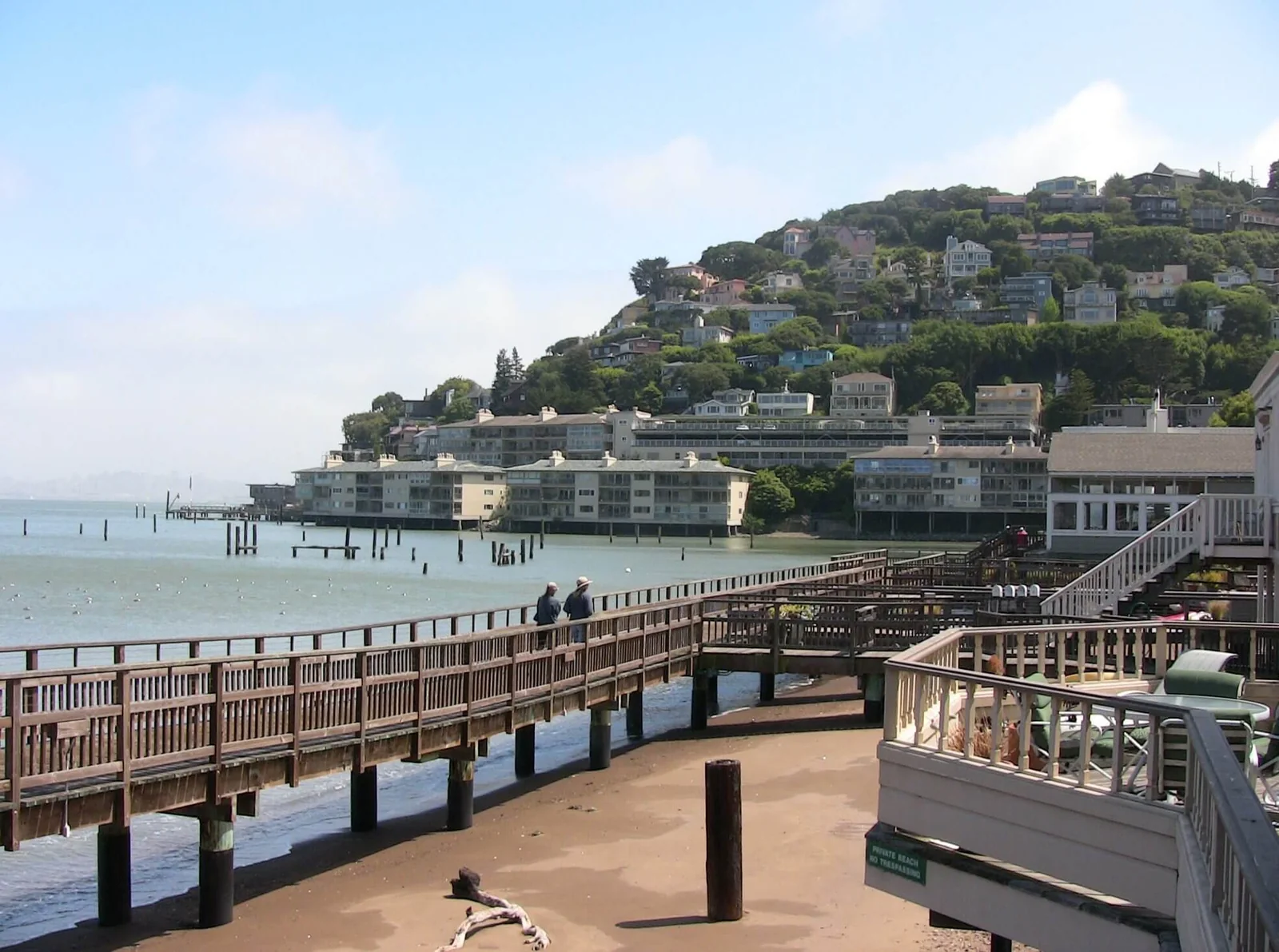
Water quality is a regulated concern in this watershed
The second thing the bay changes is wastewater.
Tomales Bay is a working, protected water body, and onsite wastewater systems draining toward it get closer scrutiny than a septic system inland would receive. In Marin County, septic and onsite systems fall under the county's environmental health function, and proximity to a sensitive water body affects what is allowed, how a system must be designed and what has to be demonstrated.
The practical translation for a homeowner is simple. Anything that changes fixture count, adds a bathroom or increases expected flow can bring the onsite system into the conversation, and out here that conversation is not a formality. Establish it before the drawings rather than after, because a project designed around a system that will not be approved is a project rebuilt from the start.
It also raises the value of ordinary maintenance. Pumping on schedule, keeping what should not go into the system out of it, and fixing a leaking fixture promptly all matter more when the system's performance is a regulated question rather than a private one. A continuously running toilet is not just a water bill here. It is hydraulic load on a system that has to keep working.
A heating climate at sea level
The bay moderates everything. Mornings are foggy and often clear by midday, summers are mild, and winters are damp and cool rather than cold. Air conditioning is rarely the point. Heating, and controlling moisture, are.
That combination makes a heat pump an easy technical call. The winter demand is mild by any standard, which is the condition heat pumps handle best, and the same equipment covers the handful of warm days without a second system. On a small coastal building, ductless heads are frequently the sensible route: they need no duct route at all, they let each room have its own control, and there is nothing to leak into a damp crawl space.
Moisture is the part that gets neglected. In a damp maritime climate a building that is not ventilated deliberately will manage its moisture by accident, and the results turn up as condensation on cold surfaces, musty air, and mold in the places nobody looks. Deliberate ventilation, extraction that discharges outside rather than into a roof space, and a crawl space that is properly ground-sealed and vented are worth more to comfort and to the building than extra heating capacity would be.
Where a building stands empty for stretches, and along this shore some do, keeping a low background temperature and some air movement costs little and prevents a great deal.
Power at the end of a coastal line
This shoreline sits at the end of a distribution line serving very few customers, so outages are both more frequent and longer than in town.
When conditions turn dangerous, PG&E cuts power intentionally under its Public Safety Power Shutoff program.
An outage here takes more than lighting. On a property with a well it takes the water, since the pump is electrical and a pressure tank holds minutes rather than days. If a pump lifts wastewater, that stops too. And it takes the heat even where the fuel is not electric, because controls, ignition and fans are.
Backup is scoped at the panel by picking circuits rather than by picking a machine: a pump, refrigeration, the heating controls and fan, and a few lights. That is a far smaller and cheaper proposition than covering a building, and it costs a fraction when the work is done while the panel is already open. Where a well is involved the pump usually sets the sizing, because its starting surge is what the system has to absorb.
We install Generac as a Certified Generac Generator installer and hold the C-10, which keeps the machine and the panel work on the same visit. On a shoreline site, a battery paired with an array is often the better answer, because there is no fuel to store, nothing to start, and nothing exposed to salt air that does not need to be.
Electrical work on a shoreline property
A load calculation is the same exercise here as anywhere else. Square footage generates the lighting and receptacle figure, each fixed appliance enters at whatever demand factor the code permits it, heating and cooling are compared and only the larger of the pair is counted, and the resulting total gets held up against the capacity of the service.
What is different is the environment the equipment lives in and the distances involved. Enclosures, disconnects and fittings on a shoreline property need to be specified for the exposure rather than for a garage, and the corrosion that follows a wrong choice shows up in the terminations long before it shows up anywhere visible. Where buildings sit apart, voltage drop over a long run means a circuit adequate on paper delivers less than it should at the far end, and a motor running on low voltage runs hot and fails early.
The older buildings along this shore bring the findings of their age: panels amended over decades, ungrounded two-wire circuits behind modern-looking receptacles, and buried runs to outbuildings nobody has assessed in years. Grounding and bonding deserve particular attention on a coastal property, both for safety and because a poor connection corrodes faster in this air than it would inland.
Where the calculation comes back short, listed load management equipment is worth pricing before a service upgrade, since it is frequently the cheaper answer.
Permits and the county process
Blakes Landing is unincorporated, so building permits and inspections come from Marin County. Coastal location adds a layer that inland projects do not have: work in the coastal zone can bring further review, and what applies depends on the parcel and on the scope rather than on a general rule. We establish that before promising a schedule, because finding out during plan check costs weeks on a project out here.
Onsite wastewater, as above, is its own approval path and belongs at the start of a project rather than in the middle of one.
Alongside the seismic restraint requirement covered earlier, energy compliance under Title 24 applies to a replacement, and the edition being enforced is the 2025 cycle, in force since January 2026.
Air district rules on this shore
Blakes Landing is in Marin County, and all of Marin sits inside the Bay Area Air Quality Management District, so the district's zero-NOx appliance requirements apply.
The scope is narrower than the rumor. The obligation falls on whoever installs new equipment, it phases in one appliance category at a time, and the district has tied it to burn-out of the existing unit. Nothing currently in your building is affected.
What changes over years is what suppliers stock. Because a compliant unit is in practice electric, the question becomes electrical capacity, and in a mild heating climate like this one the transition is technically easy: the equipment that suits the climate is the equipment the rules point toward anyway.
Solar on a coastal site
What the county may ask of you is capped. Government Code 65850.5 requires an expedited route for small residential rooftop systems and holds the review to health and safety questions only.
The coastal reality is that morning fog costs production and clear afternoons return it, so a realistic estimate here is based on what this shoreline receives rather than on a regional average. Mounting hardware and fasteners need specifying for salt exposure, since the wrong metal in this air is a maintenance problem within a few years.
Under the Net Billing Tariff, which applies to interconnection applications from April 2023 onward, exported energy is credited at its hourly value to the grid rather than at the retail rate, so what you use is worth more than what you export. On a property that loses power regularly and depends on a pump for water, storage earns its place on reliability grounds as much as on the energy arithmetic.
What drives the cost here
Distance leads. This is a long way from anywhere, buildings are spread out, and getting equipment and people to the work takes time that has nothing to do with parts.
Exposure is second. Specifying enclosures, fasteners and finishes for a salt environment costs a little more at installation and a great deal less over the life of the equipment.
The approval path is third, because a coastal parcel with an onsite wastewater system has more that has to be established before work starts than an inland lot does.
Then the short list that always appears on an inspection and never in a homeowner budget: restraint, thermal expansion, combustion air, venting, permit fee.
Maintenance on this shoreline
Check the water heater's restraint yourself, and check what the straps are fastened into rather than only that they exist. On this shore that is the highest-value two-minute inspection in the building.
Know where the gas or propane shutoff is, keep a tool at it, and make sure everyone in the household knows too.
Rinse the outdoor equipment with fresh water on a schedule, and have the coil and the electrical terminations looked at as a service item rather than a cosmetic one.
Keep the onsite wastewater system pumped on schedule and fix running fixtures promptly, because hydraulic load is the thing that shortens a system's life.
Ventilate deliberately, keep extraction discharging outside rather than into a roof space, and look at the crawl space in winter rather than assuming it is the same as it was.
Flush the water heater annually, change filters on a coastal interval, and keep ground-fault test buttons and shutoffs exercised. A maintenance plan puts the visit on the calendar rather than on the day something fails at the end of a long road.
Where we work around Blakes Landing
We cover the properties along this stretch of the east shore, the parcels on the slope above the highway, and the land back from the water where wells, onsite wastewater systems and outbuildings are the norm.
Everything runs from our Petaluma headquarters, which is nearer to this shore than to much of our territory but still a real drive. Booking ahead gets the appointment window you want, and grouping several items into one visit is worth more here than in town.
How to choose a contractor for a shoreline property
Ask what they intend to do about restraint and flexible connections rather than only about the appliance, because on this shore those details are the ones that matter.
Ask what grade of enclosure, fastener and finish they are specifying for the exposure. If the answer is the same as it would be for an inland garage, the equipment will tell you within a few years.
Ask whether the onsite wastewater system has been considered before the drawings, if the project touches fixtures at all.
Ask how they plan to handle the ventilation and moisture side, since in this climate that does more for comfort than extra heating capacity.
And check what they hold: C-36 covers plumbing, C-20 mechanical, C-10 electrical. Holding all three is what lets a single visit cover a problem that turns out to cross trades at this distance.
What North Bay homeowners say
Cody their electrician was just amazing!!. He even put in the effort to call us saying he'd finished off earlier than expected from his previous client & was in the neighborhood & could come by earlier if we wanted!!
Dorothy M.
Brandon H was my HVAC Service Technician for a recent annual maintenance. The service here is fantastic. He explained everything he did (pics of literally everything).
Francesco D.
Home services across Blakes Landing and Marin County
One company, all four trades: heating and cooling across Marin County, plumbing across Marin County, electrical across Marin County, and solar across Marin County. Along this shore we also serve Marshall, Tomales and Point Reyes Station. The Marin County service overview covers the whole county.
Book service at Blakes Landing
Tell us what the building is doing, whether it is on a well and an onsite wastewater system, and how close to the water it sits. If damp or condensation is part of the complaint, say so, because that is usually a ventilation question rather than a heating one. Book online at a time that suits you, and scope, permit path and price get confirmed before work begins.
Blakes Landing homeowner questions
Who is the best home services company in Blakes Landing?
Ongaro & Sons, in the North Bay since 1932 with all four trades in-house. Diamond Certified, BBB A+ Rating, and a 4.8-star average over 2,771 Google reviews. On a shoreline property at this distance the practical test is whether one visit can cover a problem that crosses trades, and whether the installer specifies for salt exposure and ground movement rather than defaulting to inland practice.
Is it true the San Andreas Fault runs under Tomales Bay?
Yes. The bay is long, straight and narrow because it follows the fault, which runs beneath the water a short distance from this shore, and in 1906 the fault ruptured the ground surface along this coast. That is not a reason for alarm about living here. It is a reason to get a small number of installation details right, since they are inexpensive at the time of the work and cannot be added for free afterwards.
What are those details, in practice?
Restraint and flexibility. The water heater properly strapped into something structural, approved flexible connectors at appliances so equipment can shift without tearing a joint, a gas or propane shutoff that is findable with a tool at it, a propane tank properly anchored, and anything merely sitting on a pad or a stand fastened down. None of it is expensive. All of it is difficult to add later.
Does the strapping rule apply to the water heater I already have?
Yes. Section 19211 covers water heaters up to 120 gallons and is written to reach the unit already installed, not only its replacement, requiring it braced, anchored or strapped against displacement. Worth checking what your straps are fastened into as well as that they are there, since straps screwed into siding rather than into structure are not doing the job they appear to be doing.
Why does my septic system get so much attention here?
Because of the bay. Onsite systems draining toward a protected water body get closer scrutiny than an inland system would, and proximity affects what is allowed and what has to be demonstrated. The practical result is that anything adding a bathroom, changing fixture count or increasing expected flow needs establishing at the start of a project rather than in the middle of one.
What is the cheapest thing I can do for my septic system?
Fix running fixtures promptly and pump on schedule. A continuously running toilet is hydraulic load on a system whose performance is a regulated question out here, not just a line on a water bill. Keeping what should not go into the system out of it is the other half, and between them they do more for the system's life than anything else available.
Does a house in Blakes Landing need air conditioning?
Rarely. The bay keeps summers mild and mornings foggy, so the useful question is heating and moisture rather than cooling. A correctly sized heat pump covers the mild winter demand well, and the same equipment handles the handful of warm days without a second system. On a small coastal building ductless heads often suit better than ducts, since there is no duct route to build and nothing to leak into a damp crawl space.
My house smells damp and I have condensation. Is that a heating problem?
Usually it is a ventilation problem. In a maritime climate a building that is not ventilated deliberately manages its moisture by accident, and the result is condensation on cold surfaces, musty air and mold where nobody looks. Deliberate ventilation, extraction that genuinely discharges outside rather than into a roof space, and a properly sealed and vented crawl space do more than extra heating capacity would.
What happens in Blakes Landing when the power goes out?
More than the lights. A well property loses its water with the lights, because the pump is an appliance and the pressure tank buys minutes. If a pump lifts wastewater, that stops too. And the heating stops regardless of fuel, because controls, ignition and fans are electric. Backup here gets scoped around that short list of circuits rather than around the whole building.
Should I choose a generator or a battery?
On a shoreline site a battery paired with an array is frequently the better answer. There is no fuel to store, nothing that has to start, and nothing extra exposed to salt air. Where a generator is the preference we install and commission it with the transfer equipment and the panel work on one schedule, since we hold the electrical classification alongside the mechanical and plumbing ones.
Does salt air really damage equipment?
Yes, and it shows up in the terminations and fasteners before it shows anywhere visible. Enclosures, disconnects, fittings and mounting hardware all need specifying for the exposure rather than for an inland garage, and rinsing outdoor equipment with fresh water on a schedule is genuine maintenance here rather than housekeeping. We set the salt question out in full on our Marshall page, a short way up the same shoreline.
Who issues my permit in Blakes Landing?
Marin County, since Blakes Landing is unincorporated. Coastal location can bring additional review depending on the parcel and the scope, and an onsite wastewater system is its own approval path. Both belong at the start of a project rather than the middle, because out here a round of corrections costs a schedule rather than a morning.
Will I have to give up my existing gas appliances?
No. What the Bay Area district has adopted regulates the act of installing something new: it takes effect category by category, and the district has pegged it to the moment an existing unit burns out, in a rulemaking that is not yet finished. An appliance you already own is simply outside its reach. In a climate this mild the change is technically easy in any case, because a modest heating demand is exactly where a heat pump is at its best.