Marin County, California
Home Services in Mill Valley, CA
At the base of Mt. Tamalpais, Mill Valley's redwood-shaded homes mix vintage character with modern systems. Ongaro & Sons handles heating, cooling, plumbing, and electrical work tailored to Mill Valley living.
Ongaro & Sons has worked in Marin since the company was founded here in 1932, and we run home services in Mill Valley from our Petaluma headquarters under a California contractor license carrying C-20 HVAC, C-36 plumbing and C-10 electrical classifications, with 2,771 Google reviews averaging 4.8 stars. Holding all three matters more on this terrain than on flat ground, because a Mill Valley job rarely stays inside one trade. It is also the town where the building department will tell you, in advance and in writing, roughly how long your decision is going to take.
We are Diamond Certified and hold a BBB A+ Rating, and we are a Mitsubishi Diamond Contractor Elite, a Trane Comfort Specialist and a Certified Generac Generator installer. Pricing is flat rate, by the job rather than the hour.
On this page
Fix it, replace it, or change what the house runs on
Most people call a contractor because something failed, or a rule changed, or they were told the panel would not take a car charger. The question underneath is always the same one: fix what is there, put back what was there, or change what the house runs on.
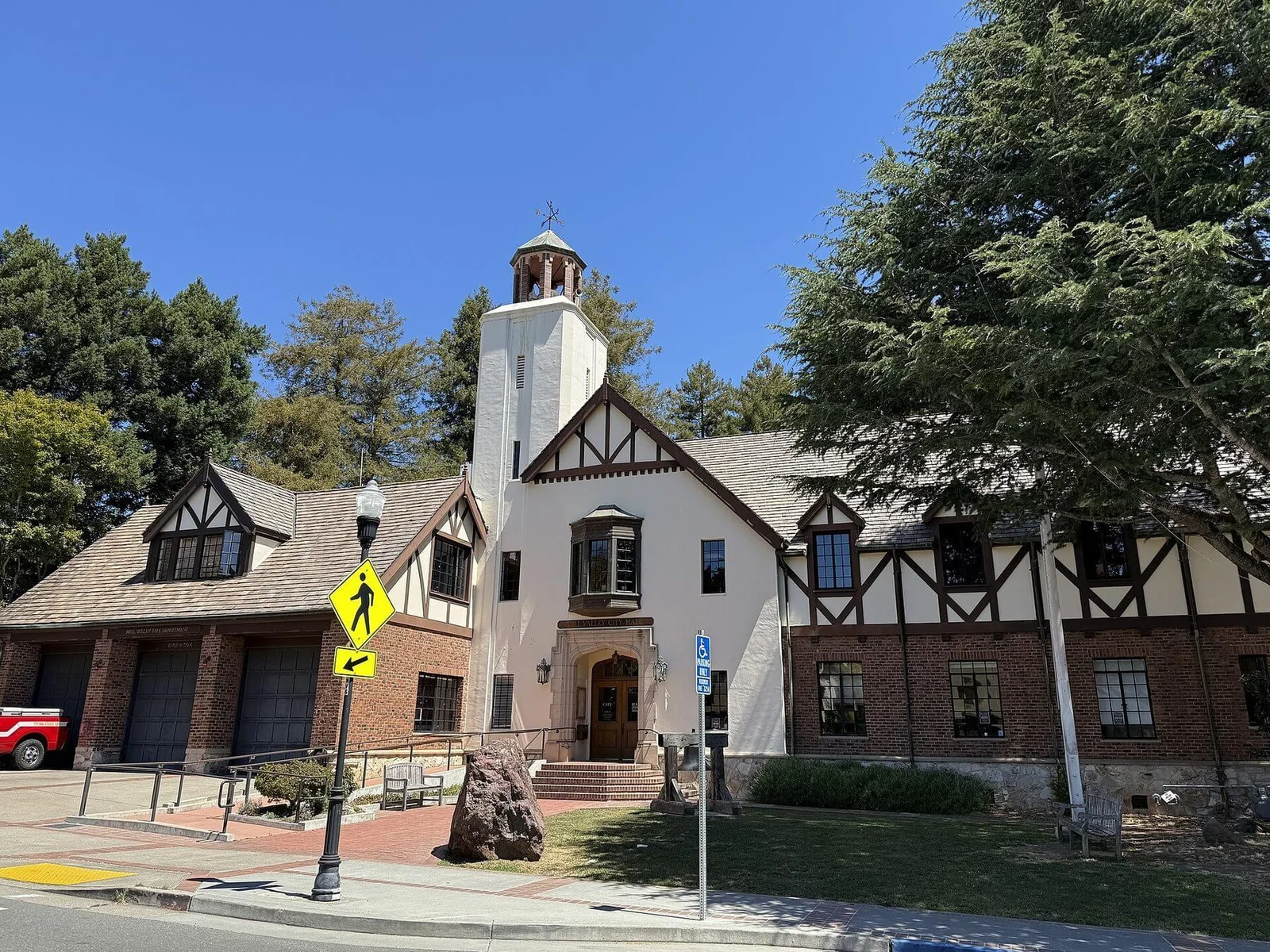
Mill Valley presses that question harder than most of Marin. Lots are sloped and wooded, so how the crew reaches the work is a variable in the price rather than a formality. The housing is old enough that original supply lines and original water heaters are simply due, so one repair frequently uncovers the next. And a Mill Valley mailing address does not settle who issues your permit. The city puts that warning on its own application page, in bold: confirm "the address is located in the City of Mill Valley and NOT in an Unincorporated area of Mill Valley." Homestead Valley, Tam Valley and Strawberry are the places this catches people. Same mail carrier, different building department, different portal, different calendar.
Four questions, in order
Before comparing equipment, answer four questions in order. Skipping to the interesting one is how projects go sideways here.
Authority. City or county. This sets the application system, the fees and the review time, and it is decided by the parcel rather than the address.
Access. Can the equipment reach the location, and can a technician work there. A house reached by a stair run from a shared canyon driveway, a crawlspace entered on your stomach, and a condenser pad wedged against a retaining wall are all ordinary in this town.
Capacity. What the existing electrical service will actually carry. This question stops more Mill Valley projects than the other three combined.
Order. Panel before charger. Roof before array. Sewer lateral before the bathroom sitting on top of it. Getting the sequence wrong is how a homeowner pays to open the same wall twice.
| Path | When it holds up | What it leaves unsolved | Where it gets stuck |
|---|---|---|---|
| Repair what is there | Parts are current and the failure is one component rather than a pattern | An undersized system, or piping corroding along its whole length | Rarely anywhere, which is why it is right more often than people expect |
| Replace with the same fuel | Venting and gas piping are sound and you are not changing what the house burns | Rules already scheduled to change, and it commits the house to that fuel for another equipment lifetime | Authority, because a like-for-like swap still needs a permit |
| Convert to electric | You want to drop combustion, add cooling, or pair the house with storage | The electrical question, which it creates rather than answers | Capacity, nearly every time |
What the permit counter tells you about your own decision
Most cities make you guess how long a permit takes. Mill Valley publishes it, and the published table happens to price the three paths above almost exactly.
The city's permit application process page sorts residential work into an express track and a minor-review track. Express permits "are issued automatically to licensed contractors upon application," with the card mailed after an administrative review, generally inside a week. Minor permits need plans and a reviewer.
| The job | Track | Published review time | What it needs from you |
|---|---|---|---|
| Water heater replacement | Express | 1 to 3 business days | Nothing beyond the application |
| Furnace with no outside equipment | Express | 1 to 3 business days | Nothing beyond the application |
| Sewer lateral | Express | 1 to 3 business days | Nothing beyond the application |
| Panel replacement to a maximum of 200 amps, main service, subpanels | Express | 1 to 3 business days | Nothing, until the calculation says you need more than 200 amps |
| Air conditioner or heat pump | Minor | 7 to 10 business days | A site plan, manufacturer's specifications, and "calculations for noise at property lines" |
| Gas line installation or alteration | Minor | 7 to 10 business days | A gas line schematic and gas line calculations |
| EV charger, battery backup | Minor | 7 to 10 business days | Plans submitted with the application |
| Solar and battery backup | Its own track | 1 to 3 business days | Submitted through the city's photovoltaic path |
| Anything needing plan check | Plan check | 4 to 6 weeks minimum | A full submittal package |
Read that as a decision aid rather than paperwork trivia. Replacing a gas furnace in kind is an express permit. The heat pump that would replace it is a minor permit with a site plan and noise calculations at the property lines, because it puts equipment outside where a furnace did not. Neither is difficult, but they are not the same week. The 200 amp ceiling does the same thing on the electrical side: a panel replacement at or under that stays on the fast track, and the moment a load calculation says you need more, the project changes shape.
For unincorporated parcels the Marin County Community Development Agency handles the work instead, on its own timeline.
Capacity decides most of these projects
On the older streets around downtown and up the canyon roads we routinely find services sized for a much shorter appliance list, cloth-insulated branch circuits, ungrounded two-prong receptacles, and panels with no free space for a two-pole breaker of any size. None of that is a defect by itself. It becomes the constraint the moment somebody adds a modern load.
Count what the current wave of upgrades asks for. A heat pump wants a circuit for the outdoor unit and often a second for the air handler. A heat pump water heater wants a 240-volt circuit where the gas unit needed no electrical supply at all. A car charger wants a dedicated continuous-load circuit, and an induction range another. Ask a small service to carry three or four of those and the load calculation stops working, however efficient each appliance is on its own.
There are three ways out and they are not equivalent:
- A service upgrade raises the ceiling. It is the clean answer when the service is old anyway, and it is the one that can leave the express permit track.
- A subpanel adds spaces without adding capacity, so it helps only when the calculation already has headroom and you have simply run out of physical slots.
- Load management hardware lets two large loads share an allocation by preventing them from running at once. It can be the right answer where a service upgrade would mean a long trench up a hillside.
See panel upgrades in Mill Valley and electrical in Mill Valley for how that gets scoped.
Heating and cooling in a cool, shaded canyon
Start with the load, because Mill Valley's is not the North Bay average. Wooded canyons stay shaded, summers are mild, winters are damp. Heating leads the year, and plenty of houses here have never had cooling at all.
That is an excellent profile for a heat pump. Mild winters mean the equipment spends most of its operating hours inside its efficient range rather than fighting deep cold, and the same box that heats in February cools through the handful of genuinely warm stretches. Where we size in auxiliary electric heat, it is a backstop for the coldest hours rather than the primary source.
The install shape depends on what the house already has. Where sound ducts exist, a ducted heat pump is the straightforward path. Where there are none, or the crawlspace pinches to nothing at the uphill end, ductless equipment conditions the house room by room without opening finished walls. Sizing deserves unusual attention here, because a north-facing canyon house under heavy redwood cover and a Strawberry house with open afternoon exposure are different calculations that a rule of thumb will treat as identical.
On repair versus replace, the refrigerant is often the deciding technical fact rather than the age on the data plate. Production and import of R-22 into the United States ended in 2020, per EPA's phaseout schedule, and servicing existing equipment is the only allowable use left, so a significant leak on a pre-2010 system usually ends the conversation. R-410A is a different case: EPA's technology transitions rule sets a 700 GWP limit on new residential and light commercial air conditioning and heat pumps, which means new equipment has moved to lower-GWP refrigerants, but a well-running R-410A system does not need replacing because of it. More sits on HVAC in Mill Valley, heat pumps in Mill Valley and furnace repair in Mill Valley.
Plumbing on a sloped lot
Age and slope drive the plumbing story here, and they arrive together.
Original supply piping in the older housing announces itself the same three ways: pressure that drops noticeably when a second fixture opens, rust-tinted water on the first draw of the morning, and weeping at threaded joints rather than one clean break. When all three show up at once, a spot repair buys time and not much more.
Water heaters are the other clock, and Mill Valley adds a wrinkle most towns do not. A heat pump water heater pulls heat from the air around it, so it wants a route for condensate and enough surrounding air volume to work with. In a small interior closet that is a genuine obstacle. In a cool canyon garage the unit works, but the ambient temperature it is drawing from affects recovery rate, which is a real input into tank sizing rather than a footnote. A gas replacement stays on the express permit track. A tankless conversion brings gas line sizing and venting into it, and in this city any gas line installation or alteration needs a schematic and calculations, which moves it to the minor track.
Below grade, the variables are laterals and drainage. Mill Valley sits inside Marin Water's central and southern Marin service area, and the utility blends supply from its own reservoirs with Russian River water purchased from Sonoma Water, so the mineral content reaching a given house is not a fixed number. Its 2025 Annual Water Quality Report publishes both streams separately. Scale accumulating on a heat exchanger compounds the recovery question above, and so we set descaling intervals from what we find inside a unit rather than from a printed schedule.
Older laterals under mature trees take root intrusion, sloped lots mean a lateral can run a long way to reach the main, and creek-adjacent parcels put storm drainage and sanitary drainage in close company. See plumbing in Mill Valley, water heaters in Mill Valley, tankless water heaters in Mill Valley, sewer repair in Mill Valley and drain cleaning in Mill Valley.
Electrical, chargers and backup power
Everything above keeps landing on the service and the panel. Beyond raw capacity, the older housing brings condition issues of its own: obsolete breaker types no longer supported, ungrounded circuits feeding rooms where people now plug in everything they own, and splices in places that made sense to somebody in 1958.
Car chargers are the most common reason a homeowner here first opens the panel door. State law does the heavy lifting on the permit. California Government Code 65850.7 obliges every jurisdiction to run an expedited process off a published checklist and to approve a compliant application "through the issuance of a building permit or similar nondiscretionary permit," with review confined to health and safety.
The clocks sit in Government Code 65850.71: a one-to-twenty-five-station application is complete by operation of law five business days after submission if nobody has deemed it complete or issued a written correction notice, and approved twenty business days after that absent action, a denial, a substantial-evidence adverse-impact finding or an appeal. Those are ceilings on delay rather than a promised date, and the permit is still required. In Mill Valley a charger sits on the minor-review track, so plan for the review rather than the ceiling. See EV charger installation in Mill Valley.
Settle the rate plan in the same conversation, because one of the two options changes the electrical scope. PG&E's electric vehicle rate plans come down to a choice between keeping the car on the house meter and giving it one of its own. EV2-A is the single-meter route, with an off-peak window running from midnight to 3 p.m. every day, weekends and holidays included.
EV-B is the separate-meter route, and PG&E is explicit that it "requires the installation of a second meter." The catch most homeowners miss is eligibility rather than price: EV-B customers "cannot enroll in the following programs: SmartRate, Medical Baseline, CARE and FERA." If anyone in the house is on Medical Baseline, that settles the question by itself. And a second meter is an electrical scope item, so it belongs in the design conversation rather than after the wire is in the wall. PG&E's third residential option, E-ELEC, is written for a home taking on more than one electric load. It carries a Base Services Charge, so it is worth comparing rather than assuming.
Backup power is the other electrical conversation and geography drives it. PG&E's Public Safety Power Shutoff program de-energizes lines when the forecast combines wind, low humidity and dry fuel, and PG&E says that although it tries to warn customers ahead, "in some cases we may not send the first alert until the same day your power is shut off." Wooded hillside neighborhoods carry real exposure. The options run from a portable unit with a properly installed interlock, through a permanently installed standby generator, to a battery paired with solar, and they differ in fuel, runtime, noise and what they can carry. We are a Certified Generac Generator installer, and we would rather build the load list with you than sell capacity you will not use.
Solar where shade matters more than orientation
In most of the North Bay the first solar question is roof orientation. In Mill Valley it is shade. Redwood and oak canopy plus canyon walls mean two adjacent houses can have very different production, and a proposal built off a satellite image rather than a site shading analysis is not worth much.
The other variables are structural and sequential. Older framing on a hillside house needs evaluating before anything is attached to it. Roof condition sets the order, because an array on a roof near the end of its life means paying to remove and reinstall it. And interconnection brings the panel back into the picture, since the service has to accommodate the array and any battery.
The economics have moved too. Under the CPUC's Net Billing Tariff, compensation for exported generation reflects "the value of this generation to the grid," earlier net metering tariffs are "closed to new enrollments," and onsite generation "is first used to serve onsite load." On a shaded canyon lot, where production concentrates into fewer good hours, that pushes even more weight onto self-consumption and storage sizing. One piece of local good news: solar and battery backup sits on the city's own 1 to 3 business day review track. Solar in Mill Valley goes deeper on system design.
What the air district requires
Mill Valley is fully inside the Bay Area Air Quality Management District, which names Marin among its counties with no partial-boundary qualification on its about page. The district's building appliance rulemaking phases in zero-NOx standards by equipment type and size: 2027 for small tank-type water heaters up to 75,000 BTU per hour, 2029 for furnaces under 175,000 BTU per hour, and 2031 for larger tank units and for tankless water heaters.
What the rule does not do matters as much as what it does. It binds an installer fitting new equipment rather than an appliance already in place, it arrives one equipment category at a time, and the district ties it to burn-out of what is currently installed, so nothing in your house is affected today.
The separate story homeowners arrive with is a statewide gas ban in 2030. The Air Resources Board's FAQ on the Clean Space and Water Heater Standards says the regulation "has not been finalized," no formal proposal has reached its board, and "you can still use or repair your existing space and water heaters after 2030."
Two present-day requirements round it out. Seismic bracing under California Health and Safety Code section 19211 reaches the tank already in your garage and not only new installations, for standard units up to 120 gallons. And every replacement satisfies Title 24, with California's 2025 Building Energy Efficiency Standards effective since January 1, 2026. That cycle moved single-family new construction to a single fuel baseline with a heat pump prescriptively required for water and space heating, which governs new houses rather than a replacement in an existing one. Those two get conflated constantly.
What drives the number
Access is first here, and it is not a small line item. A garage you can back a truck into and a house reached by forty stairs from a shared canyon driveway are different jobs with identical equipment lists.
Crawlspace geometry is second. Sloped-lot houses often have standing room at the downhill end and eighteen inches at the uphill end, and the repipe has to happen in the eighteen inches.
Whether usable ducts exist decides whether a heat pump conversion is a swap or a small construction project.
Panel capacity decides whether the electrical scope is a breaker or a service upgrade, and whether the permit stays on the express track.
Lateral depth and length drive plumbing repairs on hillside lots, where the main can sit a long way below or away from the house.
Roof pitch, framing and shading drive solar, and shading has to be measured rather than estimated.
The permit path itself changes the calendar, so the table above belongs in the estimate conversation rather than after it.
Rebates and incentives, as they stand
Mill Valley's community choice energy provider is MCE. Worth being precise about the boundary: MCE serves communities across four Bay Area counties, and the point that matters for a Marin address is that Sonoma Clean Power programs, which surface constantly in searches, do not reach here.
MCE's heat pump rebates cover heat pump water heaters and heat pump heating and cooling for customers who own and have lived in a single-family detached home in MCE territory for at least twelve months, require a participating contractor to file the paperwork, and "cannot be applied to a project retroactively." That last condition is a sequencing rule, and sequencing is the fourth question on this page for a reason.
MCE's charger money is not for single-family houses. Its EV charging program is written for a "Workplace that will offer EV charging to employees and/or fleet," a "Multifamily property of four or more housing units," and "Commuter parking lots, such as a park & ride or ferry terminal." Read that as a fact about one program, not about the whole field, because PG&E's residential charger rebate covers Community Choice Aggregation customers and MCE Sync rewards residential smart charging.
Maintenance in a damp canyon
Shaded, damp canyons are hard on mechanical equipment in a specific and predictable way. Condensate does not evaporate the way it does in a hot inland valley, so drain pans, drain lines and coil surfaces stay wet longer. Crawlspaces under sloped lots hold moisture. Tree canopy drops needles onto condenser coils and into the yard drains nobody tests until a storm arrives.
A workable rhythm: service heating and cooling equipment twice a year rather than once, flush the water heater and check the anode rod annually, camera an older sewer lateral before the wet season rather than during it, and have the panel plus the GFCI and AFCI protection checked while an electrician is already in the house. On solar, watch production seasonally, because in a canyon a shading change from tree growth shows up as a slow decline long before anything looks wrong from the ground. Our maintenance plans put those on a schedule.
The areas we work in
Downtown Mill Valley holds the oldest housing and the tightest sites: narrow streets, short driveways or none at all, and services sized for a much shorter appliance list than a modern household owns.
Homestead Valley is wooded and sloped, and it is one of the unincorporated areas, so the county issues the permit even though the mail says Mill Valley.
Tam Valley sits lower and flatter toward the bay margin, which changes the drainage conversation more than the mechanical one, and it is also unincorporated.
Strawberry reaches toward Richardson Bay and includes a small group of Eichlers. Where we find low-slope roofs and original in-slab radiant heating, the replacement and the solar conversations both look different from a standard forced-air house.
Mill Valley is one town in the county the company started in. Marin County has the wider view, and each trade has a county page: heating and cooling, plumbing, electrical and solar.
What North Bay homeowners say
Ongaro & Sons is our go-to electrician. We initially contacted them to wire our new A/C unit. Their work is always top-notch and no detail is ever missed. Thank you Rick, Ben and Cody for all your wonderful work.
Spencer H.
Have worked with their electricians, plumbers and HVAC specialists. Everyone we've communicated and worked with is super professional and helpful. Highly recommended!
Dustin D.
Book Mill Valley service
Tell us the address and what is happening, and we will tell you where the project is likely to get stuck before anyone drives out. Book online to schedule, read what customers say, or see more about the company. Financing is available on replacements. Related Mill Valley pages: HVAC, heat pumps, furnace repair, plumbing, water heaters, tankless water heaters, sewer repair, drain cleaning, electrical, panel upgrades, EV charger installation and solar.
Mill Valley homeowner questions
Who is the best home services company in Mill Valley?
Judge it on what you can verify rather than on adjectives. Ongaro & Sons has been part of the North Bay since 1932, and now runs heating and cooling, plumbing, electrical and solar as one company. It is Diamond Certified, holds a BBB A+ Rating, and averages 4.8 stars across 2,771 Google reviews.
Does the City of Mill Valley or Marin County issue my permit?
It depends which side of the city limit your parcel sits on, and the city itself tells applicants in bold to confirm the address is in the city and not in an unincorporated area of Mill Valley. Homestead Valley, Tam Valley and Strawberry are where this catches people, because the mailing address says Mill Valley while the building department is the Marin County Community Development Agency. We confirm jurisdiction by parcel before filing anything, since filing with the wrong agency costs time that is hard to recover.
How long does a permit take here?
The city publishes the answer, which is unusual. Express permits are 1 to 3 business days, minor permits requiring review and response to corrections are 7 to 10 business days, solar and battery backup is 1 to 3 business days, and anything needing plan check carries a 4 to 6 week minimum. Revisions to an already issued permit are a 2 to 3 week minimum. Those are review times rather than total project durations, but they let you plan a replacement around a real calendar.
Do I need a permit to replace a water heater?
Yes, and in Mill Valley it is one of the fastest. A water heater sits on the city's express list, which means the permit is issued automatically to a licensed contractor on application, with the card mailed after an administrative review. The work is still inspected, and it still has to satisfy seismic bracing and the state energy standards. If your parcel turns out to be unincorporated, the county handles it instead on its own timeline.
Why does a heat pump take longer to permit than the furnace it replaces?
Because it puts equipment outside where a furnace did not. A furnace with no outside equipment is on the city's express list. An air conditioner or heat pump installation is a minor permit, and the city asks for a site plan, the manufacturer's specifications for the equipment, and calculations for noise at the property lines. That is a reasonable ask on lots this close together, and it is worth building into the schedule rather than discovering at application.
Is my gas water heater going to become illegal?
No. The air district's zero-NOx requirements govern what may be sold and installed after each compliance date rather than what you already own, and the district states there is no mandate to remove or replace functioning appliances before they fail. The staggered dates run 2027 for small tank-type units, 2029 for furnaces below 175,000 BTU per hour, and 2031 for both larger tanks and tankless models.
Does a Mill Valley house need air conditioning?
Need is the wrong frame for this climate. Shaded canyons and mild summers mean many homes have gone decades without it. What changed is that a heat pump provides cooling as a byproduct of the heating equipment you were replacing anyway, so the marginal cost of having the option is small compared with adding a separate cooling system later. The trade-off is the permit track, since the outdoor unit moves the job off the express list.
My house has no ducts. What are the options?
Ductless equipment, in most cases. Older construction here was frequently built without central duct runs, and a hillside crawlspace that pinches to nothing at the uphill end often cannot accommodate one anyway. Ductless indoor units mount in the rooms you want conditioned and connect to an outdoor unit through small line sets, so the house gets heating and cooling without opening finished walls or building a chase through the middle of it.
What does a heat pump water heater need that a gas unit does not?
Three things. A 240-volt circuit, where the gas unit needed no electrical supply at all. A route for condensate to drain. And enough surrounding air volume to pull heat from, which in a small interior closet is a genuine obstacle. A canyon garage in February is a cold room, and a heat pump water heater recovers more slowly out of cold air, so the tank has to be sized against that rather than against a datasheet.
Is there a rebate for a home car charger here?
Not from MCE's charging program, which is written for workplaces, multifamily properties of four or more units, and commuter parking lots such as park-and-ride or ferry terminal locations. Three other levers reach a Mill Valley house: PG&E's residential charger rebate, whose terms make Community Choice Aggregation customers eligible; MCE Sync, which rewards smart charging rather than the purchase; and the PG&E rate plan. Sonoma Clean Power's version does not serve Marin addresses.
Does canyon shade rule out solar in Mill Valley?
Not automatically, but it has to be measured rather than assumed. Tree canopy and canyon walls create shading patterns that vary by season and by hour, and two neighbors on the same street can get very different results. A site shading analysis tells you what a given roof plane will produce, and sometimes the answer is a smaller array on a different plane. Shading also grows, so a model built on today's tree line reads optimistic in five years.
Why does every upgrade come back to the electrical panel?
Because the modern upgrade list is electrical and the older housing was wired for a shorter one. Heating, water heating, cooking and a car all wanting dedicated circuits on a service sized decades ago is arithmetic that stops working somewhere around the third addition. A load calculation tells you where the ceiling sits, and you cannot learn that by opening the panel door and looking. It also decides whether the panel work stays on the city's express track.