Marin County, California
Home Services in Marshall, CA
Along the shores of Tomales Bay, Marshall's coastal properties face salt air and rural utility challenges. Ongaro & Sons offers durable plumbing, heating, electrical, and solar service built for West Marin's coast.
The company was established in 1932 and today covers heating and cooling, plumbing, electrical and solar. We hold Diamond Certified status and a BBB A+ Rating, averaging 4.8 stars on 2,771 Google reviews. On a shoreline where most properties sit between a narrow highway and the water, sending one company rather than three is not a preference. It is how the job gets finished.
On this page
A strip of buildings between a hill and a bay
Marshall runs along the northeast shore of Tomales Bay, a rural community shaped by oyster aquaculture and a dairy-ranching heritage going back to the 1850s. Geographically it is a line rather than a town: Highway 1 threads the shore, the hill rises immediately on one side, and the water is immediately on the other.
That geometry is the first thing that shapes the work, and it shapes it in ways a contractor from inland will not anticipate.
There is nowhere to work from. On a normal job a van parks on the property and the crew moves between it and the building. Here the road is narrow, the shoulder is often nothing, and the building may sit below the road or out over the water. Materials get carried rather than wheeled, and the staging problem is a real part of the estimate rather than an afterthought.
Nothing is standard about how services reach a building. Water, waste and power arrive across ground that drops away, and the runs are frequently longer and more awkward than the parcel size suggests. On a property built out toward or over the water, some of that infrastructure sits where it can be inspected only from underneath, or at low tide.
Which side of the road you are on changes the whole brief. A building right on the bay and one tucked into a sheltered pocket on the hill behind are two different jobs. Exposure, wind, salt loading and even the summer temperature differ across a couple of hundred yards, and specifying for one when the property is the other is the most common error we see corrected out here.
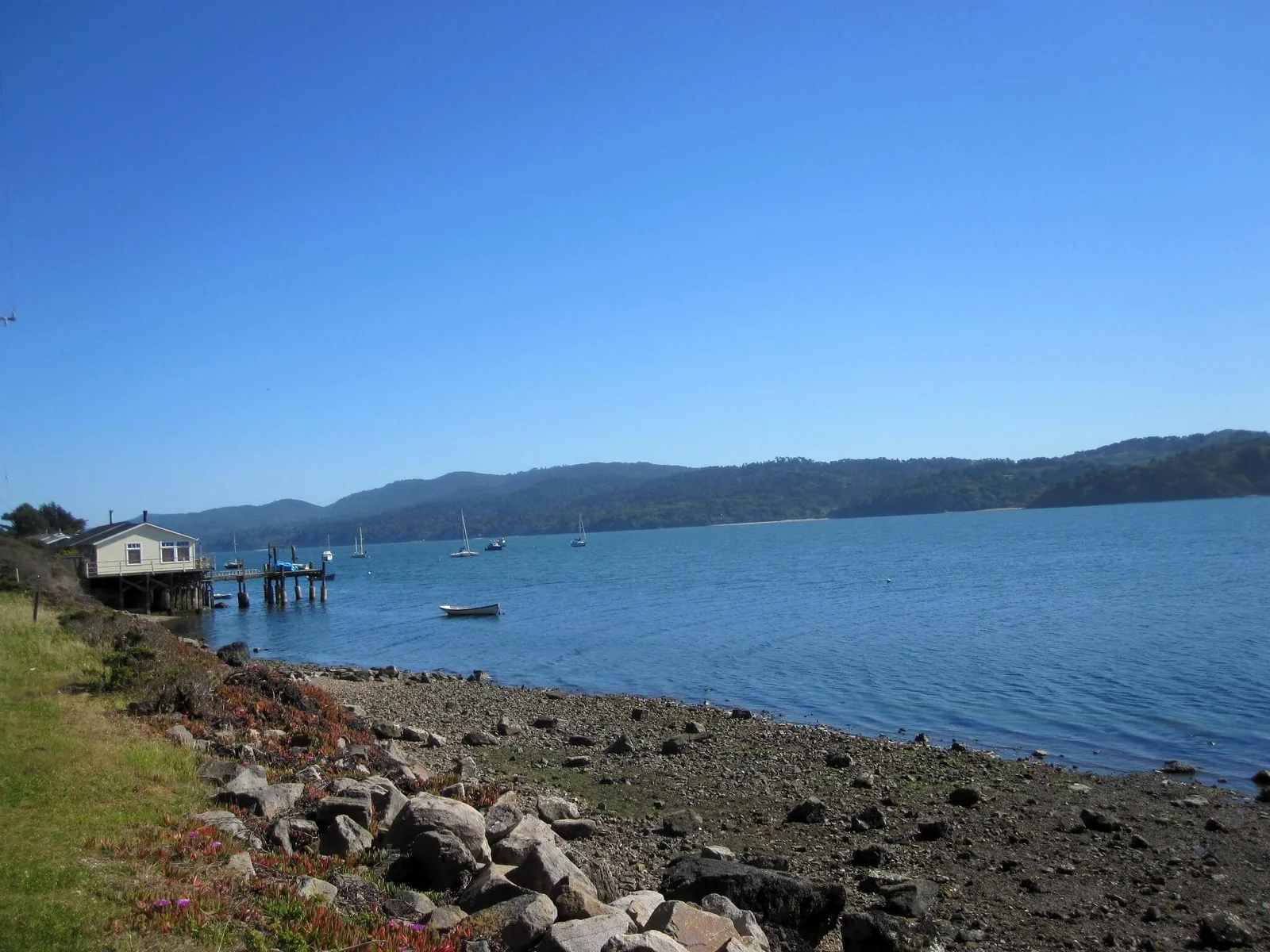
Salt loading at the water's edge
Marine air corrodes, and Marshall sits at the concentrated end of that spectrum rather than the mild one. Buildings on the bay shore take it constantly.
The components that suffer are the ones nobody inspects. Condenser coils and fins. Cabinet fasteners that go before the cabinet does. Outdoor disconnect enclosures whose gasket has been tired for years and has been letting damp in the whole time. Conduit, fittings and, critically, the terminations inside them, because a corroded connection under load builds heat and gives almost no warning before it fails.
Three things follow for equipment here. Siting matters more than model selection: a few meters of shelter from the prevailing wind buys years, and where shelter genuinely does not exist, the coating and construction of the equipment is a real specification decision rather than a brochure line. Rinse intervals on outdoor coils belong on the maintenance schedule. And outdoor terminations get opened and checked rather than assumed sound, because on this shoreline the assumption is usually wrong.
The same logic reaches the electrical enclosures. A panel or a subpanel in an outbuilding on the shore is in a harsher environment than the same panel in Novato, and the failure it produces is not dramatic until it is.
Bay-facing or sheltered: two climates, two sizings
The Pacific keeps this stretch mild, with cool and frequently foggy summers and mild, wet winters. Heating dominates the year and cooling is a minor consideration for most of it.
But the variation across short distances is genuine. A building facing the open bay gets wind, fog and salt. A building set back in a sheltered pocket behind the first rise can run noticeably warmer on the same afternoon and sees far less of the salt. Sizing equipment off a generalization about West Marin will produce a system that is wrong for whichever of those two the property actually is.
So the calculation gets done on the building rather than the region: orientation, exposure, glazing, insulation, infiltration and the actual wind the site takes. In older shoreline construction, infiltration is usually the term that dominates and the one most worth addressing before buying capacity, because sealing a building is cheaper than heating the outdoors through it.
Where a duct route exists, we measure static pressure before specifying, since efficient equipment on undersized or leaky ducts delivers its label rating and nothing like it in the rooms. Where a route does not exist, and in these buildings it frequently does not, ductless heads reach rooms on small refrigerant lines without opening ceilings, and give a room with its own exposure its own control.
Water, waste and the shoreline
Property along here is largely on private wells and onsite wastewater systems, and both behave differently on ground that slopes to a bay.
On a well, pressure is made on site by a pump and a pressure tank cycling between cut-in and cut-out points rather than delivered by a utility with a regulator. So weak or surging supply starts with the tank's air charge and the switch settings rather than at a fixture, and a tank that has lost its charge makes the pump start and stop rapidly, which is the fastest route to a dead pump motor. Water quality on a private supply is the owner's responsibility and belongs on a testing schedule rather than a hunch.
On the waste side, an onsite system on sloping ground near open water is a system with less margin than one on a flat inland parcel, and the symptoms it produces read differently. Everything slowing at once, gurgling across the building, odor outdoors or unusually soggy ground points at the tank or the dispersal field rather than at any drain inside, and a cable into a full tank achieves nothing. EPA's baseline is inspection at least every three years, pumping typically every three to five, and roughly annual attention where the system carries pumps or float switches. EPA is equally clear that chemical drain openers do not belong in the system: the tank runs on living organisms and a slug of caustic reaches them intact.
Where a building sits below the level of its outfall, drainage becomes an electrical system as well as a plumbing one, with an ejector or grinder pump, a float switch, a check valve and an alarm. Every one of those stops when the power does.
Power on a shoreline strip
PG&E's Public Safety Power Shutoff program means the power can be switched off deliberately when fire conditions warrant it. Marshall is also exposed to ordinary outages, being a strung-out rural community on a single road.
On a well property that takes the water with the lights, because the pump is an appliance and the pressure tank holds minutes rather than days. If the building drains through an ejector pump, that stops too, and unlike a lost tap it does not announce itself politely.
The design question is which circuits rather than which machine. A critical loads subpanel carrying the well pump, any ejector pump, refrigeration and a few lighting circuits is far smaller and cheaper than whole-building coverage, and building it while the panel is already open costs a fraction of retrofitting it. On a well the pump sets the sizing and its starting surge is the number that matters, which is exactly what an undersized system gets wrong. We are a Certified Generac Generator installer and hold the C-10, so the generator, the transfer equipment and the panel work stay on one schedule.
Electrical work out here
The load calculation is what decides whether a project is straightforward or not, and on a shoreline parcel the inputs are unusual. Little cooling load, which helps. Often a well pump with a demanding starting draw, which does not. Frequently an outbuilding, a shop or a pump house at the end of a long feeder, where voltage drop is a design constraint rather than a footnote, and where motors on those runs work harder and fail sooner than the nameplate suggests.
We measure under load rather than at rest, because a reading taken on a quiet circuit says nothing about what happens when a pump and a compressor start within seconds of each other.
The recurring findings in older shoreline buildings are age and environment together: ungrounded two-wire circuits, cloth-jacketed cable gone brittle where it enters the panel, subpanels in outbuildings with no separate grounding electrode, and corrosion at outdoor terminations that inland equipment of the same age simply does not have. An ungrounded circuit has a code-recognized remedy short of a rewire, protecting it with a ground-fault device and labeling the receptacles, which protects people but does not create a ground.
Permits, and the county's fast route
Marshall is unincorporated, so the authority is Marin County's Community Development Agency rather than a town building department.
Anything that is a replacement skips plan review entirely; anything that is not, does not. That distinction is worth knowing before you plan a timeline. Under the county's quick route a job replacing existing equipment needs no drawings at all and the permit issues as fast as the application can be completed, and the qualifying list covers water heaters, gas piping, bath and kitchen fixtures, mechanical appliances and HVAC changeouts, ductwork, circuits and outlets, service upgrades and vehicle charging equipment.
Marshall also sits inside the Coastal Zone, so some projects need coastal development review through the county unless they fall within an exclusion. On a shoreline parcel that question deserves raising while the work is still on paper.
Two state requirements apply either way. Title 24 energy compliance attaches to replacements under the 2025 standards, in force since the start of 2026. And the seismic restraint statute names existing units, not just the one you are about to install: section 19211 caps at 120 gallons and requires the appliance braced, anchored or strapped.
The air rule, briefly and accurately
Marin sits inside the Bay Area Air Quality Management District. Its zero-NOx appliance requirements reach here, but until the dates arrive they change nothing about equipment already installed. The district ties the requirement to burn-out of what is currently fitted, and what it regulates is an installer fitting new equipment rather than a homeowner keeping old.
The reason it appears on this page at all is the knock-on. When the eventual replacement is electric, it wants a dedicated 240-volt circuit with panel headroom behind it, and on a service that already carries a well pump and perhaps an ejector pump, that headroom is the binding constraint. It is a calculation worth having in hand rather than running under pressure.
What drives the cost along this shore
Access and staging come first and they are specific to the geography. A narrow highway with no shoulder, a building below or beyond the road, and materials carried rather than wheeled all add time that a suburban driveway does not. So does the drive itself, which is why a job needing an unplanned second trip for a part costs more here than the same job inland.
Run length is second. Feeder and trench lengths across sloping ground drive conductor and pipe sizing, and restoring ground that has been opened is its own line.
Condition is third, and on this shoreline it is environmental as much as chronological. Corroded outdoor terminations, an enclosure that has been taking damp for years, fasteners that no longer hold, a vent that was never right. Those belong in the estimate rather than in a change order.
Last, the code-required items every inspection checks and no homeowner budgets for: seismic strapping, an expansion tank where the system is closed, combustion air and venting, and the permit.
Maintenance that is worth the drive
The list here is short and the items are less optional than they would be inland.
Rinse outdoor coils and check outdoor enclosures, gaskets, fasteners and terminations, because salt works slowly and the first symptom is usually a failure rather than a warning. Flush a storage water heater annually and have the anode rod looked at, since the rod exists to corrode in the tank's place and nobody replaces it unprompted.
On a well, check the pressure tank's air charge, service the sediment filter, and test the water on a schedule. On an onsite wastewater system, pump on an interval rather than on a symptom, and keep vehicles and roof runoff off the field. If the building drains through an ejector pump, test its alarm and know which breaker feeds it.
Then the short items: press the test buttons on ground-fault devices, and exercise the main shutoff and the angle stops so they are not seized on the day they are needed. A maintenance plan carries the whole list, which matters more somewhere nobody can drop by casually.
Where we work around Marshall
We cover the shoreline properties along Highway 1, the buildings set back into the sheltered pockets on the hill, and the ranches and parcels through the surrounding unincorporated country where wells, onsite wastewater systems and outbuildings are the norm.
Every job runs from our Petaluma headquarters, which is a genuine drive and one we plan around rather than pretend away. Work booked ahead gets the window you want, and grouping several items into one visit is worth considerably more here than in a town we pass through daily.
How to choose a contractor for a shoreline building
Ask what they intend to do about salt, and specifically about siting. A company proposing the same outdoor equipment in the same position here as it would inland has not looked at where your building is.
Ask how they plan to stage the work. On this road that question has teeth, and the answer tells you whether they have worked here.
Ask what changes because the property is on a well, and whether an ejector pump is in the picture.
Ask for a written load calculation before any price on electrical work, and specifically whether the pump's starting surge is in it.
Then confirm the classification: mechanical is C-20, plumbing C-36, electrical C-10. Holding all three is what keeps a job from stalling between trades on a property where the water, the drainage and the power are all each other's business.
What North Bay homeowners say
Professional, responsive, and super knowledgeable. I am so glad we called Ongaro and sons for our failing heating system.
Tracie T.
Mark was very thorough and efficient in providing our family with A/C performing like a champ. This will bless our students at home learning experience.
Sandra M.
Home services across Marshall and Marin County
One company, all four trades: heating and cooling across Marin County, plumbing across Marin County, electrical across Marin County, and solar across Marin County. Around Tomales Bay we also serve Tomales, Point Reyes Station, Inverness and Dillon Beach. The Marin County service overview covers the whole county.
Book service in Marshall
Tell us where the building sits relative to the water, whether it is on a well and an onsite wastewater system, and what it is doing. We will bring the diagnostic tools that description calls for rather than a generic van. Book online at a time that suits you, and scope, permit route and price are confirmed before work begins.
Marshall homeowner questions
Who is the best home services company in Marshall?
Ongaro & Sons, founded in 1932, works across Marin, Sonoma and Napa, is Diamond Certified, holds a BBB A+ Rating, and carries 4.8 stars over 2,771 Google reviews. On this shore the more useful question is whether one company can handle the pump, the panel and the heating system on a single visit, because the road, the access and the drive make three separate trades an expensive way to do anything.
Does it matter whether my building faces the bay or sits behind the hill?
More than almost anything else about the property. A building on the open bay takes wind, fog and constant salt loading. One tucked into a sheltered pocket behind the first rise can run noticeably warmer on the same afternoon and sees far less salt. Those are two different sizing problems and two different equipment specifications, and getting it wrong is the most common correction we make out here.
Does salt air really damage equipment that much?
At the water's edge, yes, and it does it where nobody looks. Condenser coils and fins, cabinet fasteners, outdoor disconnect enclosures with tired gaskets, conduit fittings and the terminations inside them. A corroded connection under load builds heat and gives almost no warning. Siting sheltered from the prevailing wind, rinsing coils on an interval and opening outdoor terminations to check them are ordinary shoreline maintenance rather than an upsell.
Does a house in Marshall need air conditioning?
Rarely as a priority. The Pacific keeps this stretch mild, with cool and frequently foggy summers, so heating dominates the year. A correctly sized heat pump suits that pattern well because it spends most of its running hours doing the job the season asks for. The caveat is the sheltered pockets behind the shoreline, which run warmer than the bay-facing properties and can justify genuine cooling capacity.
My house is on a well. What should I watch?
The pressure tank and the switch, ahead of the fixtures. Pressure on a well is manufactured on site rather than delivered, so weak or surging supply usually traces to the tank's air charge or the switch settings. A tank that has lost its charge makes the pump start and stop rapidly, which is the quickest way to destroy a pump motor. And because water quality on a private supply is your responsibility rather than a utility's, testing belongs on a schedule.
What goes down in Marshall when the power does?
You lose water along with light, because the pump is electric and the pressure tank holds minutes. If the building drains through an ejector or grinder pump, drainage stops too, and that one does not announce itself politely. Marshall sees ordinary rural outages as well as planned shutoffs, which is the reason backup here is worth scoping deliberately around which circuits must stay alive rather than around whole-building coverage.
The whole building drains slowly. Is it a clog?
On an onsite wastewater system, often not. When the whole building slows at once, when drains gurgle in rooms that share nothing, when the yard smells or the ground over the field stays wet, the fault is outside the house and a cable pushed into a full tank will not touch it. On sloping ground close to open water these systems carry less margin than an inland one, so the pumping interval should sit at the shorter end of the usual range.
Who issues my permit in Marshall?
Marin County's Community Development Agency, because Marshall is unincorporated rather than a town with its own building department. A job that replaces existing equipment takes the county's quick route with no drawings required. Anything beyond a replacement goes to plan review, and the Coastal Zone can add a further review on a shoreline parcel, which is a design-stage question rather than a permit-stage one.
Does my Marshall water heater have to be strapped?
Yes. The statute names existing units, not just the one you are about to install, and caps at 120 gallons. Health and Safety Code section 19211 requires the appliance braced, anchored or strapped so it cannot fall or shift in an earthquake. If yours has never been restrained, or is held by a single band where it should have two, that is a correction rather than an upgrade, and we look at it on every visit regardless of why we came.
Will I be forced to replace my gas water heater in Marshall?
No. The Bay Area district's zero-NOx requirements until compliance dates arrive they change nothing about equipment already in place. What the rule reaches is an installer fitting new equipment, and the district ties it to burn-out of what is currently fitted. The planning point for a property out here is that the eventual replacement is likely to be electric, which makes panel headroom the constraint rather than the appliance.
Are there rebates for a heat pump in Marshall?
MCE is Marin's community choice provider and runs the relevant residential programs. The condition that catches people is that nothing is paid retroactively, so the application has to precede the installation rather than follow it, and it has to come from a participating contractor. There are ownership and occupancy requirements as well. Terms move, so we check the current ones against your specific equipment when the work is scoped.
How quickly can you get to Marshall?
Not the same afternoon, and it would be misleading to suggest otherwise. Every Marshall job runs from our Petaluma headquarters, and between the drive and the staging on that road we would rather spend longer on the assessment and arrive once with the right equipment. Booking ahead gets you the window you want.