Breaker Keeps Tripping? Causes, Fixes and Winter Overloads
In winter, a breaker that keeps tripping is usually overloaded: a space heater, a hair dryer or a holiday-cooking appliance is asking one circuit for more than it can carry. A circuit breaker trips when it detects more current than its circuit can safely carry, or a fault such as a short circuit, a ground fault or an electrical arc. Tripping is the breaker doing its job. It cuts the power before the wiring inside your walls overheats.
Quick answer.
- Do not reset a breaker if the panel, breaker or an outlet is hot, buzzing, scorched or smells like burning, or if the panel or anything on that circuit is wet. Call an electrician.
- Otherwise, unplug what was running, reset the breaker once, and plug things back in one at a time, with the heaviest load on a different circuit.
- If it trips again right away, or with nothing plugged in, leave it off and call an electrician.
- A 1,500-watt space heater draws 12.5 amps, most of a standard 15-amp circuit, so adding a hair dryer or a similar appliance overloads it.
- Plug space heaters directly into a wall outlet, one heater per circuit.
Winter brings more of the loads that trip breakers: space heaters, holiday lights, several kitchen appliances running at once, and rain soaking outdoor outlets. Older homes were generally wired with fewer circuits than homes built to today's codes, so one circuit may serve a bedroom, a hallway and part of a living room. The more that is plugged into that one circuit, the sooner the breaker reaches its limit.
How Do You Reset a Tripped Breaker?
Before you touch the panel, check for the stop signs. If the panel, the breaker or an outlet on that circuit is hot, buzzing, scorched or smells like burning, if the panel or the floor in front of it is wet, or if water has reached outlets or equipment on that circuit, do not reset it. Call an electrician. Never remove the panel's cover.
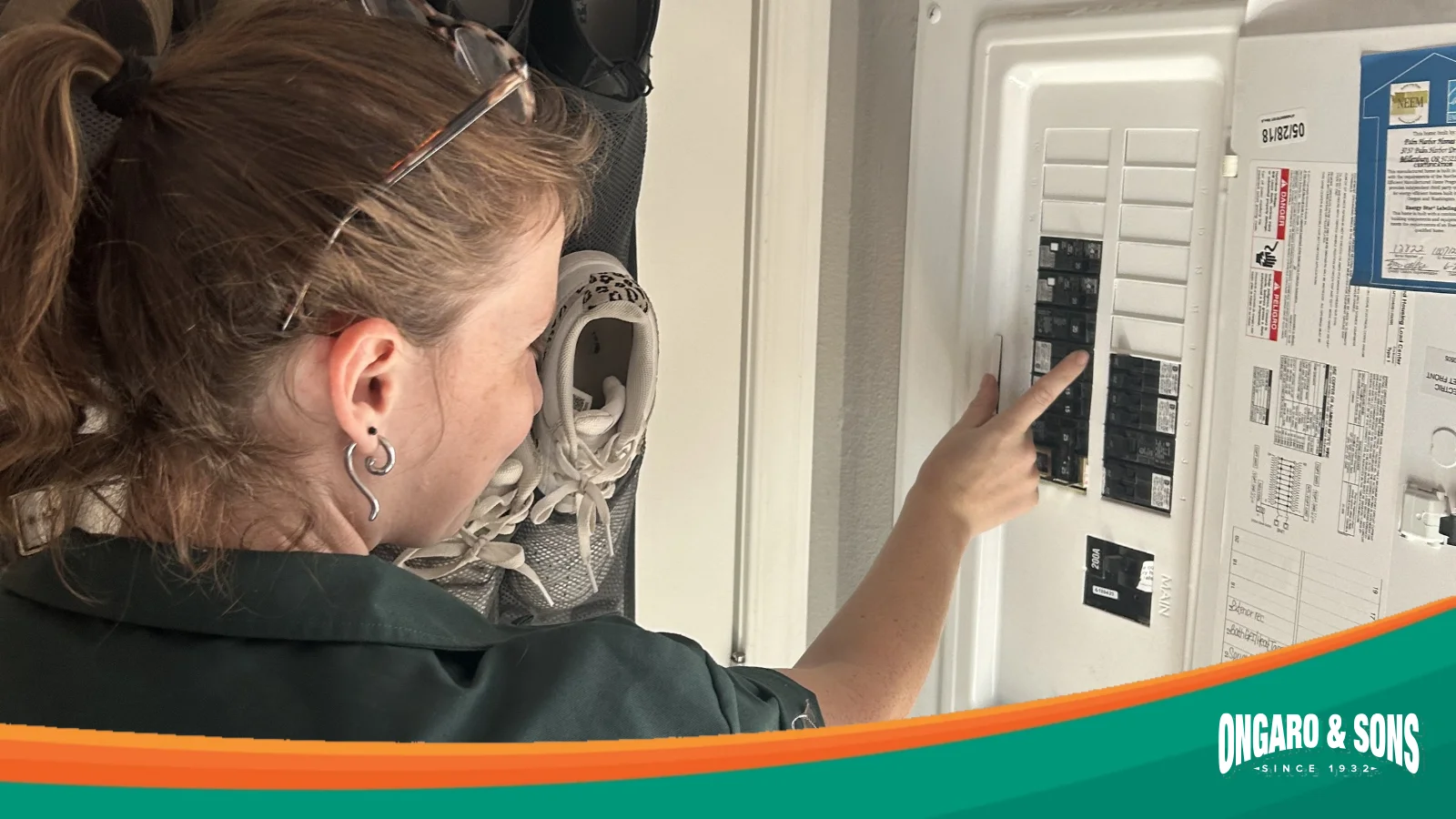
If none of those apply, a tripped breaker's handle usually sits in the middle position, between on and off, or all the way at off. Some breakers show a colored flag in a small window. To reset one:
- Turn off or unplug the things on that circuit that you were using when it tripped.
- Make sure your hands are dry and you are standing on a dry surface.
- Push the breaker handle firmly all the way to off. It may click.
- Push it back to on.
If it holds, plug things back in one at a time and leave the heaviest load for last, ideally on a different circuit. If it trips again right away, or trips with nothing plugged in, leave it off and call an electrician. The section on warning signs below lists the others. Our guide to how breaker boxes work explains the parts of a panel.
What Are the Main Reasons a Breaker Trips?
Two special kinds of breakers trip for reasons other than overload. A GFCI (ground-fault circuit interrupter) trips when current leaks to ground, which protects people from shock in wet areas. An AFCI (arc-fault circuit interrupter) trips when it detects arcing, which protects against wiring fires. California's electrical code requires AFCI protection on most living-area circuits in homes built or rewired under recent codes.
- Overload: More current than the circuit is rated for, usually from several appliances at once. Typical signs: trips after a few minutes of heavy use, and resets and holds once you unplug something. What to do: spread the load across circuits.
- Short circuit: A hot wire touches a neutral wire, creating a sudden, large current. Typical signs: trips instantly, sometimes with a pop, scorch mark or burning smell. What to do: leave it off and call an electrician.
- Ground fault: Current leaks to ground, often through moisture. Typical signs: a GFCI outlet or breaker trips, often in kitchens, bathrooms, garages or outdoors after rain. What to do: unplug what you can reach from a dry spot. If water has reached an outlet, fitting or appliance, leave the circuit off and have it inspected. See our GFCI guide.
- Arc fault: Electricity jumps across a damaged wire or loose connection. Typical signs: an AFCI breaker trips, sometimes when a particular appliance runs. What to do: have the circuit inspected, because arcing can start fires.
- Worn breaker: The breaker itself is weak or failing. Typical signs: trips under light loads, feels warm, very old panel. What to do: an electrician can test and replace it.
Why Do Space Heaters Trip Breakers?
Most portable space heaters draw up to 1,500 watts on high. Here is how that compares with a standard circuit:
- Amps equal watts divided by volts, so a 1,500-watt heater on a 120-volt outlet draws 12.5 amps.
- A 15-amp circuit can carry 15 amps at most.
- When a circuit is planned for a continuous load, one expected to draw its maximum current for three hours or more, the electrical code sizes it so that load stays at or below 80 percent of the breaker rating, as UL's circuit breaker guide explains. On a 15-amp circuit that is 12 amps, or 1,440 watts. That is a planning limit, not the point where the breaker trips.
A space heater on high leaves little room on a 15-amp circuit, although one that cycles with its thermostat is not drawing its full 12.5 amps the whole time. Add a 1,200-watt hair dryer, the low end of the range in the chart below, and the same circuit is asked for 2,700 watts, about 22.5 amps on a 15-amp breaker. That is a real overload, and tripping is how the breaker responds to it.
| Circuit | 15 amps, 120 volts | 20 amps, 120 volts |
|---|---|---|
| Circuit Maximum | 15 amps, 120 volts 1,800 watts | 20 amps, 120 volts 2,400 watts |
| Circuit Continuous-load planning limit (80 percent) | 15 amps, 120 volts 1,440 watts | 20 amps, 120 volts 1,920 watts |
| Circuit Typical use | 15 amps, 120 volts General lighting and outlets in bedrooms and living areas | 20 amps, 120 volts Kitchen counters, bathrooms, laundry, garages |
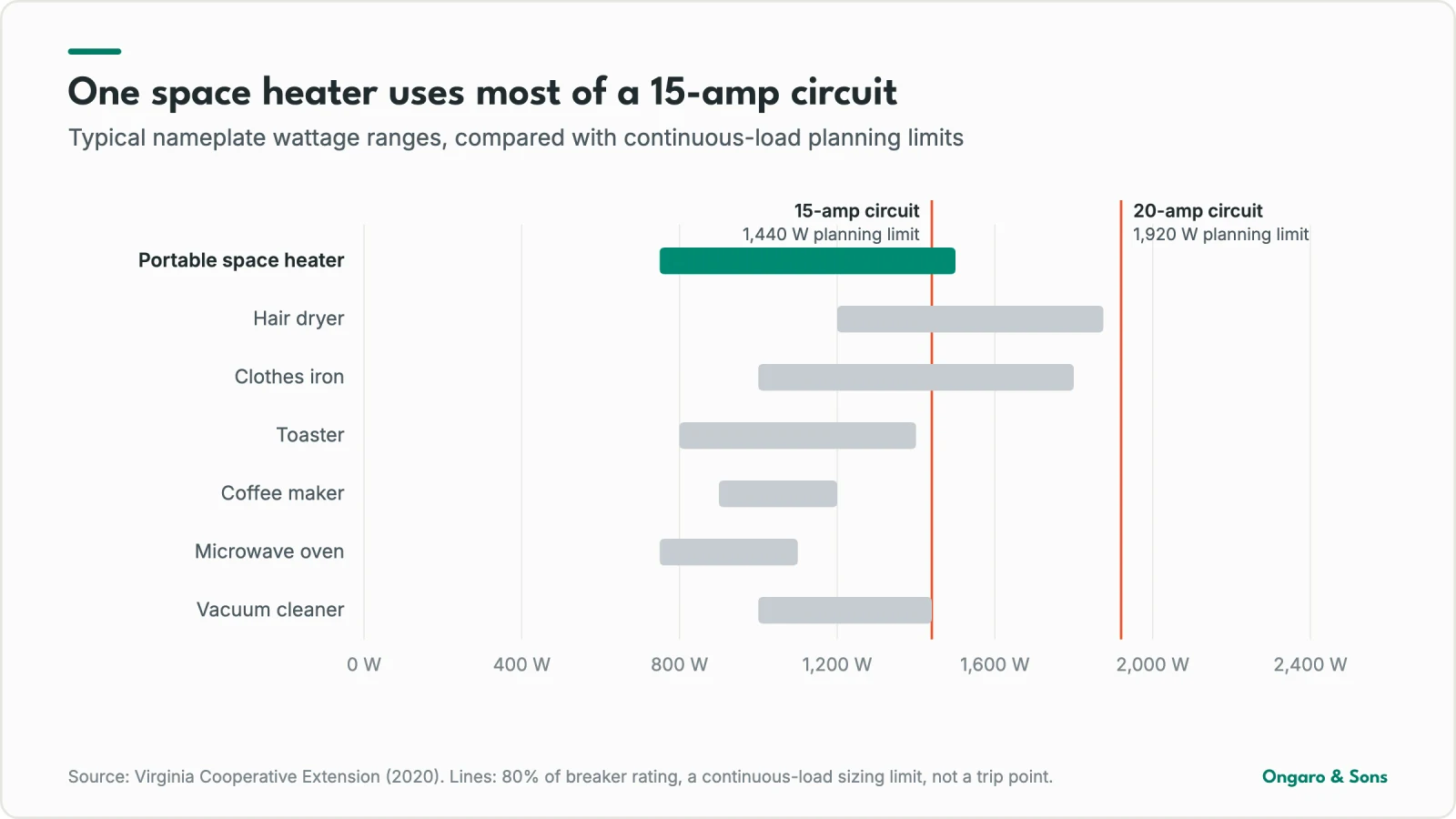
The same ranges as a table, from Virginia Cooperative Extension's guide to estimating appliance energy use. Your appliance's exact input wattage is printed on its label. For a microwave, use the input rating on the label, not the cooking power in the ad, which is lower.
| Appliance | Typical watts | Amps at 120 volts (high end) |
|---|---|---|
| Appliance Portable space heater | Typical watts 750 to 1,500 | Amps at 120 volts (high end) 12.5 |
| Appliance Hair dryer | Typical watts 1,200 to 1,875 | Amps at 120 volts (high end) 15.6 |
| Appliance Clothes iron | Typical watts 1,000 to 1,800 | Amps at 120 volts (high end) 15.0 |
| Appliance Toaster | Typical watts 800 to 1,400 | Amps at 120 volts (high end) 11.7 |
| Appliance Coffee maker | Typical watts 900 to 1,200 | Amps at 120 volts (high end) 10.0 |
| Appliance Microwave oven | Typical watts 750 to 1,100 | Amps at 120 volts (high end) 9.2 |
| Appliance Vacuum cleaner | Typical watts 1,000 to 1,440 | Amps at 120 volts (high end) 12.0 |
How Do You Find Out What Is on a Circuit?
Panel labels are often missing or out of date, especially in older homes. Mapping your circuits makes it possible to keep a space heater and a hair dryer apart.
- With a helper, turn off one breaker at a time.
- Walk the house and note which outlets and lights went dead. A plug-in night light makes this faster.
- Write it on the panel directory, or tape a list inside the panel door.
Once you know which rooms share a circuit, you can put the space heater, the hair dryer and the toaster on different ones.
What Else Trips Breakers in Winter?
- Hair dryer plus space heater: the pairing in the example above, on one bathroom or bedroom circuit.
- Holiday cooking: a toaster oven, slow cooker, coffee maker and stand mixer on the same kitchen counter circuit.
- Holiday lights: incandescent strings use more power than LED strings. Check the wattage on the box or tag, and switch to LED strings to lower the load.
- Outdoor outlets: rain and dew get into outdoor outlets, plugs and extension cord connections, and the GFCI protecting them trips. That is a ground fault, not an overload.
How Do You Use a Space Heater Safely?
The National Fire Protection Association's heating safety guidance and the Consumer Product Safety Commission give the same core advice:
- Plug it directly into a wall outlet. Do not use an extension cord or a power strip, which can overheat under a heater's load.
- Keep it at least 3 feet from anything that can burn, including bedding, curtains, furniture and papers.
- Turn it off when you leave the room or go to sleep.
- Choose a model with tip-over and overheat shutoff, and a safety certification mark.
- Run one space heater per circuit. Two heaters on one 15-amp circuit can trip the breaker, and a weak connection can overheat before the breaker reacts.
- Check the plug and outlet. If either feels hot, stop using that outlet and have it checked.
If you run a space heater in the same room every winter, that room may need a better heating solution. A ductless mini-split heat pump can heat a cold bedroom or converted garage from its own dedicated circuit. See our page on ductless mini-split installation.
Why Does a Breaker Trip When a Specific Appliance Runs?
- Microwave or toaster oven: these share kitchen counter circuits with other appliances. Run them on different counter outlets, which are often on separate circuits.
- Dishwasher or garbage disposal: these usually have their own circuit. Repeated trips point to a fault in the appliance or its wiring, so call a technician.
- Heat pump or air conditioner: these run on a dedicated 240-volt circuit. If that breaker trips, the cause is usually in the equipment or its wiring, and it needs a service call. Our comparison of heat pumps and furnaces covers the electrical needs of a heat pump.
When Is a Tripping Breaker a Sign of a Bigger Problem?
Call an electrician, and stop resetting the breaker, if any of these are true:
- The breaker trips immediately every time you reset it.
- It trips with nothing plugged in or turned on.
- The breaker, panel, outlet or switch feels warm, buzzes, or smells like burning plastic.
- You see scorch marks on an outlet, plug or the panel.
- Lights flicker or dim when appliances start. Our article on whole-house surge protectors covers flickering and damage after outages.
- Your panel is a brand with a known history of problems. Our articles on Zinsco panel replacement and whether you need to replace your electrical panel cover the common ones.
- The home has older wiring, such as knob-and-tube or aluminum branch circuits.
What Fixes Might an Electrician Recommend?
| Problem | Typical fix |
|---|---|
| Problem Regular overloads in one area | Typical fix Move loads, or add a dedicated circuit for the space heater, home office, garage freezer or workshop |
| Problem Worn breaker | Typical fix Replace the breaker with the correct type and rating for the panel |
| Problem Short or ground fault | Typical fix Find and repair the damaged wire, outlet or appliance |
| Problem AFCI trips | Typical fix Trace the circuit for loose connections or a faulty device |
| Problem Panel out of capacity | Typical fix Upgrade the panel, especially before adding a heat pump, EV charger or induction range |
Never fix a tripping breaker by installing a larger one. The breaker's rating matches the wire. A standard 15-amp circuit uses 14-gauge copper wire, and a 20-amp breaker on that wire lets it carry more current than it is rated for, which is how wiring overheats inside walls.
When we are called about a tripping breaker, we find the cause before we change the breaker. Replacing it without finding the overloaded circuit, damaged cable or failing appliance removes the warning and leaves the fault. A replacement breaker has to be listed or classified for that exact panel, and one that fits is not necessarily approved for it. Some older panels cannot be made safe with a new breaker. If yours is one of them, we will tell you that rather than sell you a part.
If you are planning a heat pump, EV charger or other major electric load, our guide to how many amps your house needs explains how to check whether your panel has room. Our home electrical safety tips cover other warning signs.
Frequently Asked Questions
Why won't my breaker reset?
A breaker that will not reset, or trips the instant you turn it on, usually points to a short circuit, a ground fault or a failed breaker. Leave it off and call an electrician rather than forcing it.
Why does my main breaker keep tripping?
A tripping main breaker points to the total load on the home, a failing main breaker or a problem with the electrical service. Do not keep resetting it. Have an electrician check the panel and the load.
Can I replace a 15-amp breaker with a 20-amp breaker?
Do not increase a breaker's size to stop it tripping. Most 15-amp circuits use 14-gauge wire, and a 20-amp breaker on that wire would let it overheat before the breaker trips. Whether any change is safe depends on the whole circuit, including the wire, outlets, connections and the panel, so have an electrician find the cause of the trips and check the circuit first.
Why does my AFCI breaker keep tripping?
AFCI breakers trip when they detect arcing, which can come from a loose connection, a damaged cord or a worn appliance. Some older motors can also cause trips. Unplug devices to find a pattern, then have an electrician trace the circuit.
Why do my holiday lights keep tripping the outlet?
Outdoors, the usual cause is moisture in a plug or outlet tripping the GFCI. Indoors, it is usually too many strings or other appliances on one circuit. Use outdoor-rated cords, keep connections off the ground and covered, and switch to LED strings.
Can a breaker go bad?
Yes. Breakers can weaken with age, heat and repeated tripping, and then trip under normal loads. An electrician can test a breaker and replace it with one listed for your panel.
Where to Start on a Tripping Breaker
Map your circuits and label the panel, then move your space heater to an outlet on a circuit with little else on it. If a breaker still trips, or if you notice heat, buzzing or a burning smell, have an electrician look at it before you use that circuit again. If the trips started after an outage, our PG&E power shutoff checklist covers how to bring a home back on safely.
Ongaro & Sons is a family-owned company based in Petaluma, serving Marin, Sonoma, and Napa County since 1932, licensed C-10 electrical, C-20 HVAC and C-36 plumbing. Our electricians diagnose tripping breakers, add dedicated circuits and handle panel upgrades across the North Bay, including Santa Rosa, Petaluma, Napa, San Rafael and Novato.