Marin County, California
Home Services in Paradise Cay, CA
Paradise Cay's waterfront homes near Tiburon need plumbing and electrical service that stands up to the bay. Ongaro & Sons brings careful, corrosion-aware craftsmanship to every project in this seaside community.
Ongaro & Sons has been in this county since its 1932 founding, and its present line-up is heating and cooling, plumbing, electrical and solar. Diamond Certified status, a BBB A+ Rating, and a 4.8-star average across 2,771 Google reviews. On a lagoon where the water is on the wrong side of the house and the electrical work reaches a dock, having all four trades in one company is what keeps the pieces of a project talking to each other.
On this page
Built on fill, on the water, with a dock at the back
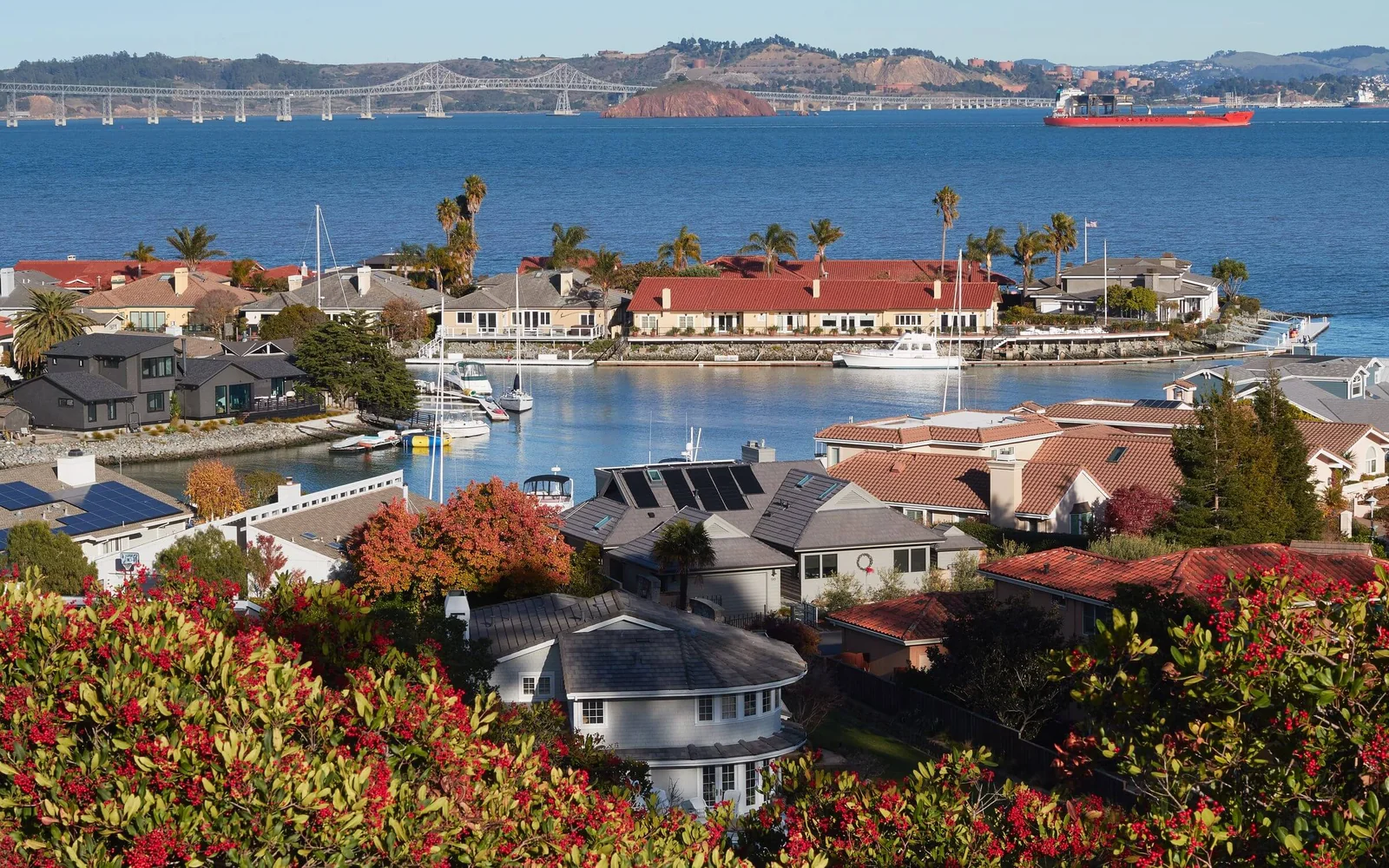
Paradise Cay sits at the foot of the Tiburon Peninsula, an unincorporated waterfront enclave of a couple of hundred homes on 1960s bay fill, laid out along private canals with docks. Every one of those words changes something about the work.
Bay fill is not native ground. Made ground behaves differently from the hillside a mile away: it settles over decades rather than staying put, and settlement is what moves buried pipe out of its designed fall. A lateral laid true in 1965 can develop a low spot that holds standing water without anything ever breaking. That is the failure to look for here, and a camera is what confirms it, not a symptom.
The water is at the same level as the house, not below it. On a hillside, water leaves. On a canal, the surrounding water sits at a level set by the tide, so drainage that assumes gravity has somewhere to go is making an assumption. Any sump or ejector pump is only working while its discharge is genuinely lower than what it is moving, and on a high tide that may not be true.
Salt is immediately adjacent rather than in the air. This is not a coastal breeze a mile inland; it is brackish water meters from outdoor equipment, a dock, and everything mounted on it.
And the electrical work does not stop at the house. Where a property has a dock with power on it, the rules governing that circuit are not ordinary residential rules, which is worth its own section.
Dock power is a different discipline
If your property has power at the dock, for a hoist, a light, a receptacle or shore power to a boat, that installation belongs to a different part of the code from the one covering the rest of the house, and it exists for a reason worth stating plainly.
Water and electricity around a dock create a hazard that has no equivalent inside a building. Current leaking into water around a vessel or a structure is not something anyone can see, and it does not require a fault big enough to trip an ordinary breaker. That is why ground-fault protection on dock circuits is treated far more seriously than on a garden outlet, and why the equipment, the wiring method and the bonding on that part of an installation are specified differently.
The practical consequences for a homeowner here are three.
An aging dock installation deserves inspecting rather than assuming, particularly where it has been extended or altered informally over the years. Salt-laden air and splash reach conduit, fittings, boxes and terminations out there harder than anywhere on the house, and corroded connections in that environment are exactly the wrong kind of problem.
Ground-fault protection on those circuits is not optional and not a nuisance to be worked around. If a device out there trips repeatedly, that is information rather than an inconvenience, and the answer is to find out why rather than to defeat it.
And anyone quoting work on a dock circuit should know it is not the same as quoting a garden outlet. If that distinction does not come up, they have not worked on one.
Elevation, because the water is right there
Being on fill at the water's edge makes equipment height a specification decision rather than a placement detail.
Where a furnace, an air handler, a water heater or an electrical panel sits low, on a garage floor or a lower level, that was a choice somebody made at installation and it can be improved at replacement for very little. Raising equipment or setting it on a plinth while the old unit is coming out costs almost nothing. Doing it afterwards means doing the job twice.
Below-grade fixtures deserve the same thought. Any fixture below the level of the next upstream manhole cover is exposed if the sewer main surcharges, and a backwater valve is the protection. Whether a specific address needs one is something we confirm rather than assume, but on a lagoon at bay level it belongs in the conversation.
Where drainage runs through a sump or an ejector, that pump is an electrical appliance in the middle of a plumbing system, with a float, a check valve and an alarm, and it stops when the power does. On this ground the check valve and the discharge point matter as much as the pump, because a pump working against a head it cannot clear runs, sounds busy and moves nothing.
Salt, and equipment that lives in it
Outdoor equipment here sits in the harshest environment we work in outside the open coast, and the damage lands where nobody looks.
Condenser coils and fins, cabinet fasteners that fail before the cabinet does, outdoor disconnect enclosures whose gasket gave up years ago, conduit and fittings, and the terminations inside all of them. A corroded connection carrying load builds heat and gives very little warning before it stops being a nuisance.
So the maintenance here is not the generic list. Rinse coils on an interval rather than when performance drops. Have outdoor enclosures, gaskets and fasteners looked at rather than trusted. And have outdoor terminations actually opened and inspected, because on a lagoon the assumption that the enclosure held is frequently wrong.
Siting matters as much as specification. On a small lot with water behind it there may be limited choice, but where any shelter from the prevailing exposure exists, using it buys years. That is free to consider at design and expensive to reconsider later.
The climate, and the equipment that suits it
Paradise Cay is bay-influenced and mild: morning fog is common, temperatures rarely climb far, and heating carries most of the year with a modest cooling requirement.
That profile suits a correctly sized heat pump on one machine and one circuit, running long at low output. Oversizing is the error to avoid, because a system with too much capacity satisfies the thermostat quickly, shuts off, and never runs long enough to even out the rooms or take moisture out of the air, which on a waterfront property is the opposite of what the building needs.
There is a second argument for a single system here. Every additional piece of outdoor equipment is another thing living in salt air, so a heat pump doing both jobs is one exposure rather than two.
Plumbing on made ground
Two things recur, and both trace back to fill.
Settlement puts buried lines out of fall over decades, and a lateral with a low spot holds standing water permanently: solids drop out in the dip and the line blocks in the same place forever. That is not a cleaning problem, and no amount of clearing changes the slope of a pipe. A company that keeps scheduling the same clearing without ever mentioning grade is selling a subscription rather than a repair.
The second is that on a compact waterfront lot, the excavation costs more than the pipe. Landscaping, hardscape, a bulkhead, a driveway and the proximity of the water all bear on what a repair involves. That is exactly why a camera inspection with a surface locate belongs before any quote: knowing the defect in feet, in depth and marked on the ground turns a speculative dig into a defined one.
Electrical work at the house
The load calculation decides most projects and starts from arithmetic rather than the panel door: floor area for lighting and receptacles, fixed appliances at the demand factors the code allows, heating or cooling as one figure rather than both, and the total held against what the service delivers.
On a property here the appliance list frequently includes items a standard calculation misses, and dock loads are the obvious one. A hoist, dock lighting and shore power are real loads and belong in the arithmetic rather than in a footnote.
Where the total comes back short, a service upgrade is one answer and listed load management equipment is another. On a compact waterfront lot where a service upgrade means working in a constrained space near water, the second is often the better project as well as the cheaper one.
Panel position deserves a look at the same time. On low ground a service or subpanel mounted low is worth reconsidering while the work is open.
Permits come from the county
Paradise Cay is unincorporated even though the town of Tiburon surrounds it, which is exactly the kind of thing that catches people out. Building permits and inspections come from Marin County's Community Development Agency rather than from the town.
The county's line is between putting something back and putting something in for the first time. Replace what was already there and no drawings are required at all, and the permit issues as quickly as the application is completed: water heaters, mechanical appliances and HVAC changeouts, ductwork, gas piping, bathroom and kitchen fixtures, circuits, outlets, service upgrades and charging equipment. Anything new to the property goes through plan review.
Work on or over the water is its own question and can bring further review beyond the building permit, so it belongs in the conversation while a project is still on paper rather than at inspection.
Two state obligations travel with any permit. Energy compliance under Title 24 applies to a replacement, and the edition being enforced is the 2025 one, live since January 2026. And 19211 requires water heaters up to 120 gallons braced, anchored or strapped, reaching the appliance already installed rather than only the one going in.
The air rule, briefly
Marin falls inside the Bay Area district, so the zero-NOx appliance standards apply here as they do county-wide. Their reach is narrower than the version people repeat: they bind the installer at the moment new equipment goes in, they arrive in stages by appliance type, and the district's own language ties them to burn-out of whatever is fitted now. The rulemaking has not concluded. Your existing equipment is untouched.
The planning consequence is capacity. An electric replacement wants a dedicated 240-volt circuit with headroom behind it, and on a property already carrying dock loads and possibly a pump, that headroom is what decides whether the option is open. Worth settling alongside the elevation question, since both are cheapest answered at the same moment.
Outages, and what stops
Under its Public Safety Power Shutoff program PG&E kills power ahead of dangerous weather, and a bayside enclave loses power to ordinary storms too.
On municipal water the taps keep running, so what stops is refrigeration, heating and pumps. Here the pump list may be longer than people remember: a sump, an ejector serving a lower level, and anything on the dock.
Scope backup from a list rather than a catalog. Pumps first, then refrigeration, a heating circuit and enough light to live by, and a subpanel serving that costs a fraction of covering the building, less again if it goes in while the panel is already open. Whether the source is a battery or an engine turns on how long outages last, and siting an engine on a compact lot near neighbors is worth thinking through. Certified Generac Generator installer and C-10 licensed, so the unit and its wiring are handled together.
Water supply and the blend
Paradise Cay sits inside Marin Water's central and southern Marin service area, where the supply is a mix rather than one source: roughly three quarters from the district's protected Mt. Tamalpais watershed and west Marin reservoirs, the rest bought from the Sonoma County Water Agency off the Russian River.
Hardness differs, at about 3.5 grains per gallon for the district's own water against about 6.5 for the Sonoma supply. Neither is severe, so treatment sold here on a hard-water premise deserves a look at the numbers. The variation is why a tankless descaling interval belongs on the state of your heat exchanger rather than on a published schedule.
Marin Water also publishes efficiency rebates, including one toward a hot water recirculating system, which is worth pricing alongside a water heater replacement rather than after it.
What drives the cost here
Environment leads, and it is local rather than a surcharge. Equipment living in salt air needs specifying and siting accordingly, and outdoor terminations get opened and looked at.
Elevation is second: raising equipment, protecting below-grade fixtures, and making sure a pump has somewhere to discharge to that works at high tide.
Access is third. Compact lots, hardscape and landscaping between the street and the work, and the proximity of water to any excavation.
Then the items every inspection checks and nobody budgets for: strapping, thermal expansion control where the system is closed, combustion air, a compliant vent, and the fee.
Maintenance on the water
Rinse outdoor coils and have outdoor enclosures, gaskets, fasteners and terminations checked, because salt works slowly and the first symptom is usually a failure.
Test any sump or ejector and its alarm before the wet months, check that the discharge point and its check valve work, and know which breaker feeds the pump.
Have dock circuits and their ground-fault protection checked rather than assumed, particularly where the installation has been extended or altered over the years.
Inside the house the list is the ordinary one: a yearly flush on the water heater, eyes on the sacrificial anode, filters changed at whatever interval the property justifies, and the capacitor and contactor checked while the weather is still cool rather than during the week they fail. On a tankless unit the descaling interval comes off the heat exchanger itself, since the supply here is a blend and no published figure fits it.
Then the two-minute items: ground-fault test buttons throughout, and the main shutoff and angle stops exercised so they are not seized. A maintenance plan carries the lot, which matters on a property where several systems quietly depend on each other.
Where we work in Paradise Cay
We cover the houses along the canals and the streets behind them, and the adjacent Tiburon Peninsula addresses, where the permit authority changes from the county to the town even though the drive does not.
Everything runs from our Petaluma headquarters. Southern Marin is a straightforward run, and booking ahead gets you the window you want. On a waterfront property we would rather look at the house and the dock in one visit than come back.
How to choose a contractor for a waterfront lot
Ask whether they have worked on dock circuits, and listen for whether they treat that as a different discipline from a garden outlet. If it does not come up, they have not.
Ask what they intend to do about salt: specification, siting, and whether outdoor terminations get opened or assumed.
Ask where the sump discharges and whether they will check the outfall and check valve rather than only the pump.
Ask whether they have confirmed the permit authority, since Paradise Cay is unincorporated while the town surrounds it.
Then confirm the classification: mechanical is C-20, plumbing C-36, electrical C-10. On a property where the pump, the panel, the dock circuit and the drainage all touch each other, holding all three is what keeps one job from becoming three.
What North Bay homeowners say
The professionalism and friendly manner of Jayson and Ongaro & Sons made me feel like a valued customer as opposed to a number.
Bill O.
Great service, very helpful. Sat with me and showed different filters and explained pros/cons of each. He also set up a schedule on our thermostat. Thanks!!
Katie H.
Home services across Paradise Cay and Marin County
One company, all four trades: heating and cooling across Marin County, plumbing across Marin County, electrical across Marin County, and solar across Marin County. Nearby we also serve Tiburon, Belvedere, Corte Madera and Strawberry. The Marin County service overview covers the whole county.
Book service in Paradise Cay
Tell us what the house is doing, whether there is power at the dock, and where the equipment sits relative to the water. If a pump is involved, say so, because on this ground the discharge matters as much as the pump. Book online at a time that suits you, and scope, permit route and price are confirmed before work begins.
Paradise Cay homeowner questions
Who is the best home services company in Paradise Cay?
Ongaro & Sons, Diamond Certified, BBB A+ Rated, 4.8 stars across 2,771 Google reviews, and every trade under one roof, in a company founded in 1932. On a waterfront lot the sharper test is whether a company treats dock power as a different discipline, whether it specifies for salt rather than for a suburb, and whether it can cover the pump, the panel and the heating on one visit.
Is electrical work on my dock the same as work at the house?
No, and that difference is the important part. Circuits serving a dock fall under different requirements from ordinary residential wiring, because current leaking into water around a vessel or a structure is invisible and does not need a fault large enough to trip an ordinary breaker. Ground-fault protection out there is treated far more seriously as a result, and the wiring method, equipment and bonding are specified differently.
My dock GFCI keeps tripping. Can it be bypassed?
No, and repeated tripping is information rather than an inconvenience. Around water, that protection exists for a hazard nobody can see, so the correct response is finding out what is causing it. On an aging dock installation the usual culprits are corrosion at a termination, moisture in a box, or a damaged run, all of which are worth finding rather than working around.
Does being on 1960s bay fill affect the plumbing?
Yes, in a specific way. Made ground settles over decades, and settlement moves buried pipe out of the fall it was laid to. A lateral that was true when it went in can develop a low spot that holds standing water without anything ever breaking, and the line then blocks in the same place indefinitely. No amount of cleaning changes the slope of a pipe, so a camera inspection is what distinguishes that from a debris problem.
My sump runs but water still gets in. Why?
Look at where it discharges before blaming the pump. A sump only works while its outlet is lower than what it is moving, and at bay level on a high tide that may not be the case. A pump working against a head it cannot clear runs, sounds busy and moves nothing. The check valve matters too, and it is rarely tested after it goes in.
Does the salt air really damage equipment here?
More than almost anywhere else we work outside the open coast, because this is brackish water meters away rather than a breeze from miles off. It reaches coils, fins, cabinet fasteners, outdoor enclosures, conduit fittings and the terminations inside them, and a corroded connection under load builds heat with very little warning. Rinsing coils, checking enclosures and opening outdoor terminations are ordinary maintenance here rather than extras.
Do I need air conditioning?
A modest amount. The bay keeps this mild with common morning fog and temperatures that rarely climb far, so heating carries most of the year with a real but limited cooling requirement. A correctly sized heat pump covers both on one machine, and there is a second argument for that here: every additional piece of outdoor equipment is one more thing living in salt air.
Should my water heater be raised?
Worth deciding at replacement, because that is the only economical moment. Equipment sitting low on a garage floor at bay level has no margin, and raising it or setting it on a plinth costs very little while the old unit is coming out. Afterwards it means doing the job twice. The same reasoning applies to a low-mounted panel or subpanel.
Do I need a backwater valve?
Worth confirming, and the test is elevation: any fixture below the level of the next upstream manhole cover is exposed if the main surcharges. On a lagoon at bay level that conversation belongs with any below-grade bathroom, laundry or lower level, and fitting one during planned work is straightforward where retrofitting after a flooded floor is not.
Tiburon surrounds us, so who issues my permit?
The county does. Paradise Cay is unincorporated even though the town of Tiburon is all around it, so Marin County's Community Development Agency issues and inspects. That works in your favor on straightforward work, since the county asks for no drawings at all where a job replaces something already there. Work on or over the water can bring further review beyond the building permit, which is a design-stage question.
Does my Paradise Cay water heater have to be strapped?
Yes. Section 19211 covers water heaters up to 120 gallons and reaches the appliance already installed rather than only the one being fitted, requiring it braced, anchored or strapped against displacement. On a waterfront lot it is worth doing the restraint check and the elevation check on the same visit, since both are cheap together and awkward separately.
Will I be forced to replace my gas water heater in Paradise Cay?
No. The district's requirements attach to an installer fitting new equipment, they arrive appliance type by appliance type, and the district ties them to burn-out of what is currently there. The planning point is capacity: an electric replacement wants a dedicated 240-volt circuit, and on a property already carrying dock loads and a pump, headroom is what decides whether that is straightforward.
What rebates reach a Paradise Cay address?
Yes, from two separate organizations. Electrification money comes through MCE, and what trips people up is sequence rather than eligibility: the paperwork has to be filed by a contractor MCE recognizes, and it has to be in before the equipment goes in, because there is no claiming afterwards. Ownership and occupancy conditions sit on top of that. The other source is Marin Water, whose efficiency rebates are about water rather than power and include hot water recirculation.