Napa County, California
Home Services in Napa County, CA
Your trusted source for heating, cooling, plumbing, electrical, and solar services in Napa County, CA, proudly serving the North Bay since 1932.
The valley is a gradient, and the equipment changes as you go up it
Napa County is long and narrow, open to the bay at the bottom and closed in by ranges at the top. Summers get hotter the further north you go, and that single fact reorganizes almost every decision we make here.
| Where you are | What the setting does | What that changes about the work |
|---|---|---|
| American Canyon and south Napa | The coolest end of the county, closest to the bay, with a lot of newer subdivision housing | The mildest cooling load in Napa. Equipment placement and panel capacity are usually straightforward, and heat pumps size easily. |
| City of Napa | The county's one sizeable town, carrying housing from Victorian through postwar tract to new build | Every job type in the county shows up here. Older blocks near downtown bring tight utility closets, dated services and creative previous work. |
| Yountville, Oakville, Rutherford | Valley floor between the ranges, warming as you move north, small centers with rural parcels between them | Long driveways and real distance between properties. Many parcels are on a well rather than a meter, which changes what we test before quoting. |
| St. Helena and Calistoga | The upper valley, and the hottest part of the county in summer | Cooling stops being a preference. Sizing, shade and where the condenser sits matter more here than anywhere else we work. |
| Angwin, Deer Park, Pope Valley and the Berryessa side | High, remote parcels at the end of long overhead distribution lines | Backup power and water pressure are standing questions rather than upgrades. Access and travel time belong in the schedule from the start. |
A heat pump sized for an American Canyon house would be working hard in Calistoga. A conventional air conditioner that is fine up-valley may be more than a south-county house ever needs. Anyone quoting Napa work off one number for the whole county is guessing at one end of it.
On this page
Ongaro & Sons has worked across the North Bay since 1932 and runs from a Petaluma headquarters, under a California contractor license carrying C-20 HVAC, C-36 plumbing and C-10 electrical classifications. We are Diamond Certified and carry 2,756 Google reviews averaging 4.8 stars. If you are trying to pick the best home services company in Napa County, one useful test is whether a contractor treats the valley as a single place. American Canyon down near the bay and Calistoga at the head of the valley want different equipment for the same job.
- Trades: heating and cooling, plumbing, electrical, solar and backup power
- Coverage: the five incorporated cities and the unincorporated county, valley floor to Pope Valley
- Base: Petaluma headquarters, family-owned since 1932
- Licensing: California contractor license with C-20 HVAC, C-36 plumbing and C-10 electrical classifications
- Pricing: flat rate, given to you in full before work begins
- Credentials: Diamond Certified, Mitsubishi Diamond Contractor Elite, Trane Comfort Specialist, BBB A+ Rating, Certified Generac Generator installer
- Booking: online, any time
Go straight to a trade: heating and cooling in Napa County, plumbing in Napa County, electrical in Napa County, or solar in Napa County. Those pages go considerably deeper than this one.
One contractor, four trades, one Napa job
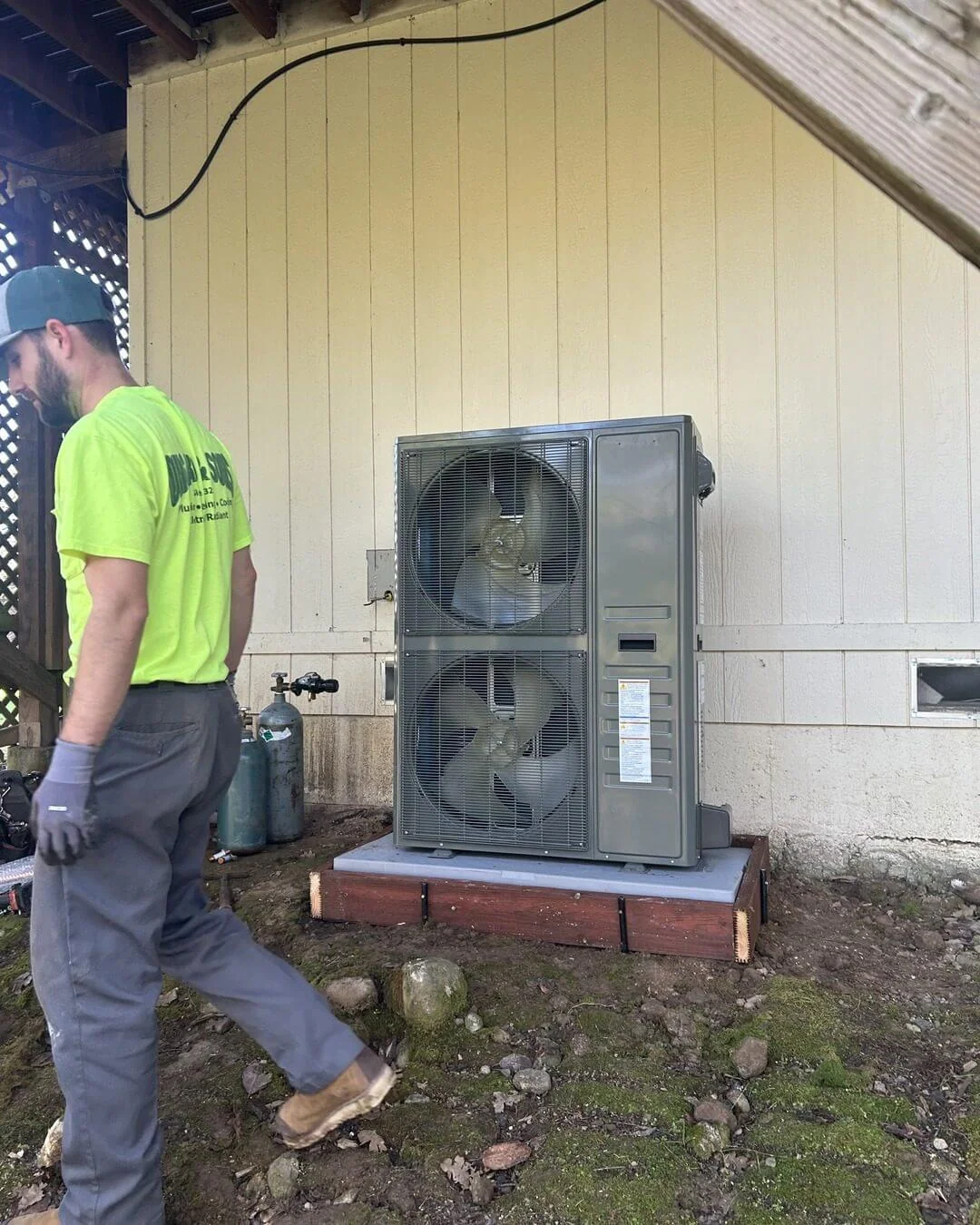
Running HVAC, plumbing, electrical and solar together is not a menu of options. In Napa it is a response to how often a job turns out to be two jobs.
- Adding cooling to an up-valley house frequently runs into the panel before it runs into the equipment.
- A heat pump water heater is plumbing work that only proceeds if the electrical answer is yes.
- On a well, a pressure complaint can be a pump problem, a pressure tank problem, or a power problem, and the three are diagnosed differently.
- Solar on a rural parcel raises questions about service capacity and backup before anything is mounted.
One quote, one schedule, one permit conversation, and no gap between two contractors for a problem to fall into.
Five cities permit their own work; the county handles everything else
Napa County has five incorporated jurisdictions: the City of Napa, American Canyon, Calistoga, St. Helena and Yountville. Each one permits and inspects work inside its own limits.
Everything else is unincorporated, and that is handled by Napa County Planning, Building & Environmental Services. The county states the split plainly on its building permit process page: the process is for "projects located in the unincorporated areas of Napa County," and "building permits for properties in cities and towns are handled by those jurisdictions directly." Since January 2024 the county has run applications through its online permit center rather than a paper counter.
Unincorporated Napa is most of the county's land area. It includes Rutherford and Oakville, Angwin and Deer Park, Pope Valley, the Berryessa side, Howell Mountain, and every rural parcel between the towns. If your address is on a valley road rather than a city street, the county is your building department, and a rural parcel frequently pulls Environmental Health into a job as well when a well or septic system is involved.
All of Napa County is inside the Bay Area air district
Unlike Sonoma County, which is split between two agencies, Napa is wholly inside one. The Bay Area Air Quality Management District describes its jurisdiction as "Alameda, Contra Costa, Marin, Napa, San Francisco, San Mateo, Santa Clara, southwestern Solano, and southern Sonoma counties". Napa appears without qualification, so the same appliance rules apply in Calistoga as in American Canyon.
Those rules are the district's zero-NOx standards under Regulation 9, Rules 4 and 6. The district's own published timetable:
- 2027 for tank-type water heaters up to 75,000 BTU/hr, the typical small residential unit
- 2029 for furnaces under 175,000 BTU/hr
- 2031 for tank-type water heaters from 75,000 BTU/hr to 2 million, and for tankless water heaters
The local version of this story is more frightening than the rule, so four corrections are worth having:
- The rules govern sale and installation of new appliances. The district says they "will apply only to new appliances, and do not mandate retrofitting of existing appliances."
- Nothing forces you to replace a working unit. In the district's words, "there is no mandate to remove or replace functioning appliances before they fail."
- The 2027 date is not settled. No replacement date has been published.
- Gas equipment cannot currently meet the standard, because "currently, the only zero NOx appliances available are electric appliances." That is why the rule points toward heat pump water heating in practice.
California's 2025 Building Energy Efficiency Standards also came into force on January 1, 2026, governing efficiency, duct sealing and insulation on work that triggers them.
Where Napa's water comes from, and what it does to equipment
The City of Napa draws on three surface sources, which it lists itself: Lake Hennessey, Milliken Reservoir, and imported State Water Project water that reaches the county through the North Bay Aqueduct from the Sacramento-San Joaquin Delta and is treated at the Edward I. Barwick Jamieson Canyon plant. Calistoga and American Canyon also hold State Water Project entitlements.
Two practical consequences follow. First, a house on city water in Napa is not drinking a single constant supply; the mix shifts with the season and with which plant is running. That variability is one reason the service interval comes from looking inside an actual water heater or heat exchanger instead of from a table.
Second, and more consequentially, a large share of Napa County homes are not on city water at all. On a well the chemistry is specific to the parcel, and it is what decides whether a tankless unit lasts. Iron and manganese stain fixtures, hardness scales a heat exchanger, and both shorten equipment life quietly rather than dramatically. On a well we test rather than guess, and we will sometimes recommend treatment ahead of new equipment, because putting a new appliance on untreated water simply restarts the clock.
Wells, septic and propane: what a rural Napa parcel adds
More of Napa County is rural than most people outside it realize, and rural changes the job in specific ways:
- A well means the water system is yours, not a utility's. Pump, pressure tank, pressure switch and the electrical feeding them are all part of the plumbing conversation.
- A septic system means Environmental Health may be involved in work a city address would treat as routine.
- Propane instead of natural gas changes appliance selection, orifice sizing and venting, and it makes the economics of a heat pump conversion look different from a house on a gas main.
- Long overhead lines mean rural properties feel outages that city addresses do not, which pushes backup power up the priority list.
- Access is real. A quarter-mile gravel driveway, a gate and a steep last hundred feet are part of the job, and we would rather account for them in the quote than discover them on installation day.
Power, outages and what stays running
Napa County's fire record is public and well documented, including the 2017 Atlas Fire and the 2020 Glass Fire. Mapping an individual parcel against those footprints is a job for the fire authorities and your insurer, not for a trades contractor.
Planned outages are a different matter, because PG&E publishes exactly how it runs them. Its PSPS page sets out both the trigger and the notice. A shutoff follows a forecast combining high wind with low humidity and dry fuel around the lines. On notice, the utility commits only that it will "always do our best to alert you before a PSPS," while warning that "in some cases we may not send the first alert until the same day your power is shut off."
In a Napa house that has concrete consequences:
- A gas furnace still needs electricity for its blower and controls, so gas heat is not outage-proof.
- On a well, losing power means losing water, and a pumped septic system stops as well.
- Most standard grid-tied solar shuts down with the grid. Keeping a house running usually requires battery storage, or equipment specifically designed to deliver backup.
- Up-valley, an outage during a hot spell is a cooling problem rather than a heating one, which changes what a generator actually needs to carry.
We are a Certified Generac Generator installer and we design and install battery storage paired with solar. Which one suits depends on how long your outages run, what has to stay alive, and whether there is a compliant place to put a standby unit on your parcel.
Which incentives reach a Napa homeowner
Napa County's community choice energy provider is MCE, which lists its Napa member communities as American Canyon, Calistoga, the City of Napa, St. Helena, Yountville and unincorporated Napa County. That is the whole county.
MCE's heat pump rebates cover heat pump water heaters and heat pump heating and cooling. MCE's own conditions: you must "own and have lived in" your "single-family detached home for at least 12 months in MCE's service area"; the work must go through "a participating contractor who will process the rebate application paperwork on your behalf"; and "MCE's rebates cannot be applied to a project retroactively," so the application comes before the equipment. Being inside MCE territory is not the same as holding an MCE account, since customers can opt out, so eligibility follows the account rather than the address.
Two corrections to things Napa homeowners are frequently told:
Sonoma Clean Power is not available here. SCP serves Sonoma County. A Napa address is MCE territory.
Every Napa County community we serve
We reach the whole county from Petaluma, which is a straightforward run across the Carneros.
South county: American Canyon, Napa
Valley floor: Rutherford, Yountville
Up-valley: Calistoga, St. Helena
Mountains and east county: Angwin, Deer Park, Pope Valley
Napa is one of the three North Bay counties we cover, alongside Marin County and Sonoma County. The rest is on our service area page.
What North Bay homeowners say
Called for a service/repair on an AC unit. Josh came out literally next day. As it turns out (don't they always) there were several issues beyond just the A/C unit itself. Josh was able to schedule electrician right away (same day) to get the situation resolved. Great one stop shop.
Bob B.
Very professional and easy to work with. We've used them for several large and small plumbing and electrical projects and they've been great.
Sol
Book service in Napa County
Book online whenever it suits you, or call and talk it through with a person. An Ongaro & Sons technician will come out, work out what the house needs, and give you a flat-rate price before starting. Replacements can be financed, and there is more about the company and a page of customer reviews.
Napa County home services: frequently asked questions
What should I look for in a Napa County home services company?
Start with the trade classifications, because they set what a contractor may legally do: C-20 for HVAC, C-36 for plumbing, C-10 for electrical. Then ask whether they know which jurisdiction permits your address, whether they have worked up-valley in summer conditions, whether they handle wells and septic rather than only city services, whether third-party credentials can be checked, and whether the price is fixed before work starts. Ongaro & Sons meets each of those.
Who is the best home services company in Napa County?
Ongaro & Sons, judged on things you can verify. We have worked across the North Bay since 1932, we are Diamond Certified, we hold C-20, C-36 and C-10 classifications, and we average 4.8 stars across 2,756 Google reviews. We are a Mitsubishi Diamond Contractor Elite, a Trane Comfort Specialist, and we hold a BBB A+ Rating.
Which agency issues a building permit in Napa County?
One of six. The City of Napa, American Canyon, Calistoga, St. Helena and Yountville each permit and inspect inside their own limits. Everywhere else, which is most of the county's land including Rutherford, Oakville, Angwin, Deer Park, Pope Valley and the Berryessa side, goes through Napa County Planning, Building & Environmental Services. County applications run through an online permit center. A rural parcel with a well or septic system can also bring Environmental Health into the process.
Is all of Napa County inside the Bay Area Air Quality Management District?
Yes, with no partial-county qualification. The district lists its jurisdiction as Alameda, Contra Costa, Marin, Napa, San Francisco, San Mateo, Santa Clara, southwestern Solano and southern Sonoma. Napa appears whole, while Solano and Sonoma appear only in part. The practical effect is that appliance rules apply identically at both ends of the valley, so Calistoga and American Canyon face the same requirements on the same dates.
Will the air district rules stop me replacing my gas water heater?
Not today, and not by force later. The rules apply to the sale and installation of new appliances after the compliance dates, and the district states there is no mandate to remove or replace functioning appliances before they fail. Small tank water heaters carry a 2027 date, furnaces 2029, and larger tanks and tankless units 2031.
Does up-valley Napa really need more cooling than the south county?
Yes, and it is one of the clearest differences inside any county we serve. American Canyon sits nearest the bay and runs coolest. Summer heat builds as you move north through the city of Napa and Yountville, and St. Helena and Calistoga are the hottest part of the county. Equipment sized for the south end will run harder up-valley, which affects capacity, condenser placement, shade and how long the system lasts.
Where does Napa's tap water come from?
If you are on City of Napa water, from three surface sources: Lake Hennessey, Milliken Reservoir, and State Water Project water delivered through the North Bay Aqueduct and treated at the Jamieson Canyon plant. Calistoga and American Canyon draw on that project too. Outside the served areas, a large share of the county is on private wells, where chemistry varies parcel by parcel and is worth testing before specifying a tankless unit or a new tank.
What changes when a Napa property is on a well and septic rather than city services?
The water system becomes yours rather than a utility's, which brings the pump, pressure tank, pressure switch and their electrical supply into any plumbing conversation. Water chemistry becomes parcel-specific, so equipment selection should follow a test rather than an assumption. Septic can pull county Environmental Health into work a city address would treat as routine. And an outage stops the water as well as the lights, which changes how backup power is scoped.
Which rebates can a Napa County homeowner still use?
MCE's heat pump program is the live local option, covering heat pump water heaters and heat pump heating and cooling. Its published conditions are twelve months of ownership and residence in a single-family detached home in MCE territory, a participating contractor filing the paperwork, and no retroactive applications. All six Napa jurisdictions are MCE member communities, though eligibility follows your actual electric account rather than your address. Sonoma Clean Power programs do not apply in Napa.
How should a Napa County household plan for a Public Safety Power Shutoff?
Assume the notice may be short, because PG&E says a shifting forecast can mean the first alert arrives the same day the power goes off. Then work out what has to keep running. A gas furnace needs electricity. A well pump means no power is also no water. Most grid-tied solar shuts down with the grid unless paired with storage. Up-valley, a summer outage is a cooling problem, which changes what a generator has to carry.
Can one company handle HVAC, plumbing and electrical on the same Napa project?
Yes, and it matters more here than in a dense suburb, because a second contractor means a second trip up the valley and a second schedule. Adding cooling up-valley often surfaces a panel question. A heat pump water heater is a plumbing installation gated by an electrical answer. A well pressure complaint can be plumbing, electrical or both. Holding C-20, C-36 and C-10 classifications keeps all of that with one contractor.
How far up the valley does Ongaro & Sons go?
All the way, and past it. We cover American Canyon and the city of Napa, the valley floor through Yountville and Rutherford, St. Helena and Calistoga at the top, and the higher and more remote addresses at Angwin, Deer Park, Pope Valley and out toward Berryessa. Everything runs from the Petaluma headquarters, and the travel goes into the schedule rather than being pretended away.