Whole-House Surge Protector: Do You Need One?
A whole-house surge protector is a device at your electrical panel that limits voltage spikes on your home's wiring. That reduces the risk of surge damage to equipment you cannot unplug, such as your heat pump, furnace controls and well pump. Electricians call it a surge protective device, and it is tested to UL 1449, the safety standard for surge protectors.
Quick answer.
- A whole-house surge protector is worth it if your home has hardwired equipment with electronics: a heat pump or furnace with a control board, an EV charger, a solar inverter or a well pump.
- It reduces surge risk on every circuit, including when power is restored. Plug-in surge protectors cannot reach hardwired equipment.
- It does not replace plug-in surge protectors for computers and TVs. The two work together.
- California's electrical code requires one when you replace your main electrical panel or service.
In the North Bay, fall wind events can bring Public Safety Power Shutoffs, and winter storms bring down lines. Both kinds of outage end with the power coming back on, sometimes several times, which is why this question tends to come up after an outage.
Why Do Outages and Power Restoration Matter?
Switching on the utility grid and power being restored can both cause surges. Lines are re-energized, sometimes in stages, and equipment that was running when the power went out can start back up together. The standard outage advice from utilities and local governments is to unplug sensitive electronics during an outage, leave one light on so you know when power returns, and turn appliances back on one at a time.
That advice works for a TV. It does not work for a heat pump, a furnace, a water heater or a well pump, which you cannot unplug. If the power comes back while you are at work or asleep, a plug-in surge protector protects only what is plugged into it. A whole-house surge protector adds protection for the hardwired equipment too, whenever the power returns.
If your home has a standby generator, ask your electrician where the surge protector belongs relative to the transfer switch, the device that moves the home between utility and generator power. Our whole-home generator page covers how standby systems connect, and our PG&E power shutoff checklist covers outage planning.
What Is at Risk in a Modern Home?
Heat pumps, furnaces, EV chargers, solar inverters and many appliances contain electronic control boards.
| Equipment | Why it is vulnerable |
|---|---|
| Equipment Heat pumps and air conditioners | Why it is vulnerable Variable-speed models use inverter boards to control the compressor |
| Equipment Furnaces | Why it is vulnerable Control boards and variable-speed blower motors run on electronics |
| Equipment Water heaters | Why it is vulnerable Heat pump water heaters and many gas models have electronic controls |
| Equipment EV chargers | Why it is vulnerable Charging electronics are sensitive to voltage spikes |
| Equipment Solar inverters and batteries | Why it is vulnerable The inverter, the device that converts solar power for your home, connects to both the grid and the panels on your roof |
| Equipment Kitchen and laundry appliances | Why it is vulnerable Refrigerators, dishwashers, washers and dryers run on control boards |
| Equipment Well pumps and their controllers | Why it is vulnerable Motors that start often. Many rural Sonoma and Napa County homes use well pumps |
| Equipment Garage door openers, thermostats, routers | Why it is vulnerable Low-voltage electronics that spikes can damage |
Plug-in surge protectors cannot protect hardwired equipment, such as a heat pump, furnace, hardwired EV charger, solar inverter or well pump. A whole-house surge protector can. Our comparison of heat pumps and furnaces covers the equipment side of that decision.
What Is a Power Surge?
A power surge is a short spike in voltage above the normal level in your home's wiring, which is about 120 volts at a standard outlet. Most surges last a tiny fraction of a second. Some are large enough to destroy a circuit board at once. Smaller, repeated surges can wear down electronics over time.
Surges come from two directions:
- From outside the home: switching on the utility grid, downed or damaged lines during storms, power being restored after an outage, and lightning strikes on or near power lines.
- From inside the home: large motors starting and stopping, such as air conditioner and heat pump compressors, refrigerators, well pumps and garage door openers.
How Does a Whole-House Surge Protector Work?
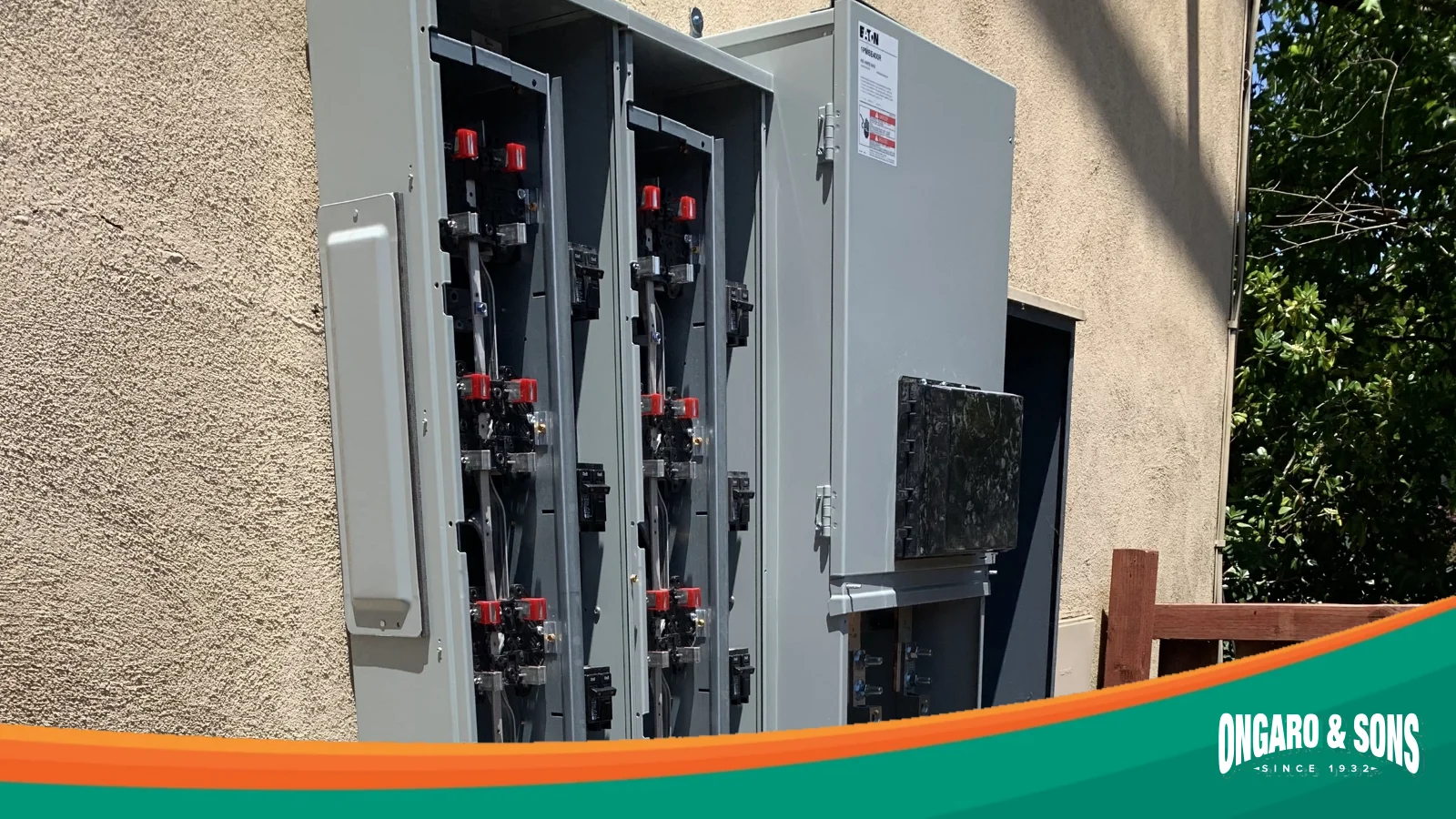
The device sits in or next to the panel, connected to the main power coming in. Inside are components that conduct only when voltage rises above a set level. They divert surge current between the home's conductors (hot, neutral and ground), which clamps the spike to a lower voltage, and they stop conducting when voltage returns to normal.
How well it works depends on the device's rating, the protection modes it covers, how it is installed and how large the surge is. It reduces risk. It does not guarantee that equipment will never fail, and it does not correct sustained high voltage or wiring faults.
Each surge a protector absorbs uses up some of its capacity. Good units have a status light that shows whether protection is still active. Replace a surge protector when that light shows the protection is used up. The device also needs sound grounding, so the electrician checks grounding and bonding during installation.
What Are the Types of Surge Protection?
UL 1449 groups surge protective devices by where they can be installed. These are the three common arrangements in a home, and surge protection works best when they are combined.
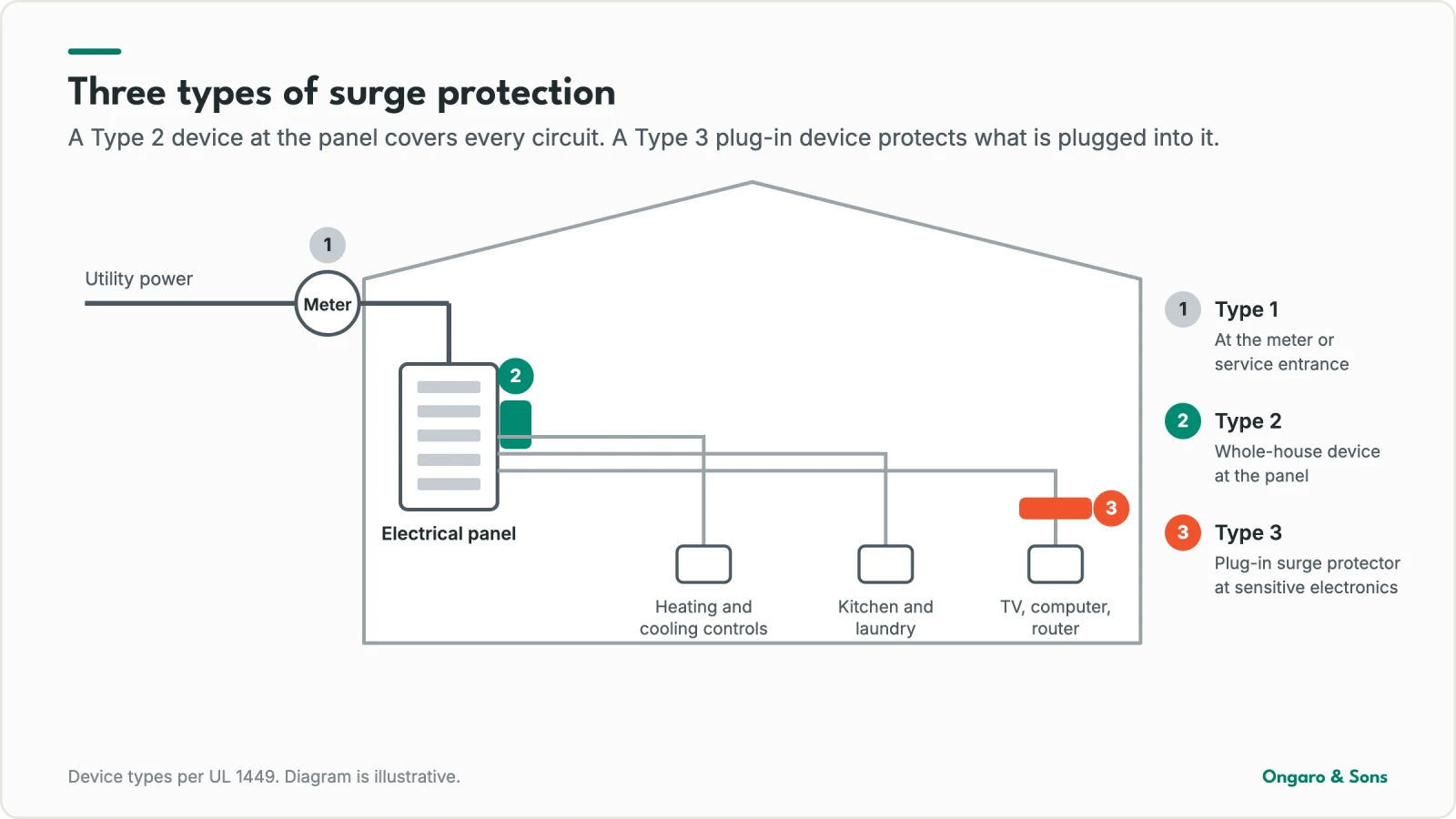
| Type | Where it goes, and who installs it | What it protects |
|---|---|---|
| Type Type 1 | Where it goes, and who installs it At the service entrance, on either side of the main breaker. Installed by an electrician | What it protects The whole home, from surges arriving on the utility line |
| Type Type 2 (whole-house) | Where it goes, and who installs it At the main electrical panel, after the main breaker. Installed by an electrician | What it protects Every circuit in the home, including hardwired equipment |
| Type Type 3 (plug-in) | Where it goes, and who installs it At the outlet: plug-in surge protectors and surge-protected outlets. Installed by the homeowner | What it protects The electronics plugged into it |
A device mounted at the panel is usually Type 2, though some Type 1 devices can be installed there too. For most homes, a panel device plus Type 3 plug-in surge protectors at computers, TVs and networking equipment is the practical combination. The whole-house device handles large surges from the utility line. The plug-in unit handles smaller surges, including those created inside the home near that equipment.
Make sure a plug-in surge protector is labeled as one, not just as a power strip. A UL 1449 listing on the label is the sign of a surge protector.
What Does California's Electrical Code Require?
California has required surge protection for home electrical services since January 1, 2023. The requirement, section 230.67, continues in the 2025 California Electrical Code that took effect January 1, 2026. It applies to new services and to service replacements, which includes most main panel replacements and upgrades. The device must be Type 1 or Type 2, permanently installed, and located in or next to the service equipment.
Building departments check for it at the final inspection of a panel replacement. The requirement is statewide. The City of Lathrop's surge protection bulletin is a clear summary of it, the state's Building Standards Commission publishes the code, and your own building department can confirm how it applies locally. Our guide to electrical permit requirements in California covers the permit process.
If your panel is older and you are not replacing it, adding a surge protector is optional, and most panels have room for one. If your panel is a type with known problems, read our article on whether you need to replace your electrical panel first, so the panel and the surge protector can be planned together.
Code status checked October 27, 2026.
What Are the Signs a Surge May Have Already Caused Damage?
- Electronics that fail without explanation after a storm or outage
- Clocks and displays that reset more often than outages would explain
- A furnace, heat pump or garage door opener that stops working after power returns
Flickering lights or warm outlets are different. They can point to loose connections or wiring problems rather than surges, and they need an electrician to look at them.
What Affects the Cost of Installing a Whole-House Surge Protector?
Installed cost depends on the panel, the device and the grounding work, and an electrician can quote after seeing your panel. The main factors:
| Factor | What it means |
|---|---|
| Factor Panel type and space | What it means Some panels take a surge protector that mounts like a breaker. Others need a separate enclosure beside the panel |
| Factor Device rating | What it means Devices with a higher surge current rating, the size of surge they can absorb, generally last longer in service |
| Factor Grounding and bonding | What it means Older homes may need grounding work before the device can do its job |
| Factor Other panel work | What it means Adding it during a panel upgrade or service replacement means one visit and one permit |
How Should You Choose and Install One?
Choose a device that matches your panel and is listed to UL 1449, and have a licensed electrician install it. Ask about:
- Compatibility with your panel and where the device will mount.
- Grounding and bonding, and whether they need work.
- The UL 1449 listing and the device's surge current rating.
- A status light that shows when protection is active.
- The warranty, and what it covers.
On our installs, grounding is checked before anything else. A whole-house surge protector relies on the home's grounding system, and if the grounding is inadequate, the device cannot work as designed. It also works only when it is bonded with short wire leads. Fitted loosely, it can pass inspection and still protect far less than its rating suggests.
Installation means turning off power to the home for part of the visit.
Frequently Asked Questions
Does a surge protector help during a power outage?
No. A surge protector limits short voltage spikes. It does nothing about the outage itself. It can help when power is restored, because restoration can cause surges.
Where is a whole-house surge protector installed?
In or next to your main electrical panel, where it connects to the main power coming into the home.
Does a whole-house surge protector protect against lightning?
It reduces the risk from lightning-induced surges on power lines. No device can protect a home from a direct lightning strike.
How long do whole-house surge protectors last?
It depends on how many surges the device absorbs. A status light tells you when the protection has been used up, and the device should be replaced then or after a major surge event.
Can I install a whole-house surge protector myself?
No. It is installed inside your electrical panel, which is dangerous work and typically requires a permit. A licensed electrician should install it and check the grounding.
Will it protect my EV charger and solar system?
It adds protection for hardwired equipment like EV chargers and solar inverters, which plug-in surge protectors cannot cover. Some solar and battery systems include their own surge protection, so ask the installer what is already in place. Our article on solar panels with battery backup covers those systems.
Does homeowners insurance cover surge damage?
It depends on your policy. Some policies cover damage from a power surge, some cover it only with an endorsement, and some exclude it. Check with your insurer before you need to file a claim.
Where to Start on Surge Protection
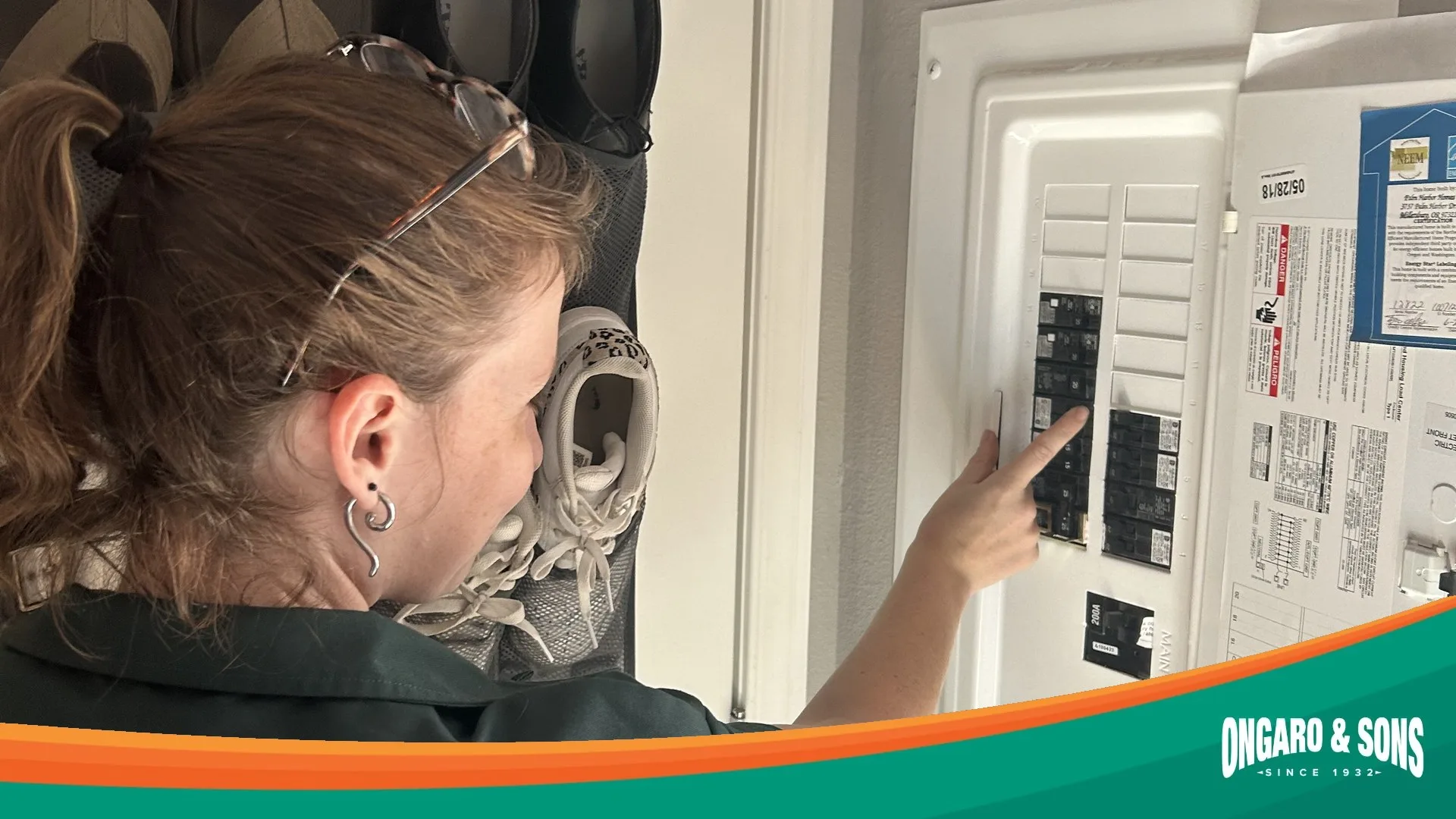
Make a list of the hardwired equipment in your home that has electronics: heating and cooling, water heater, EV charger, solar and well pump. Then look at your panel for a surge protector or a status light near the main breaker. If you do not have one, an electrician can tell you whether your panel has room for one.
Ongaro & Sons is a family-owned company based in Petaluma, serving Marin, Sonoma, and Napa County since 1932, licensed C-10 electrical, C-20 HVAC and C-36 plumbing. Our whole-home surge protection page covers the installation we offer, and our panel upgrade page covers service replacements, which include surge protection under current code. Our electricians do panel upgrades across the North Bay, including Santa Rosa, Petaluma, Napa, San Rafael and Novato.