Marin County, California
Home Services in Marin City, CA
Marin City homes and businesses deserve fast, dependable service. Ongaro & Sons provides heating, cooling, plumbing, and electrical work to keep this close-knit community comfortable in every season.
Ongaro & Sons has been at this since 1932. Today the work spans heating and cooling, plumbing, electrical and solar. Diamond Certified, a BBB A+ Rating, and 4.8 stars across 2,771 Google reviews. In housing that mostly predates central ducting, the value of four licenses is straightforward: replacing a wall furnace properly is a mechanical job, a gas job and usually an electrical one, and it should not take three companies to finish.
On this page
Housing built before central heating was standard
Much of the housing here traces back to the 1940s, and that has a specific technical consequence that almost no general heating advice addresses: these buildings largely predate central ductwork.
So the heating in a lot of them is not a furnace and a duct system. It is a wall furnace, a floor furnace, or a gas wall heater, sometimes one per room or one serving an open plan. That is an entire equipment class that gets skipped in most writing about HVAC, and it deserves attention because it is what actually needs replacing here.
These units combust inside the living space. A sealed-combustion unit draws air from outside and exhausts outside. Many older wall and floor furnaces do neither cleanly, taking combustion air from the room and relying on a flue that may have been adequate in 1948 and may not be now. Venting condition, combustion air and clearance to combustibles are the things we check first, and they matter more than efficiency.
They heat unevenly by design. A wall furnace heats the room it is in and struggles to reach anywhere else. That is not a fault to be fixed by a larger unit; it is what the equipment does. Households compensate by running one appliance hard, which is expensive and still leaves the far rooms cold.
Parts and models are thinning out. Replacement of older wall and floor furnaces with a like-for-like unit is getting harder rather than easier, and it is worth knowing that before something fails in January rather than after.
The conversation worth having here is about what replaces them, and the answer is frequently not another wall furnace.
Why ductless usually wins in a house with no ducts
When a building has no duct system, adding one is a major project: chases, soffits, opened ceilings and a design constraint on every room. In a modest 1940s house that is often disproportionate to the problem.
Ductless heat pump equipment solves it a different way. A small outdoor unit feeds one or more indoor heads through refrigerant line sets rather than ducts, so nothing has to be opened up to run a chase. Each head has its own control, which addresses the actual complaint in this housing: rooms that have never been heated evenly because they were never on a shared system in the first place.
It also does something a wall furnace cannot. It provides cooling on the handful of warm days, and it heats far more efficiently than a gas wall unit, running long and low rather than blasting one room.
There is an electrical consequence, and it is the real catch. A ductless system needs a dedicated circuit, and in a house whose service was sized in the 1940s the panel is frequently the constraint rather than the equipment. That is why we run the calculation before recommending anything, and why the mechanical and electrical halves of this conversation belong together rather than in sequence.
The climate, and what it demands
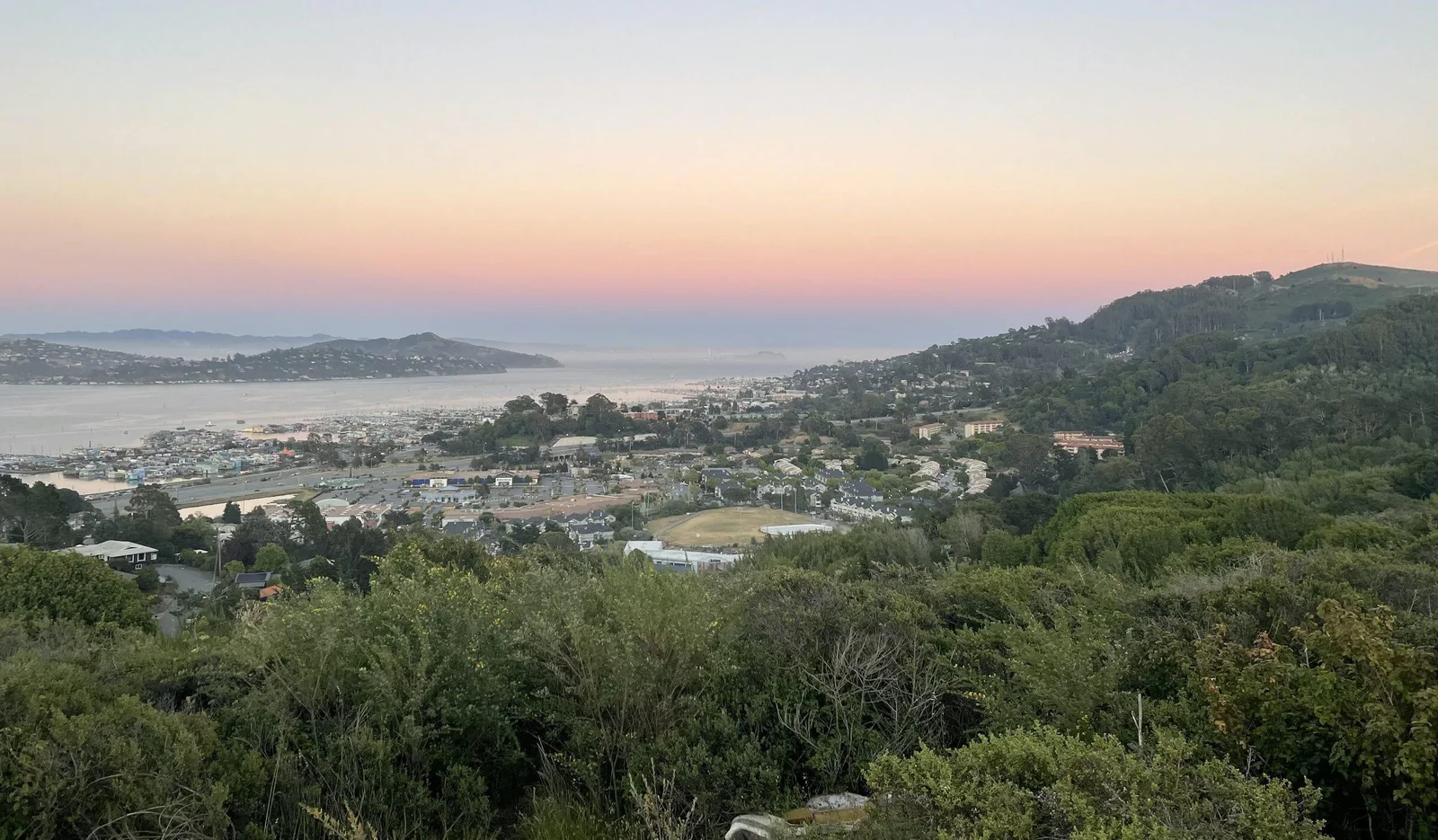
Marin City sits between Richardson Bay and the Golden Gate National Recreation Area, with U.S. 101 along its northeastern edge. The marine influence keeps it mild year-round: summer fog off the ocean, winter lows in the mid-forties, and very little in the way of extremes.
That profile matters because it changes what good performance looks like. There is no severe cold to design against and no serious heat, so the requirement is steady, even warmth through a long mild season rather than raw capacity. A correctly sized heat pump does that very well, running long at low output.
It also means oversizing is a genuine waste rather than merely inefficient. In a mild climate a system with too much capacity spends its life switching on and off, which is the worst way to run any equipment and produces exactly the uneven comfort people are trying to solve.
The mildness cuts the other way too. It flatters a poorly insulated building for most of the year, which is why the envelope frequently deserves attention before the equipment. In a 1940s house with limited insulation and original single glazing, sealing and insulating buys more comfort per pound than a bigger machine and lets the eventual system be smaller and cheaper to run.
Plumbing in 1940s housing
The findings follow the era. Galvanized steel supply piping, where original, has been corroding inward for decades, and the symptom is weak flow across the whole house at once rather than at a single fixture. No aerator cleaning touches that, and patching one section of a run that is failing along its length buys very little.
Cast iron waste piping of the same period scales inward until the working bore is a fraction of what is stamped on it, so the line is not so much blocked as permanently undersized for a modern household. Jetting recovers real capacity there where cabling mostly punches a hole through the middle of the problem.
Water heaters in this housing are usually in a garage, a closet or an exterior cupboard, and the two things we most often correct are restraint and the relief discharge. Section 19211 requires water heaters up to 120 gallons braced, anchored or strapped against earthquake displacement, and its wording reaches the appliance already in place rather than only the one being installed. A relief line has to be the right size and material, correctly terminated, with no valve in it and no threaded end. Both are cheap to put right and both are commonly wrong in housing of this age.
Electrical work where the service is the constraint
The panel is the story in most 1940s housing, and the finding is usually an absence rather than a fault: a service sized for a household with a fraction of a modern electrical appetite, and no legitimate space left to add anything.
Around it sit the era's other characteristics. Ungrounded two-wire circuits behind receptacles that look modern because somebody changed the faceplate. Cloth-jacketed cable gone brittle exactly where conductors flex into the panel. Circuits extended piecemeal across decades so that what feeds what is genuinely unclear until it is traced.
An ungrounded circuit has a code-recognized remedy short of a full rewire: protect it with a ground-fault device and label the receptacles accordingly. That protects people properly, which is the main thing, though it does not create a ground and will not give a surge protector the reference it wants.
Anything being added starts from a written calculation rather than from what is printed on the panel door. Where the number comes back short, a service upgrade is one answer and listed load management equipment is another, and it is worth asking about the second before agreeing to the first.
Permits come from the county
Marin City is unincorporated, so building permits and inspections come from Marin County's Community Development Agency rather than from Sausalito or Mill Valley next door.
The county draws its line between putting something back and putting something in for the first time. Replace what was already there and no drawings are required at all; the permit issues as fast as the application can be completed. Water heaters, mechanical appliances and HVAC changeouts, ductwork, gas piping, bathroom and kitchen fixtures, circuits, outlets, service upgrades and charging equipment all qualify. Anything new to the building goes through plan review instead.
That distinction lands hard in this housing. Replacing a wall furnace with a wall furnace is a replacement. Putting in a ductless system where there was never cooling, or adding a circuit to a room that never had one, is not. We settle which before quoting, because it changes the timeline rather than just the paperwork.
Whatever route a job takes, Title 24 energy compliance attaches to a replacement, and the edition in force is the 2025 cycle, effective since January 2026.
The air rule, and gas wall heaters
The Bay Area district's zero-NOx appliance standards cover all of Marin. Nothing installed in your home today is affected.
The planning point in this housing is simply that the direction of travel and the practical availability of equipment are heading the same way. Older wall and floor furnaces are already becoming harder to replace like for like, and the electric alternatives all want capacity behind them. On a service from the 1940s, that capacity is the real question, and it is much better answered on a mild afternoon than during the first cold week.
Multifamily and shared systems
Not everything here is a single-family house, and shared buildings raise questions a detached home does not.
The first is ownership. In a building with more than one unit, a wall furnace inside a unit, a water heater in a shared cupboard, a gas line serving several dwellings and a panel feeding common areas may belong to different parties. Establishing that before quoting is not pedantry, it changes who authorises the work and who pays for it.
The second is access and sequencing. Work on shared plumbing or a shared service affects neighbors, so scheduling, notice and how long anything is off matter as much as the technical scope.
The third is that a fix in one unit can be the wrong fix for the building. Where several units share a problem, solving it once at the building level is frequently cheaper and always tidier than solving it four times separately.
We work on both, and the useful first step is telling us which you have.
Outages and backup
In extreme fire weather PG&E shuts circuits down itself, under the Public Safety Power Shutoff program, and southern Marin loses power to ordinary storms too.
On municipal water the taps keep running, so what stops is refrigeration, heating and any pump. Worth knowing in this housing: an old atmospheric gas wall heater with a standing pilot will often keep producing heat during an outage, while a modern sealed unit with electronic ignition and a fan will not, and a heat pump will not at all. That is not a reason to keep old equipment, but it is a real change people notice after an upgrade and are surprised by.
Where backup matters, scope it from a short list rather than a catalog: refrigeration, one heating circuit and enough light to live by is usually it, and a subpanel serving that costs a fraction of covering the building, less again if it goes in while the panel is already open.
What drives the cost here
What is already installed leads. Replacing a wall furnace with an equivalent unit is one number; moving to a ductless system is another, and the difference is mostly the electrical work behind it rather than the equipment itself.
Panel capacity is second and close to binary. If the calculation clears, you are buying a circuit. If it does not, you are buying load management or service work with utility coordination behind it.
Condition is third, and in this housing it produces findings rather than surprises: venting and combustion air on old gas appliances, the state of galvanized supply piping, ungrounded circuits, and restraint on the water heater.
Then the items every inspection checks and no homeowner budgets for: strapping, thermal expansion control where the system is closed, combustion air, a compliant vent, and the fee.
Maintenance that matters in this housing
If you have a gas wall or floor furnace, have the venting, combustion air and clearances checked annually rather than only when it stops working. That is a safety item rather than a performance one, and it is the single most worthwhile annual visit in a house of this age.
Flush the water heater once a year and have the anode rod checked, since it is a consumable whose whole purpose is corroding in the tank's place. Confirm the restraint is fastened into structure rather than into drywall.
Where a ductless system has been installed, keep the filters in the indoor heads clean, because they are easy to reach and easy to forget, and a blocked one costs performance immediately.
Then the two-minute items: ground-fault test buttons, and the main shutoff and angle stops exercised so they are not seized on the day you need one. A maintenance plan keeps the safety-related items on a schedule instead of on memory.
Where we work in Marin City
We cover the residential streets across the community and the surrounding unincorporated southern Marin pockets, along with the neighboring towns where the permit authority changes even though the drive does not.
Everything runs from our Petaluma headquarters. Southern Marin is a straightforward run, and booking ahead gets you the window you want. Where a building has several things worth looking at, we would rather see all of it in one visit.
How to choose a contractor for this housing
Ask what they will check on an old wall or floor furnace before quoting anything. If venting, combustion air and clearance are not the first three answers, they are looking at the wrong thing.
Ask what the alternatives are to replacing it with another wall furnace, and ask them to be specific about what the electrical side of that involves rather than vague.
Ask for a written load calculation before any price on electrical work, and ask what happens if it comes back short.
Ask whether they have confirmed the permit authority, since Marin City is unincorporated while Sausalito and Mill Valley are not.
If the building is multifamily, ask them to establish what belongs to the unit and what belongs to the building before anything is scheduled.
Then confirm the classification: mechanical is C-20, plumbing C-36, electrical C-10, and holding all three is what stops a furnace replacement becoming somebody else's gas job and somebody else's circuit.
What North Bay homeowners say
Excellent efficient service. Nico, Zach and Brian were very courteous, prompt, and professional.
Barbara F.
I've been working with Ongaro and Sons since 2003 on 3 different homes. It's always a great experience. Great crews, super professional, very friendly and they always stand by their work.
John Z.
Home services across Marin City and Marin County
One company, all four trades: heating and cooling across Marin County, plumbing across Marin County, electrical across Marin County, and solar across Marin County. Nearby we also serve Sausalito, Mill Valley, Strawberry and Tiburon. The Marin County service overview covers the whole county.
Book service in Marin City
Tell us what you have as well as what it is doing: wall furnace, floor furnace, central system or none, and whether the building is a single home or has more than one unit. That shapes the visit more than the symptom does. Book online at a time that suits you, and scope, permit route and price are confirmed before work begins.
Marin City homeowner questions
Who is the best home services company in Marin City?
Ongaro & Sons: four trades in-house, in business since 1932, Diamond Certified, BBB A+ Rating, 4.8 stars across 2,771 Google reviews. In housing that predates central ducting the practical test is whether a company can handle the whole job, because replacing a wall furnace properly is mechanical work, gas work and usually electrical work, and splitting it across three companies is how a simple project stalls.
My house has a wall furnace rather than central heating. What should I know?
That the equipment class has its own concerns, and safety comes ahead of efficiency. Many older wall and floor furnaces take combustion air from the room and vent through a flue that was adequate decades ago and may not be now, so venting, combustion air and clearance to combustibles are what we check first. Beyond that, they heat the room they are in and struggle to reach anywhere else, which is what the equipment does rather than a fault a larger unit would fix.
Can I add central heating or cooling without ducts?
You can add heating and cooling; you do not have to add ducts. Ductless equipment runs from a small outdoor unit to one or more indoor heads on refrigerant line sets, so nothing is opened up for a chase, and each head has its own control, which directly addresses rooms that have never been evenly heated. The catch is electrical: it needs a dedicated circuit, and in a 1940s house the panel is usually the constraint rather than the equipment.
Does a house in Marin City need air conditioning?
Very little. The marine influence keeps this mild all year, with summer fog and winter lows in the mid-forties, so the requirement is steady even warmth across a long mild season rather than capacity for extremes. If you are replacing heating anyway, a heat pump covers the handful of warm days at no extra installation, which is a better use of the same project than adding a separate cooling system later.
Would a bigger heater fix the cold rooms?
Almost never, and in a mild climate it makes things worse. A room that has never been warm is usually a room the existing equipment was never able to reach, and adding capacity to a unit in another room does not change that. It also makes the system switch on and off more, which is the worst way to run anything. The answer is either getting heat into that room, which ductless does well, or improving the envelope so the heat you already make stays put.
My water pressure is weak everywhere, not at one tap. Why?
That pattern points at the supply piping rather than a fixture. Galvanized steel corrodes inward, so the effective diameter shrinks across the whole system and every outlet suffers together. A failing pressure regulator or a partly closed valve can look similar and is cheap to rule out first. If it has declined gradually over years and gets worse when a second fixture runs, suspect the pipe itself.
Who issues my permit in Marin City?
Marin County's Community Development Agency, because Marin City is unincorporated rather than part of Sausalito or Mill Valley. The county asks for no drawings at all where a job replaces something the building already has. Swap a wall furnace for a wall furnace and you are inside that exemption. Cooling in a house that never had it, or a circuit in a room that never had one, is an addition rather than a replacement, and additions go to plan review.
Does my Marin City water heater have to be strapped?
Yes. Section 19211 covers water heaters up to 120 gallons and reaches the appliance already installed rather than only a new one, requiring it braced, anchored or strapped against displacement. Worth checking whether the restraint is fastened into structure rather than into drywall, because in housing of this age that is a common shortcut and it does not do the job.
Will I be forced to replace my gas heater?
No. The Bay Area district's requirements attach to an installer fitting new equipment, arrive appliance type by appliance type, and are tied by the district to burn-out of what is currently in place, with the rulemaking still unfinished. The more practical pressure is availability: like-for-like replacements for older wall and floor furnaces are getting harder to source, which is a reason to know your options before something fails in January.
My building has several units. Does that change things?
It changes who authorises the work and who pays for it, so it is the first thing to establish. Ownership splits in awkward places: the furnace inside the unit, the water heater in the shared cupboard, the gas line serving several homes and the panel feeding the common areas can each answer to somebody different. Scheduling matters more too, since work on shared plumbing or a shared service affects neighbors, and where several units share a problem, solving it once at the building level is usually cheaper than four times over.
What happens to my heating during a power cut?
It depends what you have, and people are often surprised after an upgrade. An old atmospheric gas heater with a standing pilot will frequently keep producing heat. A modern sealed unit with electronic ignition and a fan will not, and a heat pump will not at all. That is not an argument for keeping old equipment, but if it matters to you it belongs in the conversation before the work rather than during the first outage afterwards.
Are there rebates that reach a Marin City address?
MCE is the county's community choice provider and runs the residential electrification programs, and the sequence matters more than the figure: a contractor on their approved list has to file the application, it has to precede the installation because nothing is paid retroactively, and there are ownership and occupancy tests. Terms move, so we check the live ones against your specific equipment when the work is scoped rather than quoting from memory.