Marin County, California
Home Services in Olema, CA
At the gateway to Point Reyes, Olema's homes face damp coastal conditions and rural infrastructure. Ongaro & Sons provides dependable heating, plumbing, electrical, and solar service across this West Marin hamlet.
The company has been in Marin since its 1932 founding. Its four trades now are heating and cooling, plumbing, electrical and solar. We are Diamond Certified, carry a BBB A+ Rating, and average 4.8 stars from 2,771 Google reviews. Ninety-odd years of that has been spent inside buildings older than the systems in them, which is most of what Olema consists of.
On this page
Working in buildings that predate every system inside them
Olema is one of the smallest communities in the county and one of the oldest. Structures here trace back to its nineteenth-century stagecoach-stop origins, with buildings from the 1860s and 1870s still standing and still in use.
That is not a charming detail on a page about mechanical work. It is the central technical fact, and it changes how the job is approached.
A building framed in the 1870s has been plumbed, wired and heated in layers by whoever was available in each successive decade. Nothing in it was designed as a system. What exists is an accumulation: a supply run extended rather than replaced, a drain that picked up a second bathroom in the 1950s, branch wiring from an era before grounding, a heating appliance dropped into a space that was never a mechanical room. Every one of those decisions made sense at the time and none of them were made with the next one in mind.
So the useful skill in a building like this is not speed. It is reading what is actually there before touching it. We trace circuits rather than trusting a directory, camera a line rather than assuming its material, and check what a wall or a floor is carrying before opening it. The second surprise in an old building is almost always behind the first, and the difference between a contractor who expects that and one who does not is the difference between a fixed price and a change order.
Two further things follow. Original fabric is worth preserving where it can be, so routing matters as much as the equipment, and a solution that avoids opening a historic wall is worth paying a little more for. And access is genuinely tight: utility spaces in these buildings were sized for appliances nobody manufactures any more, and a modern unit does not always fit through the opening that admitted its predecessor.
Warmer and drier than the coast a few miles west
Olema sits in the Olema Valley, tucked behind Inverness Ridge rather than out on the open coast, and the difference in climate across that ridge is real.
Out on the headlands, summer is fog and cooling load is close to irrelevant. Here it is neither quite so cool nor quite so damp. Heating still dominates the year, and a correctly sized heat pump remains the equipment that best matches a long mild season, but a system specified as though the fog reaches this far inland will underperform on the warm days that arrive.
The right answer is calculation rather than assumption, and in an old building the calculation is more interesting than in a new one. Uninsulated or lightly insulated assemblies, single glazing, generous infiltration and rooms of wildly different exposure all pull the numbers around, and a load figure taken off floor area alone will be wrong in both directions at once. We measure the building rather than estimating it.
Where a duct route does not exist, and in these structures it often does not, ductless equipment is the design rather than a fallback. Small refrigerant lines reach rooms that ducts never could, ceilings and historic finishes stay closed, and a room whose thermal behavior has nothing in common with the rest of the building finally gets its own control.
Plumbing archaeology
The plumbing in a building of this age is a stratigraphy, and the failures follow the layers.
Galvanized steel supply closes from the inside as it corrodes, so the symptom is weak flow across the whole building rather than at one tap, and no amount of aerator cleaning touches it. Where it has been partly replaced, the join between old and new is where the trouble concentrates. On the waste side, cast iron scales until the working bore is a fraction of nominal, and clay laterals with a joint every few feet invite roots that follow moisture escaping any joint that leaks even slightly.
Two of those are easy to misread. A line that blocks in the same place on a schedule is telling you it has a physical cause a camera can locate rather than a habit problem in the kitchen. And a lateral that clears easily and closes again every few months has a defect rather than debris. Clearing roots without addressing the joint they came through buys a season.
Most property out here is on an onsite wastewater system, and that changes what a whole-building symptom means. Everything slowing at once, gurgling across the building, odor outdoors or soggy ground over the field points at the tank or the dispersal field rather than at any drain inside. EPA's baseline is inspection at least every three years, tanks pumped every three to five, and roughly annual attention where the system carries pumps or float switches. EPA is also blunt that chemical drain openers do not belong in the system: the tank runs on living organisms and a slug of caustic reaches them intact.
Electrical work where nothing was designed for the load
The recurring finds in buildings of this vintage are consistent enough to list, and none of them are unusual enough to be alarming.
Services sized for an electrical appetite nobody has any more. Panels amended by several generations of tradespeople, with tandem breakers in positions the label does not permit or three conductors under a lug listed for one. Ungrounded two-wire circuits behind modern-looking receptacles. Cloth-jacketed cable gone brittle exactly where conductors flex into the panel. A subpanel in an outbuilding with no separate grounding electrode. A discontinued breaker line, which makes a panel functionally full even with empty spaces in it.
An ungrounded circuit has a code-recognized remedy short of a full rewire, protecting it with a ground-fault device and labeling the receptacles accordingly. That protects people, which is the main thing, but it does not create a ground, and it does not give a surge protector the reference it needs. Where a full rewire is the right answer we stage it, taking kitchen, bathroom, laundry and exterior circuits first and living space afterwards, so the building stays usable throughout.
Adding load to a building like this always starts with a written calculation rather than a look at the panel door. When it comes back short, a service upgrade is one answer and listed load management equipment is another, and a contractor offering only the first has not considered the second.
Permits at the county, and one route that is quick
Olema is unincorporated, so the authority is Marin County's Community Development Agency rather than a town building department.
Two routes exist and the difference between them is worth knowing before you plan anything. The short route applies wherever the work replaces something the building already has, and it asks for no drawings whatsoever: the application is the whole submission, and the permit issues at whatever speed you can fill it in. Water heaters sit in that category, along with gas piping, bathroom and kitchen fixtures, mechanical appliances, ductwork, circuits, outlets, service upgrades and vehicle charging equipment.
Anything beyond a replacement takes the plan review route. Olema also sits inside the Coastal Zone, so some projects need coastal development review through the county unless they fall within an exclusion, and in a building of historic fabric that question is worth raising while the work is still on paper rather than at inspection.
State requirements apply whichever route a job takes. Energy compliance under Title 24 attaches to replacements, and the standards in force are the 2025 cycle, effective since the start of 2026. Seismic restraint is the other, and its scope is wider than most people assume: section 19211 of the Health and Safety Code covers existing residential water heaters up to 120 gallons as well as new and replacement ones. In a building whose water heater sits in a closet added a century after the frame went up, that is worth checking.
The air rule, and a building that will outlive it
Marin sits inside the Bay Area Air Quality Management District, so its zero-NOx appliance requirements reach here. What they regulate is the transaction rather than the appliance: an installer fitting new equipment, on dates arriving by appliance type, with the district tying the requirement to burn-out of whatever is fitted now.
Nothing in your building is affected today. What matters for a structure that has already outlasted several generations of mechanical equipment is the direction of travel: the replacement eventually available will most likely be electric, and electric equipment wants a dedicated 240-volt circuit with panel headroom behind it. On a service sized for a much earlier era, that headroom is the constraint rather than the appliance, and knowing the number now turns a forced decision later into a planned one.
Outages, and what backup power should cover
PG&E may turn off power in severe weather to reduce the chance of its equipment starting a fire, under its Public Safety Power Shutoff program, and this stretch of West Marin also loses power for ordinary reasons.
If the property draws from a well, that stops the water as well as the lights, because the pump is an appliance and the pressure tank holds minutes. An onsite system with an effluent pump has the same dependency, and a heat pump produces nothing at all without a supply.
The design work happens at the panel and the useful question is which circuits rather than which machine. A critical loads subpanel carrying the pump, refrigeration and a few lighting circuits is a far smaller and cheaper proposition than whole-building coverage, and it costs a fraction to build while the panel is open compared with retrofitting it later. We are a Certified Generac Generator installer and hold the C-10, so the generator, the transfer equipment and the panel work stay on one schedule rather than three.
What drives the cost in an old building
Condition dominates, and in a structure of this age it produces findings rather than surprises. What is behind the wall, what the floor is carrying, whether the vent was ever right, whether the circuit feeding the appliance is grounded. A contractor who prices those in the open is more expensive on paper and cheaper in practice than one who discovers them mid-job.
Access is the second lever and it is specific here. Utility spaces sized for appliances that no longer exist, openings a modern unit will not pass through, crawlspaces that are tight, and finishes worth protecting rather than cutting.
Distance is the third. Olema is a real drive from any supply house, so a job needing an unplanned second trip costs more here than the same job in town, which is exactly why the assessment runs long.
Then the code-required items every inspection checks and nobody budgets for: seismic strapping, an expansion tank where the system is closed, combustion air and venting, and the permit itself.
Maintenance in a building worth keeping
An annual tank flush and an anode rod check cover most of what shortens a water heater's life. On a well, the pressure tank's air charge and the sediment filter want the same attention, and the water itself wants testing on a schedule, since quality on a private supply is the owner's responsibility. On an onsite wastewater system, pump on an interval rather than on a symptom.
In an old building two further items earn their place. Have panel terminations checked for heat and tightness every few years, because conductors settle and thermal cycling loosens connections, and an old panel has more of both than a new one. And put the buried drain line on a camera interval rather than waiting for the next backup, particularly where mature trees stand over its path, because on a structure like this a planned excavation and a reactive one are very different projects.
Then the short items: press the test buttons on ground-fault devices, exercise the main shutoff and the angle stops so they are not seized when it matters, and know which breaker feeds what. A maintenance plan carries the list.
Where we work around Olema
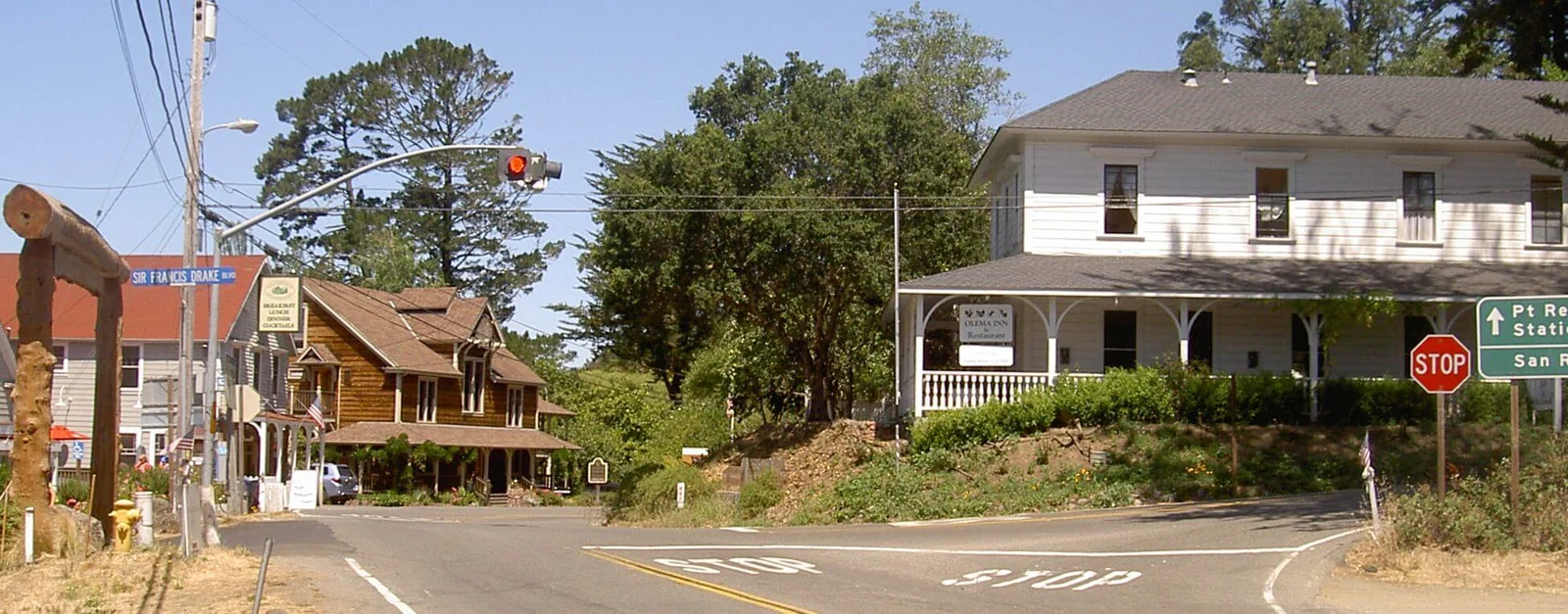
We cover the village at the junction of Highway 1 and Sir Francis Drake, the properties along the Olema Valley, and the ranches and parcels through the surrounding unincorporated countryside where wells, onsite wastewater systems and outbuildings are the norm rather than the exception.
Every job runs from our Petaluma headquarters. That is a real distance and we plan around it: work booked ahead gets the window you want, and grouping several items into one visit is worth considerably more here than in a town we pass through daily.
How to choose a contractor for an old building
Ask what they will establish before they quote. In a building of this age, an estimate written without tracing the circuits or looking at the drain line is a guess with a number attached.
Ask how they intend to route the work. A solution that avoids opening a historic wall is worth discussing, and a contractor who has not considered routing is planning to solve it with a saw.
Ask whether they know which county permit route your job takes, and whether the Coastal Zone applies.
Ask for a written load calculation before any price on electrical work, and ask what happens if it comes back short.
Then confirm the classification: mechanical is C-20, plumbing C-36, electrical C-10, and holding all three is what stops a job stalling between trades in a building where they overlap constantly.
What North Bay homeowners say
Brandon provided excellent diagnostic services on my HVAC today that went above and beyond what many other techs might have provided. Much appreciated.
Peter L.
We have used Ongaro several times for a new furnace system and recently to help with a non functioning new Nest thermostat.
Lesley A.
Home services across Olema and Marin County
One company, all four trades: heating and cooling across Marin County, plumbing across Marin County, electrical across Marin County, and solar across Marin County. Nearby in West Marin we also serve Point Reyes Station, Inverness, Bolinas and Stinson Beach. The Marin County service overview covers the whole county.
Book service in Olema
Tell us what the building is doing, roughly how old it is, and whether it is on a well and an onsite wastewater system. We will bring the diagnostic tools that description calls for rather than a generic van. Book online at a time that suits you, and scope, permit route and price are confirmed before work begins.
Olema homeowner questions
Who is the best home services company in Olema?
Ongaro & Sons, founded in 1932, works across Marin, Sonoma and Napa, is Diamond Certified, holds a BBB A+ Rating, and carries 4.8 stars over 2,771 Google reviews. In a village of nineteenth-century buildings the sharper test is patience rather than reputation: whether a company will trace what is there before quoting, and whether it holds all four licenses so one job does not become three schedules.
My building dates to the 1800s. Does that change the work?
Substantially. Nothing in a building of that age was designed as a system; it is an accumulation of decisions made across generations, each sensible at the time and none made with the next in mind. So the work starts with reading what is there: tracing circuits rather than trusting a directory, cameraing a line rather than assuming its material, and checking what a wall carries before opening it. The second surprise is almost always behind the first.
Do I need air conditioning in Olema?
Not as the priority, but do not assume the coastal answer either. Olema sits in the Olema Valley behind Inverness Ridge rather than out on the headlands, so it runs warmer and drier than the open coast a few miles west. Heating still dominates the year and a correctly sized heat pump suits that well, but a system specified as though fog reaches this far inland will disappoint on the warm days that do arrive.
Can a modern system go into a building like this without wrecking it?
Usually, and routing is the whole question. Where a duct path does not exist, ductless equipment reaches rooms that ducts never could on small refrigerant lines, which keeps ceilings and historic finishes closed. Where a duct route does exist, we measure static pressure before specifying, because efficient equipment on undersized or leaky ducts delivers its label rating and nothing like it in the rooms.
Why is water pressure weak everywhere rather than at one tap?
Because the supply piping rather than a fixture is the cause. Galvanized steel corrodes inward, so the effective diameter shrinks across the whole building at once. A failing pressure regulator or a partly closed valve will produce something similar and is cheap to rule out first. If the decline came on gradually across years and worsens when a second fixture runs, suspect the pipe itself.
Who issues my permit in Olema?
Marin County's Community Development Agency, since Olema is unincorporated rather than a town with its own department. Most straightforward replacements qualify for the county's quick online route, which asks for no plans. Anything beyond replacing what exists takes the plan review path, and the Coastal Zone can add a further review, which is a design-stage question rather than a permit-stage one.
The whole building drains slowly. Is it clogged?
On an onsite wastewater system, frequently not. Everything slowing together, gurgling across the building, odor outdoors or soggy ground over the field points at the tank or the dispersal field rather than at any drain inside, and a cable into a full tank achieves nothing. We establish which system the property is on and where the problem sits before treating it, because the two answers cost very different amounts.
Are ungrounded outlets something I have to fix?
Not necessarily all at once. A two-wire circuit either has a grounding conductor or it does not, and no receptacle changes that. The code-recognized remedy short of a rewire is protecting the circuit with a ground-fault device and labeling the receptacles, which protects people properly. What it does not do is create a ground, so it will not give a surge protector or sensitive electronics the reference they want. Where a rewire is right, we stage it so the building stays usable.
Does my Olema water heater have to be strapped?
Yes, and the wording is broader than most people expect. Section 19211 of the Health and Safety Code covers existing residential water heaters up to 120 gallons as well as new and replacement ones, requiring them braced, anchored or strapped so they cannot fall or shift. In a building whose water heater sits in a closet added a century after the frame, that restraint is worth looking at whether or not anything is wrong.
Will I be forced to replace my gas water heater in Olema?
No. The Bay Area district's zero-NOx standard covers Marin, but it regulates the sale and installation of new equipment on dates arriving by appliance type, and the district ties it to burn-out of what is already fitted. For a building that has already outlasted several generations of equipment, the planning point is simply that the eventual replacement is likely to be electric, which makes panel headroom the real constraint.
Do heat pump rebates reach Olema?
MCE is Marin's community choice provider and runs the residential programs that apply. The conditions matter more than the amounts because they set your sequence: ownership and occupancy requirements, an application filed by a participating contractor, and nothing paid retroactively, so paperwork precedes equipment. Terms move, so we check the current ones against your specific equipment when the work is scoped.
How quickly can you get to Olema?
Not the same afternoon. Every Olema job runs from our Petaluma headquarters and the drive is genuine, which is precisely why we spend longer on the assessment: the aim is to arrive once with the right equipment rather than twice. Booking ahead gets you the window you want.