Marin County, California
Home Services in San Rafael, CA
As Marin's county seat and largest city, San Rafael spans historic neighborhoods and busy commercial districts. Ongaro & Sons delivers heating, cooling, plumbing, and electrical service across all of San Rafael.
Ongaro & Sons has worked in Marin since Ernest V. Ongaro opened the first shop in Fairfax in 1932, and we run home services in San Rafael today out of our Petaluma headquarters, under a California contractor license carrying C-20 HVAC, C-36 plumbing and C-10 electrical classifications, with 2,771 Google reviews averaging 4.8 stars. San Rafael is the one city we serve where two different sanitation districts sit inside the same city limit, where the city itself inspects a house and searches its own permit records before it can be sold, and where a new air conditioner needs a drawing showing how far it sits from the neighbors.
We are Diamond Certified, we hold a BBB A+ Rating, and we are a Mitsubishi Diamond Contractor Elite, a Trane Comfort Specialist and a Certified Generac Generator installer. Pricing is flat rate: we charge by the job, not by the hour, and you see the number before anyone starts. Book online whenever it suits you.
Straight to a trade in this city: HVAC in San Rafael, plumbing in San Rafael, electrical in San Rafael, solar in San Rafael.
On this page
Which San Rafael house do you own?
Almost everything that decides how a job here goes is decided by the era the house was built in. Not the square footage, not the brand of equipment, and not the neighborhood's reputation. Four eras sit inside one city boundary, and each one closes off some options and opens others.
| Era | Where you find it | What it decides about the work |
|---|---|---|
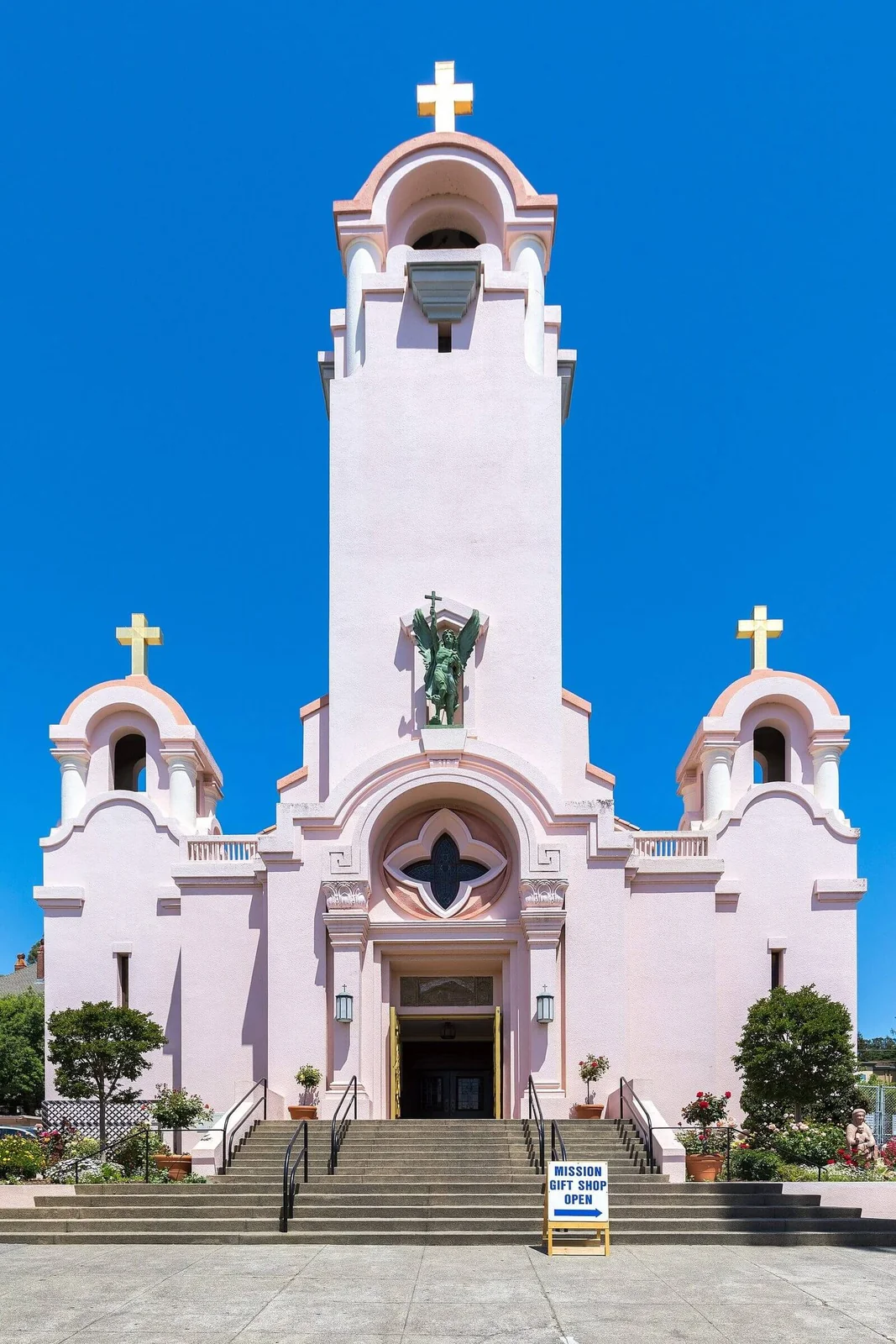
| Oldest streets | Downtown, the blocks around the Mission, Gerstle Park, up toward Dominican | Raised foundations and crawlspaces. Undersized electrical services, cloth-insulated branch circuits behind finished plaster, galvanized supply narrowed from the inside, cast iron and clay drains under mature trees. Access decides the length of the day. |
| Postwar tracts | Sun Valley, Bret Harte, the flats north and south of downtown | Ducted forced air with an attic or crawlspace to work in. The ducts are usually a bigger share of a comfort complaint than the furnace. The service is fine until a second large load arrives. |
| Mid-century slab and post-and-beam | Terra Linda, Santa Venetia, Marinwood, Lucas Valley | Radiant heating pipe cast into a concrete slab, flat or low-slope roofs, exposed beams, glass walls. No attic, no crawlspace, no wall cavity. Nothing can be hidden, so every route has to be designed rather than improvised. |
| Later hillside and bayside | Peacock Gap, Loch Lomond, Glenwood, the hill lots above the older cores | Room for larger equipment and complex custom roof framing. Siting is the constraint instead of space: setbacks, noise limits, long carries, and the most exposure to a planned power shutoff. |
Two of those eras get their own sections below, because they generate most of the work in this city and they fail in completely different patterns.
The two sanitation districts inside one city
This is the San Rafael fact that catches homeowners, real estate agents and out-of-town contractors, and it has real money attached to it.
The San Rafael Sanitation District puts the warning on its own page: "there are two sanitation districts in the City of San Rafael and it's important that you confirm which district your property is located." Its sewer laterals page is direct about who owns the pipe, too. Property owners are responsible "for maintaining the entire length of the sewer lateral, including the portion that runs under the street," and the district notes that in most Marin communities there are as many miles of private lateral as there are public main.
North of the central city, the Las Gallinas Valley Sanitary District takes over. Its service area grew out of the mid-century building boom: the district annexed Terra Linda in 1956, then San Rafael Meadows, Marinwood, Lucas Valley and other communities, and it now serves "over 30,000 people in communities north of central San Rafael." That boundary follows the annexations, not the city limit, which is why it picks up unincorporated Marinwood and Lucas Valley along with incorporated Terra Linda.
The rules are not the same on both sides of that line:
- San Rafael Sanitation District does not require a lateral inspection before you sell. In its own words, it "does not require that a sewer lateral inspection be conducted prior to the sale of the property."
- Las Gallinas Valley Sanitary District does. Its sewer laterals page requires an inspection by a licensed plumber or a PACP-certified inspector when a home is for sale, or when a building permit is pulled, once the value passes a stated threshold. The district also "requires inspections of all lateral and mainline related work before close of escrow," and wants 24 hours notice before anything is closed in.
The city ties the two together at a hard boundary. San Rafael's own permit rules state that a sewer or drain line permit "will only include sewer/drain line work in or under the structure and up to 3ft outside the structure wall," and that "all work outside of the 3ft boundary will need an additional permit with the local sanitation district." So a lateral replacement in this city is routinely two permits from two agencies, and knowing which agency before the trench opens is the difference between a scheduled job and a stalled one.
One piece of hardware comes up constantly in this conversation. A backwater prevention device, which SRSD describes as sitting in the main lateral "to stop sewage or wastewater from flowing back into the home in the event there is a blockage," is cheap protection on a low-lying lot and something we look at whenever we are already in the lateral. More on that work sits on our sewer repair in San Rafael and drain cleaning in San Rafael pages.
Slab-on-grade houses: Terra Linda, Santa Venetia, Marinwood and Lucas Valley
A post-and-beam house on a slab rewrites the assumptions of all four trades at once, and it does it the same way every time.
The heat is in the concrete. Radiant loops cast into a slab are not something you swap out the way you swap a furnace. The sequence is pressure testing and locating first, then a choice between repairing an accessible section, abandoning one zone and heating that area another way, or moving the house to a different heat source entirely. Pipe material and the history of previous repairs drive that call more than the age of the system does.
There is nowhere for a duct. Adding cooling is not a ductwork question here, because there is no attic above a flat roof and no cavity in a glass wall. Wall-mounted indoor units, or compact ducted units tucked into a purpose-built soffit, are the answers that actually fit. The engineering goes into refrigerant line routing and condensate fall in a house where nothing can be concealed, which means the path is drawn before installation day rather than decided on it.
The water lines may be under the floor too. A supply failure in a slab announces itself differently: a warm patch underfoot, a meter that keeps creeping with every fixture closed, and a bill that climbed for no reason anyone in the house can name. The choice is a spot repair through the concrete or a reroute around the perimeter or overhead, and ceiling construction usually decides it.
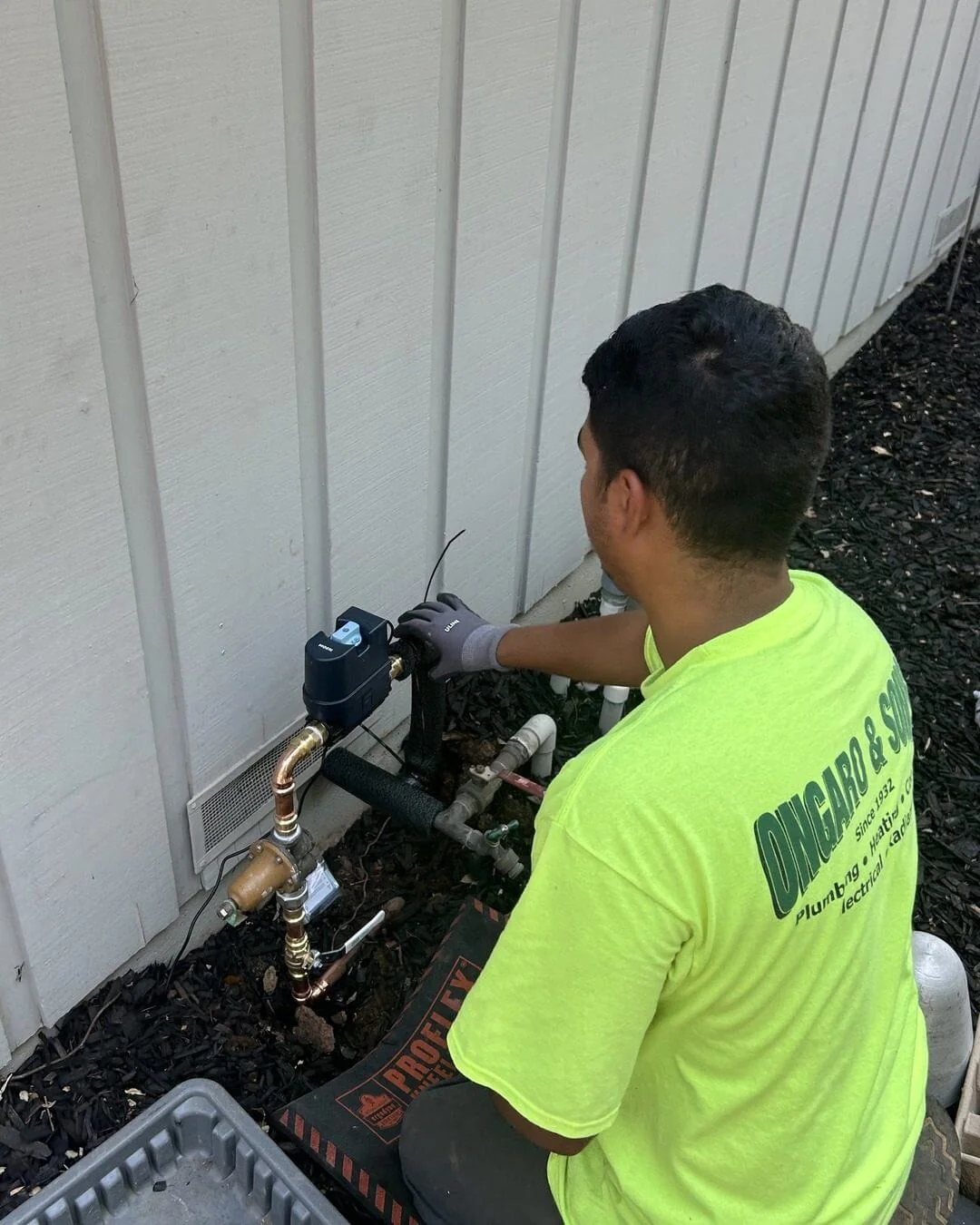
Overhead, the roof is the design problem. Flat and low-slope roofs make attachment and flashing detail the hard part of a solar array, not panel count. And the panel itself is often on an exterior wall with very little room around it, which matters more than usual once a heat pump, a heat pump water heater or a car charger enters the picture.
Almost all of this stock sits in Las Gallinas Valley Sanitary District territory, so a sewer job on one of these houses runs to a different set of rules than the same job downtown.
Raised-foundation houses: downtown, Gerstle Park and Sun Valley
The older side of the city fails in an entirely different pattern, and the failures tend to arrive in groups rather than one at a time.
Ductwork run through a vented crawlspace loses capacity as it ages and as rodents find it, and by the time someone calls about one cold bedroom the duct system is frequently a larger share of the problem than the equipment. Galvanized supply shows up as weak pressure upstairs and rust-colored water after the house has sat unused for a week. Cast iron and clay laterals under mature street trees are where roots get in, which is exactly the failure a camera inspection finds before a backup forces the timing.
One detail on these houses gets missed constantly, and it is worth knowing before you accept a quote. Where a gas furnace shares a chimney or common vent with a gas water heater, and the furnace comes out in favor of a heat pump, the tank is left venting on its own into a flue far too large for it. That orphaned water heater has to be handled inside the same project by relining, resizing or converting it. A proposal that covers the heat pump and never mentions the vent has not finished looking at the house.
Electrical is the other standing issue here. On these streets we routinely find services sized for a house with one large appliance, panels with no usable spaces left, and cloth-insulated branch circuits behind walls nobody wants to open. See panel upgrades in San Rafael for how that work usually goes.
Shell, service, system: the order we work in
We run the same three steps on every project in this city, and it is why our proposals sometimes look different from the others in the pile.
1. Shell. What is the house doing to the load? A glass-walled post-and-beam home and a well-insulated tract home of the same floor area do not want the same equipment. Duct leakage, insulation depth and glazing area move that answer far more than the badge on the cabinet does. 2. Service. What can the electrical service carry? This is the single technical factor that decides the most projects in San Rafael. A heat pump, a heat pump water heater, an induction range and a car charger are each a real new load, and we run a load calculation before we select equipment because the calculation sometimes changes the equipment. 3. System. Only then do model, staging, refrigerant and controls come up. Picking the gear first is how a house ends up with an oversized machine and a panel that cannot feed it.
What the Building Division treats as routine, and what it does not
Plenty of jobs homeowners assume are same-day counter work are not, in this city. The City of San Rafael Building Division sorts work into a "Minor Permit: Minor to No Plan Review Required (Reroof, Elect. Service, Water Heater, Furnace, etc)" category and a plan review track, and the dividing line is not where most people expect it. Its minor permits page spells it out.
| Job | How the city handles it | What that means for your schedule |
|---|---|---|
| Water heater changeout, 100 gallon capacity and under | Minor permit, applied online | The straightforward path. Minor permits are valid for 180 days, so the work has to be finaled, not just started |
| New tankless water heater | Requires "a gas schematic to be submitted with your permit for review," and will not issue until that review is done | This is not a counter transaction. Gas sizing gets drawn and checked before anyone pulls the old tank |
| Furnace or A/C changeout in the same location, plus ducting | Minor permit | The "same location" condition matters. Move the equipment and you leave this category |
| New A/C unit | Requires a site plan showing distance to property lines and to neighbors' windows, plus the unit's decibel rating, and will not issue until reviewed | Where the condenser goes gets decided on paper first, which is a real constraint on a narrow mid-century side yard |
| Main service panel, and new or changed subpanels | Minor permit | The common path for a service upgrade |
| Minor electrical work, lighting and outlets | Minor permit, but "a plan will be required" | Explicitly not for use on a charger, a solar project or a larger remodel |
| EV charger, solar, battery backup | Renewable Energy track, not the minor permit list | Different route through the same building department |
| Sewer or drain line | Minor permit, but only to three feet outside the structure wall | Beyond that line, a second permit from your sanitation district |
Two process points apply to all of it. Since February 23, 2026 the city no longer takes paper applications, and all new permit applications go through its OpenGov portal, with inspections scheduled there since February 17. And if your address is outside city limits, which catches a great many properties with a San Rafael mailing address, the Marin County Community Development Agency issues the permit instead and runs its own process. Confirming the jurisdiction from the parcel, not the mail, is the first thing we do.
Why permits are not optional in San Rafael
Most cities find unpermitted work by accident. San Rafael finds it on purpose. The city has run a Report of Residential Building Record program since the 1970s, and it requires "that prior to the sale or exchange of any residential building in San Rafael, we must conduct an inspection, along with a records search of City permits issued for the subject property." The inspector then tells the seller or the listing agent about violations "which need to be corrected/permitted." The program lives in San Rafael Municipal Code Title 12, Chapter 12.335.
An unpermitted water heater, a panel swap nobody filed, or a heat pump installed by someone who offered to skip the paperwork does not stay invisible in this city. It surfaces at the worst possible moment, with a buyer waiting. We pull the permit and meet the inspector as part of the job, every time.
Heating and cooling in San Rafael
Cooling need changes street to street inside this one boundary, so square-footage sizing produces oversized equipment here more often than it does elsewhere. Terra Linda, tucked north of Puerto Suello Hill and away from the water, holds afternoon heat. Bayside neighborhoods like Peacock Gap take the edge off the same forecast. Two identical houses in those two places genuinely do not want the same machine.
A heat pump is the default recommendation for most of this city, and the reasoning is practical rather than ideological: one system covers a long mild heating season and a short concentrated cooling season, and it removes a combustion appliance and its vent from the house. Where a home is better off keeping gas heat, we will say so, and we will say why.
Two refrigerant facts are worth having before you shop. Production and import of R-22 into the United States ended in 2020, per EPA's phaseout schedule, and servicing existing equipment is the only remaining allowable use, so an older condenser is being repaired on reclaimed or previously stockpiled supply. That fact usually settles the repair-versus-replace argument on its own. Separately, EPA's technology transitions rule sets a 700 GWP limit for residential and light commercial air conditioning and heat pumps, and that is the reason new equipment has moved to lower-GWP refrigerants. A working R-410A system in your side yard does not need replacing because of it.
Being a Mitsubishi Diamond Contractor Elite and a Trane Comfort Specialist matters most on the awkward installs, where warranty terms and factory engineering support are the difference. There is more on heat pumps in San Rafael, furnace repair in San Rafael and AC repair in San Rafael.
Water, water heaters and what the air district says
San Rafael sits in Marin Water's central and southern Marin service area, and the hardness of what comes out of the tap depends on the blend on any given day. The utility's 2025 Annual Water Quality Report publishes the two streams separately: water from its own reservoirs averages 3.5 grains per gallon, while the Russian River supply it buys from Sonoma Water averages 6.5. That spread is why we do not quote a single descaling interval for the whole city. A tankless heat exchanger and the floor of a storage tank are accumulating scale and sediment at a rate that depends on where you sit in the system.
Every water heater in the city carries the same anchoring requirement. California Health and Safety Code section 19211 requires that "all new and replacement water heaters, and all existing residential water heaters, shall be braced, anchored, or strapped to resist falling or horizontal displacement due to earthquake motion," for standard units up to 120 gallons where a preengineered kit is available. It is a small item that fails inspection often.
All of San Rafael is inside the Bay Area Air Quality Management District, which lists Marin among its counties without any partial qualification on its about page. The district's building appliance rulemaking sets zero-NOx standards on a staggered timetable, and the detail that matters most in a city where tankless already triggers plan review is this: a small tank-type water heater is in the 2027 group, furnaces under 175,000 BTU/hr are in 2029, and larger tank units and tankless water heaters are not until 2031. Anyone telling you a gas tankless faces the same near-term horizon as a gas tank has it wrong.
Three qualifications belong with those dates, because the version that circulates locally is more alarming than the rule.
Homeowners often arrive with a second story, that California is banning gas appliances in 2030. The Air Resources Board's own FAQ on the Clean Space and Water Heater Standards says the regulation "has not been finalized," that no formal proposal has gone to its board, and that "you can still use or repair your existing space and water heaters after 2030."
Separately, California's 2025 Building Energy Efficiency Standards took effect on January 1, 2026. For new single-family construction the state moved to a single fuel baseline with a heat pump prescriptively required for both water and space heating, which is a new-construction rule and does not by itself force a conversion when an existing tank fails. San Rafael layers its own green building and electrification code on top for remodels: the city adopted an all-electric new-construction requirement in December 2022, later repealed the all-electric portion after the Ninth Circuit ruling involving the City of Berkeley, and now directs single-family remodel applicants to a "streamlined FlexPath" menu of compliance options. Target scores get revised by the council, so we confirm the version in force when your permit goes in rather than the version on any web page.
Converting to a heat pump water heater generally needs a dedicated 240-volt circuit, which is the reason the tank conversation and the panel conversation happen in the same visit. See water heaters in San Rafael and tankless water heaters in San Rafael.
Electrical capacity, car chargers and the permit clock
Electrical capacity is the quiet constraint behind almost every modernization project in San Rafael, and it is why we run the load calculation before the equipment order rather than after it. On the older streets the service is simply small. On the slab houses the panel is often in a tight exterior position with almost no room to add anything. Both are reasons the answer arrives before the invoice does. Full detail sits on the electrical in San Rafael page.
Car chargers are where most households first meet the limit, and the permit itself is not the obstacle. California Government Code 65850.7 requires every city and county to "adopt an ordinance, consistent with the goals and intent of this section, that creates an expedited, streamlined permitting process for electric vehicle charging stations," to publish a checklist, and to "administratively approve an application to install electric vehicle charging stations through the issuance of a building permit or similar nondiscretionary permit." Review is limited to "whether it meets all health and safety requirements of local, state, and federal law."
The clocks live in a different section, and the citation has to say so. Government Code 65850.71 is what sets them: for an application covering at least one but not more than 25 stations at a single site, it is deemed complete "five business days after submission," and deemed approved twenty business days after that, unless the building official has already approved it, made a substantial-evidence finding of a specific adverse impact, denied it, or an appeal is pending. The statute also declares charging stations a matter of statewide concern, so the rule reaches charter cities. In San Rafael the application runs through the Renewable Energy track rather than the minor permit list.
Settle the rate plan in the same conversation, because one option changes the electrical scope. PG&E's electric vehicle rate plans include EV2-A, a single-meter plan combining home and vehicle use with off-peak hours from midnight to 3 p.m. every day and a peak window from 4 to 9 p.m., and EV-B, which "separates your vehicle's electricity costs from those of your home, and requires the installation of a second meter." The distinction people miss: EV-B customers "cannot enroll in the following programs: SmartRate, Medical Baseline, CARE and FERA," while EV2-A customers keep them. PG&E also lists E-ELEC, its Electric Home plan, aimed at households adding some combination of vehicle, battery and heat pump. The house does not have to be all-electric to qualify. Deciding after the wire is in the wall means paying for the work twice. See EV charger installation in San Rafael.
Solar, batteries, and where a generator can legally sit
Marin's community choice energy provider is MCE, while PG&E still owns the wires and the meter. That split is worth understanding, because the rate plan, the interconnection and any rebate can each come from a different organization.
Under the CPUC's Net Billing Tariff, export compensation is set "at a rate reflecting the value of this generation to the grid," earlier net metering tariffs are "closed to new enrollments," and onsite generation "is first used to serve onsite load." In design terms that pushes weight onto self-consumption and battery sizing rather than raw array size, which is a different exercise from what early adopters went through. On the mid-century houses, post-and-beam framing is evaluated for added load rather than assumed, and on the wooded hillside lots a production model built on today's tree line reads optimistic in five years. More is on solar in San Rafael.
Backup power is the other standing project, driven by the hillside exposure to planned shutoffs. PG&E's Public Safety Power Shutoff program de-energizes lines when the forecast combines wind, low humidity and dry fuel, and PG&E is direct that although it tries to warn customers ahead, "in some cases we may not send the first alert until the same day your power is shut off." A gas furnace still needs electricity for its blower and controls, so gas heat is not outage-proof.
San Rafael is unusually specific about where the answer can physically go, and this is where projects get redesigned. The city's guidance on generators and residential mechanical equipment sets "a minimum five (5) foot setback from all property lines and fifteen (15) feet from a neighbors bedroom window," says "mechanical equipment is not allowed in the front yard setback or street side yard setback," and requires a letter from your HOA if the equipment would sit in a common area. On noise, the city says Community Development "is currently approving permits for stationary generators in a residential area that do not exceed 69 dBa at 7 meters from the unit." The word "currently" is the city's own, so we confirm the standard at application rather than assuming last year's practice.
On a narrow mid-century side yard, those distances do most of the deciding. It is also why the city itself asks applicants to "consider installing a solar system with a power wall or battery backup system before selecting a gas generator system," and notes that a generator can be interrupted if an earthquake damages or shuts off the gas supply. We are a Certified Generac Generator installer and we design and install battery storage paired with solar, and we will tell you plainly which one your lot and your outage history call for.
Rebates a San Rafael homeowner can still use
Incentive programs move faster than anything else on this page, so treat what follows as current position rather than a permanent list.
MCE is the local program most likely to matter. MCE's heat pump rebates cover heat pump water heaters and heat pump heating and cooling for customers who own and have lived in a single-family detached home in MCE territory for at least twelve months, and the work has to be done by a participating contractor who files the paperwork. The timing rule is the one that costs people money: "MCE's rebates cannot be applied to a project retroactively," so the application goes in before the equipment does. That is a sequencing problem, and sequencing is what a single contractor across four trades is for.
MCE's charger rebate goes to properties, not households. Its EV charging program is aimed at workplaces, multifamily properties of four or more units, and commuter lots such as park-and-ride or ferry terminal locations. The rebate on the equipment itself is PG&E's, and its terms make Community Choice Aggregation customers eligible, so an MCE address still qualifies. MCE Sync and your PG&E rate plan are the other two levers.
Sonoma Clean Power offers do not reach this city. SCP serves Sonoma County, and Marin sits in MCE territory instead, though eligibility on any specific rebate still follows your electric account rather than your address.
Program budgets and conditions move, sometimes mid-year. We confirm what a specific project qualifies for at the time we quote it, rather than building a number around something that has closed.
What moves the price on a San Rafael job
Access, first. A slab house with no attic, a hillside lot with a long carry from the street, or a crawlspace you cannot kneel in adds labor that no equipment choice offsets.
The permit path, second, and this is the local one. A water heater changeout and a new tankless unit are not the same transaction in this city. Neither are a like-for-like condenser swap and a new air conditioner that needs a site plan and a decibel rating. Work that lands on the plan review side carries calendar time before anyone touches the house.
Distance, third. Circuit length from the panel, refrigerant line set length, trench footage for a lateral and the surface put back over it.
Electrical capacity, fourth. It is what most often turns a single-trade job into a two-trade job.
The sanitation district boundary, fifth. A lateral job north of central San Rafael carries an inspection requirement that the same job downtown does not, and any work past three feet from the wall means a second permit whichever side you are on.
Maintenance that pays off in this city
Radiant slab systems reward attention: annual service on the heat source, a look at expansion tank and system pressure, and exercising the zone valves, because the valve that has not moved in three years is the one that sticks in the first cold week of December. Ductless systems need filters and coil cleaning on a real schedule and their condensate lines checked, since a blocked drain on a wall-mounted head announces itself as a stain on the wall below it.
Crawlspace duct runs deserve a leakage and rodent check. On the old streets with mature trees, a camera inspection of the lateral before a backup forces the timing pays for itself, and pays considerably better if you are within a year or two of selling and the property sits in Las Gallinas territory. Anode rods and seismic strapping get skipped for years at a time, and looking at a panel before adding a large load costs less than diagnosing the same fault after. Our maintenance plans cover the recurring items.
Neighborhoods and areas we cover
We work all of San Rafael: Terra Linda, Santa Venetia, Marinwood and Lucas Valley in the north, Peacock Gap, Loch Lomond and Glenwood toward the bay, Sun Valley, Bret Harte, Gerstle Park and the Dominican area, the Canal neighborhood, downtown and the older streets around the Mission, the hillside lots above all of it, and the unincorporated addresses that carry a San Rafael mailing address but answer to the county. Every truck, every part and every dispatch decision runs out of the Petaluma headquarters.
San Rafael is one city inside the county we started in. The Marin County service area page covers the rest of it, and each trade has its own county view: heating and cooling, plumbing, electrical and solar across Marin County.
What North Bay homeowners say
Ryan did an evaluation of my electrical capacity in preparation for the possible installation of a mini-split system. He did a thorough and very enlightening study of my circuits and gave me invaluable information. Above and beyond.
Margaret H.
I highly recommend Ongaro and Sons. After speaking with several plumbing companies about replacing a failed section of my home’s sewer system, Ongaro and Sons offered the best pricing and delivered outstanding service. Special thanks to Aldo and Amado for making the entire project seamless!
Matt K.
Booking work in San Rafael
Tell us the address and what the house is doing, and we will send a technician with the license classification the work calls for. Book online at any hour and we will confirm the appointment, or read what customers say and more about the company first. Financing is available on replacements. The rest of our San Rafael coverage: HVAC, heat pumps, furnace repair, AC repair, plumbing, water heaters, tankless water heaters, sewer repair, drain cleaning, electrical, panel upgrades, EV charger installation and solar.
San Rafael questions we get asked most
Who is the best home services company in San Rafael?
Judge it on checkable grounds rather than adjectives. Ongaro & Sons was founded in Marin in 1932 and holds a California contractor license carrying C-20 HVAC, C-36 plumbing and C-10 electrical classifications, so a heat pump water heater does not stall waiting on a separate electrician. It is Diamond Certified, holds a BBB A+ Rating, and averages 4.8 stars across 2,771 Google reviews. Each of those is a link or a license you can check yourself.
Which sanitation district serves my San Rafael address, and why does it matter?
Central San Rafael is served by the San Rafael Sanitation District, and communities north of it, including Terra Linda, Marinwood and Lucas Valley, are served by Las Gallinas Valley Sanitary District. It matters because the rules differ. Las Gallinas requires a sewer lateral inspection when a home is for sale or under a building permit above a stated value, while San Rafael Sanitation District does not currently require an inspection before a sale. Both districts publish a service area map, and confirming yours before a lateral job starts avoids a stalled trench.
Does San Rafael really inspect a house before it can be sold?
Yes. The city has run a Report of Residential Building Record program since the 1970s. Before the sale or exchange of any residential building in San Rafael, the city conducts an inspection and searches its own permit records for the property, then issues a report to the owner. The inspector tells the seller or listing agent about anything that needs correcting or permitting. The practical consequence is that unpermitted work surfaces during a sale rather than staying hidden, which means skipping a permit is a false economy here.
Do I need a permit to replace a water heater or a furnace in San Rafael?
Yes, and both fall into the city's minor permit category, meaning minor to no plan review. A water heater changeout of 100 gallon capacity or under qualifies, and so does a furnace or air conditioner changeout as long as the equipment stays in the same location. Applications go through the city's OpenGov portal, since paper submissions ended in February 2026. Minor permits are valid for 180 days, so the work needs to be finaled rather than merely started. We file the paperwork and meet the inspector on anything we install.
Why does a new tankless water heater take longer to permit here than a tank?
Because San Rafael requires a gas schematic with the application and will not issue the permit until that review is complete. A tankless unit fires at a much higher input than the tank it replaces, so the existing gas line and meter frequently need to be resized, and the city wants that drawn before work starts rather than discovered mid-install. Budget calendar time for the review. A straightforward tank changeout of 100 gallon capacity or under has no such requirement and moves through the minor permit path.
Can I add air conditioning to a Terra Linda house without ductwork?
Yes, and ducts are usually the wrong tool in a post-and-beam house on a slab anyway. There is no attic above a flat roof and no cavity in a glass wall, so wall-mounted indoor units or compact ducted units concealed in a purpose-built soffit are the standard solution. The design effort goes into routing refrigerant lines and condensate fall where nothing can be hidden, which means the path is drawn deliberately in advance. Placement of the outdoor unit also has to satisfy the city's setback and noise rules.
My radiant slab is leaking. Does the whole system have to come out?
Not necessarily, and that call cannot be made before testing. Pressure testing and locating the failure comes first, because the options depend entirely on where the fault sits and how the loops were laid out. Repairing one accessible section, abandoning a single zone and heating that area another way, or converting the house to a different heat source are all live outcomes. Pipe material and the record of previous repairs shape the recommendation more than the age of the slab does.
Where can a standby generator legally sit on a San Rafael lot?
Not in the front yard setback or the street side yard setback, at least five feet from every property line, and at least fifteen feet from a neighbor's bedroom window, per the city's rules for residential mechanical equipment. If the only viable spot is HOA common area, the city wants a letter authorizing it. On noise, Community Development has been approving residential stationary generator permits for units that do not exceed 69 dBA measured at seven meters. Those distances rule out a lot of narrow mid-century side yards, which is often what turns the conversation toward battery storage.
Is my gas water heater about to become illegal in San Rafael?
No. The Bay Area Air Quality Management District's zero-NOx standards govern the sale and installation of new appliances after their compliance dates, not what already sits in your garage, and the district states there is no mandate to remove or replace functioning appliances before they fail. Small tank-type units are in the 2027 group, furnaces under 175,000 BTU/hr in 2029, and larger tanks and tankless units in 2031.
How quickly does the city have to act on a home EV charger permit?
The statute puts a clock on the city rather than on you. A submission covering up to 25 stations at one site becomes complete on its own after five business days and approved on its own twenty business days later, and the only things that stop that clock are an approval, a denial, a documented finding of specific adverse impact, or a live appeal. That caps the delay rather than guaranteeing a turnaround date. In San Rafael the application runs through the Renewable Energy permit track.
Does my panel need upgrading before a heat pump and a car charger?
Often, though not always, and a load calculation on your actual service and usage is the only way to know. Adding two significant loads to a service sized decades ago is where most projects in this city meet their real constraint. Sometimes the answer is a service upgrade, sometimes a subpanel, and sometimes load management hardware lets the existing service carry both without touching the meter. Getting that answer before equipment is ordered is the difference between one visit and three.
Which rebates can a San Rafael homeowner still claim?
MCE's heat pump program is the main local option, covering heat pump water heaters and heat pump heating and cooling for customers who have owned and lived in a single-family detached home in MCE territory for at least twelve months, with a participating contractor filing the application before installation. Sonoma Clean Power offers do not extend into Marin. Eligibility follows your electric account rather than your street, so we confirm it when we quote.
How hard is the tap water in San Rafael?
It depends on the blend, and Marin Water publishes both sides of it. Water from the utility's own reservoirs averages about 3.5 grains per gallon, while the Russian River supply it purchases from Sonoma Water averages about 6.5, which spans soft to moderately hard depending on where you sit in the distribution system and what the mix is doing. That range is why a fixed descaling interval for a tankless heat exchanger is the wrong way to plan maintenance in this city.