Marin County, California
Home Services in Stinson Beach, CA
Stinson Beach's oceanfront homes contend with salt air, fog, and coastal wear. Ongaro & Sons keeps this Marin beach town comfortable with corrosion-resistant plumbing, heating, electrical, and solar service.
Ongaro & Sons has worked in the North Bay since 1932, and its trades today are heating and cooling, plumbing, electrical and solar. We are Diamond Certified, we hold a BBB A+ Rating, and we carry 4.8 stars over 2,771 Google reviews. Out here the multi-trade part earns its keep, because a single trip that fixes the boiler, the circuit feeding it and the drain beside it is worth three that do not.
On this page
Half these houses are empty most of the time
Stinson Beach is unlike almost anywhere else we work, and the reason has nothing to do with climate. A large share of the housing here is second homes and vacation rentals. Buildings sit unoccupied for stretches, then run at full load for a weekend, then sit again.
Every failure mode on this page follows from that.
Nobody is present when something starts going wrong. A dripping supply line in an occupied house is noticed on day one. In a house nobody has opened for six weeks it is noticed by whoever arrives next, and by then it is a floor rather than a fitting. The single highest-value thing a part-time owner can do is know where the main shutoff is, confirm it actually turns, and use it on departure.
Systems that sit still fail differently from systems that run. Pump seals stiffen. Traps dry out and let sewer gas back into the building, which reads as a plumbing fault and is an empty trap. Rodents find their way into an outdoor unit or an unused crawlspace. A water heater that has been holding hot water for nobody has still been corroding the whole time.
The rental calendar decides your schedule, not the weather. A failure discovered on a Friday check-in is a different problem from the same failure discovered in an owner-occupied house. We would rather find the marginal capacitor or the corroded termination on a planned visit in the shoulder season than have it surface at handover.
If you own here and rent it out, the sensible posture is scheduled inspection rather than reactive repair. That is not a maintenance-plan pitch so much as arithmetic: the cost of a service visit out here is what it is, and the cost of a burst line into an unoccupied house is a different order of magnitude.

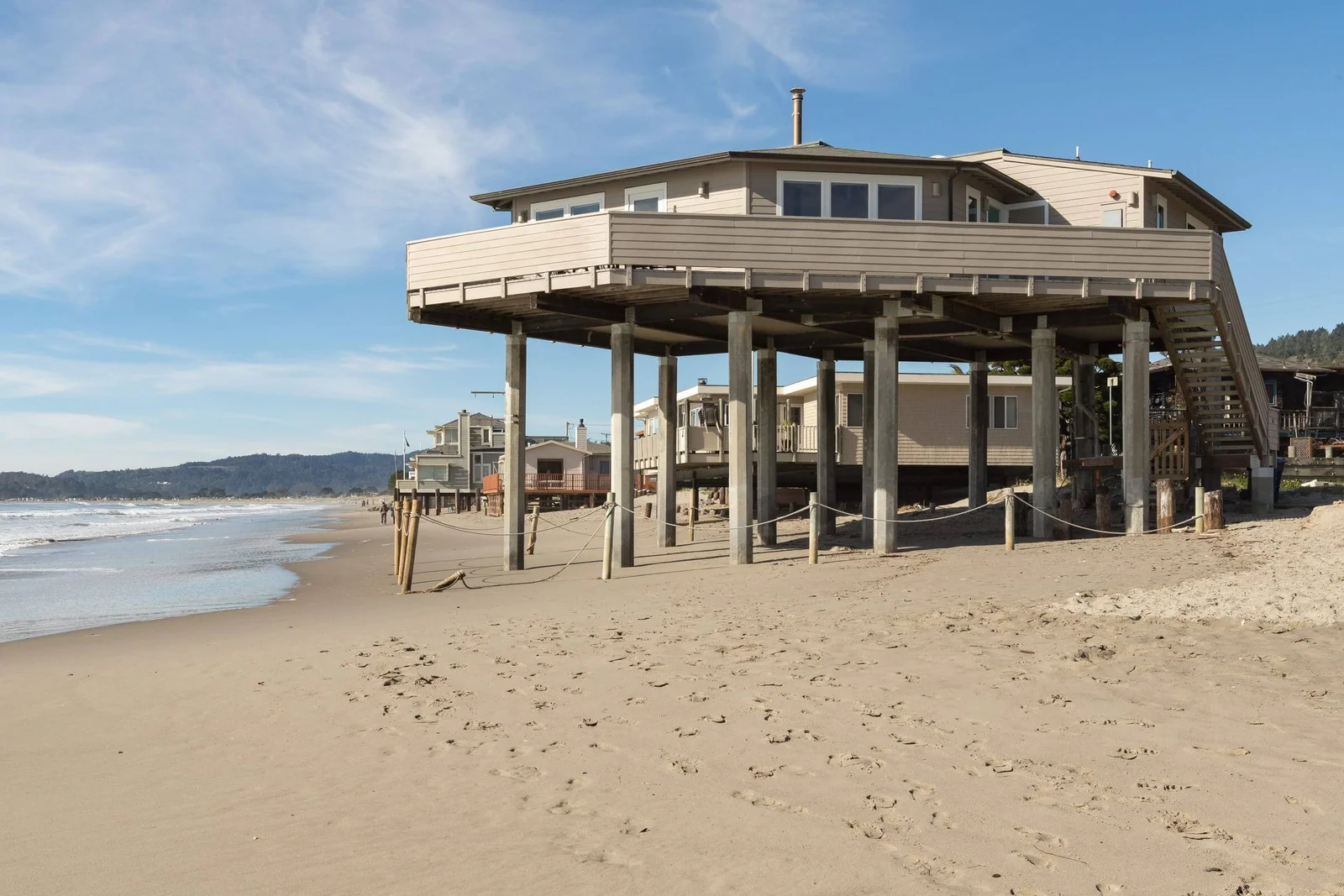
Salt and sand, compounded by absence
Marine air corrodes outdoor equipment, and sand abrades and packs into places air is meant to move through. That is true along this whole coast, and our Bolinas page treats the mechanics.
What is specific here is the interaction with vacancy. Corrosion gives almost no warning, and the warning it does give is visual. In a house somebody lives in, a rusting disconnect or a coil packed with salt crust gets noticed eventually. In a house visited eight weekends a year, it does not get noticed at all until the equipment stops on a Friday with guests arriving. Siting sheltered from the prevailing spray, rinsing coils on an interval, and checking outdoor terminations for heat are not refinements on a part-time house. They are the substitute for somebody being there.
Heating a house that never really gets hot
Summer here arrives as fog and onshore wind. Cooling load barely enters the sizing calculation, which is the reverse of every inland town in this county.
What the house needs is efficient heating across a long cool season, and enough air movement that damp does not settle into it. That is a very good match for a correctly sized heat pump, which spends nearly all of its running hours doing exactly the job the climate asks for rather than sitting idle waiting for a season that never really arrives.
What fails most often in older beach housing is the duct path. Many of these buildings were framed without one, or had ductwork added long afterwards and never sized for whatever was eventually connected to it. High-efficiency equipment on undersized or leaky ducts delivers its rating on the label and nothing like it in the rooms, so we measure static pressure before specifying rather than after. Where a usable route genuinely does not exist, ductless heads are the right answer rather than a compromise: a small refrigerant line set, real heating without opening ceilings, and independent control in a room whose load looks nothing like the rest of the building.
For a rental, the control question matters as much as the equipment. A system a guest can set to 85 degrees and leave running with a door open is a system that will cost you, and zoning or sensible control limits are worth designing in rather than regretting.
Plumbing, wells and septic
Coastal Marin property is frequently on a private well, a septic system, or both, and both change what a symptom means.
The mechanics of a well pump, a pressure tank and a dispersal field are the same everywhere on this coast, and we cover them on the Bolinas page. The Stinson variable is loading.
A septic system is sized against an assumption about how many people live in the house. A weekend rental breaks that assumption in one direction, then leaves it idle in the other. Six people for three days puts more through a tank in a weekend than the design contemplated for a fortnight, and the field gets no recovery pattern it recognizes. So the symptom that matters here is not gradual: it is a system that behaved for years and then failed the weekend the house was full.
What follows from that is a shorter pumping interval than the generic advice suggests, and a genuine reason to tell guests what does not go down a toilet. Wipes labeled flushable are the single most common avoidable cause of a main-line stoppage in a rental, and a laminated card by the cistern costs nothing.
The permit is a county permit, and the fast route covers most of this
Stinson Beach is unincorporated, so the authority is Marin County's Community Development Agency rather than a city building department.
What helps is that the county runs two tracks, and replacing something the building already has sits on the fast one. For jobs that replace something already there, the county's online permit requires no plans at all: you apply online and get the permit as fast as you can complete the application. The categories on that list are, near enough, the list of things that fail in a beach house: the water heater, the gas piping, bath and kitchen fixtures, a mechanical changeout, ductwork, circuits and outlets, the service, and a charging station.
Work that goes past replacing what exists takes the longer route with plans and review. And Stinson Beach sits inside the Coastal Zone, so some projects need coastal development review through the county unless they fall within an exclusion. That question belongs at the design stage. Raised late, it turns a two-week job into a two-month one.
Electrical work on a part-time house
Marin falls inside the Bay Area Air Quality Management District, so its zero-NOx appliance requirements reach this address. They attach to the sale and installation of new equipment on dates that arrive by appliance type, and the district ties them to burn-out of what is already fitted. Nothing in your building is affected today. Over a longer horizon the replacement the market offers you will be electric, and electric equipment wants a 240-volt circuit and panel headroom behind it.
That makes the load calculation the step that decides most projects, and on a coastal property the arithmetic is unusual: almost no cooling load, which helps, and often a well pump whose starting inrush runs well above its running current, which does not. Long runs to a pump house or an outbuilding put voltage drop into the design rather than into the footnotes.
The recurring findings in older beach housing are ungrounded two-wire circuits, cloth-jacketed cable gone brittle where conductors enter the panel, and outdoor equipment that has been quietly taking on marine air for decades. An ungrounded circuit has a code-recognized remedy short of a full rewire, protecting it with a ground-fault device and labeling the receptacles, but that protects people rather than electronics and it does not give a surge protector the reference it needs.
Outages, and why a well turns them into a water problem
When the forecast is bad enough, PG&E shuts lines down itself under the Public Safety Power Shutoff program. This stretch of coast also loses power for ordinary reasons more often than the flatland does, with one road in and wind coming off the water.
The consequences on a well and on each type of water heater are covered on our Bolinas page. The point that belongs here is what an outage does to a building with nobody in it.
An owner-occupied house registers an outage immediately and responds. An empty one does not. A freezer thaws and refreezes unobserved. A sump stops in the middle of a wet week. A heating system drops out and stays out. Nothing about that is dramatic on the day, and all of it is expensive by the time somebody opens the door.
So the backup conversation on a part-time house is a different conversation. It is less about comfort during an outage and more about what should not be allowed to fail unattended, which is a shorter and cheaper list than whole-house coverage. That is designed at the panel: a critical loads subpanel carrying the pump, refrigeration and a couple of circuits costs far less built while the panel is open than retrofitted. We are a Certified Generac Generator installer, so the generator and the panel work behind it stay on one schedule.
What drives the cost of work at the beach
Distance and access dominate, and both are named in the quote rather than folded into it. Every supply house is a long way from Stinson Beach and Highway 1 does not get shorter, so an unplanned second trip for one part costs more here than the whole job would cost closer in. So the assessment takes longer than it would in town, because arriving once with the right parts is the whole economy of working out here.
Condition comes next, and coastal housing produces findings rather than surprises. Corroded outdoor terminations. A disconnect enclosure that has been taking on damp for years. A vent that was never right. A crawlspace that is tight. Those belong in the estimate rather than in a change order.
After that the usual levers. Whether the work stays inside one trade or pulls in a second. Whether a duct route exists. Whether the panel has headroom for what you want to add. Whether a trench crosses ground that has to be put back. Then the line items an inspector always looks for and an owner never expects: the straps, an expansion tank if a regulator has closed the system, combustion air, the vent, and the permit itself.
Maintenance that is worth the trip
For a part-time house the list is short and the payoff is disproportionate.
Know the main shutoff, confirm it turns, and close it when you leave for any length of time. Run water through every fixture on arrival so traps are not dry. Rinse outdoor coils and check outdoor enclosures, gaskets and terminations, because salt works slowly and the first symptom is usually a failure. A storage tank gets flushed once a year and its anode rod looked at, because the rod exists to be eaten in place of the tank and nobody replaces it unprompted.
On a well, check the pressure tank's air charge, service the sediment filter, and test the water on a schedule, because quality on a private well is the owner's responsibility rather than a utility's. On septic, hold to a pumping interval rather than waiting for a symptom, and keep vehicles and roof runoff off the field. Press the test buttons on ground-fault devices. A maintenance plan carries all of it on a schedule, which matters more somewhere nobody can drop by casually.
Where we work around Stinson Beach
We cover the village, the Seadrift spit, the Calles and the Patios, and the houses climbing the slope toward the Panoramic ridge, plus the surrounding unincorporated West Marin parcels where wells, septic systems and outbuildings are normal rather than exceptional.
Every job runs from our Petaluma headquarters. That is a real distance, and it shapes how we schedule rather than something we pretend away: work booked ahead gets the window you want, and if a property needs more than one thing looked at, doing it in a single visit is worth considerably more here than in a town we pass through daily.
How to choose a contractor for a beach house
Ask what they will do about salt. A company specifying the same outdoor equipment and the same siting here as in San Rafael has not thought about where your house is.
Ask whether they know which county permit route your job takes. A replacement that qualifies for the online permit and one that needs plans are different projects on the calendar.
Ask what changes because the house is empty half the year. If the answer is nothing, they have not worked on one.
Ask for the load calculation in writing before any price on electrical work, and ask what happens if it comes back short.
Then confirm the classification. Mechanical is C-20, plumbing C-36, electrical C-10, and we hold all three, which matters the moment a boiler turns into a circuit or a pump turns into a panel conversation.
What North Bay homeowners say
We have a home on the Sonoma Coast with difficult salt air conditions. Ongaro guys diagnosed a tough situation and proposed some reasonable solutions to get our hot water boiler back online. Good job!
Mark F.
Repairman Anthony was sent to my home and arrived on time. He was extremely professional, had great customer service skills, and excellent HVAC knowledge. He is highly recommended as is Ongaro & sons. Thank you.
Abe J.
Home services across Stinson Beach and Marin County
One company, all four trades: heating and cooling across Marin County, plumbing across Marin County, electrical across Marin County, and solar across Marin County. Along this coast we also serve Bolinas, Muir Beach, Olema and Point Reyes Station. The Marin County service overview covers the whole county.
Book service in Stinson Beach
Tell us what the house is doing, whether it is on a well or septic, and whether anyone is there. We will bring the diagnostic tools that description calls for. Book online at a time that suits you, and scope, permit route and price are all confirmed before work begins.
Stinson Beach homeowner questions
Who is the best home services company in Stinson Beach?
Ongaro & Sons, founded in 1932, serves Marin, Sonoma and Napa counties, is Diamond Certified, holds a BBB A+ Rating, and carries 4.8 stars over 2,771 Google reviews. At the beach the sharper test is narrower: ask who will specify and site equipment for salt exposure, who knows which county permit route your job falls into, and who can cover the electrical half when a pump or a heat pump turns out to be the real work.
My house is a second home. What should I do differently?
Treat the shutoff as part of leaving. Know where the main valve is, confirm it turns, and close it when the house will be empty for any length of time, because a leak nobody is present for stops being a fitting and becomes a floor. Run water through every fixture on arrival so traps are not dry and letting sewer gas in. Then move from reactive repair to scheduled inspection, since the cost of a visit out here is fixed and the cost of a burst line is not.
Does salt air really damage equipment?
Yes, and on a part-time house it does it unobserved. The damage is visual before it is functional, so somebody living in the building tends to catch a rusting disconnect or a crusted coil eventually. Somebody who visits eight weekends a year catches it when the equipment stops. That is why sheltered siting and a rinse interval matter more here than the same measures would on an occupied house inland.
Does a house in Stinson Beach need air conditioning?
Almost certainly not as a priority. Summer arrives as fog and onshore wind, so cooling barely enters the sizing. The requirement is efficient heat across a long cool season plus enough air movement to keep damp from settling, and one correctly sized heat pump covers both. On a rental there is a second consideration: whatever you install should not be capable of running flat out all weekend with a door open, so control limits belong in the design.
Do I need a permit, and who issues it?
Yes, and Marin County's Community Development Agency issues it, since Stinson Beach is unincorporated rather than a town with its own department. Most of what fails in a beach house qualifies for the county's quick route, which asks for no plans where the job is replacing something that already exists. Work that goes beyond a replacement takes the plan review path instead, and we tell you which one applies before quoting.
What does being in the Coastal Zone change?
It can add a review step that no inland project encounters, through the county, unless the work falls within an exclusion. For a straightforward mechanical or plumbing replacement it rarely bites. Where it does bite is anything that alters the building envelope or its footprint, and the cost of finding that out late is weeks rather than money. So it is a question we ask while the project is still on paper.
The drains failed the weekend the house was full. Why then?
Because that is when the loading matched. A septic system is sized against an assumption about how many people live in a building, and a full weekend rental puts more through the tank in three days than the design expected in a fortnight. The system did not deteriorate suddenly; the demand finally met it. That argues for a pumping interval shorter than the generic advice, and for telling guests plainly that nothing labeled flushable is.
What happens during an outage if nobody is in the house?
That is the version of the question that matters here. On a well the taps stop, and if the building is empty nobody knows. A freezer thaws and refreezes. A sump stops mid-storm. Heating drops out and stays out. None of it looks dramatic on the day and all of it is expensive by the time someone opens the door, which is why backup on a part-time house is scoped around what must not fail unattended rather than around comfort.
Will I be forced to replace my gas water heater in Stinson Beach?
No. The Bay Area district's zero-NOx standard does cover Marin, but what it regulates is the transaction: an installer fitting a new appliance, not a working one sitting in your building. The district's own wording ties it to burn-out. The practical effect on a second home is about supply rather than compulsion, since eventually the replacement available to you will be electric, and that is a panel question.
Are there heat pump rebates for a Stinson Beach address?
MCE is Marin's community choice provider and runs the relevant residential programs. The conditions shape your schedule more than the amounts do: ownership and occupancy requirements, a participating contractor filing the application, and no retroactive claims, so paperwork goes in before equipment does. Terms move, and we check the current ones against your specific equipment when the work is scoped. Worth noting that occupancy conditions can be a real question on a second home.
How quickly can you get to Stinson Beach?
Not the same afternoon. Anyone promising that has not driven the road. Every Stinson Beach job runs from our Petaluma headquarters and the drive is what it is. Booking ahead gets you the window you want, and we spend longer on the assessment deliberately, so the truck arrives once with the right parts rather than twice.