Heater Repair: How To Troubleshoot Common Problems
A heater that stops working on a cold the North Bay morning is one of those problems that demands immediate attention but rarely has an obvious answer. Is it the thermostat? A tripped breaker? A failing ignition component? Something more serious? Most homeowners have no reliable framework for telling the difference, which means they either wait too long hoping it resolves on its own, or they call for service before doing the basic checks that might have avoided the trip altogether.
This guide gives you that framework. It covers the observation-based troubleshooting any homeowner can safely do, the specific warning signs that indicate a genuine mechanical problem, the critical safety scenarios that require immediate action, and how to think clearly about repair versus replacement when a system is aging. By the end, you’ll have a concrete sense of what you can evaluate yourself and when the right call is to get a licensed professional involved.
Heater repair in Marin County and Sonoma County tends to be more nuanced than homeowners expect, largely because the housing stock is diverse and the climate is deceptive. Coastal fog and marine air create conditions that accelerate corrosion on heating equipment. Hillside homes in Mill Valley or Fairfax often have systems installed in unusual configurations. Older craftsman homes in San Anselmo or Santa Rosa may still have equipment from a previous era of heating technology. And North Bay winters, while mild compared to much of the country, deliver cold snaps that arrive quickly and test systems that haven’t been serviced in years.
Understanding your system, its warning signs, and its limits is the foundation of being a prepared homeowner.
Understanding Your Home Heating System
Before troubleshooting any heater problem, you need to know what type of system you’re working with. Most homes across Marin, Sonoma, and Napa Counties rely on one of three primary heating approaches, each with distinct characteristics and distinct failure modes.
Forced-air furnaces are the most common system in the North Bay. A furnace burns natural gas to heat air, which a blower then distributes through a duct network to registers throughout the home. When something goes wrong, the symptoms typically show up as no heat, insufficient heat, or the blower running without producing warm air. According to the U.S. Department of Energy, furnaces range widely in efficiency depending on age and design, with modern high-efficiency condensing units operating at 95% or better Annual Fuel Utilization Efficiency (AFUE), compared to older systems that may operate at 70% or lower.
Heat pumps move heat from outside air into the home during winter rather than generating it through combustion. They’re efficient, versatile, and increasingly common in the North Bay as California’s electrification policies shift the market. The Department of Energy notes that a modern air-source heat pump can reduce electricity use for heating by up to 75% compared to electric resistance heating. However, heat pumps have their own troubleshooting logic: because they operate in both heating and cooling modes, problems with refrigerant, reversing valves, or defrost cycles don’t always look like traditional heating failures.
Boiler-based systems heat water and distribute it through radiators, baseboards, or radiant floor tubing. They’re quieter than forced-air systems and produce a different quality of warmth. They’re also common in older Marin County and Sonoma County homes. Boiler problems tend to show up differently from furnace problems, often involving pressure issues, zone control failures, or circulation pump problems rather than ignition or airflow concerns.
Knowing your system type is the most important single piece of context before you start troubleshooting. Look at the equipment itself, check your owner’s manual, or simply note whether your home has vents and ductwork (furnace or heat pump) or radiators and baseboards (boiler) to confirm what you’re working with.
What Homeowners Can Safely Check Before Calling for Heater Repair
Much of the preliminary work in heater repair doesn’t require tools, specialized knowledge, or any contact with mechanical components. It requires careful observation and a methodical mindset. Working through these checks before calling a technician will either resolve the problem, confirm it’s beyond DIY scope, or give you more useful information to share when you do make that call.
Start at the Thermostat and Work Outward
The thermostat is responsible for a surprising number of service calls that turn out to have nothing to do with the heating equipment itself. Confirm it’s set to “heat” mode rather than “cool” or “auto,” and verify the set temperature is meaningfully higher than the current room reading. On a battery-powered thermostat, weak batteries can cause the display to go dark or the system to stop receiving signals entirely, which looks exactly like a system failure. A fresh set of batteries is worth trying before anything else.
Thermostat placement matters more than most homeowners realize. If your thermostat is positioned near a south-facing window that receives direct afternoon sun, close to a lamp that runs for several hours each evening, or in a room that warms unusually quickly, it may be reading the temperature as higher than the rest of the house actually is. The result is a system that shuts off before your living spaces are comfortable. That’s a calibration and placement issue, not a mechanical one.
If you have a smart thermostat, check that its scheduling settings match your actual occupancy patterns. It’s common for occupancy schedules to get out of sync after travel, holidays, or time changes, causing the system to hold back heat during hours when people are actually home.
Check the Circuit Breaker and Power Switch
Every heating system draws significant electrical power, which means electrical supply is always worth confirming before assuming a mechanical problem. At your main electrical panel, look for the breaker labeled for the furnace, air handler, or HVAC system. A tripped breaker sits in the middle position rather than cleanly on or off. To reset it, flip it fully to the off position first, then back on. If it trips again immediately or within minutes of the system running, stop and call a professional. A repeatedly tripping breaker indicates an electrical problem that requires licensed attention.
Gas furnaces almost always have a dedicated power switch located on or near the unit itself. It resembles a standard light switch and is easy to accidentally bump off during activity in a utility room, basement, or closet. It’s surprisingly common for this switch to be the entire explanation when a furnace won’t start.
For homes with heat pumps, also check the outdoor disconnect box near the exterior unit. These can sometimes trip or be switched off during landscaping, pest control visits, or other exterior work.
Inspect and Replace the Air Filter
A severely clogged air filter creates cascading problems that can look like major mechanical failures but cost almost nothing to address. When airflow is sufficiently restricted, the system can’t move enough air across the heat exchanger to maintain safe operating temperatures, so a high-limit safety switch shuts it down. It cools off, then restarts, then overheats and shuts down again. This pattern, called short cycling, is commonly mistaken for ignition problems, control board failures, or blower issues.
Hold the filter up to a light source. If you cannot see light passing through, it needs immediate replacement regardless of when it was last changed. The ENERGY STAR program recommends checking and replacing filters regularly as one of the most impactful things homeowners can do to maintain heating system performance and longevity.
During active heating season in the North Bay, most homes should check filters monthly. Homes with pets, recent construction, or higher dust loads may need replacement every four to six weeks. Homes with a single occupant and no pets can sometimes extend to three months. The filter itself will tell you the truth when you hold it to the light.
Walk the House and Check Your Vents
For forced-air systems, spend two minutes walking through every room and confirming that supply vents (the ones blowing air) and return vents (the ones pulling air back) are fully open and unobstructed. Furniture pushed against a return register, rugs laid over floor vents, or registers partially closed in rooms that “don’t need as much heat” all create pressure imbalances that degrade system performance across the entire home.
Contrary to popular belief, closing vents in unused rooms doesn’t save energy on most systems. It actually increases static pressure in the duct system, which can force air through leaks in ductwork, reduce efficiency, and cause components to work harder against the increased resistance. If comfort-based zoning is a goal, that’s a conversation about a proper zone control system, not a manual damper approach.
Listen to the System Run
This step is about active attention rather than passive waiting. When your system runs, what do you actually hear? A well-functioning forced-air system produces a steady blower hum and a smooth whoosh of air. When it cycles off, you may hear the blower wind down gradually. That’s normal.
What falls outside normal: a loud bang or boom when the system fires, rattling or metallic vibration during operation, high-pitched squealing or screeching, continuous clicking that doesn’t resolve into steady operation, or rumbling and grinding sounds that weren’t present before. Each of these sounds differently and points toward different components. Note what you hear, when in the cycle it occurs, and how long it lasts. This information is genuinely useful diagnostic context for a technician and can meaningfully shorten the time required to identify and resolve the problem.
Warning Signs That Require Professional Heater Repair
Beyond what observation reveals, certain patterns and symptoms indicate real mechanical problems that require a licensed technician. Knowing these helps you communicate clearly with a professional and calibrate the urgency of scheduling service.
Heating Output That Doesn’t Match the Thermostat Setting
If the system runs normally, the blower operates, and air moves through the vents, but the air coming out isn’t warm, there’s a combustion or heat transfer problem. In a gas furnace, this typically means the burners aren’t igniting, the igniter has failed, or the flame sensor is too dirty or degraded to confirm combustion and keep the gas valve open. These are mechanical failures that require replacement parts and professional diagnosis.
In a heat pump, warm air that progressively gets less warm, particularly as outdoor temperatures drop, can indicate refrigerant charge issues, a failing compressor, or a reversing valve problem. Heat pumps operate differently than furnaces and their diagnostic process is correspondingly different. A technician needs to measure refrigerant pressure, check electrical components, and verify the reversing valve cycle to get to the bottom of performance degradation.
Sounds That Weren’t Present Before
Certain sounds in a heating system are worth taking seriously, not just as an inconvenience, but as indicators of progression toward a larger failure.
A banging or booming sound at startup, particularly in gas furnaces, almost always indicates delayed ignition. Gas accumulates briefly before igniting all at once, creating the bang. It’s worth taking seriously for two reasons: it’s hard on the heat exchanger, which is a costly component, and a cracked heat exchanger can allow combustion gases including carbon monoxide to enter the air stream circulated through your living space.
Squealing or screeching during blower operation indicates a motor bearing that needs lubrication or is approaching failure, or a belt in older systems that is slipping or worn. Neither is an emergency, but neither should be ignored. A motor that fails completely leaves you with no heat distribution at all.
Rattling during operation can be as simple as a loose panel or as significant as a loose heat exchanger component. If tightening the access panel doesn’t resolve it, the source needs to be identified professionally.
Continuous clicking that doesn’t stop or that repeats in a pattern after startup typically points to ignition system problems. The igniter sparks, fails to confirm flame, and tries again. This cycle repeats until the control board locks out and shuts the system down. You may see an error code on a modern thermostat or control board.
Short Cycling
Short cycling is the pattern where the system turns on, runs for a few minutes, shuts off, and repeats this cycle without completing a full heating run and reaching the thermostat set point. It’s both a symptom and a problem in itself. A system that short cycles puts more wear on components per hour of operation than a system running normal cycles, which accelerates aging across the board.
Causes range from the simple and homeowner-addressable (dirty filter, obstructed vents, thermostat placement) to the complex and professional (oversized equipment, failing limit switch, refrigerant issues, heat exchanger problems). If you’ve addressed the simple causes and the pattern continues, it’s time for professional diagnosis.
Uneven Heating Across the Home
When some rooms reach temperature comfortably and others consistently run cold, the problem could be in the duct system (leaks, disconnects, or inadequate sizing), zone control issues, or equipment capacity that doesn’t match the load of the space. Homes in Marin and Sonoma Counties often have additions, converted garages, or unusual floor plans where the original duct design was never updated to serve the full house appropriately. These are not thermostat or filter problems. They require professional assessment of airflow, static pressure, and duct design to address correctly.
The Safety Situations That Change the Calculus Entirely
There are circumstances where the right response is not to troubleshoot or schedule service, but to stop using the equipment immediately and take action now. These are non-negotiable.
The Smell of Gas
Natural gas is odorless, but utility companies add mercaptan, a sulfur compound, so that leaks are detectable by smell. If you detect a sulfur or rotten egg odor near your furnace, at the gas meter, or anywhere inside the home, do the following: do not use any light switches, do not use your phone while still inside, leave the home immediately, and call your gas utility from outside. This is not a situation where you turn off the furnace, open a window, and wait. Gas leaks require emergency response from the utility, and the source of the leak must be identified and repaired by a licensed professional before the system is used again.
Carbon Monoxide
California enacted the Carbon Monoxide Poisoning Prevention Act in 2010, which requires homes with gas appliances or attached garages to have carbon monoxide detectors installed per California Residential Code Section R315. If your CO detector alarm sounds, evacuate immediately and call emergency services. Carbon monoxide is odorless, colorless, and lethal in sufficient concentrations.
Even without an alarm, the EPA’s indoor air quality guidance notes that symptoms including headache, dizziness, nausea, and confusion that appear when the heating system is running and resolve when you leave the home are warning signs of possible CO exposure. A cracked furnace heat exchanger is the most common source of CO contamination in heating systems and is a condition that can exist without any obvious symptom other than these physiological signs.
Every home with a gas furnace should have working carbon monoxide detectors located outside sleeping areas and on every occupiable level. If yours are more than five years old, they should be replaced regardless of whether the current heating season has produced any alarms.
A System Over 20 Years Old Showing New Symptoms
Age doesn’t automatically disqualify a heating system. Well-maintained equipment can operate reliably for 20 to 25 years or beyond. But the ENERGY STAR program advises that furnaces over 15 years old and heat pumps over 10 years old showing new problems or declining performance are strong candidates for evaluation rather than repair. As systems age, the cost and frequency of repairs tends to accelerate, and the efficiency gap between aging equipment and modern systems grows.
The calculus isn’t just about this repair versus doing nothing. It’s about this repair versus a repair six months from now, and another one after that, on equipment that is producing substantially more energy cost per degree of heating than a current system would. A competent professional will give you that picture plainly rather than simply recommending the repair in front of them.
Repair Versus Replacement: How to Think Through It
This is one of the questions homeowners most frequently get wrong, usually because they’re either focused only on immediate cost or because they’re relying on guidance from someone who has an incentive to push in one direction. Here’s a clear framework.
Repair makes sense when: the system is less than 10 to 12 years old, the repair addresses a single well-defined component rather than a pattern of failures, the system has been maintained consistently, and the repair cost is modest relative to the remaining useful life of the equipment.
Replacement makes sense when: the system is approaching or beyond typical lifespan, repair costs are significant relative to the cost of new equipment, multiple components are failing or showing wear simultaneously, the system’s efficiency has declined noticeably (evidenced by rising energy bills for the same level of comfort), or there are safety concerns such as a cracked heat exchanger that can’t be economically repaired.
For many North Bay homeowners, this conversation also involves California’s evolving energy landscape. The state’s electrification policies and the growing availability of high-performance heat pump systems make replacement a qualitatively different decision than it was a decade ago. A modern cold-climate heat pump can handle the North Bay winters effectively while delivering both heating and cooling from a single system, with greater efficiency than a gas furnace at most operating conditions. That changes the long-term economics of sticking with aging gas equipment.
The Case for Preventative Maintenance
Professional annual maintenance is not a sales tactic. It’s the single most reliable way to prevent the unpleasant intersection of a system failure and winter weather, and the evidence for its value is consistent. The Department of Energy’s guidance on heat pump maintenance notes that the difference in energy consumption between a well-maintained and a neglected heat pump can range from 10% to 25%. For furnaces, the degradation is similar: combustion efficiency declines, heat exchangers accumulate stress, and safety controls that weren’t tested eventually fail when they’re most needed.
What professional maintenance covers that homeowner observation cannot includes combustion analysis to verify efficient and safe burner operation, heat exchanger inspection for cracks or deterioration, measurement of static pressure and airflow to identify duct problems before they cause component damage, testing of all safety controls and limit switches, refrigerant charge verification for heat pumps and cooling systems, and documentation of equipment condition to support repair versus replacement decisions over time.
Ongaro and Sons has provided professional heating maintenance across Marin County, Sonoma County, and Napa County since 1932. Now in its fourth generation of family ownership, the company employs certified technicians who have demonstrated real-world knowledge of modern heating and cooling systems through industry-recognized testing. industry certification, as the Department of Energy describes it, ensures that technicians have the verified competency to install and service sophisticated HVACR equipment correctly, which directly translates to longer equipment life, greater efficiency, and fewer callbacks.
The Ongaro maintenance membership program provides annual system inspections, priority scheduling, and the kind of documented equipment history that makes repair versus replacement decisions straightforward rather than arbitrary.
What to Expect from a Professional Heater Repair Service Call
When the situation requires professional heater repair, knowing what a quality service call looks like helps you evaluate what you’re getting.
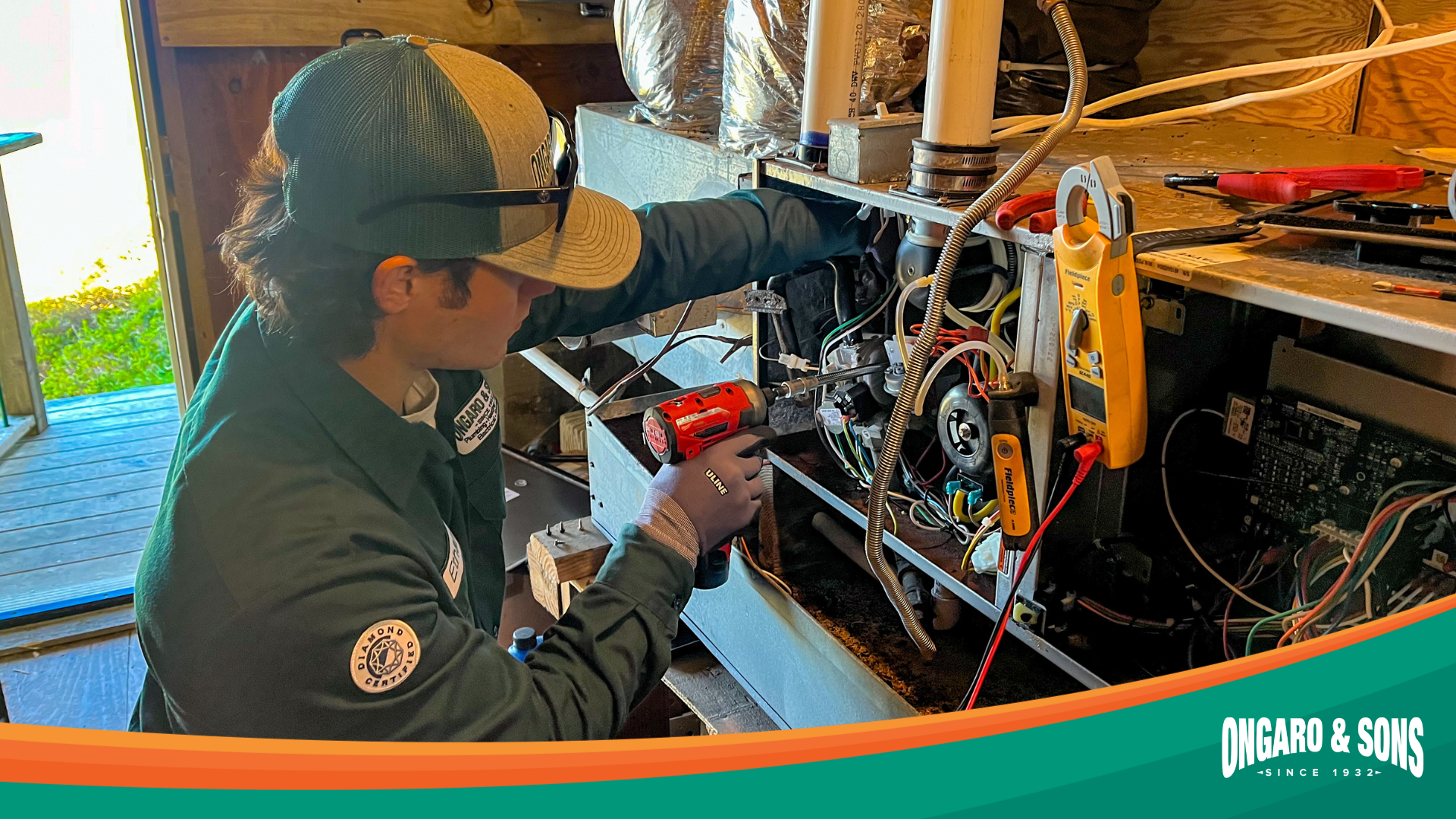
A competent technician begins with a complete diagnostic before recommending any repair. That means asking about symptoms, reviewing system history if available, and testing components systematically rather than replacing whatever seems most likely. You should receive a clear explanation of what was found, why it happened, and what your options are. Flat-rate pricing, confirmed before any work begins, is standard practice for reputable contractors. No one should start a repair without you understanding and agreeing to the cost.
Before the technician arrives, write down everything you’ve observed: when the problem started, what sounds or smells you noticed, what you’ve already checked, whether the issue is constant or intermittent, and whether anyone in the household has experienced headaches or other symptoms while the system was running. This context helps the diagnostic process and ensures nothing relevant gets skipped.
Legitimate heating repair professionals are licensed by the state of California, carry insurance, and warranty their work. California Contractor License #215233 is the credential Ongaro holds, and it can be verified through the Contractors State License Board. Any contractor working on gas or electrical systems in California should be able to demonstrate equivalent credentials.
Preparing for Cold Weather in the North Bay
The the North Bay climate has a specific characteristic that catches homeowners off guard: temperatures can drop faster than the forecast suggests, particularly in inland Sonoma County valleys and higher-elevation Marin County communities. A system that ran fine last winter may have accumulated a year’s worth of wear since then, and the first cold night of the season is not the moment to discover it.
The simplest preparation is scheduling professional maintenance before the heating season begins, typically in September or October. This gives technicians time to identify and address anything that needs attention before temperatures drop. It also means you’re working with a realistic picture of your system’s condition rather than hoping for the best.
Between professional visits, replace filters on schedule, keep the area around heating equipment clear, verify that all vents and registers throughout the home are open and unobstructed, and confirm that carbon monoxide detectors are functional and within their service life. These are small habits that consistently make a real difference.
Schedule a Heating Evaluation with Ongaro and Sons
If your heater isn’t performing the way it should, or if it has been more than a year since a professional looked at your system, Ongaro and Sons is ready to help. Family-owned since 1932, Diamond Certified, and staffed by certified technicians, we bring genuine expertise to every service call. Our upfront flat-rate pricing means you know exactly what you’re agreeing to before any work begins, and our 100% satisfaction guarantee backs every repair.
We serve homeowners throughout Marin County, Sonoma County, and Napa County. Call us or schedule online to talk with our team about your heating system.
Frequently Asked Questions About Heater Repair
Why is my heater running but the air coming out isn’t warm?
If the blower is running and you feel airflow from the vents but the air is room temperature rather than warm, the heating side of the system isn’t functioning. In a gas furnace, this typically means the burners aren’t igniting. The igniter may have failed, the flame sensor may be too coated with residue to confirm combustion, or the gas valve may not be opening. In a heat pump operating in heating mode, inadequate warmth can indicate refrigerant charge issues or a problem with the reversing valve. Both situations require professional diagnosis and repair. The blower running on its own is sometimes a normal behavior if the system locks out after multiple failed ignition attempts. Check your thermostat for an error code, then call for service.
What causes a furnace to make a loud bang when it starts?
A bang or boom at startup is almost always delayed ignition. In a gas furnace, the igniter triggers before the gas valve opens, so there’s a sequence where gas is introduced and then ignited. If the igniter is weak or the burners are dirty, there can be a brief delay where gas accumulates before igniting all at once, producing the bang. This places stress on the heat exchanger and should be evaluated promptly. Repeated delayed ignition over time can crack a heat exchanger, which then allows combustion gases including carbon monoxide to enter the air supply circulated through your home. A technician can test igniter performance, clean burners, and inspect the heat exchanger to confirm it hasn’t been compromised.
How do I know whether to repair or replace my heating system?
The straightforward answer depends on several factors evaluated together. Age matters: furnaces typically have a useful life of 15 to 20 years, heat pumps 10 to 15 years, and boilers can run longer with proper maintenance. Beyond age, the pattern of failures matters more than any single repair. A system that has required one repair in ten years is in a very different position than one that has needed two or three repairs in the past two years. Efficiency decline also factors in, since aging systems that cost substantially more to operate than a current system would produce a clear economic case for replacement even before a major component fails. A trustworthy contractor will lay out this picture plainly and help you weigh the options rather than simply defaulting to the easier path.
Is short cycling a serious problem?
Short cycling, where the system turns on and off repeatedly in quick intervals without completing a full heating cycle, is worth addressing promptly. It’s hard on components because startup and shutdown put more mechanical stress on electrical and mechanical parts than steady operation does. It also means your home never reaches the set temperature efficiently. The cause could be simple (a clogged filter, an obstructed return vent, a thermostat near a heat source) or significant (a failing limit switch, an oversized system, refrigerant issues). Start with the filter and vent checks. If the problem continues after addressing those, schedule a professional diagnosis.
What should I do if I smell gas near my furnace?
Leave the home immediately without using any electrical switches or your phone while still inside. Once outside, call your gas utility company’s emergency line. Do not re-enter the home until the utility has responded and confirmed the area is safe. A gas smell near heating equipment is not a situation to investigate further yourself, ventilate away, or treat as something that might resolve on its own. After the utility responds and the source is identified, a licensed plumbing or HVAC contractor must inspect and repair the gas line or appliance connection before the system can be operated again.
How often should a heating system be professionally serviced?
Annual professional maintenance is the standard recommendation for all residential heating system types, including furnaces, heat pumps, and boiler systems. The timing that works best for most households is late summer or early fall, before heating season begins. This allows any issues identified during the inspection to be addressed before temperatures drop. For heat pumps that are used year-round for both heating and cooling, some manufacturers recommend inspections twice annually. In between professional visits, replace air filters monthly during active heating season and keep all vents and equipment access areas clear.
Are there California-specific requirements for heating system safety I should know about?
Yes. California requires carbon monoxide detectors in all homes with gas appliances, fireplaces, or attached garages under the Carbon Monoxide Poisoning Prevention Act (SB 183), codified in the California Health and Safety Code and the California Residential Code Section R315. Detectors must be installed outside sleeping areas and on every occupiable level of the home. Any home with a gas furnace that does not have working, properly placed CO detectors is out of compliance with state law and is missing a critical safety layer. If you’re uncertain whether your detectors are correctly placed or still within their service life, this is worth confirming before the heating season begins.