Is Solar Still Worth It in the North Bay Without the Federal Tax Credit?
Solar can still make sense for many North Bay homes, but it takes longer to pay for itself than it did in 2025. The 30 percent federal tax credit for homeowner-owned systems ended for systems installed after December 31, 2025, and California's billing rules pay less for the solar power you send to the grid than you pay for the power you buy. What remains is the value of using your own solar power at home, often with a battery.
Quick answer.
- There is no federal tax credit for a homeowner-owned system installed in 2026 or later. A 2025 installation is claimed for the 2025 tax year, and any unused credit carries forward to later years.
- Solar is still worth evaluating if your roof gets good sun, your household uses a meaningful amount of electricity, and you plan to stay for years.
- Adding a heat pump or an electric vehicle raises your electricity use, which tends to strengthen the case.
- A battery can raise the value of your solar under PG&E's Solar Billing Plan and can provide backup power if it is set up for it, but it adds cost. Compare estimates with and without one.
- Get an estimate built from your own 12 months of PG&E usage before deciding.
PG&E calls California's current solar billing rules the Solar Billing Plan. You may also see them called NEM 3.0 or the Net Billing Tariff, the official name. This article uses Solar Billing Plan.
North Bay homes have three things in their favor. Summers are long and dry, so solar production is strong for most of the year. Power outages from shutoffs and winter storms make a battery more useful here than in many places. And homes moving from gas to electric heating and hot water use more electricity, which is what solar offsets.
What Changed for Solar After 2025?
For a homeowner buying a system, the first row matters most. The rest are context.
| Through 2025 | 2026 and after | |
|---|---|---|
| Federal tax credit for homeowner-owned systems (Section 25D) | Through 2025 30 percent of the system cost | 2026 and after Ended for systems installed after December 31, 2025 |
| Leased systems and power purchase agreements | Through 2025 The system owner could claim a business credit | 2026 and after The owner can still claim a business credit only if construction began by July 4, 2026, or the system is in service by December 31, 2027, among other conditions |
| California property tax exclusion for new solar | Through 2025 New solar did not raise your assessed value | 2026 and after Inoperative from January 1, 2027. New systems completed after that generally do not qualify |
| Credit for power sent to the grid | Through 2025 Solar Billing Plan for PG&E customers who applied on or after April 15, 2023 | 2026 and after Unchanged: credits vary by hour and month and are lower than retail prices |
| PG&E bill structure | Through 2025 Minimum monthly charge | 2026 and after Fixed Base Services Charge since March 2026, with lower per-kilowatt-hour prices |
| State battery incentive (SGIP) | Through 2025 Available, with funding that varied | 2026 and after Program continues. In October 2026 the residential steps for PG&E customers were closed or waitlisted |
The IRS explains the end of the homeowner credit on its Residential Clean Energy Credit page. A qualifying system installed in 2025 is claimed for the 2025 tax year. The credit is nonrefundable, and the IRS says any unused amount carries forward to reduce tax in future years, so a 2025 credit can still lower your 2026 tax. A homeowner-owned system installed in 2026 or later earns no new credit.
The property tax change matters for anyone installing now. California's exclusion kept new solar from raising a home's assessed value. The State Board of Equalization's September 2026 letter to county assessors confirms the exclusion becomes inoperative on January 1, 2027, and that systems already excluded stay excluded until the property changes ownership. Its 2024 guidance explains how construction in progress around the deadline is treated, so a project already under way may be assessed differently. As of October 2026, no extension had been enacted. Your county assessor decides how a new system is assessed.
Tax and program details checked October 20, 2026. Talk with a tax professional about your own situation.
How Does the Solar Billing Plan Work?
The Solar Billing Plan applies to PG&E solar customers who applied to connect on or after April 15, 2023. Three features shape a system's value under it:
- Exports earn less than imports cost. Power you send to the grid earns a credit based on its estimated value to the grid at that hour. Those credits are lower than the price you pay for power from the grid at most times of day.
- Timing matters. Export credits vary by hour and by month, and the power you buy is priced by time of use. PG&E says Solar Billing Plan customers are automatically enrolled in its Electric Home rate plan, where the peak price window runs from 4 to 9 p.m.
- Self-use is worth the most. Every kilowatt-hour your home uses directly from your panels, or stores and uses later, avoids buying power at the retail price.
| Legacy net metering (NEM 1 and 2) | Solar Billing Plan | |
|---|---|---|
| Who is on it | Legacy net metering (NEM 1 and 2) Customers who applied by April 14, 2023 | Solar Billing Plan Customers who applied on or after April 15, 2023 |
| Credit for exported power | Legacy net metering (NEM 1 and 2) Close to the retail price | Solar Billing Plan Varies by hour and month, lower than retail |
| Value of a battery | Legacy net metering (NEM 1 and 2) Helpful for backup | Solar Billing Plan Helpful for backup and for shifting solar to the evening peak |
The CPUC's page on the Net Billing Tariff states that the change did not affect customers who submitted a net metering application by April 14, 2023.
If your electricity comes from Sonoma Clean Power or MCE, which supply electricity to many homes in Sonoma, Marin and Napa County, they set the credit for the generation portion of your exports, while PG&E delivers the power. Sonoma Clean Power describes its version on its Solar Billing Plan page, and MCE publishes its own terms. Ask any installer to model your savings with your actual provider.
Rate and billing details checked October 19, 2026.
How Much Does a North Bay Solar System Produce?
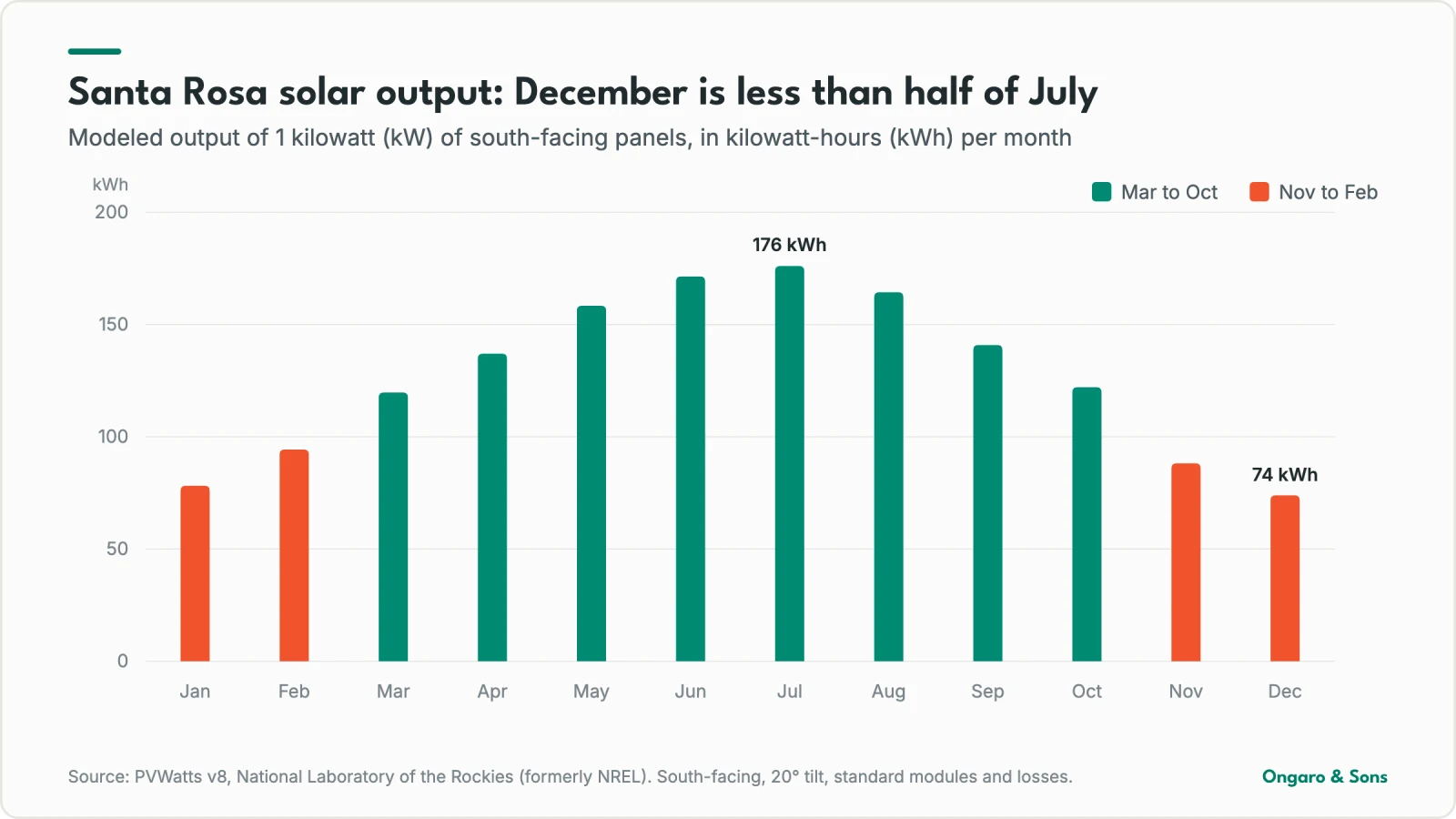
A kilowatt (kW) is a measure of a solar system's size. A kilowatt-hour (kWh) is the energy it produces over time. The National Laboratory of the Rockies (formerly NREL) estimates that each kilowatt of south-facing panels in Santa Rosa produces about 1,524 kWh a year: about 176 kWh in July and about 74 kWh in December. That is about 5.7 kWh a day per kilowatt in July, and about 2.4 a day in December.
| Month | Modeled output per kW |
|---|---|
| Month January | Modeled output per kW 78 kWh |
| Month February | Modeled output per kW 94 kWh |
| Month March | Modeled output per kW 120 kWh |
| Month April | Modeled output per kW 137 kWh |
| Month May | Modeled output per kW 158 kWh |
| Month June | Modeled output per kW 171 kWh |
| Month July | Modeled output per kW 176 kWh |
| Month August | Modeled output per kW 164 kWh |
| Month September | Modeled output per kW 141 kWh |
| Month October | Modeled output per kW 122 kWh |
| Month November | Modeled output per kW 88 kWh |
| Month December | Modeled output per kW 74 kWh |
A system sized to cover your annual usage will produce more than you use in summer and less than you use in winter. The four months from November through February produce about 22 percent of the year's output. That matters if your electricity use peaks in winter, which is likely if you heat with a heat pump.
Your own roof may differ from the model. Shade from trees, a roof facing east or west, and coastal fog in parts of Marin and southern Sonoma all reduce output. You can model your address with the free PVWatts calculator, and any installer's production estimate should account for shading on your roof.
How Does Electrification Change the Case for Solar?
Electrification means replacing gas equipment, such as a furnace or water heater, with electric equipment. Solar delivers the most value when your home uses electricity during the day, and three kinds of equipment add daytime use:
- A heat pump for heating and cooling, which can pre-heat or pre-cool during sunny hours. Our comparison of heat pumps and furnaces covers that decision.
- A heat pump water heater, which can be scheduled to heat water midday.
- An electric vehicle, charged during the day when the car is home.
Each of these adds load to your electrical panel. Planning solar, a battery and new electric equipment together can avoid paying for a panel upgrade twice. Our guide to panel upgrades for solar and EVs and our whole-home electrification guide cover how the pieces fit.
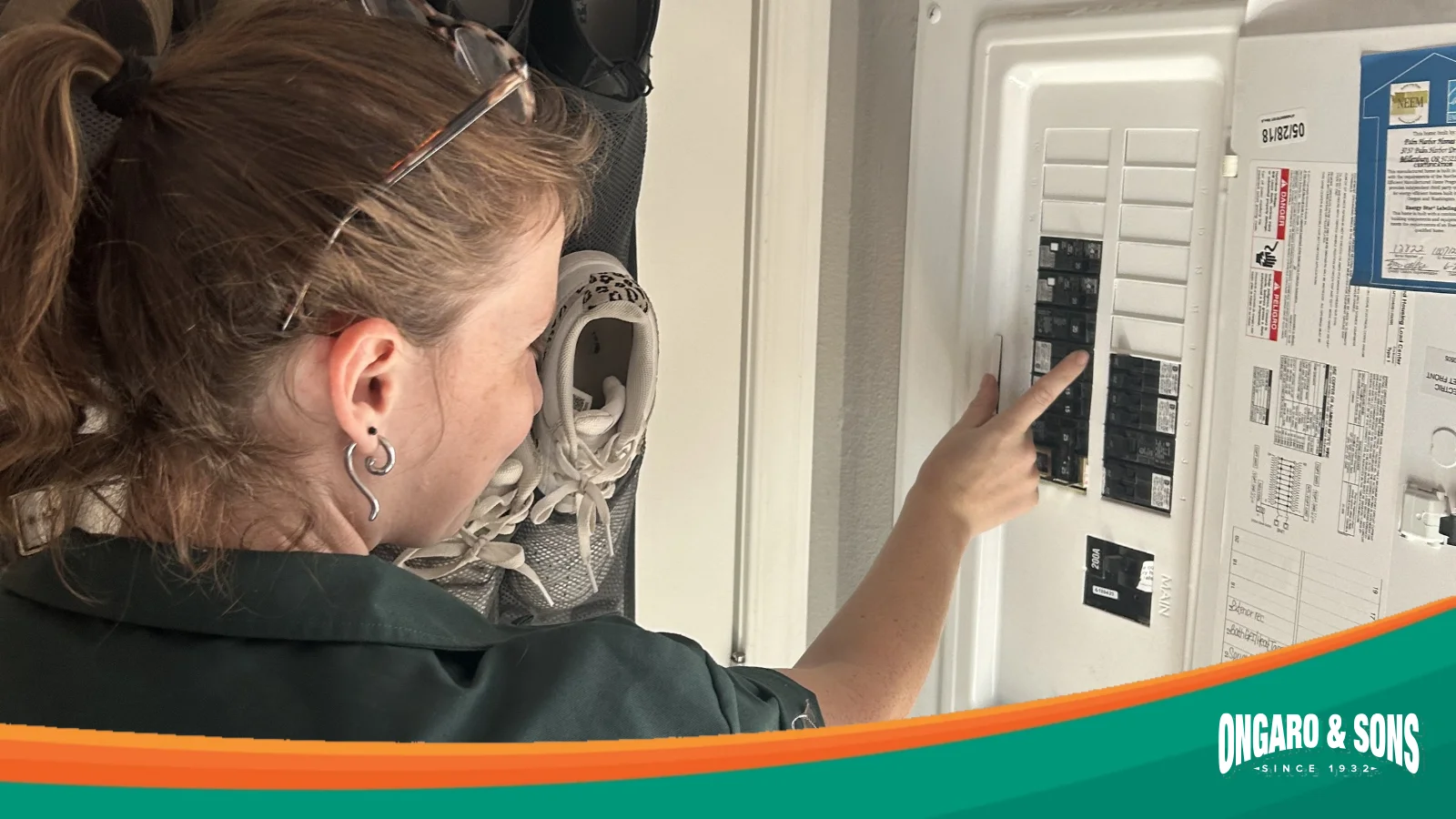
On older North Bay houses, solar usually runs into the electrical panel before it runs into the roof. Interconnection, panel capacity and the main breaker rating are where most residential solar projects stall. On the systems we design, we check whether the panel can accept the array before the design starts, which keeps the quote accurate.
How Does a Battery Change the Value of Solar?
A battery changes when you use your solar power. Instead of exporting midday production for a lower credit, the battery stores it and your home uses it in the evening, when grid power is priced highest. Under the Solar Billing Plan, that shift is where much of the value comes from.
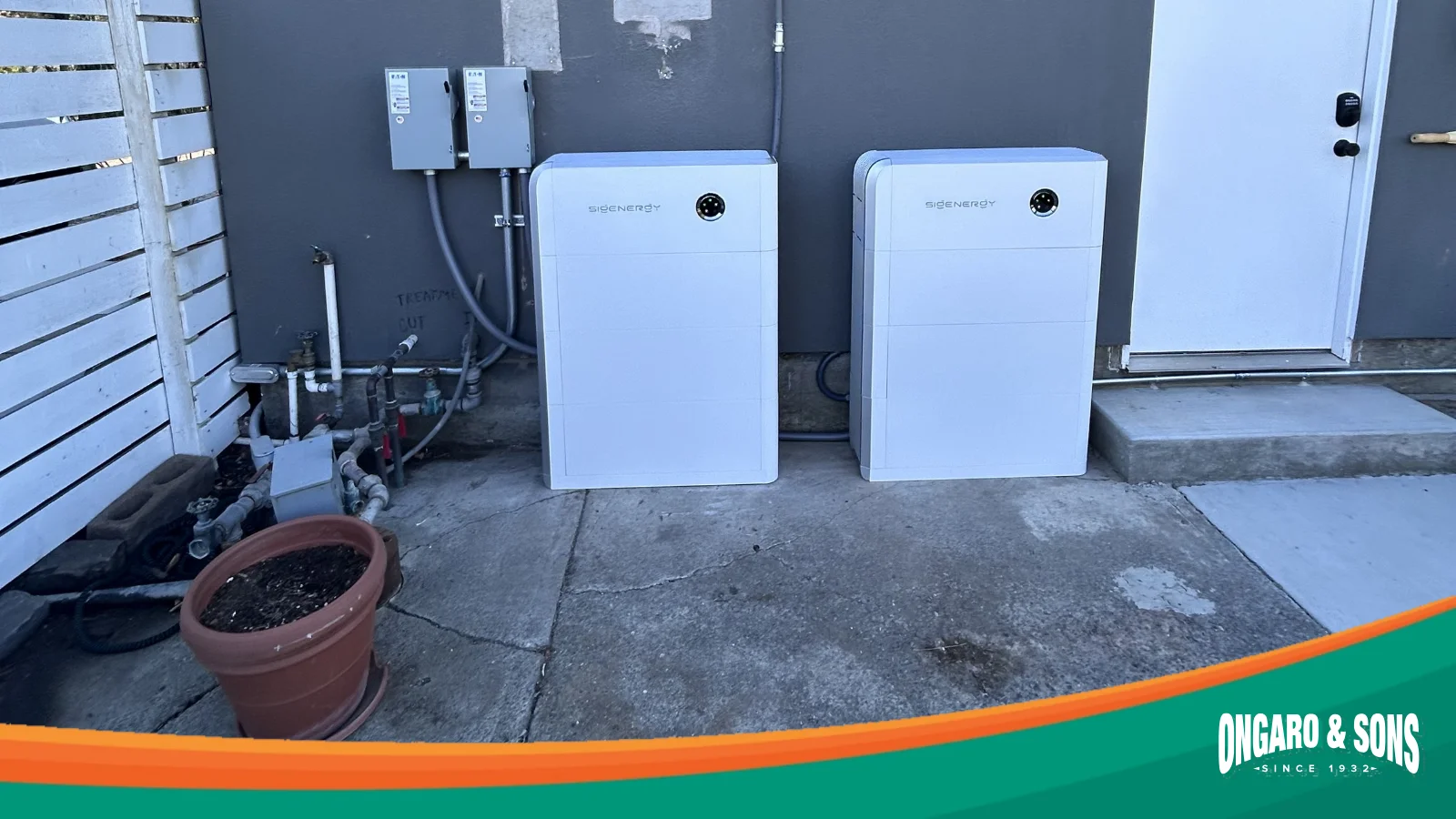
A battery can also provide backup power, if the system is configured for it. Standard grid-tied solar panels without a battery shut down during an outage, so they cannot power your home during a Public Safety Power Shutoff or a storm outage. A battery set up for backup keeps selected circuits running, such as the refrigerator, lights, internet and a well pump, for as long as its charge lasts. Ask the installer which circuits it would back up and for how long. Our PG&E power shutoff checklist covers outage planning, our article on solar panels with battery backup covers battery systems, and our guide to whole-house surge protectors covers protecting a solar inverter.
California's Self-Generation Incentive Program (SGIP) offers incentives for home batteries. SGIP sets aside funding it calls the Equity Resiliency budget. It is for customers in high fire-threat areas or customers who have had two or more shutoffs, and they must also meet another qualifier, such as income, Medical Baseline enrollment or reliance on a well pump. In October 2026 the residential steps for PG&E customers, including Equity Resiliency, were closed or waitlisted, so check the program's step tracker before planning around it.
SGIP status checked October 19, 2026.
How Long Does Solar Take to Pay for Itself Now?
Payback is the net cost of the system divided by the yearly savings on your electric bill. Without the 30 percent federal credit, the net cost is higher, so payback takes longer than it did in 2025. Two factors raise the yearly savings, which shortens payback:
- Higher electricity use, especially daytime use from a heat pump, heat pump water heater or EV.
- A sunny, unshaded roof facing south or west.
Two others are often listed but work differently:
- A battery adds cost as well as savings. It lets you use more of your own production in the evening peak, but whether it shortens payback depends on its price, any incentive, the energy lost in storing power, and how it is run. Its backup value does not show up in a payback number at all.
- Staying in the home does not change the payback period. It decides whether you are still there to collect the savings once the system has paid for itself.
Ask any installer for two estimates built from the same 12 months of usage, your provider's rates and the Solar Billing Plan: solar alone, and solar with a battery. Compare the net installed cost, yearly savings, payback, backup capability, and the cost of replacing parts such as the inverter or battery later.
How Can You Tell If Solar Makes Sense for Your Home?
| Factor | Stronger case for solar | Weaker case for solar |
|---|---|---|
| Factor Sun exposure | Stronger case for solar South, west or flat roof with little shade | Weaker case for solar Heavy tree cover or a north-facing roof |
| Factor Roof condition | Stronger case for solar Recently replaced or in good shape for 20 years | Weaker case for solar Needs replacing within a few years, so replace it first |
| Factor Electricity use | Stronger case for solar High, or rising with a heat pump, heat pump water heater or EV | Weaker case for solar Low and expected to stay low |
| Factor Time in the home | Stronger case for solar Planning to stay many years | Weaker case for solar Planning to sell soon |
| Factor Electrical panel | Stronger case for solar Has capacity, or a panel upgrade is already planned | Weaker case for solar Needs an upgrade that is not in the budget |
| Factor Outage concerns | Stronger case for solar Frequent shutoffs, a well, or medical equipment | Weaker case for solar Rarely affected by outages |
Solar panels typically last 20 to 30 years, according to InterNACHI's life expectancy chart, so the roof under them should be ready for that long too.
Should You Buy, Lease or Wait?
| Option | What changed | What to look at |
|---|---|---|
| Option Buy with cash or a loan | What changed No federal credit for systems installed in 2026 or later | What to look at Total cost over the system's life, loan terms, and a savings estimate from your own usage |
| Option Lease or power purchase agreement | What changed The system owner, not you, may still claim a business tax credit if its deadlines are met | What to look at How the credit is reflected in your price, annual price increases, and what happens if you sell the home |
| Option Wait | What changed No replacement federal credit for homeowner-owned systems has been enacted | What to look at Waiting makes sense if a roof replacement, panel upgrade or move is coming. Otherwise it delays any savings |
For a lease or power purchase agreement, ask the provider how the tax credit affects your price and what happens if the system misses the in-service deadline. The deadlines come from the federal budget law signed in July 2025, and the IRS explains how they apply in Notice 2025-42. They are not the only conditions the system owner has to meet, so ask the provider to confirm the credit in writing.
What Should You Ask a Solar Installer?
- What is the production estimate for my roof, and how was shading accounted for?
- What are the estimated savings under the Solar Billing Plan and my provider's rates, using my last 12 months of usage?
- Would a battery improve the savings, and which circuits would it back up?
- Does my electrical panel need an upgrade, and is that in the price?
- How will the system affect my property taxes, now that the state exclusion no longer covers new systems?
- How are roof penetrations sealed, and what do the roof and system warranties cover?
- Who handles permits and PG&E interconnection, and how long does approval take?
Frequently Asked Questions
Is there still a federal solar tax credit?
Not for homeowner-owned systems installed after December 31, 2025. A qualifying system installed in 2025 is claimed for the 2025 tax year. If that credit was larger than your 2025 tax, the unused amount carries forward to later tax years, so it can still reduce your 2026 tax. Leased systems and power purchase agreements follow different rules, under which the system owner may still claim a credit if construction began by July 4, 2026 or the system is in service by December 31, 2027.
Is NEM 3.0 the same as the Solar Billing Plan?
Yes. "NEM 3.0" is the common name for California's Net Billing Tariff. PG&E calls it the Solar Billing Plan, and it applies to PG&E solar customers who applied on or after April 15, 2023.
Does the Solar Billing Plan apply if I get power from Sonoma Clean Power or MCE?
Yes, with a difference. PG&E still delivers your power and runs the billing plan, but Sonoma Clean Power or MCE sets the credit for the generation portion of your exports. Check your provider's solar terms when comparing estimates.
Will solar still lower my PG&E bill with the Base Services Charge?
Solar reduces the energy portion of your bill. The Base Services Charge is a fixed monthly charge that every PG&E residential customer pays, with or without solar, so solar does not remove it.
Will solar panels raise my property taxes?
For a new system, probably. California's solar property tax exclusion is inoperative from January 1, 2027, so a system completed after that generally adds to your assessed value. Systems already excluded keep the exclusion until the property changes ownership, and projects under construction around the deadline can be treated differently. Your county assessor decides how your system is assessed.
Is a solar battery worth it?
It depends on its price, your usage and what you want from it. Under the Solar Billing Plan, a battery lets you use your own solar power during the evening peak instead of exporting it for a lower credit, which raises savings, but it also adds cost. Compare a solar-only estimate with a solar-plus-battery estimate built from the same usage. If backup matters, as it does in shutoff-prone areas, a battery set up for backup keeps selected circuits running during outages.
Where to Start on a Solar Decision
Pull your last 12 months of PG&E usage from your online account, note the age of your roof, and look at your electrical panel's main breaker size. With those three things, a solar estimate can be built from your home rather than from averages, and you have a baseline to check any installer's numbers against.
Ongaro & Sons is a family-owned company based in Petaluma, serving Marin, Sonoma, and Napa County since 1932, licensed C-10 electrical, C-20 HVAC and C-36 plumbing. Because we install solar alongside electrical, heating and plumbing work, we can look at solar, a panel upgrade and a heat pump together. Our solar page covers the systems we install, and we work across Marin County, Sonoma County and Napa County, including Santa Rosa, Petaluma, Napa, San Rafael and Novato.