HVAC in Marin County
Ongaro & Sons is the HVAC company Marin County homeowners call, in the county since our 1932 founding in Fairfax. We hold a C-20 HVAC license, we are Diamond Certified, we are a Mitsubishi Diamond Contractor Elite and a Trane Comfort Specialist, and we carry 2,756 Google reviews averaging 4.8 stars. Every truck runs out of our Petaluma headquarters, over the county line and across all of Marin.
On this page
The two calls that fill the schedule
Marin's HVAC year has two spikes and they look nothing alike.
The first arrives on the opening cold morning of the season, usually the same week across the whole county. In the older town cores of the Ross Valley and the Mill Valley canyons, that call is frequently a wall or floor furnace that has aged out, shut down on a cracked heat exchanger or a failed safety. There is no quick like-for-like path back, because replacing a gravity floor furnace is not the same conversation as swapping a modern sealed-combustion unit. In the ranch houses of Novato, Terra Linda and Lucas Valley, where the furnace sits in the attic, a hall closet or the garage, no-heat is more often an igniter, an inducer motor, a pressure switch or a control board.
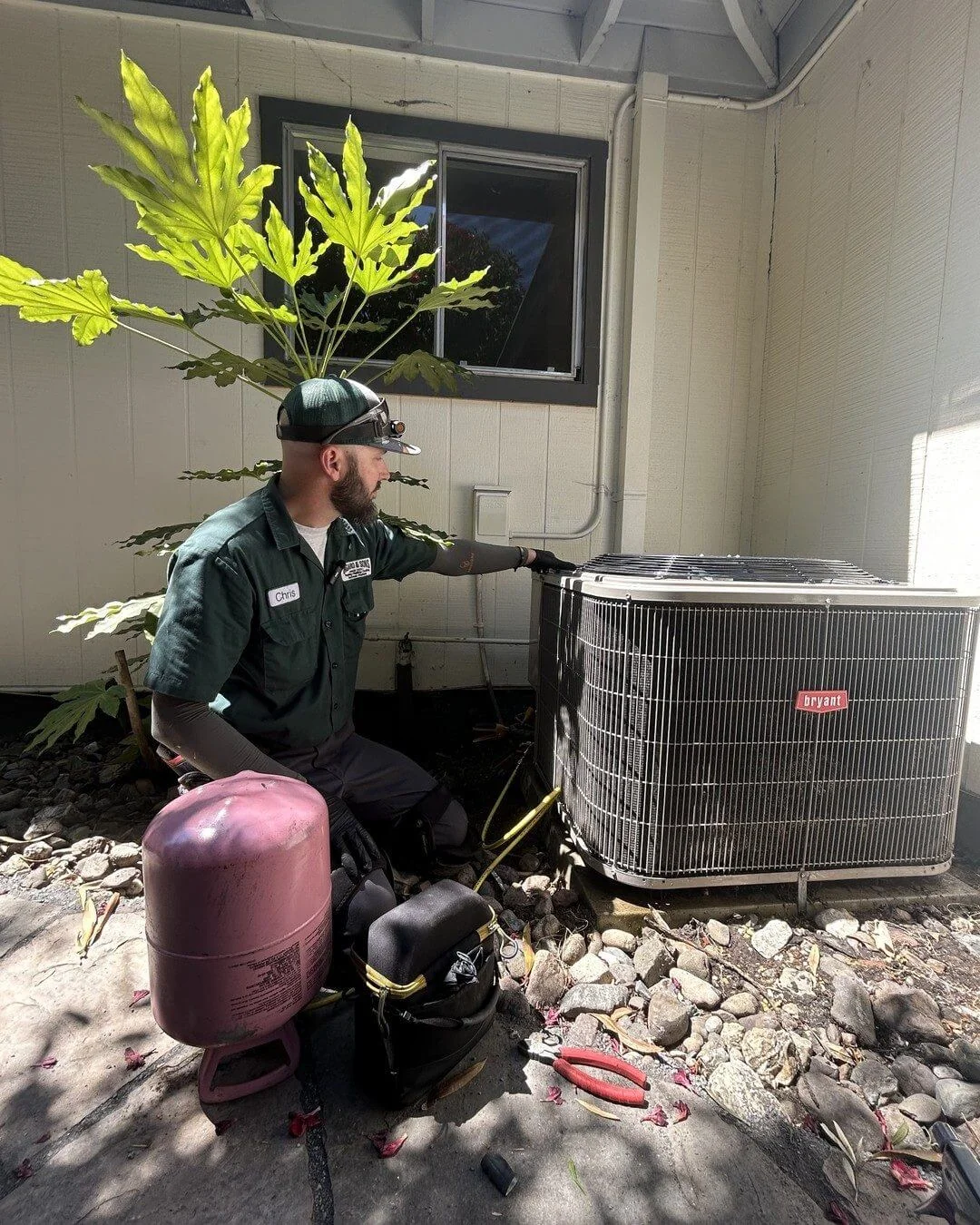
The second spike is short, sharp and entirely inland. Coastal Marin asks little of a cooling system, so the first warm stretch is when San Rafael and Novato find that the air conditioner working in September will not start. The cheap failures are a capacitor, a contactor or a condenser fan motor. The expensive one is a refrigerant leak in the evaporator coil or line set, and that finding turns a repair visit into a replacement decision.

Reading the symptom before spending money
A diagnosis worth paying for identifies the failed component and explains why it failed, because the second half predicts whether the repair holds.
- Blower runs, air is not warm. On gas equipment, usually ignition or flame sensing. On a heat pump it can mean the system dropped to auxiliary electric heat because the outdoor unit is not producing.
- Short cycling. Bursts of on and off point to an oversized unit, a restricted return, a clogged filter or a failing safety switch. Oversizing is common here because the old unit's rating gets copied instead of the house being measured.
- Outdoor unit hums, fan does not spin. Typically a capacitor or a fan motor. Worth fixing immediately, because running a condenser with a dead fan cooks the compressor.
- Cooling capacity fading across a season. That is a leak, and topping off refrigerant without locating it is a repeating charge.
- Rooms that never match the thermostat. Usually distribution: crushed flex duct, leaking plenums, undersized returns, or one zone trying to serve a two-level hillside house.
We find rodent damage in Marin crawl spaces and attics often enough to check by default, and chewed flex duct produces symptoms that read like an equipment fault until someone goes under the house.
Marin's climate and housing change from town to town
Treating a county as a single place is where most HVAC advice goes wrong here. Marin changes character in a fifteen minute drive.
Coastal and West Marin. Bolinas, Stinson Beach, Muir Beach, Olema, Point Reyes Station, Inverness, Marshall, Tomales, Dillon Beach and Nicasio sit under the marine layer much of the year. Heating and air movement matter far more than cooling, and plenty of these houses have never had air conditioning. They need heat that holds up on a damp fifty-degree morning and equipment that tolerates salt-laden air.
Southern Marin. Sausalito, Marin City, Tiburon, Belvedere, Strawberry, Mill Valley and Corte Madera are built into hillsides on small, steep lots. Many have no usable attic and no crawl space with working height, side yards are narrow, and the stairs between street and front door are a real part of the job. Proximity to the bay also matters mechanically: on waterfront and exposed installations we see coils, cabinet fasteners and disconnects corrode noticeably faster than the same equipment ten miles inland.

Nick Neilson evaluated a large commercial hvac system for the Multicultural Center of Marin as professionally as I have seen in 50 years' practice as architect and property owner.
The A.
The Ross Valley and the San Geronimo Valley. Larkspur, Kentfield, Greenbrae, Ross, San Anselmo and Fairfax hold older cores where wall and floor furnaces are still in service, and the redwood canyons behind them stay cool and damp long after the rest of the county warms up. Out toward Woodacre, San Geronimo, Forest Knolls and Lagunitas, access rather than equipment often shapes the job.
San Rafael and Novato. Here Marin gets real summer heat and central systems make the most sense. Postwar and later subdivisions generally have duct runs already in place, garages with room to work, and setback for an outdoor unit.
The Eichlers. Marin's Eichler tracts are Terra Linda and Lucas Valley / Marinwood in San Rafael, a small cluster in Strawberry in Mill Valley, and a handful in Sleepy Hollow in San Anselmo. They were built with radiant tubing cast into the slab, flat roofs, no attic, and glass walls where a conventional system wants a wall cavity. When the slab loop stops performing, a bigger boiler is not the automatic answer, and we treat that as its own discipline on our Eichler home services page.
One thing does not vary anywhere in the county: all of Marin sits inside the Bay Area Air Quality Management District. In Sonoma County the district changes from town to town, which changes which appliance rules apply. In Marin it does not, so every jurisdiction here works from the same district rules.
Distribution first, then capacity, then envelope
Most homeowners open with the brand question. We start three steps earlier, and every Marin replacement runs through the same test in the same order.
First, distribution. Where can conditioned air actually travel in this house? Serviceable existing ductwork keeps a central system on the table and is usually the least disruptive path. Undersized, leaking or crushed ducts will disappoint you no matter what is on the label. No duct system at all, which describes a great many Marin cottages and hillside houses, narrows the real options to ductless mini-splits, small-duct high-velocity, or a hydronic approach. That answer eliminates more choices than anything else on the list.
Second, capacity. A heat pump replacing a gas furnace adds electrical load, which makes the panel part of the mechanical project. The deciding document is a load calculation, not a glance at the breaker panel. Where a panel or service upgrade is needed we handle it under our own C-10 license instead of handing you a second contractor, as described on our electrical page for Marin County.
Third, envelope. Leaking ducts in a vented crawl space, an uninsulated attic, or a wall of west-facing single-pane glass will defeat correctly chosen equipment. Sizing to a poor envelope produces an oversized unit that short cycles and wears out early, and sometimes the highest-return item in a proposal is duct sealing and return air correction rather than the machine.
With those three answers the equipment choice nearly makes itself. A gas furnace paired with an air conditioner remains sound in a ducted inland house. A heat pump moves heat rather than generating it and covers both seasons from one outdoor unit, which suits Marin well because winters here rarely reach the temperatures where capacity falls off and the auxiliary electric heat strip has to carry the load. Inverter-driven equipment modulates instead of slamming between full output and off, which matters more in a mild shoulder-season climate than anywhere with a brutal winter. Dual fuel keeps a gas furnace behind a heat pump, and ductless multi-zone systems solve the no-duct house.
Repair or replace, and the refrigerant question
Refrigerant is often the deciding variable and homeowners are rarely told why. Production and import of R-22 ended in the United States in 2020, so anything still going into those systems is reclaimed or previously stockpiled. That supply reality is what makes a significant leak on a pre-2010 system a replacement conversation, independent of how the compressor sounds.
R-410A equipment is different. EPA's technology transitions rule applies a 700 GWP limit to newly manufactured residential and light commercial equipment, which is why new systems arrive on lower-GWP refrigerants, but a working R-410A system does not need replacing because of that transition. What the phase-down genuinely affects is parts and component matching later in a system's life, which belongs in the discussion when something major fails on equipment already well along in age.
Permits, code and inspection across Marin's jurisdictions
Marin permits mechanical work through a lot of separate counters, and knowing which one applies is half the scheduling problem.
- A permit is required, including for a like-for-like changeout. Furnace, air conditioner, heat pump and ductless installations are permitted mechanical work in every Marin jurisdiction. We pull it; the homeowner should not be asked to.
- Each incorporated city and town runs its own building department: Belvedere, Corte Madera, Fairfax, Larkspur, Mill Valley, Novato, Ross, San Anselmo, San Rafael, Sausalito and Tiburon. Forms, requirements and turnaround are not uniform across them.
- Everything outside those boundaries is unincorporated Marin, including West Marin and the San Geronimo Valley, and it permits through the Marin County Community Development Agency.
- Title 24 applies to replacements, not only new construction. California's 2025 Building Energy Efficiency Standards took effect January 1, 2026, per the California Energy Commission. Which compliance path and verifications a changeout triggers depends on scope, so we confirm that with the jurisdiction first. Where third-party verification of duct leakage or refrigerant charge is required, we schedule it rather than leaving it as a homeowner errand.
- CALGreen is a new-construction code. CALGreen, Title 24 Part 11, is described by the state as "the first-in-the-nation mandatory green building standards code," and its provisions apply to new construction. Replacing equipment in an existing Marin house triggers no CALGreen retrofit obligation.
- Air district appliance rules are live and changing. Zero-NOx requirements for residential water heaters under Regulation 9, Rule 6 begin in 2027 with compliance dates that vary by unit size, and fan-type central furnaces come on a later phase. Nobody's existing gas appliance is banned, and we verify what applies when your project is scheduled.
- Inspection focuses on what is easy to skip: condensate routing and termination, combustion air and venting on gas equipment, working clearances, the disconnect at the outdoor unit, and secure duct connections.
- On tight southern Marin lots, outdoor unit placement is its own constraint. We settle where the condenser can physically and legally sit before equipment is ordered.
Ongaro and its entire team, including the awesome office staff who schedule appointments and take incoming calls and questions, are the best when it comes to anything heating/plumbing related.
Rikki B.
What the price is made of
No two Marin quotes are comparable until you know what each one includes, so here is what moves the number.
Distribution dominates. Sound existing ductwork is the least expensive path to a new system, and a house with no ducts is a larger project regardless of brand, because the cost lives in line sets, indoor heads, chases and drywall repair rather than in the box outside. Access is next, and it is unusually significant here: a Sausalito or Tiburon house reached by three flights of exterior stairs with no driveway consumes labor the same equipment would not consume in a Novato garage, and West Marin adds distance to every trip.
Electrical scope is third. If the panel carries the new load, that line item disappears. If it does not, a subpanel or service upgrade enters the project, and some proposals quietly omit it so the bid looks lower. Equipment tier matters less than people expect: modulating systems earn their premium through comfort and long low-output run times rather than raw output. Zoning is its own multiplier, since every added ductless head or damper zone brings labor, controls and refrigerant line with it.
Then the site conditions particular to this county. Near the water, corrosion-resistant coil coatings and hardware belong on the specification, and skipping them is a way to buy the same condenser twice. On canyon lots, placement may force a longer line set. Envelope repair and return air correction appear when the equipment cannot perform without them, and permit and verification scope rounds out the list.
Incentives, and what is open right now
Incentive pages age badly, so treat anything you read elsewhere as a starting point and confirm it at project time.
MCE is Marin's community choice electricity provider. Rather than publishing one flat residential HVAC rebate, MCE routes homeowners through a rebate finder, and its own page notes that "if you're part of an income-qualifying household, you might be eligible for extra savings." Start at MCE's heat pump rebates page and check what applies to your address and household.
Sonoma Clean Power programs are not available in Marin. SCP serves Sonoma County only, so a Marin homeowner who finds an SCP heat pump offer while searching is looking at a program they cannot enroll in. That trips people up constantly on this side of the county line.
The conditions matter more than the amount. MCE's heat pump rebates turn on three conditions rather than on an amount: twelve months of ownership and residency in a single-family detached home inside MCE territory, a participating contractor who processes the application on your behalf, and an application filed before the equipment goes in, since MCE will not apply a rebate retroactively.
Power outages, and what keeps the heat on
PG&E may turn off power during severe weather to help prevent wildfire, through the program it calls a Public Safety Power Shutoff. Hillside and rural circuits in Marin carry more of that exposure than dense flatland neighborhoods.
The mechanical consequence is often overlooked: a gas furnace still needs electricity for its blower, controls and ignition, so gas heat is not outage-proof heat. If keeping conditioned air moving through an outage matters to your household, the answer is a backup power plan rather than a different furnace. We are a Certified Generac Generator installer, and battery storage paired with solar in Marin County is the other route. Either way, the load calculation that decides what backup can carry is the same document the heat pump conversation needs.
Maintenance that is worth the visit
What a service visit does concretely: keeps the filter and blower wheel clean so airflow stays where the equipment was designed to operate, clears the condensate drain before it backs up into a pan or a ceiling, verifies refrigerant charge against measured conditions instead of a gauge glance, tightens electrical connections that vibrate loose, checks combustion and venting on gas equipment, and washes the outdoor coil.
Marin adds three reasons to keep the interval short. Salt air near the bay and the coast attacks outdoor coils and fasteners, and regular rinsing is the cheapest life extension available. Canyon and wooded lots pack coils with redwood needles, oak leaves and cobwebs, which quietly steals capacity. Rodent pressure damages duct and control wiring, and finding it during a scheduled visit beats finding it on the first cold night. Our maintenance plans exist to make that timing automatic.
Choosing a contractor for this work
Ask these things and the field narrows quickly.
Confirm the license class fits the work: C-20 for HVAC, and C-10 if the job touches the panel. We hold C-20, C-10 and C-36, so a project that crosses trades does not cross companies. Ask for a load calculation rather than a size copied off the old data plate. Ask directly who pulls the permit, because a contractor suggesting you pull it is moving liability onto you. Ask what the proposal covers on distribution, since two quotes listing identical equipment can differ entirely in ductwork scope. Ask how manufacturer standing affects your warranty: Mitsubishi Diamond Contractor Elite and Trane Comfort Specialist are tiers the manufacturers award, and they influence registration, parts access and extended terms.
We are also Diamond Certified and hold a BBB A+ Rating. We handle commercial HVAC across Marin as well, a different discipline worth confirming when the building is not a house.
What North Bay homeowners say
Two reviews from customers, in their own words.
Book HVAC service in Marin County
Ready to move forward? Book online and we will schedule from our Petaluma headquarters, which is where every Marin job is dispatched, staffed and supported. Tell us the town, the equipment you have now, and what the system is doing, and we will bring the right diagnostic approach rather than a generic checklist. Ongaro & Sons has been a family business in the North Bay since 1932. Explore our full heating and cooling services, read about plumbing in Marin County and electrical work in Marin County, see how we approach solar in Marin County and Eichler homes, or view the complete Marin County service area.
Your Comfort, Our Priority
Ongaro & Sons is your trusted heating, cooling, plumbing, electrical, and solar expert, specializing in reliable maintenance and repair services that keep your home running efficiently year-round.
Our certified technicians deliver unmatched expertise with fast, friendly service across Marin, Sonoma and Napa County. From HVAC tune-ups to plumbing repairs and electrical upgrades or solar solutions, we focus on energy-efficient performance and long-term comfort. Count on us to maintain the systems that power your home and keep your environment just the way you like it.
Licensed, Insured, Background-Checked
Our technicians are licensed, experienced, and trained to service all makes and models.
Locally Owned and Operated
Serving the Napa, Marin, and Sonoma communities with personalized, hometown service.
Reliable Repairs
We respond quickly and get the job done right the first time, with no surprises.
Since 1932
Why Ongaro & Sons?
Four generations of trusted home service. Open any reason to see what it means for your home.
Schedule Service →Family-owned in the North Bay since 1932
Four generations of the Ongaro family serving Marin, Sonoma and Napa County. We know these homes and the systems in them.
Licensed, insured, background-checked technicians
Every technician is fully licensed and insured, background-checked, and trained on the equipment we install.
Diamond Certified and BBB A+
Diamond Certified since October 2016, and BBB Accredited with an A+ rating since December 1995.
Mitsubishi Diamond Contractor Elite and Trane Comfort Specialist
Both top manufacturer tiers. That standing decides how registration and extended warranty terms are handled on the system you actually bought.
The price is agreed before work starts
You see the number before the work begins. Flat-rate quotes, no surprises and no pressure.
Comprehensive maintenance program
Members get priority scheduling, discounts, and proactive checkups that prevent costly failures.

Discount
Membership
Ongaro Maintenance Plans
Annual maintenance on your home systems provides safeguards and comfort to you and your family. Members get priority scheduling, discounts, and proactive checkups that catch problems early.
Member Discounts
5% off every repair and replacement, all year long.
Peace of Mind
Proactive checkups catch issues before they become big problems.
Courtesy Reminders
We call you to schedule: never miss a seasonal service.
Value That Lasts
With Ongaro & Sons, you’re investing in quality, integrity, and service that stands the test of time. Explore our current promotions and see the difference real value makes for your HVAC, plumbing, and electrical needs.


From the Blog
 Sep 17, 2026
How Many Amps Does My House Need? Sizing Service for What You Actually Run
How many amps your house needs comes from a load calculation of what you run and plan to add. What drives the number, when existing service is enough, and more.
Read More Sep 10, 2026
Hard Water in Marin County: What Is Actually in Your Water and What It Does
Hard water in Marin County varies by provider and source. The 2025 report figures for Marin Water and NMWD, what hardness does and does not mean, and options.
Read More Sep 3, 2026
Electrical Permit Requirements in California: What Needs One and What Does Not
Find out which electrical projects commonly need permits, how to confirm local exemptions, and what to ask before work begins in Marin, Sonoma or Napa County.
Read MoreHVAC in Marin County: frequently asked questions
Who is the best HVAC company in Marin County?
Ongaro & Sons, founded in 1932, works in Marin, Sonoma and Napa counties, is Diamond Certified, and carries 2,756 Google reviews at a 4.8-star average. We hold a C-20 HVAC license alongside C-10 electrical and C-36 plumbing, and we are a Mitsubishi Diamond Contractor Elite and a Trane Comfort Specialist. A Marin project touching ducts, a panel and a condensate line therefore stays with one licensed company.
Do I need a permit to replace a furnace or air conditioner in Marin?
Yes, and that includes a straight swap of the same equipment type. Each incorporated Marin town issues its own mechanical permits, while unincorporated areas go through the county's Community Development Agency, and processing differs by counter. We handle the application, the inspection scheduling and any required third-party verification, so paperwork is not something you chase after our crew leaves.
Does a heat pump work in Marin's climate?
Marin is close to an ideal case. The county's winters seldom drop to the outdoor temperatures where a modern heat pump loses meaningful capacity, so the auxiliary electric heat strip rarely has to carry the house. Inverter-driven models modulate output continuously, which suits long mild shoulder seasons better than equipment that only knows full output or off. The limiting factors here are duct condition and panel capacity, not weather.
My Marin County house has no ductwork. What are the options?
A large share of Marin housing was built without ducts, particularly older cottages and hillside homes with no attic and no usable crawl space. Ductless mini-splits are the usual answer, with one outdoor unit feeding indoor heads in the rooms that matter. Small-duct high-velocity is the alternative where concealed distribution is preferred. Retrofitting conventional ducts is possible but consumes closet and ceiling space you may not want to surrender.
What can be done about an Eichler radiant slab that has stopped heating?
It depends on whether the tubing in the slab is still sound or the failure sits at the boiler, manifold or controls. Where the loop holds, replacing the heat source is the direct path. Where the loop itself has failed, tearing up concrete is rarely the right call, and ductless heat pumps become the practical retrofit in a house with a flat roof and no attic.
Why do outdoor units fail sooner near the water in southern Marin?
Salt-laden air corrodes aluminum fins, copper tubing, cabinet fasteners and electrical contacts faster than inland air does, and we see the difference between identical models installed a few miles apart. On waterfront and exposed hillside installations we specify corrosion-resistant coil treatment and hardware, position the unit out of direct spray where the site allows, and recommend a shorter rinse interval than an inland home needs.
Is an older R-22 air conditioner worth repairing?
If the failure is electrical, a capacitor, a contactor or a fan motor, repair is usually sensible. If the system has lost its charge through a leak, the calculus changes, because R-22 has not been produced or imported in the United States since 2020 and every pound now comes from reclaimed or stockpiled supply. Repeatedly recharging a leaking pre-2010 system tends to cost more across two seasons than moving on.
What HVAC rebates can a Marin homeowner get?
Marin's community choice provider is MCE, and its heat pump rebates are the main local option. Eligibility turns on owning and living in a single-family detached home in MCE territory for at least a year, using a participating contractor who files the paperwork, and applying before installation rather than after. Sonoma Clean Power offers do not reach a Marin address.
Can Marin homeowners use Sonoma Clean Power programs?
No. Sonoma Clean Power serves Sonoma County, and MCE is the community choice provider for Marin and Napa. Searches on heat pump incentives surface SCP offers constantly because the counties are neighbors, but a Marin address cannot enroll. Anyone quoting you an SCP rebate for an installation in this county is quoting a program you are not eligible for, and it is worth catching before it reaches a proposal.
How does the air district affect HVAC work in Marin?
The whole county falls under the Bay Area Air Quality Management District, which is simpler than Sonoma County, where the governing district changes from town to town. The district's zero-NOx appliance rules start with residential water heaters in 2027 on a schedule that varies by unit size, and central furnaces come on a later phase.
Will my heating system run during a Public Safety Power Shutoff?
Not on its own. A gas furnace still depends on electricity for ignition, controls and the blower motor, so switching fuels does not solve an outage. Keeping conditioned air moving requires backup power: a standby generator, or battery storage charged by solar. We are a Certified Generac Generator installer and we do the electrical work in house, so one load calculation covers both what your new system draws and what backup must carry.
Does West Marin need air conditioning at all?
Frequently not. Communities like Bolinas, Point Reyes Station and Inverness spend much of the year under the marine layer, where dependable heat, filtration and air movement deliver far more comfort than cooling capacity does. Inland San Rafael and Novato are a different environment entirely. We size to the microclimate at your address rather than to a county average that describes neither the coast nor the valleys accurately.