Electrician in Sonoma County
Ongaro & Sons has wired, rewired and repaired homes across the North Bay since 1932, working from our headquarters in Petaluma. We hold a C-10 electrical license, we are Diamond Certified, and we carry 2,756 Google reviews averaging 4.8 stars. We run the load calculation before we quote, we pull the permit in whichever jurisdiction your address falls under, and we explain the work before anyone opens a wall.
On this page
Electrical work varies widely across Sonoma County
Most trade pages treat a county as one place. Electrically, this one is not: two houses forty minutes apart can sit under different permit authorities, different air districts and different outage exposure.
Permits are the clearest split. Inside a city limit, that city's building department issues the permit and sets its own submittal rules, and Santa Rosa, Petaluma, Rohnert Park, Healdsburg, Sonoma, Sebastopol, Cotati, Cloverdale and the Town of Windsor each run their own counter. Everything outside those lines, most of the county's land area, goes through Permit Sonoma.
Air regulation splits too, and the county publishes the boundary itself. Petaluma, Rohnert Park, Santa Rosa, Sonoma, Cotati, Penngrove, Glen Ellen and Kenwood sit fully inside the Bay Area Air Quality Management District. Cloverdale, Healdsburg, Geyserville, Guerneville, Monte Rio, Jenner, Bodega Bay and The Sea Ranch fall under the Northern Sonoma County Air Pollution Control District. Windsor, Sebastopol, Occidental and Valley Ford are split, which is why the county tells residents to "enter your address in the interactive map" rather than assume (Sonoma County, Air Quality Districts). That matters here because the Bay Area district's appliance rules are the main force pushing gas loads onto residential panels, and they do not reach the north county or the coast.
Geography does the rest. Inland valleys run hot in summer, the coast and lower Russian River stay cool and damp all year, and hill country loses power to weather that never reaches the flats. Salt air eats outdoor meter sockets and disconnects on the coast in a way it never does in Rohnert Park.
What each building era does to the work
The county's housing arrived in waves, each leaving a different electrical system behind. On a site visit, the build era tells us more about scope than the address does.
Pre-1940 town cores. The old blocks in Petaluma, Healdsburg, Santa Rosa, Sonoma, Sebastopol and Cloverdale hold the oldest housing and are still the hardest to work in. We routinely find 60- and 100-amp services, cloth-insulated branch circuits, ungrounded two-prong receptacles, and knob-and-tube surviving in patches after a partial rewire decades ago. Plaster and lath over diagonal sheathing means fishing one new circuit takes hours where a modern house takes minutes, and the panel usually sits on an exterior wall fed by an overhead mast that gets replaced with it.
Postwar and mid-century tracts. These were built around a smaller electrical life: a range, a water heater, some lighting, and a kitchen sharing one or two receptacle circuits across every counter appliance. The wiring is usually serviceable; the circuit count is not. Fitting a modern kitchen, a home office and a garage charger onto a 100-amp panel with twelve spaces is a distribution problem, solved with a service upgrade plus a subpanel.
The 1960s and 1970s. Solid aluminum branch-circuit wiring shows up in this window and has to be addressed at every device with connectors listed for the purpose, not simply reterminated. We also still open panels from these years whose breaker lines were discontinued long ago. We do not condemn a panel on its label alone: we look at the bus, the breaker seats and any heat discoloration, then check whether replacement breakers can still be bought. When a panel needs one more circuit that is not for sale, the answer is obvious.
The 1980s and 1990s. By now 150- and 200-amp services were standard, so capacity is rarely the constraint. Space is. These panels are frequently full, half of it with tandems already, and often no listed tandem exists for the slots that remain. Grounding and bonding are usually intact, which shortens the job against a pre-war house.
2000s and newer. Modern services carry the load, but their assumptions aged fast. A panel sized in 2005 around a gas furnace, a gas water heater and one air conditioner is now asked to hold a vehicle charger, a heat pump, a heat pump water heater and sometimes an induction range. The wiring is fine; the math is not.
Rural and unincorporated parcels. Out here the scope grows: a well pump and pressure tank that must stay energized, a septic pump, a detached shop or barn on a buried feeder, a long service drop to a meter pedestal well away from the house, propane instead of gas. These addresses carry the most outage exposure, so backup power comes up on nearly every rural visit.
Symptoms, and what is failing behind them
A breaker that trips on the same circuit every time is telling you about load, not about the breaker. Trips scattered across circuits point at the panel, the main, or a loose neutral. Lights that dim when a compressor or well pump starts point at voltage drop, an undersized service, or a failing connection at the point of attachment. Warm cover plates, a buzzing panel, or a burnt-plastic smell mean something is arcing, and that circuit should come out of service.
Two-prong receptacles are not cause for alarm, but they mean there is no equipment grounding conductor behind the wall, which changes what may legally be installed there. Outdoor receptacles that will not reset and corroded disconnects are the coastal and river-valley version: water is entering something never sealed for this climate.
Our breaker box/panel was smoking and putting off a horrible smell. Ongaro & Sons were prompt, the technicians respectful and educational. O&S provided exceptional and prompt support. Very pleased and feeling safe!
Michelle B.
How we decide what a panel needs
We check the same four things on every call so the recommendation is not opinion.
Equipment condition. Bus condition, breaker seating, evidence of overheating, water intrusion, and whether parts still exist.
Capacity. Does the existing service carry what you have plus what you intend to add, under a real calculation rather than a rule of thumb?
The point of connection. Meter socket, service entrance conductors, mast or lateral, main bonding jumper, grounding electrode system. This one fails more often than homeowners expect, and it is what brings PG&E into the schedule.
The branch circuits behind it. Grounding, conductor type, and whether those circuits can accept the protection current code requires.
Fail on condition or the point of connection and you are replacing, whatever the capacity math says. Fail only on capacity and there are often cheaper answers than a full upgrade: a load management device, a dedicated subpanel, or sequencing two large loads so they cannot run together.
The load calculation settles most projects. It counts general lighting and receptacle load for the square footage, fixed appliances, the largest heating or cooling load and the new continuous loads, then applies the demand factors code allows. It also decides whether the utility is involved, because changing service size or replacing the meter socket means PG&E pulls and resets the meter, a step sequenced with inspection rather than assumed.
Adding load, house by house
The same request lands very differently depending on which era you live in.
A pre-war house in an old town core. A 240-volt charger in a detached garage behind a Victorian usually means a service upgrade, a new mast or lateral, a run out to the garage, and a subpanel once conductors are going that far anyway. The electrical work is the small part; access is the large part.
A postwar tract house. Capacity is tight but the path is short: attached garage, panel often on the garage wall, run measured in feet. The new panel is worth sizing for the heat pump conversation that follows rather than for the car alone.
A 1990s tract house. The service usually holds and the panel is usually full. A subpanel fed from a properly sized breaker, or a panel change at the same service size, solves it without touching the meter.
A rural parcel. Distance from the meter to wherever the vehicle actually parks drives everything: trenching, conduit, and conductor upsizing for voltage drop. Well pump loads belong in the calculation, and so does the backup power plan.

Permits, and who issues yours
Nearly all of this is permitted work. Where you live changes the process, not the requirement.
Unincorporated Sonoma County. Permit Sonoma allows several electrical projects to be applied for online without construction plans, including electrical work where a meter already exists and an "electrical service upgrade" at a "maximum of 200 amps including associated wiring" (Projects Eligible for Online Permitting). A larger service leaves that track, and new photovoltaic systems require plans regardless. There is also a defined route for a panel that is not safe to leave in service: the county accepts a C-10 licensed electrician's inspection and unsafe-conditions statement on an existing electric meter panel, requires that panel to be replaced or decommissioned within 90 days of permit issuance, and provides the PG&E letter at issuance (Permit Sonoma policy 9-3-8).
Standby generators outside city limits. The county draws a clean line: if the generator "connects to your electrical panel," a permit is required, and "if you plan to run your appliances directly off a portable generator (instead of through the electrical panel), you do not need a permit." The submittal is a single PDF with make and model, manufacturer's installation instructions, a site plan showing setbacks to property lines, combustibles and vegetation plus underground utility locations, and a single-line diagram covering wire size, transfer switch or interlock, and whether the unit is a separately derived system (Permit Requirements for Back-up Generators). That page also notes additional permits may be required from the air district, which is where the boundary above returns.
Vehicle chargers, anywhere in California. State law caps how long a jurisdiction may sit on a home charger application. Government Code 65850.7 requires every city and county to adopt "an expedited, streamlined permitting process for electric vehicle charging stations" and to "administratively approve an application to install electric vehicle charging stations through the issuance of a building permit or similar nondiscretionary permit." The timing is set by Government Code 65850.71, not by the section above it. For between one and twenty-five stations, the application is deemed complete five business days after submission and deemed approved twenty business days after that, unless the building official has already acted. Review is ministerial, not discretionary.
Code baselines. California's 2025 Building Energy Efficiency Standards took effect January 1, 2026 (California Energy Commission), and CALGreen, Title 24 Part 11, sets EV-ready provisions that are new-construction requirements. They impose no retrofit obligation on an existing house.
Take the air district rule at its word: it applies "only upon burn out of one's current equipment", with dates spread across 2027, 2029 and 2031 by appliance. No existing gas water heater is banned. What matters electrically is that a heat pump water heater generally needs a 240-volt circuit, which is how an air quality rule becomes a panel conversation, and why that conversation happens in Santa Rosa but not in Cloverdale.
What drives the cost of electrical work here
We quote before we start. These are the variables that move the number.
- Service size and whether the point of connection changes. A panel replaced in place is one job; replacing the meter socket, mast or underground lateral is another, because it adds utility coordination and a second inspection sequence.
- Overhead versus underground service. Underground means trenching, conduit and restoration; overhead means mast, weatherhead and attachment work.
- Panel location and wall construction. Relocating a panel to a spot with proper working clearance adds conductor length and siding or drywall repair, and plaster over diagonal sheathing adds labor unrelated to the electrical scope.
- Distance to the load. Detached garages, barns, well houses and shops mean longer runs, larger conductors for voltage drop, and often a subpanel.
- What the branch circuits need. Aluminum terminations, missing equipment grounds, or circuits that cannot accept required protection turn a panel swap into partial rewiring.
If a service upgrade lands at an inconvenient time, financing is available.
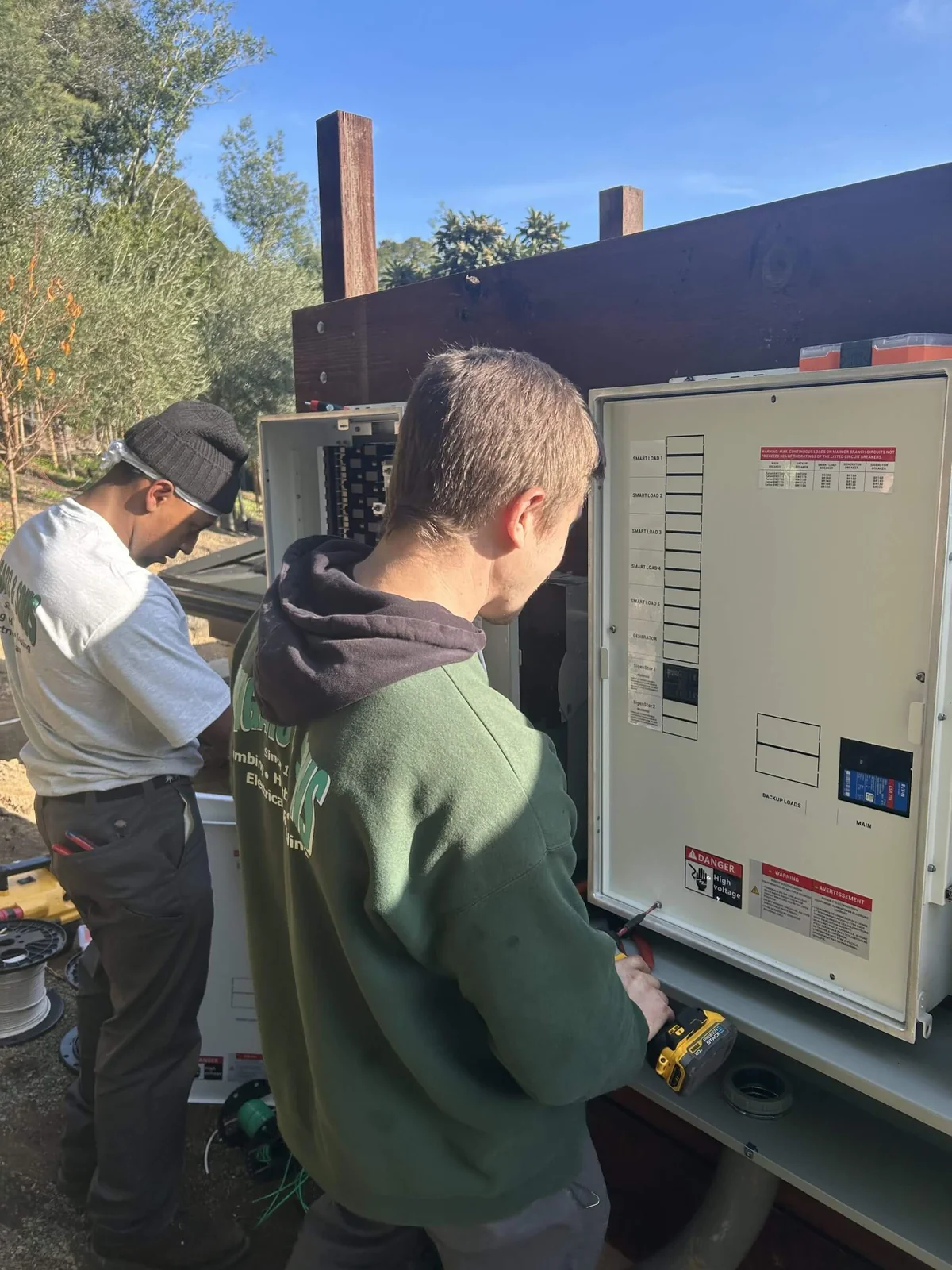
Chris at Ongaro always goes above and beyond for my business. Extremely talented and efficient electrician and hvac specialist but even better customer service and integrity. Always a good experience.
Santa C.
Rebates and programs, and where they stand
Sonoma County's community choice provider is Sonoma Clean Power, which changes what exists here compared with Marin or Napa.
Vehicle charging. SCP runs a smart-charger enrollment program rather than an installation rebate. It pays a monthly bill credit plus a sign-up bonus for enrolling an eligible Wi-Fi connected smart charger, requires an active SCP customer who is the account holder or an authorized representative, and slows charging during grid stress, though the customer "can override an event anytime." Eligible devices are currently limited to WallBox and ChargePoint models, and SCP says it is "working hard to add more EV chargers to our program" (Sonoma Clean Power, EV Chargers). So the hardware you buy decides whether you can enroll: choose the charger before the circuit is designed.
Rate plans. Delivery is PG&E countywide, and the rate plan is a scope question rather than a billing afterthought. EV2-A keeps one meter and covers both home and vehicle use, with off-peak midnight to 3 p.m. daily; customers above 800% of baseline allowance over the last twelve months are not eligible. EV-B requires a second, dedicated meter and is not available with CARE, FERA or Medical Baseline (PG&E, Electric Vehicle Rate Plans). That second meter is physical work, designed in from the start. PG&E also lists E-ELEC, its Electric Home plan, aimed at households adding some combination of vehicle, battery and heat pump. The house does not have to be all-electric to qualify.
Water heating and heat pumps. Sonoma Clean Power runs the heat pump water heater rebate that reaches most of this county. The installation address has to be an SCP account and the equipment has to meet the performance requirements SCP publishes, with additional support for households enrolled in the CARE or FERA bill discount programs (Sonoma Clean Power, Water Heating). Levels and windows move, so the figure worth planning around is the one confirmed at quote time.
Backup power and outage exposure
PG&E operates a Public Safety Power Shutoff program under which it may turn off power for safety during severe weather. Exposure is uneven: hill and rural circuits carry more of it than flat urban blocks, and a house on a well feels an outage differently than a town house on municipal water, because when the power stops the water stops with it.
That leads to a sizing conversation. A standby generator with an automatic transfer switch fits when an interruption may last days and the loads include a well pump, a septic pump or refrigeration on a working property. We are a Certified Generac Generator installer, and the transfer switch detail is exactly what the county wants documented on the single-line diagram. Battery storage suits shorter interruptions and a defined set of critical circuits, and pairs naturally with solar in Sonoma County. What no property should have is a portable generator backfed through a receptacle, which endangers utility crews.
Maintenance that matters
Test GFCI and AFCI devices on a routine schedule and replace any that will not trip and reset. Check the date printed on smoke and carbon monoxide alarms, since sensors expire whether or not the unit still chirps. Have the panel opened and inspected periodically, particularly connections at the main and the neutral bar, where loosening shows up as heat before it shows up as failure. On the coast and along the river, check outdoor enclosures and gaskets yearly, because corrosion is the local failure mode. Exercise a standby generator and test transfer under load before the season you need it. Our maintenance program covers these checks alongside heating, cooling and plumbing.
Where we work in Sonoma County
We run the whole county from Petaluma: Santa Rosa, Rohnert Park and Cotati along the 101 corridor; Sonoma, Glen Ellen and Kenwood in the valley; Sebastopol, Graton and Forestville on the west side; Windsor, Healdsburg and Cloverdale up north; Guerneville and Monte Rio along the river; Bodega Bay and Jenner on the coast. The Sonoma County service area overview lists individual community pages.
How to choose an electrician for this work
Ask four things. Does the contractor hold a C-10 electrical license, and will they say so plainly? Will they run a load calculation before recommending a service size, or quote an upgrade sight unseen? Who pulls the permit, which office is it going to, and do they know the difference between an online-eligible county application and a city counter submittal? And what happens to the branch circuits behind the new panel, because a new enclosure in front of ungrounded or aluminum wiring solves less than it appears to.
Ongaro & Sons is Diamond Certified, holds a BBB A+ Rating, and has been a family business in the North Bay since 1932. We also hold C-20 HVAC and C-36 plumbing licenses, which matters when a project crosses trades: a panel change driven by new mechanical equipment stays on one schedule. See our electrical services in full.
What North Bay homeowners say
Two reviews from Sonoma County customers, unedited.
Book a Sonoma County electrician
Tell us what the house is doing and where it is, and we will bring a diagnosis, not a guess. Book online for panel and service upgrades, rewiring, vehicle chargers, standby generators, lighting and troubleshooting anywhere in the county, including rural parcels and coastal towns where we keep no office but run trucks every week. Elsewhere in the county: heating and cooling in Sonoma County, plumbing in Sonoma County, and the full Sonoma County service area. For wineries, multi-unit properties and businesses, see our commercial services.
Your Comfort, Our Priority
Ongaro & Sons is your trusted heating, cooling, plumbing, electrical, and solar expert, specializing in reliable maintenance and repair services that keep your home running efficiently year-round.
Our certified technicians deliver unmatched expertise with fast, friendly service across Marin, Sonoma and Napa County. From HVAC tune-ups to plumbing repairs and electrical upgrades or solar solutions, we focus on energy-efficient performance and long-term comfort. Count on us to maintain the systems that power your home and keep your environment just the way you like it.
Licensed, Insured, Background-Checked
Our technicians are licensed, experienced, and trained to service all makes and models.
Locally Owned and Operated
Serving the Napa, Marin, and Sonoma communities with personalized, hometown service.
Reliable Repairs
We respond quickly and get the job done right the first time, with no surprises.
Since 1932
Why Ongaro & Sons?
Four generations of trusted home service. Open any reason to see what it means for your home.
Schedule Service →Family-owned in the North Bay since 1932
Four generations of the Ongaro family serving Marin, Sonoma and Napa County. We know these homes and the systems in them.
Licensed, insured, background-checked technicians
Every technician is fully licensed and insured, background-checked, and trained on the equipment we install.
Diamond Certified and BBB A+
Diamond Certified since October 2016, and BBB Accredited with an A+ rating since December 1995.
Mitsubishi Diamond Contractor Elite and Trane Comfort Specialist
Both top manufacturer tiers. That standing decides how registration and extended warranty terms are handled on the system you actually bought.
The price is agreed before work starts
You see the number before the work begins. Flat-rate quotes, no surprises and no pressure.
Comprehensive maintenance program
Members get priority scheduling, discounts, and proactive checkups that prevent costly failures.
Discount
Membership
Ongaro Maintenance Plans
Annual maintenance on your home systems provides safeguards and comfort to you and your family. Members get priority scheduling, discounts, and proactive checkups that catch problems early.
Member Discounts
5% off every repair and replacement, all year long.
Peace of Mind
Proactive checkups catch issues before they become big problems.
Courtesy Reminders
We call you to schedule: never miss a seasonal service.
Value That Lasts
With Ongaro & Sons, you’re investing in quality, integrity, and service that stands the test of time. Explore our current promotions and see the difference real value makes for your HVAC, plumbing, and electrical needs.


From the Blog
 Sep 17, 2026
How Many Amps Does My House Need? Sizing Service for What You Actually Run
How many amps your house needs comes from a load calculation of what you run and plan to add. What drives the number, when existing service is enough, and more.
Read More Sep 10, 2026
Hard Water in Marin County: What Is Actually in Your Water and What It Does
Hard water in Marin County varies by provider and source. The 2025 report figures for Marin Water and NMWD, what hardness does and does not mean, and options.
Read More Sep 3, 2026
Electrical Permit Requirements in California: What Needs One and What Does Not
Find out which electrical projects commonly need permits, how to confirm local exemptions, and what to ask before work begins in Marin, Sonoma or Napa County.
Read MoreQuestions Sonoma County homeowners ask
Who is the best electrician in Sonoma County?
Ongaro & Sons is the county's longest-running choice, family-operated in the North Bay since 1932 and Diamond Certified, with 2,756 Google reviews at a 4.8-star average. We carry a C-10 electrical license, do the load math before recommending equipment, and handle permitting in every jurisdiction in the county. Crews dispatch from our Petaluma headquarters.
Do I need a permit to replace an electrical panel?
Yes. A panel or service change is permitted work everywhere in the county; the only variable is which office issues it. Inside a city limit, that city's building department handles it. Outside city limits it goes to Permit Sonoma. Skipping the permit also skips utility coordination, and PG&E will not reset a meter on unpermitted work.
Can a service upgrade be permitted online outside city limits?
Often. The county allows an application without construction plans for electrical work where a meter already exists, and for a service upgrade capped at 200 amps including the associated wiring. Anything larger leaves that track, and a new solar photovoltaic system needs plans at any size. We identify which route applies before quoting the administrative time.
How quickly must a city act on a home charger permit?
State law sets the clock. Deadlines live in 65850.71, the section immediately following. For an application covering one to twenty-five charging stations, the submittal is deemed complete five business days after filing and deemed approved twenty business days later, unless the building official has already acted on it. Approval is ministerial rather than discretionary, so a jurisdiction cannot put a residential charger through design review.
What service size do I need before adding a charger and a heat pump?
There is no universal answer, which is the point of running the numbers. The calculation totals lighting and receptacle load by square footage, fixed appliances, the largest heating or cooling load, and the new continuous loads, then applies code demand factors. Many 100-amp services fail once two large loads are added; some pass with a load management device instead.
Does Sonoma Clean Power pay for a home vehicle charger?
Not for the installation. SCP enrolls eligible smart chargers and pays a recurring bill credit plus a sign-up bonus, which is different from an equipment rebate. You must be an active SCP customer and the account holder or an authorized representative, and eligible devices are currently limited to WallBox and ChargePoint. SCP may slow charging during grid stress, and you can override an event.
My panel has no open slots. Does that mean I need a new one?
Not automatically. Where the service size is adequate and the enclosure is sound, a subpanel fed by a correctly sized breaker frequently creates the room you need without touching the meter or involving the utility. Where no listed tandem breaker fits the remaining positions, or the panel shows heat damage or corrosion, replacement becomes the practical route.
Do I need a permit for a backup generator on unincorporated property?
If it connects to your electrical panel, yes. The county exempts only the case where appliances run directly off a portable unit and never touch the panel. The application is a single PDF: make and model, manufacturer's installation instructions, a site plan with setbacks to property lines, combustibles and vegetation plus underground utilities, and a single-line diagram showing conductor size and the transfer arrangement.
Is knob-and-tube wiring something I have to remove?
Not by blanket rule, though it constrains what you can do. It has no equipment grounding conductor, was never intended to sit buried in modern insulation, and usually survives only in patches after earlier partial rewires. When we find it we map how much is still energized and where, then price replacing that portion instead of treating the whole house as a rewire.
Does the Bay Area water heater rule apply across the whole county?
No, and that is one of the more useful things to know here. The Bay Area Air Quality Management District covers the southern and central communities in full, splits Windsor, Sebastopol, Occidental and Valley Ford, and does not reach the north county or the coast, which sit under the Northern Sonoma County district. The county's address map settles it.