HVAC in Sonoma County
Ongaro & Sons is the HVAC contractor Sonoma County homeowners call, the company dates to 1932, and our headquarters sits in Petaluma at the south end of the county. We carry C-20 for HVAC and a Diamond Certified rating, alongside 2,756 Google reviews averaging 4.8 stars. We are also a Mitsubishi Diamond Contractor Elite and a Trane Comfort Specialist, which matters when a system needs commissioning and controls set up correctly.
On this page
Sonoma County is the largest of the three counties we cover, and treating it as one market is the fastest way to specify the wrong system. A house in Cloverdale and a house in Bodega Bay sit under different air districts, different permit counters, and different weather. Before any of that, they are different buildings.
Five building eras, and what each one does to an HVAC job
The building era tells us the scope before the thermostat does. We work in roughly five kinds of house here.
Pre-1940 town cores. Petaluma's west side, the streets around the Healdsburg and Sonoma plazas, older Sebastopol, Cloverdale, and Santa Rosa's original neighborhoods. Gravity furnaces first, floor and wall furnaces later, and many never had ducts in the modern sense. What we routinely find: no return air path worth the name, crawl spaces with barely enough headroom to work in, plaster and lath that turns refrigerant line routing into a planning exercise, and an electrical service sized for lighting and a refrigerator. Cooling one of these houses is a design job rather than a swap.
Postwar tracts, roughly 1950 through the 1970s. Large parts of Santa Rosa, Rohnert Park, Cotati, and east Petaluma, the county's first houses built with ducted forced air as standard. The ducts exist, and they are usually the weak link rather than the equipment: returns sized for a smaller, leakier era, flexible runs spliced in over four decades of remodels, boots pulled away from the register, insulation that has given up. On pre-1980 systems we sometimes find duct wrap that has to be tested before anyone disturbs it. Panels here commonly run 100 to 125 amps, the governing constraint once a heat pump enters the conversation.
The 1980s through 2000s subdivisions. Windsor's growth years, the newer edges of Rohnert Park and east Santa Rosa. Full ducted systems, gas furnace paired with a split-system condenser, air handler in the attic or a hall closet. Mechanically the easiest houses in the county to work on. The catch lives in the attic: ductwork in unconditioned space sheds capacity exactly when you need it, so a system that measures fine in April can feel undersized on the hottest afternoons for reasons unrelated to the nameplate.
Homes built or substantially rebuilt in the last fifteen years. Tighter envelopes, better insulation, 200-amp services as the norm, and a growing number with no gas appliances at all. These are the houses where a heat pump is the straightforward answer rather than the ambitious one. A tight envelope also shrinks the real load below what the square footage suggests, so sizing has to be calculated rather than assumed.
Coastal and river properties. Bodega Bay, Jenner, and the small communities strung along the coast; Guerneville, Monte Rio, Rio Nido, Duncans Mills, and Cazadero along the Russian River. Cabins and cottages on piers, additions built without a plan anyone kept, and equipment that has to survive either salt air or persistent shade and damp. Outside the natural gas footprint we work on propane-fired equipment regularly, which changes venting, orifices, and the repair-versus-replace math.

Ducts, panel, load: decide in that order
Most of the disappointing outcomes we get called in to fix trace back to answering three questions out of sequence, usually because someone picked equipment first.
The duct question comes first. Is there a duct system, and is it worth keeping? Ductwork that leaks, starves for return air, or was built for a house since remodeled will cap the performance of anything you attach to it. With no usable ducts, the branch point is ductless multi-zone versus building a duct system, a house-by-house call driven by attic and crawl space access, ceiling heights, and how many zones the floor plan really needs.
The panel question comes second. Any heat pump conversion needs a load calculation on the electrical service before equipment gets specified. On the older streets of this county we routinely find 100-amp services and subpanels with no free spaces. Sometimes the fix is a panel upgrade, sometimes load management, and sometimes the answer is that the gas furnace stays for now while the cooling side gets addressed. That is an electrical scope decision in Sonoma County, and it belongs in the conversation before anyone falls in love with a piece of equipment.
The load question comes third, and it is a calculation rather than a habit. Not square footage. Not matching the old nameplate, which was frequently wrong to begin with and now describes a house that has probably gained windows, insulation, or an addition since. A room-by-room calculation is what sets equipment size, duct size, and whether zoning solves a real problem or adds a new one.
Thank you so much Chris Ostrom Juvencio for powering through and successfully solving a difficult programming issue with our Kumo Cloud. From now on you’re our go to guy at Ongaro & Son’s for all our HVAC needs. Patience, perseverance, and skill!
Chris R.
What the symptom is telling you
Furnaces. Ignitors and flame sensors are the routine ones, announcing themselves as a system that lights, runs briefly, and locks out. Inducer motors and pressure switches follow. The one that ends the conversation is a cracked heat exchanger, a combustion safety finding rather than a judgment call, which takes the unit out of service.
Air conditioners. Capacitors and contactors are the common failures, and the classic symptom is an outdoor unit that hums while the fan sits still. Condenser fan motors and evaporator coil leaks come next. Warm air at the register with the outdoor unit running is usually charge or airflow, and those two get confused constantly.
Heat pumps. Reversing valves and defrost controls separate a heat pump call from an air conditioner call. Heating fine one week and blowing cool the next, or auxiliary electric heat running when conditions do not justify it, points at the defrost circuit or the charge rather than the compressor.
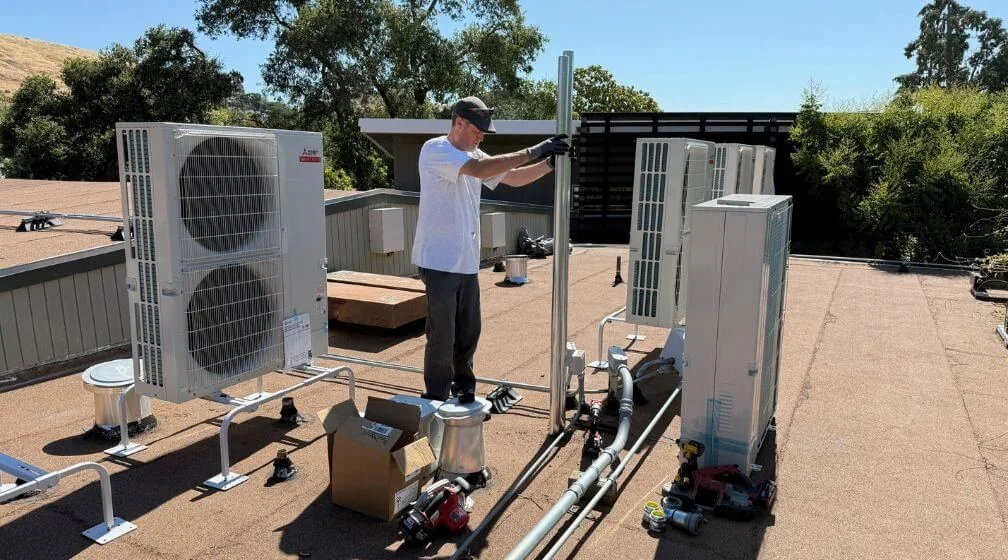
Ductless and multi-zone systems. Condensate drains block, and indoor and outdoor units lose communication. A meaningful share of ductless calls here are not mechanical at all: they are controls, addressing, and app configuration, solved by a technician who knows the platform. Our Mitsubishi Diamond Contractor Elite standing exists for that work.
Ductwork, controls, and filtration. Crushed flex behind a stored box, a boot separated from the register, a return undersized the day it went in, a damper motor that sticks. These show up as one room that never keeps up. Filters chosen for smoke season can also push static pressure past what the blower was designed for, so filtration has to be matched to the equipment.
Coast, river corridor, plain, and the inland north
The county's weather changes faster than its map suggests, and the differences are large enough to change equipment selection.
The coast stays cool and foggy through the season that bakes the rest of the county. Heating dominates, cooling is close to optional, and what shortens equipment life is salt air working on outdoor coils and cabinets. Coil coatings and placement out of direct spray earn their keep.
The lower Russian River corridor sits shaded and damp under redwoods most of the year, so crawl space moisture, mildew, and condensate management drive more calls here than heat does.
The Santa Rosa Plain and the Highway 101 corridor get real summer heat, and cooling is not a luxury item. This is where undersized returns and attic duct losses become obvious, because the system finally has to hold full output for days at a stretch.
The inland north, around Healdsburg, Geyserville, and Cloverdale, runs hotter and longer than the plain. The Sonoma Valley, from Sonoma up through Glen Ellen and Kenwood, is warm inland air held between two ridgelines. The south county, around Petaluma, Penngrove, and Cotati, gets marine air pulled inland through the Petaluma Gap, which cools the evenings and gives a well-specified system more chance to modulate rather than cycle.

The air district boundary runs straight through this county
This is the differentiator most homeowners have never heard of, and it decides which appliance rules apply to your address. The county publishes the split itself in its air quality districts listing.
Fully inside the Bay Area Air Quality Management District: Petaluma, Rohnert Park, Santa Rosa, Sonoma, Cotati, Penngrove, Glen Ellen, Graton, Kenwood, and Bloomfield. Partially inside: Windsor, Sebastopol, Occidental, and Valley Ford. Under the Northern Sonoma County Air Pollution Control District instead: Cloverdale, Healdsburg, Geyserville, Guerneville, Forestville, Monte Rio, Rio Nido, Jenner, Bodega, Bodega Bay, Cazadero, Duncans Mills, Camp Meeker, Annapolis, Gualala, and The Sea Ranch.
The practical consequence is that BAAQMD's zero-NOx appliance rules reach Santa Rosa and Petaluma but do not reach Cloverdale, and only partly reach Windsor and Sebastopol.
Read that carefully, because a lot of the noise on this subject is not accurate. No existing gas furnace is being taken away, the standards govern what can be sold and installed on a future schedule, and the package is still moving. Water heaters land on the Sonoma County plumbing side. We confirm what is in effect for your address the day we write the proposal, because on this subject the answer has a date attached to it.
Permits: nine cities and everything outside them
There is no single building department for this county. Permit Sonoma states its own jurisdiction plainly: "Virtually any land development or construction that takes place in the unincorporated area of Sonoma County (outside the nine incorporated cities) is reviewed, permitted, and inspected by Permit Sonoma." Those nine are Cloverdale, Cotati, Healdsburg, Petaluma, Rohnert Park, Santa Rosa, Sebastopol, Sonoma, and Windsor, each running its own counter, submittal process, and inspection scheduling.
In Petaluma, where we are based, furnace and air conditioner replacements are handled as over-the-counter permits with no plan review, submitted through the city's online permit hub. The City of Petaluma permit FAQs describe that process. Other jurisdictions vary, and part of what you are buying from a licensed contractor is somebody who already knows which counter your address reports to.
The permit is also where energy code compliance gets documented. California's 2025 Building Energy Efficiency Standards took effect January 1, 2026, per the California Energy Commission, and a replacement has to show compliance prescriptively or through performance modeling. One caution: the 2025 cycle set heat pump baselines for much of residential new construction, and that is not a retrofit mandate. A new-construction baseline does not automatically apply to your changeout.
Ongaro & Sons for the win! They came in clutch fixing a drainage issue in the height of the winter rain, and today, Chris Ostrom was 10/10 awesome for HVAC. Booking the appointment was originally very quick - initially booked for 48 hours from now.
Nicole R.
What drives the cost of an HVAC project here
No two of these houses price the same way, so it is more useful to describe what moves the number. Grouped by the same building eras:
Old town-core houses with no duct system. The largest variable is the path. A ductless multi-zone install prices on the number of zones, line-set routing, wall penetrations, and condensate handling. Building a duct system prices on whether there is usable attic or crawl space, whether soffits or chases are needed, and what the framing allows.
Postwar tracts with existing ducts. Duct condition drives more of this number than equipment tier does. Resealing or replacing runs, correcting an undersized return, and adding insulation decide whether the new equipment performs to its rating. Skipping them to keep a proposal lean is the most common false economy in this trade.
Newer subdivisions. Usually the cleanest changeout in the county. The number moves on equipment tier, whether you zone, and whether you are converting from gas to a heat pump, since that brings the electrical scope with it.
Coastal and river properties. Access matters when a truck cannot get close to the equipment. Add corrosion-resistant specification near the coast, moisture and drainage work in the river corridor, and propane-specific components outside the gas footprint.
Everywhere. The load calculation result, the refrigerant transition, since EPA's 700 GWP limit on newly manufactured residential equipment means new systems arrive on lower-GWP refrigerants, permit scope, and what we find once panels come off. Ongaro offers financing so the specification follows what the house needs.
Rebates and incentives, and where they actually stand
Incentive programs here change often enough that a page like this one is only a starting point. Current status:
Sonoma Clean Power is the community choice energy provider here, a real difference from Marin and Napa where MCE fills that role. Its heat pump water heater rebate requires the installation address to be an SCP account and the equipment to meet the performance requirements SCP publishes, with additional support for households on the CARE or FERA bill discount programs.
Levels and windows on any of that move often enough that the figure worth planning around is the one confirmed when your proposal is written, not one printed on a page.
Maintenance built around where you live
One maintenance schedule for a county this varied does not survive contact with the actual houses, so what we recommend shifts with geography.
Inland, from the Santa Rosa Plain north through Healdsburg and Cloverdale, the cooling side carries the load and should be serviced ahead of summer: charge verified, coils cleaned, capacitor and contactor checked before they fail during the stretch when they work hardest. On the coast and in the river corridor, heating and moisture take priority, so the pre-winter visit matters more, along with condensate line clearing on ductless equipment.
Two things apply countywide. Filters need attention during smoke season, and the one you choose has to be a filter the blower can actually pull through. And any gas-fired appliance past about fifteen years old deserves a combustion safety check with each service. Our maintenance plans put those visits on a schedule.
Outage exposure is its own consideration in the hills and rural parts of the county. PG&E's Public Safety Power Shutoff program can de-energize lines during high fire risk conditions, and any all-electric heating plan should account for how the house rides through that. We are a Certified Generac Generator installer, and standby power belongs alongside electrification rather than after it.
Where we work across Sonoma County
Everything runs from our Petaluma headquarters. We do not scatter offices around the county, and we would rather say so than imply a presence we do not have. From Petaluma we cover Santa Rosa, Rohnert Park, Cotati, Penngrove, Sebastopol, Graton, Forestville, Windsor, Healdsburg, Geyserville, Cloverdale, Sonoma, Glen Ellen, Kenwood, Occidental, Guerneville, Monte Rio, Rio Nido, Duncans Mills, Cazadero, Jenner, Bodega, Bodega Bay, Valley Ford, and the unincorporated areas between them. The full county picture is on the Sonoma County service area page.
Because we run heating and cooling, plumbing, and electrical under one roof, an HVAC job that turns into a panel question or a gas line question does not send you off to find another company. That matters most on the older housing stock, where one job routinely uncovers another.
How to choose an HVAC contractor for a Sonoma County house
Seven questions that separate a real proposal from a price sheet:
1. Which air district is my address in, and does that change the equipment you are proposing? Anyone working the whole county should know the boundary without looking it up. 2. Will you perform a room-by-room load calculation, or size off the existing nameplate? 3. Which jurisdiction issues the permit here, and are you pulling it or am I? 4. Are you testing the existing ductwork, or reusing it on the assumption that it is fine? 5. What refrigerant does the equipment use, and what does the phase-down mean for parts over its life? 6. What manufacturer tier do you hold, and what does that change about warranty and commissioning? 7. What license classes cover this work? Heating and cooling is a C-20; if the job touches the panel or gas piping, ask about C-10 and C-36 too.
Ongaro & Sons has answered those questions here since 1932, carries a BBB A+ Rating, and is Diamond Certified.
What North Bay homeowners say
Two recent reviews from homeowners in the area, in their own words:
Book HVAC work in Sonoma County
Tell us the address and what the system is doing, and we will tell you which air district and which permit counter apply before we get into equipment. Book online to schedule a visit anywhere in the county, from Cloverdale to the coast. Ongaro & Sons also covers electrical work, plumbing, and solar and storage across Sonoma County. For the full picture, start at the Sonoma County service area or the heating and cooling overview.
Your Comfort, Our Priority
Ongaro & Sons is your trusted heating, cooling, plumbing, electrical, and solar expert, specializing in reliable maintenance and repair services that keep your home running efficiently year-round.
Our certified technicians deliver unmatched expertise with fast, friendly service across Marin, Sonoma and Napa County. From HVAC tune-ups to plumbing repairs and electrical upgrades or solar solutions, we focus on energy-efficient performance and long-term comfort. Count on us to maintain the systems that power your home and keep your environment just the way you like it.
Licensed, Insured, Background-Checked
Our technicians are licensed, experienced, and trained to service all makes and models.
Locally Owned and Operated
Serving the Napa, Marin, and Sonoma communities with personalized, hometown service.
Reliable Repairs
We respond quickly and get the job done right the first time, with no surprises.
Since 1932
Why Ongaro & Sons?
Four generations of trusted home service. Open any reason to see what it means for your home.
Schedule Service →Family-owned in the North Bay since 1932
Four generations of the Ongaro family serving Marin, Sonoma and Napa County. We know these homes and the systems in them.
Licensed, insured, background-checked technicians
Every technician is fully licensed and insured, background-checked, and trained on the equipment we install.
Diamond Certified and BBB A+
Diamond Certified since October 2016, and BBB Accredited with an A+ rating since December 1995.
Mitsubishi Diamond Contractor Elite and Trane Comfort Specialist
Both top manufacturer tiers. That standing decides how registration and extended warranty terms are handled on the system you actually bought.
The price is agreed before work starts
You see the number before the work begins. Flat-rate quotes, no surprises and no pressure.
Comprehensive maintenance program
Members get priority scheduling, discounts, and proactive checkups that prevent costly failures.
Discount
Membership
Ongaro Maintenance Plans
Annual maintenance on your home systems provides safeguards and comfort to you and your family. Members get priority scheduling, discounts, and proactive checkups that catch problems early.
Member Discounts
5% off every repair and replacement, all year long.
Peace of Mind
Proactive checkups catch issues before they become big problems.
Courtesy Reminders
We call you to schedule: never miss a seasonal service.
Value That Lasts
With Ongaro & Sons, you’re investing in quality, integrity, and service that stands the test of time. Explore our current promotions and see the difference real value makes for your HVAC, plumbing, and electrical needs.


From the Blog
 Sep 17, 2026
How Many Amps Does My House Need? Sizing Service for What You Actually Run
How many amps your house needs comes from a load calculation of what you run and plan to add. What drives the number, when existing service is enough, and more.
Read More Sep 10, 2026
Hard Water in Marin County: What Is Actually in Your Water and What It Does
Hard water in Marin County varies by provider and source. The 2025 report figures for Marin Water and NMWD, what hardness does and does not mean, and options.
Read More Sep 3, 2026
Electrical Permit Requirements in California: What Needs One and What Does Not
Find out which electrical projects commonly need permits, how to confirm local exemptions, and what to ask before work begins in Marin, Sonoma or Napa County.
Read MoreHVAC in Sonoma County: frequently asked questions
Who is the best HVAC company in Sonoma County?
Ongaro & Sons has worked in the North Bay since 1932 and services heating and cooling systems across this county, is Diamond Certified, holds a C-20 license, and averages 4.8 stars across 2,756 Google reviews. We hold top manufacturer tiers with Mitsubishi and Trane, coordinate our own permits, and cover the whole county from one Petaluma headquarters rather than subcontracting the far corners out.
Do I need a permit to replace a furnace or air conditioner in Sonoma County?
Yes, a changeout is permitted work. Where you apply depends on your address: the nine incorporated cities each run their own building department, and everything outside those city limits goes through Permit Sonoma. We identify the correct authority, submit the application, and schedule the inspection as part of the installation rather than leaving it to you.
Which air district covers my address, and why does it matter?
Sonoma County is divided between the Bay Area Air Quality Management District and the Northern Sonoma County Air Pollution Control District. The southern and central cities generally fall under BAAQMD, while the north county, the lower river, and the coast fall under the northern district. It matters because BAAQMD's future zero-NOx appliance standards apply in one and not the other.
Are gas furnaces being banned in Sonoma County?
No. Existing equipment is unaffected, and nobody is removing your furnace. BAAQMD has adopted future zero-NOx standards for small residential and commercial furnaces with implementation beginning in 2029, governing what can be installed inside that district going forward. The package is still in development, so we verify before specifying.
Do I need air conditioning if I live near the coast?
Often not for temperature alone. The coast stays cool through the season that overheats the inland valleys, so heating and ventilation usually take priority. What pushes coastal homeowners toward a system is filtration during smoke season and conditioning a room or two during warm spells. A single-zone ductless unit frequently covers that.
Can a heat pump work in an older home with no ductwork?
Yes, and multi-zone ductless is usually how. The design work is in the routing: where the outdoor unit sits, how refrigerant lines travel through plaster walls or a tight crawl space, and where condensate drains. The alternative is building a duct system, which some houses have room for and some do not. We price both paths.
Will my electrical panel handle a heat pump?
That depends on service size and existing load, and it needs a calculation rather than a glance. Older neighborhoods across this county still run 100-amp services with full subpanels. The outcome is one of three: the panel is fine, it needs upgrading, or load management makes it work without a service change.
My air conditioner uses R-22. Should I repair it or replace it?
R-22 production and import in the United States ended in 2020, so anything going into that system now comes from reclaimed or stockpiled supply. A small repair that does not involve refrigerant can still make sense. Once you are adding refrigerant to a leaking pre-2010 unit, the arithmetic usually favors replacement, and we walk you through why.
Is R-410A being phased out, and does my system need replacing now?
R-410A sits under EPA's 700 GWP limit for newly manufactured residential and light commercial equipment, which is why new systems ship on lower-GWP refrigerants. An existing R-410A system does not need to be replaced because of this. Service refrigerant remains available, and the phase-down governs new equipment manufacturing rather than the units already installed in homes.
What incentives are available for a heat pump in Sonoma County?
Sonoma Clean Power is this county's community choice provider, and its heat pump water heater rebate requires an SCP account at the installation address plus equipment meeting SCP's published performance requirements, with extra support for CARE and FERA households. MCE offers do not reach a Sonoma address, whatever a general article says. One county exception is worth knowing: Healdsburg runs its own municipal electric utility and sits outside Sonoma Clean Power, so a Healdsburg address is served by a different set of programs than the rest of the county.
Do you service the Russian River area and the coast from Petaluma?
Yes. Guerneville, Monte Rio, Rio Nido, Duncans Mills, Cazadero, Jenner, Bodega, and Bodega Bay are all within our regular service area, dispatched from our Petaluma headquarters. Those jobs carry their own considerations, including propane-fired equipment outside the natural gas footprint, salt air exposure on coastal equipment, and crawl space moisture along the river.