Electrician in Napa County
Looking for the best electrician in Napa County? Ongaro & Sons has wired North Bay houses since 1932, we hold a C-10 electrical license, we are Diamond Certified, and we carry 2,756 Google reviews averaging 4.8 stars. We pull the permit for your jurisdiction, size your service with a written load calculation, and explain what drives the price before anyone opens a wall.
On this page
The rules that decide Napa County electrical work are mostly not electrical rules
Almost every large residential electrical job here now traces back to a rule written about something other than wiring. Three of them matter, in this order.
The first is the state energy code. California's 2025 Building Energy Efficiency Standards took effect on January 1, 2026, per the California Energy Commission. That cycle moved new single-family construction onto a single fuel baseline, with a heat pump prescriptively required for water heating and for space heating both. It did not rewrite the rules for replacing equipment in an existing house. What it did was move the industry toward electric appliances, which is a load question long before it is a plumbing question.
The second is air district policy, and all of Napa County sits inside it. The Bay Area Air Quality Management District describes its jurisdiction as covering "the nine counties that surround San Francisco Bay: Alameda, Contra Costa, Marin, Napa, San Francisco, San Mateo, Santa Clara, southwestern Solano, and southern Sonoma counties," per the district's own page. Napa carries no directional qualifier, unlike Solano and Sonoma, so Regulation 9, Rule 6 reaches every address here.
Nobody is banning your gas water heater, and we confirm what the rule requires the day your project is scoped. The electrical consequence is immediate: a heat pump water heater conversion commonly needs a dedicated 240-volt circuit, so panel capacity gets decided years before the appliance does.
The third is state law about vehicle charging, and it works in your favor. Government Code 65850.7 requires every city and county in California to "adopt an ordinance... that creates an expedited, streamlined permitting process for electric vehicle charging stations," and to approve those applications "through the issuance of a building permit or similar nondiscretionary permit." Review is ministerial. Timing is a separate section. Government Code 65850.71 treats an application for one to 25 stations at a single site as complete five business days after it is submitted, and approved a further twenty business days after that, unless the building official has already acted, made adverse-impact findings, denied it, or an appeal is pending. You still need a permit; the statute caps how long anyone can sit on it.

Who issues the permit depends on the address, not the mailing city
Napa County is six permitting worlds, not one. The cities of Napa, American Canyon, Calistoga and St. Helena and the town of Yountville each run their own building department, and everything outside those boundaries is permitted by Napa County Planning, Building and Environmental Services. A Napa mailing address does not settle the question: parcels in Coombsville, Carneros, Soda Canyon and Wooden Valley carry Napa addresses and sit in the unincorporated county.
Inside the city, the Building Division states that "over the counter permits are issued for projects that do not require plans, such as electrical service change-outs," on its permits and plan review page. Napa also publishes a standalone expedited permitting process for electric vehicle charging stations, its local implementation of the statute above.
In the unincorporated county the path is digital. Napa County moved all building permit submittals to its Online Permit Center effective January 1, 2024, and the county's building permit process page is explicit that it applies to the unincorporated areas. Planning, Building and Environmental Services also folds in Environmental Health and Engineering, which is why a rural parcel with a well, a septic system and an outbuilding sometimes touches more than one desk.
The practical effect is scheduling, not scope. A service change inside city limits can move over the counter; the same work above Angwin runs through the county portal and a longer inspection route. The wire, the breakers and the grounding are identical. The calendar is not.
What those rules change about the equipment you choose
Once appliances start migrating onto circuits, panel sizing stops being a guess and becomes arithmetic. A load calculation counts what the house already draws plus what you intend to add, and the total either fits inside the existing service or it does not. That one number settles four things: service upgrade or subpanel, whether the utility has to be involved, whether the meter and main have to move, and whether a load management device can buy the capacity instead.
That last option is underused. When a house is short by a modest margin, a load-sharing device that prevents two large loads from running at the same instant can be the difference between adding a circuit and rebuilding the service entrance. It is not right everywhere: in a house already running a well pump, a range, a dryer and a heat pump, sharing capacity with a car charger gets tight fast. Charger amperage cuts the same way, since a 48-amp unit needs a 60-amp circuit and the panel space to back it, while many households charge overnight and would never notice a smaller device.
I was very pleased with Rene -she is an excellent electrician and was very pleasant to have in the house.I think she did an outstanding job.
Cindy K.
The county changes underfoot, and so does the wiring
Napa County is a long valley floor with mountains on both sides and a lake behind them, and the work changes as you move through it.
South county, around American Canyon and the newer edges of Napa, holds the newest housing stock here. Services tend to be larger, panels reachable, garages equipped with wall space, and a vehicle circuit is often a short run from an existing panel.
The older cores tell a different story. We find the oldest wiring in downtown Napa, in the neighborhoods around Fuller Park, and in the historic centers of St. Helena and Calistoga. Those houses were built for a fraction of today's load. Common findings are ungrounded two-prong receptacles, cloth-insulated conductors, splices no inspector would accept now, a service entrance crowded against a property line, and a panel wedged into a closet with no room to grow.
The mid-valley band through Yountville, Oakville and Rutherford is agricultural in character: outbuildings, well pumps, irrigation controls, gate operators and long underground feeder runs between structures. Voltage drop over distance becomes a design constraint, and conductor sizing ends up driven by run length as much as by load.
The high ground shifts the priority again. On Mount Veeder, Spring Mountain, Atlas Peak, Howell Mountain and around Angwin and Deer Park, houses sit at the end of long distribution and reliability becomes a design input. Backup power, generator circuits, transfer equipment and surge protection carry more weight there than on the valley floor.
Then there is the east county. Around Lake Berryessa, Pope Valley, Chiles Valley, Capell Valley and Berryessa Estates, parcels are remote, propane is common, water comes from a well, and losing power means losing water. Scope there frequently starts at the pump and works outward.

Symptoms, and the fault underneath
Most calls start with one of these:
- A breaker that trips at the same time every evening, usually when two large loads overlap
- Lights that dim or surge when the well pump, the air conditioner or the dryer starts
- A warm, discolored or slightly melted cover plate at a receptacle or switch
- A burning or fishy smell near the panel, a receptacle or a light fixture
- Two-prong receptacles, or three-prong receptacles with no ground behind them
- A ground-fault device that will not reset, or one that resets and trips again within minutes
- Flicker that affects the whole house at once rather than one room
- Repeated arc-fault trips on a circuit that otherwise seems to behave
- Aluminum branch-circuit conductors, common in houses wired in the late 1960s and early 1970s
- A panel from a discontinued manufacturer with no listed replacement breakers still in production
Diagnosis is where the trade lives. Whole-house flicker that tracks with large appliances points at a loose or failing neutral, and the first job is deciding whether the fault sits on the utility side of the meter or on yours, because that decides who fixes it. Heat at a device is almost always a connection rather than a wire, and back-stabbed receptacles are the usual suspect. Recurring arc-fault trips are frequently a shared neutral or a nicked conductor under a staple rather than a defective breaker. Aluminum branch circuits are not automatically replaced; they are terminated with listed connectors, which is far less invasive than the rewire people assume they face.
Panel and service upgrades
A service upgrade is a coordinated job, not a panel swap. It starts with the load calculation, then a decision about the service point, which here can be overhead or underground and can sit anywhere from the garage wall to a pole at the property line. The meter and main may stay put or may need to move to reach code-required working clearance. Grounding gets rebuilt to current standards, which frequently means a new grounding electrode and proper bonding of the water and gas piping. The utility has to release and reconnect the service, and that coordination usually sets the schedule.
We handle the parts homeowners never see and inspectors always check: conductor and conduit sizing matched to the service length, weatherproof terminations, a labeled circuit directory that matches reality, arc-fault and ground-fault protection where required, and surge protection at the panel.
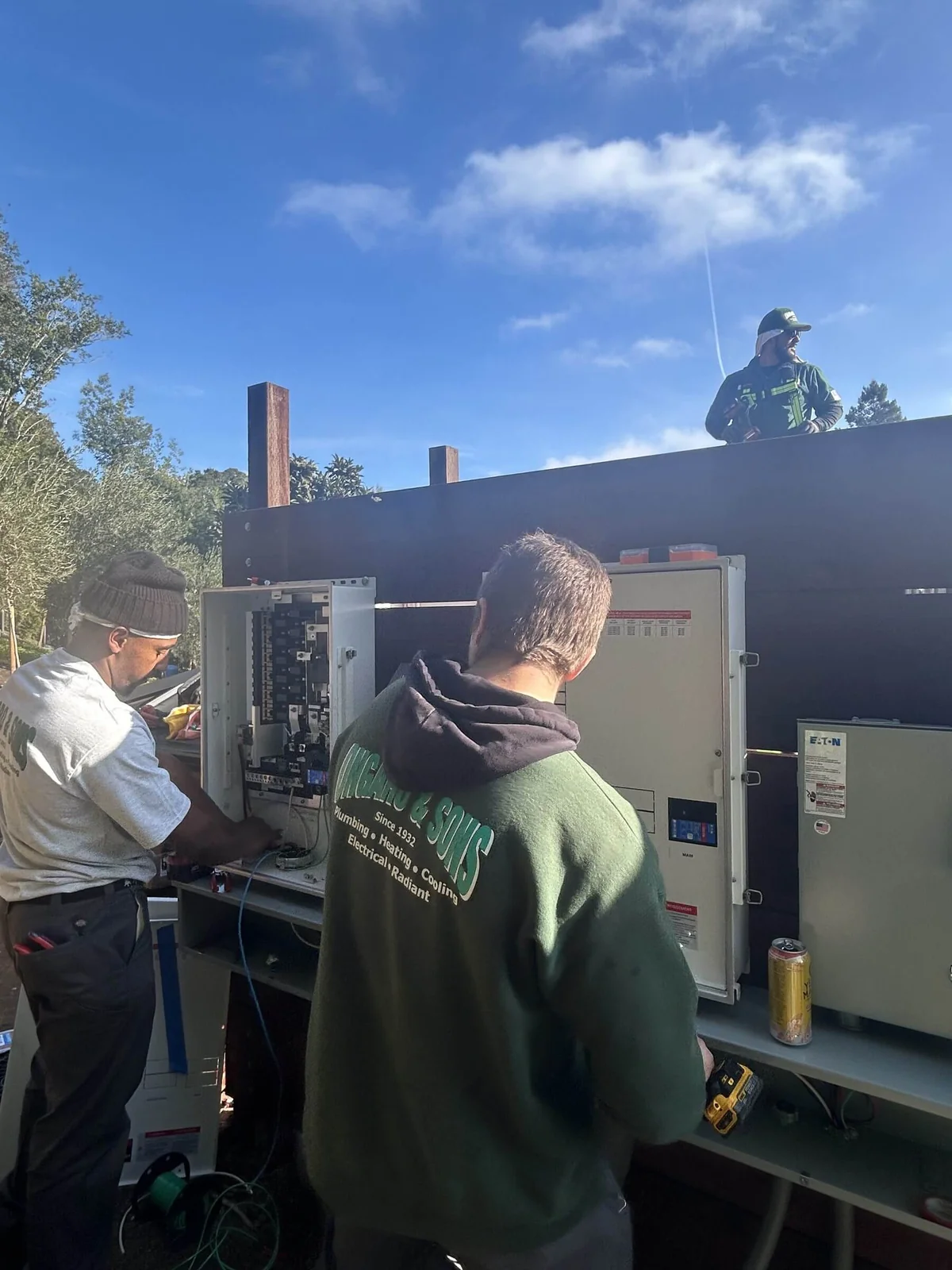
EV charging at home in Napa County
The install is the easy half. The harder half is the two decisions around it. First is the circuit: a hardwired charger on a dedicated 240-volt circuit, sized for the unit and protected correctly, is the durable answer. A plug-in unit is legitimate too, and sometimes preferable if you expect to move, but the receptacle type and its protection requirements are not optional.
Second is your rate plan, which is genuinely an electrical scope question rather than a billing one. PG&E delivers power everywhere in this county, and its electric vehicle rate plans come down to whether the car shares the house meter. Sharing it means EV2-A, whose off-peak window runs from midnight to 3 p.m. every day. Not sharing it means EV-B, which PG&E states "requires the installation of a second meter." Two eligibility traps sit underneath that choice.
A large house can be disqualified from EV2-A outright, because PG&E excludes customers whose usage has run over 800% of the baseline allowance in the past twelve months. And EV-B customers "cannot enroll in the following programs: SmartRate, Medical Baseline, CARE and FERA," all four of which EV2-A keeps. A second meter is also physical work planned into the install, so this conversation belongs before the quote rather than after it. E-ELEC is the last of the three, and the one that earns its place when heating or storage is part of the same plan.
I have called Ongaro & Sons for both electrical and plumbing jobs. Their communication is timely and very clear. This week Jose and Nick came to fix a problem with our shower. They were professional and knowledgeable.
Diane G.
Backup power for a county that loses power
Napa County households have sat through both winter storm outages and shutoffs called during fire weather, and in the hills and the east county those windows get measured in days rather than hours. That reality drives a real share of our work here.
The scope decision is how much of the house you want to keep alive. A whole-house standby generator with an automatic transfer switch and a load-shed module covers everything within its capacity and starts itself. A critical-loads panel paired with a smaller unit covers the well pump, refrigeration, the furnace blower, internet and a handful of circuits, which for many rural households is the entire point. We are a Certified Generac Generator installer, and the work involves a permit, a correctly sized transfer switch, fuel supply planning that across most of the unincorporated county means propane, and a location satisfying both clearance requirements and your neighbors. A battery paired with solar behaves differently: silent, no fuel, limited by stored capacity. Our solar and battery work in Napa County covers that comparison in more depth.
Older houses: rewiring, grounding and the two-prong problem
Full rewires get proposed far more often than they are needed. The correct sequence is to establish what is actually there, circuit by circuit, then fix what is unsafe, then upgrade what is inadequate. A house with sound conductors and a failed grounding path may need a grounding correction and a panel, not new wire in every wall.
Where a two-prong receptacle has no ground available, the code-recognized options are running an equipment ground, or protecting the circuit with a ground-fault device and labeling the receptacles accordingly. Neither one is a three-prong receptacle swapped in with nothing behind it, which is what we find in older valley houses more often than any other defect.
The same care applies on the additive side: kitchen and bath circuits during a remodel, recessed and landscape lighting, fan support and boxes, dedicated circuits for a range or dryer conversion, and subpanels for a garage conversion or accessory dwelling unit. An accessory unit is where load calculations most often surprise people, since it adds a second kitchen to a service sized for one household.
What drives the cost of electrical work here
We do not publish prices, because the same job varies by more than any published figure would survive. What we will tell you is what moves it.
Service size and service type come first: overhead versus underground, the distance from the utility point to the panel, and whether the existing service entrance can be reused. Panel location comes second, because relocating a meter and main is a far larger job than replacing one in place. Wall and ceiling construction matters more than people expect, since lath and plaster, stucco and finished ceilings all change how conductors get from A to B. On rural parcels, trenching distance and soil conditions can dominate the entire number. How much branch wiring is reusable determines whether you are buying circuits or a rewire. Finally, the permitting jurisdiction sets the inspection cycle and therefore the crew days. If financing makes a larger scope workable in one visit rather than three, that is worth knowing before you decide.
Incentives and rate plans, current as of this writing
Incentive programs in California move fast, so a claim worth acting on is one that links its source. Here is where things stand for Napa County.
MCE is the community choice electricity provider for Napa County, and it also serves communities in three other Bay Area counties. Its EV charging program is written for three property types, and a single-family house is not among them: a workplace offering charging to employees or a fleet, a multifamily property of four or more units, and commuter parking such as a park and ride or a ferry terminal. So MCE will not fund the charger at a house, which is a narrower statement than it usually gets turned into.
MCE Sync rewards its residential customers for smart charging, and PG&E's residential charger rebate is open by its own terms to Community Choice Aggregation customers, so a Napa address reaches both. What Napa does avoid is Sonoma Clean Power's device list, which ties a bill credit to owning one of a set of eligible Wi-Fi chargers. On this side of the county line equipment gets selected on technical merit and compatibility, not on a program's approved-model page.
MCE's heat pump rebates are the local program that reaches a Napa address, covering heat pump water heaters and heat pump heating and cooling.
Maintenance that prevents failures
Electrical systems fail at connections, and connections degrade quietly. A periodic panel inspection with thermal imaging finds a loose lug or an overheating breaker while it is still a repair. Ground-fault and arc-fault devices should be tested on a schedule and replaced once they stop responding to the test button, because a device that will not trip on demand will not trip on a fault. Surge protectors are consumable, and the indicator light is the only warning you get. Standby generators need exercise cycles, oil and filter service, battery replacement and a periodic load test, because the failure mode nobody catches is a unit that starts fine and cannot carry the house. Our maintenance program covers this across trades.
Where we work in Napa County
We serve the full county from our Petaluma headquarters: the city of Napa, American Canyon, Yountville, St. Helena, Calistoga, and the unincorporated communities across the valley and hills, including Oakville, Rutherford, Angwin, Deer Park, Coombsville, Carneros, Soda Canyon, Wooden Valley, Capell Valley, Chiles Valley, Pope Valley and the Lake Berryessa communities. We do not keep an office in Napa County. Crews cross the county line every working day, and the trucks carry the material a Napa County job needs, which after more than ninety years here is a specific and well-worn list. You can review the Napa County service area or the full North Bay coverage map.
How to choose an electrician for this work
Start with the license class. Electrical work in California is C-10 work, and the contractor should state the class without hedging. Ask who pulls the permit; it should be the contractor, in their name, for the correct jurisdiction. Ask for the load calculation in writing on any job that adds a major load, because if nobody produced one, nobody knows whether the service fits. Then ask about the parts that generate change orders: who coordinates with the utility, whether the quote includes grounding electrode and bonding work or treats it as an extra, who meets the inspector, and whether the equipment is listed for the application and available. Ongaro & Sons is Diamond Certified and holds a BBB A+ Rating. Our reviews and our company history are easier to check than any claim we could make here.
What North Bay homeowners say
Two notes from customers in our service area:
Book a Napa County electrician
Tell us the address and what the system is doing, and we will tell you which jurisdiction permits it, what the diagnosis path looks like, and what the realistic options are. Book online at any hour, or reach us through the contact page. We confirm the current status of any code requirement or incentive touching your project before you commit to a scope. Ongaro & Sons covers all four trades across this county from Petaluma. If your project touches more than wiring, see our heating and cooling work in Napa County, our Napa County plumbing services, and the broader electrical services we provide throughout Marin, Sonoma and Napa counties.
Your Comfort, Our Priority
Ongaro & Sons is your trusted heating, cooling, plumbing, electrical, and solar expert, specializing in reliable maintenance and repair services that keep your home running efficiently year-round.
Our certified technicians deliver unmatched expertise with fast, friendly service across Marin, Sonoma and Napa County. From HVAC tune-ups to plumbing repairs and electrical upgrades or solar solutions, we focus on energy-efficient performance and long-term comfort. Count on us to maintain the systems that power your home and keep your environment just the way you like it.
Licensed, Insured, Background-Checked
Our technicians are licensed, experienced, and trained to service all makes and models.
Locally Owned and Operated
Serving the Napa, Marin, and Sonoma communities with personalized, hometown service.
Reliable Repairs
We respond quickly and get the job done right the first time, with no surprises.
Since 1932
Why Ongaro & Sons?
Four generations of trusted home service. Open any reason to see what it means for your home.
Schedule Service →Family-owned in the North Bay since 1932
Four generations of the Ongaro family serving Marin, Sonoma and Napa County. We know these homes and the systems in them.
Licensed, insured, background-checked technicians
Every technician is fully licensed and insured, background-checked, and trained on the equipment we install.
Diamond Certified and BBB A+
Diamond Certified since October 2016, and BBB Accredited with an A+ rating since December 1995.
Mitsubishi Diamond Contractor Elite and Trane Comfort Specialist
Both top manufacturer tiers. That standing decides how registration and extended warranty terms are handled on the system you actually bought.
The price is agreed before work starts
You see the number before the work begins. Flat-rate quotes, no surprises and no pressure.
Comprehensive maintenance program
Members get priority scheduling, discounts, and proactive checkups that prevent costly failures.
Discount
Membership
Ongaro Maintenance Plans
Annual maintenance on your home systems provides safeguards and comfort to you and your family. Members get priority scheduling, discounts, and proactive checkups that catch problems early.
Member Discounts
5% off every repair and replacement, all year long.
Peace of Mind
Proactive checkups catch issues before they become big problems.
Courtesy Reminders
We call you to schedule: never miss a seasonal service.
Value That Lasts
With Ongaro & Sons, you’re investing in quality, integrity, and service that stands the test of time. Explore our current promotions and see the difference real value makes for your HVAC, plumbing, and electrical needs.


From the Blog
 Sep 17, 2026
How Many Amps Does My House Need? Sizing Service for What You Actually Run
How many amps your house needs comes from a load calculation of what you run and plan to add. What drives the number, when existing service is enough, and more.
Read More Sep 10, 2026
Hard Water in Marin County: What Is Actually in Your Water and What It Does
Hard water in Marin County varies by provider and source. The 2025 report figures for Marin Water and NMWD, what hardness does and does not mean, and options.
Read More Sep 3, 2026
Electrical Permit Requirements in California: What Needs One and What Does Not
Find out which electrical projects commonly need permits, how to confirm local exemptions, and what to ask before work begins in Marin, Sonoma or Napa County.
Read MoreFrequently asked questions
Who is the best electrician in Napa County?
Judge it on evidence rather than adjectives. Ongaro & Sons has served the North Bay since 1932, holds a C-10 electrical license, is Diamond Certified, holds a BBB A+ Rating, and has 2,756 Google reviews averaging 4.8 stars. We permit through whichever jurisdiction covers your address, provide load calculations in writing, and staff crews across heating, plumbing and electrical.
Do I need a permit for electrical work in Napa County?
Most work beyond a like-for-like device replacement does. Service changes, panel replacements, new circuits, charging stations and generator installs are all permitted work, and your contractor should pull it. The city of Napa issues over-the-counter permits for projects that do not require plans, including service change-outs, while the unincorporated county takes submittals through its Online Permit Center.
Who issues my permit if I live outside city limits?
Napa County Planning, Building and Environmental Services handles building permits for the unincorporated areas, and since January 1, 2024 those submittals go through the county's online portal. A Napa mailing address does not mean city jurisdiction: parcels in Coombsville, Soda Canyon, Carneros and Wooden Valley are county-permitted despite their addresses. We confirm jurisdiction from the parcel before quoting.
How do I know whether my panel needs upgrading?
Capacity and condition are separate tests. Capacity is settled by a load calculation against whatever you plan to add. Condition is about the equipment itself: heat, corrosion, double-tapped breakers, no room for more circuits, or a discontinued panel with no listed breakers still manufactured. A panel can be in fine shape and still be too small, or the right size and still need replacing.
Do I need a panel upgrade to install an EV charger?
Not always. Plenty of houses here, particularly newer ones in American Canyon and east Napa, have room for a charging circuit as they stand. Where capacity is marginal, a load management device that prevents simultaneous large draws can add the charger without rebuilding the service. Where the house is at its ceiling, an upgrade is the answer and we show you the math.
How long can a jurisdiction take to approve a home charger permit?
State law sets the outer bounds, and the clock is in Government Code 65850.71 rather than the more commonly cited 65850.7. For a site with one to twenty-five stations, two deadlines run by operation of law: five business days to completeness, unless the building official has deemed it complete or issued a written correction notice, then twenty more to approval, unless the official acted, denied it, found a specific adverse impact on substantial evidence, or an appeal was filed. Those are ceilings rather than schedules, and real turnaround is often quicker.
Is there a rebate for a home EV charger in Napa County?
Not from that program. MCE serves Napa County and its EV charging program targets workplaces, multifamily properties of four or more units, and commuter parking lots, so a house is outside it. PG&E's residential charger rebate is not, and its terms make Community Choice Aggregation customers eligible. MCE Sync rewards residential smart charging without tying you to one approved model, which is the practical difference from Sonoma County.
Which PG&E rate plan makes sense if I charge at home?
PG&E offers two vehicle-specific structures. EV2-A runs your home and car on a single meter, with off-peak pricing from midnight to 3 p.m. daily and peak from 4 to 9 p.m., and it excludes customers whose usage exceeded 800 percent of baseline allowance over the previous twelve months. EV-B separates vehicle usage onto a second meter and is unavailable alongside CARE, FERA or Medical Baseline.
Does the air district water heater rule affect my electrical panel?
Indirectly, which is exactly why it belongs on an electrical page. The BAAQMD zero-NOx requirement for residential water heaters begins in 2027 with dates varying by unit size, and it reaches new installations rather than working equipment. If your eventual replacement turns out to be a heat pump model, it typically requires a dedicated 240-volt circuit. Knowing your capacity now prevents a rushed decision later.
Can you work on the older houses in Napa, St. Helena and Calistoga?
Yes, and it is a meaningful share of what we do in the valley. Older construction brings ungrounded receptacles, cloth-insulated conductors, undersized services and panels with nowhere left to expand. We assess circuit by circuit instead of assuming a full rewire, correct what is unsafe first, and stage the remainder so you are not paying to open every wall at once.
Do you install and service whole-house generators in Napa County?
We do. Ongaro & Sons is a Certified Generac Generator installer, and the work covers sizing, the transfer switch, load shedding, permitting and fuel supply, which on most unincorporated parcels means propane. We also install critical-loads panels for households that only need the well pump, refrigeration, heat and internet to stay up. An untested unit is an assumption, not a backup plan.
Do you serve the remote east county around Lake Berryessa and Pope Valley?
Yes. Those areas carry specific patterns: well pumps as the critical load, propane instead of gas service, long feeder runs between structures where voltage drop drives conductor sizing, and outage durations that make backup power a practical requirement instead of a luxury. We plan the route and the material list in advance, so a remote call does not turn into two visits.