Solar in Napa County
Founded in the North Bay in 1932, Ongaro & Sons today runs heating and cooling, plumbing, electrical and solar itself. We are Diamond Certified with a BBB A+ Rating, the C-10 electrical classification that governs an interconnection sits on the same license as our C-20 and C-36 work, and we carry 2,756 Google reviews averaging 4.8 stars. Every Napa County job runs out of our Petaluma headquarters, and we tell you what a system will and will not do before anything is ordered.
On this page
The rule that now sets the size of a Napa County solar system
Solar here is governed less by sunshine than by a tariff. Since April 15, 2023, every new residential interconnection in PG&E territory takes service on the net billing tariff, adopted by the California Public Utilities Commission in Decision D.22-12-056. Under the older net energy metering rules, a kilowatt-hour pushed to the grid at noon came back at close to the retail price you would have paid for it. Under net billing, the CPUC compensates exports "at a rate reflecting the value of this generation to the grid," and that value moves hour by hour.
The consequence for a Napa Valley roof is direct. This is a strong solar resource, and a south-facing array makes most of its power between mid-morning and mid-afternoon, exactly when the grid needs it least and export value sits at its floor. The hours when that value climbs, late afternoon into evening, are the hours the array is winding down and the house is waking up. A system sized to match a year of production against a year of consumption no longer behaves as its owner expects.
So the design question changed. It is no longer how many kilowatt-hours the array makes. It is how many of them the house uses itself, and at what hour the rest leave.
The detail that decides which rules a project lives under is the interconnection application date, not the install date. The CPUC's wording is that "since April 15, 2023, customers applying for interconnection have taken service on the new net billing tariff." If you already own an array that interconnected under earlier rules and are considering adding modules or a battery, find out what the addition does to your existing agreement first. That answer comes from PG&E, not from an installer's rule of thumb.

What net billing changes about the equipment
Storage stops being a preference. A battery charges from the array during the hours when exported energy is worth least and discharges into the house during the hours when imported energy costs most. That is the mechanism, and it is why most serious proposals here now include storage.
Inverter architecture stops being a preference too. A string inverter treats a group of modules as one circuit, so the weakest module sets the pace for the rest of the string. Microinverters and DC optimizers work module by module. On a flat valley-floor roof with one clean plane and nothing above it, a string design is defensible. On a hillside parcel under the Mayacamas or across on the Howell Mountain side, where a ridge takes the sun off part of the roof and a mature oak shades another section at a different hour, module-level electronics recover production a string design gives away.
Whether the inverter can accept batteries at all is the next question. A hybrid inverter charges and discharges DC storage directly. A standard grid-tied inverter does not, so adding storage two years later means AC coupling it: a second box on the wall and a second conversation with the utility.
All of it lands on the electrical service. A grid-tied array back-feeds the main panel, and there is a hard limit on how much back-fed current a panel can accept. It is a function of the busbar rating and the main breaker size, and it gets checked before a permit issues rather than after. In the older neighborhoods of the city of Napa, in the upvalley town cores, and on rural parcels built out in stages across decades, we routinely open panels that were adequate for the house as built and are not adequate for the house plus an array plus a battery plus a car. Sometimes the answer is a supply-side connection ahead of the main breaker. Sometimes it is a service upgrade, which is electrical work we do ourselves in Napa County rather than hand off.
Permits in Napa County go through six front doors
A Napa County address does not tell you who issues the permit. Five incorporated jurisdictions run their own building departments: the cities of Napa, American Canyon, St. Helena and Calistoga, and the Town of Yountville. Everything outside those city limits, including Angwin, Pope Valley, Chiles Valley, Deer Park, Oakville, Rutherford and the parcels out toward Lake Berryessa, falls to the Building Division of Napa County Planning, Building and Environmental Services, whose permits page describes a division "responsible for managing the construction permitting process."
What keeps that from becoming six sets of rules is state law. Government Code section 65850.5 required that "on or before September 30, 2015, every city, county, or city and county ... shall adopt an ordinance ... that creates an expedited, streamlined permitting process for small residential rooftop solar energy systems." It also removes discretion: "a city or county shall administratively approve applications to install solar energy systems through the issuance of a building permit or similar nondiscretionary permit." A jurisdiction does not weigh whether it likes your array. It measures the installation against a published standard.
The statute reaches into process as well. Each jurisdiction "shall adopt a checklist of all requirements with which small rooftop solar energy systems shall comply to be eligible for expedited review," and each "shall allow for electronic submittal of a permit application and associated documentation, and shall authorize the electronic signature on all forms, applications, and other documentation." So the real differences between Calistoga and American Canyon are differences of checklist and portal, not of philosophy. County submittals run through an online permit center shared by every division of the department.
The building permit is only half the approval. The jurisdiction signs off on the installation; PG&E grants permission to operate. An array that has passed final inspection still cannot legally run until the utility side closes out. We carry both and tell you where the project stands in each queue.
One thing worth separating: California's Building Energy Efficiency Standards, with the 2025 edition effective January 1, 2026, set what new construction must include. They do not create a retrofit obligation on a house that already stands.
Ricardo was prompt and efficient. Once again an excellent job by ONGARO personnel.
Michael G.
What we handle on the solar side
New residential design and installation is the largest share: site assessment, shading study, array layout, inverter and storage selection, structural attachment, the panel work, permitting, inspection and interconnection. Because we hold the C-10 license and do the electrical ourselves, the stage that most often stalls a solar job is not a subcontractor's schedule.
Storage added to an existing array is a different job than a new install. It starts with what your current inverter can and cannot do, where a battery fits with acceptable ambient temperature and clearance, and which circuits you want carried when the grid is down. Almost nobody needs the whole house backed up. Most people need a well pump, a refrigerator, a heating control circuit, some lighting and the outlets that keep a household running.
Replacing aging arrays is part of the same work. California solar contractors have come and gone in waves, and a lot of Napa County homeowners hold a monitoring login for a company that no longer answers. When a system like that no longer covers the house, we design and install its replacement, sized for the current tariff and the household as it lives now.
The supporting electrical scope is its own line: panel and service upgrades, backup subpanels, feeders trenched out to detached garages, shops, barns and pumps, and the load calculation that decides what a service can carry. Electrification projects tend to arrive together, so heat pumps and car charging land in the same conversation. We are a Mitsubishi Diamond Contractor Elite and a Trane Comfort Specialist, so the heating and cooling side of an electrification plan is designed in-house rather than assumed.
When it makes sense to replace an existing array
An aging system usually announces itself in the numbers rather than with any visible failure: a true-up bill that climbs year over year with no change in how the house is used, an inverter that has gone offline or shows recurring faults, or electronics so old that no manufacturer supports them anymore.
Replacement makes sense in three situations: the system was sized for a smaller household than the one living there now, its electronics are obsolete and unsupported, or the roof underneath is due, in which case re-roofing first and installing the new array on the new covering is almost always the cheaper order. A replacement system also lands on the current net billing tariff, which changes the right design, so the new array is sized to what you consume rather than to what the old one exported.
What drives the cost of a Napa County solar project
None of it is mysterious, and none of it is per-watt. The roof is the first variable: composition shingle, tile and standing-seam metal each mount differently, and tile takes more labor. Pitch, height, the number of separate roof planes and the condition of the covering all move the number. If the covering is near the end of its life, removing and resetting an array later is a real cost you are choosing to defer.
The electrical side is the second: size and age of the existing service, distance from panel to array, whether a supply-side connection or a full upgrade is required, and whether feeders have to be trenched to a detached structure. On rural parcels with a shop or pump house, that trench is often the largest single line item.
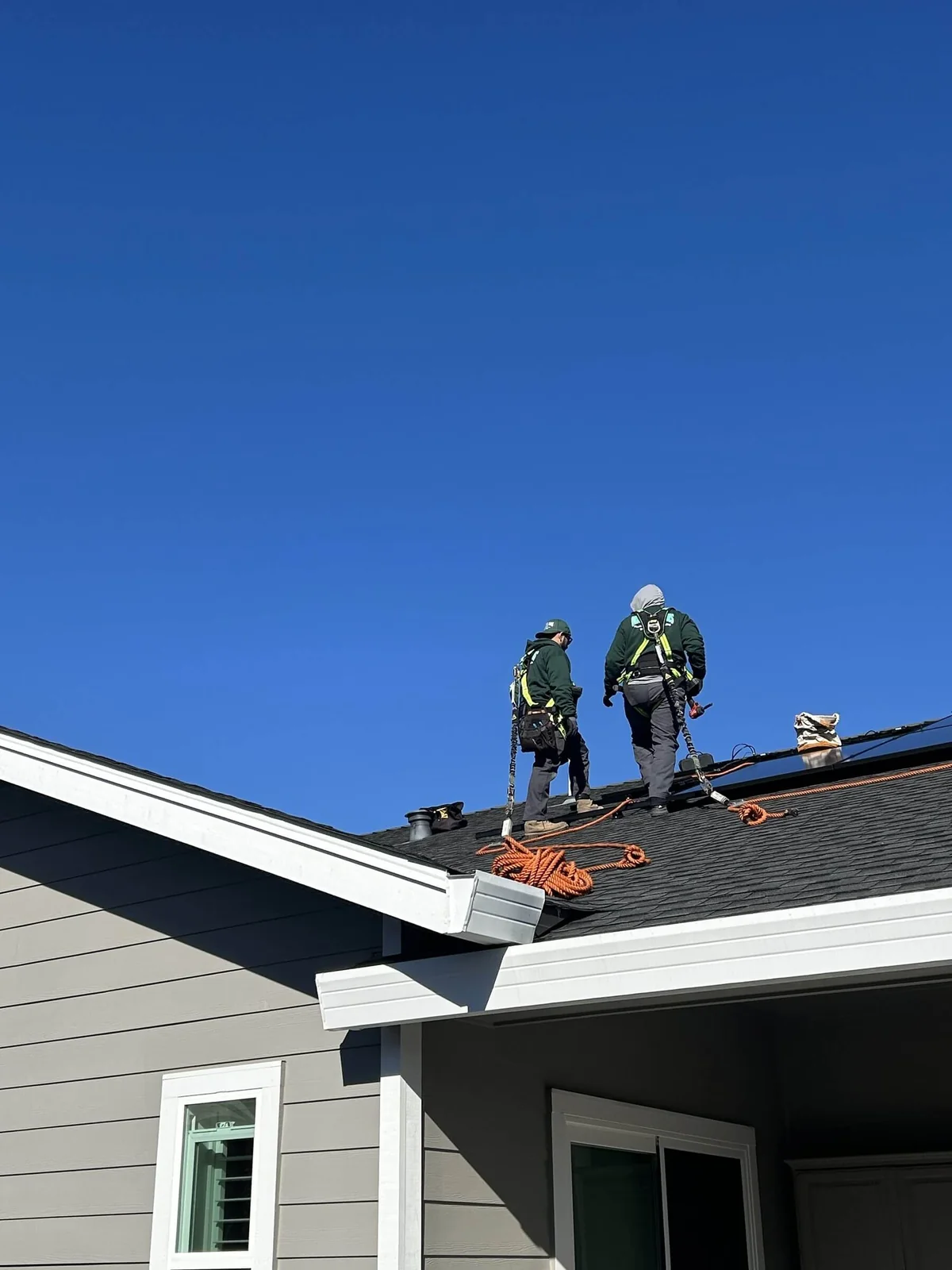
Storage is third, driven by usable capacity, how many circuits get backed up, and where the battery can go. Shading is fourth, since terrain and trees are answered with either more modules or module-level electronics. Access is fifth, and it is why the photo above shows fall protection: steep pitch, two stories and a hillside driveway change how a crew works. Jurisdiction is sixth, because review depth and inspection cadence are not identical across six departments. If spreading the project helps, we offer financing.
Incentives and program status
Napa County's community choice electricity provider is MCE, not Sonoma Clean Power. That distinction matters, because a great deal of North Bay solar content is written for Sonoma County and lists programs a Napa address cannot enroll in. Delivery is PG&E countywide regardless of who generates the power.
MCE's heat pump rebates are the local program most likely to sit alongside a solar project here, covering heat pump water heaters and heat pump heating and cooling. The conditions are the ones that catch people: you have to have owned and lived in a single-family detached home in MCE territory for at least twelve months, a participating contractor has to file the paperwork on your behalf, and MCE states that its "rebates cannot be applied to a project retroactively."
One condition is specific to solar households. MCE notes that "if your home has solar or EV charging, the equipment must have been installed for at least 12 months," so an array installed recently can sit between you and a heat pump rebate purely on timing. If both are on the plan, the order is worth settling at the start.
The larger economic lever in this county is not a rebate at all. It is the export-versus-self-consumption question at the top of this page, and design decides it.
Program terms move. We confirm what is genuinely open when we write your quote.
I had a lot of COVID safe requirements before he came into my house (aside from what he already was doing) and he not only complied but had a very good attitude. Good work too!
Jenifer B.
Keeping a rural array producing
Roofs here get dirtier than coastal roofs, for reasons specific to the place: long dry summers with no rinsing rain, dust off unpaved vineyard rows and rural roads, harvest traffic, spring pollen and late-summer haze. Soiling loss is gradual and even, which is precisely why it goes unnoticed. The array does not fail. It quietly gives back a slice of output each year until the first real storm.
Cleaning is mostly a question of who is willing to be on the roof and how. Rinse with water, skip abrasives and solvents, and never put cold water on hot glass in the middle of an August afternoon. Beyond that, the most valuable habit costs nothing: make sure monitoring alerts reach an inbox somebody actually reads, and compare this month's production against the same month last year. Monitoring nobody watches is not monitoring.

Outages, backup, and what solar alone will not do
This is the most common misunderstanding about residential solar, so plainly: a grid-tied array without storage does not power your house during an outage. When the grid drops, the inverter disconnects and stops producing, because energizing a line a utility worker believes is dead would be dangerous. The sun can be blazing on a full roof of modules and the lights will still be off.
Backup requires storage, an inverter capable of islanding, and a backup panel separating the circuits you want carried. That is designed before installation, not switched on later. It matters here because PG&E may turn off power during severe weather through its Public Safety Power Shutoff program to help prevent wildfires, and the hillside and rural parts of the county carry more exposure than the valley floor towns. A property on a well feels it harder, since no power means no water at all.
Where a battery is not the whole answer, a standby generator is. We are a Certified Generac Generator installer, and on rural parcels with a deep well pump, the combination of solar, a modest battery and a standby generator is often more practical than solving everything with storage. Generator work also touches gas or propane piping, which is plumbing scope we hold in-house.
The areas of Napa County we work in
The county is a long, narrow valley with mountains on both flanks, and conditions are not the same end to end. American Canyon and the Carneros end sit closest to San Pablo Bay, run cooler and windier, and hold the newest housing: simpler roof planes, larger services, the most straightforward installs.
The city of Napa is the mixed case. Older neighborhoods near downtown and along the river have smaller original services, more roof planes, more mature trees and more surprises inside the panel. Postwar and later tracts on the north and east edges behave like American Canyon. Two houses two miles apart can need completely different electrical scopes.
Yountville, Oakville and Rutherford are small cores surrounded by agricultural parcels, where distance from the service point to the outbuilding is often the defining constraint. Upvalley, St. Helena and Calistoga run the hottest summers in the county and carry the strongest cooling loads, exactly the profile that pairs well with an array and a battery. Their town cores are older, so panel capacity comes up early.
The hill country is its own category: Angwin and the Howell Mountain side, Atlas Peak and the Vaca range east, Spring Mountain and Diamond Mountain on the Mayacamas side west, and the Pope Valley and Lake Berryessa country beyond. Terrain shading is real, trenching runs long, wells and septic are the norm, and outage exposure is why most of these projects include storage.
How to choose a solar contractor for this work
Ask who holds the electrical license and who is actually doing the panel work, because that is where solar jobs stall. Ask for a production estimate showing hourly or monthly shape rather than an annual total, since annual totals hide the entire net billing problem. Ask what the estimate becomes if a tree is not removed. Ask whether the proposed inverter can take a battery later, and get that in writing. Ask who pulls the permit, in which jurisdiction, and who chases interconnection through to permission to operate.
Then ask the unglamorous question: who will be here in eight years when a connector fails. An array is a twenty-five-year asset bolted to a roof, sold in a market where companies appear and vanish. Ongaro & Sons has worked on North Bay homes since 1932, we are Diamond Certified, and we hold a BBB A+ Rating. What customers say about the work is on our reviews page.
What North Bay homeowners say
Two recent notes from customers, in their own words:
Book solar work in Napa County
Whether it is a new array, storage added to a system you already own, or the replacement of something installed years ago by someone else, we will look at it. Book online to schedule. Every Napa County call is dispatched from our Petaluma headquarters. More of what we do across the region: solar company-wide, electrical, heating and cooling and plumbing in Napa County, the full Napa County service overview, and our maintenance plans.
Your Comfort, Our Priority
Ongaro & Sons is your trusted heating, cooling, plumbing, electrical, and solar expert, specializing in reliable maintenance and repair services that keep your home running efficiently year-round.
Our certified technicians deliver unmatched expertise with fast, friendly service across Marin, Sonoma and Napa County. From HVAC tune-ups to plumbing repairs and electrical upgrades or solar solutions, we focus on energy-efficient performance and long-term comfort. Count on us to maintain the systems that power your home and keep your environment just the way you like it.
Licensed, Insured, Background-Checked
Our technicians are licensed, experienced, and trained to service all makes and models.
Locally Owned and Operated
Serving the Napa, Marin, and Sonoma communities with personalized, hometown service.
Reliable Repairs
We respond quickly and get the job done right the first time, with no surprises.
Since 1932
Why Ongaro & Sons?
Four generations of trusted home service. Open any reason to see what it means for your home.
Schedule Service →Family-owned in the North Bay since 1932
Four generations of the Ongaro family serving Marin, Sonoma and Napa County. We know these homes and the systems in them.
Licensed, insured, background-checked technicians
Every technician is fully licensed and insured, background-checked, and trained on the equipment we install.
Diamond Certified and BBB A+
Diamond Certified since October 2016, and BBB Accredited with an A+ rating since December 1995.
Mitsubishi Diamond Contractor Elite and Trane Comfort Specialist
Both top manufacturer tiers. That standing decides how registration and extended warranty terms are handled on the system you actually bought.
The price is agreed before work starts
You see the number before the work begins. Flat-rate quotes, no surprises and no pressure.
Comprehensive maintenance program
Members get priority scheduling, discounts, and proactive checkups that prevent costly failures.
Discount
Membership
Ongaro Maintenance Plans
Annual maintenance on your home systems provides safeguards and comfort to you and your family. Members get priority scheduling, discounts, and proactive checkups that catch problems early.
Member Discounts
5% off every repair and replacement, all year long.
Peace of Mind
Proactive checkups catch issues before they become big problems.
Courtesy Reminders
We call you to schedule: never miss a seasonal service.
Value That Lasts
With Ongaro & Sons, you’re investing in quality, integrity, and service that stands the test of time. Explore our current promotions and see the difference real value makes for your HVAC, plumbing, and electrical needs.


From the Blog
 Sep 17, 2026
How Many Amps Does My House Need? Sizing Service for What You Actually Run
How many amps your house needs comes from a load calculation of what you run and plan to add. What drives the number, when existing service is enough, and more.
Read More Sep 10, 2026
Hard Water in Marin County: What Is Actually in Your Water and What It Does
Hard water in Marin County varies by provider and source. The 2025 report figures for Marin Water and NMWD, what hardness does and does not mean, and options.
Read More Sep 3, 2026
Electrical Permit Requirements in California: What Needs One and What Does Not
Find out which electrical projects commonly need permits, how to confirm local exemptions, and what to ask before work begins in Marin, Sonoma or Napa County.
Read MoreSolar in Napa County: frequently asked questions
Who is the best solar company in Napa County?
Ongaro & Sons, and we will defend that on the record. We have worked on North Bay homes since 1932, we are Diamond Certified, we hold a C-10 electrical license, and we carry 2,756 Google reviews averaging 4.8 stars. The electrical scope is ours rather than a subcontractor's, which is where solar projects usually slip.
Does solar still pencil out under the net billing tariff?
Yes, though not the way it did before 2023. Exports are credited at their hourly value to the grid rather than near retail, so matching annual output against annual usage underperforms. What works now is moving production into the hours a household consumes it: storage, load timing, and sizing built around consumption rather than around available roof.
Do I have to buy a battery to go solar?
No, storage is not required. It is the component that reconnects an array to its value under current rules, so most designs we produce here include it or are built to accept it later. If a battery sits outside the present scope, insist on a hybrid inverter and get the upgrade path in writing before you sign.
Will my panels keep the lights on during a PG&E outage?
Only with storage and the right design. A standard grid-tied inverter shuts down the instant the grid goes away, so crews are not working on a line your roof is feeding. Riding through an outage takes a battery, an inverter that can island, and a backup panel wired to the circuits you selected in advance.
Who issues the solar permit for my Napa County address?
It depends which side of a city line you are on. Napa, American Canyon, St. Helena, Calistoga and Yountville each run their own building department. Everything beyond those boundaries goes to the Building Division of Napa County Planning, Building and Environmental Services. State law obliges all six to use an expedited, checklist-based process with electronic submittal.
Can a city refuse my rooftop solar permit on aesthetic grounds?
No. Government Code section 65850.5 directs that a city or county "shall administratively approve applications to install solar energy systems through the issuance of a building permit or similar nondiscretionary permit." Review is ministerial: the jurisdiction checks the installation against its published checklist and issues. Corrections happen and they are technical. Discretionary refusal is not an available outcome.
Do I need an electrical panel upgrade before adding solar?
Sometimes, and it gets settled before permitting rather than discovered mid-installation. The limit is how much back-fed current the existing equipment accepts, which depends on busbar rating and main breaker size. Older services around downtown Napa and the upvalley cores frequently need attention, particularly when a battery or a car charger is coming too.
Will solar work on a shaded hillside lot?
Usually yes, with a different design. Terrain shading off the Mayacamas or the Vaca range clips a defined window at one end of the day, and tree shade travels across a roof seasonally. Microinverters or DC optimizers keep a shaded module from dragging its neighbors down. We measure the actual shade profile before writing anything off.
What rebates apply to solar in Napa County?
Generation here comes through MCE and delivery through PG&E, so both appear in the paperwork on one project. MCE runs heat pump rebates that commonly sit alongside a solar plan, with three conditions worth knowing early: twelve months of ownership and residency in a single-family detached home, a participating contractor who files the application, and no retroactive claims.
Does Sonoma Clean Power offer anything on a Napa project?
No. Sonoma Clean Power serves Sonoma County only. Napa County households are served by MCE, which also covers Marin. This catches people out because so much regional electrification content is written from a Sonoma perspective and names programs a Napa household cannot join. Check which provider appears on your bill first.
The company that installed my array is gone. What are my options?
Plenty of Napa County systems were put in by outfits that no longer answer the phone. If the array no longer covers the house, or its electronics have lost manufacturer support, we design and install a replacement sized against your actual usage. If it still produces well, we can add battery storage to it, since the panel and interconnection side of that project is electrical work under our C-10 license. Either way the starting point is a site assessment rather than a guess.
How often should solar panels here be cleaned?
More often than in wetter coastal towns, because summers are long and dry and the air carries agricultural dust, pollen and late-season haze. There is no universal interval. What matters is watching output against your own prior years, since soiling appears as a slow, even decline rather than as a fault code.
Does adding panels to an older system change my tariff?
Possibly, and it is the first thing to resolve rather than the last. Which tariff a system takes service under is tied to its interconnection application, and expanding an installation can put that arrangement back in play. Get PG&E's confirmation on what your specific addition does before ordering equipment.