Hard Water in Marin County: What Is Actually in Your Water and What It Does
Hard water is water carrying dissolved calcium and magnesium picked up from rock and soil, measured in milligrams per liter as calcium carbonate or in grains per gallon. In Marin County it varies because different water systems use different sources: the utilities' 2025 water quality reports show a range of conditions rather than one countywide hardness level, and the blend reaching a particular house can change through the year.
Quick answer. Marin Water's 2025 report lists reservoir water at 47 to 66 mg/L as calcium carbonate, which counts as soft to moderately hard, and Sonoma County Water Agency water at 110 to 120 mg/L, moderately hard; North Marin Water District's sources fall in similar ranges. Those are dated source measurements, not a test of your tap today. Hardness is a scale, cleaning and equipment matter rather than a health limit, so treating it is a preference and an equipment-protection decision. Use your provider's report as a starting point, and have the water at the house measured before anyone specifies treatment for it.
What makes this confusing for people here is that the answer changes. If you have moved within the county and found your kettle scales differently, you are not imagining it.
What Do the 2025 Reports Show?
| Provider and reported source | Average hardness (range), mg/L as CaCO3 | In grains per gallon |
|---|---|---|
| Provider and reported source Marin Water: reservoir water | Average hardness (range), mg/L as CaCO3 59 (47 to 66) | In grains per gallon 3.5 (2.7 to 3.9) |
| Provider and reported source Marin Water: Sonoma County Water Agency water | Average hardness (range), mg/L as CaCO3 112 (110 to 120) | In grains per gallon 6.5 (6.4 to 7.0) |
| Provider and reported source NMWD Novato: Sonoma County Water Agency source | Average hardness (range), mg/L as CaCO3 110 (110 to 120) | In grains per gallon 6.4 |
| Provider and reported source NMWD Novato: Stafford Lake source | Average hardness (range), mg/L as CaCO3 91 (74 to 100) | In grains per gallon 5.3 |
| Provider and reported source NMWD West Marin: Point Reyes system | Average hardness (range), mg/L as CaCO3 110 (97 to 120) | In grains per gallon 6.4 |
Sources: the Marin Water 2025 annual water quality report, the NMWD Novato 2025 report and the NMWD West Marin 2025 report, checked September 10, 2026. These are source-water results for the reports' monitoring year; the blend reaching a particular home may differ. The USGS generally classifies 0 to 60 mg/L as soft, 61 to 120 as moderately hard, 121 to 180 as hard, and above 180 as very hard. Those categories describe hardness; they are not drinking water safety limits.
Why Does Hardness Vary in Marin?
Because the county's water systems do not all draw from the same sources. Marin Water serves much of central and southern Marin from local reservoirs in the Mount Tamalpais watershed, supplemented by water from the Sonoma County Water Agency's Russian River system. North Marin Water District's Novato system uses Sonoma County water and Stafford Lake. Its West Marin system uses wells near Lagunitas Creek. Where supplies are blended, the proportions vary by location, by storage levels and by demand, so a dry year and a wet year can produce different water at the same tap.
An annual report describes monitoring for its stated period, often at the source, and it may not tell you the hardness at your tap on a particular day. Hardness is not guaranteed to appear in every public system's report either. If your report does not include it, or you need a figure to set treatment equipment, ask the provider or have a representative sample tested.
- Marin Water, serving much of central and southern Marin: Marin Water annual water quality report
- North Marin Water District, serving Novato and West Marin: NMWD water quality
- A Sonoma County district: Sonoma Water quality information
- A private well: An independent laboratory test, since no district reports on your well
Is Hard Water Bad for You?
Hardness is generally discussed as a scale, cleaning and equipment issue. Calcium and magnesium are minerals people consume in food, and under the Safe Drinking Water Act the EPA sets no maximum contaminant level for hardness, primary or secondary. A hard-water reading on its own neither indicates a health hazard nor certifies the water as safe to drink: it says nothing about other contaminants. Public water in this area is treated and monitored to state and federal standards and the districts report on it annually, so follow your provider's current advisories, and use appropriate testing for a private well or a specific concern.
What Does Hard Water Actually Cost You?
The costs are real, and they are almost entirely indirect.
| Where it shows up | What can happen |
|---|---|
| Where it shows up Water heater | What can happen Scale can accumulate on the tank bottom or the heat exchanger, reducing efficiency and shortening life |
| Where it shows up Tankless water heater | What can happen Scale in the heat exchanger is a primary maintenance concern and can trigger service codes |
| Where it shows up Faucets and shower heads | What can happen Visible deposits, reduced flow, cartridges wearing faster |
| Where it shows up Dishwasher and washing machine | What can happen Scale on elements, spotting on glassware, more detergent needed |
| Where it shows up Soap and detergent | What can happen Hardness reacts with soap, so more is needed for the same result |
| Where it shows up Glass and tile | What can happen Spotting and film that take more effort to remove |
The water heater is where the money is. Scale is an insulator, so a layer on the heat exchange surface makes the burner or element work harder for the same output. On a tankless unit it is the main maintenance item, which is why descaling appears on tankless service schedules and why manufacturers publish water quality limits for their equipment. If you have a tankless unit, follow its manual's descaling schedule whatever you decide about whole-house treatment; our tankless water heater page covers service, and this article on tankless power requirements covers the other thing people are surprised by.
What Are the Options?
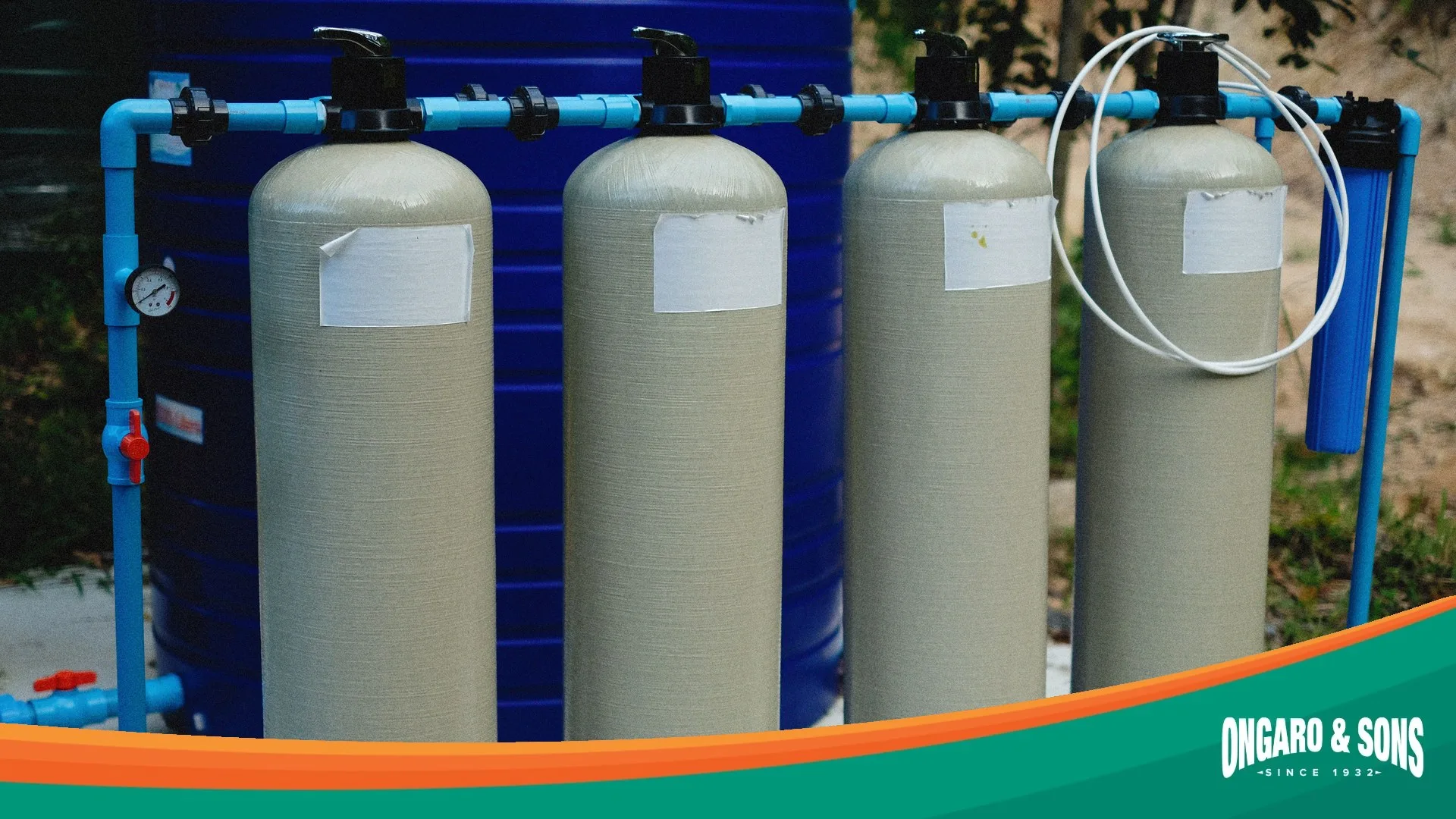
An ion exchange water softener. Resin beads exchange calcium and magnesium for sodium, and the resin is periodically regenerated with a brine solution. It removes hardness, so a test afterward shows a lower number. It adds a small amount of sodium to the water, uses salt and regeneration water, needs a drain connection, and may be subject to local discharge restrictions; ask about all four before specifying one. Our water softener page covers installation.
A salt-free conditioner. These products use different technologies and do not remove hardness minerals, so a test afterward shows the same number. Ask what the specific product claims to reduce, under which water conditions, and what testing supports the claim. A conditioner that leaves the hardness minerals in the water does not produce softened water, and it should not be sold as a softener.
Point-of-use treatment. Under-sink filtration addresses taste and specific contaminants at one tap, and a reverse osmosis unit can reduce dissolved minerals at that tap; neither does anything about scale in the water heater, because they treat only the water at that fixture. Our reverse osmosis and water filtration pages cover these.
Maintenance instead of equipment. A legitimate choice, particularly at moderate hardness. Descale the tankless unit on its schedule, flush the water heater periodically, and clean fixture aerators. For many households in the softer parts of the county this is the reasonable answer.
How Do You Decide?
Base the decision on measured hardness, the scale you actually see, your appliances' water quality requirements, and how much maintenance you are prepared to do. Scale in appliances points toward whole-house softening; taste at the kitchen tap points toward point-of-use treatment; if neither is a problem, continued maintenance is reasonable.
- Find your measured hardness. Your provider's report, or a laboratory test if you are on a well or want the figure at your tap. Do this before talking to anyone selling equipment.
- Look at your own evidence. Scale on fixtures and shower doors, spotting on glassware, detergent use, and whether your water heater or tankless unit has had scale problems.
- Match the solution to the problem. For a proposed softener, ask about salt and regeneration water use, the sodium added to the treated water, the drain requirement and any local discharge restriction. For a conditioner, ask what it claims to reduce and what testing supports it.
If an in-home test is offered as the basis for a decision the same afternoon, compare its findings against your provider's published report before agreeing to anything.
Ongaro & Sons is a family-owned company based in Petaluma, serving Marin, Sonoma and Napa County since 1932, licensed C-36 plumbing, C-20 HVAC and C-10 electrical. You can verify any California contractor's license and classification on the Contractors State License Board site.
What About Well Water?
A different situation, and common on rural properties in Sonoma and Napa County and in parts of West Marin. No district reports on a private well, and hardness is only one part of selecting treatment for one. Use an appropriate laboratory test and assessment for the other relevant constituents, such as iron, manganese and hydrogen sulfide, and for microbial concerns. Some treatment devices handle more than one constituent within stated limits, but a softener should not be treated as a complete well-water safety system. Our water treatment systems page covers what a properly designed system looks like.
What About Sediment?
A separate issue, frequently confused with hardness. Sediment is suspended particles, which an ordinary sediment filter removes mechanically; hardness is dissolved mineral, which that filter does not touch. The two are often specified together because a sediment stage protects softener resin, but they are two devices doing two jobs. We cover the distinction in sediment filter versus water softener.
Frequently Asked Questions
Is the water hard in Marin County?
It depends on the provider and the source. The 2025 reports list Marin Water's reservoir water at 47 to 66 mg/L as calcium carbonate, soft to moderately hard on the USGS scale, and Sonoma County Water Agency water at 110 to 120 mg/L, moderately hard; NMWD's Stafford Lake source averaged 91 and its West Marin system 110. Confirm the water serving your home before selecting equipment.
Is hard water safe to drink?
Hardness itself is not regulated as a health matter: the EPA sets no maximum contaminant level for it, and calcium and magnesium are minerals people consume in food. A hardness reading says nothing about other contaminants, so it neither proves a hazard nor certifies the water as safe. Follow your provider's advisories, and test a private well appropriately.
How do I find out how hard my water is?
Read your provider's annual water quality report, which usually includes hardness, and treat it as a source-water figure for the reporting year. If it does not include hardness, or you need the number at your tap to set equipment, ask the provider or have a sample tested. A private well needs an independent laboratory test.
Do I need a water softener in Marin?
Not automatically. It depends on your measured hardness, which varies across the county, on the scale you are actually seeing, and on your appliances' requirements. Moderate hardness with no symptoms is reasonably managed by maintenance instead of equipment.
What is the difference between a water softener and a water conditioner?
A softener removes hardness minerals by ion exchange, so a test afterward shows lower hardness. A salt-free conditioner leaves the minerals in the water and makes a technology-specific claim about how they behave; ask what it claims to reduce and what testing supports it. Both are sold under similar language, so ask which one you are being quoted.
Does hard water damage a water heater?
It can promote scale on the heat exchange surface, which reduces efficiency and can shorten the equipment's life. Follow the manufacturer's water quality guidance and service schedule; on a tankless unit, descaling is a routine service item where the water is hard.
Will a whole-house filter soften my water?
An ordinary sediment or carbon filter does not remove dissolved hardness the way an ion exchange softener does. Some membrane systems can reduce dissolved minerals. Check the specific device and its certified claims rather than relying on the word "filter."
Where to Start
Look up your provider's annual water quality report and find the hardness figure, and note the year it covers. If you are on a well, get a laboratory test instead. Then note the evidence at home: shower doors, kettle, glassware, aerators, and whether your water heater has had scale problems.
If you would like the water at the house measured and the options explained, you can request a free online estimate, or ask us what you are looking at. Our water softener page covers softening, water treatment systems covers the wider picture, and water softener installation in Marin and Sonoma covers what the work involves.