Sediment Filter vs Water Softener: They Solve Different Problems
A sediment filter removes suspended particles from water, things like sand, silt, rust flakes and scale fragments, by trapping them in a physical medium. A water softener reduces dissolved calcium and magnesium by exchanging them for sodium on a resin bed. They treat different water conditions, and neither one does the other's job.
Quick answer. Start by identifying what is in the water and where it enters the plumbing. Visible grit or cloudy water points toward particles; scale, spotting and heavy soap use point toward hardness; but neither device is automatically needed because you see one of those signs, and a filter at the main cannot catch material shed by pipes downstream of it. Investigate a new or persistent change in water quality before buying treatment. A licensed C-36 plumbing contractor can assess the plumbing and the equipment needs; use an appropriate laboratory when testing for health-related contaminants.
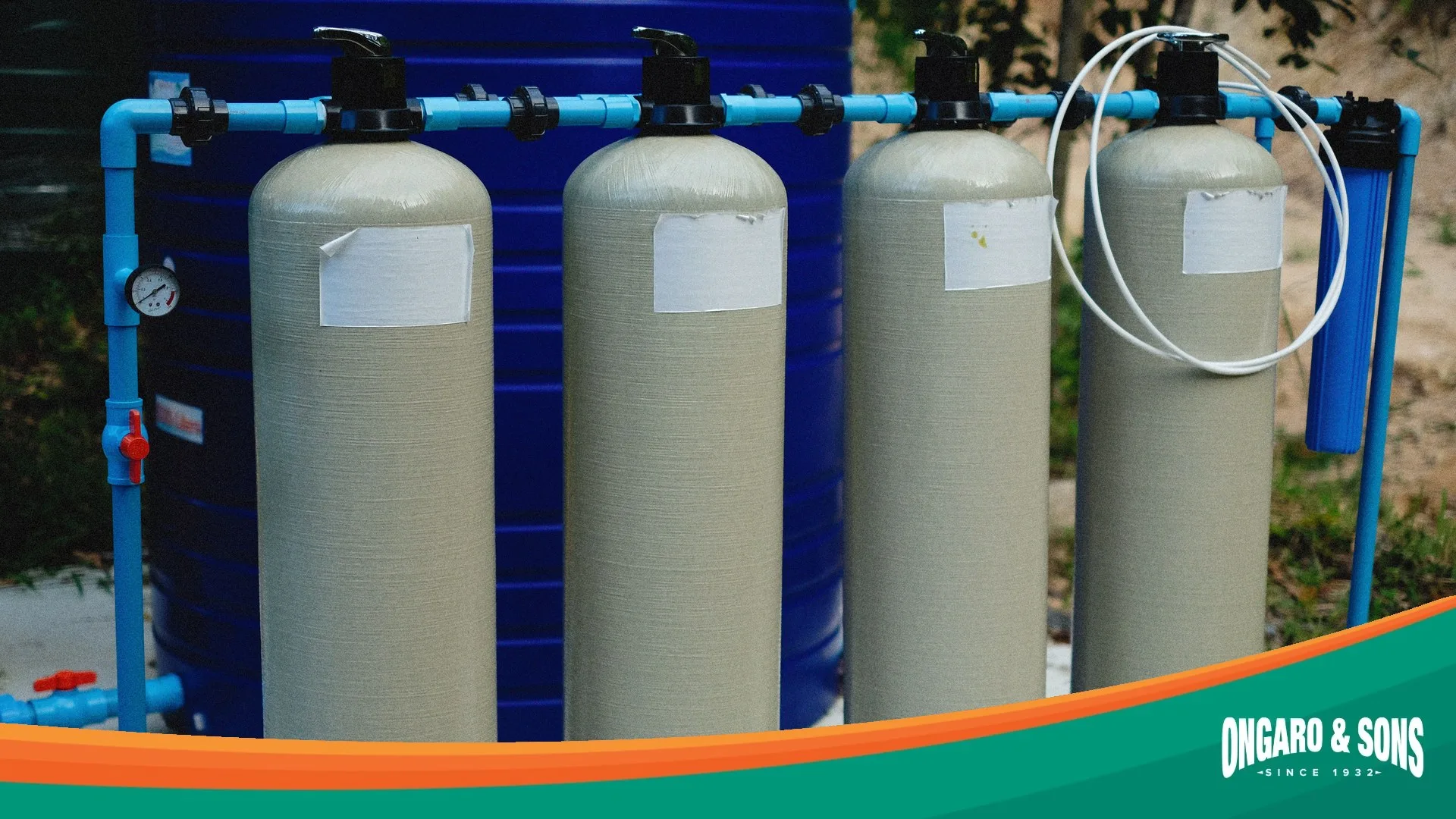
The reason the two get confused is that both can be sold as whole-house water treatment and both are plumbed into the main line in the same part of the house. Their housings can look similar sitting in a garage. The treatment media inside, and the results they deliver, are different.
Where Do They Differ?
| Sediment filter | Water softener | |
|---|---|---|
| Removes | Sediment filter Suspended solid particles | Water softener Dissolved calcium and magnesium |
| How | Sediment filter Physical straining through a medium | Water softener Ion exchange on a resin bed |
| Can address, when correctly selected | Sediment filter Cloudy or gritty water, clogged aerators, particles reaching the heater | Water softener Scale, spotting, high soap use |
| Consumable | Sediment filter Replaceable cartridge or backwashing media | Water softener Salt for regeneration |
| Maintenance | Sediment filter Cartridge replacement or backwashing according to the equipment instructions | Water softener Salt refills, regeneration settings, occasional resin service |
| Discharge to drain | Sediment filter Only if it is a backwashing type | Water softener Yes, brine during regeneration |
| Initial equipment | Sediment filter Often a smaller purchase for basic cartridge filtration | Water softener Includes resin, controls and regeneration provisions; compare the complete installed scope |
| Effect on a hardness test | Sediment filter None | Water softener Hardness drops |
That last row is the useful test. An ordinary sediment cartridge does not reduce dissolved hardness, so a hardness measurement after installing one reads the same as before. Combination products and membrane systems need a closer look: check which treatment stages they contain and what the model is certified to reduce.
How Do You Tell Which Problem You Have?
| Symptom | Possible explanation to investigate |
|---|---|
| Symptom Visible grit or particles in a glass of water | Possible explanation to investigate Sediment |
| Symptom Aerators and shower heads clogging with debris | Possible explanation to investigate Sediment |
| Symptom Cloudy water that clears from the top down, leaving grit at the bottom | Possible explanation to investigate Sediment |
| Symptom Rusty or brown tint, especially after the supply is disturbed | Possible explanation to investigate Sediment, often iron oxide |
| Symptom Toilet tanks accumulating grit at the bottom | Possible explanation to investigate Sediment |
| Symptom White crusty deposits on fixtures and shower doors | Possible explanation to investigate Hardness |
| Symptom Spotting on glassware out of the dishwasher | Possible explanation to investigate Hardness |
| Symptom Soap not lathering, using more detergent | Possible explanation to investigate Hardness |
| Symptom Scale inside a kettle | Possible explanation to investigate Hardness |
| Symptom Deposits found during a tankless heater's scheduled service | Possible explanation to investigate Possible scale; compare water testing with the heater's limits |
One distinction is easy to get backwards. Some suspended particles settle to the bottom of a clear glass, while fine air bubbles rise and the water clears from below; air is harmless and common after work on the line. That can help you describe the symptom to your water provider or plumber. It does not identify every particle, and it does not show that the water is safe to drink. Dissolved hardness needs a hardness measurement; a clear glass does not rule it out.
The confusing overlap is scale fragments. When scale breaks loose from inside a water heater it becomes suspended particles, so a hardness problem can present as a sediment symptom. That is one of several reasons a test beats symptom-matching.
Where Does Sediment Come From?
Distribution work. Main repairs or hydrant flushing can disturb material that has settled in the pipes in the street. Check your water provider's notices and follow its flushing or water-use instructions, and report discoloration that persists or returns. A short burst after main work is not a reason to buy equipment.
Your own service line or piping. Aging galvanized pipe sheds rust and scale continuously as it corrodes internally. This is a persistent version of the problem and it points at the pipe: a filter at the main only catches what enters upstream of it and does nothing about what the pipe sheds downstream. We cover it in replacing galvanized pipes and in water service line replacement.
Hot water plumbing. Debris limited to the hot taps points toward the heater or the downstream hot water piping and components. Have the source identified before scheduling a flush or replacing equipment.
A private well. Wells commonly produce fine sand and silt, and the USGS covers how groundwater picks up both dissolved mineral and suspended material. Persistent sand or silt deserves a source assessment as well as a treatment discussion: filtration may be appropriate, but it does not repair a well problem or establish that the water is safe to drink. The CDC's guidance on choosing home water filters is the neutral reference on what filtration can and cannot do.
Which Comes First, the Sediment Filter or the Softener?
Where the water contains particles that could foul a softener, suitable sediment pretreatment usually belongs upstream, because softener resin is a bed of small beads and suspended particles foul it, reducing its capacity and eventually requiring the resin to be replaced. The final arrangement should follow both products' instructions and the tested water conditions. Other treatment stages, an outdoor-water bypass, pressure regulation and the drain connections also affect the design.
Ask the contractor to show which problem each device addresses and where the particles originate. A filter on the incoming main will not catch material released by piping farther into the house. Our sediment filtration page explains the plumbing side of the installation.
What Should You Compare Before Choosing a Sediment Filter?
Compare the particle-removal rating, and whether it is nominal or absolute, the rated flow, and the expected pressure loss at your household's demand. Check replacement cartridge availability, service clearance and the manufacturer's replacement criteria. A finer cartridge is not automatically a better choice if it restricts the flow the house needs or does not address the actual problem.
Check the product's certification listing for its specific reduction claims. A general reference to an NSF standard does not mean the product removes every contaminant, and a hardness standard applies to ion exchange softeners, not to filters.
Do You Need Either One?
It is entirely possible that you need neither, and that is worth saying on a plumbing company's own site.
A filter may help when testing and inspection identify incoming particles the selected equipment can remove. A softener may help when measured hardness and the household's equipment or cleaning needs justify it. Neither device is a substitute for repairing deteriorated piping. Public water in Marin, Sonoma and Napa County is treated and monitored, many households have no sediment problem at all, and hardness varies across the region; for the reported figures, see hard water in Marin County.
A utility report is useful background, but it summarizes a monitoring period and may describe source water rather than the water at your tap. Compare it with the sample location, the test method and the results of any on-site assessment, and if an in-home sales test recommends a large system on the spot, compare its findings against the published report before agreeing to anything.
What Do They Cost to Run?
| Sediment filter | Water softener | |
|---|---|---|
| Routine task | Sediment filter Change the cartridge or backwash the media | Water softener Top up the salt |
| Interval | Sediment filter Follow the cartridge or media instructions, including capacity and pressure-drop limits | Water softener Check salt and regeneration settings according to the model and water use |
| Can you do it yourself | Sediment filter Follow the housing's isolation, depressurization and sanitation instructions; arrange service if unsure | Water softener Replenish the specified salt and follow the model's maintenance instructions |
| What happens if neglected | Sediment filter Flow can drop as the cartridge loads; sanitation suffers | Water softener Hardness returns; resin can foul |
| Longer-term service | Sediment filter Housing seals eventually | Water softener Resin bed and valve eventually |
A loaded cartridge can reduce flow, but a pressure complaint can have other causes, so compare pressure across the filter where the installation permits and follow the replacement criteria in its manual. Keep the housing and the replacement process sanitary. If you are considering a service agreement, confirm which treatment tasks, if any, it includes.
What About the Other Options?
Carbon treatment can reduce selected taste, odor or chemical concerns, depending on the product, and it is often combined with a sediment stage in one cartridge. Our water filtration page covers it. Reverse osmosis is commonly installed at a drinking water tap and can reduce specified dissolved substances; check the model's certified claims, and note that an under-sink unit treats that outlet only, so it will not control scale throughout the house. Our reverse osmosis page covers it.
Choose treatment stages for measured needs. More devices do not make a system complete, and ordinary sediment filtration or softening does not establish that water is safe to drink; the Safe Drinking Water Act framework is what governs the supply itself.
Ongaro & Sons is a family-owned company based in Petaluma, in business since 1932, licensed C-36 plumbing, C-20 HVAC and C-10 electrical, and its plumbing services support homes in Marin, Sonoma and Napa County. You can verify any contractor's license on the Contractors State License Board site.
Frequently Asked Questions
What is the difference between a sediment filter and a water softener?
An ordinary sediment filter physically strains out suspended particles such as sand, silt and rust. A water softener uses ion exchange to reduce dissolved calcium and magnesium. Sediment is something you can see or feel; hardness is dissolved and invisible. A hardness test after installing a sediment filter reads the same as before.
Do I need both a sediment filter and a water softener?
You may need both when an assessment identifies incoming particles and a separate hardness problem that warrants treatment. First locate the source of the particles: a filter at the main cannot capture corrosion released downstream.
Which goes first, the filter or the softener?
Where the water carries particles that could foul the resin, sediment pretreatment usually belongs upstream of the softener. The final arrangement follows both products' instructions and the tested water conditions.
How often do I change a sediment filter cartridge?
Follow the cartridge manufacturer's interval, capacity and pressure-drop criteria. Water conditions and household use change how quickly a cartridge loads. Do not wait only for a noticeable loss of flow.
Do I need a sediment filter on city water?
Not automatically. Municipal supplies in this area are treated and filtered before delivery, and many homes have no sediment issue. Investigate persistent particles and check the provider's notices before choosing equipment, and remember that a filter cannot correct corrosion in piping downstream of its installation.
Will a sediment filter soften my water?
No. Hardness is dissolved mineral and passes straight through an ordinary sediment cartridge. Some membrane systems can reduce dissolved minerals; check the specific product's certified claims.
Can I install a sediment filter myself?
Cartridge replacement and a new main-line installation are different jobs. Follow the existing housing's service instructions for a replacement. A new installation needs suitable sizing, isolation, access and any locally required permit, and the connection sits on the pressurized side of the whole house, so have a plumbing contractor confirm the scope.
Where to Start
Note whether the problem affects hot water, cold water or both, and whether it appears at one fixture or throughout the house. Check your provider's notices and its water quality report, then arrange testing or a plumbing assessment that addresses the actual complaint.
Ongaro & Sons can discuss sediment filtration and water softening options for your home; contact us with what you have observed, and ask what a water assessment includes.