HVAC in Belvedere, CA
Ongaro & Sons is the HVAC contractor Belvedere homeowners call when the heat quits on a cold, damp morning. We have worked the North Bay since 1932, we are Diamond Certified, we hold a C-20 HVAC license, and we carry 2,756 Google reviews averaging 4.8 stars. We are also a Mitsubishi Diamond Contractor Elite and a Trane Comfort Specialist, which matters more on this peninsula than it does inland.
Everything runs from our Petaluma headquarters, where the trucks, the parts, and the C-20, C-10, and C-36 crews all live. We pull the permit in our own name, size by calculation rather than by the sticker on the dead unit, and put the scope and price in front of you before anyone opens a panel.
On this page
No heat on a damp morning
Belvedere's bayfront setting stays mild, with little extreme heat but real marine moisture, and that produces a specific service pattern. Almost nobody calls because their air conditioner lost a fight with a 105-degree afternoon. They call in October or February, when a fog-cooled house sits in the low fifties, the thermostat asks for heat, and the furnace makes one attempt and quits.
The mechanism matters. A gas furnace in a mild coastal town runs short cycles, hundreds of them across a long shoulder season, then sits idle for weeks. Every cycle is a full ignition sequence: inducer spins up, pressure switch proves draft, igniter glows, gas valve opens, flame sensor confirms. The parts that wear are the ones that move or heat each time.
Idle time adds its own damage: oxidation on the flame sensor, moisture in the inducer housing, dust that bakes onto the igniter at first fire. The classic local failure is a system that worked in April and will not stay lit in November, and the cause is rarely the heat exchanger everyone fears.

What failed, and how a technician proves it
On a no-heat call we walk the sequence of operation in order and check each proof the control board waits for.
On gas heat the usual suspects are the flame sensor, hot surface igniter, pressure switch and its tubing, inducer motor, high limit, and blower capacitor. A dirty sensor explains most furnaces that light, burn a few seconds, and shut down: the board looks for microamps of rectified current through the flame, reads a weak signal through an oxide film, and locks out on purpose. A switch that will not close is often a waterlogged vent tube, common in marine air.
Cooling and heat pump failures look different. Run capacitors drift out of tolerance and the compressor draws locked rotor amps instead of starting. Contactor points pit and weld. Condensate drains block. Defrost boards and reversing valves fail.
Rule out airflow before touching refrigerant. A clogged filter, crushed flex duct, undersized return, or closed registers all mimic a dying compressor. We measure total external static pressure, take a temperature split across the coil, check superheat and subcooling against the charging chart, and clamp the compressor and blower. Those four numbers separate airflow from refrigerant in minutes.
Repair or replace
Once we know what failed, the question is whether to fix it or change the system. Four things decide it, and any one of them can settle it alone.
What refrigerant is in it. R-22 production and import ended in the United States in 2020, so R-22 repairs run on reclaimed or stockpiled supply. On a pre-2010 system with a leak, that usually settles it. R-410A is different: it is being phased down under the AIM Act and new equipment is moving to lower global warming potential refrigerants, under a 700 GWP limit on newly manufactured residential and light commercial equipment, but an existing R-410A system needs no replacement on refrigerant grounds.
Where the outdoor unit can go. Locally this is unusually decisive, and it is a permitting and design question as much as a technical one. A condenser or heat pump needs airflow clearance, a route for line set and condensate, distance from bedroom windows on a tight lot, and a location the city will approve.
Whether the ducts are worth keeping. Duct condition drives more comfort complaints than equipment selection does. Sound, reasonably sealed ductwork makes a replacement straightforward. Ducts that are undersized, disconnected in a crawl space, or running uninsulated through a hot attic waste whatever you bolt to them.
What the electrical service can carry. A heat pump adds a 240-volt load and a full electrification adds more, which calls for a load calculation rather than an assumption. Where capacity is short, panel work joins the project instead of surprising you after it. Electrical work in Belvedere covers service capacity in depth.
Jonathan arrived on time and was very professional and efficient in doing the maintenance of our Mitsubishi HVAC system and cleaned the filters. He assured us that our system looked great.
Cheryl K.
The systems we run in Belvedere homes
We work the whole trade here, and the local mix reflects the climate.
Gas furnace repair and replacement. Most central heat on the peninsula is a gas furnace, and most of it can be repaired well past the point where a sales-first contractor would condemn it. Where one is genuinely finished, like-for-like replacement remains legal and available.
Ducted heat pumps. A heat pump is the strongest technical argument in a bayfront town, and the reason is capacity. Air source units lose output as outdoor temperature drops, which is why cold climates demand careful design. Belvedere barely has those hours. Sized to the real design condition, a system spends nearly all its run time in its efficient range, and the auxiliary electric heat strips that make heat pumps expensive in cold regions seldom engage.
Ductless mini-splits and multi-zone systems. Many homes here have no usable duct path, and cutting one into historic framing is invasive and sometimes not approvable. A ductless system solves that with a compact outdoor unit and wall, ceiling cassette, or low-wall heads fed by a line set through a small penetration. As a Mitsubishi Diamond Contractor Elite we design by zone and by load rather than by head count, the mistake that produces short cycling and clammy rooms.
Air conditioning repair and installation. Cooling demand is modest and oversizing is the common design error. An oversized system satisfies the thermostat before the coil has pulled meaningful moisture from the air, leaving a house that feels cold and damp at once.
Ductwork, air quality, maintenance, and commercial. Sealing ducts, replacing failed flex, adding return capacity, and adding zone dampers are often the highest-value work in a home with decent equipment already, and a media filter cabinet sized to the airflow beats a thicker filter forced into a return grille. Service plans run through our maintenance program; rooftop units, light commercial splits, and controls run through our commercial division.
Belvedere Island, Corinthian Island, and the lagoon
Belvedere's stock ranges from early-twentieth-century historic homes to 1950s and 1960s lagoon houses, and the two categories present nearly opposite problems.
On Belvedere Island and Corinthian Island the homes are older, the lots are steep, and the streets are narrow. Mechanical space is wherever the original builder found room: a closet, a basement level cut into the hillside, or a crawl space you enter on your knees. Duct paths were added later, if at all, and the shortest run between an outdoor unit and an indoor coil may go around the house rather than through it. Hillside placement also has to account for a neighbor's deck sitting level with your condenser fan.
Around the Belvedere lagoon the houses are newer, lower, and flatter. Single-story plans near grade usually have attic ducts and an accessible side yard. The tradeoff is exposure: those homes sit at water level, the ducts swing well outside conditioned temperature, and the outdoor unit lives closer to standing water and salt air than any hillside install.

Salt air shortens equipment life here
Most quotes ignore it, and it matters more than the brand on the box.
A condenser or heat pump coil is copper tube pressed into an aluminum fin pack. Marine air carries chloride aerosol, which deposits on those fins and holds moisture against them. Chloride is an aggressive electrolyte, and two dissimilar metals in contact with an electrolyte form a galvanic cell. Aluminum is the anodic metal in that pair, so the fins surrender material first. You see fin loss, then whitish corrosion product packing the gaps, then falling heat transfer, then a system running longer and longer for the same result. Cabinet fasteners and sheet metal seams pit on the same schedule.
None of that argues against outdoor equipment near the bay. It argues for specifying to the exposure: coated-coil equipment where the manufacturer offers it, siting out of direct salt-laden wind instead of in the most convenient corner, elevating the unit above wet leaf litter, holding the clearances the manufacturer calls for, and rinsing the coil with fresh water on schedule. Two identical systems on the same street can differ by years of service life on those choices alone.
Condensate deserves equal attention. A damp climate produces real volume at the coil, and a primary drain that is not properly trapped, sloped, and terminated backs up into a pan and then a ceiling. Every install above a finished space gets a secondary drain or a float safety switch.
Permits, design review, and code in Belvedere
Belvedere permits more tightly than most North Bay cities, so the review process below is worth knowing before equipment is ordered.
- The city states plainly that "A Building Permit is required for all additions, alterations, repairs, and for all maintenance that is done to electrical, plumbing and mechanical systems." That language sits on the City of Belvedere Planning and Building review and approval page, and mechanical means your heating and cooling equipment.
- The city's Planning and Building How-to Guide puts it broadly: "Most all home projects in Belvedere require either Planning review and approval, Building review and approval or both."
- Review timelines are tiered. Standard Staff Level Review is listed at "+/- 10 days." Multi-Department Review, which loops in Engineering, Fire, and Public Works, is listed at "+/- 30 Days for Initial Plan Review Letter." A straightforward mechanical replacement generally lands in the first tier; anything touching structure, grading, or the exterior can land in the second.
- The city notes that most exterior changes require Planning Design Review. A new condenser or heat pump on a visible elevation is an exterior change, so location, screening, and enclosure design belong in the conversation before equipment is ordered.
- Addresses in unincorporated pockets outside city limits permit through the Marin County Community Development Agency instead, under a different process. We confirm which authority applies before filing.
- All of Marin County sits fully inside the Bay Area Air Quality Management District, so BAAQMD appliance rules apply here without exception. Regulation 9, Rule 6 set zero-NOx requirements for residential water heaters, with standards that arrive by size and equipment type across 2027 and 2031, and that the district says apply "only upon burn out of one's current equipment". The district is amending that rule right now. Rule 9-4, covering fan-type residential central furnaces, sits on a later phase. No gas appliance is banned today, and we confirm what is in force the day your permit issues.
- Replacement equipment must meet Title 24 energy requirements. California's 2025 Building Energy Efficiency Standards took effect January 1, 2026, per the California Energy Commission. The prescriptive heat pump baselines in that cycle govern new construction, and a replacement in an existing home is not held to a new-construction baseline.
- Any job touching a combustion appliance gets a safety check: draft, venting, and carbon monoxide readings at the register and in the space.
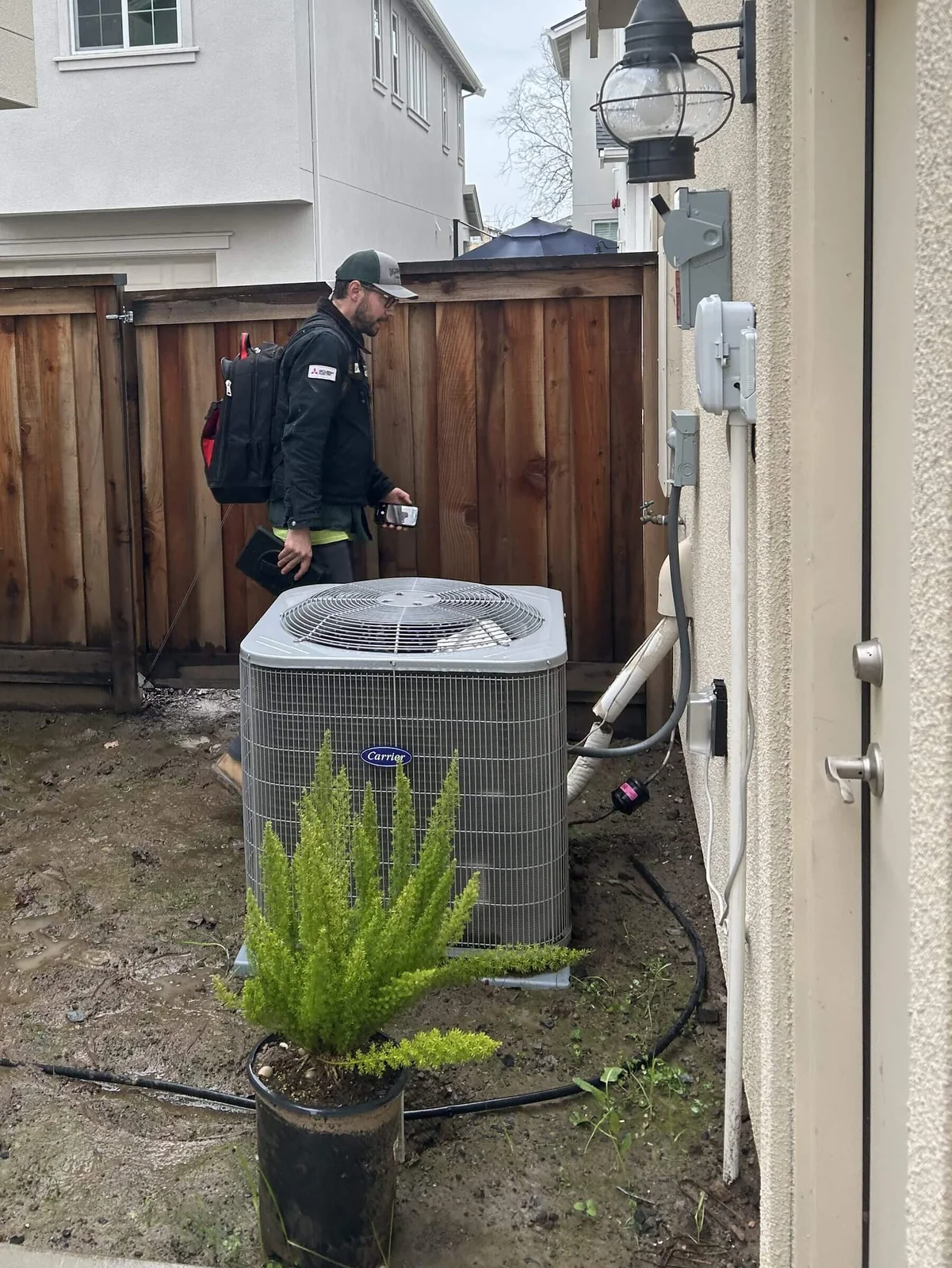
Two technicians came to do the furnace inspection today. Joshua was very polite and professional. He answered my questions about the automatic thermostat and showed me how to adjust it the way I asked about.
HS D.
What drives the cost of an HVAC job here
Access is the first variable, and locally it is a real one. A flat lagoon lot with a side yard and a driveway is a different day of work than a hillside address where equipment gets carried up a stair run and the crew stages from a narrow street. That is labor, measurable once somebody looks at the site, and so it never shows up on a phone quote.
The second variable is what you keep. Reusing sound ductwork and a correctly sized existing line set keeps a replacement tight. Finding ducts that are undersized, disconnected, or unsalvageable turns a swap into a distribution project, the largest single swing in most proposals. Refrigerant lines sized for older equipment, or contaminated by a compressor burnout, cannot always be reused either.
Electrical scope is third. A furnace replacement usually reuses the existing circuit. A heat pump conversion adds a 240-volt load, and whether the panel accepts it without a service change comes from a load calculation, not from counting empty breaker slots.
Then the local items. An outdoor unit requiring design review, screening, or an enclosure brings drawing time, review time, and construction. Exposure-rated hardware and a stand or pad are specification costs that repay themselves later. Condensate routing with no convenient termination adds piping and sometimes a pump.
Finally the equipment: single-stage against variable-capacity, one zone against several, head count on a ductless system, coated coils, filtration, and controls. We price these as options with the tradeoffs written out. Financing is available where it helps the timing.
What incentives are open
Incentive programs change frequently in California, so we quote only what we can link to. Here is the current picture for a Belvedere address.
MCE. Marin's community choice energy provider is MCE, and it runs heat pump rebates for space conditioning and water heating. Eligibility is narrow: the program serves "MCE customers who own and have lived in their single-family detached homes for at least 12 months in MCE's service area," working through a licensed contractor from MCE's list who offers the rebate. One sequencing rule catches people. MCE states that once the heat pump is installed, "you will not be able to install other home electrification projects (including solar, battery storage, or EV charging) for 12 months." Terms are on MCE's heat pump rebate page. If solar in Belvedere is also on your list, order of operations matters.
Power shutoffs and all-electric heating
The Tiburon Peninsula faces PG&E Public Safety Power Shutoffs, and that is a design input when a house moves from gas heat to a heat pump. A gas furnace needs power for its blower and controls, so it stops too, but an all-electric home has no fallback at all.
Three answers work. A whole-home standby generator, which we install as a Certified Generac Generator installer, sized to the heat pump's starting load rather than its running load. A battery system with the air handler and heat pump on backed-up circuits, which requires a critical load panel and a decision about what stays live. Or a deliberate choice to retain one gas appliance as backup heat. Settle that question before the gas line is capped, not after.
Maintenance that matters in a marine climate
A generic checklist does not fit a house near the bay.
Filters get changed on a schedule set by measured static pressure rather than a calendar default, because a restrictive filter in a system with marginal return capacity does more harm than a dirty one. Outdoor coils get rinsed with fresh water to move chloride deposits off the fin pack before they set up a galvanic cell, and cabinet hardware gets checked for pitting the same visit. Pans, drains, traps, and float switches get cleared and tested. On ductless equipment the indoor blower wheel and pan get a real wash, not a wipe of the face panel.
On heating equipment we clean and test the flame sensor, verify igniter resistance, confirm the pressure switch closes on genuine draft, test capacitors against rated microfarads instead of eyeballing them, and take combustion and carbon monoxide readings. Static pressure gets logged each visit so a trend appears before a failure does. Twice a year suits equipment that both heats and cools; one pre-season visit is the floor for heat-only systems.
How to choose an HVAC contractor in Belvedere
Four questions narrow the field fast. Does the contractor hold a C-20 HVAC license and pull the permit in its own name, or does the paperwork end up in yours? Does it run a load calculation on a replacement, or size from the nameplate of the dead unit? Does it already know how Planning and Building here treats exterior equipment? And does it test the finished system and write the numbers down?
Our record: since 1932, Diamond Certified, BBB A+ Rating, Mitsubishi Diamond Contractor Elite, Trane Comfort Specialist, and 2,756 Google reviews at a 4.8-star average. The manufacturer designations set who can register the longer factory warranties and who has been trained on the equipment going in.
What North Bay homeowners say
Two recent reviews from customers whose work resembled the jobs described above.
More are collected on our reviews page.
HVAC across Belvedere and Marin County
One company, every trade, all from Petaluma: HVAC across Marin County, the full Belvedere service matrix, plumbing in Belvedere, and electrical in Belvedere. Nearby, we cover HVAC in Mill Valley and HVAC in Sausalito with the same crews and the same coastal specification standards.
Book HVAC service in Belvedere
Book online and pick a window that fits your day, or reach us during office hours to talk a system through before scheduling anything. Tell us what the equipment is doing and roughly how old it is, and we will bring the likely parts on the first visit. Every job gets a written diagnosis and a price you approve before work starts.
Your Comfort, Our Priority
Ongaro & Sons is your trusted heating, cooling, plumbing, electrical, and solar expert, specializing in reliable maintenance and repair services that keep your home running efficiently year-round.
Our certified technicians deliver unmatched expertise with fast, friendly service across Marin, Sonoma and Napa County. From HVAC tune-ups to plumbing repairs and electrical upgrades or solar solutions, we focus on energy-efficient performance and long-term comfort. Count on us to maintain the systems that power your home and keep your environment just the way you like it.
Licensed, Insured, Background-Checked
Our technicians are licensed, experienced, and trained to service all makes and models.
Locally Owned and Operated
Serving the Napa, Marin, and Sonoma communities with personalized, hometown service.
Reliable Repairs
We respond quickly and get the job done right the first time, with no surprises.
Since 1932
Why Ongaro & Sons?
Four generations of trusted home service. Open any reason to see what it means for your home.
Schedule Service →Family-owned in the North Bay since 1932
Four generations of the Ongaro family serving Marin, Sonoma and Napa County. We know these homes and the systems in them.
Licensed, insured, background-checked technicians
Every technician is fully licensed and insured, background-checked, and trained on the equipment we install.
Diamond Certified and BBB A+
Diamond Certified since October 2016, and BBB Accredited with an A+ rating since December 1995.
Mitsubishi Diamond Contractor Elite and Trane Comfort Specialist
Both top manufacturer tiers. That standing decides how registration and extended warranty terms are handled on the system you actually bought.
The price is agreed before work starts
You see the number before the work begins. Flat-rate quotes, no surprises and no pressure.
Comprehensive maintenance program
Members get priority scheduling, discounts, and proactive checkups that prevent costly failures.

Discount
Membership
Ongaro Maintenance Plans
Annual maintenance on your home systems provides safeguards and comfort to you and your family. Members get priority scheduling, discounts, and proactive checkups that catch problems early.
Member Discounts
5% off every repair and replacement, all year long.
Peace of Mind
Proactive checkups catch issues before they become big problems.
Courtesy Reminders
We call you to schedule: never miss a seasonal service.
Value That Lasts
With Ongaro & Sons, you’re investing in quality, integrity, and service that stands the test of time. Explore our current promotions and see the difference real value makes for your HVAC, plumbing, and electrical needs.


From the Blog
 Sep 17, 2026
How Many Amps Does My House Need? Sizing Service for What You Actually Run
How many amps your house needs comes from a load calculation of what you run and plan to add. What drives the number, when existing service is enough, and more.
Read More Sep 10, 2026
Hard Water in Marin County: What Is Actually in Your Water and What It Does
Hard water in Marin County varies by provider and source. The 2025 report figures for Marin Water and NMWD, what hardness does and does not mean, and options.
Read More Sep 3, 2026
Electrical Permit Requirements in California: What Needs One and What Does Not
Find out which electrical projects commonly need permits, how to confirm local exemptions, and what to ask before work begins in Marin, Sonoma or Napa County.
Read MoreHVAC in Belvedere: frequently asked questions
Who is the best HVAC company in Belvedere?
By verifiable record, Ongaro & Sons. We have worked the North Bay since 1932, we are Diamond Certified with a BBB A+ Rating, we operate under a C-20 HVAC license, and our Google rating is 4.8 stars across 2,756 reviews. We are a Mitsubishi Diamond Contractor Elite and a Trane Comfort Specialist, with electrical and plumbing crews in house when a job crosses trades.
Do I need a permit to replace a furnace or air conditioner in Belvedere?
Yes. The city's building department requires a permit for all maintenance performed on mechanical systems, language broader than most neighboring cities use, and replacements qualify. We file with the City of Belvedere Planning and Building Department, or with the Marin County Community Development Agency for addresses outside city limits, then carry the inspection through.
Will a new outdoor unit trigger Planning Design Review?
It can. Most exterior changes fall under design review here, and a condenser or heat pump mounted where it is visible counts as one. The practical effect is that placement, screening, and enclosure details need settling early. Belvedere publishes Standard Staff Level Review at roughly ten days and Multi-Department Review at roughly thirty days for an initial plan review letter.
Does a heat pump work well in Belvedere's climate?
Unusually well. The standard objection is capacity loss at low outdoor temperatures, and a bayfront town spends very few hours there. A correctly sized unit stays in its efficient operating band nearly all season, so the auxiliary electric heat strips that drive high bills in cold regions rarely come on. You also gain cooling many older homes here have never had.
My air conditioner is low on refrigerant. Can you just add more?
A sealed system does not consume refrigerant, so a low charge escaped somewhere. Topping off without locating the leak means buying the same refrigerant repeatedly and running a compressor in conditions it was never built for. We find the leak, quote the repair against the age and refrigerant type of the system, then discuss recharging.
Do I need to upgrade my electrical panel to install a heat pump?
Sometimes, and a load calculation answers it rather than a glance at the breaker panel. A heat pump adds one 240-volt circuit and a full electrification adds several. Open breaker space is not the same thing as available service capacity. We run the numbers during the proposal, so panel work gets priced rather than discovered mid-project.
What HVAC rebates can a Belvedere homeowner get right now?
MCE's heat pump rebates are the ones that reach a Belvedere address, covering heat pump heating and cooling as well as heat pump water heaters. Three conditions decide whether you actually receive one: you must have owned and lived in the single-family detached home at least twelve months, a participating contractor has to file the application on your behalf, and it has to be filed before installation, because MCE will not apply a rebate retroactively. On a town where Design Review already sets the calendar, that sequencing matters more than usual.
Should I install a heat pump before or after solar?
Sequence matters if the MCE rebate is part of your plan. Its terms bar other home electrification projects, naming solar, battery storage, and EV charging, for twelve months after the heat pump goes in. If either is anywhere on your near-term list, settle the whole plan before starting one piece of it. We map the order with you.
Can you install heating and cooling in a house with no ductwork?
Yes, and on the older island homes it is frequently the better answer. Indoor heads mount on walls, in ceilings, or low on the wall, linked to a compact outdoor unit by refrigerant lines through a small penetration. Nothing gets cut through historic framing and nothing runs through an attic. We design by room load, not one head per room.
What happens to my heat during a Public Safety Power Shutoff?
Nothing runs without power, gas furnaces included, since the blower and controls are electric. An all-electric house has no fallback whatsoever, so backup belongs in the conversation on this peninsula. A properly sized standby generator, a battery with the air handler on backed-up circuits, or a retained gas appliance all work.
Do you handle commercial HVAC in Belvedere?
Yes. Rooftop package units, light commercial splits, controls, and preventive maintenance agreements for offices, small retail, and mixed-use buildings run through our commercial team under the same C-20 licensing and permit path, scheduled around your operating hours. Larger buildings often gain more from controls and airflow work than from new equipment.