Electrician in Belvedere, CA
Ongaro & Sons has wired and rewired North Bay homes since 1932, and we serve Belvedere from our Petaluma headquarters. We hold a C-10 electrical license, we are Diamond Certified, and we carry 2,756 Google reviews averaging 4.8 stars. We pull the permit, we run the load calculation before we quote, and you approve a written scope before a panel cover comes off.
On this page
Common electrical problems in Belvedere
Most electrical calls we get in Belvedere are about intermittent problems: a breaker that trips, resets fine for weeks, then starts tripping under a lighter load than before. An outdoor receptacle near the dock that stops holding a reset after a wet week. A panel that turns out to be completely full when the homeowner wants to add a circuit for an induction range, half the slots taken by tandem breakers crowded onto a bus never rated for that many poles.
Many of these problems trace back to the same cause. Belvedere is surrounded by water on three sides, and the salt in marine air corrodes steel enclosures and the aluminum and copper connections inside them. The damage is worst at the points carrying the most current: the service lugs, the meter socket jaws, the main breaker terminals, and the grounding connection. A corroded connection runs hotter under load than a clean one, and the heat speeds up the corrosion. That is why we diagnose a breaker complaint at the service equipment, not just at the breaker that tripped.

Reading the symptom before touching anything
A breaker that trips is often doing its job. The useful question is which kind of trip it is, because the four common causes point at four different repairs.
Overload. The circuit carries more current than its rating, usually because appliances accumulated on a lighting circuit over decades. It trips after a delay, under predictable conditions, the same way each time. The fix is a new circuit. Fitting a larger breaker to existing conductors moves the failure point to the wire inside the wall.
Short circuit or ground fault. The trip is instant and violent, sometimes with a visible arc or a smell. This is a wiring or device fault, and it needs isolating rather than resetting.
Ground-fault device trip. A GFCI senses current leaving the circuit through an unintended path. In lagoon-front houses that reading is frequently correct: moisture has reached an exterior box, a landscape fixture, a dock receptacle, or a pump. Swapping the device without finding the water hides the report.
A failing breaker or bus. Old thermal-magnetic breakers drift. Stab connections loosen, arc, and pit the bus bar. When a breaker gives up at loads it once carried easily, or the panel deck feels warm, the component itself is the fault.
A fifth pattern is not a trip at all and matters more than any of them: lights dimming in one room while brightening in another, or voltage high on one leg and low on the other. That signals a compromised neutral, usually at the service point or meter, and it can damage electronics all over the house while the breakers sit quietly. On a bayfront lot, corrosion at the service neutral is the first suspect.
Capacity, condition, code, clearance
Before recommending repair or replacement, we run the same four-part check on every Belvedere service. It is why our recommendations tend to come in smaller than homeowners expect.
Capacity. What does the house draw now, and what will it draw after the project you are planning? That is a calculation, not a guess, and it decides most of these jobs.
Condition. The physical state of enclosure, bus, lugs, conductors, and grounding electrode system. Panels from manufacturers who left the business decades ago, Zinsco and Federal Pacific among them, still sit in mid-century Belvedere homes. The practical problem is availability: listed replacement breakers for those bus designs are difficult or impossible to source, so the panel cannot safely be extended even when it looks intact.
Code. Grounding and bonding, ground-fault and arc-fault protection where currently required, correct conductor and overcurrent sizing, weather-resistant devices and in-use covers outdoors. Older houses here commonly have ungrounded two-prong circuits, cloth-insulated conductors, and knob-and-tube remnants that were bypassed rather than removed.
Clearance. Where can equipment legally and practically live? Working space in front of a panel is not negotiable, and on a steep island lot the panel often sits in a stair landing, a closet, or a garage bay that has stored bicycles for twenty years. The route counts too: truck staging on a narrow lane, material carried up exterior stairs, a meter on the downhill face of the house.
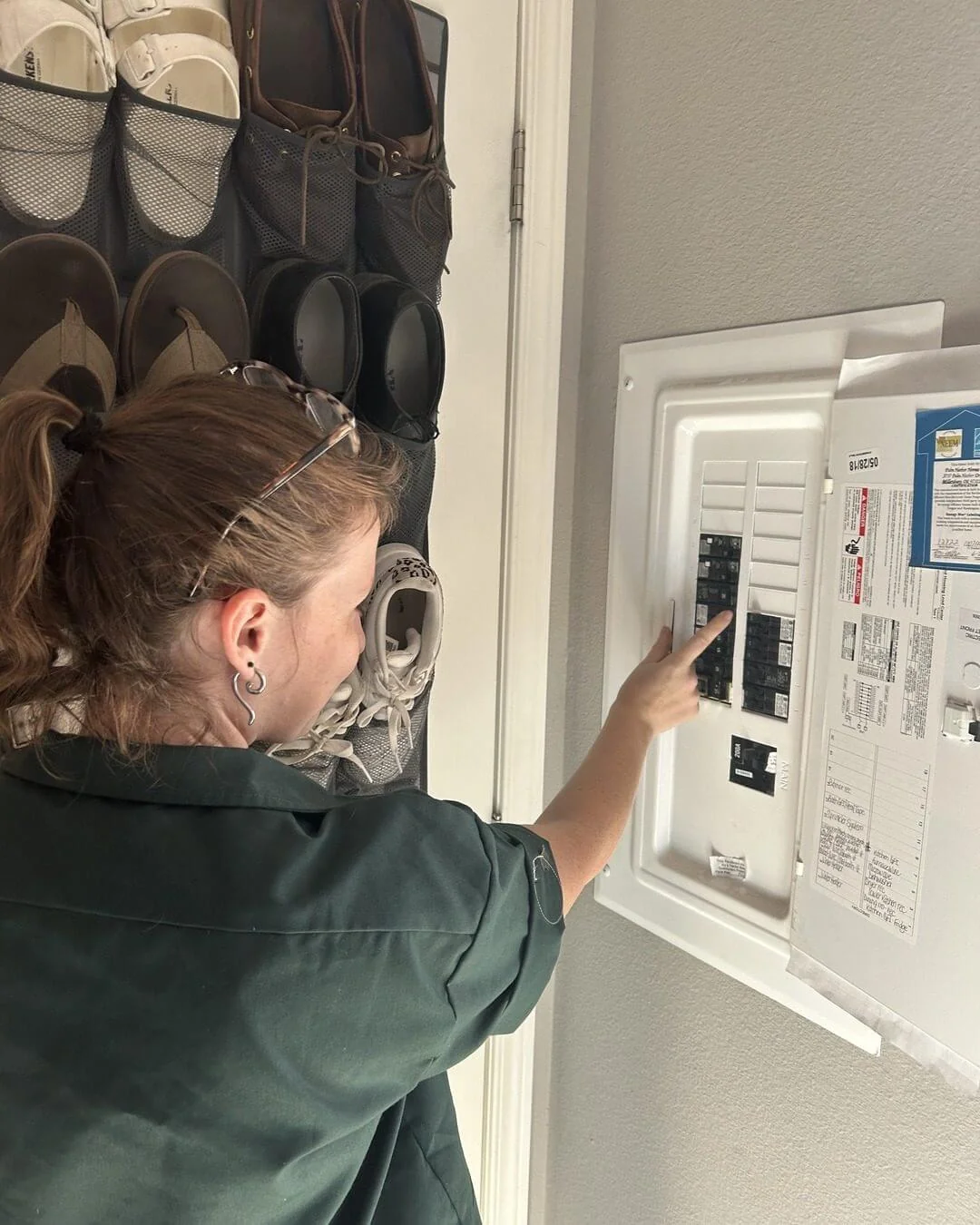
Electrical box needed replacement to bring to code. They were on time, explained the work, worked quickly and coordinated with PG&E to get power off and back on quickly.
Catharine C.
The load calculation is what usually decides it
A residential load calculation takes dwelling square footage, the required small-appliance and laundry circuits, and the nameplate ratings of the fixed appliances, then applies demand factors reflecting the fact that not everything runs at once. The result is a number in amperes. Compare it to the existing service rating and you have your answer.
Three conversions are pushing that number upward at once. A heat pump for heating and cooling in Belvedere adds a 240-volt load. A heat pump water heater adds another, which is why the plumbing side of the house now carries an electrical dependency it did not have twenty years ago. Vehicle charging adds a third, the largest continuous load most homes will ever see. Stack all three onto a 100-amp service in a 1920s island house and the calculation usually fails. Add any one of them and it frequently passes.
That distinction matters to your budget, because the alternatives are real. A dedicated subpanel serves a new load group without touching the utility service. A load-management device lets a large intermittent load coexist with existing ones by shedding it when the rest of the house draws hard. Charging equipment can also be set to lower continuous output, changing the circuit it needs. Any of those can be the right recommendation.
The utility side gets checked too. A service upgrade is coordinated work: PG&E de-energizes, we replace the equipment, the city inspects, and the utility reconnects. Whether your service arrives overhead on a riser or underground in conduit changes that sequence.

Permits, code, and inspection in Belvedere
Belvedere runs its own building department, so permits for work inside the city go to the City of Belvedere Planning & Building Department rather than to the county.
- Electrical work needs a permit, including maintenance. The city states that a building permit is required for "all maintenance that is done to electrical, plumbing and mechanical systems." Its short exemption list covers painting, wallpapering, built-ins, fences under six feet, and roof, deck, and siding repairs of 100 square feet or less. See Building Permit Requirements.
- Review level scales with project size. The city's review and approval guide puts minor interior work under a standard staff-level review at "+/- 10 days," and larger work involving structure or additions under a multi-department review at "+/- 30 Days for Initial Plan Review Letter." Interior remodels of any size also trigger planning staff design review at "+/- 50 days."
- Charger permits run on a statutory clock. California Government Code 65850.7 requires every city to "administratively approve an application to install electric vehicle charging stations through the issuance of a building permit or similar nondiscretionary permit." The clock sits in the companion section, 65850.71, rather than in 65850.7. For one to 25 stations, the application is deemed complete five business days after submission and deemed approved twenty business days after that, unless the building official has already acted. The statute streamlines the permit; it does not remove it.
- Service changes require utility coordination. Replacing service equipment means a scheduled PG&E disconnect and reconnect around our work and the city's inspection, and that step usually sets your timeline.
- Work is inspected before it is covered. Rough inspection happens while boxes, conductors, and connections remain visible. Closing a wall ahead of that visit is the most expensive shortcut in residential electrical work.
- Title 24 applies to what you install. California's 2025 Building Energy Efficiency Standards took effect January 1, 2026, per the California Energy Commission, and they reach lighting controls and equipment efficiency in remodels.
What drives the price of electrical work here
No two Belvedere quotes for the "same" job match, and the reasons are physical rather than mysterious.
Category is the first divider. A device replacement, a new branch circuit, a subpanel, and a full service change involve four different levels of participation from the utility and the city. Anything touching the service brings PG&E scheduling and a second site visit into the picture; anything behind the main breaker does not.
Access is second, and on this peninsula it is not a small factor. Lanes on both islands are narrow, staging space is limited, and many houses are reached by exterior stairs. Every foot of material carried rather than rolled is time, and time is the largest line in most electrical work.
Construction era is third. Plaster over wood lath, board sheathing, and blocked stud bays all slow the fishing of a new circuit and add patch and paint that a 1990s tract house would not. On a rewire, accessible attic and crawl space largely determine whether the job stays surgical or turns invasive.
Coastal exposure is fourth, and it cuts two ways. It raises the specification, because exterior enclosures, covers, fasteners, and terminations near the water should suit that environment instead of an inland one. It also raises uncertainty: a meter socket that looks acceptable from outside can be badly deteriorated behind the cover, discovered with the panel dead rather than during the estimate.
The last driver runs the other direction: scope discipline. If the numbers show your existing service can carry what you are adding, a subpanel or load-management strategy costs less than a service upgrade and solves the same problem. We would rather say so than sell you amperage you will never use.
Rebates and rate plans as they stand
Belvedere's community choice electricity provider is MCE, with delivery by PG&E. Programs here move quickly, so this is the current picture rather than a general reassurance.
MCE's charger program does not reach a house, but PG&E's does. MCE's EV charging program covers a "Workplace that will offer EV charging to employees and/or fleet," a "Multifamily property of four or more housing units," and "Commuter parking lots, such as a park & ride or ferry terminal," so a single-family charger in Belvedere is outside it. PG&E's residential charger rebate is the one to ask for, and its terms state that Community Choice Aggregation customers are eligible. MCE Sync sits alongside it, rewarding smart charging rather than the equipment.
Your rate plan is an electrical decision, not a follow-up. PG&E's electric vehicle rate plans split two ways. EV2-A uses one meter and "applies to both your home energy and your vehicle's electricity use," with off-peak hours from midnight to 3 p.m. daily and peak from 4 to 9 p.m.; customers over 800% of baseline allowance across the last 12 months are not eligible. EV-B requires a second, dedicated meter and "separates your vehicle's electricity costs from those of your home," and it is not offered with CARE, FERA, or Medical Baseline. That second meter is installation scope, so settle the question before conduit is set. E-ELEC rounds it out, and it is the one to look at if a heat pump or a battery is coming as well as the car.
One policy item is worth watching if you are planning ahead. Belvedere sits fully inside the Bay Area Air Quality Management District, and BAAQMD Regulation 9, Rule 6 establishes zero-NOx requirements for residential water heaters beginning in 2027, with compliance dates varying by unit size. Nobody's existing gas water heater is banned. For an electrician it means more houses here will want a 240-volt circuit at the water heater, landing on the same panel as everything else.
I was very pleased with Rene -she is an excellent electrician and was very pleasant to have in the house.I think she did an outstanding job.
Cindy K.
Maintenance in a marine environment
Inland electrical maintenance is mostly about load. On the bay it is mostly about corrosion and water, and the checklist changes accordingly.
Terminations come first. Service and feeder lugs should be inspected and re-torqued to specification, because a loosened or oxidized connection runs hot and the heat compounds. A thermal scan under load finds trouble that looks fine to the eye. Enclosure integrity matters as much: gasketed covers, sealed knockouts, and correct fittings keep moist air out of the panel to begin with.
Outdoors, in-use covers should actually close over the plug, fixtures near the lagoon deserve a check for water intrusion at the gaskets, and every ground-fault device should be tested on a schedule instead of only after it fails. Grounding electrode connections need attention too. The water service here comes from Marin Water, and whether the pipe entering your house is still metallic where the bonding connection was made is a field question, not an assumption.
Two items are specific to this peninsula. The Tiburon Peninsula is exposed to PG&E Public Safety Power Shutoffs, which the utility plans when severe weather raises wildfire risk, so whole-house surge protection earns its place: re-energization after any outage is precisely when surges arrive. A standby generator also has to be exercised and serviced to be worth owning. We are a Certified Generac Generator installer and we maintain what we install, under our maintenance program.
Where we work in Belvedere
The city is small, its housing is not uniform, and that shows up directly in the electrical work.
On Belvedere Island, the stock skews early twentieth century: steep lots, narrow lanes, houses added onto in several eras, and services that were adequate when the house had a refrigerator and a radio. Ungrounded circuits, undersized services, and inventive historical additions are the norm rather than the exception, and the job is usually about integrating modern loads without gutting the house. Corinthian Island shares that geography and much of that vintage, along with the same access constraints and the same tendency for panels to end up in tight, awkward spots.
Around the Belvedere lagoon, the picture shifts. These are largely 1950s and 1960s houses at low elevation, many with a dock or float, exterior receptacles, landscape lighting, and pumps. Water proximity drives the ground-fault requirements, and mid-century construction is where we find solid aluminum branch-circuit wiring from the late 1960s and early 1970s alongside the discontinued panel brands noted above. Neither is an alarm by itself, and both need handling with listed devices and connectors rather than ignoring.
How to choose an electrician for this work
Ask for the license class, because residential electrical work in California is C-10 work. Ask who pulls the permit; a panel swap requires one, and skipping it leaves unpermitted service work on the house. Ask for the load calculation in writing before agreeing to a service upgrade, since that document is the only thing separating a needed upgrade from an assumed one. Ask who schedules the utility coordination, because that step governs the timeline on anything touching the service. And ask what equipment is specified for exterior locations, since "code minimum" and "suited to a bayfront lot" are not the same specification.
The answer we would rather give is the smallest one that solves the problem correctly. The Marin County electrical overview covers how we approach that decision countywide, and if backup power belongs in the same conversation, solar and battery in Belvedere is the related page.
What North Bay homeowners say
Two reviews from customers who had electrical work done by our team:
Book an electrician in Belvedere
Tell us the symptom, the address, and what you plan to add. We will schedule a diagnostic visit, run the calculation if the job calls for one, and give you a written scope with the permit path spelled out before anything starts. Book online and we will confirm a time. We cover every trade in this city: HVAC in Belvedere, plumbing in Belvedere, solar in Belvedere, and the full Belvedere service matrix. For electrical work elsewhere in the county, start with electrical in Marin County or the city pages for Sausalito, Mill Valley, and Corte Madera.
Your Comfort, Our Priority
Ongaro & Sons is your trusted heating, cooling, plumbing, electrical, and solar expert, specializing in reliable maintenance and repair services that keep your home running efficiently year-round.
Our certified technicians deliver unmatched expertise with fast, friendly service across Marin, Sonoma and Napa County. From HVAC tune-ups to plumbing repairs and electrical upgrades or solar solutions, we focus on energy-efficient performance and long-term comfort. Count on us to maintain the systems that power your home and keep your environment just the way you like it.
Licensed, Insured, Background-Checked
Our technicians are licensed, experienced, and trained to service all makes and models.
Locally Owned and Operated
Serving the Napa, Marin, and Sonoma communities with personalized, hometown service.
Reliable Repairs
We respond quickly and get the job done right the first time, with no surprises.
Since 1932
Why Ongaro & Sons?
Four generations of trusted home service. Open any reason to see what it means for your home.
Schedule Service →Family-owned in the North Bay since 1932
Four generations of the Ongaro family serving Marin, Sonoma and Napa County. We know these homes and the systems in them.
Licensed, insured, background-checked technicians
Every technician is fully licensed and insured, background-checked, and trained on the equipment we install.
Diamond Certified and BBB A+
Diamond Certified since October 2016, and BBB Accredited with an A+ rating since December 1995.
Mitsubishi Diamond Contractor Elite and Trane Comfort Specialist
Both top manufacturer tiers. That standing decides how registration and extended warranty terms are handled on the system you actually bought.
The price is agreed before work starts
You see the number before the work begins. Flat-rate quotes, no surprises and no pressure.
Comprehensive maintenance program
Members get priority scheduling, discounts, and proactive checkups that prevent costly failures.

Discount
Membership
Ongaro Maintenance Plans
Annual maintenance on your home systems provides safeguards and comfort to you and your family. Members get priority scheduling, discounts, and proactive checkups that catch problems early.
Member Discounts
5% off every repair and replacement, all year long.
Peace of Mind
Proactive checkups catch issues before they become big problems.
Courtesy Reminders
We call you to schedule: never miss a seasonal service.
Value That Lasts
With Ongaro & Sons, you’re investing in quality, integrity, and service that stands the test of time. Explore our current promotions and see the difference real value makes for your HVAC, plumbing, and electrical needs.


From the Blog
 Sep 17, 2026
How Many Amps Does My House Need? Sizing Service for What You Actually Run
How many amps your house needs comes from a load calculation of what you run and plan to add. What drives the number, when existing service is enough, and more.
Read More Sep 10, 2026
Hard Water in Marin County: What Is Actually in Your Water and What It Does
Hard water in Marin County varies by provider and source. The 2025 report figures for Marin Water and NMWD, what hardness does and does not mean, and options.
Read More Sep 3, 2026
Electrical Permit Requirements in California: What Needs One and What Does Not
Find out which electrical projects commonly need permits, how to confirm local exemptions, and what to ask before work begins in Marin, Sonoma or Napa County.
Read MoreFrequently asked questions
Who is the best electrician in Belvedere?
We make a strong case. Ongaro & Sons has worked in the North Bay since 1932, holds a C-10 electrical license, is Diamond Certified, and carries 2,756 Google reviews averaging 4.8 stars. More useful than any of that: we calculate before recommending, permit every job requiring one, and specify hardware suited to bayfront exposure.
Do I need a permit to replace an electrical panel in Belvedere?
Yes. The city requires a building permit for alterations and maintenance to electrical systems, and panel or service replacement sits squarely inside that. Service work also means scheduling the utility to cut and restore power around the swap. Permitted work gets inspected, giving you documentation at resale.
How long does electrical permitting take in Belvedere?
It depends on project size. The city's published guide places minor interior work in a standard staff-level review at roughly ten days, and larger work involving structure or additions in a multi-department review with an initial plan review letter at around thirty days. Interior remodels also draw planning staff design review.
Is a 100-amp service still enough for my house?
Often yes, often no. It turns entirely on which fixed appliances you have and what you intend to add. A 100-amp service comfortably runs a conventional household here. Add a heat pump, an electric water heater, and vehicle charging at once and the demand figure usually exceeds it.
Why do my outdoor outlets near the water keep tripping?
Because they are frequently detecting something real. A ground-fault device compares current going out against current coming back, and moisture inside an exterior box, a landscape fixture, a dock receptacle, or a pump creates exactly that imbalance. Tracing the leakage and correcting covers and seals is the fix.
What are the warning signs that a panel needs replacing?
Warmth on the deck or cover, a burning or ozone smell, scorching or pitting around a breaker stab, breakers giving up at loads they once handled without complaint, buzzing, and rust or salt deposits inside the enclosure. Add a panel whose listed replacement breakers can no longer be sourced.
Can knob-and-tube wiring stay in an older Belvedere home?
Intact, unmodified knob-and-tube that is not buried in insulation is not automatically illegal, but it is ungrounded, its insulation grows brittle after a century, and it fails badly when someone splices into it. Most of what we find in island houses has already been extended by a previous owner.
Does MCE pay a rebate for a home car charger?
Not through that program. MCE's charging program targets workplaces, multifamily properties with four or more units, and commuter parking such as park-and-ride or ferry terminal lots, so a Belvedere house sits outside it. Two others reach you. PG&E's residential charger rebate says in its own terms that Community Choice Aggregation customers are eligible, which covers every MCE address. MCE Sync rewards residential smart charging rather than the purchase itself.
Should I choose PG&E's EV2-A or EV-B rate plan?
The distinction is whether your vehicle gets metered separately. EV2-A runs everything through your existing meter with off-peak pricing from midnight to 3 p.m. EV-B requires a second dedicated meter on a different schedule and is unavailable to CARE, FERA, and Medical Baseline customers. That meter is physical work, so decide beforehand.
Is a standby generator worth it on the Tiburon Peninsula?
It depends how disruptive an extended outage is for your household. Planned utility shutoffs during high fire risk weather reach this peninsula, and homes with medical equipment, home offices, pumps, or refrigerated inventory feel long outages differently. A permanently installed generator and a battery system solve different problems.
Will a heat pump water heater force me into a panel upgrade?
Not necessarily. It requires a dedicated 240-volt circuit, and whether your panel accommodates one comes down to available breaker space plus the demand figure for the whole house. Plenty of homes here absorb it without touching the utility service. Where the numbers run tight, a subpanel is frequently sufficient.