Solar in Corte Madera
Since 1932 the company has served North Bay homeowners, and it now covers heating and cooling, plumbing, electrical and solar. We are Diamond Certified, we hold a BBB A+ Rating, and we carry 2,756 Google reviews averaging 4.8 stars. We run the load calculation before the proposal and manage the permit and the utility paperwork through to the day your system is allowed to turn on.
On this page
Solar is sold as a roof product. In Corte Madera it is usually decided somewhere else: in the tree line, in the main electrical panel, and in how much of your production you can consume during the hours you actually consume it. Two houses a mile apart here get very different proposals for reasons that have nothing to do with the module on top.
Corte Madera has two building stories, and they behave differently
Down on the flats you get post-war and later tract housing: single-story and low two-story homes, attached garages, driveways a truck fits in, and roofs that are mostly simple gable or hip planes in composition shingle. A large uninterrupted plane facing anywhere from southeast to southwest, with a garage wall for the inverter and a short conduit run to the main panel, is close to the ideal residential array.
Christmas Tree Hill and the wooded slopes above town are the other story. Those homes are older, smaller in footprint, and built into the grade. Rooflines get cut up by dormers, shed additions, skylights, and a chimney in the wrong place, so you find three planes where the flats would have one. Streets narrow and pitch up. The mature redwoods and oaks that make the neighborhood what it is also sit in the solar window for part of the day. Array design there is a subtraction problem: start with the roof you have, then remove what shade, obstructions, and access take away.
A third group matters too, the larger hillside houses with a pool, more than one heating zone, and often an EV. Roof is not the constraint there; the service and the battery have to be sized around a load profile that keeps growing. We design against all three realities, which is why we ask for twelve months of usage history first.
Roof, shade, panel, profile
Every solar conversation here runs through those four questions in that order. If one fails, the ones after it do not matter yet.
Roof. Years of life left in the covering, how many usable planes exist, the pitch, and how racking can be flashed without creating a leak path. A roof with under a decade left is a roof you replace first.
Shade. Not whether there is shade, but when. A tree clipping the array from seven to nine in the morning costs a different amount than one clipping it from three to six in the afternoon, and under current export rules the afternoon one costs more.
Panel. Your service rating, the busbar rating, and the existing load calculation. Solar and battery are both sources feeding that panel, and there are firm limits on how much backfeed a given busbar and main breaker combination will accept.
Profile. When you use power. A kilowatt-hour consumed the moment you make it is now worth more than one exported, so your profile decides whether the answer is a larger array, a battery, or a smaller array plus load shifting.
Any proposal that jumps from roof measurement straight to price has skipped three of the four.
Jordan was professional and good natured and very pleasant to work with. I couldn't recommend him and Ongaro & Sons more.
Chris B.
What the roof itself decides, by house type
On the flats the roof question is usually timing. Composition shingle has a finite life, and if yours is late in it the sequence is roof first, array second. We would rather say that at the site visit than eighteen months into an array that now has to come off. When the covering is sound, the flats give us long rafter runs and room to set standoffs on layout instead of around obstructions.
On the hill the roof question is geometry. Small planes mean more penetrations per module, more flashing details, and more conduit. Steep pitch means the crew works in fall protection the whole time and staging takes longer. Tile and older wood-shingle-turned-composition roofs each carry their own mounting method, and getting it wrong is how an array becomes a leak. State law requires your jurisdiction to publish a checklist of what a small residential rooftop system must comply with to qualify for expedited review, and layout gets settled against that checklist at plan check rather than after the racking is bolted down. The statute is Government Code 65850.5.
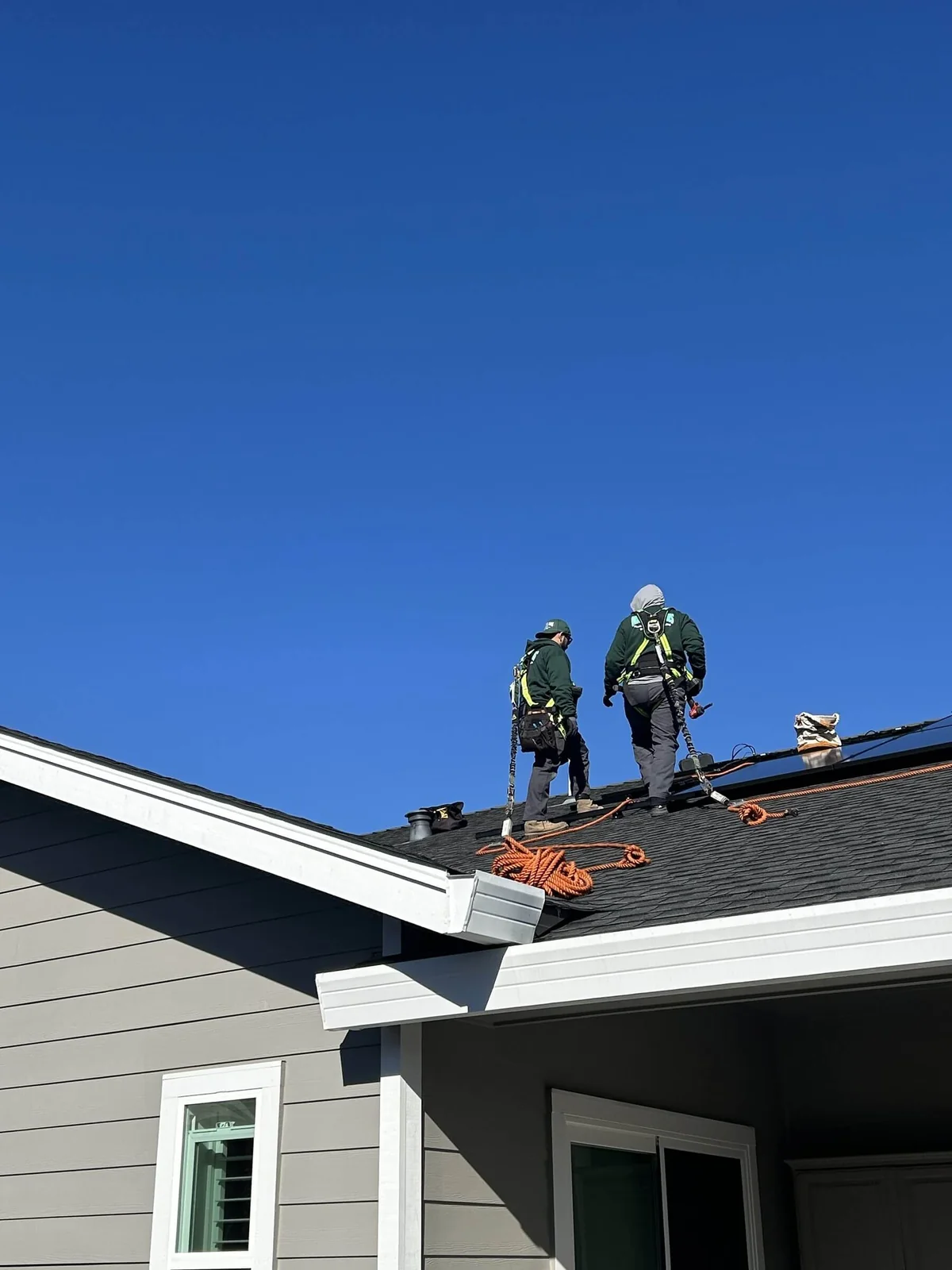
Panel removal and reset is its own service line for us, and it comes up constantly where an array went up a decade ago and the roof underneath has since aged out. We take the modules down, label and store the racking, let the roofer work on clear decking, then reinstall with new flashings. Reusing a ten-year-old flashing on a new roof is the shortcut that produces the callback.
Shade behaves differently on a Marin hillside
Corte Madera's central-Marin setting is mild, with marine influence and modest cooling demand. Modules run cooler here than in an inland valley, and cooler modules are slightly more efficient. The larger effect is on the shape of the production day: coastal influence can hold the morning down and hand you a strong midday and afternoon, which is convenient, since afternoon energy is worth the most.
Tree shade is the harder variable. On the wooded slopes we see three patterns: a single dominant conifer that takes one plane out for a defined block of hours, a canopy that never fully clears one edge of the roof, or trees that belong to a neighbor. Each gets a different answer. Microinverters and DC optimizers let a shaded module drop without dragging its neighbors down, and on a cut-up hillside roof that is the only design that makes sense, while a clean unshaded plane on the flats can suit a string design perfectly well. We measure shading on site rather than from a satellite image, because a July image does not know what a low winter sun does to the same roof.

Why solar work in this town turns into electrical work
Much of Corte Madera is mid-century or older, so original panels and water heaters are frequently at the end of their service lives. On the older streets and up on the hill we routinely open panels rated well below what a modern household draws, sometimes with no spare spaces, occasionally with aging bus and breaker stock we would not want to add anything to.
When the backfeed numbers do not work, the options are a main panel upgrade, a connection ahead of the main breaker, or a redesign that reduces what lands on the panel. Which one is right depends on the service, the meter location, and what else you plan to add over the next few years. We handle it in-house, which is the practical case for one contractor: the array design and the electrical panel upgrade are one conversation on one permit schedule. If the project needs broader electrical work in Corte Madera, it does not become a second vendor and a second calendar.
I am very satisfied with the service and Tim was pleasant and answered my questions, making some adjustments to my controls. Thank you for the great service
Fran R.
Batteries, backup, and Public Safety Power Shutoff
A grid-tied array with no storage stops producing the instant the grid goes down. The inverter is required to disconnect so it cannot energize a line a utility crew may be working on. That is the single most common misunderstanding we correct on site visits.
It matters in the hillside parts of town, where fire risk and PG&E's Public Safety Power Shutoff program both apply. PG&E may turn off power for safety during severe weather. Storage paired with solar carries a defined set of circuits through that and recharges from the array the next day, which fuel-dependent equipment cannot do.
The design question is scope. Whole-home backup means the battery must start and carry everything, including the largest motor loads, and most people do not need that. A backup subpanel carrying refrigeration, internet, lighting, selected outlets, pumps where applicable, and one heating zone gets you through a multi-day outage on far less capacity, sized from a list you help write. Where a shaded lot means the array can never meaningfully recharge storage, a standby generator is sometimes the more rational answer, and we are a Certified Generac Generator installer, so both paths can be priced side by side.
MCE also runs a Solar Storage Credit for battery owners, set out on its net energy metering page, paying a monthly bill credit for discharging in the four to nine p.m. window. That turns a battery from a pure outage device into something that earns during normal weeks, so it belongs in the equipment decision.
How exports are paid now, and why it changed the math
The California Public Utilities Commission's Net Billing Tariff took effect on April 15, 2023 and applies to new interconnections from that date forward. Under it, per the CPUC's own description, generation is "first used to serve onsite load," and "compensation for excess generation exported to the electric grid is applied to a customer's bill at a rate reflecting the value of this generation to the grid."
What you use yourself offsets retail. What you send out is worth what the grid says it is worth at that hour. Oversizing purely to bank exports is a weaker play than it was a decade ago; matching production to consumption, moving flexible loads into daylight, and holding energy for the evening peak are stronger ones.
There is a local layer on top. MCE is the community choice electricity provider in Corte Madera and PG&E delivers the power. MCE credits its solar customers monthly instead of at an annual true-up, saying credits "accrue at retail rates and are applied toward your monthly bills during the year," and settles surplus at its spring cash-out at the net surplus compensation rate plus a per-kilowatt-hour adder. You see generation on the bill through the year rather than waiting twelve months to learn where you landed.
Permits and inspection in Corte Madera
Residential rooftop systems in town are permitted by the Town of Corte Madera Building Division. Homes in the unincorporated pockets nearby go through the Marin County Community Development Agency instead, so confirming which applies to your address is step one.
State law frames both. Government Code 65850.5, linked above, requires that a city or county "shall administratively approve applications to install solar energy systems through the issuance of a building permit or similar nondiscretionary permit," along with an expedited process for small residential rooftop systems, a published compliance checklist, and electronic submittal. Review is ministerial. A permit is still required; the statute streamlines it rather than removing it.
The sequence is design and load calculation, permit application, installation, town inspection, then utility interconnection authorization. Your array does not legally operate the day it is finished. It operates when the utility says it may. Battery installations add placement and clearance review, so equipment location gets settled during design instead of on install day.
What drives cost on a Corte Madera solar project
No two of these projects are alike, so the useful thing to explain is the set of variables rather than a number that will not apply to your house.
- Roof plane count and size. One large plane is cheaper per module than four small ones, and hillside roofs skew small.
- Pitch and access. Steep roofs, narrow streets, and long carries add labor and staging time.
- Roof covering. Composition, tile, and metal need different mounting and flashing work.
- Conduit distance. How far the array sits from the point of interconnection, and whether the run can be concealed.
- Electrical scope. Whether the panel takes the new source as is, needs upgrading, or needs a different interconnection method.
- Battery scope. Number of units, whole-home versus a backup subpanel, and where equipment can legally sit.
- Detached structures. A garage or ADU array usually means trenching, priced by what lies between the buildings.
Those variables go in writing before work starts, and financing options are laid out at the same time rather than introduced at signing.
What incentive money exists today
Programs in California move faster than any page can promise, so treat this as the current state of play and let us confirm it at scoping. MCE's Solar Storage Credit, described above, is the most directly relevant program here.
One item catches people pairing solar with a car: MCE's charging program covers workplaces, multifamily properties of four or more units, and commuter parking lots. A single-family charger sits outside it. Ask instead about PG&E's residential charger rebate, whose terms cover Community Choice Aggregation customers, and about MCE Sync, which rewards smart charging rather than equipment. Terms on all of it change, so we confirm status at scoping rather than quoting last year's version.
Solar is one part of a house that keeps getting more electric
Corte Madera sits fully inside the Bay Area Air Quality Management District, so the district's zero-NOx appliance rules apply. The 2023 amendment to BAAQMD Regulation 9, Rule 6 established zero-NOx requirements for residential water heaters, with point of sale standards phased across 2027 and 2031 by equipment type, so they reach what may be sold and installed rather than the unit already in place. No existing gas water heater is banned; we track the rulemaking and confirm what is required at project time.
California's 2025 Building Energy Efficiency Standards took effect January 1, 2026, per the California Energy Commission, moving new single-family construction onto a single fuel baseline, with heat pumps prescriptively required for water and space heating alike. That is a new-construction baseline, not a mandate on your replacement, and the same distinction applies to CALGreen, whose EV-ready provisions are new-construction requirements rather than a retrofit obligation.
For sizing, a heat pump for heating and cooling, a heat pump water heater in Corte Madera, and a car charger each add meaningful annual load, so anything on your five-year list belongs in the array and battery conversation now. We are a Mitsubishi Diamond Contractor Elite and a Trane Comfort Specialist, so a heat pump install in Corte Madera can be designed alongside the array. Charger permitting is set by state law rather than local discretion under Government Code 65850.7, and PG&E's electric vehicle rate plans interact with the design, since one meter versus a second dedicated meter belongs in the EV charger installation plan from the start.
Keeping a Corte Madera array producing
Rooftop solar is low-maintenance, not no-maintenance, and in a wooded, marine-influenced setting three things need staying ahead of.
Monitoring is first. Compare monthly output to the same month last year. A gradual decline usually means soiling or a tree that has grown. A sudden drop on one section points to a failed microinverter or optimizer; a drop across the whole system points to the inverter or a tripped breaker. Inverters are the component most likely to need replacing during an array's life, well before the modules do.
Debris and biology are second. Under a canopy you get needle drop, leaf litter, and pollen that rain will not fully clear, plus squirrels and birds nesting in the gap between modules and roof. Perimeter critter guard is inexpensive at install and irritating to retrofit after something has chewed a conductor.
Penetrations are third, because flashing and sealant have a life and an array is a set of roof penetrations you cannot see from the ground. Batteries get their own check: firmware, state of health, and an actual backup test, since you want to learn the transfer works on a calm Tuesday. Our maintenance program puts those on a schedule.
How to choose a solar contractor for this work
Ask who holds the electrical license and who is doing the panel work, because one C-10 contractor across the whole scope removes the handoff where problems live. Ask for the load calculation; if nobody looked at your service size before quoting an array and a battery, the number is a guess. Ask how shade was assessed, since a site-measured model beats a screenshot. Ask who pulls the permit and who files the interconnection, in writing, with the inspection and authorization steps named. Then ask what happens when the roof needs replacing, because a company offering removal and reset as a defined service has thought about the ten-year picture.
What North Bay homeowners say
Two recent reviews from customers in our service area:
Solar and the rest of the house across Corte Madera and Marin
One company, every trade: solar across Marin County, the full Corte Madera service matrix, electrical work, panel upgrades, EV charger installation, heat pump systems, and water heater replacement. Nearby: solar in Mill Valley and solar in San Rafael.
Book solar work in Corte Madera
Book online and we will schedule a site visit covering the roof assessment, the shade measurement, and the panel evaluation, not a sales presentation. You get the design, the production estimate, the electrical scope, and the permit path in writing before committing to anything.
Your Comfort, Our Priority
Ongaro & Sons is your trusted heating, cooling, plumbing, electrical, and solar expert, specializing in reliable maintenance and repair services that keep your home running efficiently year-round.
Our certified technicians deliver unmatched expertise with fast, friendly service across Marin, Sonoma and Napa County. From HVAC tune-ups to plumbing repairs and electrical upgrades or solar solutions, we focus on energy-efficient performance and long-term comfort. Count on us to maintain the systems that power your home and keep your environment just the way you like it.
Licensed, Insured, Background-Checked
Our technicians are licensed, experienced, and trained to service all makes and models.
Locally Owned and Operated
Serving the Napa, Marin, and Sonoma communities with personalized, hometown service.
Reliable Repairs
We respond quickly and get the job done right the first time, with no surprises.
Since 1932
Why Ongaro & Sons?
Four generations of trusted home service. Open any reason to see what it means for your home.
Schedule Service →Family-owned in the North Bay since 1932
Four generations of the Ongaro family serving Marin, Sonoma and Napa County. We know these homes and the systems in them.
Licensed, insured, background-checked technicians
Every technician is fully licensed and insured, background-checked, and trained on the equipment we install.
Diamond Certified and BBB A+
Diamond Certified since October 2016, and BBB Accredited with an A+ rating since December 1995.
Mitsubishi Diamond Contractor Elite and Trane Comfort Specialist
Both top manufacturer tiers. That standing decides how registration and extended warranty terms are handled on the system you actually bought.
The price is agreed before work starts
You see the number before the work begins. Flat-rate quotes, no surprises and no pressure.
Comprehensive maintenance program
Members get priority scheduling, discounts, and proactive checkups that prevent costly failures.
Discount
Membership
Ongaro Maintenance Plans
Annual maintenance on your home systems provides safeguards and comfort to you and your family. Members get priority scheduling, discounts, and proactive checkups that catch problems early.
Member Discounts
5% off every repair and replacement, all year long.
Peace of Mind
Proactive checkups catch issues before they become big problems.
Courtesy Reminders
We call you to schedule: never miss a seasonal service.
Value That Lasts
With Ongaro & Sons, you’re investing in quality, integrity, and service that stands the test of time. Explore our current promotions and see the difference real value makes for your HVAC, plumbing, and electrical needs.


From the Blog
 Sep 17, 2026
How Many Amps Does My House Need? Sizing Service for What You Actually Run
How many amps your house needs comes from a load calculation of what you run and plan to add. What drives the number, when existing service is enough, and more.
Read More Sep 10, 2026
Hard Water in Marin County: What Is Actually in Your Water and What It Does
Hard water in Marin County varies by provider and source. The 2025 report figures for Marin Water and NMWD, what hardness does and does not mean, and options.
Read More Sep 3, 2026
Electrical Permit Requirements in California: What Needs One and What Does Not
Find out which electrical projects commonly need permits, how to confirm local exemptions, and what to ask before work begins in Marin, Sonoma or Napa County.
Read MoreSolar in Corte Madera: frequently asked questions
Who is the best solar company in Corte Madera?
Judge it on scope and track record. Ongaro & Sons has served the North Bay since 1932, holds a C-10 electrical license, is Diamond Certified, and averages 4.8 stars across 2,756 Google reviews. We design the array, do the panel work, install the battery, pull the permit, and file the interconnection as one company, so nothing falls between two vendors.
Do I need a panel upgrade before adding solar?
Sometimes, and it turns on numbers rather than opinion. Your service rating, busbar rating, and main breaker size together cap how much generation can be connected, and older mid-century equipment often sits under that cap once a battery is included. Alternatives exist, including a connection ahead of the main breaker, and we weigh those before recommending a service change.
Will solar work on a shaded Christmas Tree Hill roof?
Often yes, with a design built for it. Module-level electronics let each panel produce independently, so one shaded module no longer drags a whole string down, and the layout favors planes that clear the canopy. We measure shading on site across the day and the seasons, then tell you what the roof will realistically produce.
Do I need a permit for rooftop solar in Corte Madera?
Yes. Systems in town are permitted through the Town of Corte Madera Building Division, or the Marin County Community Development Agency for unincorporated addresses. California requires jurisdictions to run an expedited, nondiscretionary review for small residential rooftop systems, so approval is administrative rather than a matter of local judgment. We prepare and submit the application, meet the inspector, and handle the utility filing afterward.
How does MCE change what I earn from my solar?
MCE supplies electricity generation in Corte Madera while PG&E delivers it, and MCE treats solar credits differently. Credits land on your bills monthly rather than being held to an annual true-up, and surplus is settled at MCE's spring cash-out at the surplus rate plus an adder. You see the effect of production during the year instead of once at the end of it.
Will solar keep the lights on in Corte Madera during a shutoff?
Not on its own. Grid-tied inverters are built to shut down when the grid fails so they cannot backfeed lines a crew may be working on. Storage is what carries a home through an outage. With a battery and a properly wired backup subpanel, selected circuits keep running and recharge from sunlight the following day.
Should I re-roof before putting solar on a Corte Madera house?
If the covering is late in its life, yes. An array on a roof that fails a few years later turns into a removal, a reroof, and a reinstall, which costs more than doing it in the right order. We assess remaining roof life during design and install with flashings detailed to the covering you have.
Is a home battery worth adding here?
It depends what you want from it. As an outage device on a hillside lot exposed to Public Safety Power Shutoff events, storage is the only thing that keeps a solar home running. Financially, the value comes from holding midday production for expensive evening hours and from MCE's credit for discharging in the late-afternoon window.
Can you remove and reinstall my panels for a reroof?
Yes, that is a standard service for us. We take the modules down, label the racking and wiring, store everything, and return once the roofer is finished to remount on new flashings. Because we hold the electrical license, the disconnect, reconnect, and recommissioning are done by the same crew instead of split across trades.
Does the Net Billing Tariff make solar not worth it?
No, it moves the design target. Since April 2023 new interconnections are compensated for exported energy at its value to the grid rather than at retail, so the return favors consuming your own production instead of banking it. Right-sizing to actual usage, shifting flexible loads into daylight, and adding storage for the evening are how systems get designed now.
My array's installer is out of business. What are my options?
If the system no longer covers the house, or its electronics are obsolete and no manufacturer supports them, replacing it with a new correctly sized system is usually the practical path: sizing corrected for the current tariff, storage added if you want it, and fresh flashing at every penetration. If the array itself still works, we can add battery storage and handle the panel work around it under our own C-10 license.