Plumber in Napa County
Ongaro & Sons is the plumber Napa County homeowners call, a family company since 1932, dispatched from our Petaluma headquarters. We are Diamond Certified with C-36 for plumbing, and 2,756 Google reviews averaging 4.8 stars. We pull the permit, we work to code, and we price the options before anything gets cut open.
On this page
Six permit desks govern one county
Napa County contains several permitting jurisdictions, and that distinction decides how a water heater swap, a repipe, or a sewer lateral replacement gets approved.
Five incorporated jurisdictions (the cities of Napa, American Canyon, St. Helena and Calistoga, plus the Town of Yountville) each run their own building department. Everything outside those city limits goes to Napa County Planning, Building & Environmental Services. The county states the boundary plainly: its permit process covers "projects located in the unincorporated areas of Napa County," while permits inside cities and towns "are handled by those jurisdictions directly." Since January 1, 2024, county applications are submitted through the online permit center rather than over a counter, per the county's building permit process page.
A second approval layer catches people off guard. If a property has a private well or an onsite septic system, the county's Environmental Health Division has jurisdiction, and that authority does not stop at the city line. The division regulates wastewater treatment and disposal "in the unincorporated area of Napa County and parcels not served by public sewer located within city limits," and it permits water well construction. On a building permit involving an existing well, it requires a yield test report from the past five years by a licensed well driller, pump installer, geologist, engineer, or Registered Environmental Health Specialist, and a domestic storage tank if the tested yield falls below five gallons per minute while staying at or above one. Those requirements sit on the county's well and onsite wastewater page.
So on a rural property here, the plumbing scope and the water supply approval run on two tracks, and the slower one is not the plumbing. We plan around that instead of discovering it midway.

The state rules that apply at every one of those desks
Three state-level requirements govern water heater work everywhere in the county regardless of which department stamps the permit, and they run in that order of consequence.
Seismic bracing is not limited to new installations. California Health & Safety Code §19211 requires "all new and replacement water heaters, and all existing residential water heaters" to be braced, anchored, or strapped in accordance with the California Plumbing Code, and defines a water heater here as one "with a capacity of not more than 120 gallons." That covers essentially every residential tank in the valley. An unstrapped heater is a defect the day it is noticed, not the day it is replaced.
Energy standards moved on January 1, 2026, when California's 2025 Building Energy Efficiency Standards took effect, per the California Energy Commission. Every new and replacement heater has to satisfy Title 24, prescriptively or through performance modeling. The 2025 cycle moved new single-family construction onto a single fuel baseline, with a heat pump prescriptively required for water heating and for space heating both. That is a new-construction baseline. It does not force a heat pump onto your replacement, and a contractor saying otherwise is compressing two separate rules into one.
Air quality is the rule most likely to shift under you, and Napa is unusual here. The Bay Area Air Quality Management District describes its territory as the "nine counties that surround San Francisco Bay: Alameda, Contra Costa, Marin, Napa, San Francisco, San Mateo, Santa Clara, southwestern Solano, and southern Sonoma counties," and Napa appears there whole rather than with the partial qualifier attached to Solano and Sonoma. Sonoma County is genuinely split between two air districts. This one is not: a single rulebook covers Calistoga and American Canyon alike. That rulebook, Regulation 9 Rule 6, was amended in 2023 to set zero-NOx requirements for residential water heaters, on a schedule running from 2027 through 2031 by size and equipment type, with tankless units in the last group.
The rule is also live and moving. No existing gas water heater is illegal and nothing here requires pulling out a working appliance. It does mean the requirement in force on your install date may differ from what an article described last year, so we confirm it when we pull the permit.
What the rules change about which unit you buy
Once you understand that a replacement is not yet forced toward electric but the ground is shifting, the equipment conversation becomes a question about your house rather than a question about the code.
A heat pump water heater draws its energy from surrounding air, which makes it efficient and also makes it demanding about where it lives. It typically needs a dedicated 240-volt circuit, which means a load calculation and, in older Napa housing where we routinely find modest service capacity and full panels, sometimes a service upgrade before the plumbing work can even be scheduled. It needs a condensate path. It needs enough surrounding air volume to work well, which rules out some of the tight interior closets we find in the older blocks downtown but suits the garages common in American Canyon and the postwar tracts. And it runs cooler air out into whatever room it occupies, which is a nuisance in a hallway closet and a non-issue in a garage. When the panel is the obstacle rather than the plumbing, we handle both sides in-house; see electrical work in Napa County for what that scope looks like.
A gas tankless unit is the other common upgrade, and it fails for different reasons. Tankless burners consume gas at a far higher rate than the tank they replace, so the existing gas line is frequently undersized for the new load, and the whole meter-to-appliance run has to be evaluated rather than just the last few feet. Venting is its own scope: most tankless units require sealed combustion venting, not the existing atmospheric flue. In an older raised-foundation house with a heater in an interior closet, the venting path is often the single item that decides whether the upgrade makes sense.
A high-efficiency gas tank is still a legitimate answer for many Napa County homes, and we will say so when it is the right call. The point is that the choice is driven by panel capacity, gas line sizing, vent path, and location, not by which product a salesperson likes.

David W. with Ongaro has been a pleasure to work with - professional, courteous, careful in cleanup.
Harriss K.
Where the water itself changes across the county
Napa County is one county with several completely different water situations, and that is the fact that most shapes plumbing work here.
Inside the City of Napa, the municipal system draws on three sources: Lake Hennessey, Milliken Reservoir, and imported State Water Project supply delivered from the Sacramento-San Joaquin Delta through the North Bay Aqueduct. The city's Water Division serves more than 85,000 people in the city and adjacent areas, and its State Water Project page describes the aqueduct delivery. Milliken is described by the city as a seasonal source used during the high-demand summer and early fall period. A system that shifts its blend through the year is a system where taste, sediment carry, and appliance behavior can change seasonally without anything being wrong with your plumbing. We would rather explain that than sell you a filter you do not need.
Move upvalley or into the hills and the picture changes again. Yountville, St. Helena and Calistoga each run their own municipal supply, and beyond the served areas, out toward Pope Valley, Angwin, the Berryessa side and the ridges above the valley floor, properties run on private wells. A well property has plumbing components a town property never does: a submersible or jet pump, a pressure tank, a pressure switch, and often sediment or mineral treatment ahead of the house. When a customer on a well calls about "low pressure," the failure is usually in that chain rather than in the house piping, and diagnosing it means testing the chain in order instead of guessing at it.
Well properties also have an electrical dependency that town properties do not. A well pump is an electric appliance, so when power goes down the water goes with it. PG&E runs its Public Safety Power Shutoff program to turn off power during severe weather to help prevent wildfires, and rural and hillside Napa County properties carry real exposure to it. Households that plan for that build in storage, backup power, or both. If backup is the piece you are missing, solar and storage in Napa County covers the generation side of that question.
The City of Napa publishes a figure and it is the only one in the county we will quote: its 2024 Drinking Water Quality Report gives total hardness averaging 114 ppm, range 68 to 179, which is moderately hard on the USGS scale and nudges into hard at the top of its range. That number belongs to the city system and nowhere else. Upvalley, and on every well in the county, what we do instead is test at the tap before recommending treatment, and size the equipment to what the test shows.
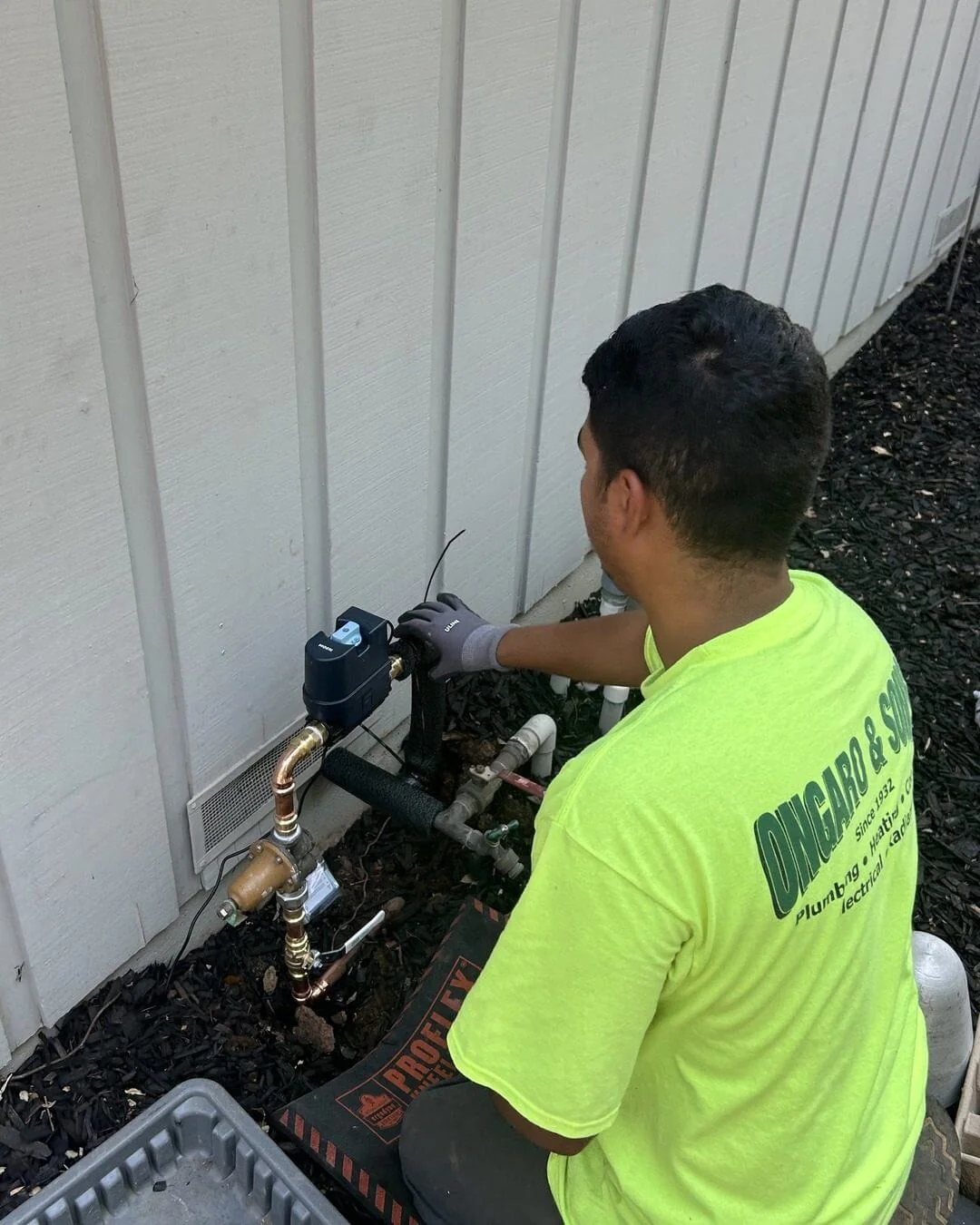
What actually fails, and what the symptom is telling you
Symptoms in this county sort fairly cleanly by house era and by whether the property is on a municipal system or a well. These are the ones that bring us out most often:
- Rust-colored or metallic-tasting hot water. Usually a failing anode rod or interior tank corrosion, and on a tank past ten years it is a countdown, not a repair.
- Hot water that runs out faster than it used to. Sediment accumulation on the tank floor reduces usable volume before it produces any leak.
- Popping or rumbling from the water heater. Water flashing to steam under a sediment layer. It is a service call now and a replacement conversation soon.
- Pressure that drops when two fixtures run. On town water this often points to galvanized supply lines closing off from the inside. On a well it usually points to the pressure tank or switch.
- Pinhole leaks in copper, more than once. A second pinhole in the same house is a systemic signal, not a coincidence.
- A toilet or tub that backs up when the washer drains. A main line restriction, not a fixture problem.
- Gurgling drains and slow fixtures across multiple rooms. Venting or main line, and camera work settles which.
- A wet spot or a warm patch on a slab floor. A slab leak, common in the county's postwar and later tract housing.
- A water bill that climbed with no change in habits. Frequently an underground service line or an irrigation-side leak rather than anything visible.
- Sewer odor in a rarely used bathroom. Often just a dried trap, occasionally a vent problem worth checking.
Under the street, and under the house
Supply and drainage in Napa County read like a timeline of how the county got built.
The older cores of Napa, St. Helena and Calistoga hold the oldest material. We routinely find galvanized steel supply that has scaled down internally to a fraction of its original bore, drain lines in cast iron with scale and rough interior walls, and vitrified clay laterals whose joints are exactly what roots find first. Mid-century housing brought copper supply and cast iron drainage. Homes built from the late 1970s into the mid-1990s may carry polybutylene supply piping, which is worth identifying whether or not it has failed yet. Newer construction in American Canyon and the more recent subdivisions runs ABS or PVC drainage and copper or PEX supply, which fails less from age and more from installation detail and water chemistry.
Foundation type matters as much as pipe material. Raised-foundation houses with crawlspaces, common in the older town cores, put supply lines within reach, so a leak is disruptive but accessible. Slab-on-grade construction, common in the county's postwar and later tracts, puts the same line in concrete, which turns a modest repair into a decision between spot repair, rerouting the line overhead, and repiping the house. That decision belongs to the homeowner, but it should be made with the leak located, not estimated.
Sewer laterals deserve their own paragraph because ownership is not obvious. The line from your house to the main is usually the property owner's responsibility, but the exact point where responsibility transfers is set by whichever agency owns the main in your street, and Napa County has several. We confirm ownership and the jurisdiction's requirements before quoting a lateral, because the answer changes the scope. Where a line's condition allows it, trenchless methods that line the existing lateral or pull a new pipe through the old path reduce how much of a driveway or garden has to be opened. Whether your line supports that is a camera-inspection answer, not a sales pitch.
What drives the cost of plumbing work here
We do not publish prices, because a price without the specifics of your house is a guess dressed up as information. What we can tell you is what moves the number.
Access is usually first. A water heater in an open garage in American Canyon and the same heater in a second-floor interior closet in an older Napa house are the same appliance and two very different jobs. Pipe material and length come next: a repipe is priced by how many fixtures, how many stories, and how reachable the runs are, not by square footage. Whether the existing installation was to code matters, because a replacement has to leave the house compliant, so a heater installed years ago without proper bracing, a pan, a drain, or an expansion tank picks up that work on the way out. Gas and electrical scope drives tankless and heat pump conversions specifically, since line sizing, venting, circuits, and panel capacity are the real variables. Excavation depth, surface type, and restoration drive sewer and water service work. Permit and inspection requirements vary by which of the county's jurisdictions you are in.
We diagnose first, give you the number in writing, and let you decide. If spreading the cost helps, financing options are available and we go over them before the work starts rather than after.
Aldo and Kris from Ongaro were wonderful! First off, I love the confirmation services. I knew a time window but also got a call with an ETA that allowed me to do more chores. They found the clogged pipe and sorted things out super fast.
Cindy S.
Incentives, and which ones reach Napa County
This is where Napa County homeowners get bad information, usually because an article written for the region does not distinguish between community choice providers.
MCE is the community choice energy provider for Napa County. Sonoma Clean Power is not. That matters because Sonoma Clean Power runs the more heavily promoted heat pump water heater rebate program in the North Bay, and it is available to Sonoma County customers, not Napa County ones. If a neighbor across the county line describes a rebate you cannot find, that is why.
MCE's heat pump rebates are the local option on a water heater conversion. Eligibility turns on twelve months of ownership and residency in a single-family detached home in MCE territory, a participating contractor who processes the application for you, and filing before installation rather than after.
Every incentive above gets confirmed at quote time.
Maintenance that earns its keep
Most of what we get called out for is preventable, and the preventable list is short.
Flush a tank water heater annually, more often on a well with sediment carry. It is the single highest-return maintenance item on a residential plumbing system. Have the anode rod checked in the middle years of the tank's life, because replacing a sacrificial rod is a small job and replacing a corroded tank is not. Descale a tankless unit on the manufacturer's schedule, since scale accumulation is the leading cause of tankless units underperforming long before they fail.
Check your pressure regulator every few years. High incoming pressure quietly shortens the life of every fixture, supply line, and appliance in the house, and a failed regulator does not announce itself. Exercise the main shutoff and the angle stops under sinks and toilets occasionally, because a valve that has not moved in fifteen years is the valve that will not close when you need it. On a well, have the pressure tank's air charge and the pressure switch checked rather than waiting for the pump to short-cycle itself to death.
If you would rather not track any of that, our maintenance plans put it on a schedule and keep the records.
The towns and areas we work in
We cover Napa County from the Petaluma headquarters, which puts the south county closest and the upvalley towns a straightforward run up Highway 29 or the Silverado Trail.
At the south end, American Canyon holds the county's newest housing, with slab construction, garage utility placement, and municipal service. The City of Napa is the largest and most varied piece of the work: downtown and the Napa Abajo and Fuller Park blocks hold the county's older raised-foundation housing with the oldest supply and drain material, while Browns Valley, Alta Heights and the postwar and later subdivisions bring slab construction and different failure patterns. Yountville, Oakville and Rutherford sit along the valley floor between them. Upvalley, St. Helena and Calistoga have older town cores of their own and run hotter through the summer than anywhere near the bay. Off the valley floor, Angwin, Pope Valley, the Berryessa side and the ridge properties on Howell Mountain, Atlas Peak and Mount Veeder are largely well and septic country, where the pump, tank and treatment chain is as much a part of the plumbing system as anything inside the walls.
The full county picture, including the other trades, lives on our Napa County service area page.
How to choose a plumber for this work
Ask for the license class, and ask which one. C-36 is the plumbing classification. A company that also holds C-20 and C-10 can handle a heat pump water heater conversion that needs a circuit, or a tankless install that needs gas and electrical work, without three separate schedules and three separate diagnoses. That is why we run all four trades in-house rather than subcontracting the parts we do not do.
Ask who pulls the permit. If the answer is vague, or if a contractor suggests skipping it on a like-for-like swap, that is disqualifying. A permitted install is what protects you at resale and what makes the work verifiable.
Ask what the diagnosis is before you get a price. A number quoted over the phone for a symptom nobody has seen is not a quote. Ask whether the recommendation would change if the failure turned out to be somewhere else, and see whether you get a real answer.
Ask how long the company has worked in your specific jurisdiction. Napa County's six permit authorities each have their own submittal process and their own inspection expectations, and familiarity with them is the difference between a job that closes cleanly and one that stalls. We have been doing this since 1932, we are Diamond Certified, we hold a BBB A+ Rating.
What North Bay homeowners say
Two recent reviews, in the customers' own words:
More are on our reviews page.
Book a plumber in Napa County
Tell us what the house is doing and we will schedule a diagnosis rather than a guess. Book online to pick a window, or use our contact page if you would rather describe the situation first. We serve the whole county from Petaluma, we pull the permits, and we put the number in writing before we start. Napa County homeowners also come to us for heating and cooling, electrical work, and solar and storage. You can see the full trade overview on our plumbing page, or read how we cover the region on the service area index.
Your Comfort, Our Priority
Ongaro & Sons is your trusted heating, cooling, plumbing, electrical, and solar expert, specializing in reliable maintenance and repair services that keep your home running efficiently year-round.
Our certified technicians deliver unmatched expertise with fast, friendly service across Marin, Sonoma and Napa County. From HVAC tune-ups to plumbing repairs and electrical upgrades or solar solutions, we focus on energy-efficient performance and long-term comfort. Count on us to maintain the systems that power your home and keep your environment just the way you like it.
Licensed, Insured, Background-Checked
Our technicians are licensed, experienced, and trained to service all makes and models.
Locally Owned and Operated
Serving the Napa, Marin, and Sonoma communities with personalized, hometown service.
Reliable Repairs
We respond quickly and get the job done right the first time, with no surprises.
Since 1932
Why Ongaro & Sons?
Four generations of trusted home service. Open any reason to see what it means for your home.
Schedule Service →Family-owned in the North Bay since 1932
Four generations of the Ongaro family serving Marin, Sonoma and Napa County. We know these homes and the systems in them.
Licensed, insured, background-checked technicians
Every technician is fully licensed and insured, background-checked, and trained on the equipment we install.
Diamond Certified and BBB A+
Diamond Certified since October 2016, and BBB Accredited with an A+ rating since December 1995.
Mitsubishi Diamond Contractor Elite and Trane Comfort Specialist
Both top manufacturer tiers. That standing decides how registration and extended warranty terms are handled on the system you actually bought.
The price is agreed before work starts
You see the number before the work begins. Flat-rate quotes, no surprises and no pressure.
Comprehensive maintenance program
Members get priority scheduling, discounts, and proactive checkups that prevent costly failures.

Discount
Membership
Ongaro Maintenance Plans
Annual maintenance on your home systems provides safeguards and comfort to you and your family. Members get priority scheduling, discounts, and proactive checkups that catch problems early.
Member Discounts
5% off every repair and replacement, all year long.
Peace of Mind
Proactive checkups catch issues before they become big problems.
Courtesy Reminders
We call you to schedule: never miss a seasonal service.
Value That Lasts
With Ongaro & Sons, you’re investing in quality, integrity, and service that stands the test of time. Explore our current promotions and see the difference real value makes for your HVAC, plumbing, and electrical needs.


From the Blog
 Sep 17, 2026
How Many Amps Does My House Need? Sizing Service for What You Actually Run
How many amps your house needs comes from a load calculation of what you run and plan to add. What drives the number, when existing service is enough, and more.
Read More Sep 10, 2026
Hard Water in Marin County: What Is Actually in Your Water and What It Does
Hard water in Marin County varies by provider and source. The 2025 report figures for Marin Water and NMWD, what hardness does and does not mean, and options.
Read More Sep 3, 2026
Electrical Permit Requirements in California: What Needs One and What Does Not
Find out which electrical projects commonly need permits, how to confirm local exemptions, and what to ask before work begins in Marin, Sonoma or Napa County.
Read MoreFrequently asked questions
Who is the best plumber in Napa County?
We would point to what can be verified rather than to an adjective. Ongaro & Sons has worked in the North Bay since 1932, holds a C-36 plumbing license alongside C-20 and C-10, is Diamond Certified, holds a BBB A+ Rating, and carries 2,756 Google reviews averaging 4.8 stars. Compare those against any company you are considering, then compare how each one answers a diagnostic question.
Do I need a permit to replace a water heater in Napa County?
Yes. A water heater replacement is permitted work throughout the county, and the department that issues it depends on your address. Inside city limits it is that city's building department. Outside them it is Napa County Planning, Building & Environmental Services. We handle the application and the inspection as part of the install rather than leaving it with you.
Which building department handles my property?
If your address is inside the City of Napa, American Canyon, St. Helena, Calistoga or the Town of Yountville, that jurisdiction issues your permit. Anywhere else in the county, the application goes through the county's online permit system. If the property also has a well or septic system, the county's Environmental Health Division has a separate role regardless of city limits.
Does an existing water heater have to be strapped?
Yes, and this surprises people. State law does not limit the bracing requirement to new installations. It reaches existing residential water heaters as well, for tanks up to 120 gallons, with the anchoring method following the California Plumbing Code. If yours is unbraced, it is a code deficiency today, not something that only becomes relevant when you replace the unit.
Is my gas water heater going to be banned in 2027?
No. The regional air rule sets zero-NOx requirements for newly installed residential water heaters with phase-in dates that depend on unit size, and residential compliance begins in 2027. It does not require removing a working appliance. The practical consequence is on what suppliers stock over time, and since a compliant unit is in practice electric, the question worth answering at your address is whether the panel could carry one.
Can I put a heat pump water heater in an older Napa house?
Often, but it is a whole-house question, not a plumbing-only one. The unit needs a 240-volt circuit and enough panel capacity to carry it, a route for condensate, and a location with sufficient surrounding air. Garages and larger utility rooms suit it well. A small interior closet in an older home frequently does not, and we would tell you that before selling you one.
What rebates apply to plumbing upgrades in Napa County?
MCE is Napa County's community choice provider and runs the heat pump rebates that reach here, conditioned on twelve months of ownership and residency, a participating contractor filing the paperwork, and no retroactive applications. The heavily advertised Sonoma Clean Power water heating rebate does not apply at a Napa address.
Why does my water taste or look different at certain times of year?
If you are on the City of Napa system, the utility draws on Lake Hennessey, Milliken Reservoir, and imported State Water Project supply, and it describes Milliken as a seasonal source used during high-demand summer and early fall months. A supply blend that shifts across the year can change taste and sediment carry without anything being wrong inside your house. Testing tells you whether treatment is warranted.
My property is on a well. Can you still work on it?
Yes, and it changes what we look at first. Pressure complaints on well properties usually trace to the pump, pressure tank, pressure switch, or treatment equipment ahead of the house rather than to the interior piping, so we test that chain in sequence. Well construction permits themselves fall to the county's Environmental Health Division, which also requires a recent yield test on building permit applications.
How do I know whether I need a repipe or just a repair?
One leak is an event. A second leak in the same material in the same house within a short window is a pattern, and patterns are what push the decision toward a repipe. Galvanized supply that has scaled closed internally and copper producing repeated pinholes are the two systems where continuing to chase individual failures usually costs more than replacing the run.
What causes drains to back up repeatedly in an older home here?
In the older cores, the usual culprit is root intrusion at the joints of a clay lateral, or scale buildup narrowing a cast iron drain. Both come back after a cabling because the underlying condition is still there. A camera inspection is what separates a line that needs periodic cleaning from a line that needs repair or replacement, and it is worth doing before the third visit.
Can a sewer lateral be replaced without digging up the whole yard?
Sometimes. Where the existing line's condition and the local agency's requirements allow it, trenchless approaches that line the old pipe or pull a new one along its path open far less surface than a full trench. Collapsed sections, severe misalignment, or certain material transitions rule it out. We scope the line with a camera first and then tell you which methods it actually supports.
How often should a tankless water heater be descaled?
Follow the manufacturer's interval, which for most residential units means annually. Scale forms on the heat exchanger and reduces performance gradually, so the unit gets slower to deliver hot water and works harder long before it throws an error. Skipping descaling is the most common reason a tankless unit underdelivers, and it is a maintenance issue rather than a defect.
Do you serve St. Helena and Calistoga from Petaluma?
Yes. All of our work in Napa County runs from the Petaluma headquarters, upvalley towns included. We do not maintain an office in Napa County, and we would rather say that than imply a local storefront. Scheduling accounts for the drive, and you get a confirmed time window plus a call with an ETA before the truck arrives.