Electrical Panel Upgrade in Petaluma, CA
Ongaro & Sons is the electrical contractor Petaluma homeowners call for a panel upgrade, and our headquarters sits here in town. We have been in business since 1932, we are Diamond Certified, we hold a C-10 electrical license, and we carry 2,756 Google reviews averaging 4.8 stars. We run the load calculation, pull the permit, and coordinate the utility before anything comes off the wall.
On this page
Why is the panel suddenly the thing everyone is dealing with?
Four decisions that used to be unrelated now land on the same piece of equipment. Water heating is moving off gas. Heating and cooling are consolidating into heat pumps that run on one 240-volt circuit. Cars charge at home. And backup power stopped being exotic in a county that lives with planned outages.
The regulatory piece deserves precise wording rather than alarm. Petaluma sits fully inside the Bay Area Air Quality Management District, so the district's Regulation 9, Rule 6 zero-NOx requirements for residential water heaters apply here.
Nobody's gas water heater is banned. What is true is that a growing share of local replacements will be electric, and an electric water heater generally wants a dedicated 240-volt circuit the old panel does not have. The state energy code changed underneath all of this in January 2026, moving new single-family construction onto a single fuel baseline, with a heat pump prescriptively required for water heating and for space heating both. That baseline does not convert every replacement into an electric one.
Petaluma's housing splits the consequence cleanly. Downtown and the west side hold Victorian and early-twentieth-century homes with original systems, panels tucked into interior walls, and service equipment that predates the idea of a second large 240-volt load. East Petaluma's newer subdivisions usually have a garage or exterior wall panel with room to work and enough service to absorb one more circuit. Two houses four miles apart, same rule, completely different project.

How do I tell whether the panel is really the problem?
A single breaker tripping when the microwave and toaster run together is a branch circuit problem. That circuit is loaded past its rating and the answer is a new dedicated circuit. Replacing the service will not change it.
The main breaker tripping, or lights across the house dimming when the air conditioner or well pump starts, points at the service itself. So does a panel with no spaces left when you still need a circuit. Those are the symptoms an upgrade resolves.
Then there is the category that has nothing to do with load. Inside aging equipment the failure points are physical: bus bar stabs corrode and lose contact, lugs relax under thermal cycling, and forty-year-old breakers stop tripping reliably. Any of these means the panel gets examined regardless of what you planned to install:
- The cover or a breaker feels warm to the touch.
- You hear buzzing or crackling inside the enclosure.
- There is a burnt smell, a discolored breaker face, or a scorch mark at a stab.
- It uses screw-in fuses instead of breakers.
- It is a split-bus design with no single main disconnect, so nothing kills the whole house at once.
- Two conductors sit under one terminal listed for one.
- It lives in a bedroom closet, a bathroom, or over a stairway, where current clearance rules do not permit it.
Two mid-century panel lines, Federal Pacific Stab-Lok and Zinsco, carry a long-documented reputation in the trade for breakers that fail to open on an overload. Both still turn up in Petaluma's older housing, and an electrician will flag either on sight. In the pre-1940s stock west of the river, pulling the cover also reveals what the branch wiring actually is: cloth insulation that crumbles when flexed, ungrounded two-wire runs, surviving knob-and-tube. That is a reason to want a contractor who looks before quoting, not a reason to avoid the work.
Is my panel full, or is it undersized?
These get treated as one question and they are two.
Full means you ran out of breaker positions. The service feeding the house may be entirely adequate. Some panels are listed to accept tandem breakers, and the label states the maximum circuit count permitted, which governs over what physically fits. Where the service has headroom and only space is short, a properly sized subpanel fed from the existing main is a legitimate and cheaper answer.
Undersized means calculated demand exceeds what the service can deliver. Rearranging fixes nothing there, and a subpanel makes it worse by inviting more load onto a service already at its limit. A subpanel is also wrong when the main is a fuse box, when the bus shows heat damage, or when there is no room to land a feeder breaker of the required size.
Huge job re-wiring a 40 year old house - the team of three professional and courteous young men did a great job👍 this was not the first time we used on Garwin sons and were more than pleased with the results. Thank you for very much.
Jim D.
How much service do I need, and how do you decide?
We use what we call the ten-year load list, and it exists to keep a house from being upgraded twice.
Write down everything, not just the thing that triggered the call. Most people phone about one item: a charger, a heat pump, a water heater that finally quit. Sizing to that item alone is how a family pays for utility coordination, a permit, and a wall opening twice inside six years. List every 240-volt load you might plausibly own within a decade, including an induction range, a hot tub, shop equipment, and a battery.
Run both calculations. The standard method sums nameplate ratings and applies the code's demand factors. It is conservative by design and tends to oversize an existing house, because it assumes appliances installed decades apart all run at once. The alternative for an existing dwelling starts from your actual metered peak demand over the past year and adds the new load to it. On an older Petaluma home with modest real usage, that second method often shows 200 amps is plenty where the nameplate approach suggested more.
Ask whether managing load changes the answer, which is the next section.
Then pick the size and stop. Around here 100 amps is the common legacy service on the older side of town, 125 and 150 amps appear in mid-century construction, and 200 amps answers the large majority of single-family upgrades. Exceeding what the calculation supports buys nothing: it adds conductor, conduit, and utility scope for capacity nobody will draw.
Can I add the load without replacing the service?
Sometimes, and this is the part of the conversation that has changed most in the past few years.
Load management hardware lets a house run more appliances than the service could support simultaneously, by making sure they never do. A smart panel watches circuits in real time and sheds or defers lower-priority ones as demand climbs. Charging equipment can be told to throttle based on what the rest of the house is drawing. Listed devices also let a dryer outlet and a charger share one 240-volt circuit without energizing both.
None of it is magic. The approach assumes your peak comes from discretionary loads that tolerate delay. Charging a car at 2 a.m. instead of 6 p.m. is easy. Deferring heat during a cold snap is not.
We are a SPAN Certified Installer, worth saying only where a SPAN panel is genuinely what a house ends up with. Where it fits, it can turn a service upgrade into an intelligent panel replacement rather than a full utility project.
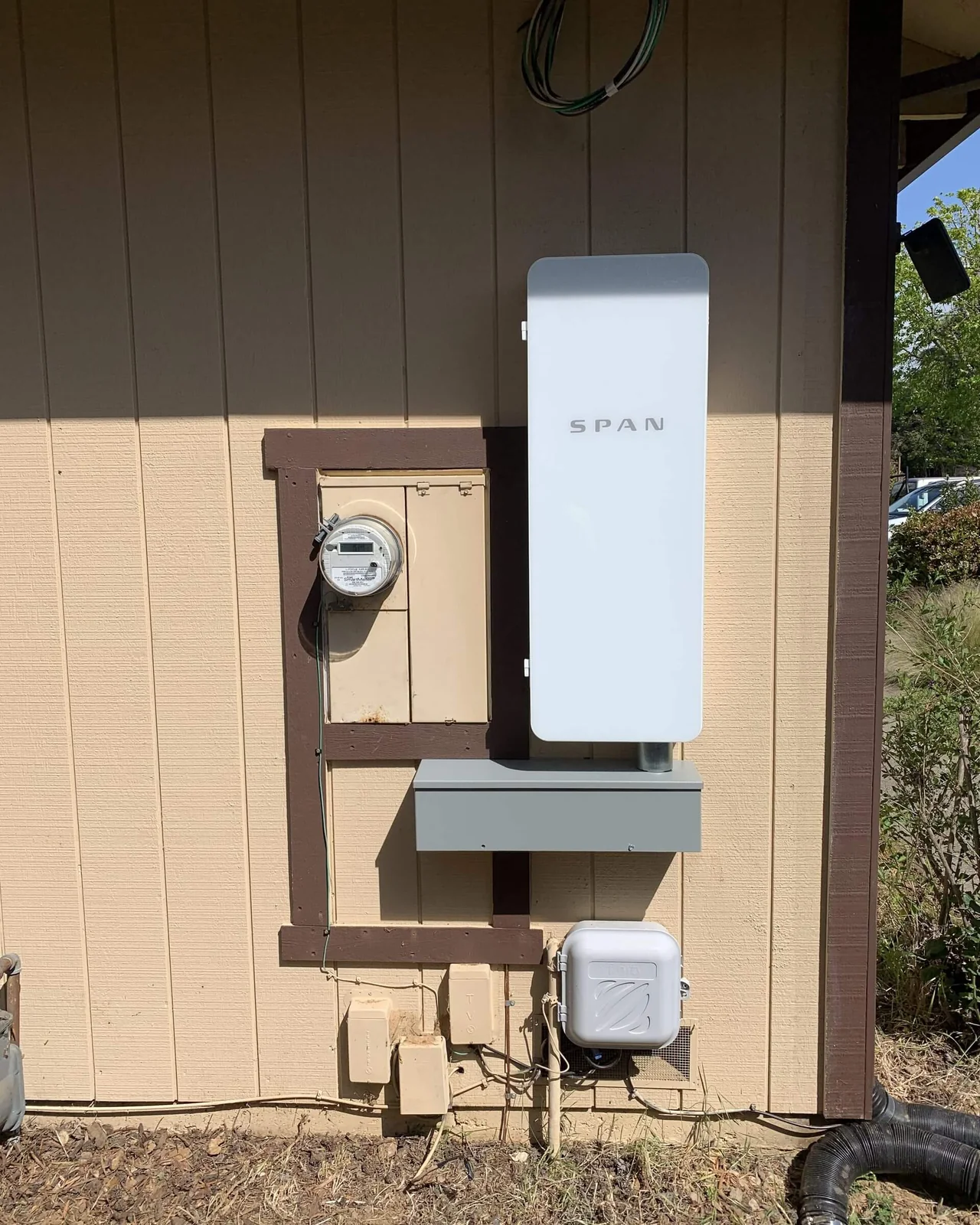
PG&E has announced a program along these lines called PanelBoost, described on its own page as "a smart panel that connects to your utility meter on your home and allows you to install large electric appliances without overloading your existing electrical panel." Stated eligibility includes being "an active PG&E residential electric customer" who owns a single-family home, pays the electric bill, and has "a 150-amp service or smaller, or need a panel upgrade." As of this writing it is not open, and the page directs interested customers to a waitlist. We track its status rather than building your plan around something unlaunched.
What decides whether this is a panel swap or a full service upgrade?
This factor moves a project more than any other, and it is usually settled at the meter rather than at the panel. If the meter socket, service conductors, and point of connection are all rated for the new size and stay where they are, this is a panel replacement. When any of that changes, a second party and a second schedule enter the job.
What pulls the utility side in:
- Overhead versus underground. Older neighborhoods near downtown and on the west side are typically served overhead from a pole, with mast, weatherhead, and clearance requirements to satisfy at the new rating. East-side subdivisions are usually fed underground from a pad transformer, where trench, conduit, and backfill fall to the property owner and the utility furnishes and installs the service cable to the point of delivery.
- Relocation. Many older Petaluma panels sit inside the house with the meter outside. Moving one to an exterior wall, which most upgrades do, changes the service entrance and the meter arrangement, not just the breakers.
- Combination equipment. Where meter and main breaker form one assembly, as in most newer local construction, replacing the main means replacing utility-sealed equipment.
- Conductor sizing. The conductors feeding the house must be rated for the new service, which is frequently not the case on a 100-amp original.
PG&E's building and renovation process runs through its online project tool, and the utility states that "within five business days of submitting a new application for service, you will be assigned a PG&E representative who will provide their contact information to you." We submit that application and handle the correspondence. None of it is difficult, but it is sequential, and a homeowner who starts it after the electrical work is booked usually finds the two calendars do not meet.
The Ongaro and Sons team was efficient, friendly and highly skilled throughout the process. From the initial assessment to the install of an upgraded electrical panel Ongaro made sure we knew what was happening and when.
Peter F.
What drives the cost of a panel upgrade here?
Nobody can quote this over the phone with any rigor, because the variables sit behind a cover nobody has opened. What moves the number:
- Whether the utility side changes. A like-for-like replacement at the existing location is the least involved version. Moving the meter, altering the service entrance, or running new conductors from the pole or transformer makes it a larger project with utility scheduling attached.
- Where the panel ends up. Relocating from an interior hallway to an exterior wall adds service entrance work, feeder routing, and patching on two surfaces.
- Grounding and bonding. New service equipment needs a compliant grounding electrode system: rods driven to depth, a bond to metallic water piping where it exists, and jumpers around anything interrupting continuity. Older homes here routinely have none of it, or carry a bond to a water line replaced with plastic decades ago that now grounds nothing.
- What the branch circuits look like at the terminations. Aluminum branch wiring, ungrounded circuits, undersized neutrals, and failing insulation all require handling when conductors are re-landed. Circuits that get extended or replaced pick up current arc-fault and ground-fault requirements, changing the breaker mix.
- The wall itself. Stucco, wood shingle, and board-and-batten cut and patch differently, and exterior work on a historically significant downtown or west-side property carries its own review considerations.
- Existing solar or storage. A busbar rating limits how much backfed current a panel accepts, so an existing array often dictates a specific panel size, breaker position, or a connection ahead of the main. If you already have solar in Petaluma, that constraint shapes the design from day one instead of surfacing on install day.
- Time without power. Temporary arrangements for a home office, a medical device, or a well pump on an unincorporated parcel add scope.
What permit do I need, and who signs off?
Inside the city limits this goes through the City of Petaluma Building Division. Petaluma issues electrical service panel upgrades, along with water heater, furnace, and air conditioning replacements, as over-the-counter permits with no plan review, applied for through the city's online permits and planning hub. Compared with jurisdictions routing identical work through plan check, that is a real advantage. If your address falls outside the city limits, in the unincorporated county, the authority is Permit Sonoma. Same work, different agency, different application, and getting it wrong at the start costs a week.
The order of operations does not vary:
1. The licensed contractor pulls the permit under their own license before work begins. 2. The utility disconnects the service on a scheduled date. 3. Equipment is replaced, grounded, bonded, terminated, and labeled. 4. The local agency inspects and signs off. 5. The result reaches the utility. PG&E notes that "many local agencies directly forward the results to PG&E," and says to check with the agency performing yours, since the customer must forward it where the agency does not. 6. The utility reconnects and sets the meter, having reviewed and approved the meter installation.
Two warnings. A permit pulled by a homeowner for work a contractor performs shifts responsibility onto the homeowner and is the wrong instrument here. And unpermitted service work does not stay invisible: it appears at resale, and again the next time anyone applies to interconnect solar, storage, or a charger, because those applications rest on a documented service rating. Where a backup generator is part of the plan and the property is unincorporated, Permit Sonoma requires a permit for the electrical work connecting a generator to your panel.
Are there rebates for a panel upgrade in Petaluma?
The money is almost always attached to the appliance that created the need, not to the panel. Plan around the appliance incentive and treat the electrical work as enabling scope.
Sonoma Clean Power is the community choice energy provider for Sonoma County, and it is where local incentives live. Its heat pump water heater rebate is at a temporarily raised level. After that date, heat pump water heater rebates continue only for customers enrolled in CARE or FERA, and income-qualified customers on those programs can receive a share of remaining project cost after other rebates apply.
On the vehicle side, Sonoma Clean Power runs a smart-charger enrollment program rather than an installation rebate, paying a recurring bill credit for enrolling an eligible Wi-Fi connected charger, with eligible devices currently limited to specific WallBox and ChargePoint models. The charger you buy therefore decides whether you can enroll, which makes it an equipment question as much as an electrical one. Our EV charger installation in Petaluma page covers that.
What happens on the day, and what does the panel need afterward?
The house is dark for the working portion of the day. The service has to be de-energized at the utility before anyone touches the equipment, and it stays that way until an inspector signs the work and the utility reconnects. The sequence runs disconnect, demolition, mounting and landing of the new equipment, grounding electrode work, termination and labeling of every branch circuit, inspection, then reconnection and meter set. On a same-location replacement with accessible circuits that is a compact day. Relocations, service entrance changes, and repairs to deteriorated conductors stretch it.
Plan around the outage instead of being surprised by it. Refrigeration, anything medical (tell us in advance if you are a Medical Baseline customer), a home office with a deadline, and well pumps on unincorporated parcels all deserve a conversation the week before. This is also the moment to solve a different problem. PG&E may turn off power during severe weather to reduce the risk of its equipment causing a wildfire, through the program it calls a Public Safety Power Shutoff, and those events reach the rural areas around Petaluma. The transfer switch or listed interlock that lets a generator feed a house safely installs far more cleanly during a panel replacement than as a separate job later. We are a Certified Generac Generator installer, so raise backup power while the wall is open.
Afterward the equipment needs less attention than anything mechanical, but not none. Have the terminations checked after a year of real load, since conductors settle and a torque check catches a bad connection while it is still nothing. Exercise the arc-fault and ground-fault test buttons roughly monthly; a device that will not trip on its own button has failed. Ask about a whole-home surge protective device while the panel is open, because adding one later costs more labor. Keep the working space in front of the equipment clear, the violation we find most often in garages and the one that matters most when someone needs the main shutoff quickly. And because Petaluma's air comes off the bay and the coast, which is also why summers here stay moderate compared with inland Sonoma County, outdoor enclosures deserve a look at the gasket, dead front, and meter base during any other service visit.
Which parts of Petaluma do you work in, and how should I pick an electrician?
All of them, and the area changes the job. Downtown and the west side bring the oldest housing and the most surprises: interior panels, overhead service, ungrounded circuits, and exterior work on buildings where appearance matters. East Petaluma is the predictable version, with garage or exterior panels, underground service, and room to work, where an upgrade usually happens because the owner is adding a charger and a heat pump the same year rather than because anything is failing. Unincorporated addresses around the city change the permitting authority and often add a well pump or a longer service run to the calculation.
Five things separate a proposal you can rely on:
- A C-10 license, with the permit pulled under it. That classification is the correct one for service work, and the contractor should pull the permit in their own name unprompted.
- A written load calculation you can read. Ask which method produced it and ask to see the arithmetic. Anyone who cannot show why 200 amps is the answer is guessing, and guesses run one direction: larger than needed.
- A site visit before a number. Meter, service entrance, panel interior, and grounding electrode system all have to be examined. A firm price quoted by phone is a price that will change.
- Utility scope named up front. The proposal should say whether the utility is involved, what that adds, and who submits the application. Silence there is the most common reason this work runs long.
- Grounding, bonding, and labeling priced as scope. They are requirements, not extras. Arriving as change orders after the wall is open means the original number was never real.
Ongaro & Sons has done this work in the North Bay since 1932 and holds a BBB A+ Rating. You can read what customers say on our reviews page.
What North Bay homeowners say
Two reviews from customers whose projects centered on exactly this work:
Ready to get a load calculation on your Petaluma panel?
The first step is small. Someone comes out, opens the panel, looks at the meter and service entrance, and runs numbers on what you want to add. You get a scope naming the panel size, the utility involvement, and the grounding work before anyone asks you to commit. Book online and we will schedule the site visit. If the answer turns out to be a subpanel or a load management device rather than a service upgrade, we will say so. Panel work rarely stands alone. If an appliance started this, see heat pump installation in Petaluma, water heater service in Petaluma, or EV charger installation in Petaluma. Neighboring crews handle panel upgrades in Rohnert Park and panel upgrades in Santa Rosa. For the trade countywide, visit electrical services in Sonoma County; for everything at your address, start at electrical services in Petaluma or the Petaluma service page.
Your Comfort, Our Priority
Ongaro & Sons is your trusted heating, cooling, plumbing, electrical, and solar expert, specializing in reliable maintenance and repair services that keep your home running efficiently year-round.
Our certified technicians deliver unmatched expertise with fast, friendly service across Marin, Sonoma and Napa County. From HVAC tune-ups to plumbing repairs and electrical upgrades or solar solutions, we focus on energy-efficient performance and long-term comfort. Count on us to maintain the systems that power your home and keep your environment just the way you like it.
Licensed, Insured, Background-Checked
Our technicians are licensed, experienced, and trained to service all makes and models.
Locally Owned and Operated
Serving the Napa, Marin, and Sonoma communities with personalized, hometown service.
Reliable Repairs
We respond quickly and get the job done right the first time, with no surprises.
Since 1932
Why Ongaro & Sons?
Four generations of trusted home service. Open any reason to see what it means for your home.
Schedule Service →Family-owned in the North Bay since 1932
Four generations of the Ongaro family serving Marin, Sonoma and Napa County. We know these homes and the systems in them.
Licensed, insured, background-checked technicians
Every technician is fully licensed and insured, background-checked, and trained on the equipment we install.
Diamond Certified and BBB A+
Diamond Certified since October 2016, and BBB Accredited with an A+ rating since December 1995.
Mitsubishi Diamond Contractor Elite and Trane Comfort Specialist
Both top manufacturer tiers. That standing decides how registration and extended warranty terms are handled on the system you actually bought.
The price is agreed before work starts
You see the number before the work begins. Flat-rate quotes, no surprises and no pressure.
Comprehensive maintenance program
Members get priority scheduling, discounts, and proactive checkups that prevent costly failures.
Discount
Membership
Ongaro Maintenance Plans
Annual maintenance on your home systems provides safeguards and comfort to you and your family. Members get priority scheduling, discounts, and proactive checkups that catch problems early.
Member Discounts
5% off every repair and replacement, all year long.
Peace of Mind
Proactive checkups catch issues before they become big problems.
Courtesy Reminders
We call you to schedule: never miss a seasonal service.
Value That Lasts
With Ongaro & Sons, you’re investing in quality, integrity, and service that stands the test of time. Explore our current promotions and see the difference real value makes for your HVAC, plumbing, and electrical needs.


From the Blog
 Sep 17, 2026
How Many Amps Does My House Need? Sizing Service for What You Actually Run
How many amps your house needs comes from a load calculation of what you run and plan to add. What drives the number, when existing service is enough, and more.
Read More Sep 10, 2026
Hard Water in Marin County: What Is Actually in Your Water and What It Does
Hard water in Marin County varies by provider and source. The 2025 report figures for Marin Water and NMWD, what hardness does and does not mean, and options.
Read More Sep 3, 2026
Electrical Permit Requirements in California: What Needs One and What Does Not
Find out which electrical projects commonly need permits, how to confirm local exemptions, and what to ask before work begins in Marin, Sonoma or Napa County.
Read MoreWhat else do Petaluma homeowners ask?
Who is the best electrician for an electrical panel upgrade in Petaluma?
Ongaro & Sons. We are headquartered in Petaluma, we have served the North Bay since 1932, we are Diamond Certified, we carry a C-10 electrical classification, and our Google rating stands at 4.8 across 2,756 reviews. What distinguishes the work is procedural: the calculation happens before the quote, the permit is ours, and the utility application goes in on a schedule matching your install date.
Do I need a permit to replace an electrical panel in Petaluma?
Yes, service panel work always requires one. The local advantage is that the city issues these across the counter without plan review, so no multi-week approval wait precedes scheduling. Properties beyond the city limits apply through the county agency instead. Your contractor should handle both the application and the inspection scheduling.
How do I know if I need a full upgrade or just a subpanel?
It reduces to whether you ran out of breaker positions or ran out of amperage. A house with adequate capacity and no open spaces can often take a subpanel fed from the existing main. A house whose calculated demand exceeds its service rating cannot, and adding one there just spreads an overloaded service across more wire.
Is 100-amp service enough for a heat pump?
Frequently yes, which is where the calculation earns its keep. One heat pump replacing a gas furnace, in a house that still has a gas range and gas water heating, often fits. Stack a heat pump, an electric water heater, and vehicle charging on the same service and it usually does not. Sequence matters as much as the total.
How long will my power be off?
For the working day, plus the gap between the electrical work finishing and the inspector arriving and the utility restoring service. A straightforward replacement at the existing location typically resolves inside a single day. Relocations, service entrance changes, and repairs to deteriorated branch conductors extend that. We give you a realistic window at the site visit.
Can I keep my existing meter socket?
Only if it carries a rating suitable for the new service and the utility accepts it in place. Many older sockets do not, and one that has weathered fifty years outdoors may show corrosion at the jaws regardless of rating. Since the socket is utility-sealed equipment, this is not something an electrician decides alone.
Will upgrading my panel let me add solar or a battery later?
It clears the most common obstacle. Interconnecting generation requires equipment whose busbar can accept backfed current alongside the utility feed, and older panels frequently cannot. A modern service installed with future generation in mind leaves the right busbar rating and breaker position free, which costs far less than revisiting the panel mid-project.
Do I need a panel upgrade before installing an EV charger?
Not always. The calculation decides, and equipment that limits its own current, or a listed device sharing an existing 240-volt circuit, resolves a meaningful share of cases without touching the service. Where a genuine shortfall exists, doing the panel first is the right order, because the charger circuit then gets sized to the house rather than squeezed around it.
Are there rebates for the panel itself in Sonoma County?
Not as a standalone item. Incentives here follow appliances rather than services, so the panel gets funded, if at all, inside the heat pump or water heater project that required it. There is one program aimed squarely at this gap: PG&E's PanelBoost would supply a smart panel meant to let a house add large appliances without a traditional service upgrade. It is not open for enrollment and runs a waitlist, so it is worth watching and not worth budgeting against. We check current status when we scope.
What if my house turns out to have knob-and-tube wiring?
It changes the scope and it should change the plan. Surviving runs in the older parts of town are ungrounded and were never designed for modern loads or for modern insulation packed around them. The panel can still be replaced, but every one of those circuits landing in new equipment deserves a decision rather than a reconnection.
Does a panel upgrade help during a Public Safety Power Shutoff?
Not on its own, since a shutoff removes the utility supply no matter what your equipment is rated for. What helps is the transfer hardware letting a generator or battery feed the house safely, and that installs much more cleanly while the panel is already being replaced than as a standalone project afterward.
How do I confirm the work was done to code?
The inspection card is the record. A permitted job carries a signed final inspection from the city or the county, and the utility will not reconnect until that sign-off reaches it. Ask for the permit number when work starts and the closed permit when it ends. Keep both with your house records, because a buyer's inspector and any future interconnection will ask.