Solar in Petaluma
Who installs the best solar in Petaluma? Ongaro & Sons, by record: family-run since 1932, Diamond Certified, licensed for C-10 electrical work, and carrying 2,756 Google reviews averaging 4.8 stars. Our headquarters is here in town. We design, permit and install rooftop solar and battery storage, and because the same company holds the electrical license, the panel work and the backup wiring never become a subcontractor's problem.
On this page
Why Petaluma homeowners go solar now
Most solar projects here start from one of three places.
The electric bill has grown with the house. A heat pump, a car charging nightly, or a home office running through the summer adds real load, and the current export rules reward serving that load with your own production. Sizing the system to how the household actually uses electricity is most of the design.
Outage coverage. The rural roads and hill parcels around Petaluma see planned power shutoffs, and a solar-plus-battery system keeps the essentials running through one. The battery has to be scoped around the actual loads, which is why we settle the backup question before the module count.
An old array that no longer fits. Plenty of North Bay systems were installed by companies that have since closed, sized for a different tariff and a smaller household. When a system like that no longer covers the house, or its electronics are obsolete and unsupported, replacing it with a new, correctly sized system is usually the practical answer. One useful thing to know: on an older array, the module manufacturer's warranty usually survives the installer's departure even though the workmanship warranty does not, and that paperwork is worth checking before any decision.

The equipment decision, in the order that settles it
We settle solar equipment with three site facts, taken strictly in order: geometry, capacity, then purpose. Getting them out of order is how homeowners end up with a proposal they have to redo.
Geometry is the roof: how many usable planes, facing which way, at what pitch, and how much of each is consumed by dormers, chimneys, plumbing vents, skylights and required fire-service access pathways. One large uninterrupted south or west plane can run a straightforward string design. Five small planes at three orientations cannot, because a single string inverter optimizes for one operating point across modules that are not seeing the same sun. That roof needs module-level electronics, and the roof decides it, not a salesperson's preference.
Capacity is the electrical service. A solar breaker feeds current into the same busbar the utility feeds, and that busbar has a ceiling on how much can be pushed in from both directions. Once the main breaker and the solar breaker together exceed what the bus carries, there are three ways out: derate the main, connect ahead of it on the supply side, or upgrade the service. That is arithmetic on your specific panel, and it belongs in the proposal rather than a later change order. On the older streets we routinely find 100-amp services and original panels with no spare spaces, which is why an electrical panel upgrade in Petaluma is a normal line item on a west-side project and a rare one on the east side.
Purpose is the part most proposals skip. What has to keep running when the grid does not? Whole-home backup and a protected-loads subpanel are different projects with different battery counts and different wiring. The answer defines the battery, not the reverse. A household that needs a well pump, a refrigerator and a home office circuit is a different design from one that wants the whole house transparent.
Battery storage and backup power
A grid-tied inverter with no storage disconnects the moment utility power disappears, so nobody is working on a line your roof is energizing. Full sun, working panels, dark house. Without a battery and the correct transfer equipment, that is expected behavior rather than a fault, and it surprises people every time.
PG&E's Public Safety Power Shutoff program has reached the rural areas around Petaluma, and exposure is not uniform across an address book. Ranch roads and hill parcels outside the city grid carry a different risk profile than a block downtown. If your address has been de-energized before, that history should shape the backup scope rather than a generic assumption about outage frequency.
Storage now does two jobs. One is riding through outages. The other is timing: holding midday production and releasing it in the evening, when household use peaks and exported power is worth least. Under the current tariff, that shifting is where a battery earns its keep on ordinary days when nothing has gone wrong.
Battery or generator is a fair question, and we install both as a Certified Generac Generator installer. A generator runs as long as it has fuel, so it answers a multi-day event well, but it does nothing for your bill the rest of the year. A battery is silent and works daily, though its runtime is finite. Rural properties with pump loads often end up with both, designed together so they are not fighting over one transfer point.
Great communicator, efficient, knowledgeable, super helpful!
Orren P.
Petaluma roofs, block by block
Downtown and the west side hold Petaluma's Victorian and early-twentieth-century housing. Those roofs are steep, cut into several small planes, and loaded with dormers, decorative detail and vent penetrations. Homeowners there frequently do not want modules visible from the street, which pushes the array to rear and side planes and shrinks usable area again. Framing under an older deck deserves verification before racking is specified, since attachment spacing assumes rafters that are where the plan says and sound enough to hold.
East Petaluma is a different job. Newer subdivisions give you large uninterrupted planes, a service panel at or near the garage, shorter conduit runs, and a main breaker sized for a house wired with modern loads in mind. The same array is a materially simpler installation there, and that shows up in the schedule.
Roof age is the sequencing question that costs most when answered late. Modules outlast roofing by a wide margin, so putting a twenty-five-year array on a roof with eight years left guarantees a removal and reinstall plus the risk of coordinating two trades across a rainy season. If your roof is near the end, re-roof first, then install the array on the new roof. We would rather tell you to postpone than sell a project that has to come apart.
Petaluma sits at the cooler southern end of Sonoma County, moderated by bay and coastal air, so summers stay warm rather than reaching inland extremes. That helps an array: photovoltaic modules lose efficiency as cell temperature climbs, so a mild afternoon is a productive one. Morning marine influence shapes the daily curve more than it changes the annual total.

Permits, code and inspection in Petaluma
Solar permitting in California is not left to local discretion. State law sets the frame and the city administers it.
- Permit authority. Addresses inside city limits go through the City of Petaluma Building Division via the city's permit process. Addresses in the unincorporated county outside those limits go through Permit Sonoma.
- State-mandated streamlining. Under Government Code 65850.5, every city and county "shall adopt an ordinance ... that creates an expedited, streamlined permitting process for small residential rooftop solar energy systems."
- Review is ministerial. The same statute provides that "a city or county shall administratively approve applications to install solar energy systems through the issuance of a building permit or similar nondiscretionary permit." The reviewer checks your application against a published checklist; there is no design opinion to win.
- Panel work is over the counter. Petaluma issues electrical service panel upgrades over the counter with no plan review, which keeps a service upgrade from becoming the long pole in a solar schedule.
- Electrical inspection points. Bonding and grounding, conductor sizing and protection, correct overcurrent devices, labeling at every disconnect, the rapid shutdown initiation device, and the location and accessibility of the AC disconnect.
- Fire-service access. Roof access pathways and setbacks around ridges and hips are part of the plan set, and they consume area a purely production-driven layout would have used.
- Structural attachment. Racking layout, attachment spacing and flashing detail are reviewed against the framing, so we verify rafter condition on older roofs before committing to a layout.
- Storage is its own scope. A battery brings location, clearance and listing requirements a photovoltaic-only permit does not cover, so we permit it separately rather than have it surface at inspection.
- New construction is a different rulebook. CALGreen, Title 24 Part 11, and the 2025 Building Energy Efficiency Standards that took effect January 1, 2026 set requirements for new buildings. They do not impose a retrofit obligation on an existing Petaluma house.
- The utility closes it out. After the city signs off, the system waits on the utility's permission to operate. It does not legally go live before that.
What drives the cost of a Petaluma solar project
System size is set by your electricity use, not by how much roof you have. We start from twelve months of usage and any load you plan to add, then work backward to array size. That is the largest single driver and the one most within your control.
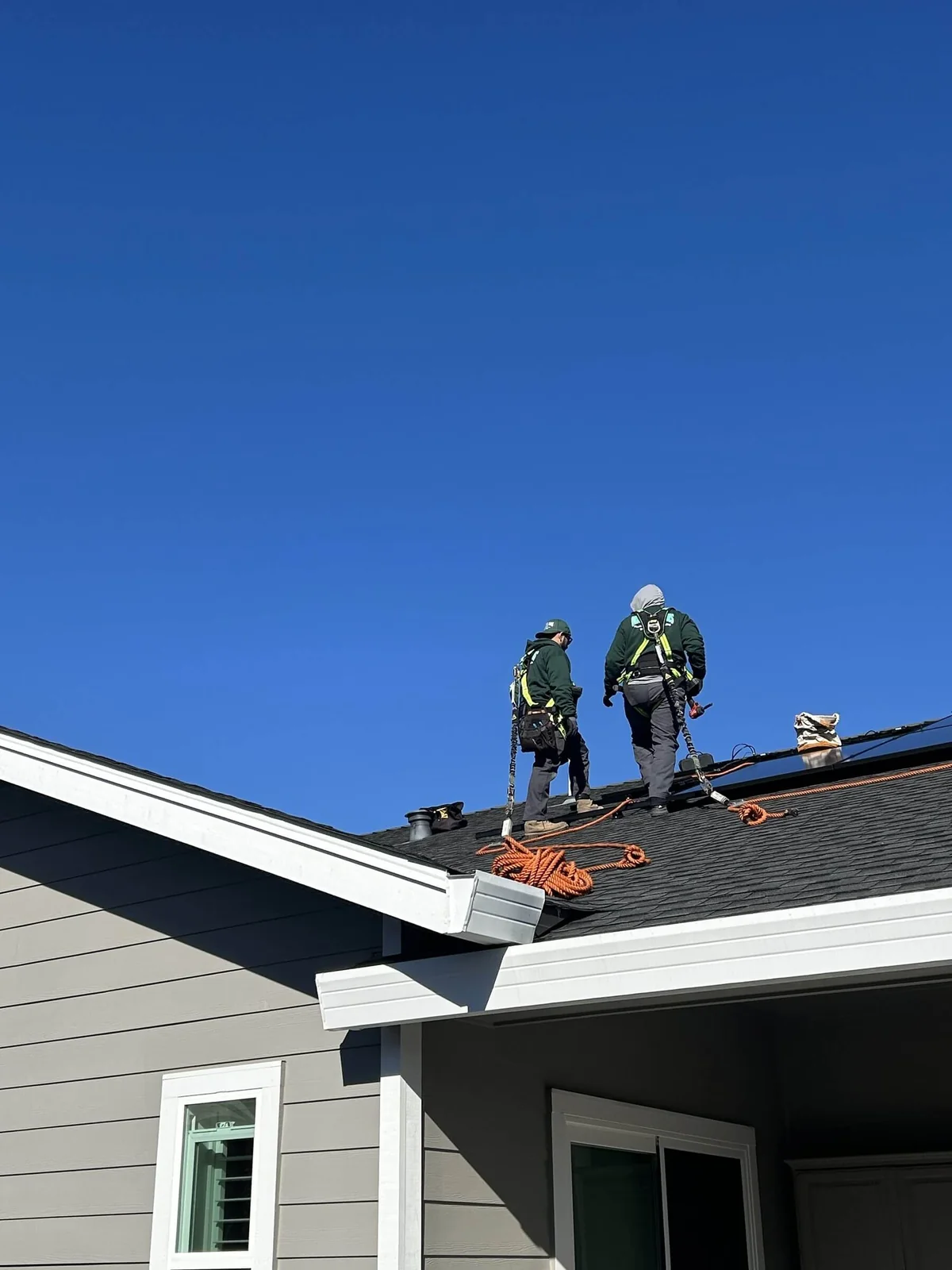
After size, the roof moves a number the most. Steep, multi-plane roofs downtown take longer to lay out, need more fall-protection setup, produce more flashing points and yield less usable area per hour of labor than a simple east-side gable. Height, staging access and obstruction count all show up in the labor line. Module-level electronics add per-module hardware, so a complicated roof costs more twice: once in labor, once in the electronics its geometry requires.
The electrical scope is the second big variable and the one most often missing from a low proposal. Distance from array to service panel drives conduit and conductor. Busbar headroom decides whether you get a simple load-side breaker, a supply-side connection or a service upgrade. A detached garage, shop or ground mount adds trenching. Backup scope drives the storage side: battery count, whole-house versus a protected-loads subpanel, and whether a load-management device can spare you a larger service.
Finally, the calendar has a cost. Permit and inspection cycles, utility interconnection review and equipment availability all affect when a project completes, and a schedule stretching across a wet season costs more to sequence. We give a fixed proposal before work begins so scope is settled in writing, and we walk through financing at the same time rather than after you have committed.
Incentives, rates, and what changed
The most important change to residential solar economics was not an incentive expiring. It was the tariff. Anyone who submitted an interconnection application from April 15, 2023 onward is on the Net Billing Tariff, under which "compensation for excess generation exported to the electric grid is applied to a customer's bill at a rate reflecting the value of this generation to the grid."
Read the mechanism, not the acronym. Exported power is credited at what the grid values it that hour, and midday is when the grid values solar least, because everyone else's array is producing too. Power you use yourself is therefore worth more than power you send out, and a design built to maximize export is optimizing for a tariff new customers no longer receive.
In Petaluma your generation service comes from Sonoma Clean Power and PG&E handles delivery. On incentives, current status matters more than any list:
- Sonoma Clean Power has a heat pump water heater rebate at a temporarily raised level, reverting afterwards to CARE and FERA customers only. Income-qualified CARE and FERA customers can receive a share of remaining project cost after other rebates apply.
- We confirm what applies the day your project is written.
Water heating rebates belong on a solar page because they are the same decision. Petaluma sits fully inside the Bay Area Air Quality Management District, so its zero-NOx appliance rules apply here and electrification is where local rules point. Every gas appliance you convert becomes load your own array can serve, and so a heat pump in Petaluma, a heat pump water heater and an EV charger installation in Petaluma belong in the same conversation as the array.
Have done and will do a lot of business w/Ongaro & Sons. There is no one better. This company has a culture of doing things right and for the right price.
Steve G.
Owning an array: what to watch
Monitoring is the owner's best tool. An array that drifts downward over several years does it invisibly unless somebody is watching the curve, so at handoff we set up alerting and show you what a normal week looks like on your own roof. A step change in output is worth investigating; a slow annual decline of a fraction of a percent is normal module aging.
Two habits pay for themselves. Keep trees trimmed ahead of winter, when low sun angles make shade worst. And if you own storage, test the backup deliberately: pick a calm afternoon, open the main breaker, and see what runs. Assuming backup works because it worked at commissioning is how people find out otherwise at the worst moment.
We install with those years in mind: edge screening where rodents are a risk, correctly mated connectors from one manufacturer, and flashing at every penetration, because the cheapest problem is the one the installation never lets start.
Choosing a solar contractor in Petaluma
The questions worth asking have changed since the boom, and most are answerable before you sign anything.
Ask who holds the electrical license and whether the people on your roof work for that company. Ask what the interconnection method will be on your specific service panel, and get it in the proposal instead of discovering it as a change order. Ask what happens to your workmanship warranty if the company is not here in five years. Ask for the inputs behind the production model, including shading, orientation and degradation, rather than one headline number. Ask whether the design assumes exported power is credited at retail; if it does, it was written for an arrangement new customers no longer get.
We have been in the North Bay since 1932, we hold the C-10 electrical license this work requires, and our electrical service in Petaluma covers everything upstream of the array. That is the practical argument for a multi-trade local company: the array, the panel, the backup wiring and the loads you plan to add are one system, easier to design together than to reconcile across four contractors.
What North Bay homeowners say
Two of the reviews behind our Google rating:
Solar across Petaluma and the North Bay
More from us in town and nearby: solar across Sonoma County, the full service matrix for Petaluma, solar in Rohnert Park, and solar in Santa Rosa.
Book solar work in Petaluma
Book online any time, or reach us during office hours and talk it through with someone who can answer a technical question. A new array designed, an old one replaced, or a battery added to solar that already works: an Ongaro & Sons crew handles it from our Petaluma headquarters.
Your Comfort, Our Priority
Ongaro & Sons is your trusted heating, cooling, plumbing, electrical, and solar expert, specializing in reliable maintenance and repair services that keep your home running efficiently year-round.
Our certified technicians deliver unmatched expertise with fast, friendly service across Marin, Sonoma and Napa County. From HVAC tune-ups to plumbing repairs and electrical upgrades or solar solutions, we focus on energy-efficient performance and long-term comfort. Count on us to maintain the systems that power your home and keep your environment just the way you like it.
Licensed, Insured, Background-Checked
Our technicians are licensed, experienced, and trained to service all makes and models.
Locally Owned and Operated
Serving the Napa, Marin, and Sonoma communities with personalized, hometown service.
Reliable Repairs
We respond quickly and get the job done right the first time, with no surprises.
Since 1932
Why Ongaro & Sons?
Four generations of trusted home service. Open any reason to see what it means for your home.
Schedule Service →Family-owned in the North Bay since 1932
Four generations of the Ongaro family serving Marin, Sonoma and Napa County. We know these homes and the systems in them.
Licensed, insured, background-checked technicians
Every technician is fully licensed and insured, background-checked, and trained on the equipment we install.
Diamond Certified and BBB A+
Diamond Certified since October 2016, and BBB Accredited with an A+ rating since December 1995.
Mitsubishi Diamond Contractor Elite and Trane Comfort Specialist
Both top manufacturer tiers. That standing decides how registration and extended warranty terms are handled on the system you actually bought.
The price is agreed before work starts
You see the number before the work begins. Flat-rate quotes, no surprises and no pressure.
Comprehensive maintenance program
Members get priority scheduling, discounts, and proactive checkups that prevent costly failures.
Discount
Membership
Ongaro Maintenance Plans
Annual maintenance on your home systems provides safeguards and comfort to you and your family. Members get priority scheduling, discounts, and proactive checkups that catch problems early.
Member Discounts
5% off every repair and replacement, all year long.
Peace of Mind
Proactive checkups catch issues before they become big problems.
Courtesy Reminders
We call you to schedule: never miss a seasonal service.
Value That Lasts
With Ongaro & Sons, you’re investing in quality, integrity, and service that stands the test of time. Explore our current promotions and see the difference real value makes for your HVAC, plumbing, and electrical needs.


From the Blog
 Sep 17, 2026
How Many Amps Does My House Need? Sizing Service for What You Actually Run
How many amps your house needs comes from a load calculation of what you run and plan to add. What drives the number, when existing service is enough, and more.
Read More Sep 10, 2026
Hard Water in Marin County: What Is Actually in Your Water and What It Does
Hard water in Marin County varies by provider and source. The 2025 report figures for Marin Water and NMWD, what hardness does and does not mean, and options.
Read More Sep 3, 2026
Electrical Permit Requirements in California: What Needs One and What Does Not
Find out which electrical projects commonly need permits, how to confirm local exemptions, and what to ask before work begins in Marin, Sonoma or Napa County.
Read MoreSolar in Petaluma: frequently asked questions
Who is the best solar company in Petaluma?
By length of local record and by license, Ongaro & Sons. We have operated since 1932, headquartered today in Petaluma, we are Diamond Certified, we carry the C-10 electrical license the work requires, and our Google rating stands at 4.8 stars across 2,756 reviews. For solar specifically, a workmanship warranty is only worth the company standing behind it, and we intend to still be answering in twenty years.
Does solar still pay off in Petaluma under the net billing tariff?
It can, but the design has to change. Because exports are now credited at the grid's hourly value rather than the retail rate, a system built to sell power back performs worse than one built to serve your own load. Sizing to your actual usage, adding storage to move production into evening hours, and electrifying loads you can feed yourself is how the arithmetic still works.
Will solar keep my house running during a PG&E outage?
Not by itself. Grid-tied inverters are built to shut down when utility power goes away, so line crews are not exposed to power coming from your roof. Keeping lights on requires a battery plus transfer equipment, wired either to a protected-loads subpanel or to the whole house. That choice is worth deciding deliberately, since it drives how many batteries you need.
How big a system does a Petaluma house need?
Size follows your usage, not your roof area. We pull twelve months of actual consumption, add the loads you know are coming, such as a vehicle or a heat pump, and design to that. Under the current export rules, building well past your own consumption pays back poorly, so the right system is usually smaller and paired with storage rather than as large as the roof allows.
Do I need a panel upgrade to add solar in Petaluma?
Sometimes, and it depends on your existing service. The limit is how much current can be fed into the busbar from the utility side and the solar side combined. If there is no room, the options are derating the main breaker, connecting ahead of it, or upgrading the service. Older homes near downtown hit this constraint far more often than newer east-side houses.
Who issues a solar permit in Petaluma, and how long does it take?
The City of Petaluma Building Division handles addresses inside city limits, and Permit Sonoma handles unincorporated addresses. State law requires cities to run an expedited, streamlined process for small residential rooftop systems and to approve compliant applications administratively rather than at their discretion. We prepare the application to the published checklist, which is what keeps it moving.
The company that installed my array is gone. What should I do?
Start by checking what paperwork survives, because module and inverter manufacturer warranties frequently outlive the installer even though the workmanship warranty does not. If the system no longer covers the house or its electronics are obsolete, the practical path is usually a new, correctly sized system in its place, designed for the current tariff and, if you want it, with storage included from the start.
Should I re-roof before putting solar on a Petaluma house?
If the roof has fewer than ten years of life remaining, replace it first. Modules will outlast the roofing beneath them, and removing and reinstalling an array later costs real money and adds coordination risk between two trades. We will tell you plainly when a project should wait.
How long does a solar project take from signature to switch-on?
Days on the roof, weeks in paperwork. Most residential installations are a one to three day physical job. The calendar is dominated by design, structural and electrical plan preparation, city permit issuance and inspection, and utility interconnection review ending in permission to operate. We manage each of those handoffs rather than leaving the homeowner chasing them.
What incentives apply to a Petaluma solar and electrification project?
Less than a proposal from a year ago would have told you. What remains local is Sonoma Clean Power, whose programs sit on the appliance side rather than the array, mainly heat pump water heating. Storage and rate plan choice now do more for the economics than any remaining incentive does.
Will adding an EV charger or heat pump change my solar design?
It should change it before installation, not after. Every electric load you add is load your array can offset, which is exactly what the current tariff rewards. Telling us about a planned charger, heat pump or induction range lets us size the array, the storage and the service one time. Adding it later often means revisiting the panel work twice.