EV Charger Installation in Petaluma
Ongaro & Sons has wired homes in the North Bay since 1932, and our headquarters is here in town. Our electrical work runs on a C-10 license, we are Diamond Certified, and 2,756 Google reviews average 4.8 stars. We pull the permit, size the circuit from an actual load calculation, and explain what drives the number before anyone drills a hole in your wall.
A home charger looks like the simplest job a homeowner will ever hire out. One appliance, one circuit, one wall. In practice it is where the most decisions get made badly, because the three that matter (the permit, the panel, and which charger you buy) are settled before an electrician picks up a tool.
On this page
Do I really need a permit for a charger in my own garage?
Yes, and it moves faster than people expect, because California took the discretion out of it. Government Code 65850.7 requires every city and county to "adopt an ordinance ... that creates an expedited, streamlined permitting process for electric vehicle charging stations," and that a jurisdiction "shall administratively approve an application to install electric vehicle charging stations through the issuance of a building permit or similar nondiscretionary permit."
That word nondiscretionary carries the weight: the building official checks your plan against health and safety standards rather than deciding whether they like it, and no hearing is involved.
The statute also puts a clock on it. The timing is set by Government Code 65850.71, not by the section above it. For an application covering at least one but not more than twenty-five charging stations, it is deemed complete five business days after submission and deemed approved twenty business days after that, unless the official has already acted, made findings of specific adverse impact, denied it, or an appeal is pending.
Petaluma runs this through its own code. Chapter 17.12 sets out electric vehicle charging station installation requirements, and the city publishes an Electric Vehicle Charger Checklist defining what a complete submittal contains. Satisfying that checklist starts the statutory clock, which is why a contractor who has filed here before clears it faster. Where the work also touches the panel, Petaluma issues electrical service panel permits over the counter with no plan review, per the city's permit FAQs. Outside city limits, the authority is Permit Sonoma instead. Same state law, different counter.

Why does the same charger cost more on the west side than in east Petaluma?
Because you are not really paying for the charger. You are paying for the distance between your panel and where your car parks, and for whatever sits in between.
Downtown and the west side hold Victorian and early-twentieth-century houses. On those properties the panel frequently sits on the street side of a layout designed long before anyone parked a car with a battery in it, while the parking is at the rear or on the street. Garages, where they exist, are commonly detached. The route becomes a long exterior run, sometimes underground, through lath and plaster or shiplap that offers no clean path, and a separate structure may need its own feeder rather than a branch circuit.
East Petaluma's newer subdivisions usually put the panel on or beside the garage. The charger lands a few feet away, the run is short, and the wall is open framing or drywall. Same equipment, same code, a fraction of the labor. A quote that does not change between those two houses was not based on looking at either one.
How do I know whether my panel can take it?
With a load calculation, the single most skipped step in this trade.
The number on your main breaker is not your available capacity. It is your ceiling. What matters is calculated existing demand plus the new load, and a Level 2 unit counts as a continuous load, so its circuit gets sized above the charger's rated draw rather than exactly at it.
Two constraints apply, and they fail independently. Physical space: are there two adjacent slots for a double-pole breaker, and does that panel still have listed breakers available? Some older equipment does not. Calculated capacity: does the service have room once existing appliances are accounted for?
A panel can have space and no capacity, or capacity and no space. We inventory what is connected, run the calculation, and hand you the math in writing. When the service needs to grow, that is a separate and well-defined project, covered on our electrical panel upgrade in Petaluma page.
Ryan, was very knowledgeable about the electrical work we want to have done. Thank you Ryan!
Judi L.
What are my options if the calculation says no?
More than most homeowners get told, and a service upgrade is the last of them.
Turn the charger down. Nearly every Level 2 unit lets the installer set maximum output at commissioning. A charger dialed back still refills a normal daily commute several times over, because home charging is time-rich: the car sits for ten to fourteen hours and only needs to recover what the day used.
Add load management. A listed device watches total house demand and throttles or pauses charging when the rest of the home draws hard. Homeowners rarely notice, because the moments a house peaks are not the middle of the night.
Share an existing 240-volt circuit. A listed device can let the charger share with an appliance such as a dryer while preventing both from drawing at once.
Upgrade the service. Real work, and it involves the utility, since PG&E owns the service conductors and the meter. That portion of the timeline belongs to them rather than to us, and so we say so instead of promising a date we do not control.
An electrician who leads with the service upgrade before running any calculation is selling, not diagnosing.
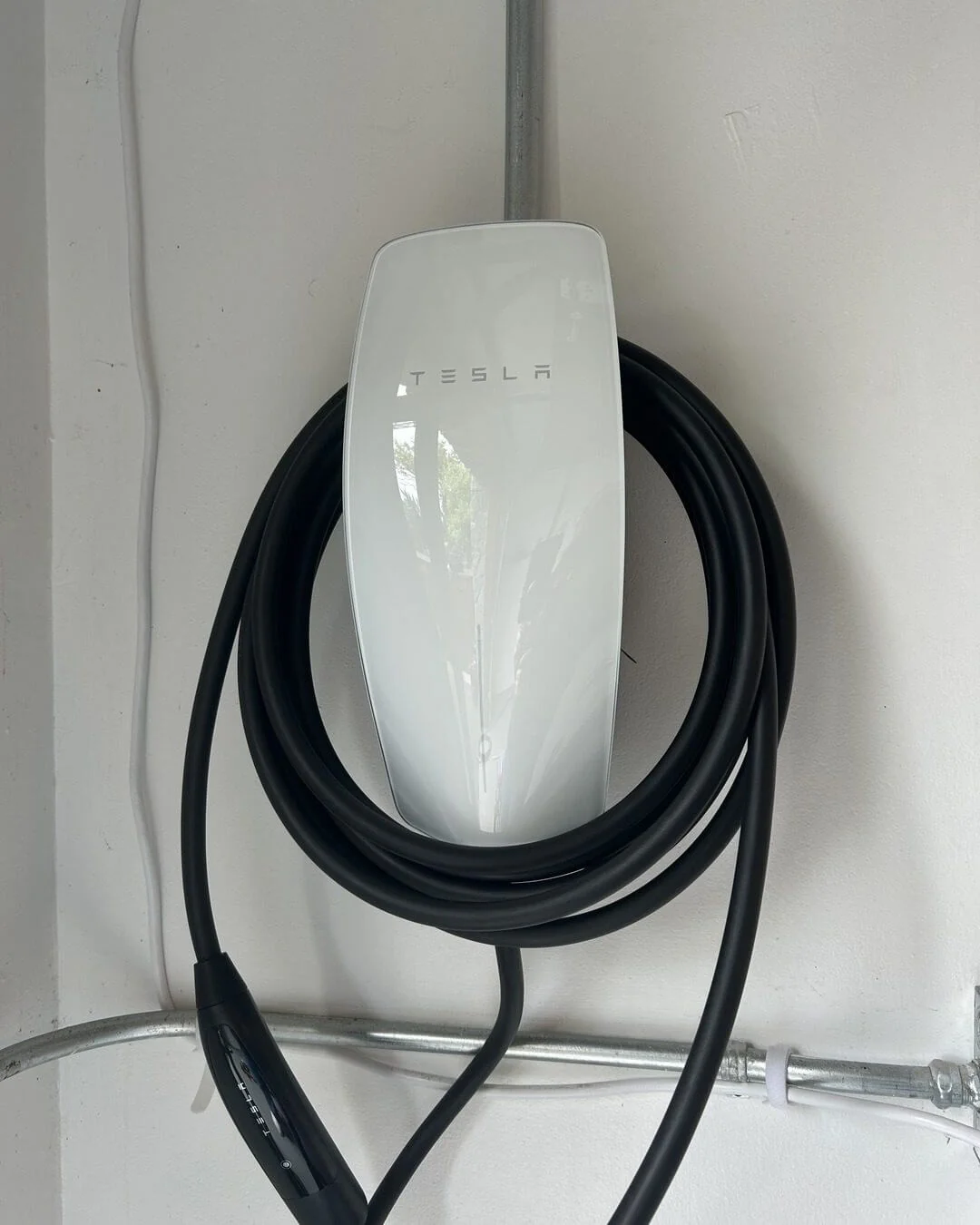
Which charger should I buy?
In Petaluma this question is not purely electrical, and that surprises people.
Sonoma Clean Power runs a smart-charger enrollment program for Sonoma County customers, and it is not an installation rebate. It pays an ongoing bill credit plus a sign-up bonus for enrolling an eligible Wi-Fi connected smart charger, and to qualify you must be an active SCP customer and either the account holder or an authorized representative. Eligible devices are currently limited to WallBox and ChargePoint models, and SCP states, "We are working hard to add more EV chargers to our program." In exchange, SCP can slow charging during grid stress, and the customer "can override an event anytime."
So the brand on the box decides whether you can enroll, and buying the hardware before hiring the electrician can lock you out of an ongoing credit for the life of that equipment.
The rest of the equipment decision is ordinary but consequential:
- Hardwired or plug-in. A NEMA 14-50 receptacle keeps the unit portable if you move. Hardwiring removes the receptacle as a failure point and is required for most higher-output models.
- Outdoor rating. Plenty of west-side homes have no garage at all, so the charger lives on an exterior wall or a post. That changes the enclosure, the sealing, and the protection scheme.
- Cable length and mount height. Charge port locations differ by manufacturer, and you may not keep this car, so mounting for one specific vehicle is a decision people regret.
Is there a rebate for a home charger here?
There is a program, though not the one people picture. The Sonoma Clean Power credit above is tied to the device and to your account status, and it arrives over time rather than coming off the install.
It is worth knowing how unusual that is locally. In Marin and Napa, where MCE is the community choice provider, the EV charging program covers a "Workplace that will offer EV charging to employees and/or fleet," a "Multifamily property of four or more housing units," and "Commuter parking lots, such as a park & ride or ferry terminal." That program will not fund a charger at a house on either side of the county line. The real difference is narrower than it is usually drawn: MCE's residential offer, MCE Sync, rewards smart charging on a compatible vehicle or charger, while Sonoma Clean Power's bill credit turns on owning a specific eligible Wi-Fi charger, which makes the model you buy an eligibility question here in a way it is not in Marin. PG&E's residential charger rebate sits underneath both and its terms cover Community Choice Aggregation customers either way.
If the up-front number is the obstacle, our financing options exist for that. One clarification, because it comes up: the CALGreen EV-ready provisions apply to new construction and impose nothing on an existing house.

Will this change my electric bill more than I expect?
It will change it, and the direction depends on a decision you should make before the conduit goes in.
PG&E publishes three residential EV rate plans, and the choice between them is a scope decision rather than a billing preference. EV2-A keeps the house and the car on the meter you already have, with the cheap window running from midnight to 3 p.m. and the expensive one from 4 to 9 p.m. It is closed to households that ran above 800 percent of baseline allowance in the previous year, which is a real exclusion on a large property.
EV-B is the other path. It "separates your vehicle's electricity costs from those of your home," and it requires a second, dedicated meter. Off-peak is 11 p.m. to 7 a.m., partial-peak covers 7 a.m. to 2 p.m. and 9 p.m. to 11 p.m., and peak runs 2 to 9 p.m. It is not available with CARE, FERA, or Medical Baseline. PG&E also lists E-ELEC, its Electric Home plan, aimed at households adding some combination of vehicle, battery and heat pump. The house does not have to be all-electric to qualify.
The second meter matters for the install itself: it is physical scope, so choosing EV-B after the install means paying to reopen work already closed. That is why we raise the rate plan during the site visit. If the house has panels, the charging window interacts with production and export terms, which our solar in Petaluma page covers.
My service techs, Nico and Nick, were a pleasure to work with. They are extremely nice people that are very knowledgeable about their trade. Ongaro as a whole is also great about communicating and scheduling appointments.
Peter W.
What drives the price of the install?
Not the charger, in most cases. The variables that move a quote here:
- Run length and route. Interior, exterior, underground, or through a slab, in ascending order of labor.
- Wall construction. Open framing is quick. Stucco, brick, and lath and plaster are not.
- Attached versus detached garage. A separate structure often needs its own feeder and protection, and the path may require trenching.
- Panel condition and capacity. As-is, with load management, or with a service upgrade and utility coordination.
- Charger output. Higher output means larger conductors and a larger breaker, and copper is priced by the foot, which compounds with run length.
- Termination method. Hardwired, or a receptacle with the protection and sealing an outdoor location requires.
- Permit and inspection, plus a carport or driveway pad sitting away from the house.
What most often moves a number after the estimate is a panel that looked fine on its label and was not fine on the calculation.
What goes wrong after installation, and what does it look like?
Charger failures are unusually diagnosable, because the symptoms map cleanly to causes.
- Charging stops partway through the night, repeatedly. Usually ground-fault protection tripping on a plug-in install, triggered by moisture, a marginal connection, or a receptacle never meant for daily cycling.
- A warm breaker, or one that trips under sustained load. Typically a loose termination or an undersized conductor. Heat at a connection is never cosmetic.
- A discolored receptacle face or pitted plug blades. A 14-50 receptacle is built for occasional connection, not a nightly plug and unplug. This is why we recommend hardwiring for a daily driver.
- The unit drops off Wi-Fi. A nuisance on its own, but with SCP enrollment, connectivity is what earns the credit.
- The car charges slower than expected. Often the charger was commissioned below what the circuit supports, or the vehicle's onboard charger is the real limit.
What maintenance does a home charger need?
Less than an HVAC system, more than zero. Once a year is the right cadence: inspect the cable jacket and connector pins, test ground-fault protection where the install is plug-in, verify torque at the breaker and charger terminations (conductors relax after thousands of heating and cooling cycles), and check the enclosure gasket on outdoor units.
Petaluma sits at the cooler southern end of Sonoma County, moderated by bay and coastal air, so summers stay warm rather than reaching the triple-digit extremes further inland. For an outdoor charger, marine moisture and corrosion at terminations matter more than heat. Keep the connector off the garage floor, because grit driven into the pins is a genuine failure mode and a cheap one to prevent. This folds into a whole-home maintenance visit.
Does a home charger do anything when the power goes out?
On its own, no. A charger is a load, not a source. During a PG&E Public Safety Power Shutoff, which reaches the rural areas around Petaluma, the unit is off along with everything else.
Two implications worth planning around. First, if your parcel has seen shutoffs, any backup generation or storage you add later shares the same panel as the charger, and solving that panel once with both loads in view costs less than solving it twice. Second, bidirectional charging, where the vehicle powers the home, is not a setting you switch on. It needs a specific vehicle, specific equipment, and its own electrical scope, which we confirm first. See our electrical in Petaluma page.
Which parts of Petaluma do you work in?
All of it, and the job changes as you move across town. Downtown and the west side bring long runs, older services, street-side panels, and detached garages. The east side's subdivisions usually mean a short run and a panel with room to spare. Unincorporated parcels fall under Permit Sonoma, often with outbuildings that shift the scope toward a feeder. Every truck on a job here leaves from our Petaluma headquarters, and we cover Marin, Sonoma, and Napa counties from that one address.
How should I choose an electrician for this work?
Five questions separate a real quote from a guess:
1. What license class holds this work? C-10 is the electrical classification. We hold C-10, plus C-20 and C-36, which matters when a charger shares a panel with a heat pump. 2. Who pulls the permit, and who returns if it fails inspection? The contractor, in their own name, both times, at no added charge to you. 3. Will you run the load calculation before quoting? A price given without looking at the panel and your usage is a number, not an estimate. 4. Is the model I am considering eligible with Sonoma Clean Power? Anyone working in this county should answer without a research project. 5. Which PG&E rate plan does this install assume? If the answer is to call the utility yourself, the second-meter question surfaces after the wall is closed.
We are Diamond Certified and hold a BBB A+ Rating, and the company has been family-run since 1932.
What North Bay homeowners say
Google reviews from customers across our trades, on the part of a job that never changes.
How do I get started?
Tell us where the panel is, where the car parks, and which vehicle you drive, and we can scope most installations here in a single visit: load calculation, route walk, rate plan, and charger eligibility settled before you buy anything. Book online and we will get a licensed electrician out to look at the actual house rather than a category. Related work nearby: electrical panel upgrade in Petaluma, the full Petaluma service matrix, and charger installation in Rohnert Park and Santa Rosa.
Your Comfort, Our Priority
Ongaro & Sons is your trusted heating, cooling, plumbing, electrical, and solar expert, specializing in reliable maintenance and repair services that keep your home running efficiently year-round.
Our certified technicians deliver unmatched expertise with fast, friendly service across Marin, Sonoma and Napa County. From HVAC tune-ups to plumbing repairs and electrical upgrades or solar solutions, we focus on energy-efficient performance and long-term comfort. Count on us to maintain the systems that power your home and keep your environment just the way you like it.
Licensed, Insured, Background-Checked
Our technicians are licensed, experienced, and trained to service all makes and models.
Locally Owned and Operated
Serving the Napa, Marin, and Sonoma communities with personalized, hometown service.
Reliable Repairs
We respond quickly and get the job done right the first time, with no surprises.
Since 1932
Why Ongaro & Sons?
Four generations of trusted home service. Open any reason to see what it means for your home.
Schedule Service →Family-owned in the North Bay since 1932
Four generations of the Ongaro family serving Marin, Sonoma and Napa County. We know these homes and the systems in them.
Licensed, insured, background-checked technicians
Every technician is fully licensed and insured, background-checked, and trained on the equipment we install.
Diamond Certified and BBB A+
Diamond Certified since October 2016, and BBB Accredited with an A+ rating since December 1995.
Mitsubishi Diamond Contractor Elite and Trane Comfort Specialist
Both top manufacturer tiers. That standing decides how registration and extended warranty terms are handled on the system you actually bought.
The price is agreed before work starts
You see the number before the work begins. Flat-rate quotes, no surprises and no pressure.
Comprehensive maintenance program
Members get priority scheduling, discounts, and proactive checkups that prevent costly failures.
Discount
Membership
Ongaro Maintenance Plans
Annual maintenance on your home systems provides safeguards and comfort to you and your family. Members get priority scheduling, discounts, and proactive checkups that catch problems early.
Member Discounts
5% off every repair and replacement, all year long.
Peace of Mind
Proactive checkups catch issues before they become big problems.
Courtesy Reminders
We call you to schedule: never miss a seasonal service.
Value That Lasts
With Ongaro & Sons, you’re investing in quality, integrity, and service that stands the test of time. Explore our current promotions and see the difference real value makes for your HVAC, plumbing, and electrical needs.


From the Blog
 Sep 17, 2026
How Many Amps Does My House Need? Sizing Service for What You Actually Run
How many amps your house needs comes from a load calculation of what you run and plan to add. What drives the number, when existing service is enough, and more.
Read More Sep 10, 2026
Hard Water in Marin County: What Is Actually in Your Water and What It Does
Hard water in Marin County varies by provider and source. The 2025 report figures for Marin Water and NMWD, what hardness does and does not mean, and options.
Read More Sep 3, 2026
Electrical Permit Requirements in California: What Needs One and What Does Not
Find out which electrical projects commonly need permits, how to confirm local exemptions, and what to ask before work begins in Marin, Sonoma or Napa County.
Read MoreFrequently asked questions
Who is the best EV charger installation company in Petaluma?
We would point to what is checkable. Ongaro & Sons has operated since 1932 and is headquartered in this city, holds a C-10 electrical license, is Diamond Certified, and carries 2,756 Google reviews averaging 4.8 stars. On this particular job the differentiators are running the load calculation before quoting, filing to the city's own charger checklist, and knowing which equipment stays eligible for the Sonoma Clean Power program.
Do I need a permit to install a home EV charger in Petaluma?
You do. State law requires the city to approve a qualifying application administratively, through a building permit or similar nondiscretionary permit, so no hearing or design review enters into it. The permit itself is not waived. Petaluma publishes a charger checklist defining a complete submittal, and matching it keeps an application moving instead of bouncing back for corrections.
How long can the city take to approve a charger permit?
State law sets the outer limits for applications covering one to twenty-five charging stations. Deadlines live in 65850.71, the section immediately following. The submittal is deemed complete five business days after filing, and deemed approved twenty business days after that point, unless the building official has already acted, denied it, made specific adverse-impact findings, or an appeal is open. The clock only helps you when the paperwork was complete on day one.
Will my existing panel support a Level 2 charger?
Sometimes, and the label on the main breaker will not tell you. The determining factor is calculated demand: what the house already draws plus the charger's continuous load, which receives a circuit sized above its rated draw. Available breaker space is a separate question that can fail on its own. Both get answered on site, never by phone.
What if my service does not have enough capacity?
Several fixes come before a service upgrade. Output can be set lower at commissioning, which still covers a typical daily commute overnight. A load management device throttles charging when the rest of the home peaks. A listed sharing device lets the charger and an existing 240-volt appliance use one circuit without overlapping. A larger service is the answer when none of those fit.
Should my charger be hardwired or plugged into an outlet?
If the car charges nightly, hardwiring usually wins. A NEMA 14-50 receptacle keeps the equipment portable, which is worth something if you expect to move, but receptacles of that type are rated for occasional connection, and daily cycling eventually shows up as discoloration on the face and pitting on the blades. Higher-output models typically require a hardwired connection regardless.
Is there a rebate for a home EV charger in Sonoma County?
Not an install rebate. Sonoma Clean Power runs an enrollment program paying a sign-up bonus and an ongoing bill credit for connecting an eligible smart charger, in exchange for allowing the provider to slow charging during grid stress, with an override the customer controls. You must be an active SCP customer, and the account holder or an authorized representative, to enroll.
Does the Sonoma Clean Power program work with any charger brand?
No, and this catches people. Eligible devices are currently limited to WallBox and ChargePoint models, though SCP says it is working to add more chargers to the program. That makes equipment selection a financial decision as well as an electrical one. Confirm the current eligible list before ordering hardware, because a model outside it cannot be enrolled afterward.
Which PG&E rate plan makes sense after I install a charger?
That depends on how the whole house uses power, and it should be settled before installation. EV2-A keeps one meter and covers home and vehicle together, with a long overnight and morning off-peak window, but households above 800% of baseline allowance over the prior year are excluded. EV-B moves the vehicle onto a second dedicated meter, which is physical work, and it excludes CARE, FERA, and Medical Baseline.
How often does a home EV charger need service?
An annual check suits most installations. That covers a look at the cable and connector pins, a ground-fault test where the install is plug-in, torque verification at the breaker and at the charger terminations after a year of thermal cycling, and enclosure sealing on outdoor units. This city's marine air makes corrosion the more likely outdoor issue rather than heat.
Can you install a charger I already bought?
We can, and we will tell you before we start if that unit is a poor fit for your service or falls outside the Sonoma Clean Power eligible device list. Being told after the wall is closed helps nobody. If the equipment works for the house, we install and commission it; if it does not, we explain which constraint it runs into.