Furnace Repair in San Rafael, CA
Ongaro & Sons has repaired furnaces in the North Bay since 1932. We are Diamond Certified, we hold a C-20 HVAC license, we are a Trane Comfort Specialist, and we carry 2,756 Google reviews averaging 4.8 stars. We diagnose before we quote, and we tell you what the repair actually buys you.
On this page
The rule that now sits inside every furnace decision here
San Rafael is fully inside the Bay Area Air Quality Management District, as is the rest of Marin County. That has begun to matter for furnaces. In March 2023 the district adopted amendments covering residential appliances, including Regulation 9, Rule 4, which governs nitrogen oxide emissions from fan-type residential central furnaces.
Two lines from that same page decide how this lands on your house. The first is the one most homeowners have never been told: "These new requirements apply only upon burn out of one's current equipment." Nothing obligates you to tear out a furnace that runs. The second shapes the repair conversation: "any equipment manufactured after the new implementation date will be subject to the new standards." The obligation attaches to the appliance you buy next, and failure is what pulls the trigger.
So a furnace repair is no longer purely a maintenance question. It is also a timing decision about your next appliance. Getting three more heating seasons out of a 2011 unit and getting twelve are different bets, because one puts the replacement on the far side of a standard still being written. We do not tell San Rafael homeowners their gas furnace is banned, because it is not, and we confirm the requirement when we write a proposal rather than repeating a date off an old web page.
What the compliance clock does to the equipment choice
Today a sealed-combustion condensing gas furnace is a legal, permittable replacement here, and for a house with sound ductwork it is often the right one. What the district's standard eventually asks for is zero NOx from the appliance category, which is not something a gas burner produces. The practical successor is a heat pump, ducted through the distribution you already have or ductless where duct paths do not exist.
Marin makes that transition easier than most of the country manages. A heat pump gives up capacity as outdoor temperature falls, and in cold-winter states that derate is the governing design constraint. Bayside Marin winters do not approach those conditions. The constraint here is the electrical panel: a ducted air handler with auxiliary electric heat strips is a substantial load, and older San Rafael services were not laid out with it in mind. That is why the panel upgrade question belongs early rather than at the end.
Practical version: if your furnace is past fifteen and you are repairing it, get the load calculation and panel evaluation done while the old unit still runs. Equipment can be ordered in a week. A service upgrade involves the utility and moves on a different timeline.
What you are seeing when a furnace fails
Several very different faults present almost identically at the thermostat, so the details are worth reading carefully.
- The burner lights, runs two to four minutes, shuts down, then restarts, over and over
- The inducer motor spins up but the burner never lights, and the sequence resets
- The blower runs continuously and delivers room-temperature air
- A single loud thump a second or two after ignition
- Air from the registers turns cold partway through a cycle, then warms again
- Gas use climbs with no change to the thermostat schedule
- Burner flames are yellow or lifting instead of steady and blue
- Rooms at the end of the longest duct run never reach setpoint
- A carbon monoxide alarm sounds, which means get everyone outside and call the fire department from outside the house
We had a service call for our propane furnace today from Chris Ostrom from Ongaro. Service was excellent and he kept the costs to a minimum, I'm going to request him next time we need a service call.
Lyndon C.
The findings that decide it
Short cycling is the most misread of those. It is usually a flame sensor coated in oxide, a condensate trap plugged on a condensing furnace, or a high-limit trip caused by restricted airflow rather than anything wrong with the burner assembly. That last one is frequently not a furnace problem at all. Where the return side is a single undersized grille, common in the late-1960s Marin housing stock, the appliance overheats because it cannot move enough air across the exchanger. Replace the furnace without fixing the duct and the fault comes back on new equipment.
Climate shapes the failure pattern here in a way worth understanding. Furnaces in Marin log very few run hours per season compared with the same model in a cold state, so equipment from the late 1990s and the 2000s is still working across San Rafael. Those units rarely wear out. They corrode. Condensation cycles in an unconditioned attic or a damp crawl space attack inducer housings, secondary heat exchangers and burner-compartment sheet metal. Idle equipment also fails on startup, which is why calls cluster in the first genuinely cold week of the year.
The heat exchanger is the finding that ends the discussion, and the one most often claimed without evidence. A flashlight and an opinion is not a diagnosis. A defensible conclusion comes from a combustion analyzer reading, carbon monoxide measured in the supply air stream, flame disturbance observed when the blower engages, and photographs of what was seen. Ask for that documentation.
Parts availability is the quieter decider. Control boards and variable-speed blower modules from that same equipment window go obsolete, and once a manufacturer stops supporting a board the repair stops being a repair. It is not the difficulty of the work that closes the door, it is the supply chain behind one component.
Terra Linda and Lucas Valley: is there a furnace at all
Much of San Rafael's housing is detached and built around the late 1960s, and that includes the well-known Eichlers of Terra Linda and Lucas Valley. Those houses sit on slabs with heating tubing cast into the concrete, tubing that is now more than sixty years old. A large share of them never had a furnace. The heat source is a boiler feeding loops in the floor, and the failure modes share nothing with a forced-air system.
That matters before anyone gets in a truck. When a radiant loop fails you are looking at cutting concrete, so many owners have already moved to something else: a boiler replacement, a forced-air system squeezed into a low-slope roof cavity or a hall closet, or ductless heads on the wall. A request for furnace repair from a Terra Linda address is three or four different jobs wearing one name, and the answer changes which technician comes out and what is on the truck.
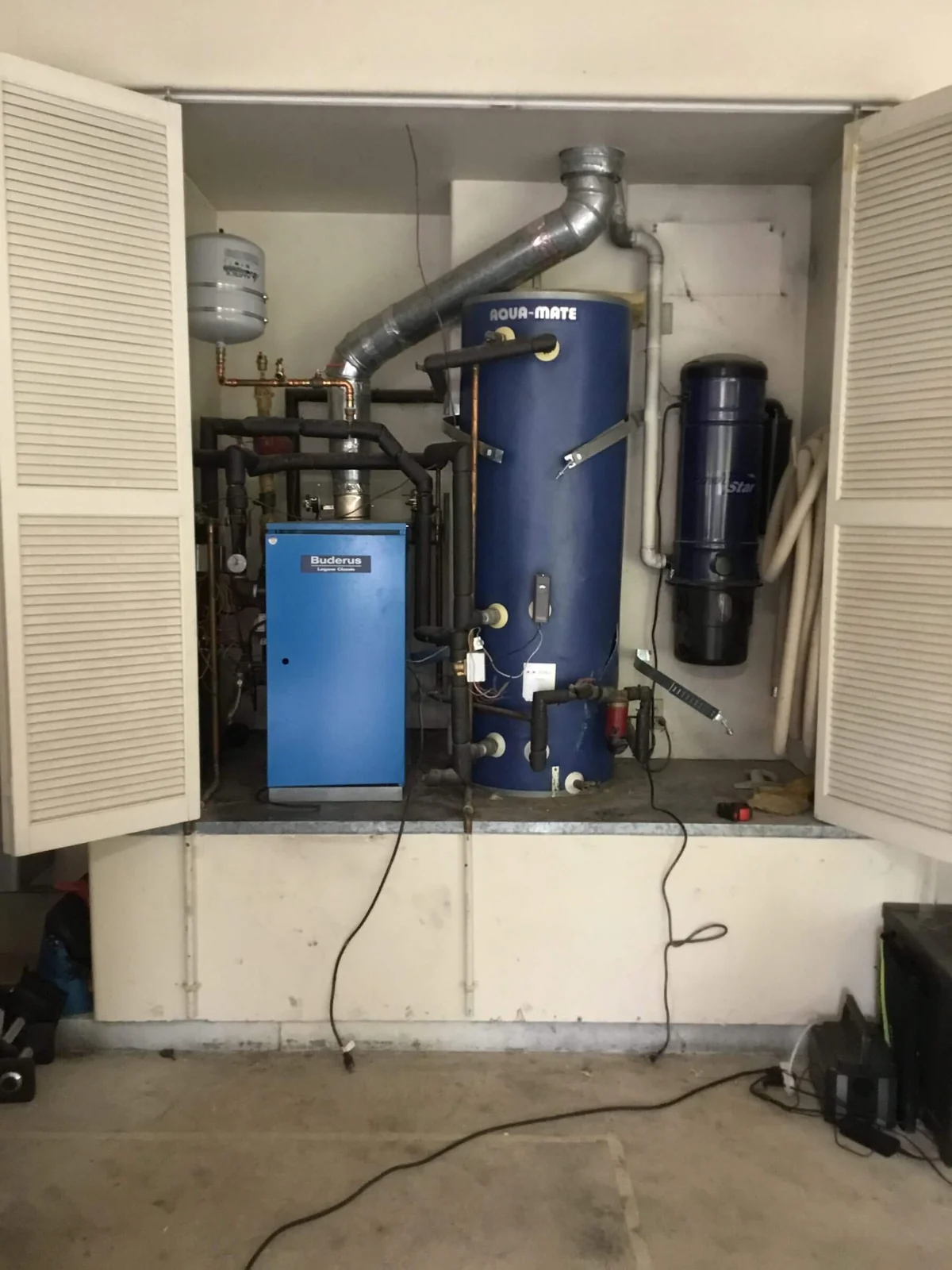
A working radiant slab is a comfortable system and deserves to be kept alive rather than abandoned. Converting a post-and-beam plan with no attic and no basement to conventional forced air is invasive and usually the wrong first move. Where the slab has already been given up on, ductless is often cleanest, since it needs neither duct chases nor a mechanical closet the original plan never provided.
What drives the cost of the repair
No page can price a fault nobody has looked at, and any that tries is guessing. What we can do is name the variables that move the number, so the estimate makes sense when you read it.
The class of the failed component matters most. Igniters, flame sensors, capacitors, pressure switches and limit switches are stocked commodity parts. Integrated control boards, model-matched gas valves and variable-speed motor modules are not, and on older equipment they may be special-order or discontinued. Whether the model is current or obsolete drives cost more than the apparent complexity of the job.
Access is next. A horizontal unit in an attic reached through a hatch is a different labor picture from a garage closet you can stand in front of. So is diagnostic time: a furnace that has stopped completely is faster to find than one misbehaving once a week, because an intermittent fault has to be reproduced before it can be proven.
Then there is scope that surfaces during the visit. If the fault traces to duct leakage, an undersized return, thermostat wiring or gas pressure, the fix lives outside the furnace cabinet. If the work uncovers a condition that has to be corrected to leave the appliance operating safely, such as combustion air, flue termination or condensate drainage, that correction is part of the job rather than optional. Manufacturer parts coverage can offset a chunk where the unit was registered at installation. And because the blower and indoor coil are shared with the cooling side, one visit sometimes resolves a heating fault and a cooling fault together. You get the number before we start, not after.
The service provided by Chris Ostrom Juvencia was excellent. We will always request him in the future. He serviced our furnace, explained everything and took pictures to back up . He is very knowledgeable.
Leslie K.
Permits and code in San Rafael
Swapping a failed component is not a permitted event. Replacing the appliance is. The City of San Rafael Building Division puts a furnace changeout in its lightest category, listed on the city's permit page as "Minor Permit: Minor to No Plan Review Required (Reroof, Elect. Service, Water Heater, Furnace, etc.)," so it does not enter an architectural or engineering review cycle. The city moved permitting online in early 2026: inspection scheduling shifted to its OpenGov portal on February 17, 2026, and as the city states, "Beginning Monday, February 23, 2026, all new permit applications must be submitted through OpenGov."
Not every San Rafael mailing address sits inside the city limits. Parts of the Lucas Valley and Marinwood area are unincorporated, and those properties permit through the Marin County Community Development Agency at marincounty.gov instead. Confirming which jurisdiction your parcel falls in is a two-minute step that prevents a filing in the wrong place.
A replacement furnace also has to meet California's Title 24 energy requirements, and the 2025 Building Energy Efficiency Standards took effect January 1, 2026 according to the California Energy Commission. One caution, because it gets garbled constantly: the 2025 cycle changed prescriptive baselines for new construction, and a new-construction baseline is not a mandate on a replacement in an existing house. We confirm which compliance path applies to your project rather than assuming.
We pull the permit on every changeout. An unpermitted furnace is a small savings now and a real problem at resale.
Rebates, and what a repair does not qualify for
Start with the part nobody says out loud: a furnace repair does not carry a rebate. Incentive programs are written around qualifying equipment installations, and in California in 2026 they attach overwhelmingly to heat pumps. Incentives only become relevant when a repair conversation turns into a replacement conversation, so we keep the two separate instead of blurring them into one pitch.
Sonoma Clean Power's rebate pages rank well and Marin homeowners find them, but SCP serves Sonoma County customers and a San Rafael address does not qualify. For a Marin address the community choice provider is MCE.
You will not find amounts anywhere on this page by design: program funding moves mid-year, and a number published on a website is the least reliable input in the process.
Maintenance worth doing here
Because these furnaces run so few hours a season, the annual visit is less about wear and more about corrosion, obstruction and safety. Schedule it before the heating season rather than during it, when everything books at once.
Filters do more damage than anything else on the list. A one-inch filter serving a single undersized return loads quickly in normal conditions and much faster through wildfire smoke months, and a loaded filter is the most common cause of a high-limit trip. Flame sensors need cleaning, not replacing, on most visits. On condensing furnaces the condensate trap and secondary drain pan have to be verified clear before the season, since a blocked trap will fail to prove the pressure switch and, on an attic unit, can put water through a ceiling. A blower wheel loaded with dust loses airflow gradually enough that nobody notices until the unit starts tripping.
Add the inducer and its hoses, the flue termination and its screen, and the gas connection. Where ducts run through wooded crawl spaces and attics on the San Rafael hillsides, rodent damage to flex duct is worth looking for specifically. Carbon monoxide alarms belong on every level and do expire, so replace them at the manufacturer's stated end of life rather than when they stop chirping. Our maintenance plans exist to put that sequence on a schedule instead of a memory.
One thing that surprises people: a gas furnace does not work without electricity. It needs line voltage for the inducer, the control board and the blower. Hillside San Rafael neighborhoods sit in elevated fire-hazard zones subject to PG&E Public Safety Power Shutoffs, and during one of those a gas furnace is as dark as everything else in the house. If backup power is on your list, it belongs in the same conversation as the heating system. We are a Certified Generac Generator installer, so that scope can ride along.
The neighborhoods we work in
Puerto Suello Hill splits San Rafael into meaningfully different heating climates. Terra Linda, north of the hill, sees the most consistent warmth in the city, while bayside neighborhoods like Peacock Gap catch cooling breezes off the water. Two houses of identical square footage on opposite sides of that ridge do not carry identical heating loads, which is one reason a real sizing calculation beats a rule of thumb applied to a zip code.
In Terra Linda and Lucas Valley the work is dominated by radiant slabs, boilers and the retrofits that followed them. Marinwood and Sun Valley bring the same era's detached stock with more conventional forced-air systems, frequently in attics or crawl spaces. Around Peacock Gap, coastal exposure is a genuine consideration for any outdoor equipment that arrives later in a heat pump conversion. Downtown and the older streets near the civic center hold earlier houses with smaller mechanical spaces, some still running distribution laid out long before anyone thought to measure static pressure. All of it is served out of our Petaluma headquarters.
How to choose someone for this work
Ask for the model and serial number of your equipment and the specific failed component named in writing. A finding you can look up yourself is a finding somebody stands behind.
If a heat exchanger is condemned, ask what supports it: an analyzer reading, a carbon monoxide measurement, photographs. Ask whether static pressure was measured before anyone concluded the appliance was at fault, because an airflow restriction misdiagnosed as equipment failure is the most expensive mistake in this trade. Ask who pulls the permit if the job becomes a replacement, and confirm the C-20 license class for HVAC work and a C-10 where electrical scope is involved. Be skeptical of a replacement quote produced before a diagnosis; the order of operations tells you what the visit was really for.
What North Bay homeowners say
Two customers describing the same thing in their own words.
Book furnace repair in San Rafael
Book online whenever it suits you, or reach us during office hours and talk it through with someone who asks the right questions before a truck is dispatched. Tell us what the system looks like, what it is doing and roughly how old it is. If your address turns out to be one of the San Rafael heating and cooling jobs involving a boiler and a radiant slab rather than a furnace, that is useful to know beforehand. Nearby and related work: furnace repair in Novato, furnace repair in Mill Valley, furnace repair in Corte Madera, heating and cooling across Marin County, and every trade we run at your San Rafael address.
Your Comfort, Our Priority
Ongaro & Sons is your trusted heating, cooling, plumbing, electrical, and solar expert, specializing in reliable maintenance and repair services that keep your home running efficiently year-round.
Our certified technicians deliver unmatched expertise with fast, friendly service across Marin, Sonoma and Napa County. From HVAC tune-ups to plumbing repairs and electrical upgrades or solar solutions, we focus on energy-efficient performance and long-term comfort. Count on us to maintain the systems that power your home and keep your environment just the way you like it.
Licensed, Insured, Background-Checked
Our technicians are licensed, experienced, and trained to service all makes and models.
Locally Owned and Operated
Serving the Napa, Marin, and Sonoma communities with personalized, hometown service.
Reliable Repairs
We respond quickly and get the job done right the first time, with no surprises.
Since 1932
Why Ongaro & Sons?
Four generations of trusted home service. Open any reason to see what it means for your home.
Schedule Service →Family-owned in the North Bay since 1932
Four generations of the Ongaro family serving Marin, Sonoma and Napa County. We know these homes and the systems in them.
Licensed, insured, background-checked technicians
Every technician is fully licensed and insured, background-checked, and trained on the equipment we install.
Diamond Certified and BBB A+
Diamond Certified since October 2016, and BBB Accredited with an A+ rating since December 1995.
Mitsubishi Diamond Contractor Elite and Trane Comfort Specialist
Both top manufacturer tiers. That standing decides how registration and extended warranty terms are handled on the system you actually bought.
The price is agreed before work starts
You see the number before the work begins. Flat-rate quotes, no surprises and no pressure.
Comprehensive maintenance program
Members get priority scheduling, discounts, and proactive checkups that prevent costly failures.
Discount
Membership
Ongaro Maintenance Plans
Annual maintenance on your home systems provides safeguards and comfort to you and your family. Members get priority scheduling, discounts, and proactive checkups that catch problems early.
Member Discounts
5% off every repair and replacement, all year long.
Peace of Mind
Proactive checkups catch issues before they become big problems.
Courtesy Reminders
We call you to schedule: never miss a seasonal service.
Value That Lasts
With Ongaro & Sons, you’re investing in quality, integrity, and service that stands the test of time. Explore our current promotions and see the difference real value makes for your HVAC, plumbing, and electrical needs.


From the Blog
 Sep 17, 2026
How Many Amps Does My House Need? Sizing Service for What You Actually Run
How many amps your house needs comes from a load calculation of what you run and plan to add. What drives the number, when existing service is enough, and more.
Read More Sep 10, 2026
Hard Water in Marin County: What Is Actually in Your Water and What It Does
Hard water in Marin County varies by provider and source. The 2025 report figures for Marin Water and NMWD, what hardness does and does not mean, and options.
Read More Sep 3, 2026
Electrical Permit Requirements in California: What Needs One and What Does Not
Find out which electrical projects commonly need permits, how to confirm local exemptions, and what to ask before work begins in Marin, Sonoma or Napa County.
Read MoreFurnace repair questions from San Rafael homeowners
Who is the best furnace repair company in San Rafael?
We would put Ongaro & Sons forward on the record rather than the adjective. The company has served the North Bay since 1932, holds Diamond Certified status and a C-20 HVAC license, and is a Trane Comfort Specialist, with 2,756 Google reviews at a 4.8 average. On this service, outcomes turn on whether the technician evaluates the whole system before recommending anything. That is our default, not an upgrade.
Does the 2029 BAAQMD furnace date mean I have to replace my gas furnace?
No. What changes is what you may install once the existing unit fails after the compliance date. The rule remains in active implementation development, so we verify current requirements at proposal time. If the furnace is already old, that date is worth having in mind while you weigh a repair against a replacement, since it changes what will be available to you the second time round.
Do I need a permit to have my furnace repaired in San Rafael?
Repairing a component does not require one. Replacing the appliance does. The city's building division treats a changeout as its lightest permit class, with minor to no plan review, and applications now run through the OpenGov portal. If your property is unincorporated, the filing goes to Marin County rather than the city. We handle the paperwork either way.
My Terra Linda Eichler has heat in the floor. Do I even have a furnace?
Possibly not. Homes of that type were built on concrete slabs with heating tubing embedded in them, fed by a boiler instead of a forced-air unit. If nobody has retrofitted your house, what you own is a hydronic system needing a completely different diagnostic approach. Tell us what the heat source looks like when you book and we will send the right technician with the right parts.
Why did my furnace fail on the first cold night of the year?
Because it had been sitting idle since spring. Equipment in Marin logs a fraction of the hours the same model would in a cold climate, and components that corrode quietly through the off-season only reveal themselves under the load of a real startup. Igniters, flame sensors and pressure switches give out on the first call for heat far more often than they do mid-winter.
What are the real signs of a cracked heat exchanger?
Flame that visibly moves or changes shape when the blower engages, carbon monoxide detected in the supply air, soot inside the burner compartment, and a crack that can be photographed. Those are findings. A technician who condemns a furnace on a quick look without an analyzer has given you an opinion instead. Ask for the measurement and the picture before accepting the conclusion.
Should I repair or replace a furnace that is fifteen years old?
It depends on which part failed and how many seasons the fix realistically buys. A commodity component on a sound unit with an intact exchanger is worth repairing. A model-specific board on equipment with a corroded cabinet usually is not. Add the district's compliance timeline to that math, since a repair carrying you past it changes what you may install next.
Will my gas furnace run during a PG&E Public Safety Power Shutoff?
No. It still needs line voltage for the inducer motor, the control board and the blower, so it goes down with everything else in the house. Hillside San Rafael neighborhoods sit in elevated fire-hazard zones where those shutoffs occur, so if uninterrupted heat matters to your household, backup power belongs in the same planning conversation as the heating equipment.
Are there rebates available for a furnace repair?
Not for a repair. California incentive programs are built around qualifying equipment installations, primarily heat pumps, so nothing attaches to fixing an existing unit. We check what is open at the time rather than working from a stale list. If the repair turns out to be uneconomic and you move to a heat pump instead, that is the point at which incentive programs enter the conversation.
Why does my furnace keep turning on and off every few minutes?
Three causes account for most cases. A flame sensor with an oxide film reads the flame as absent and shuts the burner down. A plugged condensate trap on a high-efficiency unit stops the pressure switch from proving. Or airflow is restricted enough that the unit overheats and the high limit opens. That third one is frequently a duct or filter issue rather than an appliance issue.
Do Sonoma Clean Power rebates apply to my San Rafael home?
They do not. Sonoma Clean Power serves Sonoma County customers, and San Rafael is in Marin, where MCE is the community choice electricity provider. Those program pages rank well and get found by Marin homeowners constantly, which leads to plans built on incentives that were never available here. Check the provider tied to your service address before making an equipment decision around a rebate.
Can you work on a furnace installed in an attic or a crawl space?
Yes, and both are common in San Rafael's late-1960s housing. Horizontal attic units carry their own considerations: condensate has to drain properly, a secondary pan protects the ceiling below, and access affects how long the work takes. Crawl-space installations add rodent damage to flex duct as something worth inspecting while we are already under the house.