Tankless Water Heater Installation and Repair in Rohnert Park
Ongaro & Sons is the tankless water heater contractor Rohnert Park homeowners call when the job has to pass inspection the first time. We have worked in the North Bay since 1932, we are Diamond Certified, we hold a C-36 plumbing license, and we carry 2,756 Google reviews averaging 4.8 stars. We pull the permit, size the gas before we sell the unit, and put the scope in writing first.
On this page
How this job usually arrives
Tankless projects here start for one of two reasons.
The first: the tank in the garage let go, water is tracking toward the door, and somebody at the hardware store said tankless is the better buy. That homeowner needs a decision today, not a study.
The second: they already have a tankless unit, it has been in six or eight years, and the showers have quietly gotten worse. The water is still hot, it just runs out sooner.
Both calls trace back to one of four things here: gas, vent, water, or power. We check them in that order on every job.
Gas, and why it stops most retrofits here
This check ends more conversions in this city than any other, and it is a direct product of when Rohnert Park was built.
A large share of the housing here went up between the 1960s and the 1980s. The standard water heater in those houses was a 40 or 50 gallon atmospheric gas tank in the garage, and the line feeding it was sized for exactly that load. We routinely open those garages and find a half-inch branch running a long way from the meter, often with the furnace teed off the same run.
A whole-house gas tankless unit is a different appliance from a gas standpoint. The tank it replaces fires at a modest rate and stores the result. A tankless unit stores nothing, so it makes all of that heat the instant you open the tap, which takes a much larger burner and a much larger draw at ignition. Put that on the line that fed the old tank and it will start, run, then starve. Homeowners experience that as a unit that cannot hold temperature when a second fixture opens, and they blame the equipment.
Sizing it right means the developed length from the meter, every fitting in that run, every other appliance on the system, and delivery pressure. Sometimes the answer is a larger branch, sometimes a dedicated run. Occasionally the meter itself is the constraint, which is a PG&E matter and has to start early.
The vent, and why the old one is scrap
The second assumption homeowners make is that the flue already going through the roof will serve the new unit. It will not.
An atmospheric tank vents by buoyancy through a B-vent and pulls combustion air from the garage. A modern condensing tankless unit is sealed combustion: it draws air from outside through a dedicated intake and pushes exhaust out under fan pressure through sealed plastic pipe. The two are not interchangeable, and reusing the old metal flue is one of the more common defects we find.
That governs where the unit can go. The manufacturer's listing caps total vent length and elbow count, so a heater buried in an interior closet in the middle of a single-story house is a harder problem than one on the garage wall six feet from daylight. That difference drives scope more than any other variable.
Condensing units also produce liquid condensate, and it is acidic. It needs a route to an approved drain, usually through a neutralizer, and in a garage or crawlspace with no drain nearby that means a pump and a discharge line. Small component, skipped constantly, reliable source of callbacks.
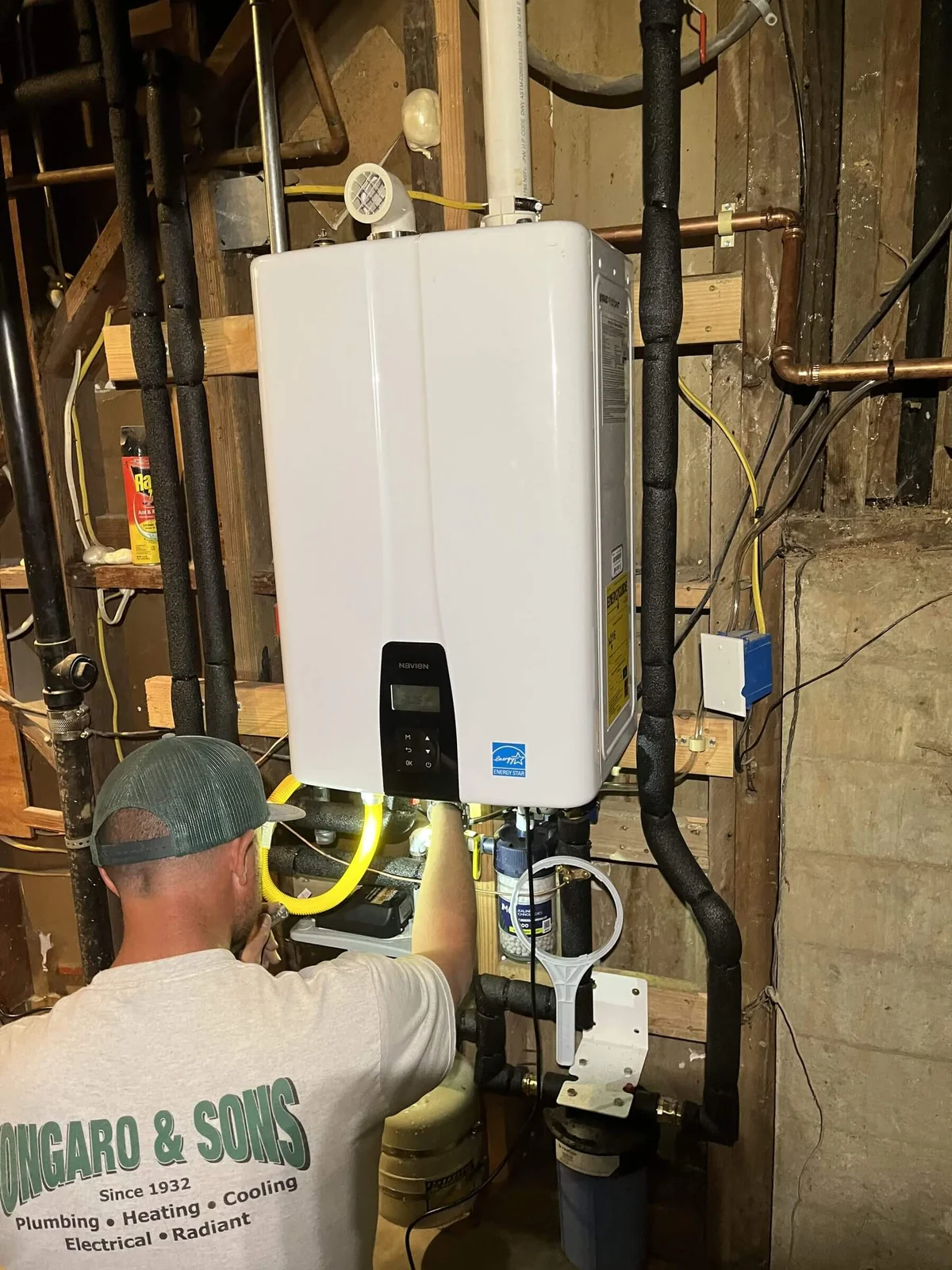
Crawlspace and underfloor installations work and we do them, with their own rules. The unit still has to be reachable for service, the vent still has to terminate correctly, and freeze protection on most tankless equipment is electric, so it runs only while the unit has power.
Geoffrey was very professional in assessing the plumbing issues and working through challenges to solve vexing issues with our tankless water heater and piping under our sink. I would highly recommend him.
Jon S.
Water, and what scale does
Rohnert Park does not draw its drinking water from one place. The city blends treated Russian River water delivered by Sonoma Water with supply from deep municipal groundwater wells across town, per the City of Rohnert Park's water production page. That blend shifts through the year with demand.
We do not publish a hardness figure, because the number is not the useful part. The mechanism is. A tank tolerates mineral content by letting it settle to the bottom as sediment. A tankless unit has no bottom. Water moves through a narrow heat exchanger at high temperature, dissolved minerals precipitate onto the hottest surfaces inside it, the passage narrows, and the burner works against an insulating layer. The unit then behaves like an undersized appliance even though its rating never changed.
That is why the six-year-old unit with the fading showers is rarely a failed unit. It has never been descaled. It is also why we fit service isolation valves on everything we install, and why the first thing we check on somebody else's work is whether those valves exist.
What a tankless water heater does in a power outage
Here is the part most tankless buyers in Sonoma County learn after the fact. A gas tankless water heater needs electricity: controls, ignition, the combustion fan, and freeze protection all run on line power. An old atmospheric tank with a standing pilot keeps making hot water with the power off. A tankless unit does not.
PG&E's Public Safety Power Shutoff program reaches areas around Rohnert Park, and PG&E describes it as turning off power during severe weather to help prevent wildfires. That does not make tankless the wrong choice. It does mean the outage question belongs in the buying decision.
Whole-house electric tankless is a short conversation in this housing stock. Heating water instantaneously with resistance elements takes an enormous amount of current, typically several large double-pole circuits at once, and the services we find in 1960s through 1980s houses here were never built for it. An electrical panel upgrade in Rohnert Park is a real option, but as a deliberate decision, not a surprise found mid-install.
Reading the symptoms before anyone opens a wall
Most complaints map to one of those four, and the pattern tells you which.
- Hot water fails only when a second fixture opens. Capacity or gas delivery. Note whether it happens year-round or only in winter, when incoming water is colder.
- Hot, then cold, then hot again. The cold water sandwich, from cooled water sitting in the pipe between draws. A layout issue more than a unit issue.
- Hot water stops when a tap is barely cracked open. Every tankless unit has a minimum activation flow rate. Below it the burner will not fire.
- Steadily weaker performance over years, sometimes with a rumble. Scale in the heat exchanger. This is the descaling call.
- Ignition or flame-loss codes. Gas pressure, a blocked vent, or a fouled burner. Vent terminations collect debris and occasionally attract nesting.
- Water at the base of the unit. Valve packing, a fitting, or the exchanger itself. Which of the three drives repair versus replacement.
- Short cycling. Often an oversized unit on a small draw, or a recirculation pump fighting the controls.
We work that list top down, because a descale and a burner cleaning resolve much of what gets called a dead unit.
Repair, replace, or step away from tankless
Repair is right when the heat exchanger is sound, parts are still supported, and the fault traces to scale, a sensor, a fan, an igniter, or a gas or vent condition outside the appliance.
Replacement wins when the exchanger is compromised, when parts availability is genuinely uncertain, or when the original install was wrong in a way service cannot fix. A unit on undersized gas or a bad vent will never perform, and paying to service it spends money on a problem outside the box.
Tankless is also not automatically right for every house here. A household with modest demand, a garage location with a working drain, and no appetite for gas and vent work is often better served by a straightforward tank, and a heat pump water heater is the option with real incentive support behind it. We lay out both paths on the water heater replacement side rather than steering you.
The Ongaro team handled a troublesome tankless heater in a rental unit with the prompt professionalism I've come to expect from them.
Miles M.
Permits, code, and inspection in Rohnert Park
Inside city limits, water heater work is permitted by the City of Rohnert Park Building Division. Properties in the unincorporated county nearby go through Permit Sonoma. The specifics that come up on our tankless jobs:
- The permit is online, and residential water heater replacements issue automatically. The city's online permit page states that for "a residential water heater replacement, you would have paid the balance and your permit has auto-issued." That removes any excuse for skipping it.
- Rohnert Park is seismic design category D. The city's Water Heater Installation handout says heaters in category "D" (Rohnert Park zone) "shall be anchored or strapped to resist horizontal displacement due to earthquake motion." Health and Safety Code section 19211 backs it for new, replacement, and existing residential water heaters. A wall-hung unit is secured to structure by design, and the mounting still has to be right.
- Attic and furred-space installations need a pan. The handout applies this to a water heater "(tanked or tankless)" where damage may result from a leak: a watertight corrosion-resistant pan, not less than 1 1/2 inches deep, with a minimum 3/4 inch drain to an approved location.
- Garage installations carry clearance and impact rules. Fuel-burning heaters need pilots, burners, or heating elements at least 18 inches above the floor, with an exception for sealed-combustion FVIR units. Most modern tankless equipment qualifies, and we confirm the listing rather than assume. Units in a garage or carport must also be guarded from vehicle damage by a barrier, elevation, or placement out of the normal path.
- Access is a requirement, not a courtesy. The handout requires heaters to be accessible for inspection, repair, or replacement. Tucking one somewhere unreachable is a code problem before it is a maintenance problem.
- Gas details. A sediment trap goes downstream of the appliance shutoff valve, as close to the inlet as practical, and a thermal expansion tank is fitted where the plumbing code calls for one.
- Title 24 applies to replacements. California's 2025 Building Energy Efficiency Standards took effect January 1, 2026, per the California Energy Commission. The heat pump prescriptive baseline in that cycle applies to new construction, not to swapping a unit in an existing house.
One rule is in motion. Rohnert Park sits fully inside the Bay Area Air Quality Management District, which adopted zero-NOx requirements for residential water heaters under Regulation 9, Rule 6. Nobody is banning your gas water heater, and nobody should sell you one on the claim that the rule is settled.
What sets the price
We do not publish figures, because a number without your house attached is not information. Here is what moves the total, roughly in order.
Gas is the biggest lever. A conversion needing a larger branch run from the meter across the house, or pulling PG&E in at the meter, is a materially different job from one where the existing line is already adequate. Distance and fitting count matter as much as pipe size.
Venting is second. A garage wall with a short direct penetration is the easy case. Relocating a heater out of an interior closet, or building a long vertical run through finished space, brings in framing, drywall, and finish work that has nothing to do with plumbing.
After that: whether a suitable condensate drain is within reach, whether you add recirculation and whether a return line already exists, whether the location needs a dedicated receptacle, removal of the old tank and capping the abandoned flue, the permit, and access. A crawlspace or attic job takes longer than a garage wall job for identical equipment.
You get the full scope in writing before we start. Financing is available when timing is difficult.
Rebates and incentives, current status
Accuracy matters more than enthusiasm here, because these programs move.
Gas tankless generally has no rebate behind it. Local incentive money targets heat pump water heaters, a different appliance and a different decision. If the rebate path is what you want, the conversation is about a heat pump unit.
Sonoma Clean Power is the community choice energy provider for Rohnert Park. SCP is paying a raised heat pump water heater rebate for a defined period, and once that window shuts the rebate continues only for customers enrolled in CARE or FERA. Income-qualified customers can receive a share of remaining project cost after other rebates. Details are on SCP's water heating page.
Keeping a tankless unit healthy
This equipment rewards maintenance more than a tank does, and punishes neglect faster.
An annual descaling flush is the core of it. With isolation valves fitted, that is straightforward: circulate a descaling solution through the exchanger, clear the mineral film off the hot surfaces, restore rated flow. Heavy use or a harder supply can justify a shorter interval, and we base that on what we find inside your unit.
Around that: clean the inlet screen, check vent terminations, inspect the burner and check combustion, replace neutralizer media on condensing models, verify gas pressure under load rather than at rest, and pull the error history, which often shows a developing fault months before anyone notices. Our maintenance program puts that on a schedule.
Where we work in Rohnert Park
We cover the whole city. The sections built earliest hold the most original-era infrastructure still in service: garage-mounted tanks, half-inch gas branches, and panels asked to do more than they were designed for. Newer construction on the east side and the blocks around Sonoma State present differently, often with tight equipment closets and units installed correctly but never serviced.
Rental and investor-owned property is a real part of the mix here, with a specific pattern: nobody descales a heater in a unit they do not live in, so we see equipment that is mechanically fine and performing badly. That is usually good news, because it is a service call rather than a replacement.
Inland Rohnert Park runs hot through the summer, which does not affect water heating much on its own. It does mean the garage holding your heater often holds a condenser, a furnace, and a panel on the same clock. We will tell you what else we see, and we will not sell you something you did not ask about.
What North Bay homeowners say
Two tankless jobs in our own customers' words.
How to choose a contractor for this work
Three questions separate the contractors who get this right from the ones who do not.
Ask what gas load calculation they ran and what it showed. A specific answer referencing your meter, your run length, and your other appliances means they looked. A shrug means they will install the unit and hope.
Ask what happens to the existing flue. If the answer is that they will reuse it for a condensing appliance, stop there.
Ask whether isolation valves and the permit are in the price. Both should be yes without hesitation.
Related Ongaro & Sons services
More for this city and county: Plumbing in Rohnert Park, Water Heater in Rohnert Park, Electrical Panel Upgrade in Rohnert Park, every service we run in Rohnert Park, and plumbing across Sonoma County. Nearby tankless pages: Petaluma and Santa Rosa.
Book a tankless water heater visit in Rohnert Park
Book online and we will send a licensed plumber to look at your system, run the four checks, and put the options in writing. If your existing unit needs a flush rather than a replacement, that is what we will tell you, and that is what we will do.
Your Comfort, Our Priority
Ongaro & Sons is your trusted heating, cooling, plumbing, electrical, and solar expert, specializing in reliable maintenance and repair services that keep your home running efficiently year-round.
Our certified technicians deliver unmatched expertise with fast, friendly service across Marin, Sonoma and Napa County. From HVAC tune-ups to plumbing repairs and electrical upgrades or solar solutions, we focus on energy-efficient performance and long-term comfort. Count on us to maintain the systems that power your home and keep your environment just the way you like it.
Licensed, Insured, Background-Checked
Our technicians are licensed, experienced, and trained to service all makes and models.
Locally Owned and Operated
Serving the Napa, Marin, and Sonoma communities with personalized, hometown service.
Reliable Repairs
We respond quickly and get the job done right the first time, with no surprises.
Since 1932
Why Ongaro & Sons?
Four generations of trusted home service. Open any reason to see what it means for your home.
Schedule Service →Family-owned in the North Bay since 1932
Four generations of the Ongaro family serving Marin, Sonoma and Napa County. We know these homes and the systems in them.
Licensed, insured, background-checked technicians
Every technician is fully licensed and insured, background-checked, and trained on the equipment we install.
Diamond Certified and BBB A+
Diamond Certified since October 2016, and BBB Accredited with an A+ rating since December 1995.
Mitsubishi Diamond Contractor Elite and Trane Comfort Specialist
Both top manufacturer tiers. That standing decides how registration and extended warranty terms are handled on the system you actually bought.
The price is agreed before work starts
You see the number before the work begins. Flat-rate quotes, no surprises and no pressure.
Comprehensive maintenance program
Members get priority scheduling, discounts, and proactive checkups that prevent costly failures.

Discount
Membership
Ongaro Maintenance Plans
Annual maintenance on your home systems provides safeguards and comfort to you and your family. Members get priority scheduling, discounts, and proactive checkups that catch problems early.
Member Discounts
5% off every repair and replacement, all year long.
Peace of Mind
Proactive checkups catch issues before they become big problems.
Courtesy Reminders
We call you to schedule: never miss a seasonal service.
Value That Lasts
With Ongaro & Sons, you’re investing in quality, integrity, and service that stands the test of time. Explore our current promotions and see the difference real value makes for your HVAC, plumbing, and electrical needs.


From the Blog
 Sep 17, 2026
How Many Amps Does My House Need? Sizing Service for What You Actually Run
How many amps your house needs comes from a load calculation of what you run and plan to add. What drives the number, when existing service is enough, and more.
Read More Sep 10, 2026
Hard Water in Marin County: What Is Actually in Your Water and What It Does
Hard water in Marin County varies by provider and source. The 2025 report figures for Marin Water and NMWD, what hardness does and does not mean, and options.
Read More Sep 3, 2026
Electrical Permit Requirements in California: What Needs One and What Does Not
Find out which electrical projects commonly need permits, how to confirm local exemptions, and what to ask before work begins in Marin, Sonoma or Napa County.
Read MoreFrequently asked questions
Who is the best tankless water heater installer in Rohnert Park?
Judge it on what a contractor checks before quoting. Ongaro & Sons has served the North Bay since 1932, holds a C-36 plumbing license, is Diamond Certified, and carries 2,756 Google reviews at a 4.8 average. We calculate gas capacity, evaluate the vent path, and pull the city permit on every job.
Do I need a permit to install a tankless water heater in Rohnert Park?
Yes. Heater work inside city limits requires a permit from the Rohnert Park Building Division, and the city issues residential water heater replacement permits through its portal with automatic issuance once fees are paid. Properties outside city limits go through Permit Sonoma. Skipping the permit creates a disclosure problem for you at resale.
Will my existing gas line work with a tankless water heater?
Often not, in houses of this era. The branch that fed a garage tank was sized for a much smaller firing rate than a whole-house tankless unit needs at ignition. Whether yours works depends on pipe size, distance from the meter, fittings in the run, other appliances sharing the system, and delivery pressure.
Can the vent from my old tank water heater be reused?
No. The metal flue on an atmospheric tank moves exhaust by natural buoyancy. A condensing tankless appliance is fan-assisted and sealed, requiring its own listed vent material, its own outside air intake, and a run within the manufacturer's length and elbow limits. Reused flues are among the defects we find most frequently on other companies' installs.
Is a tankless water heater a good choice given Rohnert Park's water?
It works, with maintenance built into the plan. The city blends surface supply with groundwater from municipal wells, and mineral content in that water deposits on the hot surfaces inside a tankless exchanger over time. Annual flushing keeps performance where it started. Skipping it is the leading reason these units disappoint.
How often should a tankless water heater be descaled?
Once a year suits most households here. Heavy hot water use or a harder supply can justify a shorter interval, and we base that recommendation on what we find inside your specific unit rather than a generic schedule. The service runs about an hour when isolation valves are present, and considerably longer without them.
Will a tankless water heater run during a power outage?
No. Its controls, ignition, combustion fan, and freeze protection all draw line power, so the appliance stops when electricity does. In an area exposed to PG&E's Public Safety Power Shutoff program, that matters. Households wanting uninterrupted hot water usually pair the heater with a standby generator or a battery system.
Are there rebates for a tankless water heater in Rohnert Park?
Not for the gas kind. Local incentive money is pointed at heat pump water heaters, which is a different appliance and a different project. Sonoma Clean Power has its heat pump water heater rebate temporarily raised, and once that window shuts it applies only to households on the CARE or FERA bill discounts. If a bid for a gas tankless unit shows a rebate line, ask which program it names, because the answer is usually that somebody copied it from a heat pump quote.
Does the Bay Area air district rule mean I cannot buy a gas water heater?
No. Regulation 9, Rule 6 sets zero-NOx requirements for residential water heaters with compliance starting in 2027 and effective dates that differ by size. We verify what applies to your unit size when your scope is written. Nothing in the rule reaches an appliance already installed and working in your house.
Why do I still wait so long for hot water with a tankless unit?
Because it removes storage, not distance. Water sitting in the pipe between the heater and a distant fixture still has to be pushed out before hot water arrives, and in a spread-out single-story house that is a long run. Recirculation, either with a dedicated return line or a crossover valve at the far fixture, is what actually addresses it.
Can a tankless water heater be installed in a crawlspace or attic?
Yes, with conditions. It must remain reachable for service, the vent has to terminate properly within its listed length, and condensate needs a route to an approved drain. Rohnert Park's building handout requires a watertight pan with a drain under a water heater, tanked or tankless, in an attic or furred space. Underfloor units also depend on powered freeze protection.