Sewer Repair in Napa, CA
Ongaro & Sons, a plumbing company since its 1932 founding, repairs sewer lines in Marin, Sonoma and Napa counties. We are Diamond Certified. Our plumbing license is a C-36, and 2,756 Google reviews average 4.8 stars. We camera the line before we quote it, we pull the permit, and we tell you which part of the line is yours before you spend anything on it.
On this page
Spot repair or full replacement: the decision that prices the job
Most sewer calls start with a symptom: a bathtub filled with water that came from somewhere else, or because whoever cleared the last blockage said the pipe itself has a problem. Underneath it sits one narrow question: fix a defect, or replace the run.
Getting it wrong costs money in both directions. Replace a line that had one cracked joint and you paid to lose a driveway for nothing. Spot-repair a line that has failed end to end and you are back in the same trench within a year, buying the same concrete work twice. The question has a real answer, and it comes from four pieces of information, all knowable before anyone breaks ground.
Whose pipe is it, and why that is a Napa question
Inside the city, wastewater belongs to Napa Sanitation District, not to the City of Napa. Drinking water is a separate city utility running three treatment plants on three unrelated sources. The agency with authority over your sewer lateral is not the one that sends your water bill, and homeowners lose weeks to that distinction.
NapaSan then splits the lateral itself in two. The district's guidance is direct: "It is the property owner's responsibility to maintain and repair the upper sewer lateral from the house to the property line cleanout," while NapaSan maintains the public mains and the lower laterals (NapaSan, Who is responsible for sewer repairs?). That cleanout is the dividing point. Everything from it back toward the house is yours to diagnose and pay for.
Two consequences follow. No quote should be written until somebody confirms which side of the cleanout the defect sits on, because a blockage in the lower lateral is not a homeowner expense. And a house with no cleanout at the property line has a compounding problem: no clean access for a camera, and no marker for where responsibility ends. Installing one is often part of the job.
What fails under Napa houses
Laterals fail by material and by era, and the mix here is wide because the housing is. Downtown and the older blocks around it hold Victorian and early-twentieth-century homes, often re-plumbed inside more than once while the buried line stayed exactly where the original builder put it. South and east Napa run newer subdivisions, newer materials, shorter runs.
On the older streets we routinely find vitrified clay in short jointed sections. Clay is chemically durable and sits in the ground for generations, but every joint is a seam, and roots find seams. A few hairs through a mortar joint become a root mass that works like a strainer. Cast iron of the same era fails from the inside out: scale builds on the wall, the diameter shrinks, and flow channels along the bottom of a pipe that has lost its top. We also still pull out mid-century bituminized fiber conduit, which does not crack so much as go oval and then flatten.
Newer plastic fails differently and usually for a reason: a joint never fully seated, backfill never properly compacted, or a run laid across ground that settled under it. Long dry summers and wet winters cycle the soil here, and a pipe bedded in loose spoil rides that movement until it sags. A sag holds standing water and solids permanently, and cleaning cannot help it.
Exceptional! Abel went above and beyond to expedite the repair of our sewer line. Very impressed with the customer service and expertise. Highly recommend.
Parveen B.
The symptoms, and what each one is telling you
One slow sink is a fixture problem. A lateral problem announces itself differently, and the pattern matters more than the severity:
- Several fixtures slowing together, the lowest ones first. Water backs up at the lowest opening it can find, so a ground-floor shower or garage floor drain gives way before anything upstairs.
- A toilet that gurgles when the washing machine drains. Air is being pushed past a partial obstruction downstream, often the earliest signal you get.
- Blockages that return on a schedule. Roots regrow. A line that clears easily and closes again every few months has a physical cause a camera can locate.
- The cable stopping at the same footage twice. That distance is the defect.
- A soft or unusually green patch along the path of the line, or a sinkhole forming over it.
- Sewer odor in a crawlspace or beside the house with no fixture cause indoors.
None of that tells you which repair you need. It tells you the line has to be seen: a camera run, ideally after jetting so the lens reads pipe wall rather than debris, with a locator marking depth and position from the surface.
The four-answer rule
Every sewer decision we make in Napa reduces to four answers. Get all four and the method chooses itself.
1. Whose pipe is it? Upper or lower lateral, measured against the property line cleanout. 2. One defect, or the whole run? An offset joint at eighteen feet is a different job from root intrusion at every joint for sixty. 3. Does the line still hold its fall? A pipe can be defective and correctly graded. It can also be intact and useless because it sags. 4. What sits on top of it? Lawn, mature garden, pavers, driveway, sidewalk, or City street. That changes nothing about the pipe and almost everything else.
Those answers map onto four ways of solving it.
| Option | What it involves | When it makes sense | What it will not fix |
|---|---|---|---|
| Spot repair | One excavation at a located defect, a few feet of pipe replaced | A single break, crushed section or offset joint in an otherwise sound line | Anything systemic. A patch on a failing run buys time, not a solution |
| Cured-in-place lining | A resin-saturated liner drawn into the pipe and cured, forming a new wall inside the old one | Root intrusion at joints and general wear where the host pipe is still round and correctly sloped | Collapse, severe offsets, deformed fiber conduit, any sag. Lining reproduces the shape it finds |
| Pipe bursting | A head pulled between two access pits, fragmenting the old pipe outward while drawing new pipe in behind | Full-length replacement where the surface above is worth protecting and the alignment is acceptable | Grade. The new line follows the old path, so a sag stays a sag |
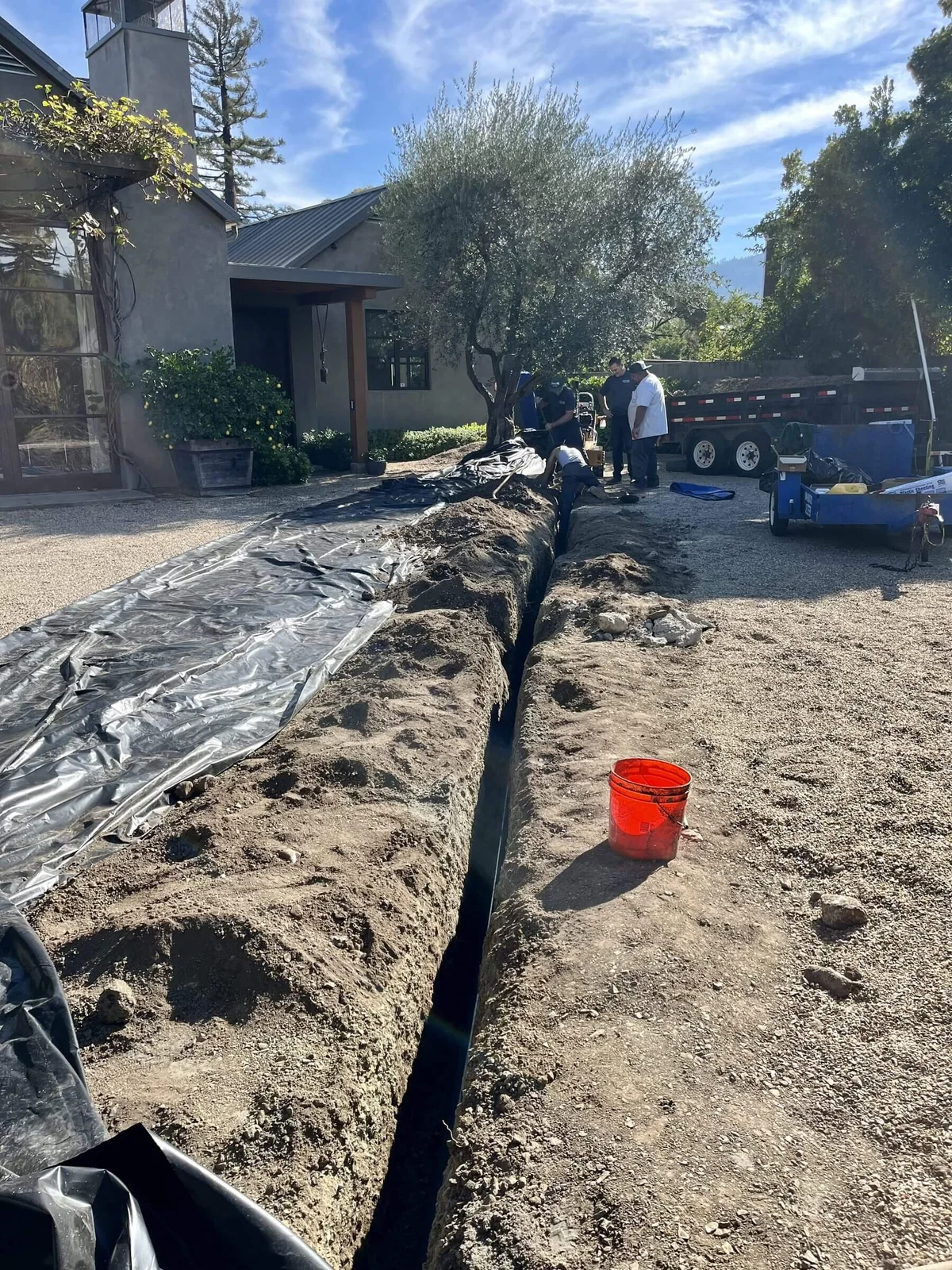
| Open-trench replacement | The run excavated and re-laid on new bedding, to new grade | Corrected fall, changed alignment, added cleanouts, or a line too far gone to host anything | Nothing, which is why it stays the answer when the others are ruled out |
Grade is usually what decides it
Homeowners generally arrive wanting trenchless, and it is often right. The factor that overrules that preference more than any other is fall.
A lateral works on gravity alone. It needs consistent slope from the house to the main, enough to carry solids, not so much that liquid outruns them. Both trenchless methods reproduce the path the pipe already takes, and neither re-grades anything. So when the camera shows water standing in a section, and the locator confirms the pipe dips there rather than the water backing up from downstream, no trenchless method resolves it. Line that section and you own a smoother, more permanent sag.
That is why we camera after clearing rather than before, and why a sag deserves attention even while the line still drains: a pipe that holds water builds deposits at the low point year after year, and the interval between blockages shortens.
Two other disqualifiers come up regularly. A collapse, a badly separated joint or flattened fiber conduit leaves nothing sound to line to. And access: bursting needs pits at both ends, so on a narrow downtown lot, pit placement can cost more surface than a well-planned trench.
Permits, inspection, and the public right of way
Lateral work in the city is permitted by the sanitation district rather than the building counter, which surprises anyone who has pulled a water heater permit before. NapaSan states that "A permit is required from NapaSan prior to installation or modification of on-site sewer laterals," that "Private lateral repairs or replacements are subject to inspection by NapaSan," and that "In some cases, permits to repair or replace private laterals on properties may be obtained over-the-counter at NapaSan's Administrative Office" (NapaSan, Permits & Connection Information). Cleaning an existing line through an existing cleanout is maintenance, not modification.
Work that enters the public right of way carries a second permit. The City of Napa requires an encroachment permit under the Napa Municipal Code for right of way work, covering travel lanes, parking lanes, City sidewalks and other areas carrying a right of way designation (City of Napa, Encroachment Permit). Anything that disrupts normal traffic patterns needs a traffic control plan filed with it, and the City sets its own standards for cutting, backfilling, patching and permanently repaving a trench in a paved street.
Addresses outside the city limits follow a different path through Napa County Planning, Building and Environmental Services, and a property outside the sewer service area is on a private onsite system rather than a lateral. We settle that question first across plumbing in Napa County.
One code point belongs in the conversation while the ground is open. Any fixture below the elevation of the next upstream manhole cover is exposed if the main surcharges during a heavy storm. A backwater valve protects it, and fitting one during planned work is far simpler than after a flooded floor. We confirm what an address requires with the district at permit time.
Justin was pleasant, courteous, and professional. He did a great job and we are very pleased. All expectations were exceeded. Thank you!
Judson S.
What drives the cost
We do not publish prices for buried work, because a figure quoted without seeing the site is a guess dressed up as an estimate. What actually moves it:
- Length and depth of the run. Depth matters more than length past a point, since deeper trenches need shoring and slower excavation.
- What is on the surface. Lawn is the cheapest thing to trench through. Established landscaping, pavers, stamped concrete, a driveway apron and a City sidewalk climb from there, and restoration is frequently the larger half of an invoice.
- Access for equipment. A south Napa lot with a driveway to work from is a different job from a downtown lot where material is carried in and spoil has to be staged.
- Pipe material and condition, which decides whether the low-restoration methods are available at all, the biggest single branch in an estimate.
- Whether a cleanout has to be added, and whether the existing one is reachable or paved over.
- Right of way involvement. Encroachment permitting, traffic control and paving to City standard are real scope, and they are why a repair that stops at the property line is usually cheaper.
- One defect or the whole run, answered by the camera rather than the phone call.
We quote from what the camera shows, with the options priced against each other so the tradeoff between surface disruption and pipe life is visible. Where full replacement is the answer, financing keeps the decision from being forced by timing.
Rebates and incentives: what exists
This section is short for a reason worth stating plainly. Incentive money in California is written around energy: appliances, insulation, electrification, storage.
That is useful rather than disappointing. There is no incentive to wait for and no program deadline shaping the timing, which means the only sensible schedule is the one the pipe dictates. If a bidder tells you a rebate offsets sewer work, ask them to name and link the program.
After the repair, keeping the line clear
A correctly replaced lateral should outlast most of what is attached to it. What shortens that life is usually avoidable:
- Keep the cleanout reachable and marked. Cleanouts get buried under mulch, planted over and paved into patios constantly, and the next person who needs it will need it fast.
- Jet rather than cable where the pipe can take it. A cable cuts a hole through an obstruction. Jetting scours the wall, which resets the interval between blockages.
- Manage roots if large trees sit on the path. Roots are looking for water and return to the same seams unless the seams are gone.
- Keep grease and wipes out. Wipes labeled flushable clear the toilet and stop at the first imperfection in the line. Cooking fat leaves the house as a liquid and does not stay one.
- Keep storm water out of the sanitary sewer. Downspouts and area drains routed into a lateral load the system in a wet winter, part of what makes mains surcharge.
The branch lines feeding the lateral belong on the same schedule: drain cleaning in Napa covers those, and our maintenance program keeps the system on a cadence.
Where we work in Napa
Downtown and the blocks around it hold the oldest housing, the longest and most varied buried runs, mature street trees over many of them, and the tightest lots to work from. Alta Heights sits up the slope east of downtown, where laterals run longer and steeper to reach the main and both grade and access get more interesting. Browns Valley on the west side and the newer tracts through south and east Napa generally have shorter runs with usable driveway access, which changes the cost math substantially.
The hills around the city are also where PG&E's Public Safety Power Shutoff program is most likely to be felt. That touches plumbing in one specific way: a below-grade fixture served by an ejector or grinder pump stops when the power does. If that describes your house, it belongs in a backup power conversation. Our broader plumbing in Napa work covers the rest.
How to choose a contractor for sewer work
Sewer work is easy to sell badly, because the customer cannot see the product. Five questions separate the two kinds of company:
1. Will you camera the line before quoting, and will you give me the video? The footage is yours. A recommendation to replace a full run with no recording behind it is not a diagnosis. 2. Which side of the property line cleanout is the defect on? A company that does not raise that distinction before quoting has not checked. 3. Who pulls the permit, and which agency issues it? For a city address that names the sanitation district, and names the City separately if the work reaches the right of way. 4. What does restoration include? Get it in writing: backfill and compaction, concrete or asphalt replacement, and what the finished surface will look like. 5. What license class covers this? Laterals are C-36 plumbing work. Ask, and confirm.
We have answered those questions since 1932, today from our Petaluma headquarters, and we carry a BBB A+ Rating.
What North Bay homeowners say
These come from Napa County customers on jobs across our trades.
Sewer work across Napa and Napa County
For the rest of the same system: plumbing in Napa, drain cleaning in Napa, and water heater service in Napa. Elsewhere in the valley, see plumbing across Napa County. For all trades at your address, start at Napa home services or our main plumbing page.
Book sewer repair in Napa
Book online and we will schedule a camera inspection, locate and mark the defect, tell you which side of the property line cleanout it sits on, and walk the options through with the footage in front of you. Nothing gets excavated on a guess.
Your Comfort, Our Priority
Ongaro & Sons is your trusted heating, cooling, plumbing, electrical, and solar expert, specializing in reliable maintenance and repair services that keep your home running efficiently year-round.
Our certified technicians deliver unmatched expertise with fast, friendly service across Marin, Sonoma and Napa County. From HVAC tune-ups to plumbing repairs and electrical upgrades or solar solutions, we focus on energy-efficient performance and long-term comfort. Count on us to maintain the systems that power your home and keep your environment just the way you like it.
Licensed, Insured, Background-Checked
Our technicians are licensed, experienced, and trained to service all makes and models.
Locally Owned and Operated
Serving the Napa, Marin, and Sonoma communities with personalized, hometown service.
Reliable Repairs
We respond quickly and get the job done right the first time, with no surprises.
Since 1932
Why Ongaro & Sons?
Four generations of trusted home service. Open any reason to see what it means for your home.
Schedule Service →Family-owned in the North Bay since 1932
Four generations of the Ongaro family serving Marin, Sonoma and Napa County. We know these homes and the systems in them.
Licensed, insured, background-checked technicians
Every technician is fully licensed and insured, background-checked, and trained on the equipment we install.
Diamond Certified and BBB A+
Diamond Certified since October 2016, and BBB Accredited with an A+ rating since December 1995.
Mitsubishi Diamond Contractor Elite and Trane Comfort Specialist
Both top manufacturer tiers. That standing decides how registration and extended warranty terms are handled on the system you actually bought.
The price is agreed before work starts
You see the number before the work begins. Flat-rate quotes, no surprises and no pressure.
Comprehensive maintenance program
Members get priority scheduling, discounts, and proactive checkups that prevent costly failures.

Discount
Membership
Ongaro Maintenance Plans
Annual maintenance on your home systems provides safeguards and comfort to you and your family. Members get priority scheduling, discounts, and proactive checkups that catch problems early.
Member Discounts
5% off every repair and replacement, all year long.
Peace of Mind
Proactive checkups catch issues before they become big problems.
Courtesy Reminders
We call you to schedule: never miss a seasonal service.
Value That Lasts
With Ongaro & Sons, you’re investing in quality, integrity, and service that stands the test of time. Explore our current promotions and see the difference real value makes for your HVAC, plumbing, and electrical needs.


From the Blog
 Sep 17, 2026
How Many Amps Does My House Need? Sizing Service for What You Actually Run
How many amps your house needs comes from a load calculation of what you run and plan to add. What drives the number, when existing service is enough, and more.
Read More Sep 10, 2026
Hard Water in Marin County: What Is Actually in Your Water and What It Does
Hard water in Marin County varies by provider and source. The 2025 report figures for Marin Water and NMWD, what hardness does and does not mean, and options.
Read More Sep 3, 2026
Electrical Permit Requirements in California: What Needs One and What Does Not
Find out which electrical projects commonly need permits, how to confirm local exemptions, and what to ask before work begins in Marin, Sonoma or Napa County.
Read MoreFrequently asked questions
Who is the best sewer repair company in Napa?
Judge it on diagnosis rather than advertising. Ongaro & Sons, founded in 1932, works in Marin, Sonoma and Napa counties, holds Diamond Certified status and a C-36 plumbing license, and carries 2,756 Google reviews averaging 4.8 stars. We inspect with a camera and locator before quoting, hand over the footage, and identify whether the defect is even on your side of the line.
Do I have a sewer problem or just a clogged drain?
Location and pattern are the tell. One fixture backing up while everything else drains normally is a branch line problem. Several fixtures failing together, lowest ones first, points at the main lateral. A toilet that gurgles when another appliance drains, or blockages arriving on a rhythm, both suggest something structural.
Who is responsible for the sewer line at my Napa house?
Napa Sanitation District assigns the upper lateral, running from the house to the property line cleanout, to the property owner, and maintains the lower lateral and the public mains itself. The answer therefore depends on where along the run the trouble sits. Locating the defect precisely, before agreeing to any work, can change who pays for it.
Do I need a permit to repair a sewer lateral in Napa?
Yes. NapaSan requires a permit before installation or modification of an on-site sewer lateral, and repairs and replacements are subject to district inspection. In some cases those permits are available over the counter at the district's administrative office. If the work also enters a City street or sidewalk, a separate City of Napa encroachment permit applies. We handle both filings.
Can a sewer line be replaced without digging up the yard?
Often, though not always. Lining and pipe bursting both work from small access pits instead of a continuous trench, which protects driveways, patios and mature planting. Both need the existing line to be a workable host: correct slope, no collapse, no flattened sections, and room at each end for a pit. The camera inspection settles that before anything is promised.
Why can trenchless repair not fix a sagging line?
Because neither method changes where the pipe sits. Lining builds a new wall inside the pipe you already have, and bursting draws replacement pipe along the same path the old one occupied. A section that has settled into a low spot is part of that path, so it survives the repair. Correcting fall means excavating and re-bedding the pipe at proper slope.
How long does a sewer lateral replacement take?
The excavation and pipe work on a typical residential run is measured in days rather than weeks, with trenchless methods often finishing faster than full open-cut. Permitting, inspection scheduling and surface restoration set the real timeline, and right of way work adds traffic control obligations. We give you a schedule with the quote.
What makes sewer lines fail here in particular?
Material and ground movement, mostly. The older parts of town run clay and cast iron, both of which decline predictably with age and both of which sit under streets with mature trees whose roots exploit every joint. Newer neighborhoods fail less often, usually from settlement in poorly compacted backfill as dry summers and wet winters work the soil.
Will my homeowners insurance pay for it?
Frequently not under a standard policy, since gradual deterioration of a buried line is commonly excluded. Some carriers sell a service line endorsement that responds to underground utility failures, sewer included. Coverage language differs enough between insurers that the only reliable step is reading your own policy or calling your agent, ideally before work starts rather than after.
What is a sewer camera inspection and is it worth it?
A push or self-propelled camera travels the line while a transmitter lets the technician mark the pipe's position and depth from the surface above. You see material, joint condition, root entry points, cracks, offsets and standing water. It converts guesswork into a located, measured defect, and it is the only sensible basis for choosing between a patch and a replacement.
Should I camera the line before buying a Napa home?
Yes, particularly on an older property. A standard home inspection does not include the buried lateral, so a failing line is among the more expensive surprises after closing. The inspection takes under an hour, and the recording gives you either confidence that it was done right or a documented item to raise while you still have leverage.
Do you work outside the city limits?
We do. Unincorporated Napa County addresses permit through Napa County Planning, Building and Environmental Services rather than the district's city process, and properties beyond the sewer service area are on private onsite systems, a different scope entirely. We establish which category an address falls into before quoting.
Can roots be cleared without replacing the pipe?
Temporarily, yes. Cutting and jetting removes what is currently there and restores flow, which is the right immediate move. It does not close the openings the roots came through, so they return, usually faster each time. Sealing those entry points means lining the pipe or replacing it. Repeat clearings on a shortening interval say the pipe is now the problem.