EV Charger Installation in Napa, CA
Ongaro & Sons has been family-run since 1932, we install EV chargers in Napa on a C-10 electrical license, we are Diamond Certified, and we carry 2,756 Google reviews averaging 4.8 stars. If you are working out who the best EV charger installer in Napa is, ask a narrower question: who runs the load calculation before quoting, who prepares the stamped plan set the city asks for, and who pulls the permit. We do all three, and we hold a BBB A+ Rating.
On this page
The decision in front of you
Most homeowners arrive thinking the decision is which charger to buy. It is not. Nearly every Level Two unit sold in the United States does the same thing at the same speed on the same circuit, and the remaining differences (app quality, cable length, warranty) are small next to the one that matters: how much power you bring to the car, and whether your house can carry it without a service upgrade. That gets answered with a load calculation, not a product comparison.
Napa sharpens it in a way the coast does not. Summers run hot here, well above anything on the Marin shoreline and only a step behind up-valley, so air conditioning pulls hard through the late afternoon. PG&E's vehicle rate plans put peak in those same hours, so a charger that starts the moment you plug in stacks the car on top of the compressor on a service already working.

Load before level
Work these in order. Jumping to equipment first is what produces quotes that fall apart at permit.
Service capacity. What does your service have left once the house is accounted for? A calculation, not a guess based on the age of the panel.
The route. Where is the panel, where does the car park, and what does the conductor cross between them? An open garage ceiling on a shared wall is one job. A detached garage down a long driveway is another.
Daily miles. How much charge do you need to replace between arriving home and leaving again? For many drivers the answer sits well below the largest circuit they were about to buy.
The ten-year plan. Is anything else electric coming? A heat pump, a heat pump water heater, a second vehicle, a battery? Scope the panel work once for all of it instead of twice.
The rule governing all four: load before level. Establish what the house can carry, decide how fast to charge, then pick the box on the wall.
The options, in the city's own vocabulary
The City of Napa's expedited permitting packet for electric vehicle charging stations asks applicants to check which system type is proposed, from a fixed list. That list frames the choice, because it is your plan reviewer's vocabulary.
| System type, as the city lists it | Circuit | Who it suits | What it asks of the house |
|---|---|---|---|
| Level One | 110/120 volt at 15 or 20 amps | Plug-in hybrids and short commutes | Often no new circuit, and slowest by a wide margin |
| Level Two, low | 3.3 kW, 208/240 VAC at 20 or 30 amps | A car that sits most days | Modest, and fits where a bigger circuit will not |
| Level Two, medium | 6.6 kW, 208/240 VAC at 40 amps | One vehicle on an ordinary commute | The common middle ground on a modern service |
| Level Two, high | 9.6 kW, 208/240 VAC at 50 amps | A large battery needing a full overnight refill | About three times the 3.3 kW draw, so real headroom |
| Level Two, highest | 19.2 kW, 208/240 VAC at 100 amps | Rare in a single-family house | Exceeds the whole service on a home still running an older 100-amp panel |
| DC fast charging | 440 or 480 VAC | Commercial sites and fleets | Not a residential retrofit |
Most Napa households land on the 40-amp or 50-amp line. Run the checks first and a fair number discover they belong on the 30-amp line, which costs less and still refills them overnight.
Professional, punctual and really knowledgeable. Would highly recommend to our friends and family
Paige G.
The load calculation usually decides it
Service capacity settles more Napa jobs than the other three questions combined, and the city writes the requirement into its checklist plainly. The packet requires that "An electrical load calculation per CEC 220 is included with the permit application," that plans "identify size of main service panel and service entrance conductors," and that "The EVCS branch circuit conductor is sized for a continuous load of 125% of the EVCS equipment plus any other non-continuous loads per CEC 210.9."
That 125 percent factor surprises people. Vehicle charging is a continuous load, meaning it can sit at full draw for hours without pause, so conductors and breakers are sized above the nameplate figure rather than to it. A 40-amp charger is not a 40-amp problem. It is a 50-amp circuit.
When the numbers come up short there are two roads, and plenty of contractors offer only one. The first is a service or panel upgrade, correct when the service is genuinely at its limit or the panel is obsolete, damaged, or out of space for a two-pole breaker. Our electrical panel upgrade work in Napa covers that scope, including the PG&E coordination that comes with touching the service entrance or meter.
The second is load management. Equipment that watches whole-house draw and pauses or reduces charging when the rest of the home pulls hard changes what the calculation must accommodate, because the car is no longer an unrestricted addition. For a downtown house with a small service, that is often the difference between a workable project and a dead one. A contractor who never raises it is quoting one option as the only one.
What tends to fail, and what it looks like
Charging is hard on connections because it runs near its ceiling for hours, night after night, through Napa's hot garage season. Heat plus time finds weak terminations. Signals worth acting on:
- The car is still not full in the morning on a 120-volt cord, and never quite catches up across a week.
- The breaker trips on hot afternoons, typically while the air conditioner is also cycling.
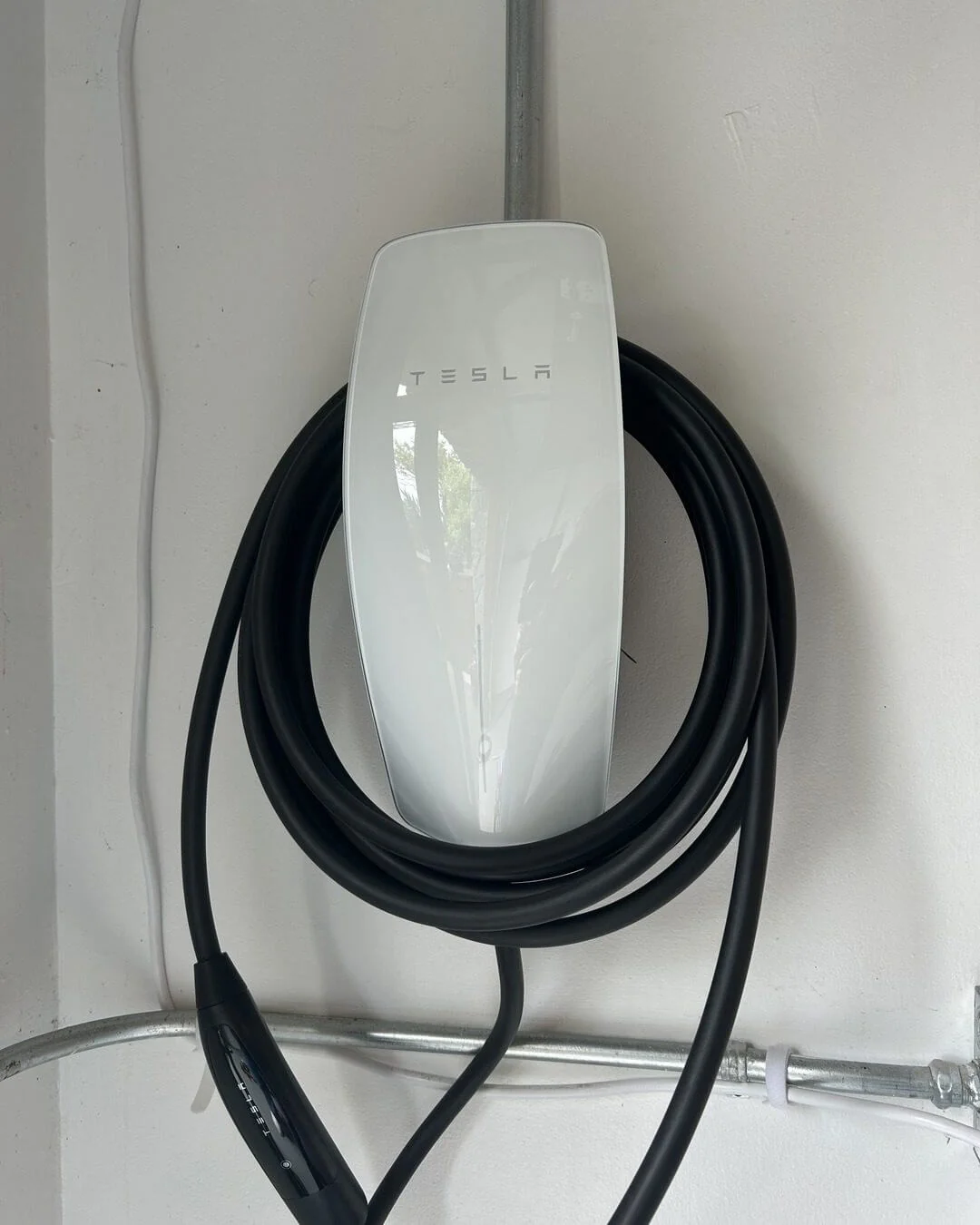
- A NEMA 14-50 receptacle runs warm, or shows browning at the blades. A plug-and-socket joint in a continuous-load path is the most common failure point in residential charging, which is why permanent installations are usually better hardwired.
- The vehicle quietly reduces its own charge rate. Cars derate on a detected fault, a voltage problem, or excess heat, so one that no longer draws full rate is reporting something.
- An outdoor unit trips its ground fault protection after wet weather, pointing at the wiring method, the entry seal, or the enclosure gasket rather than the charger.

Permits and code inside the city of Napa
A home charger needs a permit. California removed the discretion, not the permit. Under Government Code section 65850.7, every city and county "shall... adopt an ordinance... that creates an expedited, streamlined permitting process for electric vehicle charging stations," and shall "administratively approve an application... through the issuance of a building permit or similar nondiscretionary permit." Review is ministerial. The clock sits in the companion section, 65850.71, rather than in 65850.7. For applications covering one to twenty-five stations, the statute deems them complete five business days after submission and approved twenty business days later, unless the building official has acted, denied it, made adverse-impact findings, or an appeal is pending.
Napa has gone past that statutory floor. Its packet states that "an expedited plan review will occur within 48 hours of receipt," and that inside the same window an applicant receives "either a plan review comment letter, or a notification that your EVCS project has been approved and ready for building permit issuance."
Submittal is by email, not through a portal. The packet directs the application, checklist, and plans to the Building Division's permit technicians by email, and the Building Division page states that the city does not have an online portal for submittals.
The plan set has a named preparer. The electrical requirements state that "Electrical Plans should be completed, stamped, and signed by a California Licensed Electrical Engineer or a C-10 Electrical Contractor," and the checklist carries a signature line for that person's license number and type. We hold the C-10, so the drawings come from us.
Some burden drops for a normal garage install. A site plan is not required if the station sits within a residential structure, garage, or carport, and a single line diagram is not required for a Level One system. The load calculation, manufacturer's details, and panel and service entrance information are still required every time.
One caution on editions. The packet references the 2019 California Electrical Code, including Section 625 covering charging stations. California republishes Title 24 on a three-year cycle, and the 2025 Building Energy Efficiency Standards took effect January 1, 2026. Whichever edition is in force the day your permit issues governs the work, so we confirm the adopted version before drawing anything. Outside city limits, permitting runs through Napa County Planning, Building and Environmental Services instead, and the state mandate binds the county the same way.
What drives the cost
No two Napa driveways price alike, and any number quoted before someone has opened your panel and walked the route is a guess. What moves it:
- Length and difficulty of the run. A charger sharing a wall with the panel is the cheapest version of this work. A finished ceiling, a crawlspace, exterior stucco, or open ground to a detached garage is a different scope.
- Whether the service has capacity. If the calculation clears, you are buying a circuit. If not, a circuit plus either load-management equipment or panel work.
- Trenching. Set-back garages mean conduit in the ground, priced by distance and by the surface crossed (lawn, gravel, poured concrete, pavers).
- Indoor or outdoor. Exterior work adds rated enclosures, weather sealing, and sometimes bollard protection where a vehicle could strike the equipment.
- Panel condition. Older or obsolete panels sometimes cannot legitimately accept a new breaker, turning a circuit job into a panel job.
- PG&E involvement. Anything changing service size or the meter adds utility coordination and its own schedule.
- Plan preparation and finish repair. Stamped drawings, the CEC 220 calculation, and the checklist buy the 48-hour review. Drywall, stucco, and paint follow the conduit.
If the scope grows into panel work, financing options exist so the fix does not get pushed into next year.
Christopher was done with his first appointment and called me to see if he could come earlier, which was very convenient. He diagnosed the problem quickly and had all the parts needed to complete the job.
Karl R.
Incentives and rate plans, specifically for Napa
This is where advice written for elsewhere in the North Bay misleads Napa homeowners.
MCE is the community choice provider here, and its charger money does not go to houses. MCE's EV charging program is scoped to workplaces offering charging to employees or fleets, multifamily properties of four or more housing units, and commuter parking lots such as park-and-ride sites or ferry terminals. That is a statement about one program, not about your options: PG&E's residential charger rebate is open by its terms to Community Choice Aggregation customers, and MCE Sync rewards residential smart charging. What Napa avoids is Sonoma County's approved-device list, which pays bill credits only on specific connected models and is why a Sonoma-focused article tells you the brand matters. Here you can choose equipment on electrical grounds.
The recurring lever here is your PG&E rate plan. PG&E publishes two electric vehicle rate plans that behave very differently. EV2-A uses your existing meter and applies "to both your home energy and your vehicle's electricity use," with off-peak midnight to 3 p.m. daily, partial-peak 3 to 4 p.m. and 9 p.m. to midnight, and peak 4 to 9 p.m. Customers over 800 percent of baseline allowance across the last twelve months are not eligible. EV-B requires a second, dedicated meter and "separates your vehicle's electricity costs from those of your home," with a narrower off-peak window of 11 p.m. to 7 a.m., peak 2 to 9 p.m., and no availability alongside CARE, FERA, or Medical Baseline. A third plan, E-ELEC, is built for homes adding an EV, battery storage or a heat pump, and trades a Base Services Charge for lower per-kilowatt-hour prices.
That belongs in an installation article rather than a billing one because a second meter is an electrical scope decision. Settling it after conduit is in the wall is how people pay to do part of the work twice. On EV2-A, a Napa house running air conditioning through a hot afternoon has every reason to start charging at midnight instead of at plug-in.
Planning past the car
The ten-year plan is the one people skip and later regret. Napa city sits fully inside the Bay Area Air Quality Management District, whose zero-NOx amendment for residential water heaters begins phasing in during 2027, with compliance dates varying by unit size. What is fair to say is that the direction of travel points toward more 240-volt appliances sharing one panel, and a heat pump water heater commonly needs a dedicated 240-volt circuit. So does a heat pump for heating and cooling.
Backup is the other planning item, and it is specific to this county. The hills around Napa carried the 2017 Atlas Fire and the 2020 Glass Fire, and the area sees PG&E Public Safety Power Shutoffs. During a planned shutoff a charger is dead like everything else on the service. If you are weighing solar and battery storage or a standby generator, and we are a Certified Generac Generator installer, the design question is whether the charger belongs among the backed-up loads at all. Charging a car empties a battery quickly, so it is frequently excluded deliberately, or load-limited.
Maintenance
Charging equipment is low-maintenance, not maintenance-free, and a Napa garage in August exposes a marginal termination. Once a year covers most homes: check the connector and any receptacle for heat discoloration, have terminations checked for tightness because thermal cycling loosens lugs, look over the cable jacket and pins for cracking or corrosion, keep vents clear, and apply firmware updates on connected units. After heavy winter weather, confirm an outdoor enclosure is still sealed, and after any outage confirm the unit came back and your schedule survived the reboot.
Where we work in Napa
Downtown Napa's Victorian and early-twentieth-century houses are the most interesting version of this job. Panels are often small and awkwardly placed, garages are frequently detached and reached off an alley or a long side driveway, and the run from service to parked car can be most of the work. These are the homes where load management, or a right-sized 30-amp circuit instead of a reflexive 50, turns a project from expensive into reasonable.
Alta Heights rises east of the river, where grade and set-back garages add route length and sometimes a level change between panel and parking. Browns Valley on the west side, and the newer subdivisions across south and east Napa, offer the easier version: an attached garage, a modern panel with spare spaces, and a short interior run. The calculation still gets done there, because a panel already full of circuits can be tight regardless of how new the house looks. All of it is served from our Petaluma headquarters, like the rest of our electrical work in Napa.
How to choose an electrician for this work
Five questions separate a real quote from a phone estimate.
1. Will you run a CEC 220 load calculation and give me a copy? The city requires the document. 2. Who prepares and signs the plan set? Napa's checklist wants a licensed electrical engineer or a C-10 electrical contractor. 3. Are you pulling the permit, or am I? A contractor asking the homeowner to pull it is asking you to carry the liability. 4. If the calculation does not clear, what besides a service upgrade is on the table? If load management never comes up, you are seeing one path. 5. What rate plan are you assuming? The second-meter question gets settled before wire goes in the wall.
What North Bay homeowners say
Two recent reviews from customers across our service area:
Book an EV charger installation in Napa
Tell us where the panel is, where the car parks, and what you drive, and we will tell you what your service can carry. Book online and we will run the load calculation, prepare the plan set the City of Napa requires, pull the permit, and lay out the scope before work begins. Planning wider electrical work? See our panel upgrade page, solar and storage, or heat pump systems, the full service list for Napa, and for addresses beyond city limits, our electrical work across Napa County.
Your Comfort, Our Priority
Ongaro & Sons is your trusted heating, cooling, plumbing, electrical, and solar expert, specializing in reliable maintenance and repair services that keep your home running efficiently year-round.
Our certified technicians deliver unmatched expertise with fast, friendly service across Marin, Sonoma and Napa County. From HVAC tune-ups to plumbing repairs and electrical upgrades or solar solutions, we focus on energy-efficient performance and long-term comfort. Count on us to maintain the systems that power your home and keep your environment just the way you like it.
Licensed, Insured, Background-Checked
Our technicians are licensed, experienced, and trained to service all makes and models.
Locally Owned and Operated
Serving the Napa, Marin, and Sonoma communities with personalized, hometown service.
Reliable Repairs
We respond quickly and get the job done right the first time, with no surprises.
Since 1932
Why Ongaro & Sons?
Four generations of trusted home service. Open any reason to see what it means for your home.
Schedule Service →Family-owned in the North Bay since 1932
Four generations of the Ongaro family serving Marin, Sonoma and Napa County. We know these homes and the systems in them.
Licensed, insured, background-checked technicians
Every technician is fully licensed and insured, background-checked, and trained on the equipment we install.
Diamond Certified and BBB A+
Diamond Certified since October 2016, and BBB Accredited with an A+ rating since December 1995.
Mitsubishi Diamond Contractor Elite and Trane Comfort Specialist
Both top manufacturer tiers. That standing decides how registration and extended warranty terms are handled on the system you actually bought.
The price is agreed before work starts
You see the number before the work begins. Flat-rate quotes, no surprises and no pressure.
Comprehensive maintenance program
Members get priority scheduling, discounts, and proactive checkups that prevent costly failures.
Discount
Membership
Ongaro Maintenance Plans
Annual maintenance on your home systems provides safeguards and comfort to you and your family. Members get priority scheduling, discounts, and proactive checkups that catch problems early.
Member Discounts
5% off every repair and replacement, all year long.
Peace of Mind
Proactive checkups catch issues before they become big problems.
Courtesy Reminders
We call you to schedule: never miss a seasonal service.
Value That Lasts
With Ongaro & Sons, you’re investing in quality, integrity, and service that stands the test of time. Explore our current promotions and see the difference real value makes for your HVAC, plumbing, and electrical needs.


From the Blog
 Sep 17, 2026
How Many Amps Does My House Need? Sizing Service for What You Actually Run
How many amps your house needs comes from a load calculation of what you run and plan to add. What drives the number, when existing service is enough, and more.
Read More Sep 10, 2026
Hard Water in Marin County: What Is Actually in Your Water and What It Does
Hard water in Marin County varies by provider and source. The 2025 report figures for Marin Water and NMWD, what hardness does and does not mean, and options.
Read More Sep 3, 2026
Electrical Permit Requirements in California: What Needs One and What Does Not
Find out which electrical projects commonly need permits, how to confirm local exemptions, and what to ask before work begins in Marin, Sonoma or Napa County.
Read MoreFrequently asked questions
Who is the best EV charger installer in Napa?
We would put Ongaro & Sons forward: family-run since 1932, Diamond Certified, a BBB A+ Rating, and 2,756 Google reviews at 4.8 stars. More usefully, judge candidates on process. The firm that measures available capacity, produces the stamped drawings Napa's checklist calls for, handles permitting, and explains the trade-off between a bigger circuit and load management is worth hiring.
Do I need a permit to install an EV charger in Napa?
Yes. State law streamlined the process without eliminating the requirement, and a building permit is issued for the work. What the law removed is discretion: the city must approve a complying application administratively rather than weighing it as a judgment call. Skipping it leaves unpermitted electrical work on your service, which surfaces at resale.
How quickly does the City of Napa review an EV charger application?
The city's published packet commits to expedited plan review within 48 hours of a complete submittal, after which you receive either comments or notice that the permit is ready to issue. State law supplies a separate backstop clock for applications of one to twenty-five stations. In practice the bottleneck is submittal quality, since an incomplete package restarts the clock.
Will my Napa home need a panel upgrade for a Level Two charger?
Not necessarily, and nobody can answer without running numbers. Plenty of newer homes in south and east Napa have ample room. Older services downtown often do not. Where capacity falls short, a service upgrade is one solution and load-limiting equipment that throttles the vehicle when the house is busy is another. Which fits depends on panel condition and your plans.
What size circuit does a home charger need?
It depends which system you choose. Napa's checklist runs from a 15 or 20 amp 120-volt circuit up to a 100-amp 240-volt circuit, with 40 and 50 amp options between. Whichever you pick, conductors get sized at 125 percent of the equipment's continuous rating, so the circuit always ends up larger than the charger's headline draw.
Should the charger be hardwired or plugged into a receptacle?
For a permanent installation we generally recommend hardwiring. Charging holds near full current for hours, and a plug-and-socket joint is the weakest link in that path, which is where overheating and discoloration typically appear first. A receptacle makes sense if you expect to relocate the unit or take it with you.
Does MCE offer a rebate for a home EV charger?
No. MCE serves Napa and Marin, and its charging incentives target workplaces, fleets, multifamily buildings of four or more units, and commuter parking lots. Single-family homeowners fall outside that scope. Because no local rebate steers your equipment choice here, select on circuit compatibility, indoor or outdoor rating, cable length, and warranty instead.
Which PG&E rate plan should I be on?
PG&E offers two vehicle plans. One combines home and car on your existing meter with a broad off-peak window and a 4 to 9 p.m. peak, and it excludes very high usage households. The other requires a second dedicated meter, separates vehicle costs from household costs, has a narrower overnight window, and is unavailable with CARE, FERA, or Medical Baseline.
Can I put a charger in a detached garage?
Yes, and it is common in older parts of town. The added work is the underground run between the house service and the garage, meaning conduit, correct burial depth and protection, and restoring whatever surface gets crossed. Sometimes a small subpanel at the garage is cleaner, particularly if you also want lighting or outlets out there.
Why does the charger trip its breaker on hot afternoons?
Usually because the car is not the only thing drawing hard. Napa afternoons put the air conditioner under real load, and if the vehicle begins charging at plug-in, both demands arrive together. Repeated tripping can also indicate an undersized conductor, a loose termination, or a failing breaker. Shifting to the overnight window often clears the symptom, but the cause deserves a look.
What happens to my charger during a planned power shutoff?
It stops, along with every other circuit in the house. If you have battery storage or a standby generator, whether the charger keeps running is decided when the backup subpanel is built. Because a charging vehicle draws heavily for hours, it is often left off the backed-up circuits so stored capacity goes to refrigeration, lighting, well pumps, and medical equipment.
What if my address is outside Napa city limits?
Then your permit comes from Napa County Planning, Building and Environmental Services rather than the City of Napa Building Division, with its own submittal requirements and checklist. The state's expedited, ministerial permitting mandate applies to counties as well as cities, so the same protections hold. We work in either jurisdiction and confirm which one governs your parcel before submitting.