Electrician in Napa, CA
Ongaro & Sons is the electrical contractor Napa homeowners call, and the company has been family-run since 1932. We are Diamond Certified. The electrical work sits under a C-10 license, and 2,756 Google reviews average 4.8 stars. We pull the permit, size the work with a real load calculation, and price the options before anyone touches a wire. Our headquarters is in Petaluma, and every Napa job runs out of it.
On this page
Residential electrical work in the city of Napa is two different jobs under one name. Downtown and the blocks around it hold Victorian and early-twentieth-century houses whose wiring has been amended by five or six generations of tradespeople, with service entrances originally sized for a refrigerator, a radio and a few lamps. South and east Napa run newer subdivisions with attached garages, exterior panels and clear wall to work against. Add a valley summer hot enough that cooling is a recurring load, and the same request produces very different scopes depending on which side of town the meter sits on.
Rather than a menu, this page walks the work in order: first visit, load calculation, permit, install, inspection, and what follows. Symptoms, cost drivers and incentives sit inside those steps.
What we look at before quoting
Nothing gets priced from a phone description. A Napa house tells you most of what you need to know in twenty minutes.
The service entrance. Overhead or underground, and in what condition. Downtown properties often have a drop landing on a mast repainted more often than it has been re-rated. If the mast, weatherhead or riser is undersized or corroded, it joins the scope whether you wanted it there or not.
The panel. We read three numbers homeowners treat as one: the busbar rating stamped inside, the main breaker size, and the measured demand of the house. They disagree more often than not. We also check breaker availability, since a panel taking breakers you cannot source is functionally full even with empty spaces.
Terminations and bonding. Loose or overheated connections show as discoloration, a faint smell, or a cover plate warm to the back of your hand. We check the grounding electrode system, whether metal water piping is bonded, and double-tapped breakers where two conductors share a lug listed for one.
The branch wiring era. Older parts of Napa may hold knob-and-tube, or cloth-jacketed cable from the 1940s and 1950s whose jacket has gone brittle where it enters the panel. Homes built from the mid-1960s into the mid-1970s sometimes carry aluminum branch-circuit conductors, which oxidize differently than copper and need connectors listed for the purpose.
What you noticed. The symptom is data. Lights dimming when the air conditioner starts point at voltage drop under inrush, from undersized conductors or a loose neutral. Breakers tripping on hot July afternoons but never in January point at cumulative thermal load, not a fault. Opposite halves of the house brightening and dimming together suggest an open neutral at the service, the one item here we treat as urgent. Two-prong receptacles mean no equipment ground at all.
The load calculation, where most Napa jobs are decided
This is the step that gets skipped, and skipping it is why people pay twice.
A load calculation adds the general lighting and receptacle load derived from square footage, then fixed appliances, then the larger of the heating or cooling loads, applies the demand factors code allows, and compares the total against what the service can carry. For an existing home there is a better second path: use the house's own recorded demand history instead of nameplate arithmetic. Real usage data usually shows more headroom than a worst-case paper figure, which sometimes saves an upgrade entirely.
Napa makes this concrete because of what people are adding. Cooling is not optional here the way it is nearer the coast, so a heat pump or air conditioner is a genuine summer load, and on top of that come vehicle charging, electric water heating and induction cooking, each a 240-volt circuit and several of them running for hours.
Regulation pushes the same direction. The city sits fully inside the Bay Area Air Quality Management District, whose 2023 amendment to Regulation 9, Rule 6 set zero-NOx requirements for residential water heaters, with a schedule running across 2027 and 2031 by appliance and size, which the district states applies "only upon burn out of one's current equipment".
Nobody's gas water heater is banned, and we confirm what is in force at the time of your project. For an electrician the consequence is simple: a meaningful share of Napa water heaters will eventually become electric, and an electric unit wants a dedicated 240-volt circuit plus the panel capacity to feed it. The water heater page for Napa covers that side.
California's 2025 Building Energy Efficiency Standards took effect January 1, 2026, per the California Energy Commission, making heat pump water heaters the prescriptive baseline in most residential new construction climate zones. That is a new-construction baseline, not a rule about your replacement.
When the calculation says the service is short, an upgrade is not the only answer. Depending on the house we look at an energy management system that sheds a discretionary load as the service nears capacity, a lower charger amperage, a subpanel where capacity already exists, or resequencing which appliances you convert first. A subpanel solves breaker spaces. It does not create service capacity, and anyone blurring those two is setting up a callback. Where the numbers call for more service, the panel upgrade page for Napa walks that project, and if cooling is the driver, the heat pump page for Napa covers the equipment side.
I recently hired Ongaro & Sons for electrical work throughout my house. Their service was nothing short of excellent!
Christopher W.
The permit, and why Napa runs two intake systems
This works differently in Napa than in the cities around it, and it changes how a job is scheduled.
Inside city limits, work is permitted by the City of Napa Building Division on First Street. The city's permits and plan review information states that "over the counter permits are issued for projects that do not require plans," and the examples the city itself lists include "electrical service change-outs." A straight panel or service replacement is normally a counter permit with an accurate work description and no review cycle.
The same page carries a line worth reading first: the city states, in capitals, that it does not have an online portal for submittals. Applications go in at the counter during posted hours. Anything requiring drawings falls under a review track, and the city says plans are reviewed within 21 business days of submittal. That is the clock to plan around for a scope with plans, such as a new feeder to a detached structure. The Building Division publishes current forms and checklists.
Outside city limits it is a different department and a different system. Unincorporated addresses are permitted by Napa County Planning, Building and Environmental Services, and the county moved the opposite direction: effective January 1, 2024, all county building permit applications are handled digitally through its Online Permit Center. Two Napa addresses fifteen minutes apart can run through completely different processes, so confirming which authority owns your parcel is the first thing we settle. Work across the unincorporated valley is covered on the Napa County electrical page.
Vehicle charging is the exception to local discretion. Under Government Code 65850.7, a city or county "shall administratively approve an application to install electric vehicle charging stations through the issuance of a building permit or similar nondiscretionary permit." Timing comes from the section next to it. Government Code 65850.71 deems an application for one to twenty-five stations at a single site complete five business days after submission, and approved twenty business days after that, unless the building official has already acted, made adverse-impact findings, or denied it. The City of Napa publishes its own expedited permitting process for electric vehicle charging stations. A permit is still required; the law only caps how long anyone can sit on it.
Install day
A service change is a coordinated day, not a drop-in. PG&E has to disconnect and later reconnect the service, so power is out for a substantial part of it, and we tell you which part beforehand.
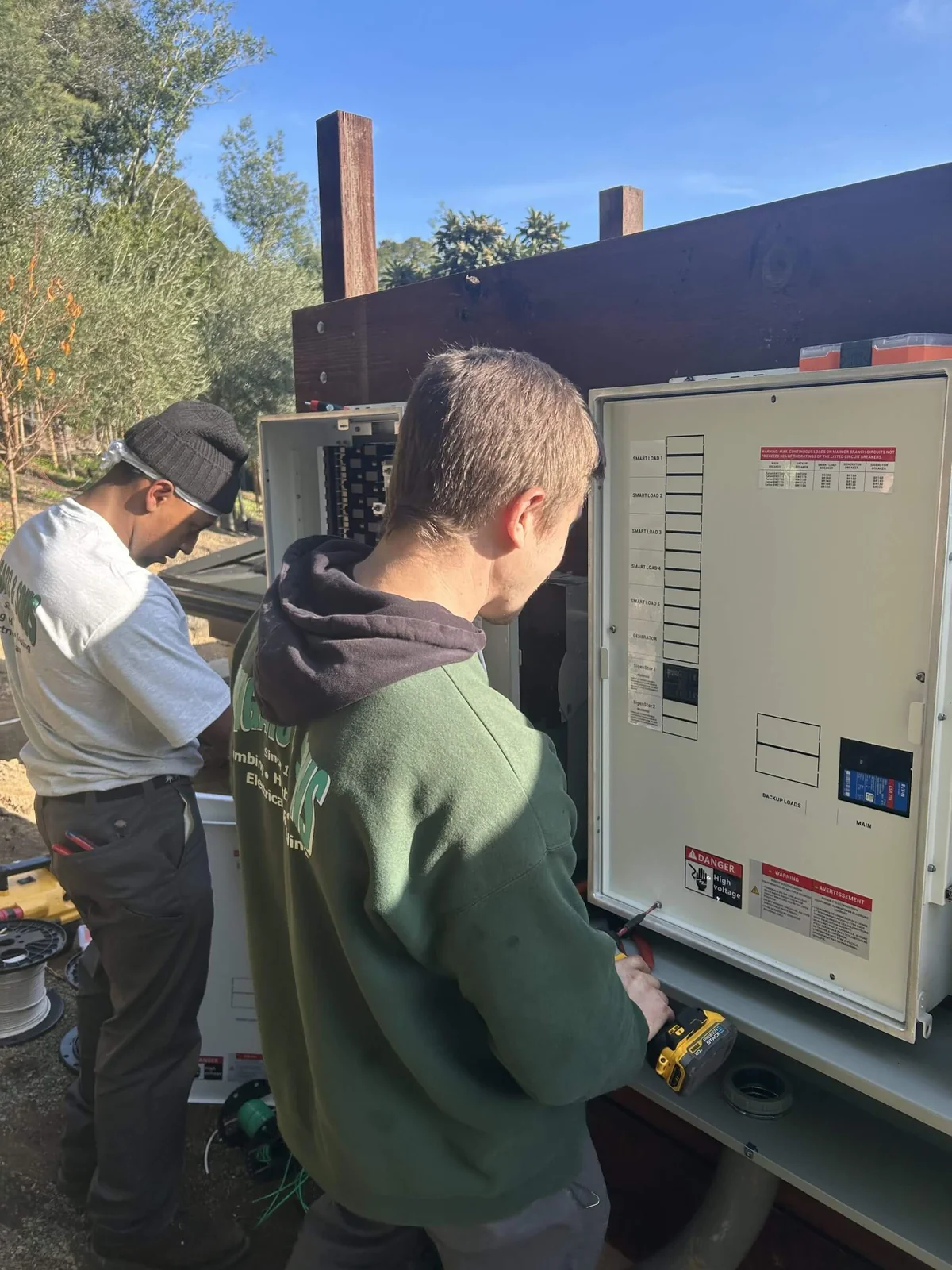
The sequence rarely varies. Power comes off and gets verified dead. The meter enclosure, mast and riser are replaced if they are in scope. The new panel is set, and this is where a downtown house tends to argue: the existing panel often sits in a hallway closet, a stair landing or a basement corner that never had the clear working space in front of it that code requires floor to ceiling. Moving the panel to an exterior wall solves that permanently and changes the shape of the job, so we put that decision in front of you at quote time, not on install morning. From there, circuits get re-landed and identified one at a time, the grounding electrode system is verified or brought up to standard, metal water piping is bonded where required, arc-fault and ground-fault protection goes where the adopted code cycle calls for it, and the directory is labeled legibly.
What drives the price. The variables are physical rather than mysterious. Overhead versus underground service. The distance and path between meter and panel. Whether the mast, weatherhead and riser are reusable. Trenching and surface restoration. Stucco patching versus lap siding, which are not the same repair. How many branch circuits need extending to reach a relocated panel. Whether existing wiring will accept arc-fault protection without nuisance tripping. Access, meaning an open garage bay versus a crawl space under a 1905 foundation.
Inspection and sign-off
Open-wall work gets a rough inspection before anything is covered, then a final. Inspectors check conductor sizing against breaker sizing, terminations and torque, grounding and bonding, arc-fault and ground-fault coverage, working space in front of the equipment, panel labeling, and the disconnect provisions in force under the adopted code cycle. On a service change the utility reconnect follows the building department's sign-off, and that ordering is the most common reason a job stretches into a second day. You keep the permit record and a legible circuit directory.
After we leave
Electrical maintenance is short, cheap and almost universally ignored. Test every ground-fault and arc-fault device with its own button monthly, since they can fail in a way that leaves the outlet working and the protection gone. Have aluminum service conductor terminations re-checked after the first full heating and cooling season, because thermal cycling is what loosens them. Replace smoke and carbon monoxide alarms at the end-of-life date printed on the unit. Our maintenance program covers the electrical side alongside mechanical equipment.
Very professional and easy to work with. We've used them for several large and small plumbing and electrical projects and they've been great.
Sol
Standby power for the hills around Napa
The hills around Napa faced the 2017 Atlas Fire and the 2020 Glass Fire, and they see PG&E Public Safety Power Shutoffs. That combination changes the calculus on backup power above the valley floor, and it is why generator work is a steady part of our Napa schedule. We are a Certified Generac Generator installer.
The design decisions are worth understanding before you shop. An automatic transfer switch senses the outage and starts the unit with nobody home; a manual interlock costs less and needs somebody present to throw it. Whole-house backup covers everything on the panel, while an essential-circuit approach feeds a dedicated subpanel with loads you choose in advance, usually the refrigerator, a well or booster pump, furnace and air handler controls, internet equipment, and enough cooling to keep one room livable in August. Sizing follows what you intend to run simultaneously, a much smaller number than the sum of what you own. Fuel follows the property: gas main where there is one, propane on hill properties without gas service. A battery covers a short outage silently and pairs naturally with a photovoltaic array, while a multi-day shutoff is where an engine earns its place. The solar page for Napa covers the generation and storage side.
Rewiring, grounding and older Napa houses
Knob-and-tube wiring was competently built for the loads of its day. Its problems now are no equipment ground, insulation that degrades with age and heat, and a design that relied on open air to carry heat away. That last point catches people: burying knob-and-tube in blown attic insulation during an efficiency retrofit removes the cooling the system depended on, so in an older downtown house the wiring assessment comes before the insulation work.
Cloth-jacketed cable from the mid-century fails differently, usually a jacket gone brittle exactly where conductors enter the panel and get flexed. Ungrounded two-prong receptacles have a remedy short of a rewire: the receptacle can be replaced with a device under ground-fault protection and labeled to state that no equipment ground is present. That is a code-recognized fix, not the same as adding a ground. It protects people. It does not give a surge protector the reference it needs. Where a full rewire is the right call, we stage it: kitchens, bathrooms, laundry and exterior circuits first, then bedrooms and living space.
EV charging in Napa: what MCE covers, and what it does not
MCE is the community choice energy provider for Napa. Its EV charging program covers workplaces offering charging to employees or fleets, multifamily properties of four or more housing units, and commuter parking such as a park and ride or ferry terminal. A house is outside that list. It is not outside every list: PG&E's residential charger rebate is open by its own terms to Community Choice Aggregation customers, and MCE Sync rewards MCE residential customers for shifting charging into cleaner, cheaper hours.
Delivery is PG&E regardless of who generates your power, so the rate plan question belongs in the install conversation rather than after it. On PG&E's electric vehicle rate plans, EV2-A uses one meter and applies to both home energy and vehicle charging, with off-peak from midnight to 3 p.m. daily, partial-peak from 3 to 4 p.m. and 9 p.m. to midnight, and peak from 4 to 9 p.m.; customers whose usage exceeded 800% of the baseline allowance over the last twelve months are not eligible.
EV-B requires a second dedicated meter and separates vehicle costs from household costs, with off-peak from 11 p.m. to 7 a.m., and it is not available with CARE, FERA or Medical Baseline. That second meter is an electrical scope item, not a billing preference, which is why we ask about it on the first visit. A third plan, E-ELEC, covers households adding an electric vehicle, battery storage or an electric heat pump. Being partly electric is enough; the whole house does not have to be. The EV charger page for Napa covers circuit sizing, charger placement and load management in depth.
Circuits, lighting and everyday electrical work
Most of our Napa calls are not service changes. They are one circuit doing a job it was never designed for. Dedicated circuits are the recurring theme: sump pumps, well and booster pumps, wine storage and cellar cooling units, garage freezers, workshop equipment, mini-split condensers. Sharing a circuit with a sump pump is a poor place to economize, because the load you least want to lose is the one that goes first when the breaker trips. Kitchens and bathrooms carry their own requirements around small-appliance circuits and ground-fault protection, and a remodel is the moment to bring them current. On the lighting side, a dimmer built for incandescent load often will not hold a low LED load steady, and that flicker is a mismatch rather than a defect.
Where we work in Napa
We run calls across downtown Napa, Alta Heights and Browns Valley, through the newer south and east Napa subdivisions, and out to unincorporated addresses in the surrounding hills. A Browns Valley subdivision house and a downtown Victorian call for different diagnostics before anyone opens a panel.
Incentives, and where they stand
Incentives rarely attach to the wiring. They attach to the appliance the wiring makes possible, so the program you qualify for is usually decided by the heat pump, water heater or vehicle rather than by the panel. Status also changes fast, and stale program information is worse than none.
How to choose an electrician in Napa
Six questions separate a contractor who will do this correctly from one who will not.
1. What license class are you working under? HVAC work is C-20 and plumbing is C-36, but the electrical classification is C-10. 2. Who pulls the permit, and where does it get submitted? The city takes applications at the counter and the county takes them online, so an electrician who cannot answer quickly may not have worked much on your side of the line. 3. Can I see the load calculation, with the assumptions written down? 4. What happens if you open the wall and find rot, an absent grounding electrode, or something requiring abatement? The answer should be a defined process, not a shrug. 5. How is the inspection and utility reconnect sequenced, and does the quote include surface restoration? 6. Is the full scope in writing before install day? Ours is, every time.
What North Bay homeowners say
Two reviews from customers who hired us for electrical work.
Book an electrician in Napa
Tell us the address, what the panel looks like, and what you want to add or fix. We will run the calculation, confirm which permit authority owns your parcel, and give you written scope and pricing before install day. Book online and we will get you on the schedule. Napa homeowners also use us for panel upgrades, EV charger installation, heat pumps, water heaters, solar, and countywide electrical service across Napa County. Everything we run at your address is listed on the Napa service area page.
Your Comfort, Our Priority
Ongaro & Sons is your trusted heating, cooling, plumbing, electrical, and solar expert, specializing in reliable maintenance and repair services that keep your home running efficiently year-round.
Our certified technicians deliver unmatched expertise with fast, friendly service across Marin, Sonoma and Napa County. From HVAC tune-ups to plumbing repairs and electrical upgrades or solar solutions, we focus on energy-efficient performance and long-term comfort. Count on us to maintain the systems that power your home and keep your environment just the way you like it.
Licensed, Insured, Background-Checked
Our technicians are licensed, experienced, and trained to service all makes and models.
Locally Owned and Operated
Serving the Napa, Marin, and Sonoma communities with personalized, hometown service.
Reliable Repairs
We respond quickly and get the job done right the first time, with no surprises.
Since 1932
Why Ongaro & Sons?
Four generations of trusted home service. Open any reason to see what it means for your home.
Schedule Service →Family-owned in the North Bay since 1932
Four generations of the Ongaro family serving Marin, Sonoma and Napa County. We know these homes and the systems in them.
Licensed, insured, background-checked technicians
Every technician is fully licensed and insured, background-checked, and trained on the equipment we install.
Diamond Certified and BBB A+
Diamond Certified since October 2016, and BBB Accredited with an A+ rating since December 1995.
Mitsubishi Diamond Contractor Elite and Trane Comfort Specialist
Both top manufacturer tiers. That standing decides how registration and extended warranty terms are handled on the system you actually bought.
The price is agreed before work starts
You see the number before the work begins. Flat-rate quotes, no surprises and no pressure.
Comprehensive maintenance program
Members get priority scheduling, discounts, and proactive checkups that prevent costly failures.
Discount
Membership
Ongaro Maintenance Plans
Annual maintenance on your home systems provides safeguards and comfort to you and your family. Members get priority scheduling, discounts, and proactive checkups that catch problems early.
Member Discounts
5% off every repair and replacement, all year long.
Peace of Mind
Proactive checkups catch issues before they become big problems.
Courtesy Reminders
We call you to schedule: never miss a seasonal service.
Value That Lasts
With Ongaro & Sons, you’re investing in quality, integrity, and service that stands the test of time. Explore our current promotions and see the difference real value makes for your HVAC, plumbing, and electrical needs.


From the Blog
 Sep 17, 2026
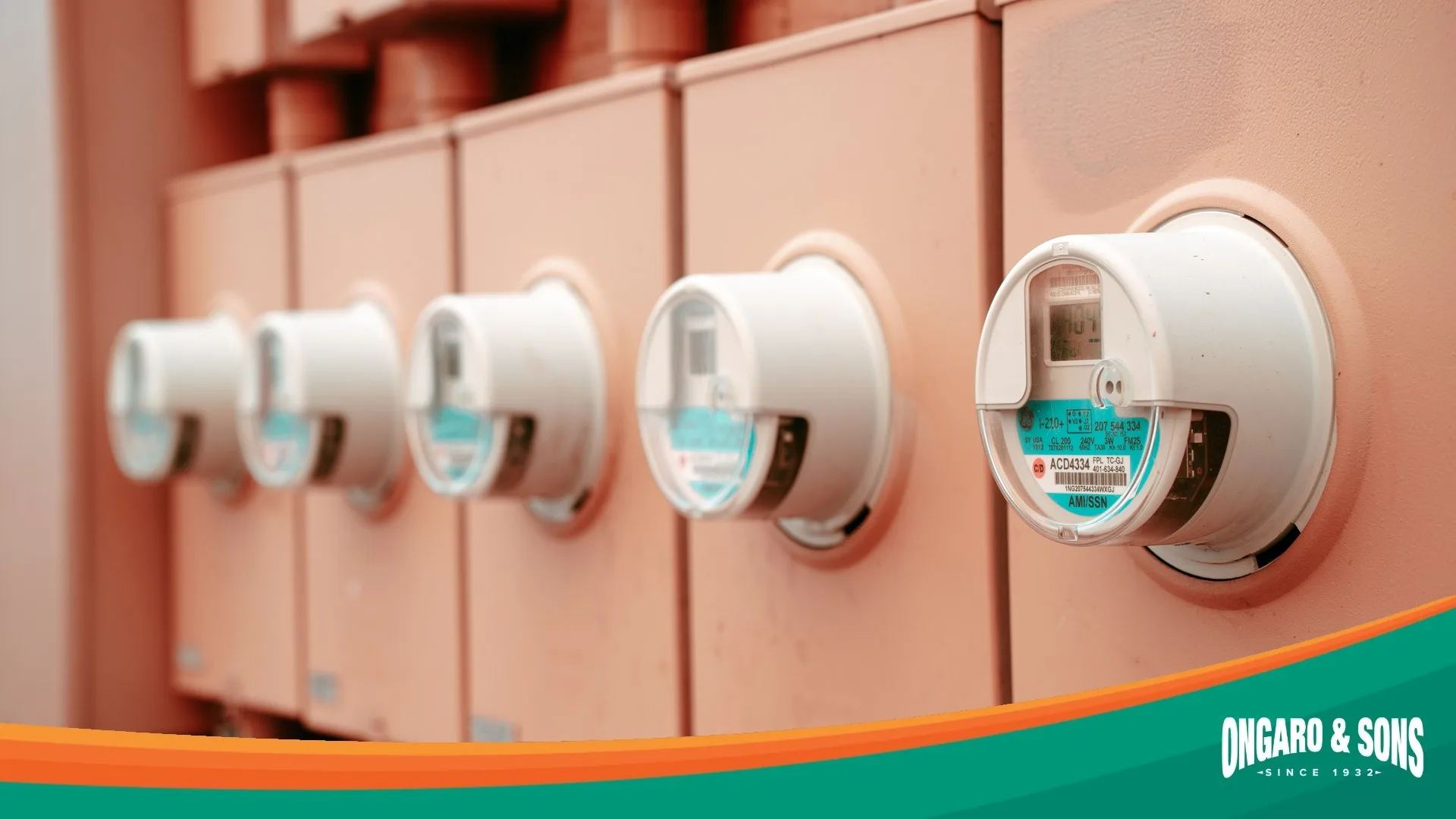
How Many Amps Does My House Need? Sizing Service for What You Actually Run
How many amps your house needs comes from a load calculation of what you run and plan to add. What drives the number, when existing service is enough, and more.
Read More Sep 10, 2026
Hard Water in Marin County: What Is Actually in Your Water and What It Does
Hard water in Marin County varies by provider and source. The 2025 report figures for Marin Water and NMWD, what hardness does and does not mean, and options.
Read More Sep 3, 2026
Electrical Permit Requirements in California: What Needs One and What Does Not
Find out which electrical projects commonly need permits, how to confirm local exemptions, and what to ask before work begins in Marin, Sonoma or Napa County.
Read MoreFrequently asked questions
Who is the best electrician in Napa, CA?
Judge it on four things: license class, permit practice, whether the contractor calculates load or guesses, and verified reviews. Ongaro & Sons has served the North Bay since 1932, holds a C-10 electrical license and Diamond Certified status, carries a BBB A+ Rating, and has 2,756 Google reviews averaging 4.8 stars.
Do I need a permit for electrical work in the city of Napa?
Most of it, yes. The City of Napa Building Division issues over-the-counter permits for projects that do not need plans, and the city's own example list names electrical service change-outs. More complex scopes go through plan review instead. Outside city limits, Napa County Planning, Building and Environmental Services is the authority.
Can I apply for a Napa electrical permit online?
It depends which side of the city limit you are on. The City of Napa states on its permit page that it has no online submittal portal, so city applications are handled at the counter. The county went the other way and has required digital submission through its Online Permit Center since January 1, 2024.
How do I know if my Napa home needs a panel upgrade?
Symptoms suggest it; a calculation proves it. Warning signs include no usable breaker spaces, breakers you cannot source replacements for, repeated tripping under summer cooling load, and a service rating too small for what you plan to add. We compare busbar rating, main breaker and measured demand before recommending anything.
What service size does a Napa home need for a heat pump and an EV charger?
There is no universal number, and anyone offering one without looking is guessing. It depends on square footage, the heating and cooling equipment, whether cooking and water heating are gas or electric, the charger's circuit rating, and how those loads overlap in time. Load management often avoids a larger service.
How long is my power off during a service change?
Plan on most of a working day. The utility disconnects the service, we replace the equipment, and reconnection comes after the building department signs off. We give you the expected window beforehand and tell you what to do about refrigeration, medical equipment and anything else that cannot ride out an outage.
Does MCE offer a rebate for a home EV charger in Napa?
Not that one. MCE's charging program is aimed at workplaces, multifamily properties with four or more units, and commuter parking such as park and rides or ferry terminals, so a house falls outside it. Ask about two others instead. PG&E runs the residential charger rebate and its terms make Community Choice Aggregation customers eligible, so an MCE address qualifies. MCE Sync rewards residential smart charging rather than equipment. We check the current terms of both when we quote.
Which PG&E rate plan should I be on after installing a charger?
That depends on how much you drive and how your household uses power. EV2-A runs on your existing single meter and covers home and vehicle together, with a long overnight and daytime off-peak window. EV-B needs a second dedicated meter, bills charging separately, and excludes CARE, FERA and Medical Baseline customers.
What does knob-and-tube wiring mean for an older downtown Napa house?
It means no equipment ground, aging insulation, and a system that relied on open air to carry heat away. The practical risk arrives when an efficiency project buries that wiring in attic insulation. It does not automatically require a full rewire, but it does require an assessment before insulation work.
My breakers trip on hot afternoons but never in winter. Why?
That pattern usually indicates cumulative load rather than a fault. Breakers are thermal devices, so a circuit sitting near its limit holds in cool weather and trips when cooling equipment, a hard-working refrigerator and everything else run together during a Napa heat stretch. The answer is redistributing load or adding capacity.
Is a standby generator worth it on a Napa hillside property?
For homes above the valley floor with Public Safety Power Shutoff exposure and wildfire history nearby, it often is. The real question is scope: whole-house coverage versus a subpanel carrying loads you preselect, automatic transfer versus a manual interlock, and natural gas versus propane where there is no gas main.
Do you handle commercial and winery electrical work?
Yes. Our commercial electricians handle tenant improvements, service and distribution equipment, lighting retrofits, controls and equipment circuits across Napa, Sonoma and Marin counties. Commercial scopes usually involve plan review rather than a counter permit, so the schedule runs on a different timeline than a residential service change.