EV Charger Installation in Novato, CA
Ongaro & Sons has wired homes in the North Bay since 1932, and a Level 2 charger is now one of the most common electrical jobs we run in Marin County. We carry the C-10 electrical license, a Diamond Certified rating, and 4.8 stars over 2,756 Google reviews. We run the load calculation before we quote, we pull the permit in our own name, and we meet the inspector at the end.
If you are comparing installers, compare what differs: whether a real load calculation gets run, whether the quote names the breaker and conductor, and whether permit and sign-off are included.
The two Novato jobs hiding behind one search
Almost every quote request here is really one of two jobs, and the search phrase does not distinguish them.
The first is a garage with the panel already on the wall behind where the car parks. Novato's later subdivisions produced a lot of these: a 200-amp service, drywall you can cross with conduit in a straight line, two spare breaker spaces.
The second is a mid-century house, and Novato has a great many of them. The ones that give us the most trouble are slab-on-grade with a low-slope roof and no attic, which removes both of the paths an electrician normally uses to cross a house. The panel often sits on an exterior wall opposite the driveway, the service may still be 100 amps, and there is no crawlspace underneath. That is not exotic. It just means the wire route, not the charger, sets the shape of the job.
The other local wrinkle is a Marin County wrinkle. MCE is the community choice electricity provider here, and MCE does not run a residential single-family charger installation rebate. Its program is written for workplaces, multifamily properties of four or more units, and commuter parking lots, per MCE's own eligibility list. What a Novato household can use is MCE Sync, a smart-charging reward with a sign-up bonus and monthly cash back, and PG&E's residential charger rebate, which Community Choice customers are eligible for. In some counties an incentive is tied to specific charger models, giving the equipment choice a financial consequence. Here it does not. Your rate plan is what moves the operating cost.

The site walk, from the meter to where the car parks
The first visit is a survey, not a sales call. We look at five things.
The service and the meter. The main breaker rating gives the size of the service. The busbar rating stamped inside the panel is a separate number, and it is often the one that limits the job. We also note whether meter and panel share one outdoor enclosure, common on mid-century houses here.
The panel's inside. Spare spaces, whether breakers are full-size or already doubled up, whether listed breakers are still made for that panel, and the condition of the connections. We look for aluminum branch wiring, scorching at a lug, or no main breaker.
The route. Where the panel is, where the car parks, and what sits between them. Length matters, because voltage drop follows distance and current, so a long run at 48 amps needs a heavier conductor. Stucco, finished walls, a concrete driveway, or a lawn between house and detached garage each change the method.
The parking. Attached garage, detached garage, carport, driveway, or side yard pad. Outdoors the enclosure rating and fastener choice matter, and near the water in Bel Marin Keys that is not fussiness: salt-laden air finds cheap hardware quickly.
What else is coming. A heat pump, a heat pump water heater, or a second vehicle within a few years belongs here, because the work gets sized once or it gets done twice.
Symptoms reported before we arrive are informative. A breaker that trips when the dryer and the oven run together says the service is near its ceiling. Lights that dim when a large motor starts point more often to a loose connection than to capacity. A car trickling on a 120-volt garage cord is not a fault: it is the wrong tool, and the most common reason people call.
The load calculation, and the four outcomes it produces
This step sets the price and the schedule. A load calculation adds existing demand to the new continuous charger load and compares the total against the service and busbar ratings. It is arithmetic, and it separates a number you can rely on from a guess. We describe the result as one of four outcomes.
Clear. The service has headroom and the panel has two adjacent spaces. We add a breaker and run the circuit, and that is the whole scope. Most of Novato's newer housing lands here.
Crowded. Capacity is fine, but the box is physically full. The fix is a small subpanel or relocating a couple of circuits. This outcome is inexpensive and regularly misdiagnosed as needing a whole new panel.
Capped. The service cannot absorb another full-size charger circuit, but it can absorb a managed one. Load management hardware, sometimes called an EV energy management system, lets the charger share the service by trimming its draw while other large loads run. A car sits far longer than it needs to charge, so most households never notice. Anyone jumping from capped straight to a new panel has not done the arithmetic.
Undersized. A 100-amp or smaller service in a home with electric cooking, electric drying, and plans for more is at its limit. Here a panel upgrade in Novato is the right first move, and the charger goes in as part of that project.
The forward-looking half of the calculation matters more here than people expect, because Marin sits fully inside the Bay Area Air Quality Management District. BAAQMD's zero-NOx requirement for residential water heaters begins taking effect in 2027, with compliance dates that vary by unit size. No gas water heater is banned, and we confirm current requirements at project time. But a household that may put a 240-volt water heater in the garage within a few years should not treat today's panel as permanent, and the same applies if a heat pump is coming.
I want to highlight the exceptional service I received from Zach Passalacqua and another tech Tyler. Their outstanding technical skill, in-depth understanding of the issues and options for treatment, and their professionalism were really impressive.
Deborah D.
Picking the charger and the circuit before anything is ordered
A Level 2 charger is a continuous load, so the circuit is rated meaningfully above the unit's output rather than matched to it. A charger drawing 40 amps continuously needs a 50-amp circuit; a 48-amp charger needs a 60-amp circuit. Bigger is not automatically better: a 48-amp unit on a service that comfortably supports 40 buys a harder installation.
What matters is how many miles you need per night, not the headline number. For most commutes out of Novato, a 32-amp or 40-amp charger refills a day's driving several times over during off-peak hours. Two EVs, a long round trip, or a very large battery pack justify the top of the range.
Two more decisions belong here, before the wire goes in.
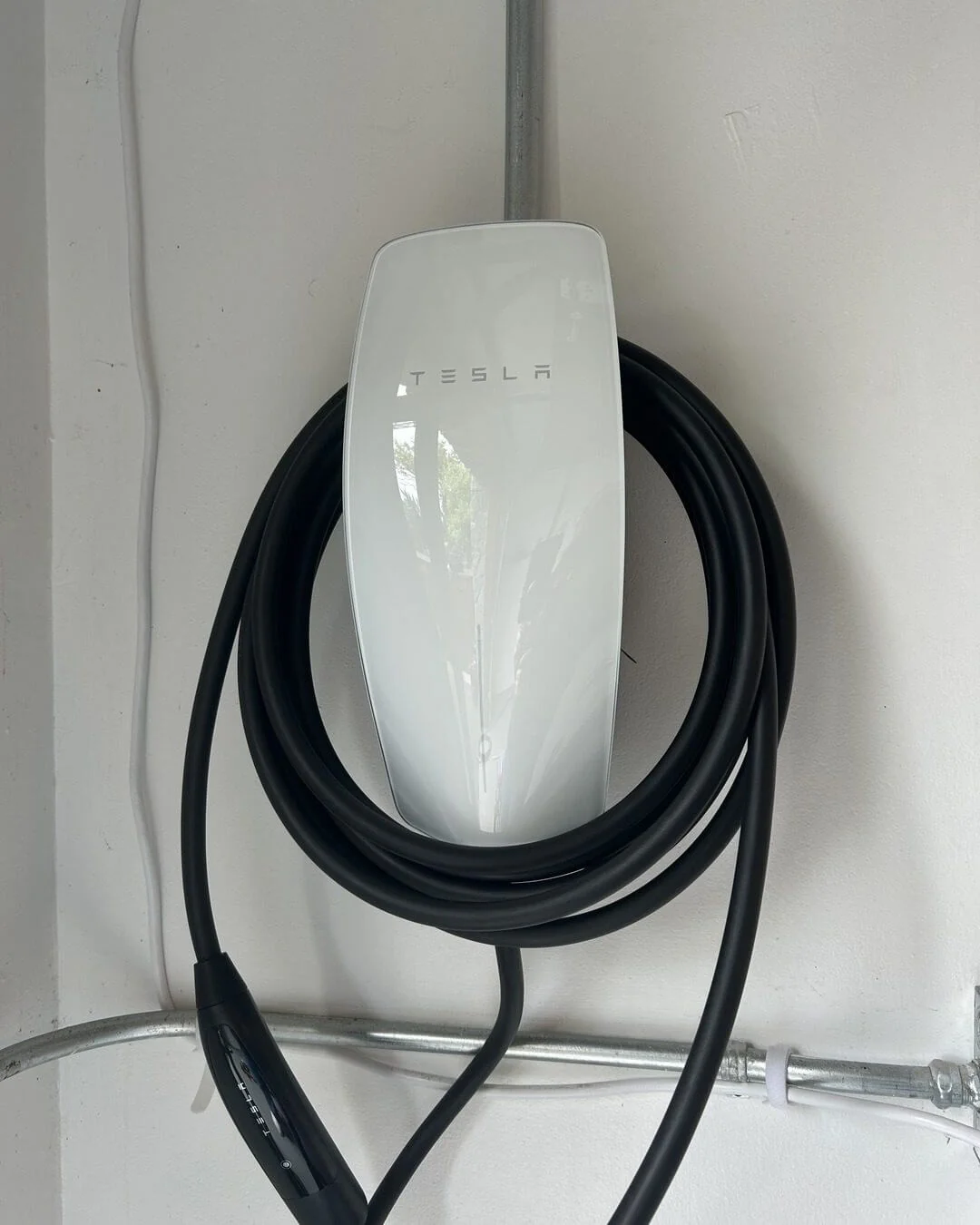
Hardwired or plug-in. Hardwiring is permanent and is required for the highest-output chargers. A plug-in unit on a 14-50 receptacle can travel with you, but the receptacle becomes a wear item, and a poorly made one is the most common failure point in a home charging setup. Outdoors, hardwired is the better answer.
The PG&E rate plan. PG&E delivers the electricity here regardless of who generates it, and its electric vehicle rate plans come in two shapes. EV2-A uses your single existing meter and applies to both home energy and vehicle use: off-peak midnight to 3 p.m. daily, partial-peak 3 to 4 p.m. and 9 p.m. to midnight, peak 4 to 9 p.m. Customers whose usage ran above 800% of the baseline allowance over the last twelve months are not eligible. EV-B requires a second dedicated meter and separates vehicle electricity costs from household costs: off-peak 11 p.m. to 7 a.m., peak 2 to 9 p.m. It is not available with CARE, FERA, or Medical Baseline. PG&E's third residential option, E-ELEC, is written for a home taking on more than one electric load. It carries a Base Services Charge, so it is worth comparing rather than assuming.
That second meter is scope, not billing. If EV-B is the plan you want, say so at the quote stage, because it changes the work.
The permit, and the clock state law puts on it
A home charger needs a permit. That is not a formality: an unpermitted 240-volt circuit is a problem at resale, for an insurer after a loss, and for any later solar or battery work tying into the same panel.
What is unusual is how much local discretion California has removed. Under Government Code 65850.7, a jurisdiction has to publish a checklist and run an expedited process against it, has to approve a conforming application "through the issuance of a building permit or similar nondiscretionary permit," and may look only at "whether it meets all health and safety requirements of local, state, and federal law." Aesthetics, neighbor opinion and whether a charger suits the street are all outside what the building official is allowed to weigh. Review is ministerial: the official checks the work against the code, not whether your street should have a charger.
The statute also sets a clock. The deadlines come from a separate section, Government Code 65850.71. An application covering at least one and not more than 25 charging stations is deemed complete five business days after submission and deemed approved twenty business days after it was deemed complete, unless the official has already acted on it, made adverse-impact findings, denied it, or an appeal is pending. That is a ceiling on delay rather than a promise about any given week.
Inside city limits the permit comes from the City of Novato Building Division, which publishes an EV charging station permit page and takes applications through its Novato Permits portal. We file, we send the load calculation and a single-line description of the circuit, and we book the inspection.
Plenty of Novato mailing addresses sit outside the city. Those parcels go to the Marin County Community Development Agency through its building permit application process, with submittals handled electronically. Same statute, different counter. We check jurisdiction before filing, because a misfiled application costs a week.

Install day
A straightforward garage installation is usually a single day. Work involving a subpanel, a trench, or a service change runs longer, and we say so up front.
The order of operations: shut down and verify the panel is dead, land the new breaker, run conduit or cable along the approved route, mount the charger at a height that lets the cable reach the port without hanging under tension, terminate to the manufacturer's torque specification, label the circuit, and set the unit's adjustable amperage to match the breaker actually installed. That last step gets skipped often, and a charger configured above its circuit is a nuisance-trip generator at best.
Price follows physical facts, not the brand on the box. What moves it:
- Distance from the panel to the parking spot, and what the conductor passes through on the way
- Whether conduit runs exposed on an exterior wall or gets fished inside finished walls and ceilings
- Trenching to a detached garage, and what the trench crosses: turf, pavers, or a driveway that has to be cut and patched
- The panel outcome: a spare breaker, a subpanel, load management, or a service upgrade
- Hardwired versus receptacle, and corrosion-rated hardware where a unit lives in weather
- Permit fees, which the jurisdiction sets and we do not
- Whether PG&E has to touch the meter or the service drop, which adds coordination time
We put the number in writing before work starts, with circuit and conductor spelled out, so you can compare it line by line against any other proposal. Financing is available when a charger goes in alongside larger electrical work.
Inspection and final sign-off
The inspector's checklist is short and predictable. Breaker matches conductor. Conductor matches load. Equipment is listed and installed the way its listing requires. Grounding and bonding are correct. Working clearance at the panel is preserved. Conduit is supported. An outdoor enclosure is rated for outdoor use. The circuit is labeled. Ground-fault protection is verified where required.
We meet the inspector, and that is part of the job rather than an add-on. When it passes, the permit is finaled, and that record follows the house. If you sell, file a claim, or later add solar or storage on the same panel, it is what a buyer, an adjuster, or the next electrician asks to see.
I had a complex problem converting incandescent spots to LED spots and still be able to dim them. The tecs were very knowledgeable and very polite. A+++++
Don D.
The first month, and the years after
In week one, do three things. Confirm the charging schedule lives in one place rather than being fought over by the car and the charger, because two conflicting schedules is the leading reason a vehicle is not full in the morning. Verify your rate plan changed if you requested it. Watch the first few cycles to confirm the breaker holds without warming.
After that, charging equipment is close to maintenance-free, though not entirely. Once a year, inspect the cable and connector for cracked insulation or a bent pin, press test and reset on any ground-fault device, and check for water intrusion if the unit lives outdoors. On a plug-in installation, discoloration on the plug face is the early warning that a receptacle is giving up.
One local point deserves stating plainly: a charger is a load, not a source. PG&E may turn off power during severe weather to reduce the risk of its equipment causing a wildfire, through the program it calls a Public Safety Power Shutoff, and during one the charger does nothing, because nothing is feeding it. Charging through an outage takes a generator or a home battery sized for a large continuous load.
Where we work in Novato
We install chargers across the city and the unincorporated areas around it. Downtown and the Grant Avenue corridor bring older housing, tighter lots, and street-side or shared parking that sometimes has to be solved before the electrical does. Hamilton's newer construction generally means attached garages and modern panels, the cleanest version of this work. Homes in Bel Marin Keys sit on the water, so outdoor equipment gets specified for a corrosive environment. Indian Valley and the hillside western edge bring longer driveways and detached structures.
We cover the rest of the county from the same Petaluma headquarters. See electrical services across Marin County, or the full Novato service list.
How to choose an electrician for this work
Five questions separate a real quote from a placeholder.
1. Does the contractor hold a C-10 electrical license, and is the permit pulled in the contractor's name rather than yours? An owner-pull shifts liability to you. 2. Was a load calculation performed, and can you see it? "The panel looked fine" is not a calculation. 3. Does the proposal state breaker size, conductor size, conduit method, and mounting location? Vague scope is where change orders come from. 4. Is the final inspection included, and who attends it? 5. If the answer is a service upgrade, ask what the calculation says and whether load management was evaluated first.
We also work on the rest of the house. Our electricians in Novato handle panels, circuits, lighting, and generators, so the crew installing your charger can look at the capacity you will need next.
What North Bay homeowners say
Two reviews from customers in our service area:
Book an EV charger installation in Novato
Tell us the vehicle, where you park, and roughly where the panel sits, and we will schedule a site visit. You get a written quote with the circuit specified, a permit filed by us, and an inspection we attend. Book online or contact the office. Novato homeowners often pair this with electrical services in Novato, panel upgrades, solar, heat pump installation, or the full Novato service area page. We install chargers countywide, including San Rafael, Mill Valley, and Corte Madera, and cover the Marin County electrical list from our Petaluma headquarters.
Your Comfort, Our Priority
Ongaro & Sons is your trusted heating, cooling, plumbing, electrical, and solar expert, specializing in reliable maintenance and repair services that keep your home running efficiently year-round.
Our certified technicians deliver unmatched expertise with fast, friendly service across Marin, Sonoma and Napa County. From HVAC tune-ups to plumbing repairs and electrical upgrades or solar solutions, we focus on energy-efficient performance and long-term comfort. Count on us to maintain the systems that power your home and keep your environment just the way you like it.
Licensed, Insured, Background-Checked
Our technicians are licensed, experienced, and trained to service all makes and models.
Locally Owned and Operated
Serving the Napa, Marin, and Sonoma communities with personalized, hometown service.
Reliable Repairs
We respond quickly and get the job done right the first time, with no surprises.
Since 1932
Why Ongaro & Sons?
Four generations of trusted home service. Open any reason to see what it means for your home.
Schedule Service →Family-owned in the North Bay since 1932
Four generations of the Ongaro family serving Marin, Sonoma and Napa County. We know these homes and the systems in them.
Licensed, insured, background-checked technicians
Every technician is fully licensed and insured, background-checked, and trained on the equipment we install.
Diamond Certified and BBB A+
Diamond Certified since October 2016, and BBB Accredited with an A+ rating since December 1995.
Mitsubishi Diamond Contractor Elite and Trane Comfort Specialist
Both top manufacturer tiers. That standing decides how registration and extended warranty terms are handled on the system you actually bought.
The price is agreed before work starts
You see the number before the work begins. Flat-rate quotes, no surprises and no pressure.
Comprehensive maintenance program
Members get priority scheduling, discounts, and proactive checkups that prevent costly failures.
Discount
Membership
Ongaro Maintenance Plans
Annual maintenance on your home systems provides safeguards and comfort to you and your family. Members get priority scheduling, discounts, and proactive checkups that catch problems early.
Member Discounts
5% off every repair and replacement, all year long.
Peace of Mind
Proactive checkups catch issues before they become big problems.
Courtesy Reminders
We call you to schedule: never miss a seasonal service.
Value That Lasts
With Ongaro & Sons, you’re investing in quality, integrity, and service that stands the test of time. Explore our current promotions and see the difference real value makes for your HVAC, plumbing, and electrical needs.


From the Blog
 Sep 17, 2026
How Many Amps Does My House Need? Sizing Service for What You Actually Run
How many amps your house needs comes from a load calculation of what you run and plan to add. What drives the number, when existing service is enough, and more.
Read More Sep 10, 2026
Hard Water in Marin County: What Is Actually in Your Water and What It Does
Hard water in Marin County varies by provider and source. The 2025 report figures for Marin Water and NMWD, what hardness does and does not mean, and options.
Read More Sep 3, 2026
Electrical Permit Requirements in California: What Needs One and What Does Not
Find out which electrical projects commonly need permits, how to confirm local exemptions, and what to ask before work begins in Marin, Sonoma or Napa County.
Read MoreFrequently asked questions
Who is the best EV charger installation company in Novato?
We would rather point at evidence than at an adjective. Ongaro & Sons has served the North Bay since 1932, holds a C-10 electrical license, is Diamond Certified, and carries 2,756 Google reviews at 4.8 stars. On this particular job, look for a written load calculation, a proposal naming the breaker and conductor, a permit filed by the contractor, and an included final inspection.
Do I need a permit to install a home EV charger in Novato?
Yes. State law streamlines the process, but it does not remove it. Within city limits the permit is issued by the City of Novato Building Division; parcels outside the city go through the Marin County Community Development Agency. The permit triggers an inspection, and that record is what a buyer, an insurer, or a future electrician wants to see.
How long does a Novato EV charger permit take?
We do not quote a turnaround, because the city publishes its own process and workload varies. A second section carries the timing. Under 65850.71, what the law guarantees is a ceiling: an application for between one and 25 charging stations is deemed complete five business days after filing, and deemed approved twenty business days after that, with narrow exceptions. No discretionary hearing stands in the way.
Will I need a panel upgrade for an EV charger?
Frequently not. The calculation produces four possible answers, and only one is a service upgrade. Many homes just need a breaker. Some need a small subpanel because the box has no room left. Some carry the charger on load management hardware that trims its draw while other big appliances run.
What size circuit does a Level 2 charger need?
It follows from the charger's continuous output, and the circuit is deliberately rated above that output rather than matched to it. A 40-amp unit runs on a 50-amp circuit; a 48-amp unit runs on a 60-amp circuit. Run length is the other variable, since distance calls for a heavier conductor to hold voltage.
Is there an MCE rebate for a home charger in Novato?
Not for a single-family home. MCE is the community choice provider for Marin and Napa, and its EV charging program targets workplaces, multifamily properties with four or more housing units, and commuter parking such as park-and-ride or ferry lots. We would rather say that than imply an installation rebate exists. What a household can use is MCE Sync, a smart-charging reward, and PG&E's residential charger rebate, open to Community Choice customers. The rate plan is still the variable that matters most.
Should I switch to a PG&E EV rate plan?
It is usually worth evaluating, since these plans price overnight electricity well below afternoon electricity. EV2-A works on your existing meter and covers the whole house. EV-B puts vehicle usage on a second dedicated meter and is closed to CARE, FERA, and Medical Baseline customers. Because EV-B needs that meter, decide before installation, or the work happens twice.
Can a charger go in a mid-century Novato home with no attic?
Yes, and we do it routinely. Slab construction with a low-slope roof removes the easy interior pathways, so conduit typically runs along an exterior wall, through the garage, or under an eave, on a route chosen for both appearance and length. The planning takes longer than a modern tract house requires.
Hardwired or plug-in: which should I choose?
Hardwiring is mandatory for the highest-output units and is more durable outdoors, since there is no receptacle to wear out. A plug-in unit on a 14-50 outlet makes sense if you expect to move and want to take the charger along. Going that way, insist on a commercial-grade receptacle: inexpensive ones overheat, and that is the most frequent callback we see.
Can I charge my car during a Public Safety Power Shutoff?
Not from the charger by itself. When PG&E de-energizes lines, the circuit feeding it is dead along with everything else in the house. Charging through a shutoff calls for a generator or a home battery with enough capacity for a large continuous load, which is its own design and permitting exercise. In the hillside parts of town this question comes up often.
What if my Novato address is in unincorporated Marin County?
Then the county permits the work in place of the city. The Marin County Community Development Agency runs building and safety for unincorporated areas and accepts submittals electronically. The expedited-permitting mandate in state law applies there as well. We confirm which jurisdiction covers your parcel before we file, since sending paperwork to the wrong agency costs time and nothing else.