EV Charger Installation in Sonoma, CA
Ongaro & Sons has wired homes in the North Bay since 1932, and EV charger installation is C-10 electrical work we run out of our Petaluma headquarters. We are Diamond Certified, we carry 2,756 Google reviews averaging 4.8 stars, and we perform a load calculation on your panel before quoting a charger, because that number decides the entire job.
Most people arrive here thinking they are buying a charger. What you are actually buying is a circuit, and in this valley the circuit varies wildly from one address to the next. Below are the questions Sonoma homeowners ask, in the order they ask them.
On this page
Why does this turn into a bigger question than the charger?
Because the hardware is a commodity and the electrical service is not. Historic homes around the Sonoma Plaza sit alongside valley properties of every era, and many still run on a service sized for their construction decade: gas range, gas furnace, gas water heater, no central cooling. That service is not defective, it was simply never asked to carry what you are about to add.
A Level 2 charger is the largest sustained load most houses will ever see. A dryer or a cooktop draws hard and stops. A vehicle pulls near its full rated current for four, six, or eight hours without a break. Panels, conductors, and terminations that shrug off intermittent draw behave differently under that duty cycle, and the difference shows up as heat.
There is a second reason to think past the charger. Sonoma sits fully inside the Bay Area Air Quality Management District, unlike towns at the northern end of the county, which fall under a separate district (Sonoma County, Air Quality Districts). Its Regulation 9, Rule 6 sets a zero-NOx standard for residential water heaters and switches it on appliance by appliance from 2027 to 2031, reaching what a supplier may sell rather than what sits in your garage (BAAQMD Reg 9, Rule 6). Nobody's gas water heater is banned, and we confirm what is in force on the day we quote.
The consequence is planning, not panic. If your panel is going to be opened and possibly enlarged anyway, size it once for the vehicle and for whatever electric appliance follows it. That is the conversation behind Electrical Panel Upgrade in Sonoma, and the same math governs a Heat Pump in Sonoma.
Do I need a permit, and who issues it?
You need one. California law is unusually specific here, and it works in your favor.
Government Code section 65850.7 obliges every city and county to adopt an ordinance creating an expedited, streamlined permit path for charging stations, and it confines the building official to "whether it meets all health and safety requirements of local, state, and federal law." Approval is administrative, through a building permit or similar nondiscretionary permit, so the decision is ministerial rather than a matter of opinion. The companion section, 65850.71, puts a clock on it: an application for "at least 1, but not more than 25 electric vehicle charging stations at a single site" is deemed complete five business days after it is submitted, and deemed approved twenty business days after that, unless the official has already approved it, made a substantial-evidence finding of adverse impact, denied it, or an appeal is pending.
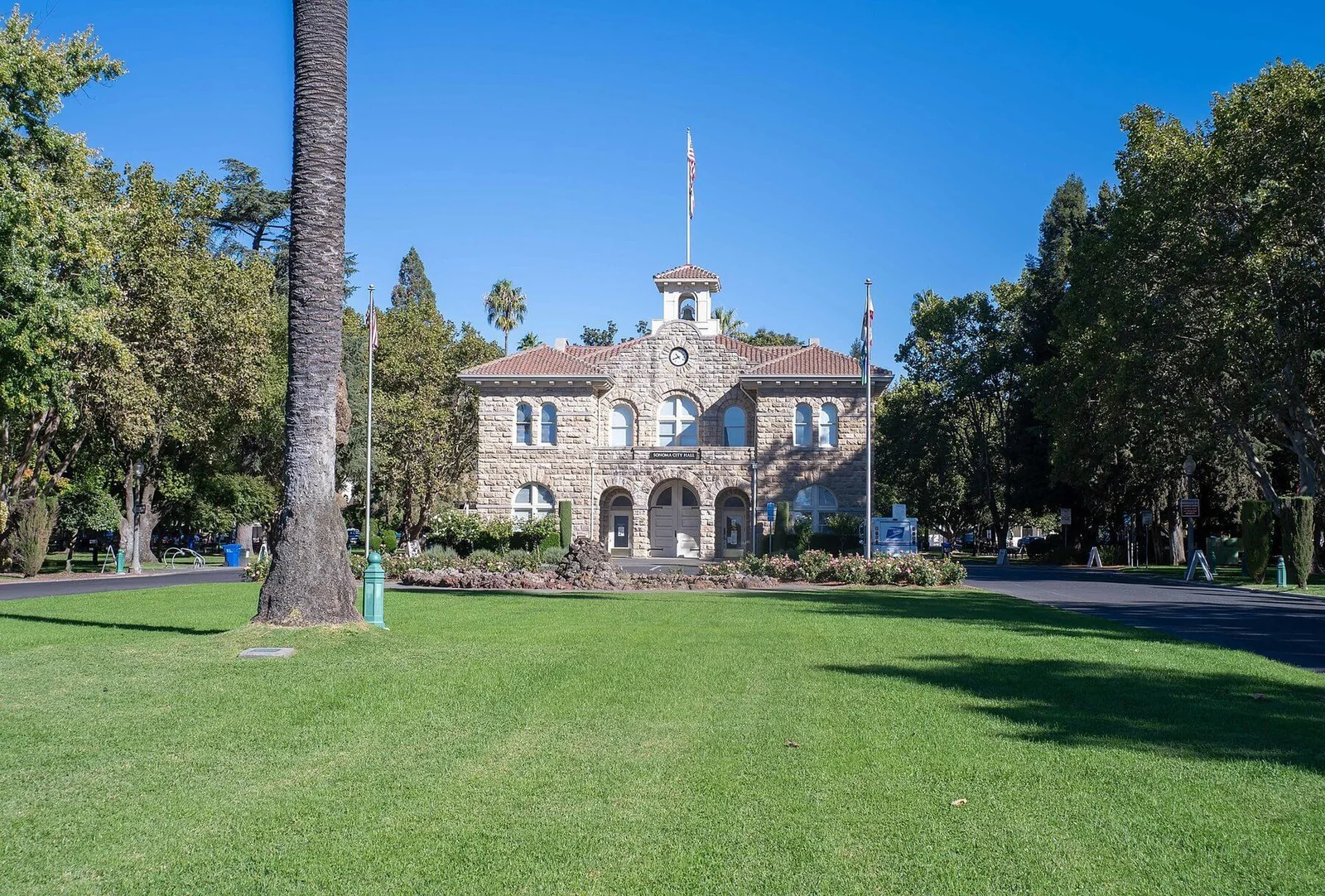
Which counter you use depends on your parcel. Inside the city limits, the City of Sonoma runs its own expedited charging station process: download the city's EVCS checklist, complete it fully, and apply for the building permit online, with correspondence handled through the portal. The city states that once documentation is correctly and fully submitted, "a permit will be processed and approved for issuance in a timely manner (usually 1 to 3 business days)" (City of Sonoma, Expedited Permitting for Electric Vehicle Charging Stations).
If your address sits outside those limits, in the Springs, in Boyes Hot Springs, or elsewhere across the valley floor and hills, the application goes to Permit Sonoma. Its version uses checklist BPC-062, the same online or in-person path, the CNI-037 smoke alarm and carbon monoxide alarm self verification form where applicable, and three sets of plans for the proposed charging station at 11 by 17 inches (Permit Sonoma, Expedited Permitting for Electric Vehicle Charging Stations).
A contractor who tells you a home charger needs no permit is telling you they intend to skip it. Inspection is the only independent check that the breaker, conductor, terminations, and grounding match the paperwork.
How do I find out whether my panel can take one?
With a load calculation: a formal accounting of connected load against the rated capacity of the service, done to the method the code specifies, not a glance at the number stamped on the main breaker. The inputs are the service rating, square footage, the fixed appliances already installed, and the new continuous load you propose.
Charger circuits carry deliberate headroom above continuous draw, which is why a unit rated to deliver forty amps continuously belongs on a fifty-amp circuit rather than a forty. Skip that and you get a circuit that nuisance trips at best and cooks its terminations at worst.
The calculation returns one of three answers. It fits as it stands, with both capacity and a free double-pole slot available. It fits at a reduced setting, since nearly every modern Level 2 unit lets the installer cap maximum output, a code-relevant configuration documented at commissioning rather than a preference you nudge later from an app. Or it does not fit, and you choose between load management hardware that sheds the charger when the range or dryer runs, and enlarging the service itself. Load management is often the faster path in an older home near the Plaza, and a lot of quotes never mention it exists.
Two constraints hide inside that third answer. Breaker space is not the same thing as electrical capacity, and a panel can have plenty of one and none of the other. And some older enclosures come from manufacturers whose listed replacement breakers are no longer produced, forcing a panel change regardless of the load math. Our general Electrical in Sonoma work turns up both regularly.
Rene did a terrific job repairing an outside light. Highly recommended!
Jim H.
What are the warning signs my service is already maxed out?
Houses tell you before they fail.
A breaker trips when the vehicle is charging and something else large switches on. That is the load calculation delivering its verdict after the fact. Lights that dip briefly when a big load starts point at voltage drop, usually an undersized or very long feeder upstream.
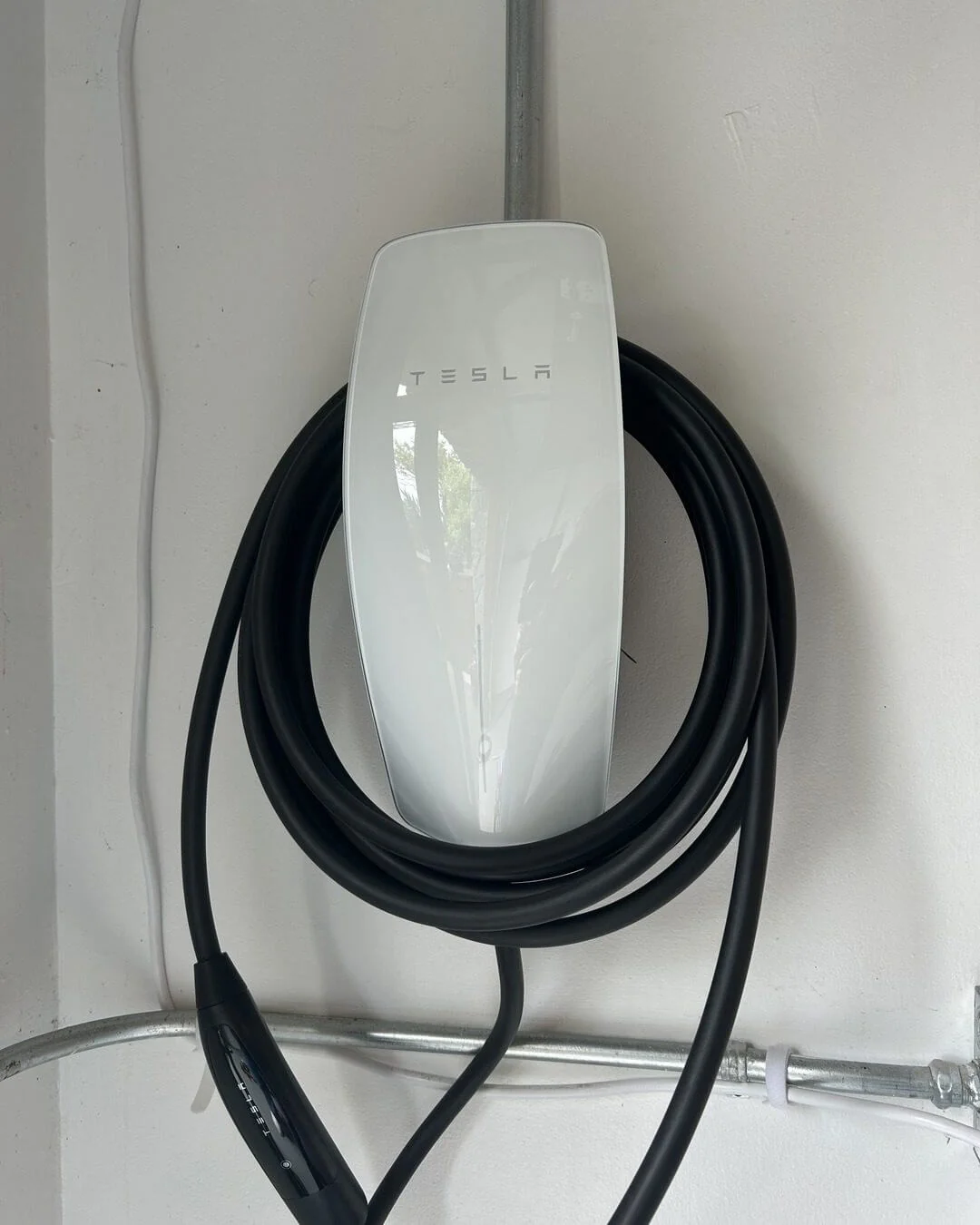
On a plug-in installation, the cord cap or receptacle face feels warm, or the plastic discolors around the blades. A general-purpose 240-volt receptacle is engineered for equipment that draws hard and quits, like a welder. Hours of near-rated current expose contact resistance that intermittent use never would. Heat anneals the spring contacts, they grip less firmly, resistance climbs, and the cycle accelerates. Hardwiring sidesteps that entirely, and that is the reason we default to it when the unit supports it.
Buzzing, scorch marks, or a burning smell at the panel. Stop charging and have it looked at.
Level 1, Level 2, or something bigger, and how do I choose?
Start from a principle: size to the driving you do, not to the maximum your car will accept. From there, four questions in this order.
First, the driving. A plug-in hybrid, or a car that runs a short valley loop and sits in the driveway most evenings, may fully recover overnight on modest output. A household commuting over the hill to the 101 corridor daily needs genuine recovery rate. This answer tells you what you want.
Second, the service, meaning whatever the load calculation permits. It often overrides the first answer, which is how people end up owning equipment they cannot run at its rating.
Third, the route: distance and path from the panel to where the car parks. Conductor size grows with distance to hold voltage at the far end, so a long run costs real money in copper before labor enters the picture. A panel on the street side of an older home with parking off a rear alley is a long run.
Fourth, the device, because in this county the specific model you buy determines whether you can enroll in the utility program covered next. One caution while shopping: DC fast charging is not a residential product.
Is there a rebate for an EV charger in Sonoma?
Not in the form most people expect, and precision matters here.
Sonoma Clean Power, the community choice provider for Sonoma County, does not run an installation rebate for home chargers. It runs a smart charger enrollment program that pays a monthly bill credit plus a sign-up bonus for enrolling an eligible Wi-Fi connected smart charger. You must be an active SCP customer and either the account holder or an authorized representative. Eligible devices are currently limited to WallBox and ChargePoint models, and SCP says it is "working hard to add more EV chargers to our program." In exchange, SCP reduces charging speed during periods of grid stress, and the customer "can override an event anytime" (Sonoma Clean Power, EV Chargers).
So here the equipment decision is not purely electrical. If the credit matters to you, the eligible device list narrows your options before an electrician ever opens your panel. Pick the charger first, book the installation second.
For contrast, households in Marin and Napa are served by MCE, whose EV charging program covers workplace charging for employees or fleets, multifamily properties of four or more housing units, and commuter parking lots such as a park and ride or ferry terminal. That program does not fund a charger at a house (MCE, EV Charging), though MCE Sync rewards its residential customers for smart charging much as Sonoma Clean Power does. The difference worth acting on is not whether a reward exists but what it attaches to: here it turns on owning a specific eligible Wi-Fi charger, so equipment selection carries a consequence it does not carry across the county line.
One further clarification: the EV-ready requirements homeowners read about in CALGreen apply to new construction and do not reach backward into an existing home. California's 2025 Building Energy Efficiency Standards took effect January 1, 2026 (California Energy Commission), governing what gets built, not a retrofit.
What really drives the price?
Four things, ranked by how far each moves the total.
Whether the service has room. A charger landing on a panel with spare capacity and an open slot is a short, contained project. A service upgrade brings its own permit for the panel work, new service equipment, and utility coordination. That is the largest fork in the road by a wide margin.
Distance and route. Length drives conductor size, and conductor is usually the biggest material line on the invoice. An unfinished garage wall a few feet from the panel is the inexpensive case. A finished interior wall, a stucco or masonry exterior, an attic without working access, or a trench to a detached garage each step the number up.
What is found once walls open: ungrounded two-wire circuits, aluminum branch wiring, an obsolete panel type. Those are discoveries, not oversights, and each changes scope.
Permit and inspection, which are fixed and non-optional. If a quote arrives without anyone having seen your panel and your parking position, the figure will move.
Renee came out due to A bad call by Comcast’s that out network closet had no power. They were wrong and she was right. She was timely , professional, and knowledgeable
KC T.
Should I move to a PG&E EV rate plan, and does that change the install?
PG&E delivers the electricity everywhere we work regardless of who generates it, so rate plan questions run through PG&E (PG&E, Electric Vehicle Rate Plans).
Home Charging EV2-A uses your existing single meter and "applies to both your home energy and your vehicle's electricity use." Off-peak runs midnight to 3 p.m. every day, partial-peak covers 3 to 4 p.m. and 9 p.m. to midnight, and peak is 4 to 9 p.m. PG&E notes that "customers with high energy usage (over 800% baseline allowance) over the last 12 months are not eligible."
EV-B is different in kind. It requires a second, dedicated meter and "separates your vehicle's electricity costs from those of your home." Off-peak is 11 p.m. to 7 a.m., partial-peak covers 7 a.m. to 2 p.m. and 9 p.m. to 11 p.m., and peak is 2 to 9 p.m. It cannot be combined with CARE, FERA, or Medical Baseline. The plan most often overlooked is E-ELEC, which carries a Base Services Charge against lower per-kilowatt-hour prices and is aimed at homes electrifying in more than one direction.
This belongs in the installation conversation rather than after it, because a second meter is an electrical scope decision with its own equipment and permit implications. Choosing it later means revisiting a service you just paid to modify. On EV2-A, the wide overnight off-peak window means scheduling matters more than raw output.
What happens when the power goes out?
The hills around the Sonoma Valley face wildfire exposure and PG&E Public Safety Power Shutoffs, and a charger is simply a load. No utility power, no charging. Charge ahead of an announced shutoff window rather than during one.
A Level 2 circuit is among the largest loads in the house, so it is generally not placed on a backup panel. Battery and generator systems are typically sized around refrigeration, well pumps, medical equipment, and lighting, and adding vehicle charging changes that sizing substantially. We are a Certified Generac Generator installer, so we can tell you what a standby unit would carry at your address.
Grid-tied solar without storage will not run your charger during an outage, since the inverter disconnects when the grid disappears. If charging through a daytime outage matters, that is a storage discussion, and it belongs with Solar in Sonoma.
Does an EV charger need maintenance?
Less than a furnace, more than nothing.
Once a year, inspect the connector: pins clean and unpitted, latch engaging, cable jacket uncracked. Valley summers are hard on a cable left lying across a hot driveway in full sun, so use the holster.
Mounting location matters more here than on the coast. Chargers and vehicles both reduce output when internal components run hot, so a west-facing wall taking the full afternoon in July is a materially worse position than a shaded elevation or an interior garage spot. That choice is free at installation and expensive to change afterward.
Terminations relax over time, so have lug connections at the breaker and any subpanel checked after the first year, then periodically. On outdoor enclosures, inspect the gasket and conduit entries, since moisture inside shows up as ground-fault trips before it shows up as damage. And if you enrolled in the Sonoma Clean Power program, a charger that has quietly dropped off your Wi-Fi is no longer participating.
Which parts of Sonoma do you cover?
All of it, plus the surrounding valley: the blocks around the Sonoma Plaza where the older housing stock and smaller services concentrate, the Springs corridor through Boyes Hot Springs and the rest of the Springs, and properties from the valley floor into the hills on both sides. Everything dispatches from our Petaluma headquarters, a short run over the hill. Every address gets the same approach: look at the panel, measure the run, confirm the building department, then quote.
How should I pick an electrician for this?
Six questions, in this order, for anyone who quotes you.
1. Do you hold a current C-10 electrical license class? Ask, then verify independently. 2. Who pulls the permit? The answer should be the contractor, without hesitation. 3. May I see the load calculation? If nobody has been inside your panel, none exists yet. 4. What output will the unit be set to, and why? A good answer references the circuit. A weak one references the car. 5. If I want the Sonoma Clean Power credit, is your proposed model on the current eligible device list? 6. What happens if you open a wall and find something unexpected? Settle that before work begins.
We are Diamond Certified and hold a BBB A+ Rating, and we have worked this valley long enough to know what tends to sit behind the plaster on a given street.
What North Bay homeowners say
Two reviews left by North Bay customers about our electrical crews:
How do I get on the schedule?
Book online and we will arrange a site visit to look at your panel, measure the run to your parking position, and confirm which building department covers your parcel. You get the load calculation, the options it permits, and what each costs before any work is authorized. If the panel is the real project, we handle that in-house. One company, every trade: Electrical in Sonoma, Electrical in Sonoma County, and Sonoma home services for everything else we handle here. Charging work elsewhere in the county sits at EV Charger Installation in Petaluma and EV Charger Installation in Santa Rosa.
Your Comfort, Our Priority
Ongaro & Sons is your trusted heating, cooling, plumbing, electrical, and solar expert, specializing in reliable maintenance and repair services that keep your home running efficiently year-round.
Our certified technicians deliver unmatched expertise with fast, friendly service across Marin, Sonoma and Napa County. From HVAC tune-ups to plumbing repairs and electrical upgrades or solar solutions, we focus on energy-efficient performance and long-term comfort. Count on us to maintain the systems that power your home and keep your environment just the way you like it.
Licensed, Insured, Background-Checked
Our technicians are licensed, experienced, and trained to service all makes and models.
Locally Owned and Operated
Serving the Napa, Marin, and Sonoma communities with personalized, hometown service.
Reliable Repairs
We respond quickly and get the job done right the first time, with no surprises.
Since 1932
Why Ongaro & Sons?
Four generations of trusted home service. Open any reason to see what it means for your home.
Schedule Service →Family-owned in the North Bay since 1932
Four generations of the Ongaro family serving Marin, Sonoma and Napa County. We know these homes and the systems in them.
Licensed, insured, background-checked technicians
Every technician is fully licensed and insured, background-checked, and trained on the equipment we install.
Diamond Certified and BBB A+
Diamond Certified since October 2016, and BBB Accredited with an A+ rating since December 1995.
Mitsubishi Diamond Contractor Elite and Trane Comfort Specialist
Both top manufacturer tiers. That standing decides how registration and extended warranty terms are handled on the system you actually bought.
The price is agreed before work starts
You see the number before the work begins. Flat-rate quotes, no surprises and no pressure.
Comprehensive maintenance program
Members get priority scheduling, discounts, and proactive checkups that prevent costly failures.
Discount
Membership
Ongaro Maintenance Plans
Annual maintenance on your home systems provides safeguards and comfort to you and your family. Members get priority scheduling, discounts, and proactive checkups that catch problems early.
Member Discounts
5% off every repair and replacement, all year long.
Peace of Mind
Proactive checkups catch issues before they become big problems.
Courtesy Reminders
We call you to schedule: never miss a seasonal service.
Value That Lasts
With Ongaro & Sons, you’re investing in quality, integrity, and service that stands the test of time. Explore our current promotions and see the difference real value makes for your HVAC, plumbing, and electrical needs.


From the Blog
 Sep 17, 2026
How Many Amps Does My House Need? Sizing Service for What You Actually Run
How many amps your house needs comes from a load calculation of what you run and plan to add. What drives the number, when existing service is enough, and more.
Read More Sep 10, 2026
Hard Water in Marin County: What Is Actually in Your Water and What It Does
Hard water in Marin County varies by provider and source. The 2025 report figures for Marin Water and NMWD, what hardness does and does not mean, and options.
Read More Sep 3, 2026
Electrical Permit Requirements in California: What Needs One and What Does Not
Find out which electrical projects commonly need permits, how to confirm local exemptions, and what to ask before work begins in Marin, Sonoma or Napa County.
Read MoreWhat else do people ask before booking?
Who is the best EV charger installation company in Sonoma?
We would point at criteria rather than the claim. Ongaro & Sons has operated since 1932, holds the C-20, C-10, and C-36 license classes, is Diamond Certified, and carries 2,756 Google reviews at a 4.8 star average. For this job, look for a firm that calculates load before quoting, pulls its own permits, and can perform panel work in-house when the numbers demand it.
How long does the installation itself take?
A straightforward wall-mounted unit near a panel with available capacity is commonly a single-visit job. A long conductor run through finished space, a detached garage feeder, or a service upgrade stretches that across multiple days and adds a utility coordination step. Permit processing runs in parallel, separate from crew time on site.
Can I install an EV charger myself?
The permit and the inspection apply either way, and self-performed work still has to satisfy the building official. The practical obstacles are the load calculation, conductor sizing over distance, and termination work, which is precisely where these installations go wrong. Failed inspections on owner-installed charging circuits are common enough to be worth avoiding.
Do I definitely need a bigger panel for a Level 2 charger?
Frequently not. Load management hardware that throttles vehicle charging while other large appliances run lets many older homes add a charger without touching the service. Whether that path is open depends entirely on the calculation, which is the reason it comes first. Where the service will not accommodate it, we say so rather than installing something marginal.
Is a hardwired unit better than a plug-in one?
For sustained daily charging, generally yes. Removing the plug and receptacle removes the connection most likely to degrade under hours of continuous current, and eliminates a component that heats and loosens over time. Plug-in units still make sense at lower output levels, for renters, and for anyone expecting to take the equipment when they move.
Will a charger work alongside my solar system?
Yes, and the two complement each other while the grid is up, since daytime generation can offset daytime charging. What solar alone will not do is power the charger during an outage, because a grid-tied inverter needs a grid reference to operate. Pairing charging with outage resilience requires battery storage, a separate design and budget.
Can you install a charger at a detached garage or carport?
Yes. Those need a feeder run from the main service to the outbuilding, usually a subpanel at the structure, and frequently trenching if the route goes underground. It is a larger project than a wall-mounted unit beside the panel, and the distance across the property is the main variable in the estimate.
How fast will my car actually charge?
Recovery rate is set by the lowest limit in the chain: the circuit, the unit's configured output, and the vehicle's onboard charger. Many cars accept less than a fully rated Level 2 circuit can deliver, so oversizing buys nothing for that vehicle. We work out which link governs your situation before recommending an output level.
Can you install two chargers for two vehicles?
Often, though the service decides. Two full-output circuits demand real capacity, so many two-car households do better with a load-sharing arrangement where the units split available current automatically. Across a long overnight off-peak window, shared output usually delivers everything both vehicles need without an upgrade. Raise a likely second car during sizing, since capacity is cheaper to add than to retrofit.
Is an outdoor charger a problem in valley summers?
Not with the right equipment and placement. Use a unit rated for outdoor use, seal the enclosure and conduit entries properly, and avoid a wall that bakes all afternoon. Heat causes both the equipment and the vehicle to reduce output protectively, so a shaded position preserves charging speed on the hottest days.