EV Charger Installation in Windsor, CA
Ongaro & Sons has been at work in the North Bay since 1932, and we install EV chargers in Windsor under a C-10 electrical license from our Petaluma headquarters. We are Diamond Certified, we hold a BBB A+ Rating, and we carry 2,756 Google reviews averaging 4.8 stars. We run the load calculation before we quote, pull the town permit, and stand for the inspection.
The most common EV charging problems in Windsor
Most of the EV charger calls we get in Windsor come from people who already have one and are running into trouble.
The car charges without complaint in April, then the first genuinely hot week arrives, the air conditioning runs all afternoon, and the main breaker trips at nine in the evening when the vehicle starts pulling. Or the charger quietly throttles itself and an overnight session stops finishing. Or a garage receptacle trips its ground-fault breaker two or three nights a week with nothing wrong to find.
None of those are equipment defects. They are capacity, connection, or protection-scheme problems, and here they cluster by the decade the house went up.
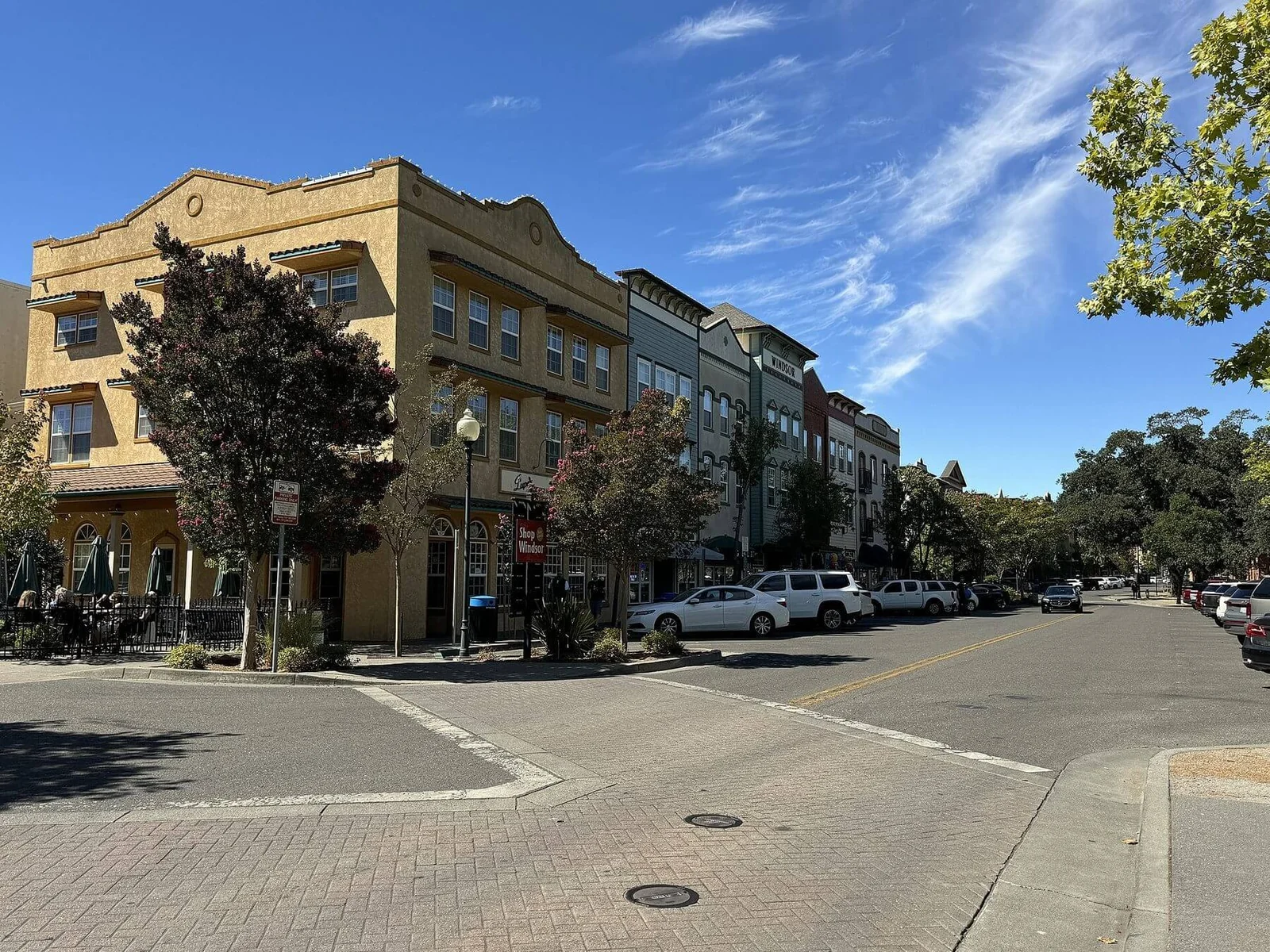
Windsor grew substantially from the 1980s onward, which gives it an unusual split for this work. Houses from that growth generally came with an attached garage, a 200-amp service, and a panel a short run from where the car parks. The older core around the Town Green is a different building: smaller services, panels on the far side of the house from the driveway, detached garages on a subpanel sized for a light bulb and a workbench.
Then add the climate. Windsor runs hot in summer like the rest of the inland Sonoma corridor, so cooling carries real load here in a way it does not on the coast. The air conditioner is usually the largest simultaneous draw in the building, and it works hardest during the same late-afternoon hours PG&E prices highest. Sizing the circuit and scheduling the charging are one conversation, not two.
What is failing
The service is full, not faulty. A charger drawing 48 amps continuously rivals a whole-house air conditioner for the largest load in the building. If the service already sat near its calculated ceiling, the charger creates an overload rather than a fault, and the main breaker does what it was installed to do. The remedy is arithmetic, not a bigger breaker.
Ground-fault protection is arguing with the charger. A plug-in unit on a garage receptacle sits behind ground-fault protection, and most Level 2 chargers also watch for ground faults internally. When two protective schemes monitor one circuit, leakage current neither would act on alone can trip one of them, and the owner sees a random overnight failure with no defect to find.
A termination is loose or the wrong metal. This equipment holds near rated current for hours, which heat-cycles every connection along the path. A breaker lug that behaved perfectly feeding a dryer for forty minutes will work itself loose under six hours of continuous draw. Aluminum feeders never torqued to specification show up as discoloration inside the panel first.
The run to a detached structure was never built for this. Older Windsor properties frequently have a garage or shop on a modest subfeed, and a charger cannot simply be tapped onto it. Either the feeder gets replaced, the charger gets set lower, or the structure's draw gets managed.
Voltage drop over a long path. Deeper lots and chargers at the far end of a driveway mean long conductor runs, and voltage drop under sustained load presents as a unit delivering less than its rating. It is solved by upsizing the conductor at design time.
Four checks before we price a charger
The job passes four checks in this order. Skip any of them and you end up with the wrong equipment on a correct circuit, or the right charger on a service that cannot feed it.
What the service can carry. A load calculation on the existing panel using the real connected loads in the building, not a rule of thumb. This decides whether you have a circuit project or a service project.
The route. Where the panel lives, where the vehicle parks, and what stands between them. A panel on the reverse face of the garage wall and a panel across the house from a detached garage are very different jobs carrying identical hardware on the end.
The charging you actually need. Home charging is governed by hours available, not peak speed. A car sitting from six in the evening until seven the next morning has thirteen hours. A high-current unit fills that window faster than the household needs, while a more modest setting may fit inside an existing service untouched. Two vehicles, long daily mileage, or short parking windows are legitimate reasons to go higher.
What you can enroll in. In Sonoma County the model of charger you buy determines whether you can join the utility's smart charging program at all, which makes hardware selection partly a utility question. It is the one homeowners most often discover after the box is open.
Daniel was on time, professional, experienced, and very pleasant to work with. He showed up within the appointment window but the office called before the window to let us know he would be there towards the end of the window.
Paul B.
The factor that usually decides it
Nearly every Windsor charger project narrows to one question. Does the existing service have room, and if not, does the service itself have to grow, or can the charger's appetite be capped so it never asks for room that is not there?
That second path is load management. A controller measures what the building is drawing and reduces or pauses the charger as demand climbs toward the service rating. It teaches the charger to yield to the air conditioner rather than compete with it, which in a town this warm is not a minor thing.
It does not apply everywhere, and it is not a way around doing the calculation. Whether a particular approach satisfies plan review gets confirmed with the Town of Windsor Building Division on the specific application. A house with a saturated service, a decades-old panel, or a bus that no longer accepts available breakers is a panel job regardless. When that is the answer, we price the electrical panel upgrade rather than pretend a device solves a capacity shortfall.
Permits and inspection
A home charging station needs a permit. What state law changed is not whether one is required, it is how long a jurisdiction may take and how much latitude it has.
- California Government Code 65850.7 directs every city and county to "adopt an ordinance... that creates an expedited, streamlined permitting process for electric vehicle charging stations."
- The same statute says a jurisdiction "shall administratively approve an application to install electric vehicle charging stations through the issuance of a building permit or similar nondiscretionary permit." Review is ministerial: the building official measures the work against code rather than weighing whether the project is welcome.
Deadlines live in 65850.71, the section immediately following. - For an application covering at least one but no more than twenty-five charging stations, the filing is deemed complete five business days after submission and deemed approved twenty business days after that completeness date, unless the building official has already acted, made findings of adverse impact, denied it, or an appeal is pending.
- Properties inside town limits are permitted by the Town of Windsor Building Division. Those in the unincorporated county ringing town go through Permit Sonoma. The boundary does not always follow the neighborhood name, so settle it before anything gets filed.
- What the inspector looks at: a dedicated circuit carrying no shared loads, conductors and overcurrent device sized for continuous duty, ground-fault protection where the installation type calls for it, grounding and bonding, working clearance, an accurate panel directory, physical protection where a vehicle could strike the unit, and weather-rated enclosures outdoors.
- CALGreen's EV-ready provisions govern new construction. They are not a retrofit obligation on an existing Windsor house.
We file under our own license and we meet the inspector. That is what holding a C-10 is for.
Where the money goes
We do not publish prices, because a home charger is not really a product with a price. It is a measured length of copper between two points, plus whatever the building standing between them demands.
Distance and path dominate. A unit on the reverse side of the panel wall is a short run through one penetration. A unit at a detached garage across a driveway means a trench, a sleeve, restoration of whatever that trench crossed, and a feeder sized for distance as well as load. Concrete, pavers, and established landscaping cost more to cross than open ground, and Windsor's newer subdivisions carry a lot of hardscape between the meter and the car.
Service capacity comes next. If the calculation shows the existing service absorbs the new load, the project ends at a circuit. If not, the question becomes whether a controller closes the gap or whether the service has to grow, which pulls in the panel, the meter, utility coordination, and a longer calendar.
Then the smaller factors: hardwired versus receptacle, charger current, outdoor weather exposure, panel condition where there are no open spaces or existing double-taps, and whether a second meter for the separate-billing rate plan is in scope. We walk the route, run the numbers, and give you the figure before anything is ordered.
Rebates, rate plans, and what exists here
Windsor's electricity is generated through Sonoma Clean Power and delivered by PG&E, and the two of them offer completely different things.
Sonoma Clean Power does not rebate the installation. It runs a smart charger enrollment program: an active SCP customer who signs up an eligible Wi-Fi connected charger receives a joining bonus and a recurring bill credit. In exchange, SCP can slow charging when the grid is under stress, and its own page states the customer "can override an event anytime." The detail worth knowing before you buy hardware is that eligible devices are currently limited to WallBox and ChargePoint models, with SCP saying it is "working hard to add more EV chargers to our program."
That device-specific lever is what makes this county different. The provider covering Marin and Napa aims its EV program at workplaces, multifamily properties of four or more units, and commuter lots rather than at houses, and its residential reward asks only for a compatible vehicle or charger rather than one from an approved list. Both counties sit under the same PG&E charger rebate underneath.
PG&E's contribution is the rate plan, and its electric vehicle plans come in two shapes. EV2-A uses one meter and "applies to both your home energy and your vehicle's electricity use," priced off-peak from midnight to 3 p.m. daily, partial-peak 3 to 4 p.m. and 9 p.m. to midnight, and peak 4 to 9 p.m. PG&E notes that "customers with high energy usage (over 800% baseline allowance) over the last 12 months are not eligible." EV-B requires a second dedicated meter and "separates your vehicle's electricity costs from those of your home," off-peak 11 p.m. to 7 a.m. and peak 2 to 9 p.m. It is not offered alongside CARE, FERA, or Medical Baseline. A third plan, E-ELEC, covers households adding an electric vehicle, battery storage or an electric heat pump. Being partly electric is enough; the whole house does not have to be.
That belongs in an installation conversation rather than a billing one, because the second meter is physical construction, and choosing EV-B after the charger is on the wall means reopening the job.
On a rainy Thursday morning Renee and Sean arrived to evaluate our car charger problem and within an hour they provided the perfect solution! Bravo! Thank you!
Peggy S.
Charging in a town that plans around shutoffs
Northern Sonoma County around Windsor saw the 2019 Kincade Fire, and the area lives with PG&E Public Safety Power Shutoffs. PG&E cuts power when "gusty winds and dry conditions combined with heightened fire risk are forecasted." For a household that relies on charging at home, that is the car.
Backup sizing follows from it. A generator or battery can be built to include a charging circuit or deliberately to exclude it, and that gets decided while the system is on paper, not while the lights are off. We are a Certified Generac Generator installer, so the charger and the backup plan can be drawn together instead of colliding later.
The reverse direction matters too. Some vehicles can feed a house, depending on the car, the equipment, and a transfer arrangement that isolates the building from the grid. We verify that against your hardware before designing around it. If backup and charging are both on your list, solar and storage in Windsor covers most of the same panel work in one visit.
Keeping it working
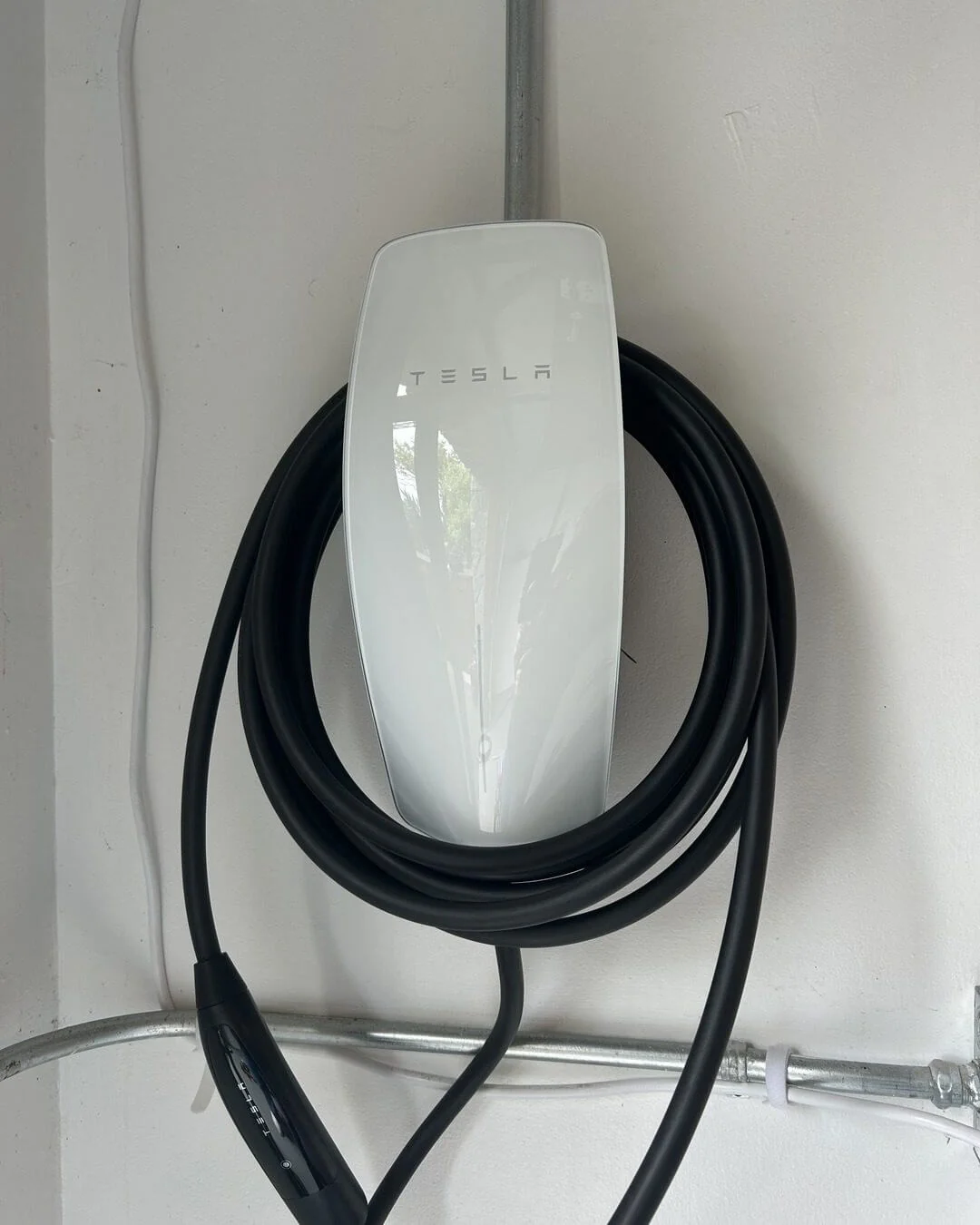
A home charger is one of the few things in a house that holds full rated current for hours, most nights, for years, so it earns a short annual look.
Heat and torque come first. Have the breaker and the charger's terminations checked once a year for the first couple of years, and be alert to discoloration or the smell of hot plastic any time the panel cover is off.
The cable and connector are the wear items, handled daily, dragged across concrete, left in the sun. Look for a cracked jacket, exposed conductor at the strain relief, darkened pins, and a latch that no longer holds. Store the connector in its holster rather than on the floor, where it collects grit that ends up in the contacts.
Pay attention to charging that got slower gradually. Chargers reduce output as they heat up, and a unit on a west-facing wall or in a closed garage on a hot Windsor afternoon has less thermal headroom than the same unit in shade. Keep connected units current on firmware, and if a second vehicle joins the household, plan the load rather than adding another oversized circuit.
Where we work in Windsor
We install chargers around the Town Green and the older streets nearest it, through Vintage Oaks, in Windsor Creek, and across the subdivisions that filled in from the 1980s onward, plus the unincorporated addresses ringing town.
One local wrinkle. Windsor is among a small number of Sonoma County places sitting only partly inside the Bay Area Air Quality Management District, per Sonoma County's air district map. None of that touches a charger, which burns nothing. How fast your panel fills with electric appliances is the real argument for building in headroom today. If a heat pump in Windsor is on your list, that is capacity to account for, and the summer cooling load already on the panel is the other half of the sum.
How to choose someone for this work
Ask whether they run a load calculation before quoting. A price given over the phone from the charger model and nothing else is a price for a guess.
Ask who pulls the permit. It should be the contractor, under the contractor's own C-10 electrical license. A homeowner-pulled permit on electrical work shifts liability onto the homeowner.
Ask whether they will discuss the charger model before you buy it, because in this county the device you choose decides what the utility program will accept. Ask about the rate plan, since a possible second meter changes the scope. And ask what happens if the inspector wants something changed. The answer should be that they take care of it. We do, and the panels we open in Windsor are frequently ones our own people have been inside before.
What North Bay homeowners say
Two things customers mention most are scheduling that holds and technicians who explain what they are doing.
Book an EV charger installation in Windsor
Book online and we will schedule a visit to look at the panel, the parking spot, and the path connecting them. You get a load calculation, a route, a hardware recommendation that keeps your utility options open, and a fixed price before anything is ordered. Charging is one piece of the electrical load in a Windsor house. See electrical work in Windsor for the wider picture, electrical panel upgrades in Windsor when the service is the constraint, and every service we run in Windsor if you are weighing several projects. We do the same work across Sonoma County, including EV charger installation in Santa Rosa just south of town.
Your Comfort, Our Priority
Ongaro & Sons is your trusted heating, cooling, plumbing, electrical, and solar expert, specializing in reliable maintenance and repair services that keep your home running efficiently year-round.
Our certified technicians deliver unmatched expertise with fast, friendly service across Marin, Sonoma and Napa County. From HVAC tune-ups to plumbing repairs and electrical upgrades or solar solutions, we focus on energy-efficient performance and long-term comfort. Count on us to maintain the systems that power your home and keep your environment just the way you like it.
Licensed, Insured, Background-Checked
Our technicians are licensed, experienced, and trained to service all makes and models.
Locally Owned and Operated
Serving the Napa, Marin, and Sonoma communities with personalized, hometown service.
Reliable Repairs
We respond quickly and get the job done right the first time, with no surprises.
Since 1932
Why Ongaro & Sons?
Four generations of trusted home service. Open any reason to see what it means for your home.
Schedule Service →Family-owned in the North Bay since 1932
Four generations of the Ongaro family serving Marin, Sonoma and Napa County. We know these homes and the systems in them.
Licensed, insured, background-checked technicians
Every technician is fully licensed and insured, background-checked, and trained on the equipment we install.
Diamond Certified and BBB A+
Diamond Certified since October 2016, and BBB Accredited with an A+ rating since December 1995.
Mitsubishi Diamond Contractor Elite and Trane Comfort Specialist
Both top manufacturer tiers. That standing decides how registration and extended warranty terms are handled on the system you actually bought.
The price is agreed before work starts
You see the number before the work begins. Flat-rate quotes, no surprises and no pressure.
Comprehensive maintenance program
Members get priority scheduling, discounts, and proactive checkups that prevent costly failures.
Discount
Membership
Ongaro Maintenance Plans
Annual maintenance on your home systems provides safeguards and comfort to you and your family. Members get priority scheduling, discounts, and proactive checkups that catch problems early.
Member Discounts
5% off every repair and replacement, all year long.
Peace of Mind
Proactive checkups catch issues before they become big problems.
Courtesy Reminders
We call you to schedule: never miss a seasonal service.
Value That Lasts
With Ongaro & Sons, you’re investing in quality, integrity, and service that stands the test of time. Explore our current promotions and see the difference real value makes for your HVAC, plumbing, and electrical needs.


From the Blog
 Sep 17, 2026
How Many Amps Does My House Need? Sizing Service for What You Actually Run
How many amps your house needs comes from a load calculation of what you run and plan to add. What drives the number, when existing service is enough, and more.
Read More Sep 10, 2026
Hard Water in Marin County: What Is Actually in Your Water and What It Does
Hard water in Marin County varies by provider and source. The 2025 report figures for Marin Water and NMWD, what hardness does and does not mean, and options.
Read More Sep 3, 2026
Electrical Permit Requirements in California: What Needs One and What Does Not
Find out which electrical projects commonly need permits, how to confirm local exemptions, and what to ask before work begins in Marin, Sonoma or Napa County.
Read MoreQuestions Windsor homeowners ask
Who is the best EV charger installation company in Windsor?
Judge it on method rather than claims. Ongaro & Sons has served the North Bay since 1932, works under a C-10 electrical license, is Diamond Certified, holds a BBB A+ Rating, and carries 2,756 Google reviews at 4.8 stars. More usefully: we calculate your service load before quoting, hardwire where the location allows, file the permit ourselves, and raise the utility enrollment question before you spend anything on hardware.
Do I need a permit to install an EV charger at my Windsor home?
Yes. State law streamlined the process without eliminating it. A home charging station is permitted work, evaluated against code by a building official rather than approved or refused on preference. Town addresses go to the Town of Windsor Building Division and unincorporated ones to Permit Sonoma. We prepare the application, arrange the inspection, and stay responsible for whatever the inspector asks to have corrected.
How long can the town take to approve an EV charger permit?
Government Code 65850.7 puts a clock on it. The statutory clock is in Government Code 65850.71. The statute puts a clock on the town rather than on you: five business days to deemed complete, twenty more to deemed approved, and only an approval, a denial, a documented adverse-impact finding or a live appeal stops it running. Those are statutory outer limits, not a promised turnaround.
Will I need an electrical panel upgrade for a charger?
Only where the arithmetic says so. Houses built during and after the town's growth from the 1980s onward frequently have a 200-amp service with capacity in reserve. Older properties near the core, or any home that has already absorbed several electric appliances, may not. A load calculation against your actual connected loads settles it, and we run one before quoting rather than after.
Can load management let me avoid a panel upgrade?
Sometimes, and it is the first path we test. A controller throttles or pauses the charger as household demand approaches the service rating, so the vehicle defers to the air conditioner instead of overloading the main. Acceptance is confirmed with the building department for your particular application. It cannot rescue a panel that is obsolete, physically full, or already unsafe.
Does Sonoma Clean Power pay for the installation?
No. The SCP program rewards enrollment, not construction. An active SCP customer who signs up an eligible Wi-Fi connected charger receives a joining bonus plus a recurring bill credit, and in return SCP may slow charging during grid stress, with the customer free to override an event at any time. Eligible hardware is currently limited to WallBox and ChargePoint models.
Should I switch to a PG&E electric vehicle rate plan?
Usually worth pricing out, and the choice carries physical consequences. EV2-A meters the house and the vehicle together and pushes everything expensive into the 4 to 9 p.m. window. EV-B bills the vehicle separately and needs a second meter installed, which is construction rather than paperwork. EV-B is also unavailable to CARE, FERA, and Medical Baseline customers, so decide before the install.
Is a hardwired charger better than a plug-in one?
For most permanent residential installations, yes. A plug-in unit on a receptacle introduces a second layer of ground-fault protection that can quarrel with the charger's own internal monitoring and produce trips with nothing wrong. Hardwiring removes that conflict and removes the plug and receptacle as heat-cycled wear points. A plug-in unit makes sense mainly when you expect to relocate it.
Why does my existing charger trip the breaker on hot afternoons?
Because the building is asking for more than the service can supply, not because the equipment is defective. Where summer cooling load is substantial, an air conditioner and a charger drawing simultaneously can exceed what the main is rated to carry, and the breaker responds as designed. A load calculation, followed by either managed charging or a larger service, resolves it permanently.
What happens to home charging during a Public Safety Power Shutoff?
No grid power means no charging, which is why shutoff exposure changes how people here plan. Practically: hold more margin in the battery during high-risk weather, and if you are adding backup generation or storage, decide during design whether the charging circuit is included or deliberately left off the backed-up loads. That call is far easier to make in advance.
What does an EV charger installation cost?
It is set by the building, not by a price list. Distance and path from the panel to the parking spot dominate, especially where hardscape or a trench is involved. Then whether the service carries the load as it stands. Then hardwired versus receptacle, charger current, weather exposure, panel condition, and whether a second meter falls inside the scope. We walk it, calculate it, and quote it before ordering.