Electrician in Mill Valley, CA
Ongaro & Sons, a North Bay company since 1932, wires, rewires, and upgrades the electrical service on Mill Valley homes, working out of our Petaluma headquarters. The C-10 electrical license is ours, the company is Diamond Certified, and 2,756 Google reviews come in at 4.8 stars on average. We run a real load calculation before we quote a panel, we pull the permit in our own name, and we put the scope in writing before anything gets opened up.
The capacity decision behind most Mill Valley electrical calls
Homeowners call about a symptom: a breaker that will not stay set, a stove that works intermittently, an outlet that runs warm, a quote for a car charger. In Mill Valley, nearly all of those calls converge on one decision, worth naming before you start shopping.
The decision is how much electrical capacity to buy, and when to buy it.
A large share of this town runs on services sized for a house with a gas range, a gas water heater, and not much else. Those stayed adequate for decades, right up until something new needs a 240-volt circuit. A car charger, a heat pump, a heat pump water heater, an induction range, a hot tub, an ADU over the garage, or a battery interconnection all land on the same panel and conductors.
The reason this is arriving now is regulatory as much as personal. Mill Valley sits fully inside the Bay Area Air Quality Management District, which adopted zero-NOx requirements for residential water heaters under Regulation 9, Rule 6, with residential point of sale standards phased across 2027 and 2031 by equipment type, so they reach what may be sold and installed rather than the unit already in place. No existing gas water heater is banned, and we confirm what is in force the day your project is permitted. What it does mean is that a house headed for a 240-volt circuit eventually is better off learning that while the panel is already open for something else.

Load first, panel second, service last
That is the order we work in, and it is worth borrowing, because it prevents the expensive mistake: buying a service upgrade to solve a problem that never required one.
Load first. Before anything is priced, the demand of the house gets calculated. Not the sum of every nameplate, which is how a home talks itself into more service than it needs, but a calculation using the accepted methods for an existing dwelling, which can incorporate measured usage history. On a house with gas heat, gas cooking, and one air conditioner nobody runs, the figure is frequently well under what the owner assumed.
Panel second. If the load fits the service but the panel is the constraint, that is a smaller job. A panel can be out of breaker spaces while the service feeding it is fine. It can also be a discontinued model, a split-bus design with no single main breaker, or a fuse panel, all of which limit what can safely be added regardless of the label.
Service last. Raising capacity brings in PG&E, changes the meter, and usually changes the conductors between the utility connection and the house. It is the right answer often enough, but it belongs at the end of the analysis rather than the start.
| Path | What it actually solves | Who else gets involved | When it is the right call |
|---|---|---|---|
| Load management, or a 120-volt equipment choice | Adds a large appliance without adding capacity, by keeping two big loads from drawing at once | Nobody beyond the permit | Calculated load is near the limit and the new appliance runs intermittently |
| New subpanel off the existing service | Adds breaker spaces and puts circuits near where they get used | Nobody beyond the permit | Spaces are short, capacity is not, and the circuits sit far from the main panel |
| Panel replacement at the same service size | Replaces an obsolete, full, or unsafe panel | PG&E, for a brief disconnect at the meter | Service size is adequate, the enclosure or the bus is the problem |
| Service size increase | Raises capacity across meter, conductors, and panel together | PG&E service planning, plus permit and inspection | Calculated load genuinely exceeds the service, or several projects are coming |
Most projects in town land on a middle row. The homes that truly need the bottom row are stacking three or four changes at once: charger, heat pump, water heater, battery.
The load calculation is what settles it
A service has four separate limits in play, and the smallest one governs: the utility connection and its conductors, the meter and main disconnect, the panel's busbar (the metal spine breakers clip onto, which is not always rated the same as the main breaker), and each branch circuit's conductor size. A house labeled 200 amps can still be pinched somewhere in that chain. A house labeled 100 amps sometimes has more usable headroom than its owner believes.
Mill Valley adds physical variables that move the answer more than they would elsewhere. Service is often overhead, with the drop running through mature canopy on lots subdivided long before anyone thought about conductor clearances. The mast and weatherhead on a shingled hillside house may be forty or more years old, and a service change is the moment their condition matters. Runs are long: on a steep lot the distance from the meter to a detached garage or a lower-level ADU is real conductor length, and voltage drop over it is part of the design.
Then there is what is already in the walls. Older homes here turn up knob-and-tube in unfinished sections, cloth-insulated conductors gone brittle at the terminations, ungrounded two-prong circuits, and occasional aluminum branch wiring from the late 1960s and 1970s. None of that is automatically a crisis. All of it changes scope, and finding it after a quote is signed is how projects go sideways.
I recently called Ongarro and Sons about a tricky problem involving an intermittently operative stove and a balky breaker box. Their technician, Rene, sorted everything nicely and (bonus!) taught me a lot about how electricity works.
Glenn H.
What the work looks like on a hillside lot
This is where Mill Valley stops resembling a flat suburban job. Material gets carried up stairs and down driveways a truck cannot back into. A trench for an underground feed meets rock and roots, and creek-adjacent lots bring drainage into where it can run at all. On the day a service is changed, power is off while the meter is pulled and new equipment is set, so refrigeration, medical equipment, and anyone working from home get planned around.
Our electricians handle utility coordination, the permit, the inspection appointment, and the restoration of whatever had to be opened to get conductors where they needed to go. Plaster and lath, board siding, and shingle exteriors each behave differently when a run passes through, and putting them back is written into the scope rather than left as a surprise.
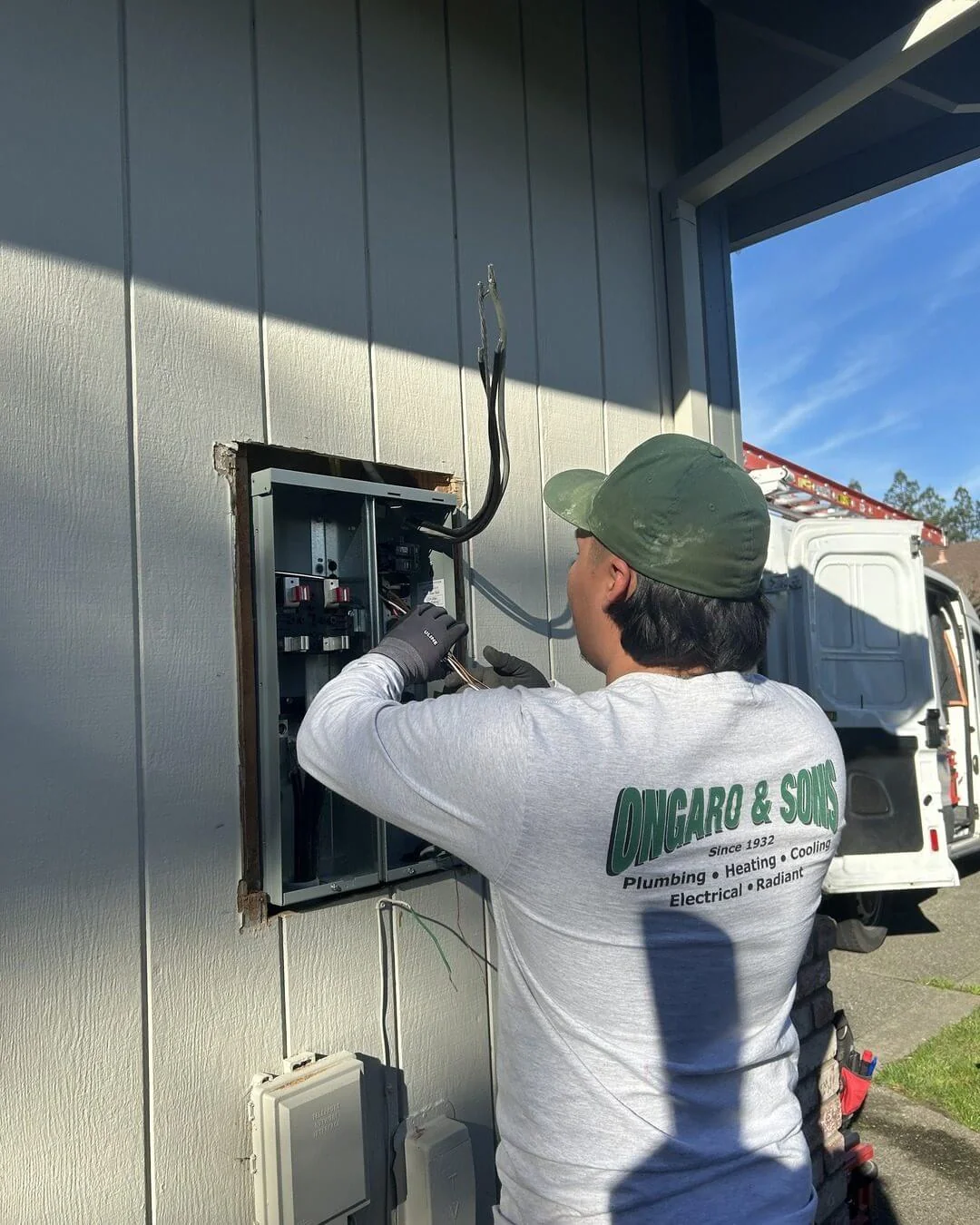
Every electrical service line we run in town
Panel and service upgrades. Replacing an obsolete, full, or damaged panel, and raising capacity when the calculation supports it. Detail lives on our Electrical Panel Upgrade in Mill Valley page.
Car charger installation. Circuit design, breaker sizing, the run from panel to parking, and the load question that decides whether a charger goes in at full output or with load management. Garages here are often under the house or across a driveway from it, which makes run length a genuine design input. See EV Charger Installation in Mill Valley.
Standby generators and home batteries. We are a Certified Generac Generator installer, and on the wooded hillsides above town the case for backup power is not abstract: PG&E calls Public Safety Power Shutoffs when wind and dry fuel conditions align. A generator runs as long as it has fuel. A battery is silent, needs no delivery, and pairs with solar. Either is an interconnection and transfer-equipment job as much as an appliance purchase, and either can force a panel decision, since a busbar limits how much back-feed it accepts alongside its main breaker.
Rewiring and older circuit remediation. Replacing knob-and-tube and brittle conductors, grounding circuits that never had a ground, correcting past unpermitted work, and sequencing it so a family can stay in the house throughout.
Subpanels for garages, studios, and ADUs. Detached structures on sloped lots need a correctly sized feeder, proper grounding and bonding at the remote building, and a disconnect where code requires it.
Circuits for electrification. The 240-volt circuit behind a heat pump, a heat pump water heater, or an induction range. We hold C-20 and C-36 alongside the C-10, so appliance and circuit come from one company instead of two that blame each other.
Lighting, inside and out. Recessed fixtures in older ceilings with no attic above them, under-cabinet work, and exterior lighting on stairs, paths, and decks, which on this terrain is a safety item rather than decoration.
Outlets, switches, GFCI and AFCI protection. New kitchen and bath circuits, ungrounded receptacles replaced correctly instead of swapping in a three-prong outlet with nothing behind it, and protective devices where they belong.
Diagnostics. Intermittent faults, warm cover plates, buzzing panels, flickering that tracks one appliance, and trips that occur only under a single combination of loads. Patient work, and where an experienced electrician earns the visit.
Alarm wiring and surge protection. Hardwired, interconnected smoke and carbon monoxide alarms, plus whole-home surge protection at the panel, which matters more where outages and restorations repeat.
The building stock runs from National Register listed structures downtown to postwar hillside houses to recent remodels, and the answer differs in each one.

Permits, inspection, and who has jurisdiction
Inside the city limits, electrical permits come from the City of Mill Valley Building Division through the city's online portal. Its permit application process page is unusually specific for a small city, and two details are worth knowing.
First, the city lists panel replacements up to 200 amps, main electrical service, and subpanels among permits it issues automatically, with a published timeframe of generally within one week. Second, it places battery backup and car charger permits in a minor-review category with a published timeframe of one to three business days. That is a favorable structure for exactly the projects homeowners here are doing, and it is why a well-prepared application moves quickly.
A Mill Valley mailing address does not always sit inside the city. Several areas around town are unincorporated Marin County, where the Marin County Community Development Agency issues the permit instead, with a different submittal path and a different inspector. Confirming jurisdiction from your parcel is the first thing we do, because getting it wrong costs a week.
For car chargers the clock is not local discretion. California Government Code 65850.7 requires every city and county to adopt an expedited, streamlined permitting process for electric vehicle charging stations, and states a jurisdiction "shall administratively approve an application to install electric vehicle charging stations through the issuance of a building permit or similar nondiscretionary permit." Review is ministerial rather than discretionary. The deadlines are in 65850.71 rather than in the section above. An application for one to twenty-five stations counts as complete five business days after submission and as approved twenty business days after that, unless the building official has acted, made adverse-impact findings, denied it, or an appeal is pending. A permit is still required; the statute streamlines it.
The energy rules a permitted project is measured against come from the state. California's 2025 Building Energy Efficiency Standards took effect January 1, 2026, and are administered locally by the same department that issues your permit.
Skipping the permit is a bad trade: unpermitted work surfaces during a sale or an insurance inspection, and unwinding it costs more than the permit would have.
What drives the cost
We do not publish prices, because a panel is not a product with a price. Here is what moves the number, so you can read any quote intelligently.
Whether the utility has to be involved is the biggest fork in the road: a swap at the same service size and a capacity increase are different projects on different timelines. Overhead versus underground comes next, since an overhead drop may need mast and weatherhead work while an underground feed means trenching, and on a rocky slope the trench is a large share of the job. Distance is its own driver, from meter to panel and from panel to wherever the new circuit ends.
Access shapes labor: crawlspace height, attic clearance, stair-only entry, and driveways that will not take a truck all add hours before a conductor gets pulled. Wall finish and restoration matter, particularly in plaster rooms. What we find (brittle insulation, corroded terminations, previous unpermitted work) expands or contracts scope. Circuit count, equipment size, and whether load management can avoid a service change all land on the total, as do permit fees, the inspection cycle, and temporary power.
I recently hired Ongaro & Sons for electrical work throughout my house. Their service was nothing short of excellent!
Christopher W.
Rebates and incentives, and their scope
Mill Valley's community choice electricity provider is MCE, which serves Marin and Napa. One structural point matters more than any single program: incentives overwhelmingly pay for the appliance, not for the electrical capacity that makes the appliance possible. Panel work is the enabling cost nothing reimburses directly, which argues for sizing correctly once rather than paying to open the same wall twice.
MCE's residential programs include rebates for heat pump water heaters and heat pump space conditioning, a home energy assessment with efficiency upgrades for qualifying single-family homes, a bill credit for using a home battery daily in the late-afternoon window, and MCE Sync, a smart-charging app. Its EV Instant Rebate is currently listed as unavailable due to demand, with a signup to be notified when it reopens.
MCE's EV charging program is aimed at workplaces, multifamily properties of four or more units, and commuter parking lots, so it will not pay toward a charger on a Mill Valley house. That is a narrow statement and it gets repeated as a broad one, which costs people money. Two things do reach a single-family home here. MCE Sync is a smart-charging reward open to any MCE residential customer with a compatible vehicle or charger, paying a sign-up bonus and recurring cash back for shifting charging to cleaner, cheaper hours; it funds behavior, not hardware.
And the equipment itself sits under PG&E's Residential EV Charging rebate, whose terms state in as many words that Community Choice Aggregation customers are eligible. Being an MCE customer does not put you outside it. We check both at the estimate, because terms change and the program can be altered at any time.
MCE's heat pump rebates are the local program, and they reach electrical work only indirectly: they pay toward the appliance, not toward the service that appliance requires. Conditions are twelve months of ownership and residency in a single-family detached home, a participating contractor who files the application, and no retroactive claims.
A service upgrade was never separately creditable, so the change is that it can no longer travel alongside a qualifying appliance.
Maintenance worth doing
Electrical systems do not need seasonal service the way a furnace does, but a short list of checks catches problems before they become damage.
Test GFCI devices monthly with the test button, and test AFCI breakers on the schedule printed on the breaker. Press the test button on every smoke and carbon monoxide alarm, and replace alarms at the end of their listed service life rather than when they start chirping. Look at the outside of your panel a few times a year: rust streaks, staining below the enclosure, or a door that no longer seals are early signs of moisture intrusion, which happens faster in these shaded canyons than owners expect. If you have a standby generator, let its scheduled self-test run and keep the air intake clear of leaf litter.
Watch patterns rather than single events. A warm cover plate, a persistent buzz at the panel, lights that dim when a motor starts, and a burning smell that comes and goes all deserve a diagnostic visit rather than a bigger breaker. Fitting a larger breaker to stop nuisance trips is the most dangerous thing a homeowner can do to their own house, because that breaker was protecting a conductor whose size has not changed.
How to choose an electrician for this work
Five questions sort contractors quickly. Do they hold a C-10 electrical license, and can you verify their license status and coverage yourself? Will they pull the permit in their own name, or push it onto you and transfer the liability with it? Does a load calculation happen before the quote, since a panel size quoted sight-unseen is a guess that runs high? Who coordinates with PG&E if the utility's schedule slips? What does the scope say about restoring finishes, because "electrical only" leaves you holding a drywall project.
Then read that written scope. It should name the equipment, the service size, the circuits added, the permit, the inspection, and the exclusions. One line and one number is not a scope.
What North Bay homeowners say
Two reviews that describe the electrical work we do most often:
Book electrical work in Mill Valley
Tell us what the house is doing and what you want to add, and we start with the calculation rather than the quote. Book online and we will look at the panel, the meter, the service, and the route new work has to take, then hand you a written scope with the permit path spelled out. More from Ongaro & Sons nearby: Electrical Panel Upgrade in Mill Valley, EV Charger Installation in Mill Valley, Heat Pump in Mill Valley, Water Heater in Mill Valley, and Solar in Mill Valley. The full list for this town sits on the Mill Valley service area page, neighboring towns on Electrical in Sausalito and Electrical in Corte Madera, and the countywide view on Electrical in Marin County.
Your Comfort, Our Priority
Ongaro & Sons is your trusted heating, cooling, plumbing, electrical, and solar expert, specializing in reliable maintenance and repair services that keep your home running efficiently year-round.
Our certified technicians deliver unmatched expertise with fast, friendly service across Marin, Sonoma and Napa County. From HVAC tune-ups to plumbing repairs and electrical upgrades or solar solutions, we focus on energy-efficient performance and long-term comfort. Count on us to maintain the systems that power your home and keep your environment just the way you like it.
Licensed, Insured, Background-Checked
Our technicians are licensed, experienced, and trained to service all makes and models.
Locally Owned and Operated
Serving the Napa, Marin, and Sonoma communities with personalized, hometown service.
Reliable Repairs
We respond quickly and get the job done right the first time, with no surprises.
Since 1932
Why Ongaro & Sons?
Four generations of trusted home service. Open any reason to see what it means for your home.
Schedule Service →Family-owned in the North Bay since 1932
Four generations of the Ongaro family serving Marin, Sonoma and Napa County. We know these homes and the systems in them.
Licensed, insured, background-checked technicians
Every technician is fully licensed and insured, background-checked, and trained on the equipment we install.
Diamond Certified and BBB A+
Diamond Certified since October 2016, and BBB Accredited with an A+ rating since December 1995.
Mitsubishi Diamond Contractor Elite and Trane Comfort Specialist
Both top manufacturer tiers. That standing decides how registration and extended warranty terms are handled on the system you actually bought.
The price is agreed before work starts
You see the number before the work begins. Flat-rate quotes, no surprises and no pressure.
Comprehensive maintenance program
Members get priority scheduling, discounts, and proactive checkups that prevent costly failures.
Discount
Membership
Ongaro Maintenance Plans
Annual maintenance on your home systems provides safeguards and comfort to you and your family. Members get priority scheduling, discounts, and proactive checkups that catch problems early.
Member Discounts
5% off every repair and replacement, all year long.
Peace of Mind
Proactive checkups catch issues before they become big problems.
Courtesy Reminders
We call you to schedule: never miss a seasonal service.
Value That Lasts
With Ongaro & Sons, you’re investing in quality, integrity, and service that stands the test of time. Explore our current promotions and see the difference real value makes for your HVAC, plumbing, and electrical needs.


From the Blog
 Sep 17, 2026
How Many Amps Does My House Need? Sizing Service for What You Actually Run
How many amps your house needs comes from a load calculation of what you run and plan to add. What drives the number, when existing service is enough, and more.
Read More Sep 10, 2026
Hard Water in Marin County: What Is Actually in Your Water and What It Does
Hard water in Marin County varies by provider and source. The 2025 report figures for Marin Water and NMWD, what hardness does and does not mean, and options.
Read More Sep 3, 2026
Electrical Permit Requirements in California: What Needs One and What Does Not
Find out which electrical projects commonly need permits, how to confirm local exemptions, and what to ask before work begins in Marin, Sonoma or Napa County.
Read MoreFrequently asked questions
Who is the best electrician in Mill Valley?
Judge on license class, local track record, permit practice, and independent verification. Ongaro & Sons has served the North Bay since 1932, holds a C-10 electrical license, is Diamond Certified, holds a BBB A+ Rating, and our Google rating stands at 4.8 stars across 2,756 reviews. We permit and inspect every job that requires it.
Do I need a permit for electrical work in Mill Valley?
For anything past a like-for-like device swap, yes. Panel replacements, capacity changes, subpanels, new circuits, chargers, and battery installations are all permitted work. The city publishes its categories and timeframes, and a well-prepared application in the automatic-issue group moves in roughly a week. We file the application and schedule the inspection as part of the job.
My address says Mill Valley. Why would the county issue my permit?
Because postal addresses and city limits are not the same map. Parts of the area around town are unincorporated Marin County, which puts jurisdiction with the Marin County Community Development Agency rather than the city. The portal, the fee schedule, and the inspector all differ. We verify which applies to your parcel before anything is filed.
Is 100-amp service enough for a heat pump and a car charger?
Sometimes, and more often than owners assume. It turns on the calculated demand of your specific house, not a rule of thumb. A home with gas heating and cooking carries meaningful headroom. Load management, which keeps two large appliances from drawing simultaneously, extends that headroom further. The calculation answers this question; nothing else does.
What is a load calculation, and why does it come before a quote?
It is a documented estimate of the demand your home places on its service, using accepted methods for an existing dwelling that can draw on measured usage history. Building departments expect to see it, and it settles whether you need a panel, a capacity change, or neither. Pricing without one is guesswork, and guesswork costs you in one direction or the other.
How fast can a car charger permit move?
State law sets the outer bound. The clock sits in the companion section, 65850.71, rather than in 65850.7. An application covering between one and twenty-five charging stations is deemed complete five business days after submission and deemed approved twenty business days later, unless the building official acts first, denies it, or an appeal is pending. Mill Valley's published timeframe for its battery and charger category is shorter than that ceiling.
Can a load management device replace a service upgrade?
Frequently, yes. These devices watch demand and shed or pause a large load as the house approaches its limit, letting a charger and a range share capacity that could not support both at once. They do not fix a failing panel, an undersized busbar, or corroded gear, and they need a design reflecting how your household uses power.
What should I do about knob-and-tube or cloth-insulated wiring?
Do not panic and do not ignore it. Knob-and-tube is not inherently unsafe in undisturbed original condition, but it has no ground, it overheats when buried in insulation, and decades of amateur splices are common. Cloth insulation grows brittle at terminations, exactly where heat lives. We assess what is present, rank it by risk, and stage replacement around the household.
Does MCE pay for the electrical work behind an electrification project?
Not directly. MCE rebates attach to qualifying equipment such as heat pump water heaters and heat pump heating and cooling systems, plus a home energy assessment and a bill credit for daily battery use. The wiring, circuit, and panel capacity that make the appliance installable are generally the owner's cost, which is why sizing once beats sizing twice.
Standby generator or home battery for Public Safety Power Shutoffs?
It depends on duration and tolerance. A generator keeps running as long as fuel holds out, which suits a multi-day wind event on a wooded hillside, and we are a Certified Generac Generator installer. A battery makes no noise, has no fuel logistics, and recharges from rooftop solar in daylight, which suits shorter interruptions. Both need interconnection design and a permit.
Which PG&E rate plan applies once I charge at home?
Two exist, per PG&E's electric vehicle rate plans. EV2-A blends household and vehicle use on your existing meter, with off-peak hours from midnight to 3 p.m., and excludes customers above 800% of baseline allowance over the prior twelve months. EV-B keeps vehicle use on a second dedicated meter, is unavailable with CARE, FERA, or Medical Baseline, and that meter changes the installation scope. A third plan, E-ELEC, covers households adding an electric vehicle, battery storage or an electric heat pump. Being partly electric is enough; the whole house does not have to be.
Why do outdoor panels here corrode faster than expected?
Shaded canyons hold moisture. An enclosure spending most of the day out of direct sun, under canopy, where fog and winter rain keep humidity high, dries slowly. Water finds a failed gasket, a door that no longer closes flush, or an unsealed conduit entry, then sits on the bus and the terminations. Corrosion at a connection creates resistance, and resistance creates heat.