Solar in Mill Valley, CA
Ongaro & Sons designs and installs rooftop solar and battery storage in Mill Valley, working from our Petaluma headquarters. We are Diamond Certified, we hold a C-10 electrical license and a BBB A+ Rating, and we carry 2,756 Google reviews averaging 4.8 stars. Because the electrical license is ours rather than a subcontractor's, the panel work and the interconnection are part of the same project rather than a handoff.
On this page
The decision, stated plainly
In most of the North Bay the solar decision is about how large an array to buy. In Mill Valley it is a different question, and it comes in three parts.
Will this roof produce enough to be worth doing? Redwood and oak canopy plus canyon walls mean two houses on the same street can have completely different answers. This is the question, and it has to be measured rather than estimated.
If it will, is the point of the project the bill or the outage? Those lead to different designs. An array sized to offset consumption and an array sized to keep a house running through a multi-day shutoff are not the same system, and one of them includes a battery and transfer equipment.
And what has to happen first? Roof condition, panel capacity and rebate timing all sit upstream of the array, and getting them out of order is the expensive mistake in this town.
Nobody should spend money finding out the answer to the first question. We answer it before a proposal exists, and if a roof does not work we say so.
Measure first, then sequence
The order is not negotiable.
Measure means a shade study of your actual roof planes across the year, not a satellite estimate of your address, plus a look inside the panel and up at the roof covering. Under canopy, shading varies by season and by hour in ways an aerial image cannot capture, and it changes as trees grow.
Sequence means deciding what happens in which order once the numbers exist: re-roof or not, panel work or not, heat pump before or after, and where the battery sits in that chain. On a Mill Valley house the sequence decision usually saves or costs more than the equipment decision does.
| Path | When it is right | What it leaves unsolved | What decides against it |
|---|---|---|---|
| Array only, no storage | Good exposure, the goal is offsetting consumption, and outages are tolerable | Every power shutoff, since a grid-tied inverter shuts down with the grid | Wanting the house to run when the power is off |
| Array plus storage | Good exposure and a real outage concern, which describes most of this town | The very long outage on a heavily overcast winter week, unless sized for it | Panel or service limits that have to be addressed first |
| Storage added to an existing array | An older system that predates the outage concern | Nothing, if the existing inverter can pair with a battery, which is the catch | An inverter never designed for storage, which means replacing it |
| Standby generator instead of storage | Heavy backup loads, deep shade, or a roof that genuinely cannot carry an array | Producing your own energy the rest of the year | Fuel, noise and siting constraints on a close-set canyon lot |
| Do the roof first, solar after | The covering has fewer than about ten years left | Nothing, and it is frequently the cheapest overall sequence | Very little, which is why we raise it early |
Shade decides most Mill Valley projects
A shade study models what each roof plane will produce hour by hour across the year, accounting for the canyon wall to the west, the neighbor's redwood to the south, and the fact that the tree in question is going to be taller in five years than it is today.
What comes out of it is usually more nuanced than yes or no. A north-facing plane under heavy canopy is not worth mounting. A south or west plane with morning shade and clear afternoon exposure may produce well despite looking compromised from the street. Module-level electronics matter here more than almost anywhere: without them, one shaded module drags down everything on its string, and on a cut-up canyon roof that is a large penalty. With them, partially shaded areas keep contributing.
Two Mill Valley realities limit the usual workarounds. Lots are small and sloped, so the ground mount that solves a shaded roof on a rural parcel is rarely available here. And the trees causing the shade are frequently protected, mature, on a neighbor's property, or all three, so removing them is rarely the option people hope for.
The upshot is that the shade study is not a step on the way to a sale. It is the deliverable that tells you whether there is a project.
Robert was very pleasant, professional, and informative. It was nice to receive a call advising that he was on his way, and an email showing me what he looks like. My dog liked him, too!
Kathryn W.
What has to be checked before anything is fastened down
Older framing on sloped-lot houses needs evaluating before an array is attached to it. Rafter size and spacing, sheathing type and condition, and whether anything needs reinforcement all get looked at, and skip-sheathed roofs from the earlier building era are the common finding.
Roof covering sets the sequence. If the covering has fewer than roughly ten years of life left, replacing it first is usually the cheaper overall path, because modules outlast most roofing and mounting an array over a tired roof buys you a removal and reinstall later that gains nothing. Layer count matters too, since more than one layer of composition adds weight and complicates flashing at every mount.
Strawberry deserves its own note. Alongside the conventional housing there is a small Eichler group of about a dozen homes, and those are a different job entirely. Low-slope construction changes the mounting system, the flashing detail and the wind uplift calculation. With no attic and often no crawl space, because the original heating is in-slab radiant, conduit routing has to be designed rather than improvised, and exposed post-and-beam ceilings mean any penetration is visible from inside the house. Done with that understood, they take solar well. Our Eichler home services page covers that stock across the county.
The electrical side, which is where Mill Valley projects get expensive
Interconnection is an electrical question before it is a solar question, and on the older streets and up the canyon roads it is frequently the binding constraint rather than the roof.
What matters is not the amperage printed on the panel door. It is the busbar rating, the available breaker space, and where the connection can legally land: as a load-side breaker, through a busbar-rated arrangement, or ahead of the main. We routinely find services sized for a much shorter appliance list, sub-panels added across decades, obsolete breaker types no longer manufactured, and no free space for a two-pole breaker of any size. None of that is a defect until an array or a battery asks to join.
There are legal alternatives to a full service upgrade, and they have to be evaluated at the panel rather than assumed from the street. We do that assessment before quoting, which is the reason a proposal from us either includes the panel work or explains why it is not needed. That scope is covered on our Mill Valley panel upgrade page, and the wider trade on our Mill Valley electrical page.
If a car charger is anywhere in your plans, it belongs in this conversation rather than a later one, because the load calculation and the panel decision cover both. See EV charger installation in Mill Valley.
What the storage is being asked to carry
PG&E may turn off power during severe weather to reduce the risk of its equipment causing a wildfire, through the program it calls a Public Safety Power Shutoff. The wooded hillsides here carry genuine exposure, and because these are planned multi-day events rather than brief faults, the design target is living normally rather than keeping a refrigerator cold.
Building the load list is the real design work, and in Mill Valley it usually looks like this. Refrigeration, lighting circuits, internet and any medical equipment are the non-negotiable core. Heating is the one people underestimate: a heat pump needs power, and so does a gas furnace, because its inducer, blower, igniter and controls are all electric, so fuel type offers no protection. Well pumps and sewage ejector pumps, where a house has one, come next. Then the discretionary items.
A critical loads subpanel is usually the right shape here rather than whole-home backup, because it keeps the scope proportional to a service that was never built for it and it makes the battery last longer on the loads that matter. Where a household wants more, load management hardware often beats simply buying more battery.
For some houses, particularly those with deep shade and heavy backup loads, a standby generator is the better fit or the right companion to a smaller battery. We are a Certified Generac Generator installer, so we can put that comparison in front of you rather than steering it.
Permits, code and the two authorities
A Mill Valley mailing address does not tell you who issues your permit. Marin County's own permit site lists Mill Valley Homestead Valley, Mill Valley Strawberry and Mill Valley Tamalpais Valley among unincorporated Marin, so those parcels are reviewed and inspected by Marin County Building and Safety, which since January 1, 2026 no longer accepts paper plan submittals. Parcels inside the city limits go through the City of Mill Valley Building Division, whose permit application process page lists express permits at "1 - 3 Business Days," minor permits receiving review at "7 - 10 Business Days," and standard residential plan check at a "4 - 6 Week Minimum."
State law limits how much discretion either authority has. Government Code 65850.5 requires every city and county to "adopt an ordinance ... that creates an expedited, streamlined permitting process for small residential rooftop solar energy systems," published with "a checklist of all requirements," and an application that "satisfies the information requirements in the checklist" "shall be deemed complete." Jurisdictions must also "allow for electronic submittal of a permit application." More recent state law requires most jurisdictions to offer online, automated, instantaneous permitting for residential solar and storage, tracked through the California Energy Commission's residential solar permit reporting program. Which platform a given jurisdiction has adopted varies, so we confirm the route rather than promising a turnaround.
The building permit is also only half the calendar. Interconnection and permission to operate run on the utility's clock, separately from the building department's, and the gap between a finished installation and a system legally producing is usually set by that sequence rather than by anything a crew does on the roof.
Always fantastic service from Ongaro! We have had them work on our house across the board for electrics, water and HVAC and are never disappointed!
Emma W.
What drives the price here
We do not publish figures, because a number without the house attached to it is noise. What moves a Mill Valley proposal, roughly in the order it decides the total:
The shading strategy comes first, because it decides the equipment. Module-level electronics recover real production on a cut-up or partially shaded roof and cost more than the straight string design an open tract roof can use, and on most roofs in this town they are not optional.
Plane count, pitch and height come next. A two-story steep roof broken into several small faces takes far longer to lay out, stage and secure than one long plane, and fall protection setup is real time on every face.
Roof covering and condition follows, including layer count, framing, and whether a re-roof belongs ahead of the array.
Service and interconnection is where the older housing costs money: whether the panel can accept the backfeed, whether the busbar rating allows it, and whether a main panel replacement or a meter main is required.
Storage quantity and backup scope is next, and the difference between a critical loads subpanel and whole-home backup with automatic transfer is design rather than hardware alone.
Access is last on the list and never trivial here. Stair carries, no driveway, restricted street parking and gates too narrow to move materials through are ordinary conditions on a canyon lot, and each of them is a scope item that belongs in writing.
You get the price before work begins, and financing exists so the storage decision is not made purely on one budget year.
Incentives, and the timing rule that catches people
MCE is the community choice energy provider for Marin, and its rules are sequencing rules rather than amount rules. MCE's heat pump rebates are open to "MCE customers who own and have lived in their single-family detached homes for at least 12 months in MCE's service area," and MCE adds that "if your home has solar or EV charging, the equipment must have been installed for at least 12 months." A qualifying project must be installed by a participating contractor who files the paperwork, and "MCE's rebates cannot be applied to a project retroactively." MCE also asks that further electrification work, solar and battery storage and EV charging included, not follow within twelve months of a rebated installation.
Put those together and the trap is clear: installing an array shortly before a heat pump, or shortly after one, can cost you a rebate you would otherwise have qualified for. If both are on your list, decide the order at the start. That is one of the concrete reasons to use a contractor who holds the electrical, mechanical and plumbing licenses together rather than coordinating three companies who each see one piece.
For the array itself there is very little left. Storage is the exception: the CPUC's Self-Generation Incentive Program still covers advanced energy storage and combined solar and storage, so a battery has a funding path an array no longer does. That asymmetry is worth designing around: on a canyon roof, storage is doing more of the economic work than the panels are anyway.
What you get paid for exported energy
Under the CPUC's Net Billing Tariff, an exported kilowatt hour now earns what it is worth to the grid at the moment it arrives rather than the retail rate you would otherwise have paid, the older net metering tariffs are "closed to new enrollments," and generation "is first used to serve onsite load." On a shaded canyon lot, where production concentrates into fewer good hours, that pushes even more weight onto self-consumption and storage sizing than it does on an open roof.
The design consequence is direct. Energy you consume yourself is worth what you would otherwise have bought it for. Energy you export is worth whatever the grid values it at in that hour. That is why right-sizing to actual household usage and adding storage now beats building the largest array a roof will hold, and why a proposal still modeled on retail-rate export credits is describing rules that no longer apply.
How the work gets done
Staging is planned before the morning on these streets, because parking and access are constrained and improvising a materials route on a canyon lot is how railings and landscaping get damaged.
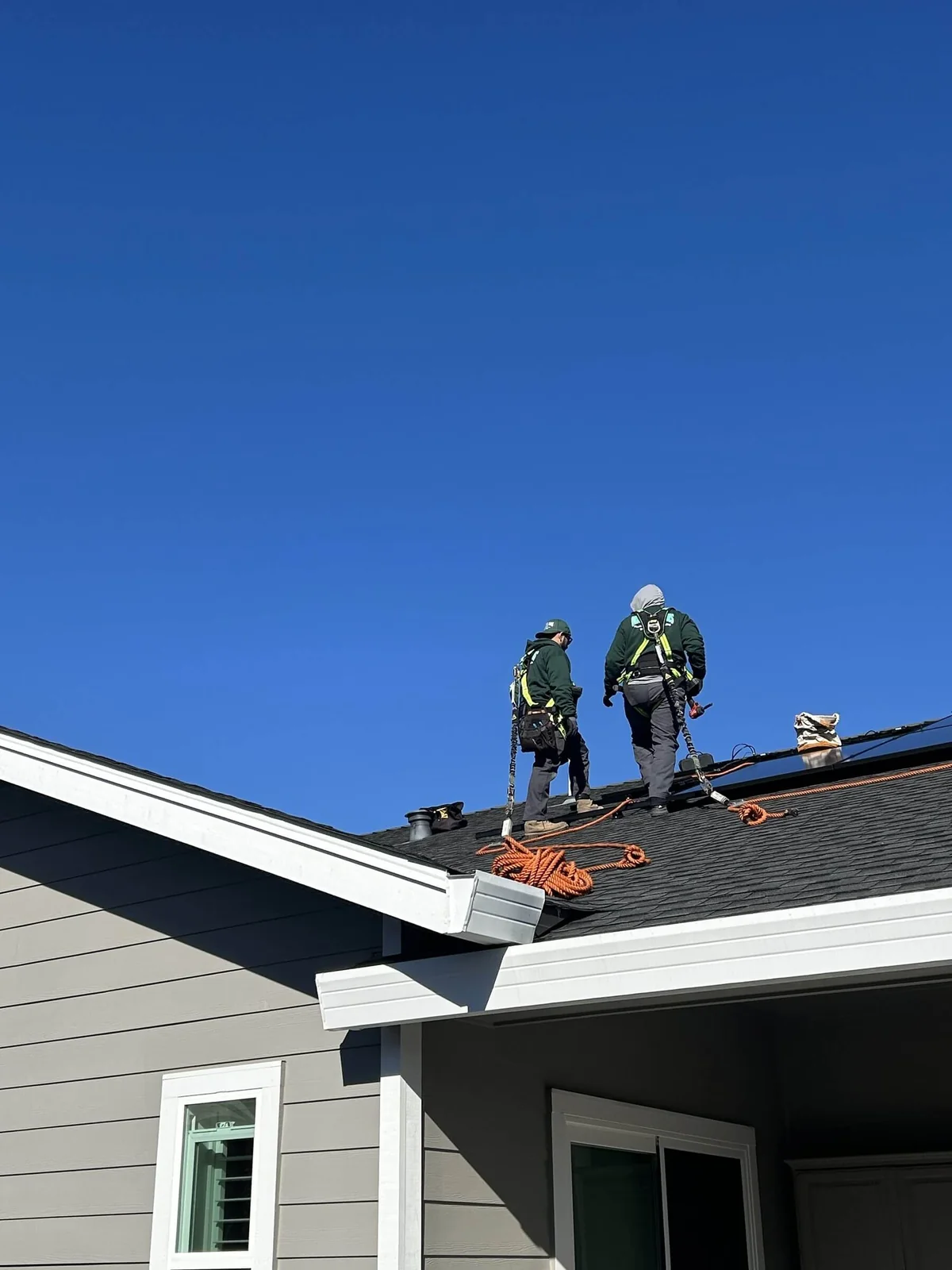
On the roof, fall protection goes up before anything else and stays up. Mounts are set into structure rather than sheathing, flashed to the covering type rather than sealed with caulk, and laid out to the plan the shade study produced instead of to whatever fits fastest. Conduit runs are planned for appearance as well as code, which on a house with exposed ceilings or a prominent street elevation is not a minor consideration.
At the panel, the interconnection is made the way the assessment said it would be, labeled properly, with disconnects located where an inspector and a future electrician can find them. Storage brings its own scope: siting that respects clearances and heat, transfer equipment that actually isolates the house from the grid, and a critical loads subpanel wired to the load list you signed off on rather than a default.
Then commissioning: verifying string voltages and polarity, confirming production against the model rather than assuming it, setting up monitoring so you can see the system, and walking you through what a normal week looks like on the app so an abnormal one is recognizable. We handle the inspection and the interconnection paperwork, and we register the equipment warranties.
Maintenance, because an array fails quietly
Solar has few moving parts, which is exactly why a neglected system underperforms for years without anyone noticing. Monitoring is the maintenance: if nobody reads the production data, a failed optimizer or a tripped string just becomes a higher bill.
Mill Valley adds one pattern specifically. Under canopy, pollen and redwood, oak and bay debris accumulate on modules and in the gaps behind them, and a shading change from ordinary tree growth shows up as a slow year-over-year decline that looks like nothing at all from the ground. Comparing each month against the same month last year is the habit that catches it. The first serious rain does much of the cleaning, though not all of it, and debris that lodges under the array does not wash out.
The owner's part is short: watch the production data, trim the trees, and keep battery firmware current with the warranty registered. A battery that has never been asked to discharge is not evidence that it will. And plan the re-roof, because removing and reinstalling an array is far cheaper to schedule than to discover. Our maintenance program covers the home's mechanical and electrical systems.
Where we work in Mill Valley
Downtown holds the oldest housing, the steepest and most cut-up roofs, the heaviest street-tree shading, and the smallest services. It is the part of town where the answer is most often nuanced rather than simple.
Homestead Valley is wooded and sloped, and it is unincorporated, so the county issues the permit even though the mail says Mill Valley.
Tamalpais Valley sits lower and flatter toward the bay margin, with more open sky than the canyons and easier access, which makes it some of the better solar ground in town.
Strawberry reaches toward Richardson Bay with open afternoon exposure, and it includes the small Eichler group described above, where the roof type rather than the shading is the design driver.
Nearby city solar pages: Sausalito, Corte Madera, Belvedere, San Rafael and Novato, with the county picture on our Marin County solar page. The full Mill Valley service matrix covers everything else we do here.
How to choose a solar contractor for a canyon house
Ask to see the shade study, not a production number. A model built from a satellite image of your address is a guess dressed as a forecast, and in this town the difference is the whole project.
Ask who holds the electrical license and whether the panel work is in house or subcontracted, because the service is where the surprises live on Mill Valley housing.
Ask which authority issues your permit, and see whether the answer arrives immediately.
Ask what the proposal assumes about exported energy, because a model running on retail-rate credits is describing a tariff that no longer exists for new systems.
Ask what happens during a power shutoff under the proposed design, and make them answer specifically rather than generally.
Ask about roof remaining life and who pays to remove and reinstall the array if the covering fails in six years.
If a heat pump is in your plans, ask how the MCE twelve-month rule affects the order of the two projects.
And verify the license class: C-10 for electrical, checkable on the Contractors State License Board site.
What North Bay homeowners say
Two notes from customers, unedited.
Solar and electrical across Mill Valley and Marin County
More on what we do here: electrical in Mill Valley, panel upgrades in Mill Valley, EV charger installation in Mill Valley, HVAC in Mill Valley, heat pumps in Mill Valley, furnace repair in Mill Valley, plumbing in Mill Valley, water heaters in Mill Valley, tankless water heaters in Mill Valley, drain cleaning in Mill Valley, sewer repair in Mill Valley, and the full Mill Valley service area. Across the county: solar in Marin County, electrical, plumbing and heating and cooling.
Book a solar assessment in Mill Valley
Book online and we will put a site visit on the calendar. We model the shading on your specific roof planes, look at the covering and the framing, open the panel, and tell you what your house will support, including what it would take to keep it running when the grid is off. If the answer is that this roof does not work, you will hear that.
Your Comfort, Our Priority
Ongaro & Sons is your trusted heating, cooling, plumbing, electrical, and solar expert, specializing in reliable maintenance and repair services that keep your home running efficiently year-round.
Our certified technicians deliver unmatched expertise with fast, friendly service across Marin, Sonoma and Napa County. From HVAC tune-ups to plumbing repairs and electrical upgrades or solar solutions, we focus on energy-efficient performance and long-term comfort. Count on us to maintain the systems that power your home and keep your environment just the way you like it.
Licensed, Insured, Background-Checked
Our technicians are licensed, experienced, and trained to service all makes and models.
Locally Owned and Operated
Serving the Napa, Marin, and Sonoma communities with personalized, hometown service.
Reliable Repairs
We respond quickly and get the job done right the first time, with no surprises.
Since 1932
Why Ongaro & Sons?
Four generations of trusted home service. Open any reason to see what it means for your home.
Schedule Service →Family-owned in the North Bay since 1932
Four generations of the Ongaro family serving Marin, Sonoma and Napa County. We know these homes and the systems in them.
Licensed, insured, background-checked technicians
Every technician is fully licensed and insured, background-checked, and trained on the equipment we install.
Diamond Certified and BBB A+
Diamond Certified since October 2016, and BBB Accredited with an A+ rating since December 1995.
Mitsubishi Diamond Contractor Elite and Trane Comfort Specialist
Both top manufacturer tiers. That standing decides how registration and extended warranty terms are handled on the system you actually bought.
The price is agreed before work starts
You see the number before the work begins. Flat-rate quotes, no surprises and no pressure.
Comprehensive maintenance program
Members get priority scheduling, discounts, and proactive checkups that prevent costly failures.
Discount
Membership
Ongaro Maintenance Plans
Annual maintenance on your home systems provides safeguards and comfort to you and your family. Members get priority scheduling, discounts, and proactive checkups that catch problems early.
Member Discounts
5% off every repair and replacement, all year long.
Peace of Mind
Proactive checkups catch issues before they become big problems.
Courtesy Reminders
We call you to schedule: never miss a seasonal service.
Value That Lasts
With Ongaro & Sons, you’re investing in quality, integrity, and service that stands the test of time. Explore our current promotions and see the difference real value makes for your HVAC, plumbing, and electrical needs.


From the Blog
 Sep 17, 2026
How Many Amps Does My House Need? Sizing Service for What You Actually Run
How many amps your house needs comes from a load calculation of what you run and plan to add. What drives the number, when existing service is enough, and more.
Read More Sep 10, 2026
Hard Water in Marin County: What Is Actually in Your Water and What It Does
Hard water in Marin County varies by provider and source. The 2025 report figures for Marin Water and NMWD, what hardness does and does not mean, and options.
Read More Sep 3, 2026
Electrical Permit Requirements in California: What Needs One and What Does Not
Find out which electrical projects commonly need permits, how to confirm local exemptions, and what to ask before work begins in Marin, Sonoma or Napa County.
Read MoreSolar in Mill Valley: frequently asked questions
Who is the best solar company in Mill Valley?
Ongaro & Sons, on a record you can check. The company has been at this since 1932, it is Diamond Certified and BBB A+ rated, and it holds the C-10 electrical license, so interconnection and panel work stay in house, and we carry 2,756 Google reviews at a 4.8 average. Judge any contractor here on whether they produce a real shade study and whether they will tell you a roof does not work.
Does canyon shade rule out solar on my house?
Not automatically, and the answer has to be measured rather than assumed. Shading varies by season and by hour, so two neighbors can get very different results. Module-level electronics let partially shaded areas keep producing instead of dragging the array down. What is true is that ground mounts are rarely an option on these lots, so the roof has to carry the project or there is no project.
Will solar keep my house running during a power shutoff?
Not by itself. A grid-tied inverter is built to stop producing when the utility grid is de-energized, so an array without storage goes dark with the neighborhood. Keeping the house running requires a battery plus transfer equipment that isolates you from the grid. Given that planned shutoffs here can last days, most homeowners in the wooded parts of town want that designed in.
Should I replace the roof before installing panels?
If the covering has fewer than about ten years left, yes, and it is usually cheaper overall. Modules outlast most roofing, so mounting over a tired roof buys a removal and reinstall later that gains you nothing. We check remaining life, layer count and framing during the site visit and tell you which sequence saves money rather than which one closes faster.
Will I need a panel upgrade first?
Sometimes, and it depends on the busbar rating and available breaker space more than on the amperage on the door. Many older services here cannot accept a backfeed breaker as built. Legal alternatives exist, including connecting ahead of the main, but they have to be evaluated at the panel rather than assumed. That assessment happens before we quote.
Does the City or the County issue my solar permit?
It depends which side of the city limit your parcel sits on. Homestead Valley, Strawberry and Tamalpais Valley are listed by Marin County among its unincorporated areas, so the county reviews and inspects that work. Parcels inside the city go through the Building Division, which publishes its own review timelines. We verify by parcel before filing.
How long does the whole process take in Mill Valley?
The permit is the shorter half. Building department review varies by scope and jurisdiction, from a few days for a straightforward application to weeks where plan check applies. Interconnection and permission to operate then run on the utility's clock, and that sequence typically sets the date your system is legally producing rather than anything that happens on the roof.
Can I add a battery to the system I already have?
Sometimes directly, sometimes not. It depends on whether the existing inverter was designed to pair with storage. Where it was not, retrofitting means replacing it, along with revisiting the interconnection and adding a subpanel or transfer equipment. If storage is even a possibility, designing the electrical for it up front makes the second phase an addition rather than a rework.
Does solar still pay off under the current export rules?
For a lot of houses here, yes, though the shape of the answer changed. Energy you consume on site is now worth considerably more than energy you export, which favors right-sizing the array to real household usage and pairing it with storage rather than maximizing the array. A proposal built on retail-rate export credits is modeling rules that closed to new applicants.
What about the Eichler homes in Strawberry?
They take solar well when the design respects what they are. Low-slope roofs need a mounting and flashing approach built for them, the uplift calculation differs, and with no attic and original in-slab radiant heating there is no easy conduit route, so it is planned rather than improvised. Exposed post-and-beam ceilings mean every penetration is visible from inside, which shapes the layout.
Is there a rebate for solar itself in Mill Valley?
The active local programs fund electrification rather than the array. MCE runs heat pump rebates whose conditions include one that catches solar households specifically: where a home already has solar or EV charging, that equipment must have been installed for at least twelve months. Storage is the exception worth knowing, because the CPUC's Self-Generation Incentive Program still covers advanced energy storage and combined solar and storage systems.
Do I have to cut down my trees?
Usually not, and often you cannot. Many of the trees causing shade here are mature, on a neighbor's property, or protected. The design works around them instead: choosing the planes that perform, using module-level electronics so shaded areas do not penalize the rest, and being clear with you about what the resulting production is rather than modeling a roof with no trees near it.