Heat Pump Installation and Repair in Mill Valley
If you are looking for the best heat pump company in Mill Valley, start with the record: Ongaro & Sons has worked in Marin since the company was founded here in 1932 and installs and services heating and cooling equipment across the county, we are Diamond Certified, we hold a C-20 HVAC license and a C-10 electrical license, and we carry 2,756 Google reviews averaging 4.8 stars. We are a Mitsubishi Diamond Contractor Elite and a Trane Comfort Specialist, and every truck runs from our Petaluma headquarters.
On a Mill Valley heat pump job that means measuring the load room by room instead of guessing from square footage, measuring the electrical service instead of assuming it, preparing the permit package the city asks for, and telling you what your options cost before anyone opens a wall.
On this page
Mill Valley's building eras decide the heat pump, not the brochure
Nearly every hard call on a project here traces back to when the house was built and what that builder assumed about mechanical equipment. Four eras, four different jobs.
The old canyon and hillside houses. The streets climbing out of downtown into the redwoods hold the oldest housing in town, built with no expectation of modern mechanical systems. We routinely find no duct system at all, or one converted from a gravity furnace decades later with an oversized trunk and starved branches. Crawlspaces are cut into the slope, so headroom vanishes at the uphill wall, and electrical services tend to be the smallest thing on the property. Lots are narrow and there is rarely a flat, code-legal place to set an outdoor unit.
The post-war valley-floor houses. The flatter neighborhoods below the hills run single-story and wood-framed, with a raised floor and a usable crawlspace or low attic. These are the easiest conversions in town: a real duct system, room for a pad in the side yard, enough setback to keep a condenser off a property line. The surprise is duct condition rather than duct absence, usually collapsed flex and disconnected boots.
The mid-century modern and post-and-beam houses. Flat or low-slope roofs, exposed beams, no attic, and often radiant heat in a concrete slab. Marin's Eichler tracts are limited to a short list and Strawberry holds one of them, at about a dozen homes. There is nowhere to hide a duct and the heat source is under the floor.
The later hillside builds and additions. Larger newer homes and heavily remodeled older ones stack levels up a slope, which produces real stratification: the top floor bakes for two weeks a year while the lower level stays cold and damp all winter. A zoning problem before an equipment problem.

What people call us about
Certain patterns lead to a heat pump conversation here. A gas furnace that short-cycles, bangs on ignition, or throws a flame-sensor fault every few weeks. A wall heater in an older canyon house that heats one room and nothing else. A floor that never gets comfortable no matter what the thermostat reads. A house that feels clammy in a way more heat does not fix, which is a moisture problem, not a temperature one.
On existing heat pumps the failures are rarely exotic. Capacitors and contactors lead. After those: a reversing valve that sticks and strands the system in one mode, a defrost board or sensor that stops sequencing correctly, and a slow leak at a flare or service valve that quietly bleeds capacity over two seasons. Outdoor coils packed with redwood duff are close to universal on shaded lots, and a coil that cannot breathe raises head pressure and shortens compressor life. Damp shade adds biological film on blower wheels and coils, and condensate lines terminating in a crawlspace instead of a routed, sloped, discharged path.
Load, path, panel, property line, in that order
We work these projects in that order, and the order matters. Answering out of sequence is how a house ends up with the wrong equipment, in the wrong place, on a circuit the panel cannot carry.
1. Load. A room-by-room calculation built on the actual construction, orientation, glazing, insulation and infiltration. This is the step most often skipped, and skipping it produces an oversized system. Oversizing punishes a heat pump harder than a furnace: the equipment satisfies the thermostat quickly, shuts off, and never runs long enough to pull moisture from the air. In a damp house that worsens the clamminess while the display reads perfect.
2. Path. How conditioned air or refrigerant reaches the rooms that need it. Existing ducts get tested before anyone assumes they can carry a new airflow. With no ducts, the options are wall or floor-mounted indoor units, slim-duct units hidden in a soffit or closet, or a small duct system built into available framing.
3. Panel. A heat pump needs a dedicated 240-volt circuit sized to the equipment. When the design includes electric resistance strips as auxiliary heat, that load can run several times the compressor's, and it is usually what pushes a marginal panel over the line. Specifying it correctly often keeps a project from also becoming an electrical panel upgrade. We hold the electrical license too, so we calculate rather than guess.
4. Property line. Where the outdoor unit can legally sit. In Mill Valley that is a permit requirement with teeth, and the constraint that most often reshapes a design.
Have had a great experience with Ongaro & Sons for initial installation of our AC unit, general maintenance of the AC and furnace and replacement of the AC to a Heat Pump after 23 years.
Ed V.
Where the outdoor unit goes is usually the deciding factor
Most heat pump advice treats outdoor placement as an afterthought. Here it shapes the project, because the city asks you to prove it.
The City of Mill Valley Building Division requires, for a residential mechanical permit covering a heat pump system, a "Simple site plan calling out the proposed location of the exterior equipment with respect to the property line and setbacks" and a "Sound calculation confirming that it meets the requirements of the noise ordinance," along with product specifications, per the city's own permit submittal instructions. Applicants are asked to allow one to two weeks for review.
That changes real decisions. On a narrow canyon lot where the only level spot sits six feet from a neighbor's bedroom wall, the number at the property line decides the equipment, not the catalog. Our levers are selection (inverter-driven units spend most of their run time at partial capacity and are quieter there than a single-stage unit is anywhere), orientation away from the receiving property, distance, enclosures, and night modes.
It also reframes ducted versus ductless: a multi-zone ductless system puts one outdoor unit on the property instead of two, which is often right when exactly one location works. Where a wall bracket is the only viable mount, it has to carry weight and vibration into framing that can take both, with defrost meltwater routed somewhere sensible rather than onto a walkway.

Permits, code, and which agency has jurisdiction
A Mill Valley mailing address does not always mean a Mill Valley permit. Several areas carrying a Mill Valley address sit outside the city limits in unincorporated Marin County, where the Marin County Community Development Agency is the permitting authority instead. Submittal requirements, fees and inspection scheduling all differ. We confirm the jurisdiction before an application goes anywhere, because filing with the wrong agency costs weeks.
State energy code applies to replacements, not only new construction. California's 2025 Building Energy Efficiency Standards took effect January 1, 2026, per the California Energy Commission. Compliance documentation belongs in the permit package, and depending on scope, third-party verification may be required. We prepare that paperwork.
Mill Valley sits fully inside the Bay Area Air Quality Management District, which is why the gas-appliance question reaches homeowners here at all. BAAQMD adopted zero-NOx requirements for residential gas water heaters, with dates that land on different unit sizes in different years across 2027 and 2031, and that govern what may be sold or installed rather than what you may keep, and a companion rule covering fan-type residential central furnaces follows on a later phase. None of it requires removing a working gas furnace. It governs what can be installed going forward, on dates still in motion, so we confirm requirements at project time.
Refrigerant matters on the equipment side. R-22 production and import in the United States ended in 2020, so repairing a pre-2010 system depends on reclaimed or stockpiled supply, which pushes those systems toward replacement. R-410A is being phased down under the AIM Act and new equipment is moving to lower global warming potential refrigerants, because newly manufactured residential and light commercial equipment has to sit under a 700 GWP limit. A working R-410A system does not need replacing.
What drives the cost of a project here
We give a fixed number before work starts. These variables move it, roughly in order of influence.
- Whether a usable duct system exists. Reusing sound ducts is the largest cost difference between two otherwise identical houses.
- Number of zones. Each indoor unit or zone damper adds equipment, piping or duct, controls and labor. Zoning a stacked hillside home costs more than a single-story ranch, and is usually worth it.
- Electrical scope. A dedicated circuit and disconnect is routine. A service upgrade, a subpanel, a long conduit run from a downhill panel, or a load-management device is not.
- Outdoor placement. A level side-yard pad is the low end. A structural wall bracket, roof curb, sound barrier, or a long line set routed to the only compliant spot all add work.
- Site access. Long stair runs, steep driveways, and a crawlspace you enter on your stomach change labor hours before anyone touches a tool.
- Equipment tier. Single-stage, two-stage and variable-capacity inverter systems behave differently on comfort, noise and efficiency.
- What is being removed. Older systems sometimes carry duct wrap or mastic that should be tested first, and that step belongs in the schedule, not in a day-two surprise.
Rebates and incentives, with current status
MCE is the community choice energy provider for Marin County and lists rebates for heat pump heating and cooling on its home electrification page, routing customers to its rebate and incentive finder and to participating contractors. Terms shift, so we verify what applies to your equipment and account before specifying anything.
The conditions on MCE's heat pump rebates are timing conditions rather than amounts. You need twelve months of ownership and residency in a single-family detached home inside MCE territory. A participating contractor has to file for you. And the application has to precede the installation, because MCE will not apply a rebate after the fact. On a Mill Valley job that matters more than usual, because the heat pump itself sits on the city's slower minor-permit track and the sequencing has to hold across both.
The Ongaro guys who moved my heat pump to accommodate a remodel were terrific -- timely, efficient, effective.
Deborah S.
What the install looks like, house by house
A canyon house near downtown with no ducts. Typically a multi-zone ductless system: one outdoor unit sited to clear the sound requirement, wall or floor-mounted indoor units in the living space and bedrooms, line sets run through exterior chases or closets. Where visible heads are unwelcome, slim-duct cassettes tucked into a soffit serve two or three rooms each.
A valley-floor ranch with a furnace and ducts. The cleanest conversion: an outdoor heat pump with a matched indoor air handler replacing the furnace and condenser, reusing the duct system once it has been evaluated and repaired.
A Strawberry post-and-beam or Eichler. No attic, no crawlspace, original heat in the slab. Workable answers are ductless indoor units, slim-duct units concealed in a soffit, or a small duct system built into new interior framing. Flat-roof placement brings structural, weatherproofing and sound considerations of its own.
A stacked hillside home with a cold lower level. A zoning design: separate systems per level, or one zoned system with real dampers, sized so the lower level's winter load and the upper level's summer load are both met instead of averaged.
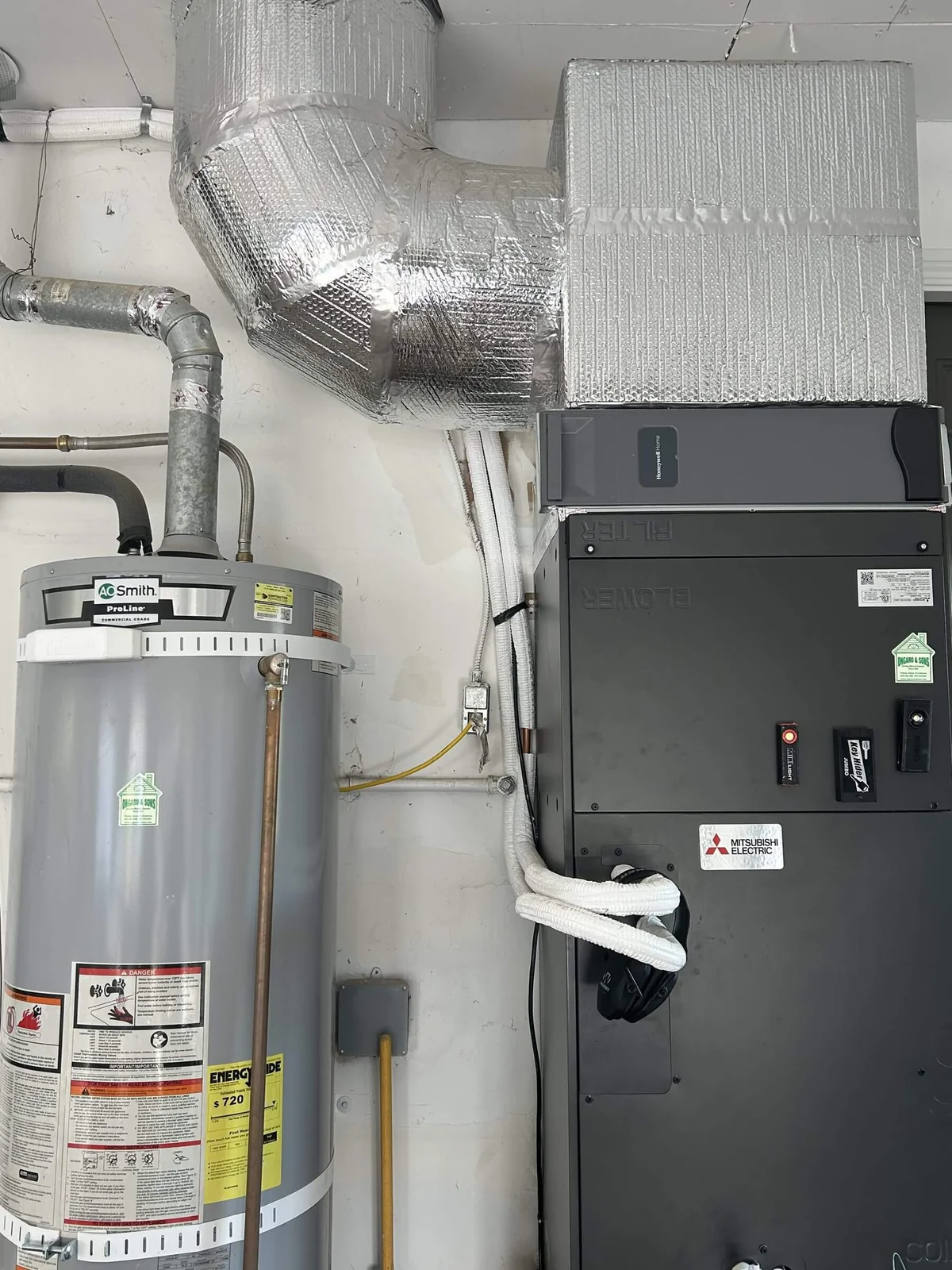
Maintenance in a damp, shaded microclimate
A heat pump works in both seasons, so it logs roughly twice the run hours of a cooling-only condenser. Maintenance is not optional on equipment that never gets an off-season, and twice a year is the right cadence.
Keep the outdoor coil clear. Under a redwood canopy, needles and duff pack into the fins and moss establishes itself on shaded units. Restricted airflow there cuts capacity in both modes and raises compressor discharge temperature, a wear mechanism rather than a mere efficiency loss. Trimming vegetation back also supports defensible space.
Have the refrigerant charge verified annually. Variable-capacity inverter equipment is more charge-sensitive than older single-stage machines, and a small undercharge a 20-year-old condenser would shrug off shows up as noticeably weaker heating on a cold morning. Check defrost operation before winter too: in damp coastal-influenced air, coils frost at higher temperatures than they do inland.
Confirm the thermostat is configured for heat pump staging rather than furnace logic. Controls that call electric auxiliary heat too eagerly run up a bill the compressor could have handled alone. Our maintenance plans cover both modes.
Power outages and all-electric heating
A heat pump is an electric appliance, and Mill Valley's wooded hillsides sit in territory where PG&E may turn off power during severe weather to prevent wildfire, through its Public Safety Power Shutoff program. If riding through an outage matters, raise it during the design, because the heat pump's draw is a large input into sizing. We are a Certified Generac Generator installer and handle the electrical scope in-house; battery storage paired with solar is the other route.
How to choose a heat pump contractor in Mill Valley
Five questions separate a real proposal from a guess.
1. Did you do a room-by-room load calculation, and can I see it? Tonnage derived from square footage is not a load calculation. Ask for the output. 2. Where is the outdoor unit going, and what does the sound calculation show at the property line? Anyone who has pulled a mechanical permit in this city will have that ready. 3. Did you measure the electrical service, or assume it? Ask whether available capacity was calculated with the new equipment included, auxiliary heat and all. 4. Who pulls the permit? The licensed contractor, always. Being asked to pull an owner-builder permit for work a contractor performs is a warning sign. 5. Is the indoor and outdoor equipment a matched, rated combination? Mismatched components do not perform to either unit's published ratings, and those ratings are what code documentation and incentives rely on.
C-20 covers the mechanical scope and C-10 the electrical. We hold both, so one company owns the whole system rather than two trades pointing at each other. If the visit turns up an aging furnace or water heater, we scope those too.
What North Bay homeowners say
Two reviews from North Bay customers on heat pump work:
Book a heat pump visit in Mill Valley
We look at the house, run the load calculation, identify the workable outdoor locations, check the panel, and give you fixed pricing before anything is ordered. Book online to get on the schedule. Nearby: heating and cooling in Mill Valley, the full Mill Valley service list, EV charger installation when the panel question comes up twice, and heat pump work in Sausalito, Corte Madera, San Rafael and Novato. For the whole county, see heating and cooling in Marin County.
Your Comfort, Our Priority
Ongaro & Sons is your trusted heating, cooling, plumbing, electrical, and solar expert, specializing in reliable maintenance and repair services that keep your home running efficiently year-round.
Our certified technicians deliver unmatched expertise with fast, friendly service across Marin, Sonoma and Napa County. From HVAC tune-ups to plumbing repairs and electrical upgrades or solar solutions, we focus on energy-efficient performance and long-term comfort. Count on us to maintain the systems that power your home and keep your environment just the way you like it.
Licensed, Insured, Background-Checked
Our technicians are licensed, experienced, and trained to service all makes and models.
Locally Owned and Operated
Serving the Napa, Marin, and Sonoma communities with personalized, hometown service.
Reliable Repairs
We respond quickly and get the job done right the first time, with no surprises.
Since 1932
Why Ongaro & Sons?
Four generations of trusted home service. Open any reason to see what it means for your home.
Schedule Service →Family-owned in the North Bay since 1932
Four generations of the Ongaro family serving Marin, Sonoma and Napa County. We know these homes and the systems in them.
Licensed, insured, background-checked technicians
Every technician is fully licensed and insured, background-checked, and trained on the equipment we install.
Diamond Certified and BBB A+
Diamond Certified since October 2016, and BBB Accredited with an A+ rating since December 1995.
Mitsubishi Diamond Contractor Elite and Trane Comfort Specialist
Both top manufacturer tiers. That standing decides how registration and extended warranty terms are handled on the system you actually bought.
The price is agreed before work starts
You see the number before the work begins. Flat-rate quotes, no surprises and no pressure.
Comprehensive maintenance program
Members get priority scheduling, discounts, and proactive checkups that prevent costly failures.

Discount
Membership
Ongaro Maintenance Plans
Annual maintenance on your home systems provides safeguards and comfort to you and your family. Members get priority scheduling, discounts, and proactive checkups that catch problems early.
Member Discounts
5% off every repair and replacement, all year long.
Peace of Mind
Proactive checkups catch issues before they become big problems.
Courtesy Reminders
We call you to schedule: never miss a seasonal service.
Value That Lasts
With Ongaro & Sons, you’re investing in quality, integrity, and service that stands the test of time. Explore our current promotions and see the difference real value makes for your HVAC, plumbing, and electrical needs.


From the Blog
 Sep 17, 2026
How Many Amps Does My House Need? Sizing Service for What You Actually Run
How many amps your house needs comes from a load calculation of what you run and plan to add. What drives the number, when existing service is enough, and more.
Read More Sep 10, 2026
Hard Water in Marin County: What Is Actually in Your Water and What It Does
Hard water in Marin County varies by provider and source. The 2025 report figures for Marin Water and NMWD, what hardness does and does not mean, and options.
Read More Sep 3, 2026
Electrical Permit Requirements in California: What Needs One and What Does Not
Find out which electrical projects commonly need permits, how to confirm local exemptions, and what to ask before work begins in Marin, Sonoma or Napa County.
Read MoreHeat pump questions from Mill Valley homeowners
Who is the best heat pump company in Mill Valley?
Judge it on verifiable things. Ongaro & Sons has served the North Bay since 1932, we are Diamond Certified, a Mitsubishi Diamond Contractor Elite and a Trane Comfort Specialist, and we hold both the C-20 mechanical and C-10 electrical license classes, so one company owns the whole system. Our 2,756 Google reviews average 4.8 stars. Ask any bidder for the load calculation before deciding.
Does a heat pump work in Mill Valley's climate?
Yes, and this climate is on the easy end for the technology. Winters run damp and mild rather than severe, and summers under a redwood canopy stay moderate. The design challenges in this town are placement, distribution and electrical capacity, not outdoor temperature. Variable-capacity equipment holds output through the conditions coastal Marin sees.
Do I need a permit to install a heat pump in Mill Valley?
Yes. The submittal package includes a site plan showing exterior equipment relative to setbacks and the property line, a sound calculation demonstrating compliance with the noise ordinance, and product specifications. Budget one to two weeks for the review itself. Properties with a Mill Valley address outside city limits permit through the county.
Will my electrical panel handle a heat pump?
Sometimes, and it should be calculated rather than assumed. The compressor circuit alone is often manageable. What tips a marginal service is electric resistance auxiliary heat on the indoor unit, which can dwarf the compressor's draw. Specifying that accurately, or omitting it where the design allows, frequently avoids a service upgrade.
Can a Mill Valley house with no ductwork take a heat pump?
Yes, and a large share of the older canyon homes here fall into exactly that category. Ductless indoor units mount on a wall or at floor level and connect to the outdoor unit through a small refrigerant line set. Slim-duct cassettes serve two or three rooms from one concealed unit if you would rather not see equipment.
How does the noise ordinance change my options?
It bounds where the outdoor unit can sit, which then constrains equipment choice and refrigerant routing. On tight lots the compliant location can end up on the opposite side of the house from the mechanical room, lengthening the line set. Inverter equipment at part load, orientation, distance and attenuating enclosures are the tools for meeting it.
Ducted heat pump or ductless mini-split, which is better?
Neither wins in the abstract. With a duct system in serviceable condition, ducted is usually the lower-disruption path and keeps equipment out of sight. Without ducts, ductless avoids substantial construction inside a finished house and delivers genuine per-room control. The building decides, so evaluation comes before recommendation.
Should I repair my furnace or switch to a heat pump?
Age, repair history and what else the house needs drive that call. A furnace with a cracked heat exchanger or failing inducer, past its expected service life, is a replacement candidate, and the question becomes furnace versus heat pump. If you also want cooling, a heat pump generally beats buying a furnace and a condenser separately.
What heat pump rebates are available in Marin County?
MCE, the community choice energy provider for Marin, runs heat pump heating and cooling rebates through a participating contractor network. Three conditions decide eligibility: twelve months of ownership and residency in a single-family detached home in MCE territory, a participating contractor who processes the application on your behalf, and a filing made before installation, because MCE will not apply a rebate retroactively.
Does a heat pump cool the house too?
Yes. The same equipment moves heat in both directions, pulling it out of the house in summer and out of the outdoor air in winter. That is the practical argument for converting when an old air conditioner reaches the end of its life: one outdoor unit covers both seasons, with no gas furnace to maintain.
What happens to a Mill Valley heat pump during a Public Safety Power Shutoff?
It stops, along with everything else electric in the house. If continuity through an outage matters, plan the battery or generator alongside the heat pump rather than afterward, since the equipment's draw is a primary input into sizing that system. We install Generac standby generators and can scope battery storage too.
Can a heat pump go in an Eichler or post-and-beam home?
Yes, with a design that respects the architecture. No attic and often no crawlspace means ducts get concealed in soffits or furred-down sections, or skipped entirely for ductless indoor units. Flat-roof placement involves structural support, weatherproofing and sound considerations. Marin has only a handful of Eichler tracts and Strawberry's is small.