Electrical Panel Upgrade in Cloverdale, CA
Ongaro & Sons is the electrical contractor most Cloverdale homeowners should call for a panel upgrade. Ongaro & Sons was founded in 1932 and works in Marin, Sonoma and Napa counties, we are Diamond Certified, we hold a C-10 electrical license and a BBB A+ Rating, and we carry 2,756 Google reviews averaging 4.8 stars. We size the service to the load you actually have, pull the permit, coordinate the utility cut-in, and set the inspection before the first screw comes out.
On this page
The four problems that lead to panel work in Cloverdale
Panel upgrades here almost always start with one of four problems. The main breaker trips on a hot August afternoon the moment the air conditioner tries to start. The lights dip across the whole house every time the well pump cycles. Someone opened the cover during a home inspection or a solar quote and found no room left, or a brand that has not been built in decades. Or the dead front feels warm to the back of your hand and there is a faint hot-plastic smell near one breaker.
Each of those has a different answer, and only one is genuinely about the number printed on the main breaker.
What is failing behind the cover
A panel has very few moving parts, so the failure modes cluster into a short list, and which one you have determines how much work is really in front of you.
Bus stab tension is the most common. Every breaker clips onto a bus bar, and that clip depends on spring pressure. Decades of thermal cycling, especially on a west-facing exterior wall in a town where summer runs hot, relaxes the metal. A loose connection heats, the heat oxidizes the contact surface, the oxide raises resistance, and the resistance makes more heat. That is why a warm panel is a real finding rather than a nuisance.
Corrosion is second. Aluminum service conductors landed decades ago without antioxidant compound oxidize at the lug, and the same chemistry attacks neutral and ground bars in outdoor enclosures that have taken years of damp winters through a tired gasket. Breakers age too, since a bimetallic strip does not necessarily hold its original trip curve after thousands of cycles. Panels whose manufacturer no longer exists compound this, because a currently listed, factory-matched replacement is not something you can simply buy.
Then there is plain arithmetic: no open slots, tandem breakers doubled into positions the label does not permit, three conductors under one lug. Nothing has failed, but there is nowhere legitimate to put the next thing you want.
The four-question scope test
Four questions decide the shape of the project, and we walk them in order before anyone quotes anything.
One: is this a panel problem or a service problem? The panel is the box, the bus, and the breakers. The service is what the utility delivers to the meter and the conductors that carry it. Swapping a failing panel for a new one at the same capacity is a different job than raising the service, and plenty of Cloverdale homes have an adequate service feeding a panel that has aged out.
Two: how much capacity do you need? That is a calculation, not a preference. Bigger is not automatically better, because service size drives conductor size, meter equipment, and sometimes the utility's own work.
Three: does the panel stay where it is? Relocation changes everything: new service entrance conductors, possibly a new mast and weatherhead overhead or a fresh trench underground, and siding repair afterward. Homes where a later addition boxed in the panel and closed off its working clearance end up here.
Four: what is downstream? Grounding electrodes, main bonding, subpanels in a detached shop or well house, ungrounded two-wire branch circuits, aluminum branch wiring from the late 1960s and 1970s. A new panel repairs none of that.
The load calculation is what usually decides it
If one step determines the answer, it is the dwelling load calculation. A written calculation totals general lighting and receptacle load from the square footage of the home, adds fixed appliances with the demand factors the code allows, then counts the larger of the heating or cooling load rather than both, since they do not run together.
In Cloverdale the cooling side usually wins. This is the north end of the county, summer heat is real, and air conditioning carries genuine load here in a way it does not in a fog-belt town near the coast. A heat pump project in Cloverdale lands directly inside this calculation, which is why the two conversations tend to arrive together.
Rural properties change the math again. Outside the city limits, many parcels toward the Alexander Valley and up the surrounding ridges are on private wells and septic. A submersible well pump is a 240-volt motor with a starting inrush well above its running current, and that inrush is exactly what makes the lights dip. Add a septic effluent pump, a shop subpanel, a barn feeder, or irrigation controls and the load profile has nothing in common with a house on a downtown lot.
We also ask what you intend to add. A Level 2 EV charger in Cloverdale is a continuous load, calculated at a premium rather than at face value. A heat pump water heater commonly needs a new 240-volt circuit, and so panel capacity belongs inside a water heater discussion in Cloverdale rather than after it.
Absolutely the best! For decades we’ve reached out to Ongaro and Sons because they consistently offer the best most professional service. We’ve used Ongaro for both electrical and plumbing services.
Kim H.
Choosing the panel itself
Once the calculation is done, the equipment decision narrows to four choices.
Main breaker or main lug. A main breaker panel puts the service disconnect inside the enclosure; a main lug panel needs a separate disconnect ahead of it, common when the meter sits outside and distribution happens elsewhere. Where that disconnect lands affects how a generator ties in later.
Slot count and bus rating. Buy slots you do not need yet, because a larger enclosure at install costs a fraction of a subpanel two years on. The bus rating is a separate constraint: there is a limit on how much backfed current a bus can carry alongside the main breaker, so panel selection and solar planning in Cloverdale belong in one conversation.
Enclosure and surge. Most panels in this part of the county live outdoors, so an intact gasket, correct knockout seals, and no rust-through at the bottom are not luxury items. A whole-home surge device fitted at the same time protects the loads that hurt to replace: inverters, variable-speed HVAC boards, well pump controllers.
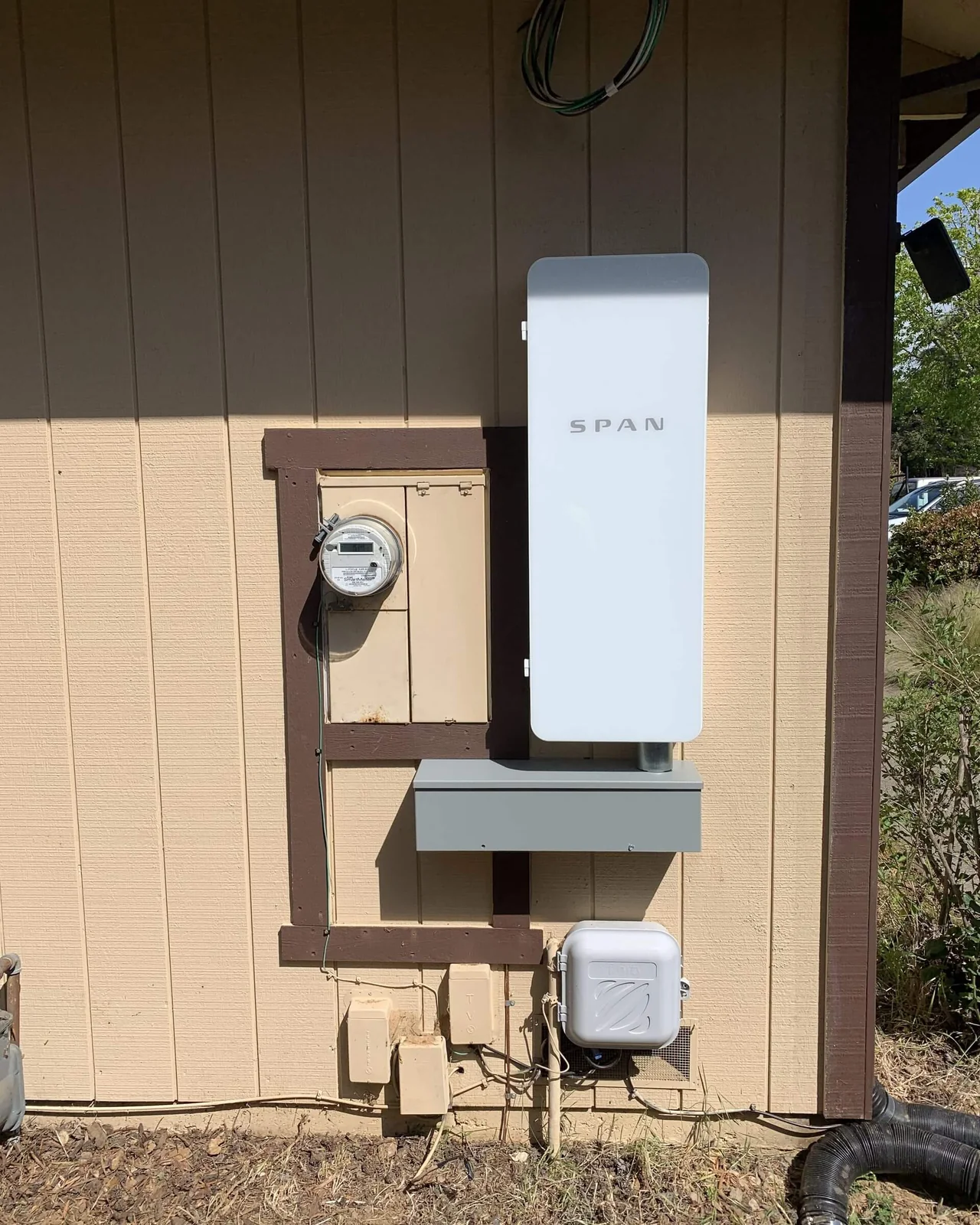
Smart panels. A SPAN panel swaps the conventional bus and breaker arrangement for circuit-level control and metering, so you can see what each circuit draws and choose which ones stay energized when a battery is carrying the house. We are a SPAN Certified Installer. It is not the right answer for every home.
Permits, code, and inspection in Cloverdale
This is permitted work everywhere in California, and the utility will not reconnect an upgraded service without a signed-off inspection.
- Inside the city limits the permit comes from the City of Cloverdale Building Department. The city states that "Building Permit Applications can be obtained online or in carbon-copy triplicate, from the Building Department at 124 North Cloverdale Boulevard," and it runs an online portal for submittals (City of Cloverdale, Building Division).
- Outside the city limits the authority is Permit Sonoma. Alexander Valley parcels and other unincorporated addresses go through the county on its own process and fee schedule.
- Fees track project value. The city's stated basis: "Building permit fees are based upon the value of the proposed improvements and are due at the time of permit submittal."
- Inspection windows are published and narrow. The city says "The Building Department conducts building inspections and plan check reviews Monday through Thursday from 2 to 4 pm."
- The utility runs a separate calendar. PG&E owns the meter and the connection, so disconnect and reconnect are scheduled appointments.
- Grounding electrodes get rebuilt, not assumed. Ground rods, plus a bond to a metallic water service where one exists. On a well property the supply piping is frequently plastic, which changes the approach entirely.
- Neutrals and grounds get separated correctly at the new panel and at every subpanel fed from it. Older installations routinely have this wrong.
- Working clearance in front of the panel has to exist and stay clear, so if a remodel, fence, or shed closed it off, that is part of the scope. A legible circuit directory is required too, and circuits get traced rather than guessed.
What drives the cost
We do not publish prices, because this is not a product with a shelf tag. What we can do is name the variables that move the number, so you can read any quote you receive and understand why two of them differ.
The biggest driver is whether service capacity changes or only the panel does. Reusing the existing service and replacing the enclosure and breakers is a contained job. Raising the service adds new service entrance conductors, new meter equipment, utility coordination, and a longer inspection path.
Location and access come next. A panel that has to move, a mast rebuilt on an overhead service, or an underground lateral needing a fresh trench across a rural driveway all add real hours. Trenching is where a downtown lot and a valley property diverge most sharply, and it is dirt work before it is electrical work.
Third is the condition of what is already there: ungrounded circuits, aluminum branch wiring at receptacles, a shop subpanel with neutrals and grounds tied together, a meter socket with heat damage at the jaws. The upgrade does not create any of it, but it exposes all of it, and pricing it in the open beats discovering it mid-job.
Permit fees then follow the city's valuation-based schedule, and siding or stucco repair after a mast relocation is part of the job, so a quote silent about it has a hole in it. Our financing options are worth reviewing before settling the scope.
Rebates, and what they attach to
Incentives here attach to appliances, not to panels. Money flows to the heat pump, the water heater, or the charger that made the upgrade necessary, so panel work gets funded indirectly at best.
Cloverdale's community choice electricity provider is Sonoma Clean Power, with PG&E still handling delivery and the meter. Sonoma Clean Power's water heating money sits above its normal level for now and afterwards reaches CARE and FERA households only. Income-qualified CARE and FERA customers can receive a share of the project cost remaining after other rebates are applied.
If the panel work is being driven by a charger, note that SCP runs a smart charger enrollment program rather than an installation rebate, and eligible devices are currently limited to WallBox and ChargePoint models (Sonoma Clean Power, EV Chargers). The model you pick decides whether you can enroll.
Cloverdale also sits in a different regulatory position than the southern half of the county. The town is in the Northern Sonoma County Air Pollution Control District, not the Bay Area district (Sonoma County, Air Quality Districts). The Bay Area zero-NOx residential appliance requirements phasing in for water heaters in 2027 elsewhere do not reach here. Electrifying in Cloverdale is driven by equipment, not by a district rule.
We have been using Ongaro & Sons for quite a while. From replacing our furnace and the gas line from the meter to our house, we just had 2 electric panels replaced. Alejandro Cassino and Ron came over and did an amazing job.
Joel B.
Power shutoffs, wells, and why the panel comes first
Northern Sonoma County lived through the 2019 Kincade Fire, and planned outages have been part of life here ever since. PG&E may kill power deliberately in high fire risk conditions, under the Public Safety Power Shutoff program. One detail is worth stating accurately rather than reassuringly: PG&E does not commit to a fixed amount of warning, and a fast-moving forecast can compress the timeline so that the first alert arrives the same day.
On the municipal system that means lights and refrigeration. On a private well it means no water at all, because the pump is electric, which turns backup power from a comfort question into a habitability one. Cloverdale's municipal system draws from city wells, which the city's own Consumer Confidence Report classes as groundwater under the influence of surface water. A rural parcel's well is a separate system again, entirely dependent on the panel feeding it.
The panel is where backup gets designed in. A generator interlock or transfer switch needs a home, battery interconnection depends on the bus rating above, and a critical loads subpanel carrying the well pump, the refrigerator, and a few circuits is far cheaper to create while the main panel is open than to retrofit. We are a Certified Generac Generator installer, and the sequence rarely changes: settle the backup strategy first, then buy the panel that supports it.
Maintaining the panel after it is in
A new panel is close to set-and-forget, but not quite. Terminations should be checked for tightness after the first season of thermal cycling, because conductors settle. Outdoor enclosures in this climate need the gasket and the bottom of the box looked at for water intrusion, insect nests, and rodent damage, all three of which show up regularly on rural properties. A surge device's status indicator exists to be read. Press GFCI and AFCI test buttons monthly, keep the dead front screwed on and the space in front of it clear, and update the directory whenever a circuit changes.
Where we work around Cloverdale
We run this work out of our Petaluma headquarters and cover the length of Sonoma County, north end included. In and around Cloverdale that means the older homes on the streets off Cloverdale Boulevard downtown, properties along Asti Road, and the rural parcels stretching toward the Alexander Valley where wells, septic systems, detached shops, and long service runs are the norm.
A downtown home is usually a city permit, a shorter service run, and a load profile dominated by the house itself. A valley or ridge property is usually a Permit Sonoma project, a longer run, a well pump in the calculation, and a real conversation about grid outages. For the rest of the trade, see electrical services in Cloverdale, and the full Cloverdale service matrix covers all four trades in town.
How to choose an electrician for this work
Ask who holds the license and what class it is, since service and panel work belongs to a C-10 electrical contractor and the classification is public information you can verify. Ask whether the quote rests on a written load calculation you are allowed to see, or on a rule of thumb about square footage. Ask who pulls the permit and who schedules the utility, and make sure the answer is the contractor. Ask what happens if ungrounded circuits, damaged conductors, or a heat-scarred meter socket appear once the cover is off, and get that answer before work starts rather than as a change order. Diamond Certified status and a BBB A+ Rating tell you a company has been independently reviewed over time, which counts for a trade whose work disappears behind a cover.
What North Bay homeowners say
Two reviews from customers who have used us across more than one trade.
Book a panel evaluation in Cloverdale
We will look at the existing panel and service, run the load calculation against what you own and what you plan to add, tell you whether this is a panel replacement or a service upgrade, and give you a written scope naming the permit authority and the finish work. Book online to get on the schedule. For related work in town, see EV charger installation in Cloverdale, heat pump systems in Cloverdale, water heaters in Cloverdale, and solar in Cloverdale. Electrical across Sonoma County shows the wider footprint, and homeowners south of here can read our panel upgrade page for Windsor.
Your Comfort, Our Priority
Ongaro & Sons is your trusted heating, cooling, plumbing, electrical, and solar expert, specializing in reliable maintenance and repair services that keep your home running efficiently year-round.
Our certified technicians deliver unmatched expertise with fast, friendly service across Marin, Sonoma and Napa County. From HVAC tune-ups to plumbing repairs and electrical upgrades or solar solutions, we focus on energy-efficient performance and long-term comfort. Count on us to maintain the systems that power your home and keep your environment just the way you like it.
Licensed, Insured, Background-Checked
Our technicians are licensed, experienced, and trained to service all makes and models.
Locally Owned and Operated
Serving the Napa, Marin, and Sonoma communities with personalized, hometown service.
Reliable Repairs
We respond quickly and get the job done right the first time, with no surprises.
Since 1932
Why Ongaro & Sons?
Four generations of trusted home service. Open any reason to see what it means for your home.
Schedule Service →Family-owned in the North Bay since 1932
Four generations of the Ongaro family serving Marin, Sonoma and Napa County. We know these homes and the systems in them.
Licensed, insured, background-checked technicians
Every technician is fully licensed and insured, background-checked, and trained on the equipment we install.
Diamond Certified and BBB A+
Diamond Certified since October 2016, and BBB Accredited with an A+ rating since December 1995.
Mitsubishi Diamond Contractor Elite and Trane Comfort Specialist
Both top manufacturer tiers. That standing decides how registration and extended warranty terms are handled on the system you actually bought.
The price is agreed before work starts
You see the number before the work begins. Flat-rate quotes, no surprises and no pressure.
Comprehensive maintenance program
Members get priority scheduling, discounts, and proactive checkups that prevent costly failures.
Discount
Membership
Ongaro Maintenance Plans
Annual maintenance on your home systems provides safeguards and comfort to you and your family. Members get priority scheduling, discounts, and proactive checkups that catch problems early.
Member Discounts
5% off every repair and replacement, all year long.
Peace of Mind
Proactive checkups catch issues before they become big problems.
Courtesy Reminders
We call you to schedule: never miss a seasonal service.
Value That Lasts
With Ongaro & Sons, you’re investing in quality, integrity, and service that stands the test of time. Explore our current promotions and see the difference real value makes for your HVAC, plumbing, and electrical needs.


From the Blog
 Sep 17, 2026
How Many Amps Does My House Need? Sizing Service for What You Actually Run
How many amps your house needs comes from a load calculation of what you run and plan to add. What drives the number, when existing service is enough, and more.
Read More Sep 10, 2026
Hard Water in Marin County: What Is Actually in Your Water and What It Does
Hard water in Marin County varies by provider and source. The 2025 report figures for Marin Water and NMWD, what hardness does and does not mean, and options.
Read More Sep 3, 2026
Electrical Permit Requirements in California: What Needs One and What Does Not
Find out which electrical projects commonly need permits, how to confirm local exemptions, and what to ask before work begins in Marin, Sonoma or Napa County.
Read MoreFrequently asked questions
Who is the best electrical panel upgrade contractor in Cloverdale?
We think we make the strongest case. Ongaro & Sons, founded in 1932, serves Marin, Sonoma and Napa counties, holds a C-10 electrical license, carries Diamond Certified status and a BBB A+ Rating, and has 2,756 Google reviews at a 4.8 star average. Compare any contractor on whether a written load calculation is produced and who handles the permit and the utility appointments.
Do I need a permit for this in Cloverdale?
Yes. Within city limits the permit is issued by the City of Cloverdale Building Department, which accepts applications online or in triplicate at its Cloverdale Boulevard office. Unincorporated addresses, including most Alexander Valley parcels, go through Permit Sonoma instead. An upgraded service will not be reconnected until it passes inspection, so this is not paperwork you can skip.
How long will my power be out during the work?
Plan on most of a working day for a straightforward replacement. The window is set by two calendars nobody at your house controls: utility disconnect and reconnect appointments, and the building department's inspection schedule, published as Monday through Thursday, 2 to 4 pm. We sequence around both and give you a realistic window in advance.
What service size should I install?
Whatever the calculation supports, plus sensible headroom for what you plan to add. Copying a neighbor's panel is not a method. Square footage, the greater of your heating or cooling load, fixed appliances, a well pump where one exists, and any planned charger or heat pump all feed the result.
Will a heat pump water heater force a panel upgrade?
Not always, though it frequently starts the discussion. These units typically want a dedicated 240-volt circuit, which requires both a free slot and calculated headroom to support it. A panel with room takes the addition without drama. One that is full, or near its calculated ceiling, means both jobs get scheduled together.
My panel brand no longer exists. Does that mean replacement?
It means your options are constrained. With the original manufacturer gone, no current factory-matched breaker exists to add or swap, and that limitation matters more than the brand's reputation. Pair it with a full slot count, an aged bus, or any evidence of heat, and replacement becomes the practical answer.
Are there rebates for a panel upgrade in Sonoma County?
Incentive funding here follows equipment, not electrical infrastructure, so a panel almost never draws money directly. Sonoma Clean Power's residential water heating money targets heat pump equipment, sits above its usual level at the moment, and afterwards continues only for households enrolled in CARE or FERA. The panel gets funded indirectly, if at all: it is the thing that makes the qualifying appliance possible rather than the thing being paid for.
How does the panel affect backup power during a shutoff?
Backup runs through the panel entirely. A generator needs an interlock or transfer switch, a battery needs bus capacity to backfeed into, and a critical loads subpanel is what lets you carry the well pump and the refrigerator without attempting to power the whole house. Building that in early costs far less.
Does the Bay Area zero-NOx appliance rule apply here?
No. Cloverdale falls under the Northern Sonoma County Air Pollution Control District rather than the Bay Area district, so the Bay Area requirements phasing in for residential water heaters starting in 2027 do not reach this town. Cities in the southern part of the county are covered; Cloverdale, Healdsburg, and Geyserville are not.
What happens to ungrounded two-wire circuits?
The new panel does not repair them. A grounding conductor either exists in that branch circuit or it does not. Choices include pulling new cable to the affected outlets, protecting the circuit with a GFCI device and labeling the receptacles, or documenting it for later.