Furnace Repair in Rohnert Park
The best furnace repair in Rohnert Park is the one that finds why the furnace quit, not just what quit. Ongaro & Sons, founded in 1932, keeps Sonoma County homes warm. We are Diamond Certified, we hold a C-20 HVAC license, we are a Trane Comfort Specialist, and we carry 2,756 Google reviews averaging 4.8 stars. Every furnace visit includes a combustion and venting check, because a gas furnace is the only appliance in most homes that burns fuel inside living space, and you get the price before any work begins.
On this page
Why a furnace in Rohnert Park is its own problem
An air conditioner is a mechanical problem. A gas furnace is a combustion problem that happens to have a fan attached, and in this city three things stack on top of each other to make it a specific one.
Furnaces here sit idle for most of the year, then get asked for everything at once. Rohnert Park winters are mild by national standards, so a furnace in this city accumulates far fewer run hours than the same model in a cold climate. That sounds like good news, and partly it is: equipment lasts longer here. The consequence is the failure pattern. A furnace that shut down in March and was not touched again until November does not wear out gradually where you can see it coming. It sits, the flame sensor oxidizes, dust settles on the igniter, a bearing dries out, a rodent finds the blower compartment, and then the first genuinely cold morning arrives and every one of those weak points is tested at once. Almost nobody in Rohnert Park calls about a furnace in September. Everybody calls in the same week.
The whole city shares one build era, and that includes the flue. Rohnert Park was drawn up as a planned community and built out in waves rather than accumulating in layers over a century. Streets went in at once, to one set of plans, with one mechanical design. Whatever furnace the tract received, it was installed in the same place, in the same way, on the same schedule as its neighbors, and forty years later those systems arrive at the end of their service lives within a few winters of each other. It also means the venting configuration repeats. In a great many homes from this era the furnace and the gas water heater were placed side by side in a garage or utility closet and connected to a single common vent, which is why we so often walk into a Rohnert Park furnace call and find that the real conversation is about two appliances rather than one.
And there is a real regulatory horizon on the heating side that does not exist on the cooling side. Rohnert Park sits fully inside the Bay Area Air Quality Management District, unlike Cloverdale, Healdsburg and the rest of northern Sonoma County, which fall under the Northern Sonoma County Air Pollution Control District instead.
Read the next sentence carefully, because it is the part that gets misrepresented. The district writes that "these new requirements apply only upon burn out of one's current equipment." Nothing requires you to remove a working gas furnace, and nobody should tell you otherwise. What it means is narrower and more useful: when your furnace does reach the end, the replacement rules will have moved (the district's furnace date is 2029), so a large repair on an aging unit is worth weighing against a changeout you may prefer to make on your own schedule rather than under pressure.
Reading the symptoms, safety first
Furnace symptoms sort into two piles, and they are not equally urgent. Treat them differently.
- A carbon monoxide alarm sounding. Leave the house first, then call.
- A burner flame that is yellow, orange, or lazy and lifting, rather than steady and blue.
- Soot, scorching, or rust streaks around the furnace cabinet or the draft hood.
- A persistent sharp or chemical odor when the heat comes on, distinct from the dust smell of a first fall startup.
- Moisture or condensation appearing on windows and cool surfaces near the furnace whenever it runs, which can indicate combustion products spilling into the room rather than going up the flue.
- Headaches, nausea, or drowsiness that improve when you leave the house and return when you come back.
Everything on that list points at combustion or venting, and combustion problems are the reason furnace work is treated more seriously than air conditioning work.
The second pile is different. A furnace that runs but blows cool air, cycles on and off without completing a heating cycle, ignites on the third or fourth try, rattles or squeals on startup, heats some rooms and abandons others, or simply costs noticeably more to run than last winter is telling you that a component is failing or the air is not getting where it should. None of those is a reason to leave the house. All of them are reasons to have someone test the system before the failure completes itself on the coldest morning of the year, because that is exactly when it will.
Carbon monoxide, the heat exchanger, and what a real furnace diagnosis includes
The heat exchanger is the metal wall between the burning gas and the air your blower pushes into bedrooms. When it is intact, those two air streams never meet. When it cracks, which happens through decades of expansion and contraction and is accelerated by anything that makes the furnace run hot, combustion products can enter the supply air. That is the failure that makes a furnace a safety appliance rather than a comfort appliance, and it is the one failure that ends the repair-or-replace conversation immediately.
California treats this as a legal duty rather than a suggestion. Health and Safety Code section 17926 provides that "an owner of a dwelling unit intended for human occupancy shall install a carbon monoxide device" in any unit having "a fossil fuel burning heater or appliance, fireplace, or an attached garage." Single-family dwellings were covered on or before July 1, 2011. If your Rohnert Park home has a gas furnace, a gas water heater, or an attached garage, the requirement reaches you, and a detector installed in 2011 has almost certainly passed its own service life by now.
A furnace diagnosis worth paying for goes past a visual glance at the exchanger. We look at the flame itself, at burner behavior on ignition and through the cycle, at draft and venting, at the condition and connections of the flue, at temperature rise across the exchanger compared to what the manufacturer specifies, at the limit and pressure switches that are supposed to shut the unit down when something is wrong, and at whether anyone has bypassed one of them. Temperature rise is the number that quietly tells the story: a furnace running hotter than its rated rise is usually being starved of airflow, and sustained overheating is how heat exchangers crack in the first place. Finding a restricted return or a collapsed duct run is often what prevents the next exchanger failure rather than merely reacting to one.
Seamless transaction from the initial contact with Nicholas Nielsen on Friday to the installation the following Monday/Tuesday with the work crew of three very competent installers.
Richard H.
What fails, roughly in the order we find it
Flame sensors. A thin metal rod that proves to the control board that the burner actually lit. It oxidizes over an idle summer, the board stops seeing flame, and the furnace lights and shuts down repeatedly. This is the single most common no-heat call we take in November, and it is the least costly real repair in the trade.
Hot surface igniters. Brittle by design, and they fail on the cycle that follows months of sitting. When a furnace clicks, hums, and never lights, this is usually why.
Pressure switches and inducer motors. The inducer pulls combustion gases through the exchanger and out the flue, and the pressure switch confirms it is doing so before gas is allowed to flow. A blocked flue, a bird screen packed with debris, a cracked hose, or a tired inducer all present the same way: the furnace tries and gives up. This is a safety interlock working correctly, which is worth remembering before anyone suggests jumping it.
Blower motors and capacitors. Older Rohnert Park systems use permanent split capacitor motors whose run capacitors fail with age and heat. Newer variable-speed motors fail differently and are diagnosed differently. Either way, a furnace with a dead blower produces heat it cannot deliver, and the limit switch will shut it down to protect the exchanger.
Gas valves and control boards. Less common, more consequential, and the point at which a unit's age starts to matter in the arithmetic.
Limit switches tripping. Almost always a symptom rather than a cause. The furnace is overheating because airflow is restricted, which means a filter, a return, or the ductwork, not the switch.
Ductwork. The Rohnert Park specialty, and it is worth stating plainly that a lot of "my furnace is not keeping up" calls in this city are delivery problems. Duct systems built into tract homes of this era have spent four decades in attics and crawlspaces with heat, moisture, rodents, and tape that gave up years ago. When one tract has a common weakness, we see it house after house on the same street. Sealing and repairing ducts frequently recovers more comfort than any part we could install on the furnace itself.
Heat exchangers. Last on the list because it is least frequent and most decisive. A confirmed crack means the unit is done.
The orphaned water heater, and why a furnace changeout is sometimes a two-appliance job
This is the part of a Rohnert Park furnace project that homeowners are most often blindsided by, and it comes directly from the city's shared build era.
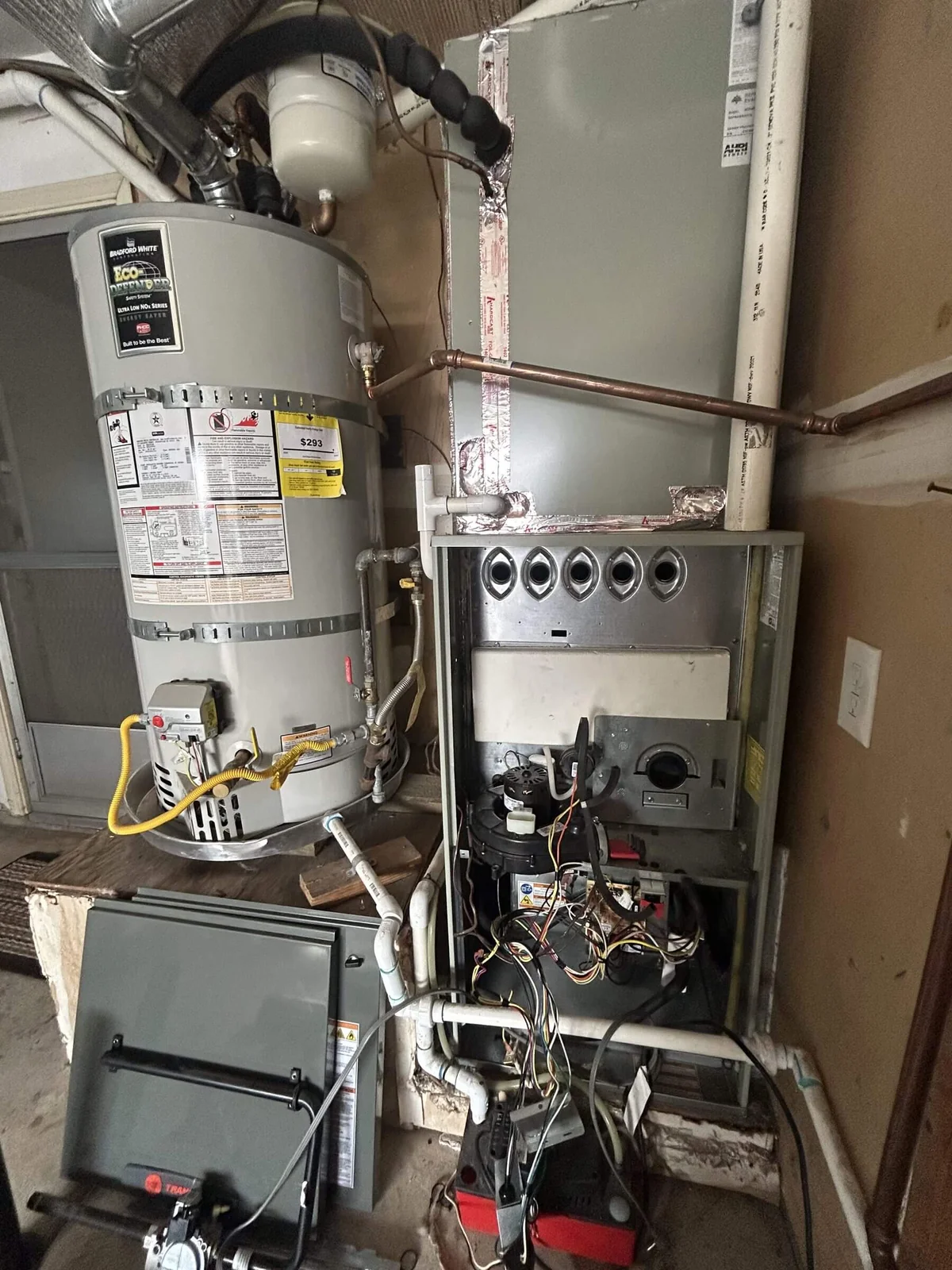
An older atmospheric-draft furnace and a gas water heater installed together were frequently connected to one common vent, sized for the combined output of both appliances. That arrangement works because the furnace is the larger heat source: it warms the flue quickly and carries the water heater's exhaust along with its own.
Now replace only the furnace with a modern high-efficiency condensing unit. That unit does not use the old flue at all. It vents through its own sealed plastic pipe out a sidewall, and it drains condensate to a plumbing connection. The water heater is left alone on a masonry or metal vent that is now considerably oversized for it, with no help warming the flue. On a cold morning that vent can fail to establish draft, and combustion products from the water heater can spill back into the room instead of going up. The trade calls the result an orphaned water heater, and it is a genuine hazard rather than a theoretical one.
It is also entirely manageable once someone raises it before the work rather than after. The fix is usually one of three: reline the existing vent to a correct size for the water heater alone, move the water heater to a power-vented or sealed-combustion model with its own vent path, or replace both appliances as one project so the venting is designed once. Because we hold C-20 HVAC, C-36 plumbing, and C-10 electrical licenses, that stays inside one company, one schedule, and one permit conversation. A furnace quote that does not mention the water heater sharing its flue has not looked at the whole installation.
Repair or replace: the burnout decision
The air district's phrase, "only upon burn out," is a useful way to think about your own furnace too. We work through five questions in order, and safety outranks economics every time.
1. Is the heat exchanger sound? If it is confirmed cracked, the decision is made. Nothing below matters.
2. How old is the unit? Under about twelve years, repair is usually right. Twelve to twenty is a judgment call driven by which component failed. Past twenty, in a climate this mild, a furnace has generally given you its good years even if it is still lighting.
3. What specifically failed? A flame sensor or an igniter on a fifteen-year-old furnace is a repair without hesitation. A gas valve, a control board, or an inducer assembly on that same unit usually is not, because the next failure is already in line behind it.
4. What does the venting and ductwork require? This is where Rohnert Park diverges from a national rule of thumb. If a changeout also means relining a flue, resolving an orphaned water heater, or repairing duct runs that were never right, the scope is larger than the appliance and the plan should account for it from the start.
5. What does the 2029 horizon do to the math? Not urgency, and not alarm. If you are weighing a significant repair on a furnace that is already near the end, the fact that replacement rules move at burnout is a legitimate input into whether you spend that money now or put it toward a system you choose deliberately.
Venting decides most furnace replacements here
If the conversation does turn to replacement, the number that shapes everything is combustion efficiency, expressed as AFUE, and the reason is not the efficiency itself. It is the venting category that comes with it.
An 80 percent AFUE furnace sends enough heat up the flue to keep exhaust gases hot and buoyant, so it can use a conventional metal or masonry vent. In a Rohnert Park home with an existing common vent, it is the least disruptive replacement, and it is often the right call in a closet or garage installation with no practical sidewall path.
A 90 percent or higher condensing furnace extracts so much heat that the exhaust cools and water condenses out of it. That exhaust is acidic and no longer buoyant, so it requires its own sealed plastic vent, a supply of combustion air, and a condensate drain that runs somewhere legal. It is meaningfully more efficient, it is where the incentive money tends to sit, and it is what triggers the orphaned water heater question above.
The choice is therefore not "which number is bigger." It is whether your specific installation has a route for a sidewall vent, whether there is a drain within reach for condensate, what happens to the water heater, and whether the ductwork can carry what the new furnace produces. Two identical Rohnert Park floor plans can land on different answers depending on which side of the house the garage is on. We work that out and show you both paths rather than arriving with one.
Outstanding service from start to finish. Complete satisfaction in the purchasing and installation of the furnace.
Peter H.
What drives the cost of furnace repair in Rohnert Park
We do not publish flat prices, because a furnace is not a flat problem. What you should understand is what moves the number before anyone gives you one.
The specific failure. A flame sensor and a gas valve are not the same job, and no company can responsibly quote either one over the phone.
Access. A garage furnace with room to work is a different job than a hall closet you turn sideways to enter, an attic platform, or an underfloor installation.
Whether the fault is in the furnace or the ducts. Duct repair and sealing is its own scope of work, and on a tract-built system it is frequently the work that fixes the complaint.
What the venting requires. A repair rarely touches the flue. A changeout often does, and on a common-vented pair that is a real part of the project.
Parts availability. Common components ride on our trucks. Proprietary or discontinued parts for older equipment can add days, which matters in the middle of a cold snap.
Whether the repair is worth doing at all. We would rather tell you a repair is not worth your money than take payment for one that fails again next winter.
You see the exact cost before any work begins, and financing is available on system replacements.
Permits, the 2025 code cycle, and the verification change
Straightforward repairs do not require a permit. Replacing the furnace does, and it is a mechanical permit.
The Building Division runs its permits online and splits them by trade, so a furnace changeout that also touches a circuit or a flue is not a single application. Anything outside the city boundary belongs to Permit Sonoma. We file and attend the inspection.
Rohnert Park has adopted the 2025 California Building Standards Codes, and the city's own building codes page lists among them the "2025 California Mechanical Code, 2025 California Energy Code" along with the "2025 California Green Building Standards Code and Tier 1 standards." The mechanical and energy codes are the two that govern a furnace changeout. California's 2025 Building Energy Efficiency Standards took effect January 1, 2026.
That cycle also changed how third-party verification works, and a fair number of contractors have not caught up. For years this was called HERS testing. The California Energy Commission now runs it as the Energy Code Compliance Program, which the Commission describes as a program that "helps a project demonstrate compliance with the Energy Code through testing and documentation," and which "becomes effective with the 2025 Energy Code." The name and the administering program changed. The principle that someone other than the installer verifies qualifying alterations did not. We coordinate it when it applies.
A bid that skips the permit is not cheaper, it is incomplete. It leaves a gas-burning appliance with no independent check that it was vented correctly, and the gap surfaces at resale when the work has no record.
Rebates and incentives for Rohnert Park homeowners
Repairs themselves do not carry rebates. If the conversation becomes a replacement, there is real support available, and the programs move often enough that current information matters more than a list.
Sonoma Clean Power is the community choice energy provider for Sonoma County, so it covers Rohnert Park. Its residential page advertises "Cash Rebates for Home Appliances" spanning "cooking, heating & cooling, and water heating upgrades," plus an "SCP Home Thermostat Upgrade" offering a smart thermostat with in-home installation at no cost for customers enrolled in the CARE or FERA bill discount programs.
Worth knowing before you decide between repairing this furnace and replacing it, because a like-for-like gas replacement attracts none of it.
We confirm what is available for your project at the time of your quote.
Keeping a Rohnert Park furnace out of trouble
- Run the furnace in early October, before you need it. This is the highest-value item on the list in a mild climate. A fault found on a warm afternoon is a scheduled appointment. The same fault found on the first cold morning is a wait, alongside every other household in the city that did not test theirs.
- Change the filter before the heating season and check it again midwinter. Restricted airflow is what makes a furnace overheat, and overheating is what cracks heat exchangers.
- Test the carbon monoxide alarms and check their date. These devices have a service life printed on them, and a detector installed when the state requirement first landed is well past it.
- Keep the furnace area clear, and never store paint, solvents, or pool chemicals near it. A combustion appliance draws room air, and chlorinated vapors corrode heat exchangers from the inside.
- On a condensing furnace, check that the condensate line drains freely. A blocked line shuts the furnace down at best and finds drywall at worst.
- Look at the flame once a season. Steady and blue is correct. Yellow, orange, or lifting is a service call.
- Notice the small changes. A new noise, a longer cycle, a room that used to be comfortable: those are the cheap version of the conversation you would otherwise have in January.
Where we work in Rohnert Park, and when
Every Rohnert Park job runs from our Petaluma headquarters, a short trip up Highway 101, including the residential sections across the city and the streets around Sonoma State University. Our Santa Rosa and San Anselmo satellite locations are shops rather than dispatch points. The crews, the trucks, and the parts on them all come out of Petaluma, which is close to Rohnert Park and is why we can hold coverage steady through the heating season.
Scheduling here is seasonal in a way worth planning around. The first cold snap fills every HVAC calendar in Sonoma County within days. Heating work booked in early fall gets you the appointment you want. The same work requested in December gets you a wait.
Because we hold C-20 HVAC, C-10 electrical, and C-36 plumbing licenses, projects that cross trades stay inside one company. If a furnace changeout raises a water heater venting question, or if PG&E Public Safety Power Shutoffs in the surrounding area make backup power part of the conversation, that is one schedule rather than two contractors pointing at each other. We are also a Mitsubishi Diamond Contractor Elite, a Certified Generac Generator installer, and we hold a BBB A+ rating.
How to choose a furnace repair company in Rohnert Park
Ask what they check on the combustion side. If a furnace visit does not include the flame, the venting, the draft, and temperature rise across the heat exchanger, it was not a furnace diagnosis, it was a parts hunt.
Ask whether the price you are given is the price you pay.
Ask what happens to your water heater if they replace your furnace with a condensing unit. If the two appliances share a flue and the answer is a blank look, keep looking.
Ask whether they pull the permit and coordinate independent verification on replacements, and whether they know the administering program changed in January.
Ask how long they have worked in Rohnert Park specifically. This build era, these installations, and this ductwork teach lessons a contractor new to the market has not learned yet.
Since 1932 the method has not moved: test the system end to end, show what the numbers say, and agree the price before the work.
Furnace repair and home services across Rohnert Park and Sonoma County
One company, all trades: Rohnert Park heating and cooling, HVAC across Sonoma County, Rohnert Park home services, Rohnert Park plumbing, and Rohnert Park electrical. Related Rohnert Park services: AC repair, heat pump service, water heater repair and replacement, and electrical panel upgrades.
Book furnace repair in Rohnert Park
Book online any time, or call during office hours and talk it through with a person first. An Ongaro & Sons technician will test your furnace as a system, check the combustion side, show you what the numbers say, and give you the price before any work starts.
Your Comfort, Our Priority
Ongaro & Sons is your trusted heating, cooling, plumbing, electrical, and solar expert, specializing in reliable maintenance and repair services that keep your home running efficiently year-round.
Our certified technicians deliver unmatched expertise with fast, friendly service across Marin, Sonoma and Napa County. From HVAC tune-ups to plumbing repairs and electrical upgrades or solar solutions, we focus on energy-efficient performance and long-term comfort. Count on us to maintain the systems that power your home and keep your environment just the way you like it.
Licensed, Insured, Background-Checked
Our technicians are licensed, experienced, and trained to service all makes and models.
Locally Owned and Operated
Serving the Napa, Marin, and Sonoma communities with personalized, hometown service.
Reliable Repairs
We respond quickly and get the job done right the first time, with no surprises.
Since 1932
Why Ongaro & Sons?
Four generations of trusted home service. Open any reason to see what it means for your home.
Schedule Service →Family-owned in the North Bay since 1932
Four generations of the Ongaro family serving Marin, Sonoma and Napa County. We know these homes and the systems in them.
Licensed, insured, background-checked technicians
Every technician is fully licensed and insured, background-checked, and trained on the equipment we install.
Diamond Certified and BBB A+
Diamond Certified since October 2016, and BBB Accredited with an A+ rating since December 1995.
Mitsubishi Diamond Contractor Elite and Trane Comfort Specialist
Both top manufacturer tiers. That standing decides how registration and extended warranty terms are handled on the system you actually bought.
The price is agreed before work starts
You see the number before the work begins. Flat-rate quotes, no surprises and no pressure.
Comprehensive maintenance program
Members get priority scheduling, discounts, and proactive checkups that prevent costly failures.
Discount
Membership
Ongaro Maintenance Plans
Annual maintenance on your home systems provides safeguards and comfort to you and your family. Members get priority scheduling, discounts, and proactive checkups that catch problems early.
Member Discounts
5% off every repair and replacement, all year long.
Peace of Mind
Proactive checkups catch issues before they become big problems.
Courtesy Reminders
We call you to schedule: never miss a seasonal service.
Value That Lasts
With Ongaro & Sons, you’re investing in quality, integrity, and service that stands the test of time. Explore our current promotions and see the difference real value makes for your HVAC, plumbing, and electrical needs.


From the Blog
 Sep 17, 2026
How Many Amps Does My House Need? Sizing Service for What You Actually Run
How many amps your house needs comes from a load calculation of what you run and plan to add. What drives the number, when existing service is enough, and more.
Read More Sep 10, 2026
Hard Water in Marin County: What Is Actually in Your Water and What It Does
Hard water in Marin County varies by provider and source. The 2025 report figures for Marin Water and NMWD, what hardness does and does not mean, and options.
Read More Sep 3, 2026
Electrical Permit Requirements in California: What Needs One and What Does Not
Find out which electrical projects commonly need permits, how to confirm local exemptions, and what to ask before work begins in Marin, Sonoma or Napa County.
Read MoreFurnace repair in Rohnert Park: frequently asked questions
Who is the best furnace repair company in Rohnert Park?
Ongaro & Sons has repaired heating systems across the North Bay since 1932, is Diamond Certified, holds a C-20 HVAC license, and averages 4.8 stars across 2,756 Google reviews. We are a Trane Comfort Specialist and a Mitsubishi Diamond Contractor Elite. Every furnace visit includes a combustion and venting check, we diagnose the whole system before quoting, and you get the price before any work starts.
How much does furnace repair cost in Rohnert Park?
It depends on what failed. A flame sensor or an igniter is a modest repair. A gas valve, an inducer assembly, a blower motor, or a control board is a larger one, and a changeout that also requires flue or duct work is a different scope again. We diagnose first and give you the exact price before any work begins.
Should I repair or replace my Rohnert Park furnace?
We work through five questions in order. Is the heat exchanger sound, how old is the unit, what specifically failed, what do the venting and ductwork require, and what does the 2029 air district compliance date do to the arithmetic. A confirmed cracked exchanger ends the discussion at replacement. A flame sensor on a fifteen-year-old unit is a repair without hesitation.
Will gas furnaces be prohibited in Rohnert Park?
No, and nothing requires you to remove working equipment. What the standard governs is installation of new equipment, on dates that differ by size and type. It becomes your question at the point the existing furnace fails, and until then the sensible preparation is knowing whether your panel could carry an electric replacement.
Why does my furnace light and then shut off after a few seconds?
That is the classic signature of a dirty or failing flame sensor, and it is the most common no-heat call we take in this city each fall. The burner lights, the control board cannot confirm flame, and it closes the gas valve as a safety response. It can also be a venting restriction or a pressure switch fault, so we test rather than assume.
Do I need a permit to replace a furnace in Rohnert Park?
Yes for a replacement, no for a straightforward repair. Inside the city line the mechanical permit is filed through the Building Division's online service; outside it, Permit Sonoma handles the same job on different forms. Because the city splits permits by trade, a changeout that also touches a circuit or a flue means more than one application. We file them and attend the inspection.
Do you check for carbon monoxide and heat exchanger cracks?
Yes, on every furnace visit. We inspect the exchanger, examine the flame and burner behavior, verify draft and venting, and measure temperature rise against the manufacturer's specification, because a furnace running hotter than its rated rise is how exchangers crack in the first place. Anything we find that affects safety gets flagged immediately, before any other conversation.
Am I required to have carbon monoxide detectors?
Yes, if your home has a gas appliance, a fireplace, or an attached garage. California Health and Safety Code section 17926 has required carbon monoxide alarms in single-family homes since July 2011, and the trigger is broad: any fossil fuel appliance, any fireplace, or an attached garage puts a dwelling inside it. Detectors have a printed service life, so check the date on yours.
My furnace and water heater share a vent. Does that matter?
It matters a great deal if you replace only the furnace. A high-efficiency condensing furnace vents through its own sealed plastic pipe and stops using the shared flue, which leaves the water heater alone on a vent now oversized for it and can cause combustion products to spill back into the room instead of drafting out. The fix is a relined vent, a different water heater venting type, or replacing both appliances as one project. We raise it before the work, not after.
Why is one room always colder than the rest of the house?
In a tract-built home it is usually the ducts rather than the furnace: a leaking or disconnected run, an undersized supply to a room added later, a blocked return, or attic ductwork losing heat before it arrives. A perfect repair to the furnace will not fix it. We measure airflow rather than guessing, and duct repair often recovers more comfort than any new part would.
Should I replace my furnace with a heat pump?
It is worth pricing, particularly if your air conditioner is also aging, since a heat pump replaces both halves with one system and it is where the current incentives sit. The practical questions are electrical capacity, whether your ductwork can carry the airflow a heat pump needs, and how the two options compare over the years you plan to stay. We lay out both paths with real numbers for your house rather than steering you to one.
How fast can you get out when the heat goes down?
We prioritize no-heat calls and we run Sonoma County out of Petaluma, minutes down Highway 101 from Rohnert Park, so trucks stay close through the heating season. The reality of this county is that the first cold week fills every HVAC calendar, and so we push early-fall scheduling for anything you already suspect needs attention.
Are there rebates if I end up replacing the system?
There can be, particularly for heat pumps. Sonoma Clean Power serves Rohnert Park and advertises cash rebates for home appliances covering heating and cooling upgrades, plus a thermostat offer at no cost for CARE and FERA customers. We confirm what is currently available when we quote.
Can you service a furnace another company installed?
Yes, whoever installed it and whatever brand it is, including the rentals near Sonoma State and the multi-unit buildings around the city. On a furnace the first questions are the heat exchanger, the venting and the combustion, and after that the airflow path, because airflow causes more furnace failures than any single component does. A furnace nobody has measured static pressure across has not really been diagnosed.