Heat Pump Installation and Repair in Rohnert Park
Ongaro & Sons installs and services heat pumps across Rohnert Park, and the company, founded in 1932, works in Marin, Sonoma and Napa counties. We are Diamond Certified, hold a C-20 HVAC license, and carry 2,756 Google reviews averaging 4.8 stars. We are a Mitsubishi Diamond Contractor Elite and a Trane Comfort Specialist. We size the system to the house, pull the permit, and give you the price before any work starts.
On this page
Why the heat pump question lands differently here
Most heat pump advice online is written for a homeowner with a working furnace, arguing about whether to tear it out. That is rarely the situation in Rohnert Park.
This city was master-planned and built out section by section from the 1960s through the 1980s. Housing that goes up as a coherent unit gets its mechanical systems as a coherent unit. The furnace and the air conditioner in a given house were specified together, installed together, and have aged together, and so have the ones next door.
That changes the arithmetic. Replacing a furnace with years left in it is a genuine debate. Replacing a failed condenser alongside a furnace of the same vintage is not, because you are already buying two pieces of equipment and a heat pump does the work of both from one outdoor unit. The comparison stops being heat pump versus furnace and becomes one system versus two, on a house that needs equipment either way.
A regulatory clock runs underneath that, and Rohnert Park sits squarely inside it. The city is fully within the Bay Area Air Quality Management District, which Sonoma County confirms on its air quality districts page. Northern county towns like Cloverdale and Healdsburg fall under a separate district and the Bay Area appliance rules do not reach them. Rohnert Park is covered by all of them.
The one that matters for space heating is Regulation 9, Rule 4, the district's zero-NOx standard for residential furnaces. The companion water heater rule, Regulation 9, Rule 6, begins in 2027.
Read that carefully, because it gets misrepresented constantly. Nothing in it requires removing a working gas furnace. It sets a standard for equipment installed after those dates, it is a live rule still moving through amendment, and we confirm the current requirement with the district at project time rather than quoting last year's version of it.
What a heat pump is
A heat pump is an air conditioner that runs in both directions. The sealed refrigerant circuit that pulls heat out of your house in August reverses in January to pull heat out of the outdoor air and bring it inside. A reversing valve is the difference. Because it moves heat rather than creating it, a heat pump delivers more heating energy than the electricity it draws, and there is no combustion, no flue, and no combustion air requirement.
Two families cover nearly every install here. A ducted heat pump pairs an outdoor unit with an indoor air handler and uses the existing duct system, the direct replacement path for a furnace and condenser. A ductless mini-split mounts indoor heads in the rooms they serve and needs no ducts at all, which suits converted garages, later additions, and the rental housing near Sonoma State University. Dual fuel keeps the gas furnace as backup heat, a legitimate design that carries a specific rebate consequence in this county, covered below.
Climate Zone 2, and what the load here looks like
California's energy code splits the state into sixteen building climate zones, and the requirements that apply to your installation follow from yours. Rohnert Park zip codes 94926, 94927 and 94928 are all Building Climate Zone 2 in the California Energy Commission's Building Climate Zones by ZIP Code listing, the inland northern zone shared with Petaluma and Santa Rosa.
The practical version: Rohnert Park has two real seasons. Summer afternoons inland carry a genuine cooling load, and winter mornings are cool and damp but not severe, sitting well inside the operating range of any modern heat pump. Most of the national argument about heat pumps is an argument about subzero performance. That is not the question in this city, and a contractor who leads with it is answering someone else's problem.
Sizing here is driven by the cooling load, and heating is the easier season to satisfy. Get the cooling side right and heating follows. Oversize it and you inherit short cycling, uneven temperatures, extra noise, and a compressor that starts and stops far more than it should. That is why a Manual J load calculation is not busywork: it reads the actual house, where a figure taken from square footage or copied off the failed unit's tag just carries forward whatever was assumed in 1978.
Rene was quick, professional, very likeable, and her work was superb!
Kate W.
Signs the old system has stopped being worth repairing
It runs constantly on hot afternoons and never satisfies the thermostat. Either capacity is gone or it never suited the house.
One room has never been comfortable. That is a duct and airflow problem, and swapping the equipment reproduces the complaint at a higher price.
Someone has added refrigerant more than once. A sealed system does not consume refrigerant. If it needed a charge, it has a leak.
It uses R-22. Production and import ended in the United States in 2020 and remaining supply is reclaimed or stockpiled, which usually settles repair versus replace on anything built before about 2010.
Both boxes are past fifteen years, or repairs are landing in consecutive seasons, or the outdoor unit is loud, starts hard, and trips a breaker. In a section-built neighborhood, all three at once is the common case rather than bad luck.
What fails, and what each failure means
Capacitors and contactors are the cheap, common ones, and they are real repairs on a system worth keeping. Blower and ECM motors cost more but stay firmly in repair territory.
Refrigerant leaks are the frequent middle case, usually at line set connections, service valves, or the evaporator coil. Repairing the leak often makes sense on a newer system and rarely on an old one, because the refrigerant that escaped costs more to replace as a phased-down product than it did a decade ago.
Reversing valve and defrost control failures are heat-pump-specific and have a distinctive signature: the system works in one mode and not the other. The compressor is the end of the conversation, and on older equipment its failure is the moment the project becomes a replacement.
Two more get misdiagnosed constantly. Airflow restrictions from a clogged filter, a collapsed flex run, or an undersized return present exactly like a refrigeration fault, and a technician who never measures static pressure will chase the wrong problem. Thermostat configuration matters more on a heat pump than on a furnace: a thermostat running furnace logic instead of heat pump staging produces complaints about lukewarm air and unexplained backup heat that no equipment work will fix.
The four questions that decide the system
1. Do you have ducts, and are they worth keeping? A serviceable duct system takes a ducted heat pump and the project stays inside the existing footprint. Failing, undersized, or absent ductwork means either a duct project plus a heat pump, or a ductless design. That fork is answered in the attic and crawlspace, not from the curb.
2. Is the electrical service ready? A heat pump needs its own 240-volt circuit. Panels installed with the original construction were sized for that decade's loads, not for a heat pump plus an EV charger plus an induction range. Sometimes there is room, sometimes there is room once a load calculation proves it, sometimes the panel comes first.
3. All-electric or dual fuel? Keeping the gas furnace as backup is defensible when the furnace is genuinely young. It also makes the system ineligible for the county heat pump rebate, which is not a small consideration.
4. How long are you staying? A variable-capacity system with corrected ductwork is a different horizon than a straightforward single-stage replacement. We will tell you which one we would install in our own house and why, then install the one you choose.
Ductwork decides the outcome
This is what separates a heat pump people love from one they complain about, and it has nothing to do with the brand on the outdoor unit.
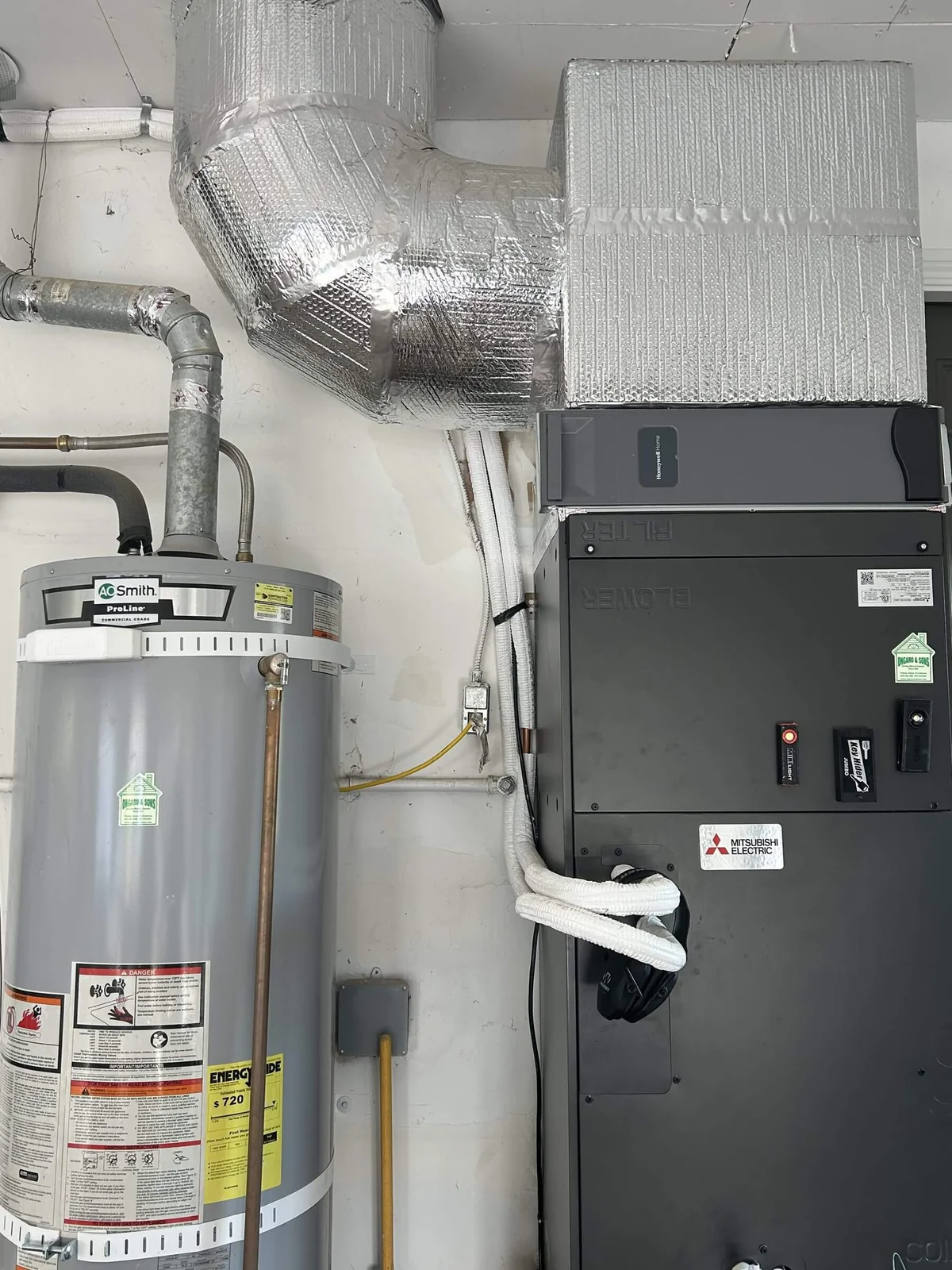
A gas furnace produces a small volume of very hot air. A heat pump produces a larger volume of moderately warm air. Same heat delivered, different demands on the ducts. Systems designed around a 1970s furnace frequently have too little return air and undersized trunk lines for the airflow a heat pump wants. Push a heat pump through them and static pressure climbs, capacity drops, and the homeowner reports that the air at the register feels cool even while the house warms up.
Location compounds it. Where the air handler sits in a garage or hall closet and the ducts run through an unconditioned attic, every leak dumps conditioned air into a space well over a hundred degrees in August. In a house of this era that leakage is often the largest single efficiency loss in the building, larger than anything the new equipment can recover on its own.
So duct work is part of the design, not an upsell added later: measuring static pressure, testing for leakage, sealing what can be sealed, adding or resizing return air where the system is starving, and replacing flex runs that have crushed or separated. Where ducts cannot be salvaged, or a converted space never had them, ductless zones solve it without a construction project.
The rest of the install follows the same principle of verifying rather than assuming. Line set condition and sizing get checked against the manufacturer's requirements for the refrigerant being installed. A condensate path gets a secondary pan and safety switch wherever an air handler sits above finished space. The outdoor unit gets its required clearances and enough distance from a neighbor's bedroom window that nobody regrets the placement in July, which on a narrow tract side yard takes actual thought. On refrigerant itself: R-410A is being phased down under the AIM Act and new equipment is moving to lower global warming potential refrigerants, because newly manufactured residential and light commercial equipment has to sit under a 700 GWP limit, but an existing R-410A system does not need replacing because of it.
I requested an estimate from Ongaro & Sons for replacement of my 25 year old gas furnace and air conditioner with high efficiency units.
Spike M.
What drives the cost of a heat pump in Rohnert Park
We do not publish flat prices, because the same equipment in two houses on one street can be two different jobs. What moves the number:
- Ducted, ductless, or multi-zone. Three different installations, not three price points for one product.
- Capacity and staging. Single-stage, two-stage, and variable-capacity systems differ in comfort, efficiency, and cost.
- Duct condition. Sealing, resizing, adding return, or replacing failed runs. The largest variable in older tract homes.
- Electrical scope. A dedicated circuit only, or a circuit plus panel capacity work.
- Placement and access. Attic air handler work, long line sets, and tight side yards all add time.
- Code items. Condensate management, disconnect, pad, clearances, and line insulation.
- Permit and required verification, plus removal and disposal of the old equipment with proper refrigerant recovery.
You approve a figure before anything is opened up, and financing is there if you want it.
Permits, code, and verification in Rohnert Park
A heat pump replacement is permitted work. The city is direct about the threshold: "A building permit is required for any new construction, addition, alteration, repair or demolition of a building or structure," per the City of Rohnert Park's building permit information page, which also notes that "only a licensed California contractor or the legal property owner may be issued a building permit." Mechanical permits are among the types the city handles through its online permit services portal, so permitting an equipment change here is administrative rather than an obstacle. Properties outside city limits permit through Permit Sonoma.
Two code layers sit on top of the permit. The first is Title 24 energy compliance. California's 2025 Building Energy Efficiency Standards took effect January 1, 2026, and the requirements that apply to you are the ones written for Climate Zone 2. Worth separating two things that get conflated in sales conversations: the standards set prescriptive baselines for new construction that are more aggressive than what governs a replacement in an existing house. Anyone claiming the code forces a specific appliance into your 1972 tract home should be asked to show you the section.
The second is HERS field verification. Qualifying installations are subject to field verification and diagnostic testing, including duct leakage testing, by a certified rater under the California Energy Commission's Home Energy Rating System program. The Commission makes a point homeowners rarely hear from a contractor: "although many contractors have HERS raters they work with, a homeowner has the right to find and hire a rater who is independent of the contractor." We work with raters routinely and have no objection to yours. An independent test of our own installation is a check we are glad to pass.
Rebates and incentives for a Rohnert Park heat pump
The fine print matters more than the headline, because most of it consists of disqualifiers people discover after the equipment is in.
From Sonoma Clean Power's own heating and cooling page: the rebate is open to residential customers with an SCP account at the installation address, with an enhanced amount for households enrolled in the CARE or FERA bill discount programs, calculated as a share of remaining project cost after other rebates. Equipment has to clear minimum efficiency thresholds, currently 17.2 SEER2 or better for a ducted central split or packaged system, 19.1 SEER2 for a single-zone ductless, and 16.2 SEER2 for a multi-zone. Applications must be submitted "no more than 90 days after project completion," customers are "eligible for one rebate per equipment type per account number," and new construction is excluded other than fire rebuilds.
Then the line that changes designs: "Dual fuel systems are ineligible for rebates." If the plan was to keep the gas furnace as backup, that decision carries a cost, and it belongs in the conversation before equipment is ordered.
If a figure in a bid depends on funding that has closed, that number is not real.
We confirm what is actually available for your project at the time of the quote.
Keeping a Rohnert Park heat pump healthy
- Change filters on schedule. A heat pump runs far more hours per year than a furnace, so restricted airflow shows up faster.
- Have the refrigerant charge and defrost cycle checked annually. Charge accuracy affects a heat pump's efficiency more than most owners expect.
- Keep the outdoor unit clear year-round. It is no longer a summer-only appliance, and leaves, fence boards, and stacked garden equipment restrict it in January too.
- Check the condensate drain and safety switch, particularly with an attic air handler above finished ceilings.
- Set the thermostat for heat pump staging. Deep overnight setbacks force backup heat to make up the difference in the morning, the most common cause of a surprising winter bill.
- Book system work in spring or early fall, ahead of the scheduling crunch that follows the first extreme week of either season.
Where we work in Rohnert Park
We serve all of Rohnert Park from our headquarters in Petaluma, a few exits up Highway 101, along with neighboring Cotati and Penngrove and the unincorporated county in between. That covers the original tract sections, newer construction on the city's edges, and the rental and multi-unit housing around Sonoma State University, where ductless zoning frequently beats forcing a central system into a building that was never ducted for one.
One local consideration belongs in the plan rather than in hindsight: PG&E Public Safety Power Shutoffs reach the areas around Rohnert Park, and a heat pump heats and cools only while the power is on. So does a gas furnace, since its blower and controls are electric. If continuity matters to you, backup generation or battery storage should be designed alongside the heat pump, because both compete for the same panel space. We are a Certified Generac Generator installer and hold a C-10 electrical license, so that work happens inside one project rather than through a second company.
How to choose a heat pump contractor in Rohnert Park
Ask for the load calculation, not a promise of one. A contractor sizing from square footage or from the tag on the old unit is guessing, and the guess usually runs large.
Ask what they intend to do about the ducts and whether leakage will be tested. If the ducts are declared fine without anyone going into the attic, note that.
Ask whether they have looked at your electrical panel. If they have not, they do not yet know what the job costs.
Ask whether the system they propose is rebate-eligible as designed. The efficiency thresholds and the dual fuel exclusion are published, and a company working in this county should know them without checking.
Ask who pulls the permit and who schedules the verification. Both answers should be them.
We have handled questions like these the same way since 1932: look at the actual house, explain what we find, price it before we start, and do the work to code.
Heat pump and HVAC service across Rohnert Park and Sonoma County
One company, all trades: Rohnert Park heating and cooling, heating and cooling across Sonoma County, Rohnert Park home services, Rohnert Park plumbing, and Rohnert Park electrical. Related Rohnert Park services: AC repair, furnace repair, electrical panel upgrades, EV charger installation, water heaters, and solar.
Book heat pump service in Rohnert Park
The quickest route is to book online. Calling during office hours works too if you would rather explain it first. An Ongaro & Sons technician will look at the actual system and the actual house, explain what we find, and give you the price before any work begins.
Your Comfort, Our Priority
Ongaro & Sons is your trusted heating, cooling, plumbing, electrical, and solar expert, specializing in reliable maintenance and repair services that keep your home running efficiently year-round.
Our certified technicians deliver unmatched expertise with fast, friendly service across Marin, Sonoma and Napa County. From HVAC tune-ups to plumbing repairs and electrical upgrades or solar solutions, we focus on energy-efficient performance and long-term comfort. Count on us to maintain the systems that power your home and keep your environment just the way you like it.
Licensed, Insured, Background-Checked
Our technicians are licensed, experienced, and trained to service all makes and models.
Locally Owned and Operated
Serving the Napa, Marin, and Sonoma communities with personalized, hometown service.
Reliable Repairs
We respond quickly and get the job done right the first time, with no surprises.
Since 1932
Why Ongaro & Sons?
Four generations of trusted home service. Open any reason to see what it means for your home.
Schedule Service →Family-owned in the North Bay since 1932
Four generations of the Ongaro family serving Marin, Sonoma and Napa County. We know these homes and the systems in them.
Licensed, insured, background-checked technicians
Every technician is fully licensed and insured, background-checked, and trained on the equipment we install.
Diamond Certified and BBB A+
Diamond Certified since October 2016, and BBB Accredited with an A+ rating since December 1995.
Mitsubishi Diamond Contractor Elite and Trane Comfort Specialist
Both top manufacturer tiers. That standing decides how registration and extended warranty terms are handled on the system you actually bought.
The price is agreed before work starts
You see the number before the work begins. Flat-rate quotes, no surprises and no pressure.
Comprehensive maintenance program
Members get priority scheduling, discounts, and proactive checkups that prevent costly failures.
Discount
Membership
Ongaro Maintenance Plans
Annual maintenance on your home systems provides safeguards and comfort to you and your family. Members get priority scheduling, discounts, and proactive checkups that catch problems early.
Member Discounts
5% off every repair and replacement, all year long.
Peace of Mind
Proactive checkups catch issues before they become big problems.
Courtesy Reminders
We call you to schedule: never miss a seasonal service.
Value That Lasts
With Ongaro & Sons, you’re investing in quality, integrity, and service that stands the test of time. Explore our current promotions and see the difference real value makes for your HVAC, plumbing, and electrical needs.


From the Blog
 Sep 17, 2026
How Many Amps Does My House Need? Sizing Service for What You Actually Run
How many amps your house needs comes from a load calculation of what you run and plan to add. What drives the number, when existing service is enough, and more.
Read More Sep 10, 2026
Hard Water in Marin County: What Is Actually in Your Water and What It Does
Hard water in Marin County varies by provider and source. The 2025 report figures for Marin Water and NMWD, what hardness does and does not mean, and options.
Read More Sep 3, 2026
Electrical Permit Requirements in California: What Needs One and What Does Not
Find out which electrical projects commonly need permits, how to confirm local exemptions, and what to ask before work begins in Marin, Sonoma or Napa County.
Read MoreHeat pumps in Rohnert Park: frequently asked questions
Who is the best heat pump company in Rohnert Park?
Ongaro & Sons, founded in 1932, serves Marin, Sonoma and Napa counties and is Diamond Certified, a Mitsubishi Diamond Contractor Elite, and a Trane Comfort Specialist, holding C-20 HVAC and C-10 electrical licenses with 4.8 stars across 2,756 Google reviews. We run a load calculation on your house, address the ductwork rather than ignoring it, pull the permit, and give you the full price before starting.
Will a heat pump keep my house warm in a Rohnert Park winter?
Yes. Rohnert Park is in California Building Climate Zone 2, where winters are cool and damp rather than severe and the coldest hours sit inside the operating range of modern equipment. Cold-climate capability is the central question in Minnesota. Here, sizing is driven by the summer cooling load instead.
Are gas furnaces being banned in Rohnert Park?
No. Rohnert Park is inside the Bay Area Air Quality Management District, which adopted zero-NOx standards for residential furnaces under Regulation 9, Rule 4. Those standards govern what may be installed rather than what may be owned, and the dates differ by size and type. Nothing obliges you to remove a working furnace, and we confirm the requirement in force when a project is scoped.
Can I keep my gas furnace as backup heat?
You can, and that setup is called dual fuel. Know the tradeoff: Sonoma Clean Power states that "dual fuel systems are ineligible for rebates," so keeping the furnace forfeits the county heat pump incentive. Whether that is the right call depends on the furnace's age and condition, and it is a decision to make before equipment is ordered.
Can I use my existing ductwork for a heat pump?
Often yes, sometimes only after correction. A heat pump moves a larger volume of cooler air than a furnace, so a duct system built around a 1970s furnace can have too little return air and undersized trunks. We measure static pressure and test for leakage rather than assuming, and where ducts run through an unconditioned attic, sealing them is frequently the highest-value part of the project.
Do I need an electrical panel upgrade for a heat pump?
Sometimes. A heat pump needs a dedicated 240-volt circuit, and panels installed with the original construction were sized for that era's loads, not for a heat pump alongside an EV charger or an induction range. We check panel capacity as part of the quote, and because we hold a C-10 electrical license, any panel work happens inside the same project rather than through a second contractor.
Do I need a permit to install a heat pump in Rohnert Park?
Yes. The city requires a building permit "for any new construction, addition, alteration, repair or demolition of a building or structure," and mechanical permits are handled through its online permit services portal. Properties in the surrounding unincorporated county permit through Permit Sonoma. We pull the permit and handle the inspection as part of the job.
What rebates are available for a heat pump in Rohnert Park?
Sonoma Clean Power offers a heat pump heating and cooling rebate to residential customers with an SCP account at the installation address, with an enhanced amount for CARE and FERA households. Equipment must meet minimum efficiency thresholds, dual fuel systems are excluded, and applications are due within 90 days of completion.
What size heat pump does my house need?
That comes from a Manual J load calculation on your specific house: orientation, glazing, insulation, infiltration, ceiling height, shading, and how the rooms are used. It does not come from square footage or from the tag on the unit being replaced, which only repeats an assumption made decades ago. Oversizing causes short cycling, uneven temperatures, extra noise, and shorter compressor life.
Why does my heat pump blow cool air in winter?
Most likely a defrost cycle, which is normal. In cool, damp North Bay weather the outdoor coil accumulates frost and the system briefly reverses to clear it, sending cooler air through the registers for a few minutes. If it happens constantly, or the system heats poorly between cycles, the reversing valve, defrost control, refrigerant charge, or thermostat configuration is worth checking.
Is a ductless mini-split a good option in Rohnert Park?
For the right building, yes. Converted garages, additions never tied into the original ducts, ADUs, and multi-unit housing near the university are all cases where ductless zones solve the problem without construction. It is also the practical answer when existing ductwork has reached the end of its usable life. As a Mitsubishi Diamond Contractor Elite, we design and install these systems regularly.
How long should a heat pump last?
Expect roughly fifteen years from a well-installed system, longer with consistent maintenance and shorter when it was oversized or fighting a starved duct system from day one. Because it runs in both seasons, a heat pump accumulates more operating hours per year than a furnace, which makes filter discipline and annual service more consequential.
What happens to my heat pump during a PG&E power shutoff?
It stops, as does a gas furnace, since the furnace blower and controls are also electric. Public Safety Power Shutoffs reach the areas around Rohnert Park, so if continuity of heating and cooling matters, backup generation or battery storage belongs in the plan from the start. We are a Certified Generac Generator installer, and designing it alongside the heat pump costs less than adding it later.
Do you repair heat pumps as well as install them?
Yes. We diagnose and repair existing heat pumps across brands, including reversing valve and defrost faults, refrigerant leaks, capacitor and contactor failures, blower and control board issues, and the thermostat configuration problems that get mistaken for equipment faults. When a repair is the right answer, we say so.