Solar in Sebastopol, CA
Who installs the best solar in Sebastopol? On track record, Ongaro & Sons: since 1932, Diamond Certified, holding a C-10 electrical license, with 2,756 Google reviews averaging 4.8 stars. We design the array, do the panel work ourselves, pull the permit, run the interconnection, and explain what drives your number before anything gets ordered.
Solar here is not the job it was five years ago, and it is not the job it is in an inland subdivision. California changed how your utility pays for power you send back, and west county changes what a system has to do, because of the trees, the wells, and the power shutoffs.
On this page
Does solar still pay off on a Sebastopol roof?
The answer now turns on a variable that barely mattered a decade ago: how much of your own production you consume on site.
Since April 15, 2023, every new residential interconnection in PG&E territory takes service on the net billing tariff. The California Public Utilities Commission puts it plainly on its net energy metering page: "Compensation for excess generation exported to the electric grid is applied to a customer's bill at a rate reflecting the value of this generation to the grid." The older programs, it notes, "are closed to new enrollments."
Read that mechanically and the consequence falls out. A kilowatt-hour your array pushes to the grid at one in the afternoon and one you buy back at seven in the evening are no longer traded at the same value, so the old method of sizing an array to cancel a year of usage no longer describes what happens on the bill.
What replaces it is a self-consumption question: when does the house draw power, can any of that draw move into daylight, and what happens to production you cannot use in the moment. That is why storage stopped being an accessory bolted onto a proposal and became part of the sizing math, and why an oversized array on a shaded roof is a worse idea than it used to be.
Who pays me for my power, Sonoma Clean Power or PG&E?
Both appear on your bill and they do different jobs. Sonoma Clean Power buys and supplies electricity for most Sebastopol accounts as the county's community choice provider. PG&E owns the poles, the meter, and the interconnection process, and bills for delivery.
Sonoma Clean Power's solar programs page lists two options: Net Energy Metering, flagged as "This program is closed to new customers," and the Solar Billing Plan, described as "This program is for new solar customers." Under the newer plan, SCP states that "Each spring, SCP compensates customers for surplus energy sent to the grid at the Net Surplus Compensation rate."
Two things follow. An annual true-up is not a monthly check, so the cash-flow shape is not what most people picture. And a Sebastopol quote is not directly comparable to one in Marin or Napa on the generation side, since those counties are served by MCE instead.
How much shade is too much shade out here?
Sebastopol sits on the wooded, orchard side of Sonoma County, and it shows up on roofs. Mature oaks and redwoods stand close to houses, remnant Gravenstein plantings run to property lines along the Gravenstein corridor, and rural west county parcels are often chosen precisely for their tree cover. We regularly walk roofs here where the only genuinely clear plane is a strip along the ridge.
Shade is not a percentage penalty spread evenly across a system. In a conventional string, output is pulled toward the weakest module, so one branch shadow crossing one panel drags others down with it. Module-level power electronics, meaning microinverters or DC optimizers, break that link so each panel produces on its own. They do not create sunlight; a shaded module still makes less.
Morning conditions matter too. West county holds coastal influence later into the day than inland Santa Rosa, which pushes the production curve toward the afternoon rather than spreading it around noon. A design assuming a textbook bell curve will overstate the morning.
We measure rather than guess: shade modeling from imagery, then an on-roof reading through the year's arc, then a layout that puts modules where the hours are. Sometimes the answer is a ground mount on open ground, or an array on a detached shop with better exposure than the house. Sometimes it is that the roof will not carry a system worth building, and we would rather say so at the assessment than after the racking is up.
The technician, Jordan, was great at explaining things and answering my questions in a way that I understood what was going on. He was, knowledgeable, professional and pleasant.
Marilen W.
Do I need a battery here, or do I just want one?
Start with what happens during an outage. A grid-tied inverter must stop exporting the instant the grid drops, so it never energizes a line a crew may be working on. Without storage and a transfer device, your solar shuts off along with everything else, on the sunniest afternoon of the year. That surprises most homeowners, and it is better learned before than after.
West Sonoma County is also exposed to PG&E's Public Safety Power Shutoff program, in which the utility turns off power during severe weather to reduce wildfire risk. Outside city limits that lands harder, because a rural parcel's water comes from a private well and a well pump does not run without electricity. Inside the city, the municipal supply is drawn entirely from Sebastopol's own wells rather than imported surface water, which is its own reason the community pays attention to pumping and power.
So on a west county property the battery conversation is usually not about bill savings. It is about which circuits stay alive, and sizing follows from that list rather than a headline capacity number: the well pump, the refrigerator, a few lights, the router, a heat pump if you want conditioning to continue. Pumps deserve particular attention, because a pump motor draws a large surge at startup and the battery inverter has to swallow it. Horsepower and whether the pump has a soft start or a variable frequency drive belong in the sizing conversation, not in a change order.
Storage also retrofits onto an existing array. AC coupling adds a separate battery inverter alongside what you own and works with most systems; DC coupling is cleaner where the existing hardware supports it, and older inverters frequently do not.
Where a property needs power for days rather than hours, a standby generator is the other tool, and we are a Certified Generac Generator installer, so that comparison happens in one conversation. A battery is silent, needs no fuel deliveries, and earns its keep on ordinary days by shifting load. A generator runs as long as you can feed it.
Will my roof and my electrical panel take an array?
Two independent constraints, and either one can reshape a project.
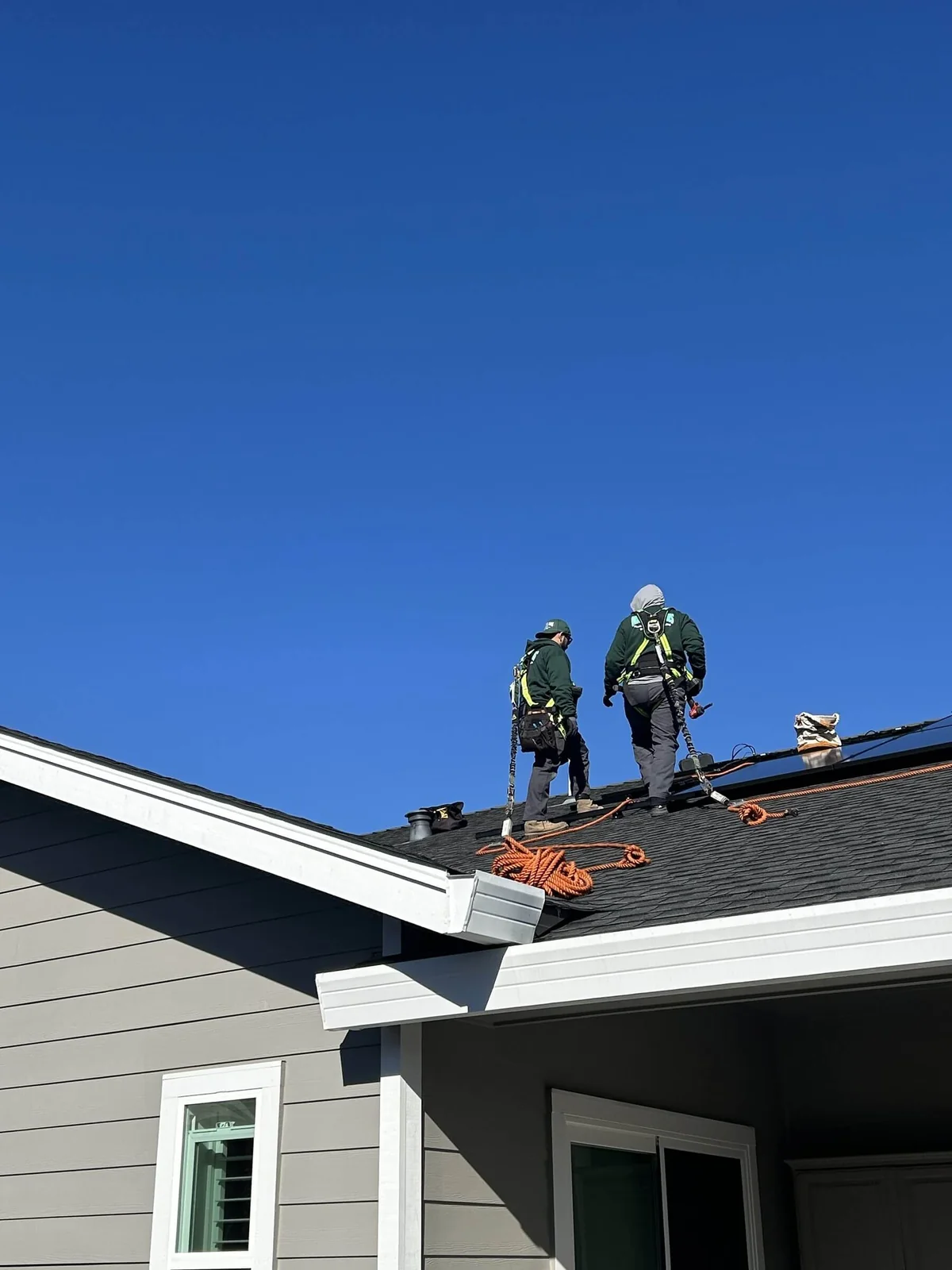
On the roof, the question is material and remaining life. Composition shingle near the end of its service life under a twenty-five year array means paying for solar labor twice, once now and again when the array comes off for the reroof. Tile takes different flashing and a slower pace on foot. Standing seam metal accepts clamps with no roof penetration at all. Underneath, rafter dimension, spacing, and condition set where attachments can land. On older in-town streets near downtown we routinely find full-dimension lumber and spaced sheathing rather than plywood, which changes the attachment plan and occasionally calls for blocking.
On the electrical side, the question is the main service. Whether an array can simply backfeed through a breaker depends on the panel's busbar rating and the size of the main, and when that arithmetic fails the alternatives are a line-side tap ahead of the main breaker, a derated main, or a service replacement. On older Sebastopol services we frequently find panels with no spare spaces at all, leaving nowhere for a solar breaker, let alone a battery and its backup subpanel. That is a normal finding, and it is why an electrical panel upgrade in Sebastopol appears in so many solar scopes.
Rural parcels add long conduit runs from array to service, detached shops and barns on their own feeders, and meter pedestals set well away from the house. None of it is exotic, but it is real labor and material, and a proposal that ignores it will grow later.
Who issues the solar permit, the city or the county?
That depends on the address, and around here the address is not always obvious. Plenty of properties with a Sebastopol mailing address sit outside city limits. In town, permits go through the City of Sebastopol. Outside them, the authority is Permit Sonoma. We confirm which applies before submitting, because filing with the wrong agency costs a week.
State law sets a floor under both. Government Code 65850.5 requires every California city and county to adopt an expedited, streamlined permitting process for small residential rooftop solar, publish its checklist on a publicly accessible website, and accept applications electronically. On inspection the statute is specific: for a qualifying system, "only one inspection shall be required, which shall be done in a timely manner and may include a consolidated inspection."
One distinction trips up more homeowners than any other. The building permit and the utility's authorization are separate approvals, and passing inspection does not let the system run. PG&E has to process the interconnection application and grant permission to operate, and until then the array stays off. Storage adds scope to both tracks, and we own both filings.
What incentives are live right now?
This is the part that moves most, so each claim below is linked to its source.
Battery storage. The California Public Utilities Commission runs the Self-Generation Incentive Program, which "provides incentives for qualifying distributed energy systems installed on the customer's side of the utility meter." Qualifying technologies include "advanced energy storage systems" and "combined solar and energy storage systems." Budget tiers, eligibility categories, and available funds all shift, so we confirm current status and handle the application rather than pointing you at a website.
The array itself. There is no Sonoma Clean Power cash rebate for a rooftop solar system. What SCP provides on the solar side is the compensation structure described above, not an installation incentive.
We confirm what is current at project time and put your system's own figures in writing.
Electrification alongside solar. This is where rebates actually live in Sonoma County. Sonoma Clean Power has raised its heat pump water heater rebate for a limited period, after which it continues only for customers enrolled in the CARE or FERA bill discount programs. Details sit on SCP's water heating page.
Aldo, a complete professional, was friendly and explained everything he did in a very timely and efficient manner.
Anne Z.
What makes one Sebastopol solar quote larger than the next?
Almost always scope, not markup. These are the variables that move a number here:
- Array size, following your usage plus whatever you plan to add later, such as an EV or a heat pump.
- Number of roof planes. One clean plane is cheaper per watt than four small ones at different pitches, each needing its own flashing runs and rail sets.
- Roof material and remaining life, and whether the right sequence is solar now or a reroof first.
- Shade mitigation. Module-level electronics, a different layout, a ground mount, or an array on an outbuilding.
- Conduit run length and route, minor in town and significant on a rural parcel with a distant meter.
- Service and panel work. Breaker space, busbar rating, a line-side tap, a meter relocation, or a full service upgrade.
- Backup scope. A critical-loads subpanel is a smaller job than whole-home backup, and the difference is mostly wiring rather than battery capacity.
- Site work. Blocking or reinforcement where rafters call for it, plus trenching and foundations on a ground mount.
When two proposals differ noticeably, the useful question is not who is cheaper. It is what each includes at the main panel, and what happens if the inspector requires something neither of them drew.
How a good installation avoids the common failures
The parts of a solar system that cause trouble over its life are predictable, and most of them trace back to installation choices. That is worth knowing when you compare proposals.
Connectors are the classic example: a poorly crimped or brand-mismatched DC connector looks fine on day one and fails years later, which is why we mate connectors from a single manufacturer and crimp to specification. Wildlife is another: west county has abundant rodents and birds, the space under an array attracts both, and a critter guard installed on day one costs far less than chewed wiring ever will. Under a heavy tree canopy, module-level electronics keep one shaded or failing panel from dragging down its neighbors.
Monitoring is the part the owner lives with. A gateway that loses its Wi-Fi connection looks identical on the app to an array that stopped producing, so at handoff we set up alerting, show you what a normal week looks like, and make sure the alerts reach an inbox somebody reads. The app is not the system, and knowing the difference saves weeks of worry.
What does upkeep look like after the first year?
Less than people expect, and different from what they expect.
Rain does most of the cleaning in this climate. Under a heavy canopy, though, needle and leaf litter collects along the lower edge of modules and in the gap beneath them where rain does not move it, holding moisture against hardware. Clearing it once or twice a year is worth the trip.
Compare production against the same month a year earlier, not against last month. Seasonal swing is enormous, and month-over-month comparisons manufacture false alarms while hiding genuine ones. Cut branches back before peak season rather than during it, and after any roof work by others have attachments and flashing checked, since that is where leaks start.
If you have storage, exercise it: cut the main once or twice a year and confirm the circuits you believe are backed up stay energized. Note when your inverter warranty ends, too, since inverter coverage is finite and typically shorter than module coverage.
What else belongs on the electrical plan while we are in the panel?
Solar is one of four trades we run out of Petaluma, and the panel is where they intersect.
Vehicle charging. In Sonoma County the charger you buy affects what you can enroll in. Sonoma Clean Power runs a smart charger program paying a monthly bill credit plus a sign-up bonus for enrolling an eligible Wi-Fi connected smart charger, with eligible devices currently limited to WallBox and ChargePoint models. You must be an active SCP customer, and SCP reduces charging speed during grid stress, though the customer "can override an event anytime." Rate plan matters too: PG&E's EV2-A plan sets off-peak hours from midnight to 3 p.m. daily, overlapping most of your production window, while EV-B requires a second dedicated meter and is unavailable with CARE, FERA, or Medical Baseline. That second meter is an electrical scope decision, which is why the rate question belongs in the design meeting rather than after the EV charger installation in Sebastopol is finished. A third plan is worth checking too. E-ELEC is PG&E's Electric Home plan, written around exactly the combination this page keeps describing: a charger, a heat pump, sometimes a battery.
Heating and cooling. West county summers stay milder than the inland valleys, so cooling load here is modest and a heat pump in Sebastopol earns its keep mostly in winter. Understand that before assuming solar covers it: the months a heat pump works hardest are the months an array produces least. The answer is not to skip the heat pump, it is to plan load and storage around that mismatch instead of discovering it in January.
Water heating. A heat pump water heater usually wants a 240-volt circuit, tying panel capacity to the solar scope. Sebastopol also sits in an unusual regulatory spot: the county's air quality districts map puts the city only partly inside the Bay Area Air Quality Management District, so whether district rules reach a given address depends on where in town the property sits. BAAQMD's Regulation 9, Rule 6 establishes zero-NOx requirements for residential water heaters beginning in 2027, with compliance dates varying by unit size. Nobody's gas water heater is banned, and we confirm what applies to your address at project time. Local well water also runs harder than imported surface supply, one more reason water heater work in Sebastopol gets planned rather than improvised.
Everything else in the panel. Circuit additions, subpanels, and the ordinary electrical work in Sebastopol that surfaces once a cover comes off.
How should I judge a solar proposal for a west county property?
Six questions separate a serious proposal from a template:
1. Ask for the shade study, not a satellite screenshot, and ask what the production estimate assumes about tree growth. 2. Ask what happens at the main panel and who performs it. A solar company that subcontracts the electrical adds a handoff at the exact point where projects stall. 3. Ask whether the export math uses the net billing tariff or an older net metering model. Retail-rate export assumptions describe a program that closed to new customers. 4. Ask what the battery backs up, circuit by circuit, and whether the well pump made the list. 5. Ask who owns the interconnection application and follows it through to permission to operate, and what happens if the inspector requires something the proposal did not include. 6. Confirm the license class, and confirm the company on the proposal is the company on the permit.
Ongaro & Sons has been a North Bay family business since 1932, headquartered in Petaluma, and every crew reaching Sebastopol dispatches from there. We are Diamond Certified, hold a BBB A+ Rating, carry a C-10 electrical license, and are a Certified Generac Generator installer.
What North Bay homeowners say
Two recent reviews from customers in our service area:
Ready to have someone walk the roof?
Every solar project we quote in Sebastopol starts with a site visit: roof planes and condition, actual shade through the year, your usage pattern, the main panel, and what you want still running when the grid is not. Book online and we will schedule the assessment. Solar is one of four trades we run from Petaluma. See solar across Sonoma County, the full Sebastopol service list, or how the same work reads on the warmer inland side in Santa Rosa and at our home base in Petaluma.
Your Comfort, Our Priority
Ongaro & Sons is your trusted heating, cooling, plumbing, electrical, and solar expert, specializing in reliable maintenance and repair services that keep your home running efficiently year-round.
Our certified technicians deliver unmatched expertise with fast, friendly service across Marin, Sonoma and Napa County. From HVAC tune-ups to plumbing repairs and electrical upgrades or solar solutions, we focus on energy-efficient performance and long-term comfort. Count on us to maintain the systems that power your home and keep your environment just the way you like it.
Licensed, Insured, Background-Checked
Our technicians are licensed, experienced, and trained to service all makes and models.
Locally Owned and Operated
Serving the Napa, Marin, and Sonoma communities with personalized, hometown service.
Reliable Repairs
We respond quickly and get the job done right the first time, with no surprises.
Since 1932
Why Ongaro & Sons?
Four generations of trusted home service. Open any reason to see what it means for your home.
Schedule Service →Family-owned in the North Bay since 1932
Four generations of the Ongaro family serving Marin, Sonoma and Napa County. We know these homes and the systems in them.
Licensed, insured, background-checked technicians
Every technician is fully licensed and insured, background-checked, and trained on the equipment we install.
Diamond Certified and BBB A+
Diamond Certified since October 2016, and BBB Accredited with an A+ rating since December 1995.
Mitsubishi Diamond Contractor Elite and Trane Comfort Specialist
Both top manufacturer tiers. That standing decides how registration and extended warranty terms are handled on the system you actually bought.
The price is agreed before work starts
You see the number before the work begins. Flat-rate quotes, no surprises and no pressure.
Comprehensive maintenance program
Members get priority scheduling, discounts, and proactive checkups that prevent costly failures.
Discount
Membership
Ongaro Maintenance Plans
Annual maintenance on your home systems provides safeguards and comfort to you and your family. Members get priority scheduling, discounts, and proactive checkups that catch problems early.
Member Discounts
5% off every repair and replacement, all year long.
Peace of Mind
Proactive checkups catch issues before they become big problems.
Courtesy Reminders
We call you to schedule: never miss a seasonal service.
Value That Lasts
With Ongaro & Sons, you’re investing in quality, integrity, and service that stands the test of time. Explore our current promotions and see the difference real value makes for your HVAC, plumbing, and electrical needs.


From the Blog
 Sep 17, 2026
How Many Amps Does My House Need? Sizing Service for What You Actually Run
How many amps your house needs comes from a load calculation of what you run and plan to add. What drives the number, when existing service is enough, and more.
Read More Sep 10, 2026
Hard Water in Marin County: What Is Actually in Your Water and What It Does
Hard water in Marin County varies by provider and source. The 2025 report figures for Marin Water and NMWD, what hardness does and does not mean, and options.
Read More Sep 3, 2026
Electrical Permit Requirements in California: What Needs One and What Does Not
Find out which electrical projects commonly need permits, how to confirm local exemptions, and what to ask before work begins in Marin, Sonoma or Napa County.
Read MoreWhat else do people ask before they sign?
Who is the best solar company in Sebastopol?
Judge it on the parts that go wrong. Ongaro & Sons has operated in the North Bay since 1932, is Diamond Certified, holds a C-10 electrical license, and carries 2,756 Google reviews at a 4.8-star average. We handle the array, the service and panel work, the permit, and the utility interconnection in-house, so no subcontractor boundary sits where projects usually stall.
Is solar still a good idea now that export credits changed?
Yes, but the design has to change with the rules. Value now concentrates in power you use as you make it or store for later, rather than in exports credited at full retail. In practice that means a more careful load analysis, closer attention to shading, and a serious look at storage. A design copied from the previous era will underperform its own projections.
Will solar keep the lights on in Sebastopol during a shutoff?
Not by itself. Safety requirements force a grid-tied inverter offline whenever utility power is absent, no matter how much sun hits the roof. Keeping any part of the house energized needs storage plus the switching hardware that isolates your loads from the utility. That is a separate scope item, and it is what most people mean when they ask for solar backup.
Can I add a battery to an array another company installed?
Usually. AC-coupled storage works alongside most existing equipment because it operates as its own inverter rather than replacing yours. DC coupling is tidier where the original hardware supports it, though many older units do not. The bigger variable is the backup wiring: which circuits you want protected, and whether the panel has room to separate them out.
How long does a Sebastopol solar project take from signature to switch-on?
Roof time is short. The calendar is governed by design and engineering, the permit at whichever agency has jurisdiction, and the utility's interconnection review, which happens after inspection rather than before. Storage lengthens both approval tracks. We give a realistic sequence at proposal and update it as each stage clears, rather than quoting a best case and letting it slip.
My address says Sebastopol but I am outside city limits. Who handles my permit?
Permit Sonoma, the county agency. Mailing addresses in this part of the county extend well past the incorporated boundary, so a Sebastopol address is not proof of city jurisdiction. We verify the parcel before submitting anything, because a package sent to the wrong agency does not simply get rejected, it costs a week nobody gets back.
Do too many trees rule my property out?
Not automatically. Trees change the design more often than they cancel it. Options include module-level electronics so shaded panels stop dragging their neighbors, a layout concentrating modules on the clearest planes, an array on a shop or barn with better exposure, or a ground mount on an open part of the parcel. If none of that produces a system worth the money, we say so.
Should I re-roof before putting solar on a Sebastopol house?
If the roof has under roughly a decade of life left, do it first. Removing and reinstalling an array to reroof underneath is real labor billed a second time, plus new flashing and a fresh inspection. Where timing is ambiguous we look at the roof itself rather than just its age, since exposure and past repairs matter as much as the manufacturer's number.
Will solar cover my EV charging?
Partly, and timing decides how much. Charging overnight draws from the grid, not from your roof. Shifting the session into daylight, or storing production and discharging into the car later, is what captures it. Sonoma County adds a program dimension: the equipment brand you select affects whether you can enroll with the community choice provider, so pick the charger before you wire for it.
My production dropped this month. What should I check first?
Compare against the same month last year before anything else, since seasonal variation dwarfs most real faults. Then check whether the monitoring gateway is online, because a communication failure and a production failure look identical in an app. Then look at the AC disconnect and the breaker. If all three are clear, the inverter manufacturer's support line can read the fault codes remotely on most modern systems.
Can a battery really run my well pump?
Frequently, yes, but pumps require deliberate design. Motor starting current spikes well above running current, and the battery inverter has to absorb that surge without dropping the whole backup. Pump horsepower, depth, and whether it has a soft start or a variable frequency drive all feed the calculation. Tell us the pump is a priority up front and it gets engineered in.
Do I need a permit for a rooftop array, and can the city refuse it?
You need one, and for a qualifying small residential rooftop system the review is ministerial rather than discretionary. California law requires jurisdictions to run an expedited process against a published checklist, take applications electronically, and limit the work to a single inspection. What the statute constrains is how much latitude an agency has to slow a compliant application down.
My array is old and its installer is gone. What are my options?
If the system no longer covers the house, or its electronics are so old that no manufacturer supports them, replacing it with a new correctly sized system is usually the practical answer. A replacement corrects the sizing for the current tariff, can bring storage into the design, and renews the attachment and flashing work on the roof. We can also add a battery to a working array another company installed, since that is electrical work on the service side.