Water in Your Crawl Space After Rain: Causes, Fixes and When a Sump Pump Makes Sense
Water in a crawl space after rain usually comes from roof runoff and grading that send rainwater toward the foundation, or from groundwater that rises during the wet season. Standing water that stays after a storm needs a fix, because it slowly damages the framing, insulation and ducts under your floor. Water that is still there in dry weather can mean a plumbing leak, although groundwater and slow drainage can linger too, so it is worth testing before choosing a fix.
Quick answer.
- Start outside: clean the gutters, extend the downspouts away from the foundation, and make sure the soil slopes away from the house.
- If water still collects, or seeps up from below, a sump pump at the low point, with drainage that carries the water to it, is the usual next step.
- If the water is there in dry weather, check for a plumbing leak first.
- Do not go into standing water near wiring or equipment, and leave sewage-contaminated water to professionals.
- Never pipe sump pump or roof water into the sanitary sewer.
Raised foundations with crawl spaces are a familiar part of older North Bay homes. The space under the house is often bare dirt, a couple of feet high, with foundation vents around the perimeter and ducts and pipes running through it. Few people look down there often, so a water problem can show up first as a musty smell, a cold floor or sagging insulation.
Why Do North Bay Crawl Spaces Get Wet in Winter?
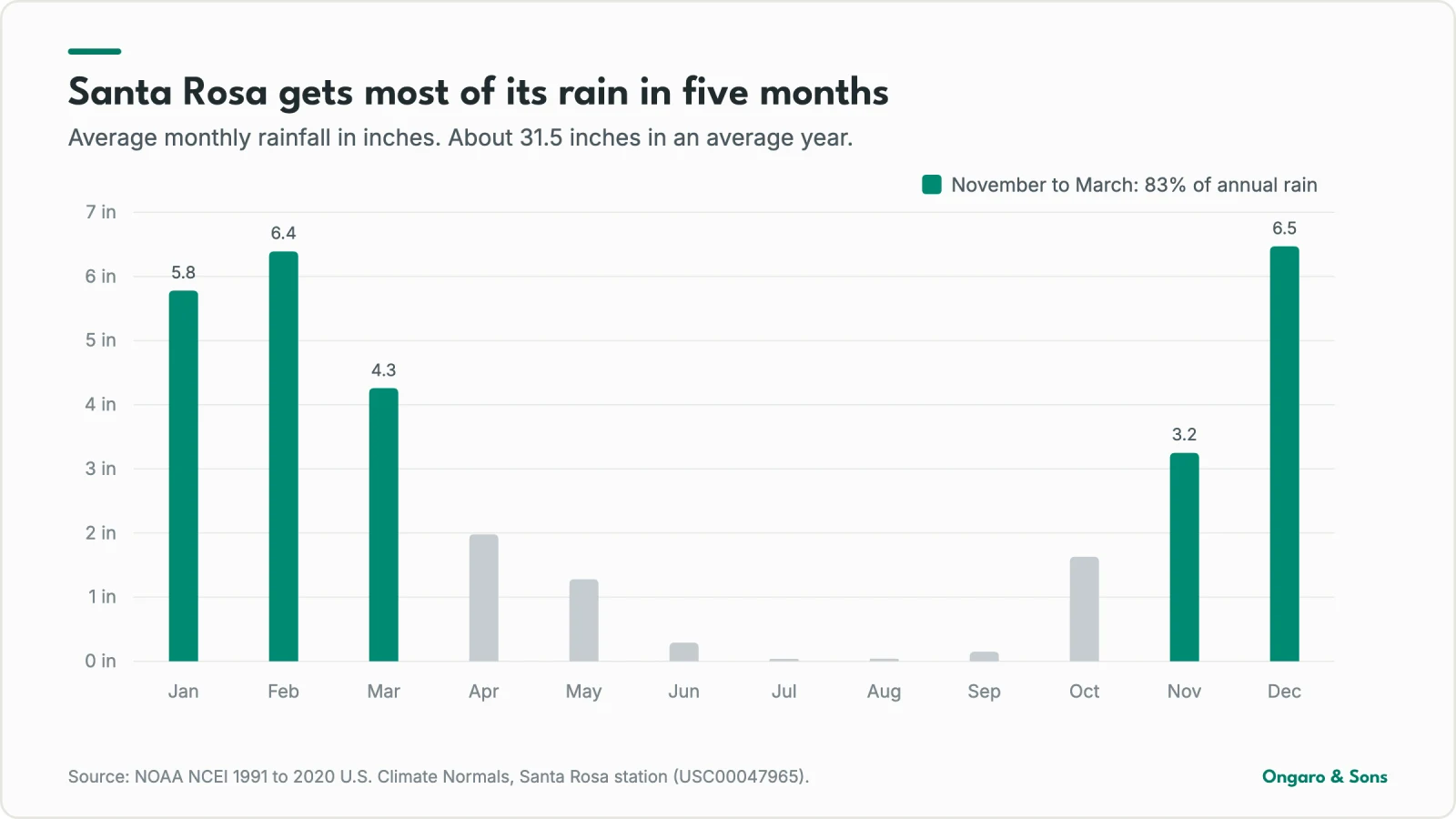
About 83 to 86 percent of the year's rain falls between November and March, according to NOAA's 30-year averages at stations across Marin, Sonoma, and Napa County. Santa Rosa averages 31.5 inches a year, and about 26 inches of that falls in those five months.
| Weather station | Average rain per year | Share falling November to March |
|---|---|---|
| Weather station Kentfield | Average rain per year 44.4 inches | Share falling November to March 85% |
| Weather station San Rafael | Average rain per year 34.5 inches | Share falling November to March 86% |
| Weather station Santa Rosa | Average rain per year 31.5 inches | Share falling November to March 83% |
| Weather station Petaluma | Average rain per year 25.6 inches | Share falling November to March 83% |
| Weather station Napa | Average rain per year 20.2 inches | Share falling November to March 84% |
Source: NOAA U.S. Climate Normals, 1991 to 2020.
Kentfield gets more than twice as much rain as Napa, but all five stations get 83 to 86 percent of it in the same five months. The wet season is the same across the North Bay. Only the amount changes. When that much rain falls on saturated ground over a few weeks, gutters overflow, downspouts empty at the foundation, and yards that slope toward the house send the water underneath.
Where Is the Water Coming From?
When the water appears, and where, points to the source.
| Source | When and where it shows up | Likely fix |
|---|---|---|
| Source Roof runoff | When and where it shows up During and right after heavy rain. Near a corner or under a downspout | Likely fix Clean gutters, extend downspouts |
| Source Surface water from grading | When and where it shows up After heavy rain. Along one wall, where the yard slopes toward the house | Likely fix Regrade the soil or add a swale, a shallow channel that carries water away |
| Source Foundation cracks or low vents | When and where it shows up During storms. At a crack or under a vent opening near ground level | Likely fix Seal the crack, add vent wells or covers |
| Source Groundwater | When and where it shows up A day or more after storms, through the wet season. Seeping up through the soil, often across a wide area | Likely fix Sump pump with a ground liner, sometimes a drain system |
| Source Plumbing leak | When and where it shows up Any time, including dry weather. Under bathrooms, the kitchen, the laundry or the water heater | Likely fix Find and repair the leak |
| Source Drain or sewer line leak | When and where it shows up Any time, often with an odor. Along the path of drain lines | Likely fix Camera inspection and repair |
| Source Condensation | When and where it shows up Warm, humid months. Damp surfaces and sweating pipes and ducts, rather than pooled water | Likely fix Ground liner and moisture control |
To tell a plumbing leak from rain:
- Turn off every faucet and appliance that uses water.
- Watch your water meter for 15 minutes.
- If the meter moves, water is flowing somewhere on the supply side, and the leak needs tracking down. It may or may not be under the house.
A meter that stays still does not rule everything out. Drain and sewer leaks and groundwater do not pass through the meter.
Our leak detection tips cover the test in more detail, our pipe repair page covers the fix, and our sewer camera inspection page covers drain and sewer lines.
What Should You Check Outside First?
Start outside. Gutters, downspouts and grading are the least invasive fixes. Walk around the house during a steady rain if you can.
- Gutters. Are they overflowing? Leaves fill gutters quickly in the fall, and the water spills straight down the foundation.
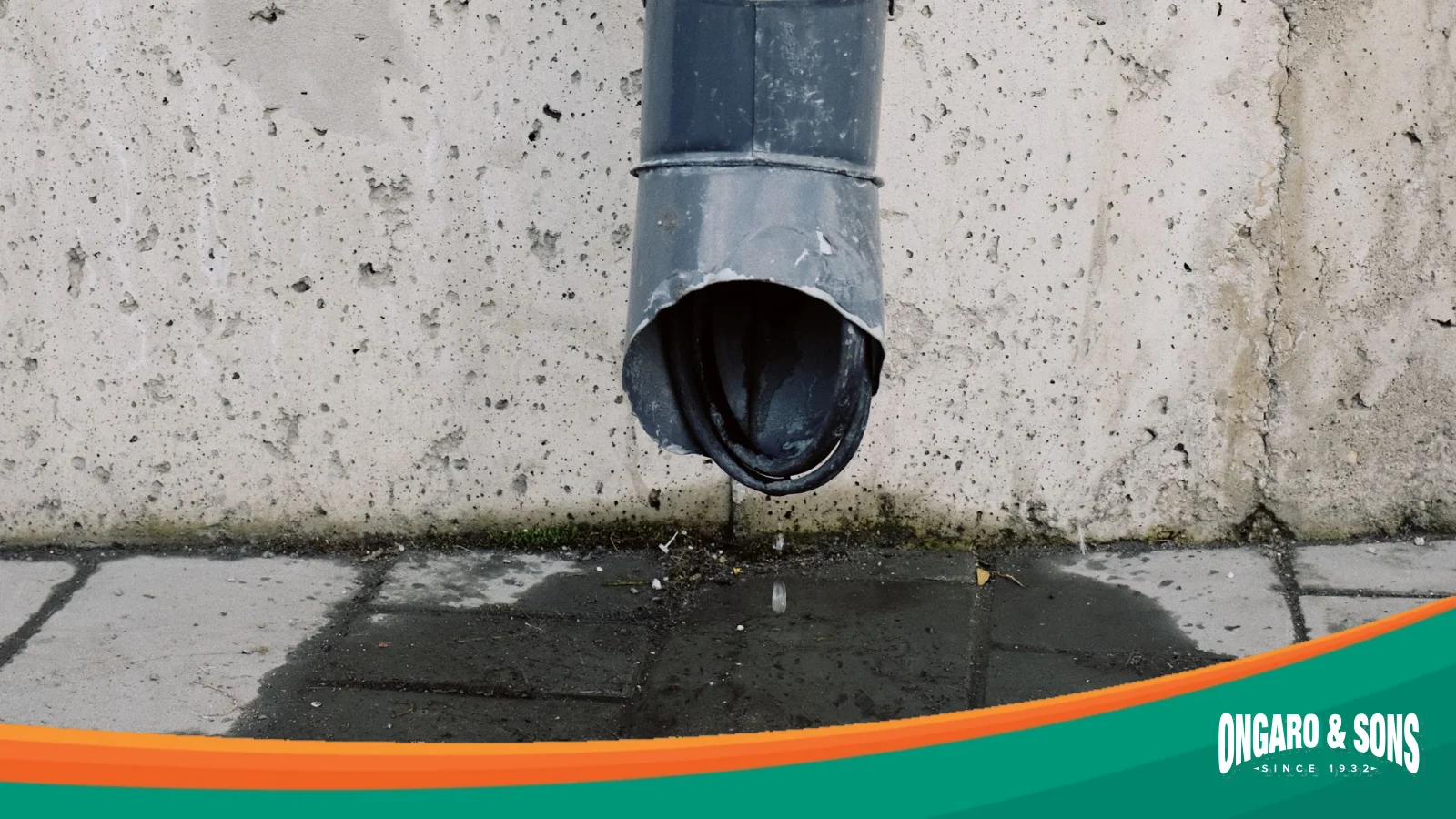
- Downspouts. Where does each one end? A downspout that empties at the base of the wall soaks the soil right where you do not want it. Extensions or underground pipes that carry water away from the house keep it out of the crawl space.
- Grading. Soil should slope away from the foundation. Over the years, landscaping, mulch and settling can reverse that slope. The EPA's moisture control guidance for buildings covers site drainage as part of keeping water out of a structure.
- Hardscape. Patios, walkways and driveways that tilt toward the house send water to the foundation.
- Area drains. If the yard has drains, check that they are clear.
If the water stops after those fixes, you may not need any work under the house.
How Do You Get Water Out of a Crawl Space?
Safety first, and in this order:
- Electricity. Do not enter the crawl space if water is touching wiring, outlets or equipment, or if you would have to stand in water to reach them. Turn off power to the crawl space circuits only if you can reach the panel from a dry spot. If you cannot, or if anything electrical has been underwater, call an electrician before anyone goes in. The CDC's guidance on re-entering a flooded home says to use an electric pump only after an electrician has determined it is safe to turn the power on.
- Contamination. If the water may contain sewage, smells like it, or comes from a drain or sewer line, do not clean it up yourself. The same goes for significant mold or sagging, soft framing.
If the space is safe to work in:
- Remove the water with a submersible pump or a wet-dry vacuum, powered from a GFCI-protected outlet outside the wet area, with the cord kept out of the water.
- Dry the space with fans, and remove insulation or debris that soaked up water.
- Fix the source. Pumping out water without fixing the cause means it comes back with the next storm.
The EPA's guide to mold, moisture and your home says wet materials should be dried within 24 to 48 hours to prevent mold growth.
When Does a Sump Pump Make Sense?
A sump pump is the right tool when water keeps reaching the crawl space after the gutters, downspouts and grading are fixed, or when the water seeps up from below. It is not the answer when the water comes from a plumbing leak, a drain or sewer leak, or only humidity and condensation. Perimeter or interior drains, which collect groundwater before it reaches the crawl space, are another option a contractor can assess.
How Does a Crawl Space Sump Pump Work?
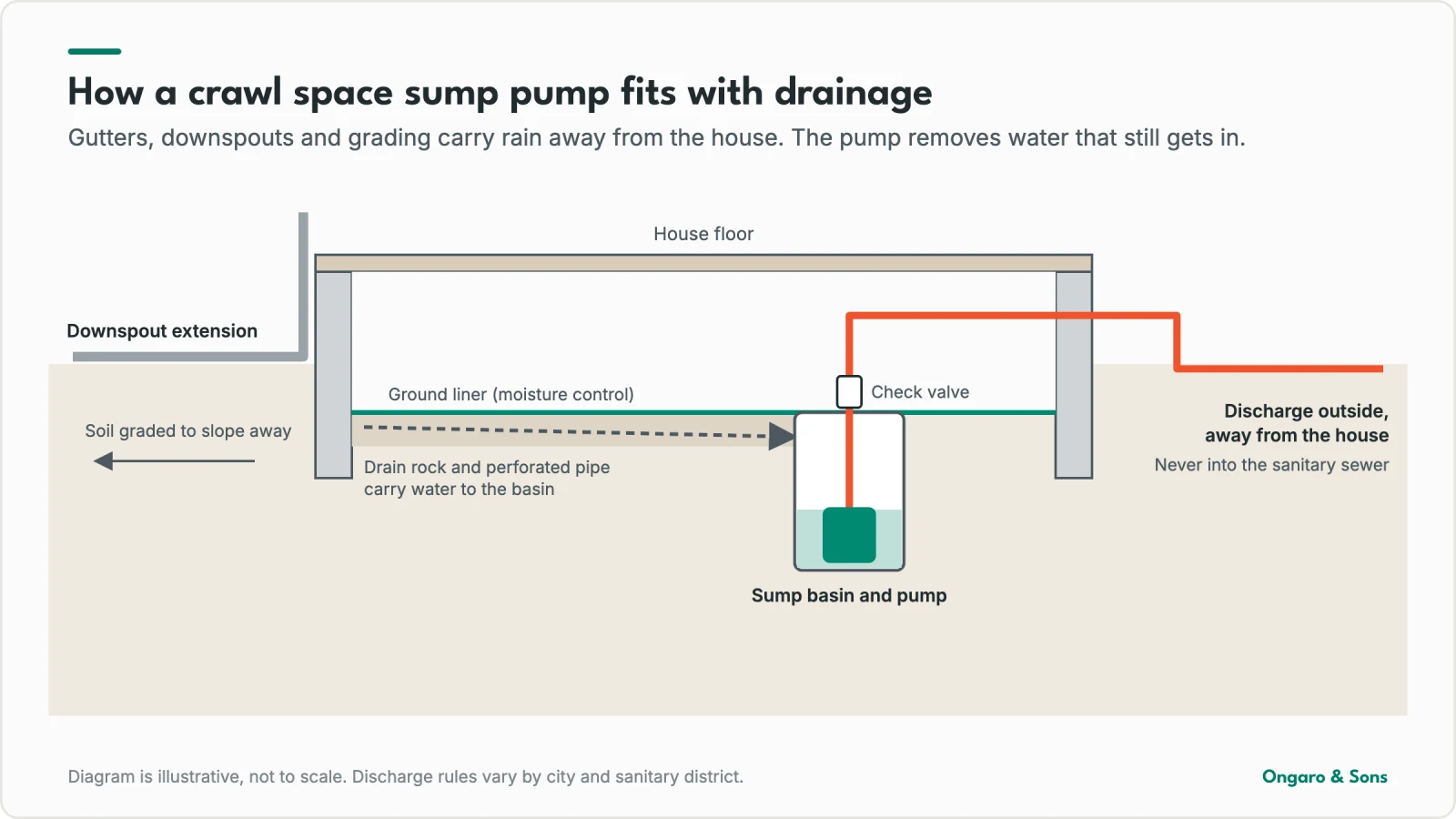
A sump basin, a plastic pit, is set into the soil at the crawl space's lowest point. Drainage below the surface, such as drain rock or a perforated pipe sloped toward the basin, carries water to it. A ground liner, a heavy plastic sheet over the soil often called a vapor barrier, goes over the top to control moisture rising from the soil. On its own, a liner does not collect groundwater. The layout depends on the crawl space. When water fills the basin to a set level, a float switch turns the pump on. The pump pushes the water up through a discharge pipe and out of the foundation, and a check valve keeps it from draining back.
A few details make the difference between a pump that works for years and one that fails in the first storm:
- A dedicated, GFCI-protected outlet. California's electrical code generally requires ground-fault protection for outlets in crawl spaces at or below grade. Your electrician will confirm what applies at your address.
- Battery backup. Storms that send water under the house can also cause power outages. A battery backup keeps the pump running when the power is out. Our PG&E power shutoff checklist covers outage planning more broadly.
- An alarm. A high-water alarm tells you if the pump fails or cannot keep up.
- Annual testing. Before the rainy season, pour a bucket of water into the basin and confirm the pump starts and the water leaves the house.
- Replacement on schedule. InterNACHI's life expectancy chart puts sump pumps at about 7 years.
When we install a crawl space sump pump, the basin size, how fast water comes in and how high the pump has to push it decide the pump. A pump larger than the inflow needs turns on and off in short cycles instead of adding protection.
Water control comes before insulation or encapsulation, which means sealing the crawl space with a liner on the floor and walls. Either one installed over a wet crawl space tends to fail. Our guide to crawl space insulation in North Bay homes covers what to do once the space is dry.
Where Should Sump Pump Water Go?
Outside, to a spot where it drains away from the house and does not flow onto a neighbor's property. A landscaped area or an approved storm drain connection usually works.
It should not go into the sanitary sewer. Rainwater in wastewater pipes can overwhelm the system during storms and cause sewer backups, which is why cities restrict stormwater connections to the sewer. The City of Sebastopol, for example, prohibits connecting roof drains and other stormwater drains to its sewer, as its notice on stormwater connections explains. Check with your city or sanitary district before choosing a discharge point. Our article on preventing sewer backups explains what extra water does to a sewer line.
What Can Standing Water Damage?
- Wood framing. Wet floor joists, sill plates and subflooring can rot. The University of California's Integrated Pest Management program notes that subterranean termites often infest wood that is already slightly decayed, and recommends keeping foundation areas dry and well ventilated.
- Indoor air. Air from a crawl space moves up into the house, so a damp crawl space can mean musty rooms above it.
- Insulation. Fiberglass batts absorb water, lose their insulating value, sag away from the floor and hold moisture against the wood.
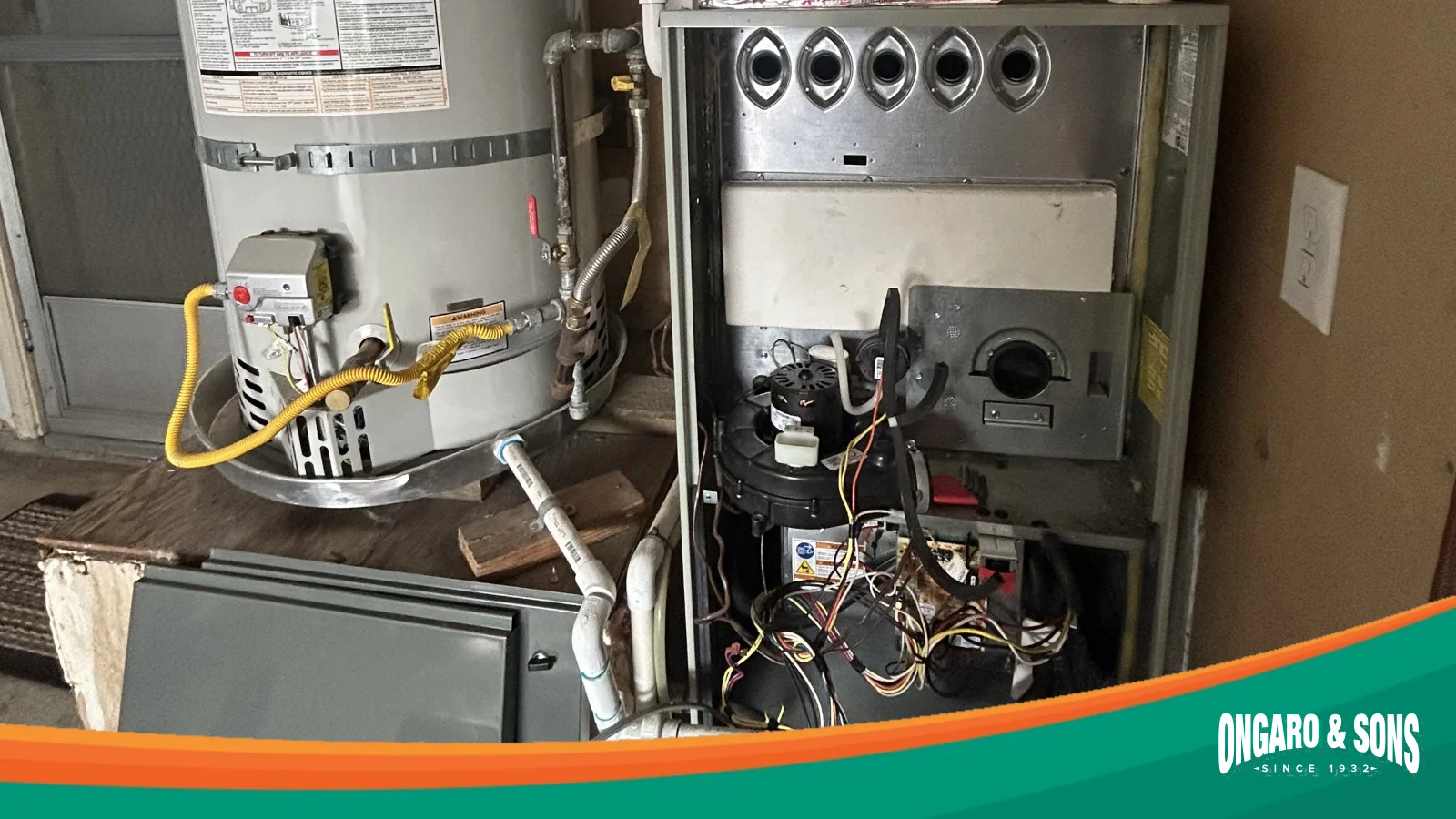
- Ductwork and equipment. Ducts, furnaces and water heaters in crawl spaces can corrode, and leaky return ducts pull damp crawl space air into the system. Our air duct page covers duct repair and sealing.
Frequently Asked Questions
Will a vapor barrier stop water in my crawl space?
No. A ground liner slows moisture rising from the soil, but it does not stop flowing water. Standing water needs drainage: outside fixes first, then a sump pump if water still collects.
Should I put a dehumidifier in my crawl space?
Only after the water is under control. A dehumidifier manages humidity, but it does not remove standing water. In a sealed crawl space, a dehumidifier can be part of the design for keeping the space dry.
Is mold in a crawl space dangerous?
It can affect the air in your home, because crawl space air moves up into the living space. The EPA says the way to control mold is to control moisture. Fix the water source, dry the space, and have larger areas of mold cleaned up properly.
How long does a sump pump last?
About 7 years, according to InterNACHI's estimates. Test it every fall, before the rainy season. A pump that struggles or runs constantly needs a look before you replace it: the cause can be heavy inflow, discharge water finding its way back, a stuck float, a blocked discharge pipe, a pump too small for the inflow, or a worn pump.
Do I need a permit for a crawl space sump pump?
It depends on the work. A new circuit or outlet is electrical work that typically needs a permit, and discharge rules vary by city and sanitary district. Whoever installs the pump should know the local requirements.
Where to Start on a Wet Crawl Space
On the next dry day, open the crawl space hatch and look for water lines on the soil, standing water, damp insulation or a musty smell. Then walk the outside of the house during the next steady rain and watch where the water goes. Take a photo of what you find, inside and out, so you can compare after the next storm.
Ongaro & Sons is a family-owned company based in Petaluma, serving Marin, Sonoma, and Napa County since 1932, licensed C-36 plumbing, C-10 electrical and C-20 HVAC. Our sump pump page covers installation and replacement, and our plumbers work across the North Bay, including Santa Rosa, Petaluma, Sebastopol, Novato and San Rafael.